
Designing and Implementing
Collaborative Assessment
David Carless
Talk at EdUHK, June 2, 2017
The University of Hong Kong
Overview
1. Collaborative assessment
2. Focus on Peer feedback
3. Some key research
4. Challenges & Implications
The University of Hong Kong
Collaborative assessment: what?
Inputs from students (and/or practitioners)
into the way assessment is designed or
implemented
The University of Hong Kong
Collaborative assessment: why?
The more students are involved, the more
likely they are to be engaged
The more engaged they are, the more likely
they are to produce good work
The University of Hong Kong
Collaborative assessment: how?
• (Input to assessment design)
• Flexibility & choice in assessment
• Brainstorming / engaging with criteria
• Self-evaluation
• Peer feedback
The University of Hong Kong
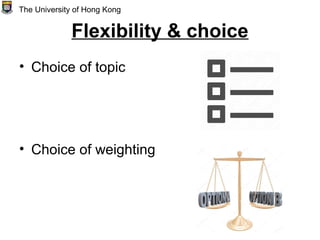
Flexibility & choice
• Choice of topic
• Choice of weighting
The University of Hong Kong
Criteria
Engaging with criteria as lever for good
performance
The University of Hong Kong
Self-evaluation
Self-regulation as core aspect of lifelong
learning
The University of Hong Kong
Students as partners
Collaborative partnerships to enhance
teaching and learning
The University of Hong Kong
PEER FEEDBACK
The University of Hong Kong
Are you …
• A peer feedback enthusiast?
• An occasional implementer?
• Someone who hasn’t yet tried peer
feedback?
The University of Hong Kong
Defining peer feedback (PF)
“A communication process through which
learners enter into dialogues related to
performance & standards” (Liu & Carless,
2006, p. 280)
peer review: (Nicol et al., 2014)
The University of Hong Kong
A key point
Learners usually gain more from composing
PF than receiving it
(Lundstrom & Baker, 2009; Nicol et al.,
2014)
The University of Hong Kong
Rationale
Involve students in dialogue
around the quality of work
Help students to reflect on
own performance
Potentially timely &
sustainable
The University of Hong Kong
Discussion
In your opinion, what are the main
challenges in carrying out PF?
How might they be tackled?
The University of Hong Kong
Main challenges
• Students don’t take it seriously
• Poor quality PF
• Students prefer teacher feedback
• Insufficient training
The University of Hong Kong
Problem 1:
Students don’t take PF seriously
Possible Solution A:
Better training, modelling & coaching
Possible Solution B:
Award 10% for PF
The University of Hong Kong
Problem 2:
Student PF is poor quality
Possible Solution:
Training, modelling, coaching
‘Feedback on feedback’
The University of Hong Kong
Problem 3:
Students don’t think they can gain from PF
Possible Solution:
Sell benefits of composing PF
The University of Hong Kong
Problem 4:
Students worried their ideas
are copied/plagiarised
Possible Solution A:
Create trusting, collaborative climate
Possible Solution B:
Students work on different topics
The University of Hong Kong
Problem 5:
Students prefer teacher feedback
Possible Solution A:
Teacher provides feedback on PF
Possible Solution B:
Teacher scaffolds & guides
The University of Hong Kong
THREE KEY STUDIES
The University of Hong Kong
1. To give is better than to receive
Students taught to give PF improved writing
more than students taught to use PF
Explanation: You review in your own ZPD
but may not receive in your ZPD
(Lundstrom & Baker, 2009)
The University of Hong Kong
2. Higher order thinking
• Composing PF is cognitively engaging:
- Applying criteria
- Diagnosing problems
- Suggesting solutions
(Nicol et al., 2014)
The University of Hong Kong
3. Modelling & training
2 hours of modelling global peer feedback
processes
+
30 minute ‘feedback on peer feedback’
individual tutorial
(Min, 2006)
The University of Hong Kong
OUR RECENT RESEARCH
The University of Hong Kong
Qiyun Zhu (Judy)
The University of Hong Kong
Context
Year 1 university EFL class
200 students, 5 teachers
Peer review of writing
Sustained observations, interviews
The University of Hong Kong
Preparation
No or minimal training
PF sheet / guiding questions
The University of Hong Kong
Selected positive findings
• Written peer feedback then
oral dialogue
• Timeliness, immediacy,
negotiation
The University of Hong Kong
Selected negative findings
• Partner not enthusiastic, perfunctory
• Comments were vague & general
• Teacher should provide more guidance
The University of Hong Kong
Implications
Importance of dialogue between peers
Scaffolding by teacher
The University of Hong Kong
Conclusions
The University of Hong Kong
Recommended PF practice
• Sell rationale & benefits to students
• Communicate gains for ‘giver’
• Provide training, modeling & support
• Encourage collaborative climate
The University of Hong Kong
Student feedback literacy
- Skills / capacities
- Developmental aspects
- Attitudinal dimensions
The University of Hong Kong
<……...>
Feedback literate students
• Are developing a sense of quality
• Are developing capacities to judge
• Seek, generate & use feedback
• Are open to critique & want to improve
The University of Hong Kong
Staff development
Dialogue & communication
Communities of practice
Leadership
The University of Hong Kong
References
Carless, D. (2013). Trust and its role in facilitating dialogic feedback. In D. Boud & L. Molloy (Eds.), Feedback in Higher
and Professional Education: Understanding it and doing it well (pp. 90-103). London: Routledge.
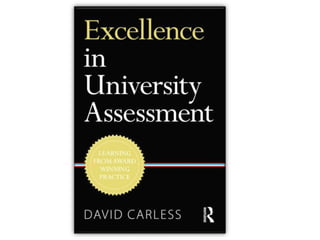
Carless, D. (2015). Excellence in University Assessment: learning from award-winning teachers. London: Routledge.
Carless, D., Salter, D., Yang, M., & Lam, J. (2011). Developing sustainable feedback practices. Studies in Higher
Education, 36 (4) 395-407.
Liu, N.F., & Carless, D. (2006) Peer feedback: the learning element of peer assessment, Teaching in Higher
Education, 11 (3), 279-290.
Lundstrom, K., & Baker, K. (2009). To give is better than to receive: The benefits of peer review to the reviewer’s own
writing. Journal of Second Language Writing, 18(1), 30-43.
Min, H.T. (2006). The effects of trained peer review on EFL students’ revision types and writing quality. Journal of
Second Language Writing, 15, 118-141.
Nicol, D., Thomson, A., & Breslin, C. (2014). Rethinking feedback practices in higher education: a peer review
perspective. Assessment & Evaluation in Higher Education, 39(1), 102–122.
Xu, Y., & Carless, D. (2016). ‘Only true friends could be cruelly honest’: cognitive scaffolding and social-affective
support in teacher feedback literacy, Assessment & Evaluation in Higher Education,
DOI:10.1080/02602938.2016.1226759.
The University of Hong Kong
QUESTIONS
COMMENTS
The University of Hong Kong

Collaborative assessment

  • 1.
    Designing and Implementing CollaborativeAssessment David Carless Talk at EdUHK, June 2, 2017 The University of Hong Kong
  • 2.
    Overview 1. Collaborative assessment 2.Focus on Peer feedback 3. Some key research 4. Challenges & Implications The University of Hong Kong
  • 3.
    Collaborative assessment: what? Inputsfrom students (and/or practitioners) into the way assessment is designed or implemented The University of Hong Kong
  • 4.
    Collaborative assessment: why? Themore students are involved, the more likely they are to be engaged The more engaged they are, the more likely they are to produce good work The University of Hong Kong
  • 5.
    Collaborative assessment: how? •(Input to assessment design) • Flexibility & choice in assessment • Brainstorming / engaging with criteria • Self-evaluation • Peer feedback The University of Hong Kong
  • 6.
    Flexibility & choice •Choice of topic • Choice of weighting The University of Hong Kong
  • 7.
    Criteria Engaging with criteriaas lever for good performance The University of Hong Kong
  • 8.
    Self-evaluation Self-regulation as coreaspect of lifelong learning The University of Hong Kong
  • 9.
    Students as partners Collaborativepartnerships to enhance teaching and learning The University of Hong Kong
  • 10.
  • 11.
    Are you … •A peer feedback enthusiast? • An occasional implementer? • Someone who hasn’t yet tried peer feedback? The University of Hong Kong
  • 12.
  • 13.
    Defining peer feedback(PF) “A communication process through which learners enter into dialogues related to performance & standards” (Liu & Carless, 2006, p. 280) peer review: (Nicol et al., 2014) The University of Hong Kong
  • 14.
    A key point Learnersusually gain more from composing PF than receiving it (Lundstrom & Baker, 2009; Nicol et al., 2014) The University of Hong Kong
  • 15.
    Rationale Involve students indialogue around the quality of work Help students to reflect on own performance Potentially timely & sustainable The University of Hong Kong
  • 16.
    Discussion In your opinion,what are the main challenges in carrying out PF? How might they be tackled? The University of Hong Kong
  • 17.
    Main challenges • Studentsdon’t take it seriously • Poor quality PF • Students prefer teacher feedback • Insufficient training The University of Hong Kong
  • 18.
    Problem 1: Students don’ttake PF seriously Possible Solution A: Better training, modelling & coaching Possible Solution B: Award 10% for PF The University of Hong Kong
  • 19.
    Problem 2: Student PFis poor quality Possible Solution: Training, modelling, coaching ‘Feedback on feedback’ The University of Hong Kong
  • 20.
    Problem 3: Students don’tthink they can gain from PF Possible Solution: Sell benefits of composing PF The University of Hong Kong
  • 21.
    Problem 4: Students worriedtheir ideas are copied/plagiarised Possible Solution A: Create trusting, collaborative climate Possible Solution B: Students work on different topics The University of Hong Kong
  • 22.
    Problem 5: Students preferteacher feedback Possible Solution A: Teacher provides feedback on PF Possible Solution B: Teacher scaffolds & guides The University of Hong Kong
  • 23.
    THREE KEY STUDIES TheUniversity of Hong Kong
  • 24.
  • 25.
    1. To giveis better than to receive Students taught to give PF improved writing more than students taught to use PF Explanation: You review in your own ZPD but may not receive in your ZPD (Lundstrom & Baker, 2009) The University of Hong Kong
  • 26.
  • 27.
    2. Higher orderthinking • Composing PF is cognitively engaging: - Applying criteria - Diagnosing problems - Suggesting solutions (Nicol et al., 2014) The University of Hong Kong
  • 28.
  • 29.
    3. Modelling &training 2 hours of modelling global peer feedback processes + 30 minute ‘feedback on peer feedback’ individual tutorial (Min, 2006) The University of Hong Kong
  • 30.
    OUR RECENT RESEARCH TheUniversity of Hong Kong
  • 31.
    Qiyun Zhu (Judy) TheUniversity of Hong Kong
  • 32.
    Context Year 1 universityEFL class 200 students, 5 teachers Peer review of writing Sustained observations, interviews The University of Hong Kong
  • 33.
    Preparation No or minimaltraining PF sheet / guiding questions The University of Hong Kong
  • 34.
    Selected positive findings •Written peer feedback then oral dialogue • Timeliness, immediacy, negotiation The University of Hong Kong
  • 35.
    Selected negative findings •Partner not enthusiastic, perfunctory • Comments were vague & general • Teacher should provide more guidance The University of Hong Kong
  • 36.
    Implications Importance of dialoguebetween peers Scaffolding by teacher The University of Hong Kong
  • 37.
  • 38.
    Recommended PF practice •Sell rationale & benefits to students • Communicate gains for ‘giver’ • Provide training, modeling & support • Encourage collaborative climate The University of Hong Kong
  • 39.
    Student feedback literacy -Skills / capacities - Developmental aspects - Attitudinal dimensions The University of Hong Kong <……...>
  • 40.
    Feedback literate students •Are developing a sense of quality • Are developing capacities to judge • Seek, generate & use feedback • Are open to critique & want to improve The University of Hong Kong
  • 41.
    Staff development Dialogue &communication Communities of practice Leadership The University of Hong Kong
  • 43.
    References Carless, D. (2013).Trust and its role in facilitating dialogic feedback. In D. Boud & L. Molloy (Eds.), Feedback in Higher and Professional Education: Understanding it and doing it well (pp. 90-103). London: Routledge. Carless, D. (2015). Excellence in University Assessment: learning from award-winning teachers. London: Routledge. Carless, D., Salter, D., Yang, M., & Lam, J. (2011). Developing sustainable feedback practices. Studies in Higher Education, 36 (4) 395-407. Liu, N.F., & Carless, D. (2006) Peer feedback: the learning element of peer assessment, Teaching in Higher Education, 11 (3), 279-290. Lundstrom, K., & Baker, K. (2009). To give is better than to receive: The benefits of peer review to the reviewer’s own writing. Journal of Second Language Writing, 18(1), 30-43. Min, H.T. (2006). The effects of trained peer review on EFL students’ revision types and writing quality. Journal of Second Language Writing, 15, 118-141. Nicol, D., Thomson, A., & Breslin, C. (2014). Rethinking feedback practices in higher education: a peer review perspective. Assessment & Evaluation in Higher Education, 39(1), 102–122. Xu, Y., & Carless, D. (2016). ‘Only true friends could be cruelly honest’: cognitive scaffolding and social-affective support in teacher feedback literacy, Assessment & Evaluation in Higher Education, DOI:10.1080/02602938.2016.1226759. The University of Hong Kong
  • 44.
  • 45.