Sustainable assessment &
online learning environments
Professor David Carless
@CarlessDavid
University of Hong Kong,
#VirtualCuppa
April 28, 2020
The University of Hong Kong
Overview
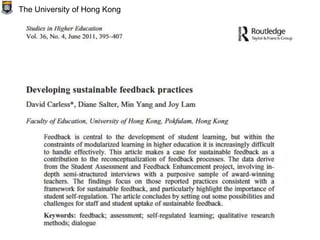
Sustainable assessment
Sustainable feedback
Online applications
The University of Hong Kong
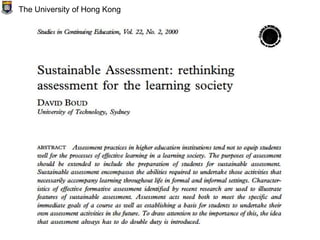
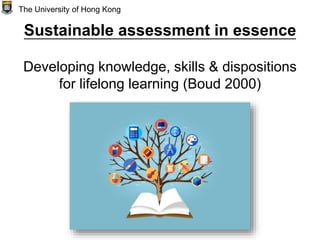
Sustainable assessment in essence
Developing knowledge, skills & dispositions
for lifelong learning (Boud 2000)
The University of Hong Kong
Sustainable assessment practices
Enhancing self-assessment strategies
Understanding, creating & applying criteria
Making judgments, giving & receiving feedback
The University of Hong Kong
Online applications
Authentic Assessment tasks e.g.:
-revising Wikipedia pages (Johinke, 2020)
-digital simulations (Way et al. 2020)
-assessed blogs (Christie & Morris, 2019)
The University of Hong Kong
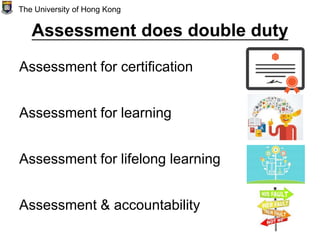
Assessment does double duty
Assessment for certification
Assessment for learning
Assessment for lifelong learning
Assessment & accountability
The University of Hong Kong
Sustainable feedback in essence
Dialogic processes focused on developing
learner capacities for self-regulation
(Carless et al., 2011, p. 397)
The University of Hong Kong
Sustainable feedback practices
• Multi-stage assignments
• Student peer review
• Technology-enabled dialogues
The University of Hong Kong
Online applications
Audio or video peer feedback (Filius et al.
2019; Mahoney et al. 2019)
Collaborative writing (e.g. Yuan & Kim,
2015)
Curated eportfolios (Clarke & Boud, 2018)
The University of Hong Kong
Feedback does double duty
• Justifying the grade & covering your back
• Advice on current task
• Insights for future tasks
(Carless, 2015; Winstone & Carless, under
review)
The University of Hong Kong
Key online feedback principles
• Pedagogy even more than technology;
• Active learner roles;
• Social and relational interaction;
• Opportunities for acting on feedback.
The University of Hong Kong
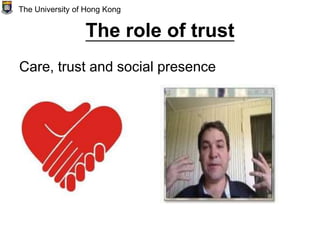
The role of trust
Care, trust and social presence
The University of Hong Kong
Deploy teacher workload wisely
Reduce teacher commentary at times when
it cannot be taken up (Boud & Molloy, 2013)
The University of Hong Kong
Key recommendations
Pedagogy driving technology use
Active student involvement
Social presence, care & trust
Support & coaching for feedback literacy
The University of Hong Kong
References (1)
Boud, D., & Molloy, E. (2013). Decision-making for feedback. In D. Boud & E.
Molloy (Eds.), Feedback in Higher and Professional Education. London:
Routledge.
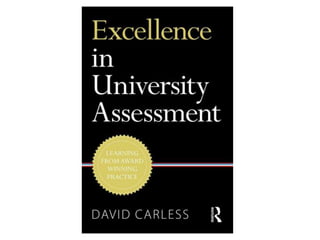
Carless, D. (2015). Excellence in University Assessment. London: Routledge.
Carless, D. & Boud, D. (2018). The development of student feedback literacy:
Enabling uptake of feedback. Assessment and Evaluation in Higher Education,
43(8), 1315-1325. https://doi.org/10.1080/02602938.2018.1463354.
Clarke, J., & D. Boud (2018). Refocusing Portfolio Assessment: Curating for
Feedback and Portrayal. Innovations in Education and Teaching
International, 55 (4): 479-486.
Christie, H. & Morris, N. (2019). Using assessed blogs to enhance student
engagement. Teaching in Higher Education.
https://doi.org/10.1080/13562517.2019.1662390
Filius, R., R. de Kleijn, S. Uijl, F. Prins, H. van Rijen & D. Grobbee (2019). Audio
peer feedback to promote deep learning in online education. Journal of
Computer Assisted Learning.
https://onlinelibrary.wiley.com/doi/full/10.1111/jcal.12363
The University of Hong Kong
References (2)
Johinke, R. (2020). Social production as authentic assessment: Wikipedia, digital
writing, and hope labour. Studies in Higher Education.
https://doi.org/10.1080/03075079.2020.1750192
Mahoney, P., S. Macfarlane and R. Ajjawi. 2019. “A Qualitative Synthesis of Video
Feedback in Higher Education. Teaching in Higher Education, 24(2), 157-179.
Nicol, D., Thomson, A., & Breslin, C. (2014). Rethinking feedback practices in
higher education: A peer review perspective. Assessment & Evaluation in Higher
Education, 39(1), 102-122.
Way, K. A., Burrell, L., D’Allura L., & Ashford-Rowe, K. (2020). Empirical
investigation of authentic assessment theory: An application in online courses
using mimetic simulation created in university learning management ecosystems.
Assessment & Evaluation in Higher Education.
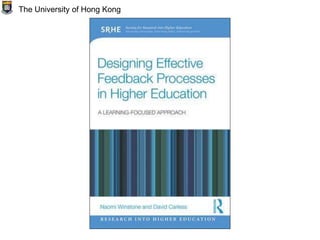
Winstone, N., & D. Carless. (2019). Designing Effective Feedback Processes in
Higher Education: A Learning-Focused Approach. London: Routledge.
Yuan, J. & Kim, C. (2015). Effective feedback design using free technologies.
Journal of Educational Computing Research, 52(3), 408-434.
The University of Hong Kong
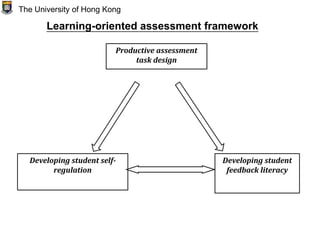
Productive assessment
task design
Developing student self-
regulation
Developing student
feedback literacy
Learning-oriented assessment framework
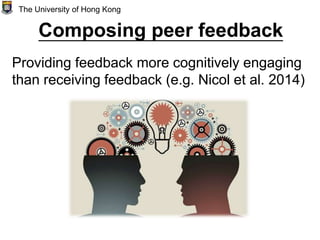
Composing peer feedback
Providing feedback more cognitively engaging
than receiving feedback (e.g. Nicol et al. 2014)
The University of Hong Kong
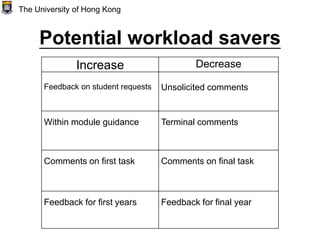
Potential workload savers
The University of Hong Kong
Increase Decrease
Feedback on student requests Unsolicited comments
Within module guidance Terminal comments
Comments on first task Comments on final task
Feedback for first years Feedback for final year
The University of Hong Kong
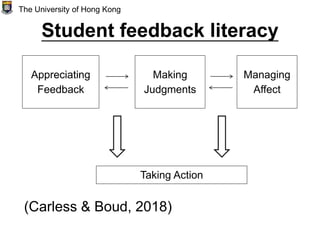
Student feedback literacy
The University of Hong Kong
Making
Judgments
Appreciating
Feedback
Managing
Affect
Taking Action
(Carless & Boud, 2018)
The University of Hong Kong

Sustainable assessment & online learning environments

  • 1.
    Sustainable assessment & onlinelearning environments Professor David Carless @CarlessDavid University of Hong Kong, #VirtualCuppa April 28, 2020 The University of Hong Kong
  • 2.
    Overview Sustainable assessment Sustainable feedback Onlineapplications The University of Hong Kong
  • 3.
  • 4.
    Sustainable assessment inessence Developing knowledge, skills & dispositions for lifelong learning (Boud 2000) The University of Hong Kong
  • 5.
    Sustainable assessment practices Enhancingself-assessment strategies Understanding, creating & applying criteria Making judgments, giving & receiving feedback The University of Hong Kong
  • 6.
    Online applications Authentic Assessmenttasks e.g.: -revising Wikipedia pages (Johinke, 2020) -digital simulations (Way et al. 2020) -assessed blogs (Christie & Morris, 2019) The University of Hong Kong
  • 7.
    Assessment does doubleduty Assessment for certification Assessment for learning Assessment for lifelong learning Assessment & accountability The University of Hong Kong
  • 8.
  • 9.
    Sustainable feedback inessence Dialogic processes focused on developing learner capacities for self-regulation (Carless et al., 2011, p. 397) The University of Hong Kong
  • 10.
    Sustainable feedback practices •Multi-stage assignments • Student peer review • Technology-enabled dialogues The University of Hong Kong
  • 11.
    Online applications Audio orvideo peer feedback (Filius et al. 2019; Mahoney et al. 2019) Collaborative writing (e.g. Yuan & Kim, 2015) Curated eportfolios (Clarke & Boud, 2018) The University of Hong Kong
  • 12.
    Feedback does doubleduty • Justifying the grade & covering your back • Advice on current task • Insights for future tasks (Carless, 2015; Winstone & Carless, under review) The University of Hong Kong
  • 14.
    Key online feedbackprinciples • Pedagogy even more than technology; • Active learner roles; • Social and relational interaction; • Opportunities for acting on feedback. The University of Hong Kong
  • 15.
    The role oftrust Care, trust and social presence The University of Hong Kong
  • 16.
    Deploy teacher workloadwisely Reduce teacher commentary at times when it cannot be taken up (Boud & Molloy, 2013) The University of Hong Kong
  • 17.
    Key recommendations Pedagogy drivingtechnology use Active student involvement Social presence, care & trust Support & coaching for feedback literacy The University of Hong Kong
  • 18.
    References (1) Boud, D.,& Molloy, E. (2013). Decision-making for feedback. In D. Boud & E. Molloy (Eds.), Feedback in Higher and Professional Education. London: Routledge. Carless, D. (2015). Excellence in University Assessment. London: Routledge. Carless, D. & Boud, D. (2018). The development of student feedback literacy: Enabling uptake of feedback. Assessment and Evaluation in Higher Education, 43(8), 1315-1325. https://doi.org/10.1080/02602938.2018.1463354. Clarke, J., & D. Boud (2018). Refocusing Portfolio Assessment: Curating for Feedback and Portrayal. Innovations in Education and Teaching International, 55 (4): 479-486. Christie, H. & Morris, N. (2019). Using assessed blogs to enhance student engagement. Teaching in Higher Education. https://doi.org/10.1080/13562517.2019.1662390 Filius, R., R. de Kleijn, S. Uijl, F. Prins, H. van Rijen & D. Grobbee (2019). Audio peer feedback to promote deep learning in online education. Journal of Computer Assisted Learning. https://onlinelibrary.wiley.com/doi/full/10.1111/jcal.12363 The University of Hong Kong
  • 19.
    References (2) Johinke, R.(2020). Social production as authentic assessment: Wikipedia, digital writing, and hope labour. Studies in Higher Education. https://doi.org/10.1080/03075079.2020.1750192 Mahoney, P., S. Macfarlane and R. Ajjawi. 2019. “A Qualitative Synthesis of Video Feedback in Higher Education. Teaching in Higher Education, 24(2), 157-179. Nicol, D., Thomson, A., & Breslin, C. (2014). Rethinking feedback practices in higher education: A peer review perspective. Assessment & Evaluation in Higher Education, 39(1), 102-122. Way, K. A., Burrell, L., D’Allura L., & Ashford-Rowe, K. (2020). Empirical investigation of authentic assessment theory: An application in online courses using mimetic simulation created in university learning management ecosystems. Assessment & Evaluation in Higher Education. Winstone, N., & D. Carless. (2019). Designing Effective Feedback Processes in Higher Education: A Learning-Focused Approach. London: Routledge. Yuan, J. & Kim, C. (2015). Effective feedback design using free technologies. Journal of Educational Computing Research, 52(3), 408-434. The University of Hong Kong
  • 20.
    The University ofHong Kong Productive assessment task design Developing student self- regulation Developing student feedback literacy Learning-oriented assessment framework
  • 21.
    Composing peer feedback Providingfeedback more cognitively engaging than receiving feedback (e.g. Nicol et al. 2014) The University of Hong Kong
  • 22.
    Potential workload savers TheUniversity of Hong Kong Increase Decrease Feedback on student requests Unsolicited comments Within module guidance Terminal comments Comments on first task Comments on final task Feedback for first years Feedback for final year
  • 23.
  • 24.
    Student feedback literacy TheUniversity of Hong Kong Making Judgments Appreciating Feedback Managing Affect Taking Action (Carless & Boud, 2018)
  • 25.

Editor's Notes

  • #22 http://i811.photobucket.com/albums/zz31/angelsofhope_picture/Kinder/r8w2fc.jpg