 defined in terms of measurable student outcomes.
 The contribution which the school makes to the students’ educational performance
in terms of their academic achievement. (Kerawalla, G.J. and Pandya, S.R.)
 All children experience success. (Lana J. Smith)
 Quality of Leadership
 High Expectations of Students and Teachers
 Ongoing Evaluation of Student’s Performance
 Goals and Direction
 Secure and Organized
 Size of the School
No Child Left Behind Act (NCLB)of 2001 was
replaced by Every Student Succeeds Act (ESSA)
on 2015
o Ensures that states set high standards
o Maintains accountability
o Empowers state and local decision-makers
o Preserves annual assessments and reduce the often onerous burden of
unnecessaryand ineffective testing
o Provides more children access to high-quality preschool
o Establishes new resources
ESSA and NCLB are the same in some
ways...
NCLB relied heavily upon a pass/fail system to measure school
performance based on targets for test scores and graduation
rates while ESSA marks significantly on the requirements for
how states must hold districts and schools accountable for
improving student outcomes.
 Focus on test scores and graduation rates to a broader view of student and
school success by requiring additional indicators and emphasizing the importance
of a more holistic approach to accountability.
 Distribute responsibility for improvement among states, districts, and schools
rather than focusing entirely on school-level actions directed by the state.
 Provide more flexibility at the local level for school improvement, requiring
evidence-based strategies rather than the specific interventions of private
tutoring and school choice that were mandatory for all struggling schools
under the NCLB’s school improvement grants program
CategoriesUsedtoFormulateNewConceptsin
Accountability
(CenterofAmericanProgress)
o Measuring progress toward college and career readiness
o Diagnosing and responding to challenges via school-based quality improvement
o State systems of support and intervention
o Resource accountability
o Professional accountability
GoalsofAccountabilityApproaches
1) Ensures that accountability systems drive
toward equal education opportunities by
creating a system for identifying and
acting on chronic low performance by
particular groups of students.
GoalsofAccountabilityApproaches
2) Ensures that accountability systems are
broadly framed in order to drive toward a
comprehensive conception of student and
school success and a culture of continuous
improvement rather than just shame and
punishment.
 Academic achievement in reading and math for third
grade through eighth grade and once in high school
 High school graduation rate
 Growth or another academic indicator for elementary
and middle schools
 English language proficiency for English learners
only
 At least one measure of school quality or student
success
Components
of a School
Accountability
System
DATA
REPORTING
SCHOOL
CLASSSIFICATIONS
SCHOOL
IMPROVEMENT
States must use the five indicators, in
every three years thereafter, to identify a
subset of their lowest-performing schools
according to the performance goals that states
set for the specific indicators.
Identified low-performing schools must
implement evidence-based interventions and supports
until they meet state-set exit criteria, and
districts must support these schools in selecting
and implementing the interventions and supports that
fit the schools’ identified needs.
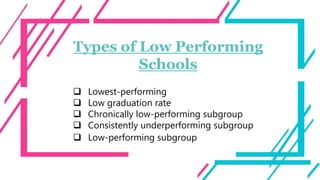
Types of Low Performing
Schools
 Lowest-performing
 Low graduation rate
 Chronically low-performing subgroup
 Consistently underperforming subgroup
 Low-performing subgroup
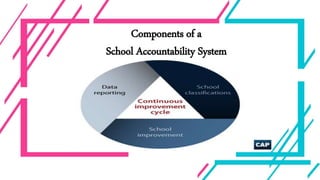
Components of a
School Accountability System
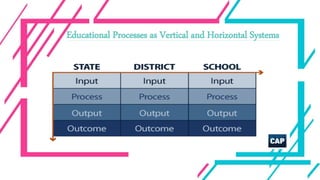
To create an accountability system that explains not just what
outcomes were reached but what decisions led to those outcomes, states
should consider measuring the effectiveness of coordination among and
between each level of the system: states, districts, and schools.
Educational Processes as Vertical and Horizontal Systems
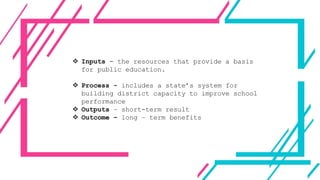
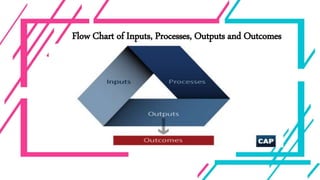
 Inputs - the resources that provide a basis
for public education.
 Process - includes a state’s system for
building district capacity to improve school
performance
 Outputs – short-term result
 Outcome – long – term benefits
Flow Chart of Inputs, Processes, Outputs and Outcomes
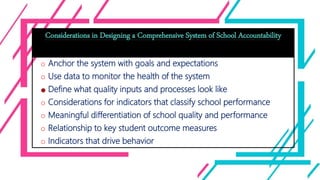
Considerations in Designing a Comprehensive System of School Accountability
o Anchor the system with goals and expectations
o Use data to monitor the health of the system
o Define what quality inputs and processes look like
o Considerations for indicators that classify school performance
o Meaningful differentiation of school quality and performance
o Relationship to key student outcome measures
o Indicators that drive behavior
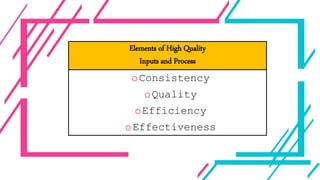
Elements of High Quality
Inputs and Process
oConsistency
oQuality
oEfficiency
oEffectiveness
Accountability systems should drive
continuous improvement towards progress. To do so,
states must build accountability systems focused
on coherence within the entire system—from schools
to districts to state educational agencies; set
goals and monitor progress against key functions
such as training and support of teachers, as well
as the distribution of financial and material
resources; and think through their mechanisms to
support districts to use all of these resources
effectively, while districts should pay attention
to building school capacity.
Thank you!!
- Crishell

School Effectiveness, Accountability and Improvement

  • 3.
     defined interms of measurable student outcomes.  The contribution which the school makes to the students’ educational performance in terms of their academic achievement. (Kerawalla, G.J. and Pandya, S.R.)  All children experience success. (Lana J. Smith)
  • 4.
     Quality ofLeadership  High Expectations of Students and Teachers  Ongoing Evaluation of Student’s Performance  Goals and Direction  Secure and Organized  Size of the School
  • 6.
    No Child LeftBehind Act (NCLB)of 2001 was replaced by Every Student Succeeds Act (ESSA) on 2015
  • 7.
    o Ensures thatstates set high standards o Maintains accountability o Empowers state and local decision-makers o Preserves annual assessments and reduce the often onerous burden of unnecessaryand ineffective testing o Provides more children access to high-quality preschool o Establishes new resources ESSA and NCLB are the same in some ways...
  • 9.
    NCLB relied heavilyupon a pass/fail system to measure school performance based on targets for test scores and graduation rates while ESSA marks significantly on the requirements for how states must hold districts and schools accountable for improving student outcomes.
  • 10.
     Focus ontest scores and graduation rates to a broader view of student and school success by requiring additional indicators and emphasizing the importance of a more holistic approach to accountability.  Distribute responsibility for improvement among states, districts, and schools rather than focusing entirely on school-level actions directed by the state.
  • 11.
     Provide moreflexibility at the local level for school improvement, requiring evidence-based strategies rather than the specific interventions of private tutoring and school choice that were mandatory for all struggling schools under the NCLB’s school improvement grants program
  • 12.
    CategoriesUsedtoFormulateNewConceptsin Accountability (CenterofAmericanProgress) o Measuring progresstoward college and career readiness o Diagnosing and responding to challenges via school-based quality improvement o State systems of support and intervention o Resource accountability o Professional accountability
  • 13.
    GoalsofAccountabilityApproaches 1) Ensures thataccountability systems drive toward equal education opportunities by creating a system for identifying and acting on chronic low performance by particular groups of students.
  • 14.
    GoalsofAccountabilityApproaches 2) Ensures thataccountability systems are broadly framed in order to drive toward a comprehensive conception of student and school success and a culture of continuous improvement rather than just shame and punishment.
  • 15.
     Academic achievementin reading and math for third grade through eighth grade and once in high school  High school graduation rate  Growth or another academic indicator for elementary and middle schools  English language proficiency for English learners only  At least one measure of school quality or student success Components of a School Accountability System DATA REPORTING SCHOOL CLASSSIFICATIONS SCHOOL IMPROVEMENT States must use the five indicators, in every three years thereafter, to identify a subset of their lowest-performing schools according to the performance goals that states set for the specific indicators. Identified low-performing schools must implement evidence-based interventions and supports until they meet state-set exit criteria, and districts must support these schools in selecting and implementing the interventions and supports that fit the schools’ identified needs.
  • 16.
    Types of LowPerforming Schools  Lowest-performing  Low graduation rate  Chronically low-performing subgroup  Consistently underperforming subgroup  Low-performing subgroup
  • 17.
    Components of a SchoolAccountability System
  • 18.
    To create anaccountability system that explains not just what outcomes were reached but what decisions led to those outcomes, states should consider measuring the effectiveness of coordination among and between each level of the system: states, districts, and schools.
  • 19.
    Educational Processes asVertical and Horizontal Systems
  • 20.
     Inputs -the resources that provide a basis for public education.  Process - includes a state’s system for building district capacity to improve school performance  Outputs – short-term result  Outcome – long – term benefits
  • 21.
    Flow Chart ofInputs, Processes, Outputs and Outcomes
  • 22.
    Considerations in Designinga Comprehensive System of School Accountability o Anchor the system with goals and expectations o Use data to monitor the health of the system o Define what quality inputs and processes look like o Considerations for indicators that classify school performance o Meaningful differentiation of school quality and performance o Relationship to key student outcome measures o Indicators that drive behavior
  • 23.
    Elements of HighQuality Inputs and Process oConsistency oQuality oEfficiency oEffectiveness
  • 24.
    Accountability systems shoulddrive continuous improvement towards progress. To do so, states must build accountability systems focused on coherence within the entire system—from schools to districts to state educational agencies; set goals and monitor progress against key functions such as training and support of teachers, as well as the distribution of financial and material resources; and think through their mechanisms to support districts to use all of these resources effectively, while districts should pay attention to building school capacity.
  • 25.