

Designing feedback processes
for large classes
Professor David Carless,
University of Hong Kong,
Nottingham Ningbo,
May 10, 2019
The University of Hong Kong
Overview
1. Feedback concepts & challenges
2. Designs for large classes
3. Implications for practice
The University of Hong Kong
DEFINING &
CONCEPTUALIZING
FEEDBACK PROCESSES
The University of Hong Kong
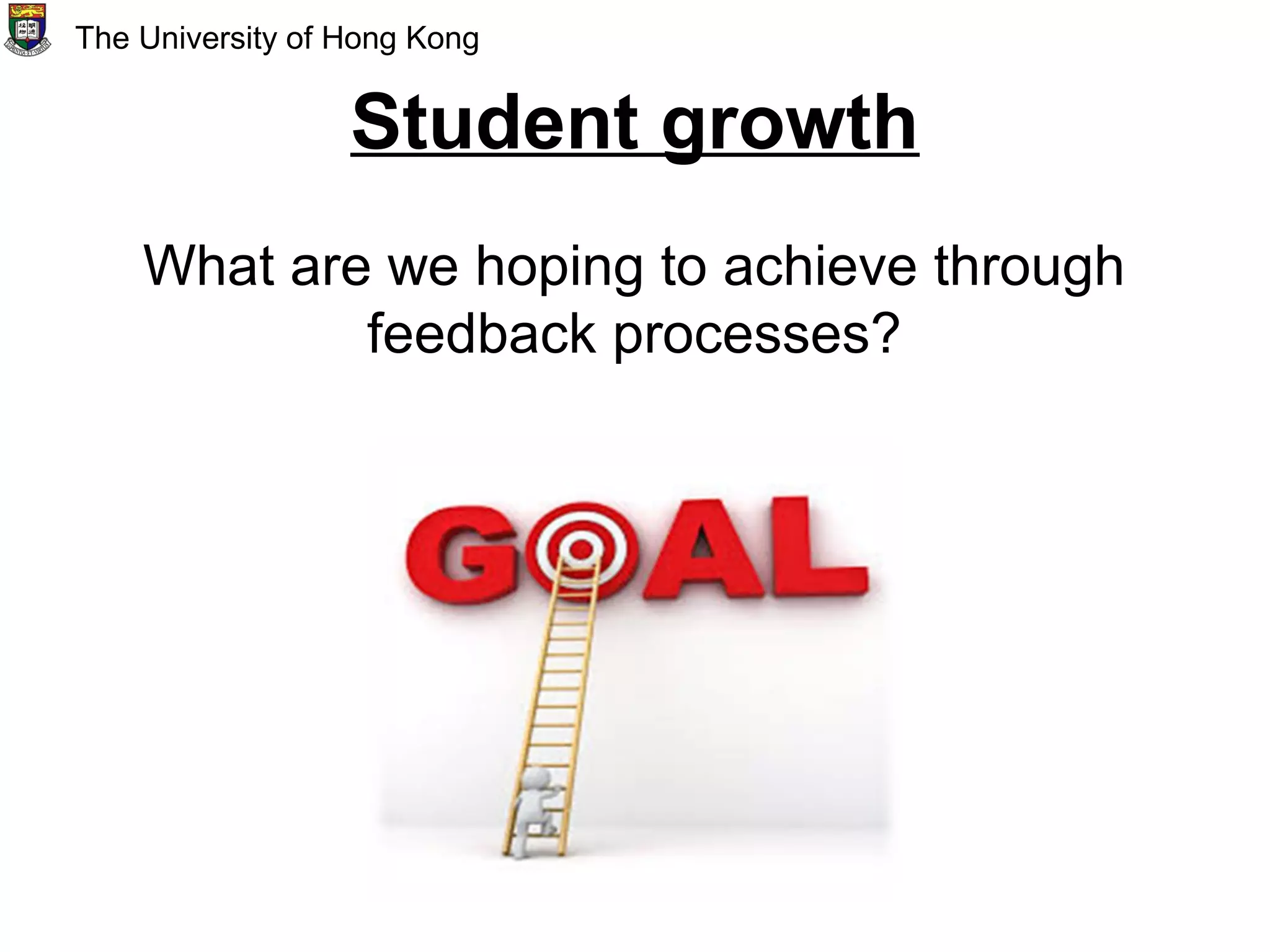
Student growth
What are we hoping to achieve through
feedback processes?
The University of Hong Kong
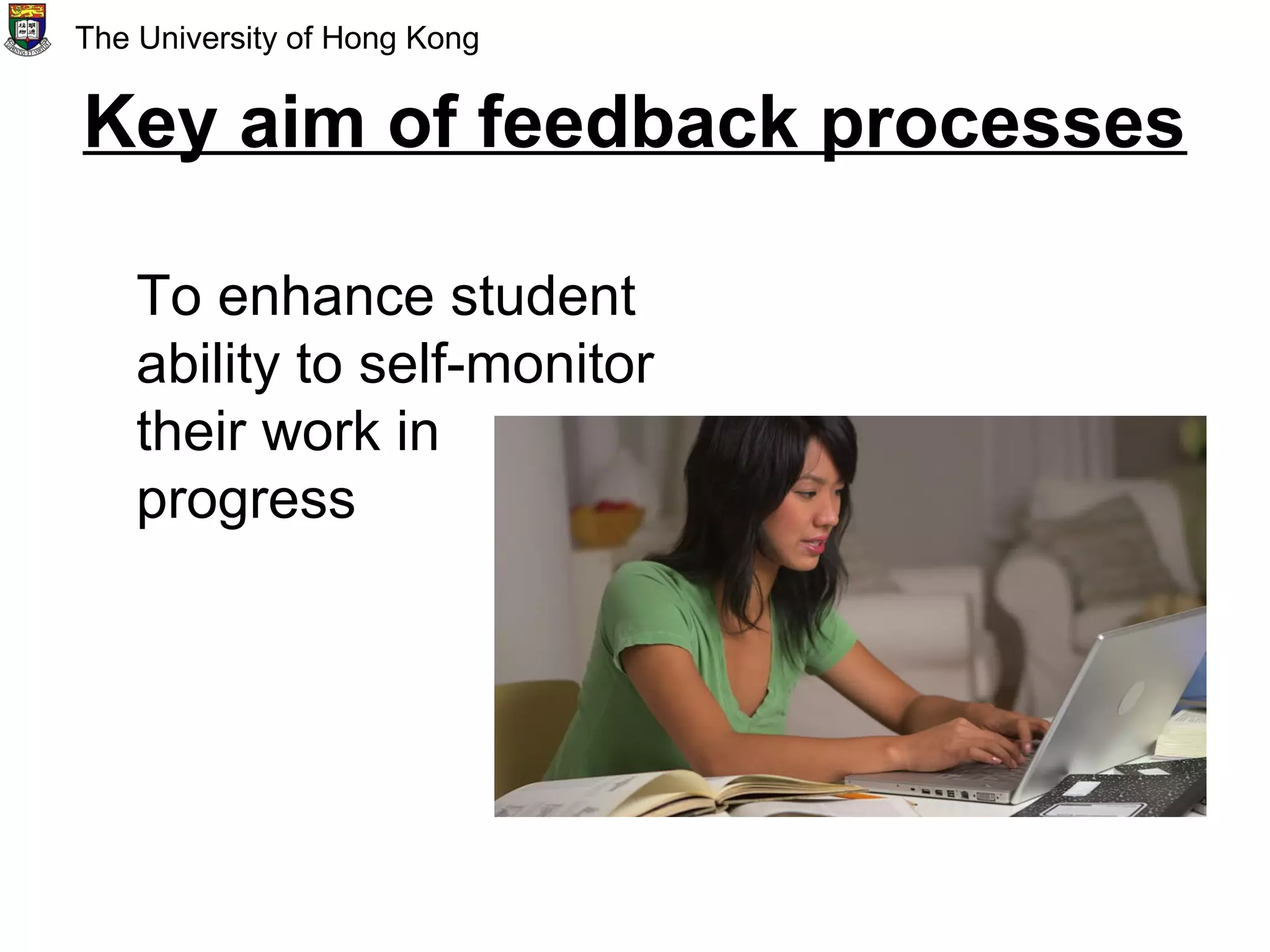
Key aim of feedback processes
To enhance student
ability to self-monitor
their work in
progress
The University of Hong Kong
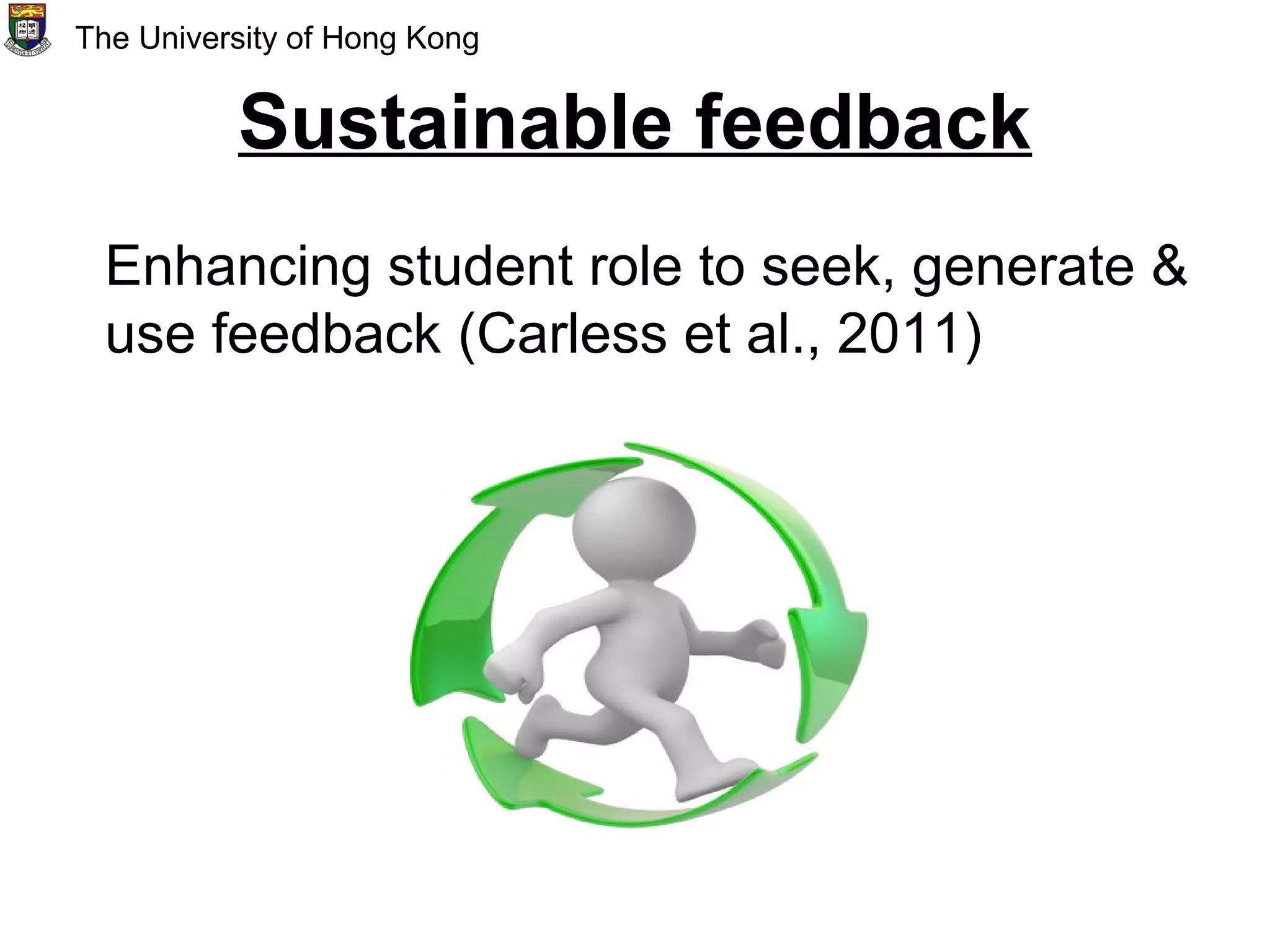
Sustainable feedback
Enhancing student role to seek, generate &
use feedback (Carless et al., 2011)
The University of Hong Kong
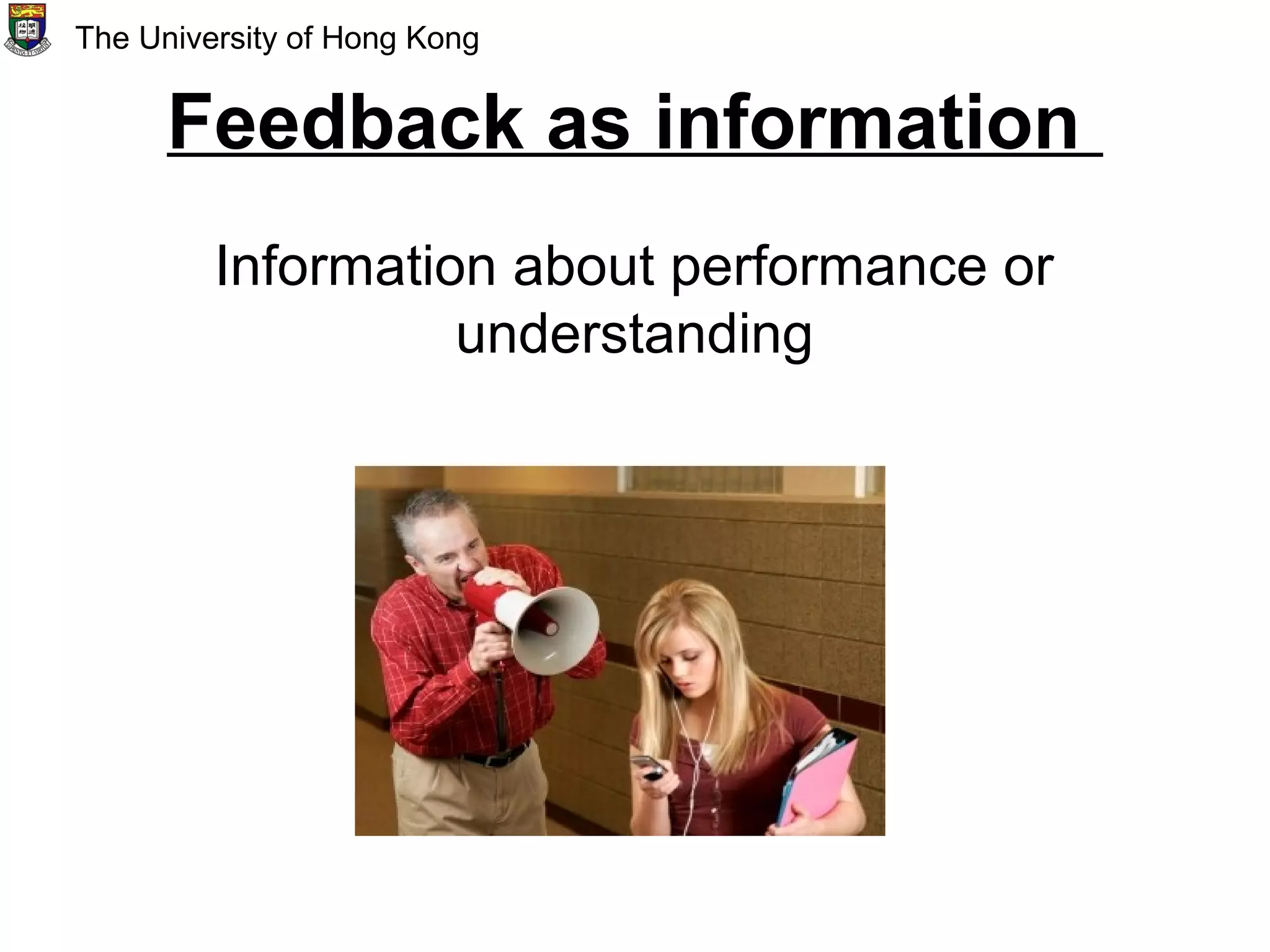
Feedback as information
Information about performance or
understanding
The University of Hong Kong
Limits of Feedback as telling
“Learners do not always
learn much purely from
being told, even when
they are told repeatedly in
the kindest possible way”
(Sadler, 2015, p. 16)
The University of Hong Kong
Student frustrations
Information often comes at the end of teaching
sequences and it is too late for students to act
The University of Hong Kong
Feedback as action
Learners using comments for improvement
to close feedback loops (Boud & Molloy,
2013)
The University of Hong Kong
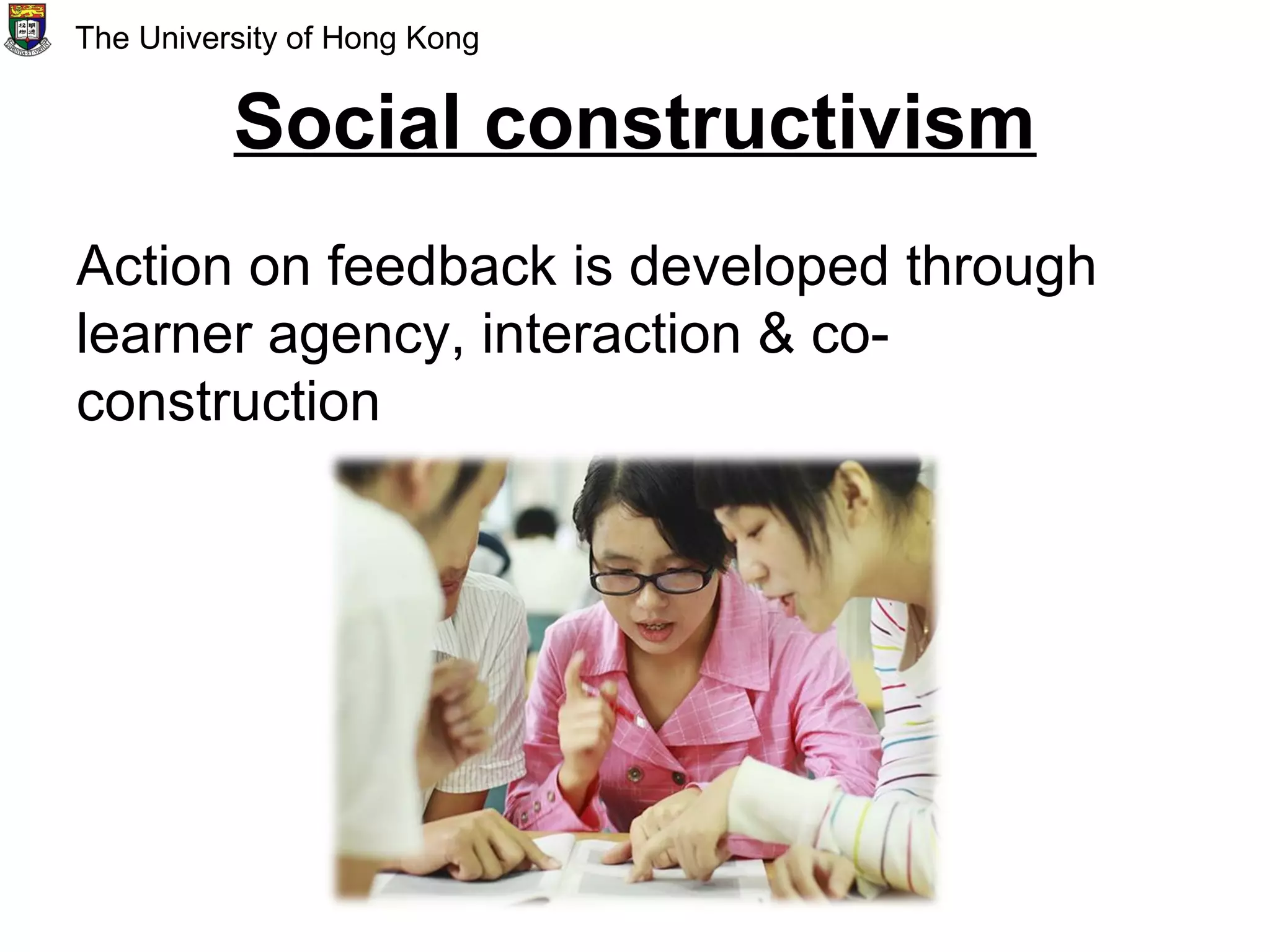
Social constructivism
Action on feedback is developed through
learner agency, interaction & co-
construction
The University of Hong Kong
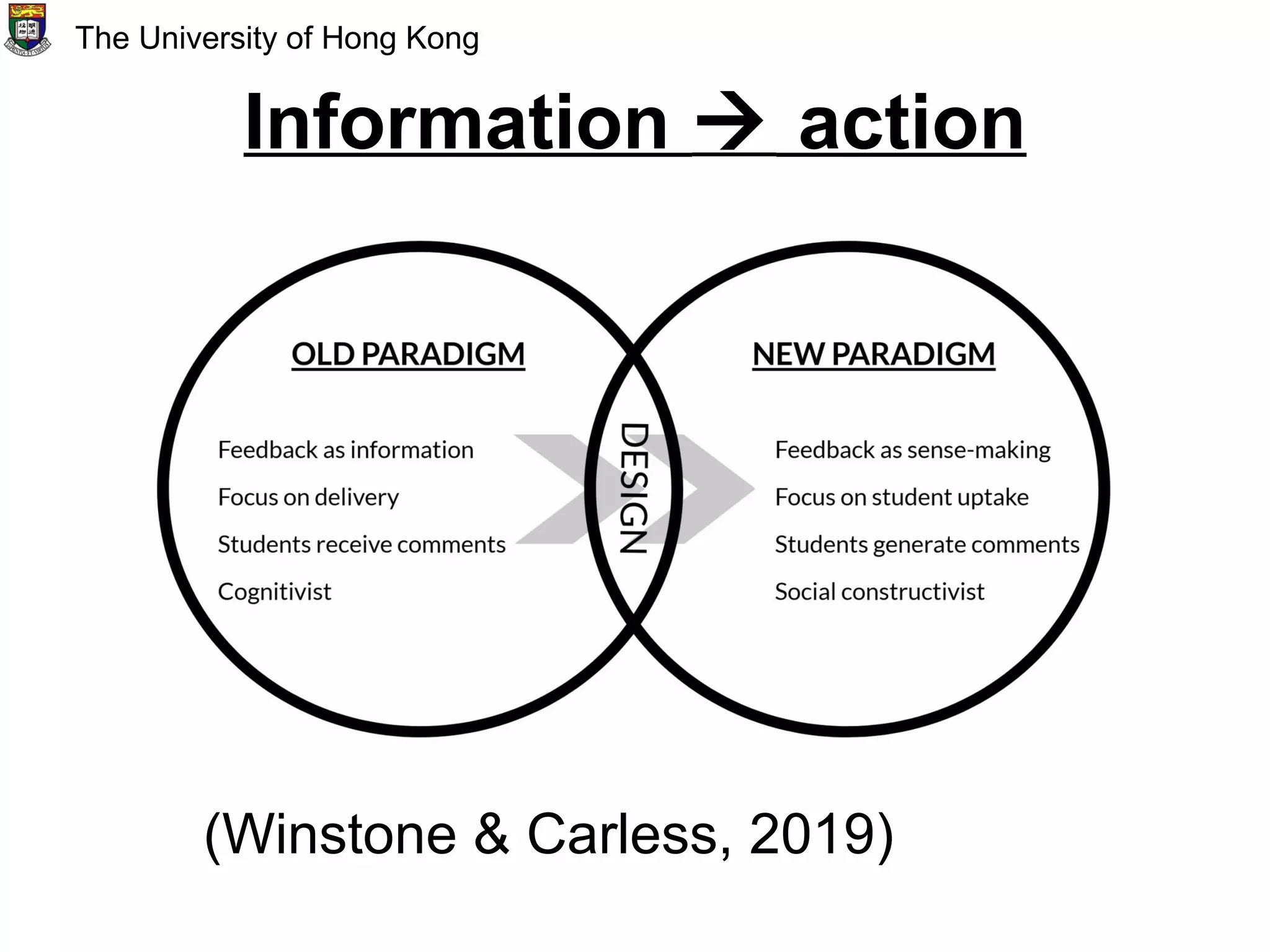
Information  action
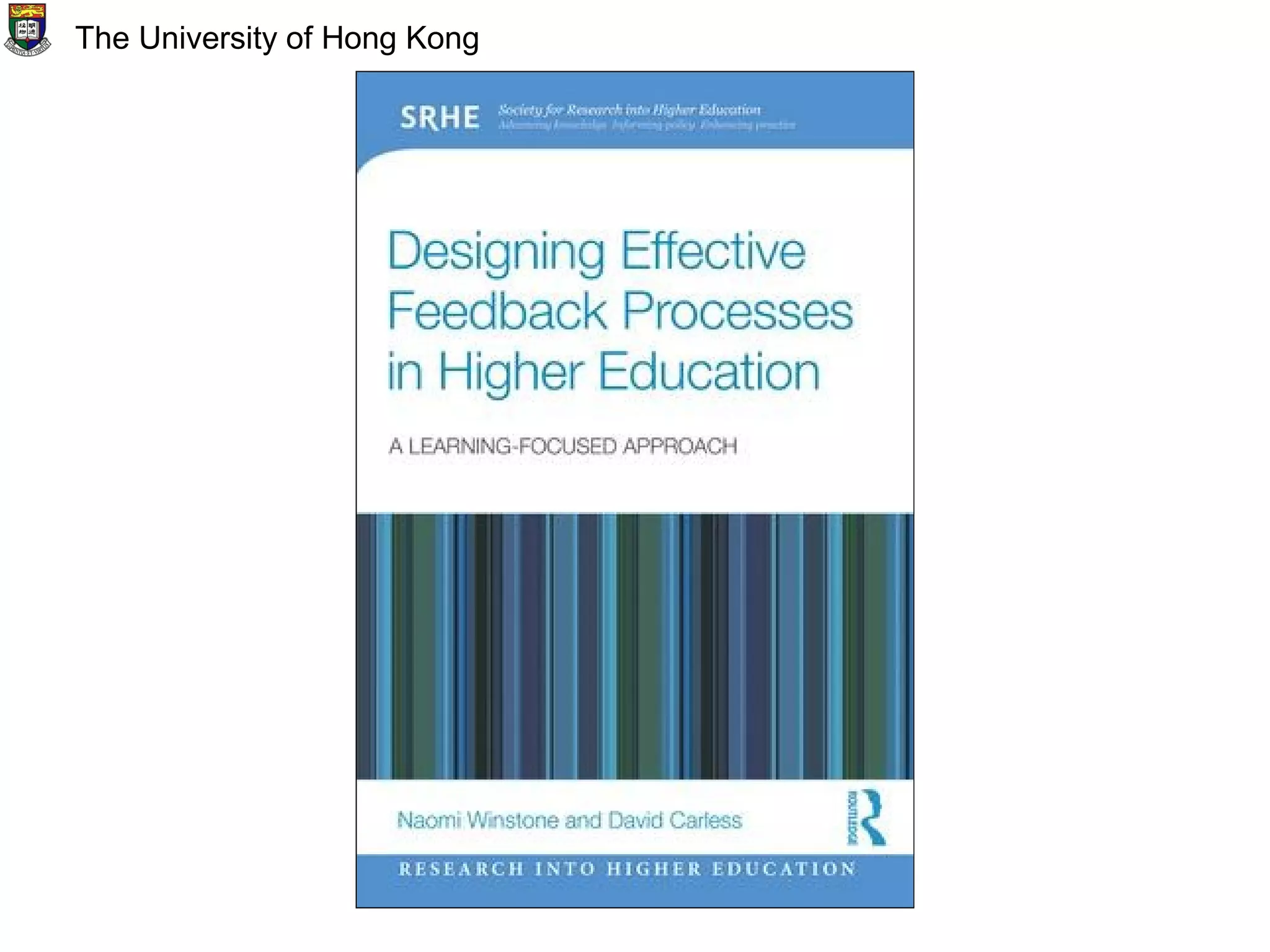
(Winstone & Carless, 2019)
The University of Hong Kong
EXAMPLE 1
PSYCHOLOGY OF HEALTH BEHAVIOR –
1300 STUDENTS
DEAKIN UNIVERSITY
The University of Hong Kong
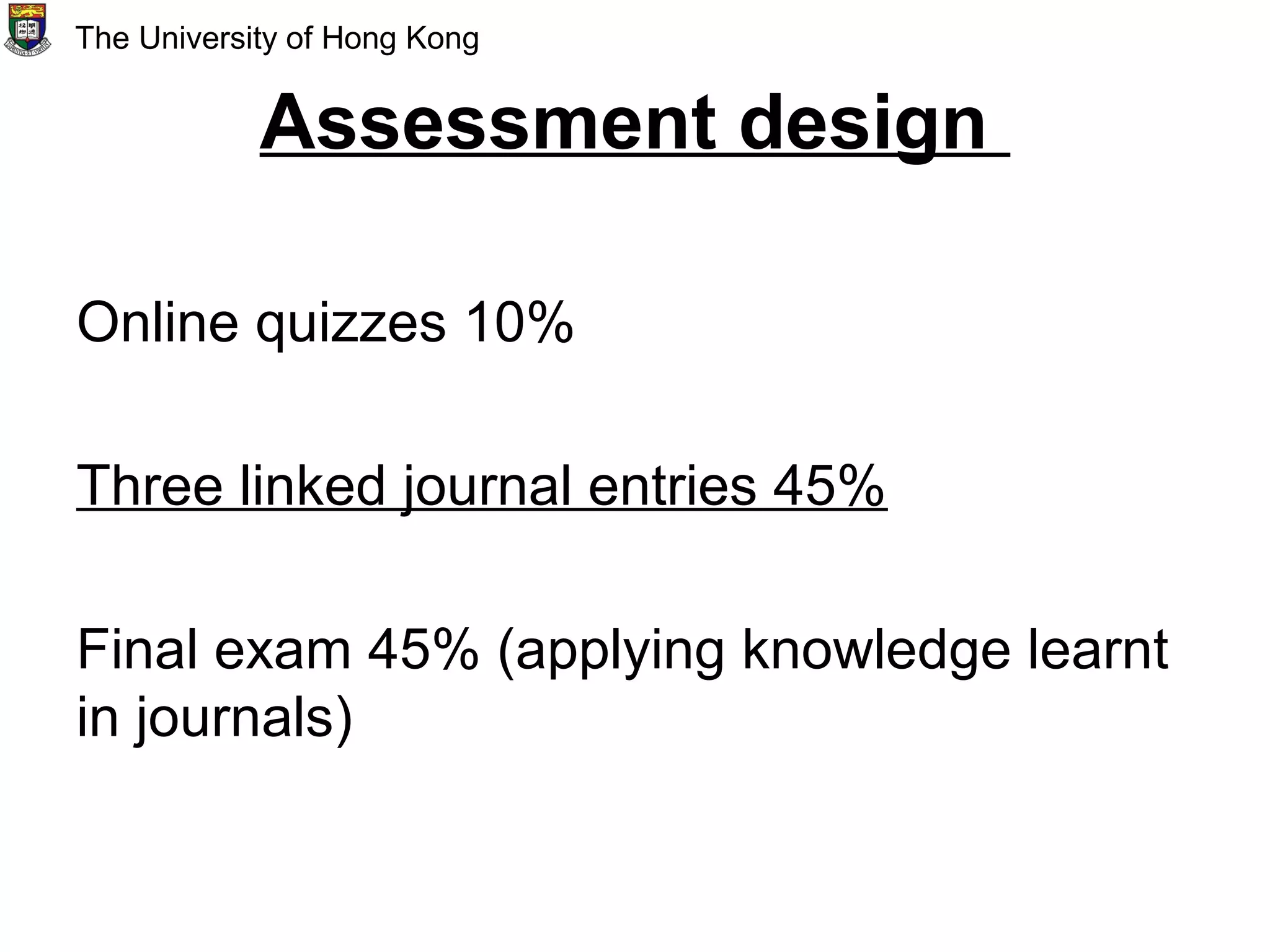
Assessment design
Online quizzes 10%
Three linked journal entries 45%
Final exam 45% (applying knowledge learnt
in journals)
The University of Hong Kong
Aligned assessment design
Three journal entries where students
produce 2 minute video & reflect on their
health behavior changes (800 words)
The University of Hong Kong
Use of exemplars
Video explanation of rubric
+
Online exemplar
The University of Hong Kong
3 forms of feedback
1. Grade aligned with rubric
2. Written explanation linked to LOs
3. 5 minute audio file (25 sessional staff)
The University of Hong Kong
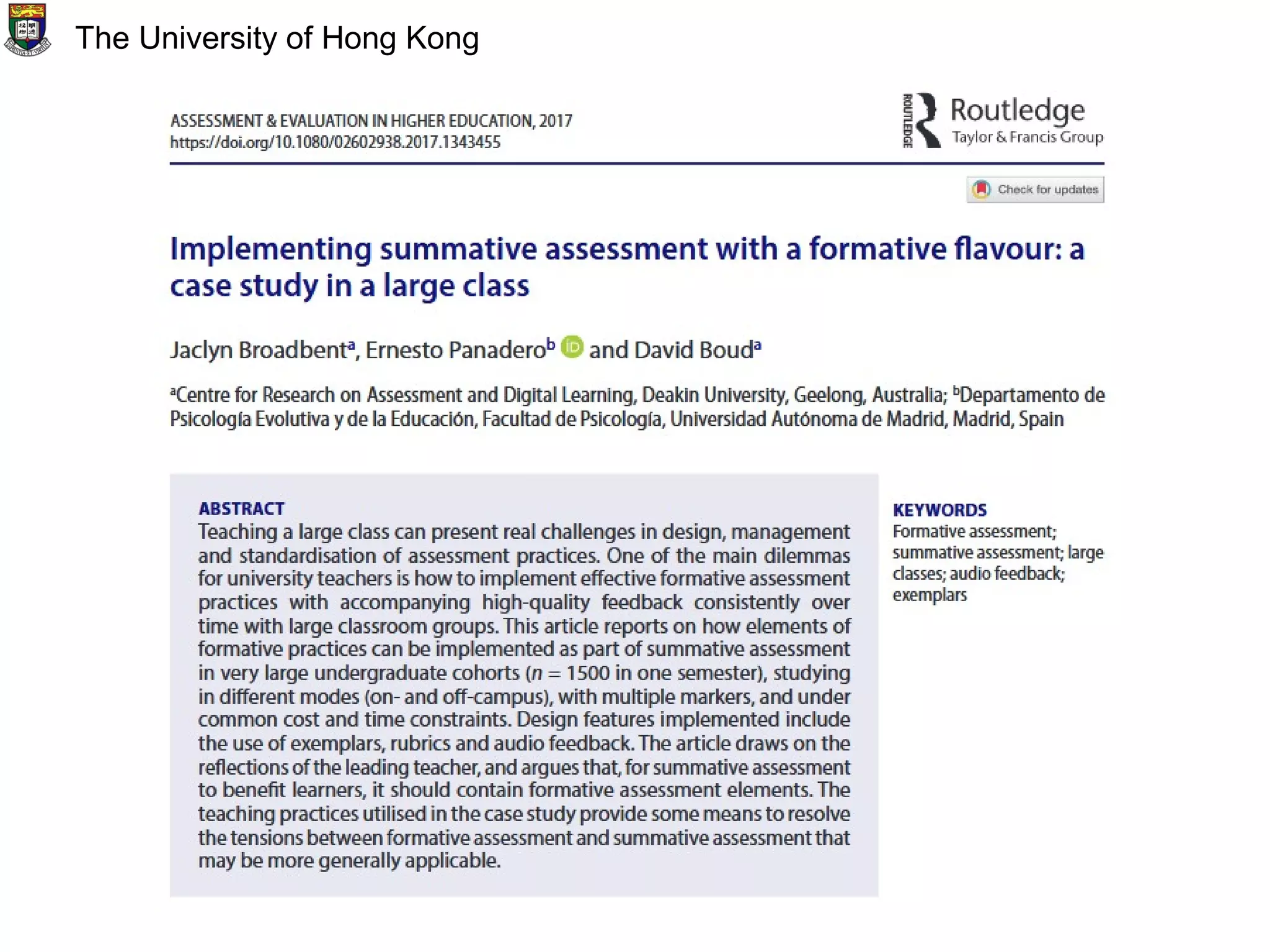
Audio feedback
Timely: 7 days before next entry is due
Enables rapport &
nuance
You can talk faster than you can write
The University of Hong Kong
Analysis
Well-designed task sequence
Use of audio feedback
Mainly ‘Teacher-telling’
The University of Hong Kong
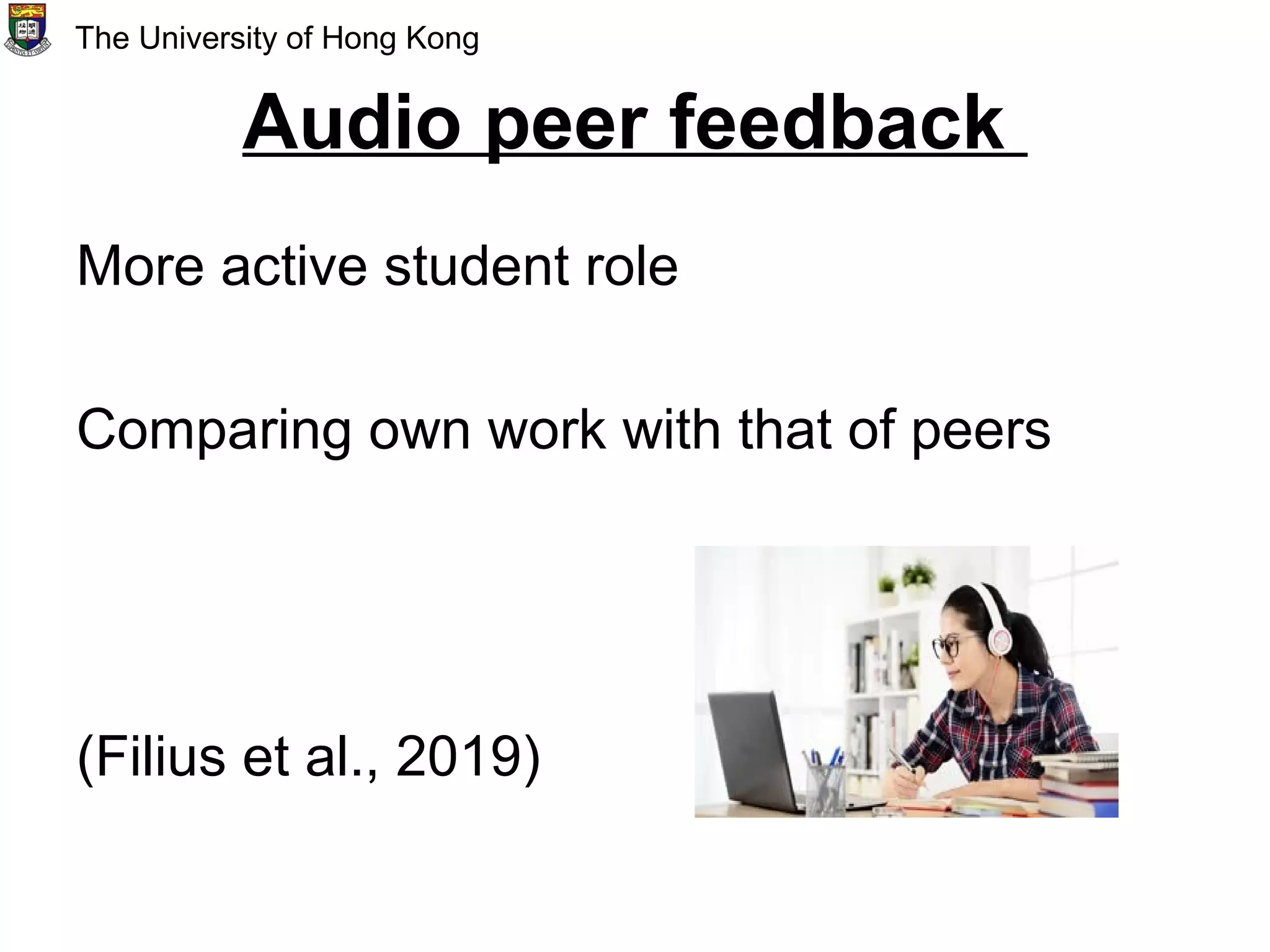
Audio peer feedback
More active student role
Comparing own work with that of peers
(Filius et al., 2019)
The University of Hong Kong
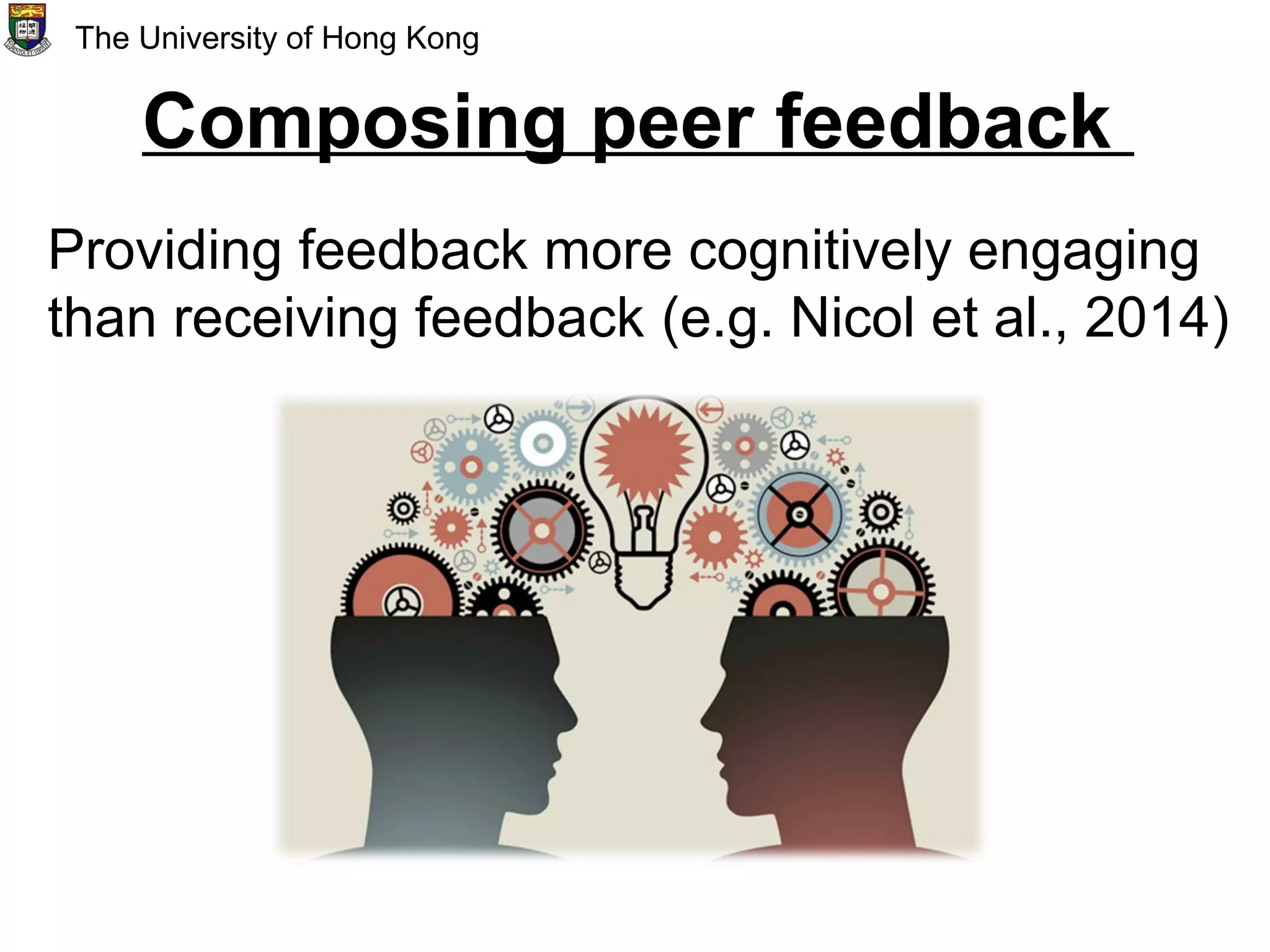
Composing peer feedback
Providing feedback more cognitively engaging
than receiving feedback (e.g. Nicol et al., 2014)
The University of Hong Kong
EXAMPLE 2
SCIENCE – 300 STUDENTS
UNIVERSITY OF HONG KONG
The University of Hong Kong
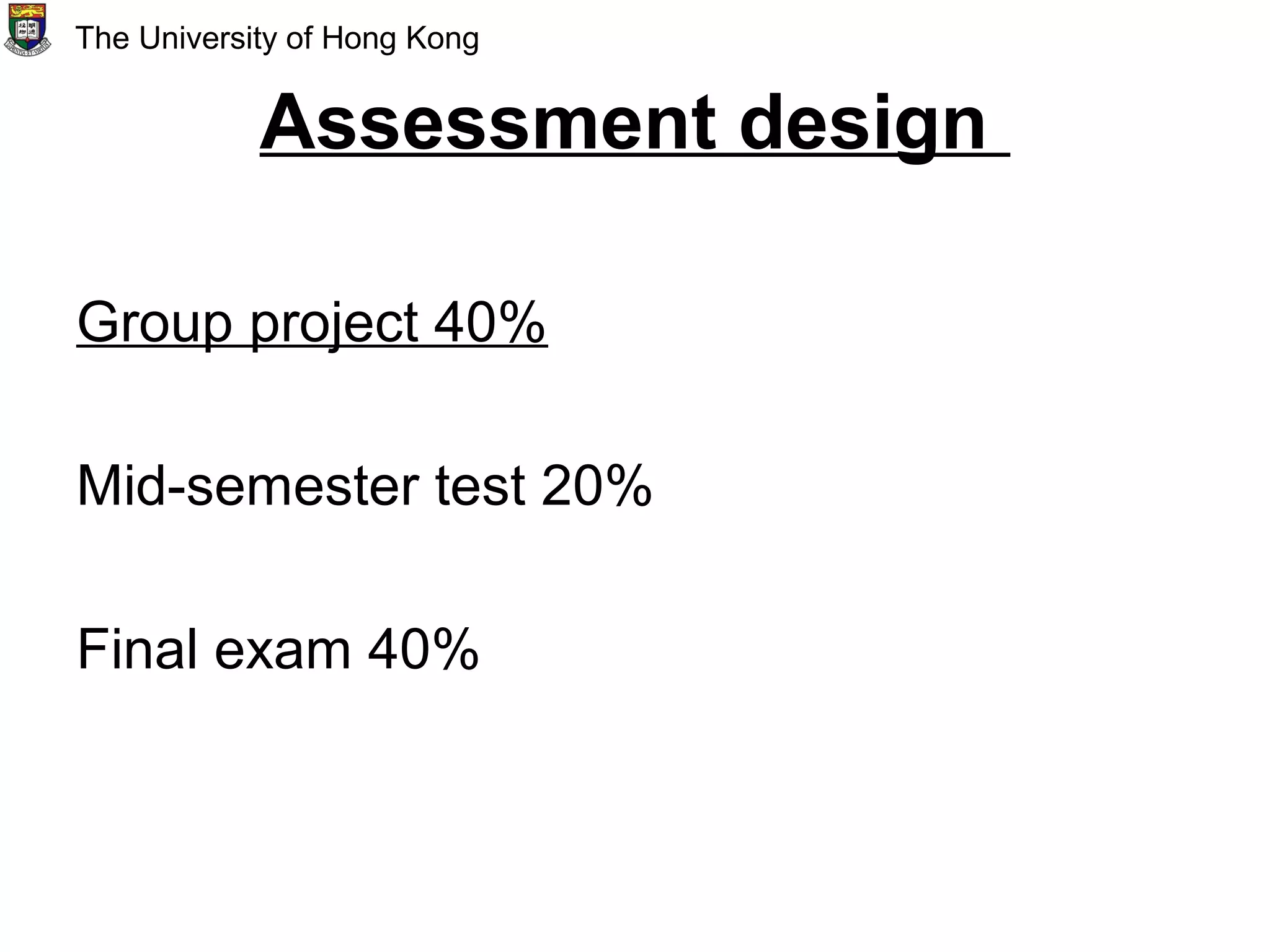
Assessment design
Group project 40%
Mid-semester test 20%
Final exam 40%
The University of Hong Kong
Feedback design
Staged group project
Peer tutoring
Help Desk
Moodle quizzes & forum
The University of Hong Kong
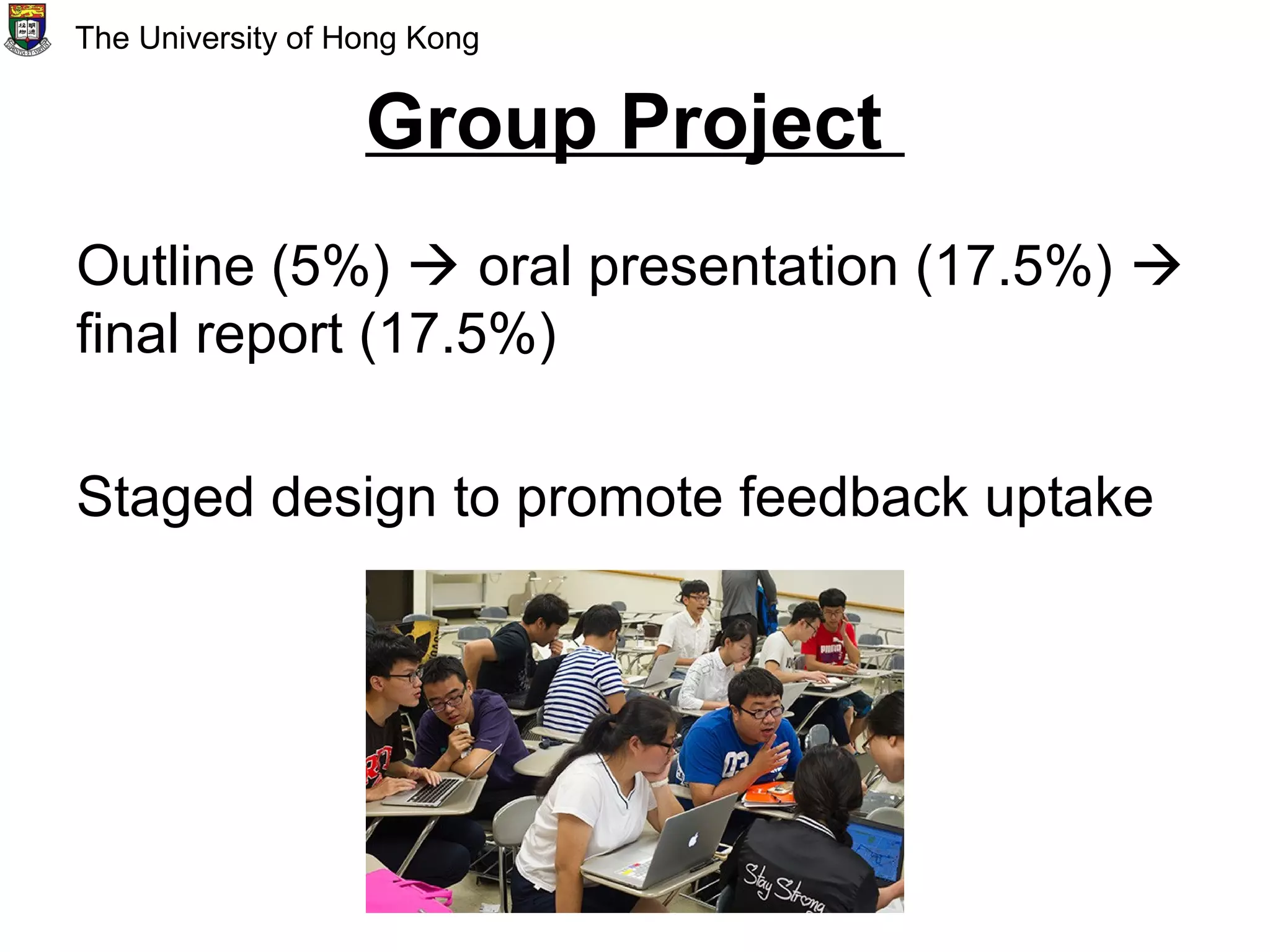
Group Project
Outline (5%)  oral presentation (17.5%) 
final report (17.5%)
Staged design to promote feedback uptake
The University of Hong Kong
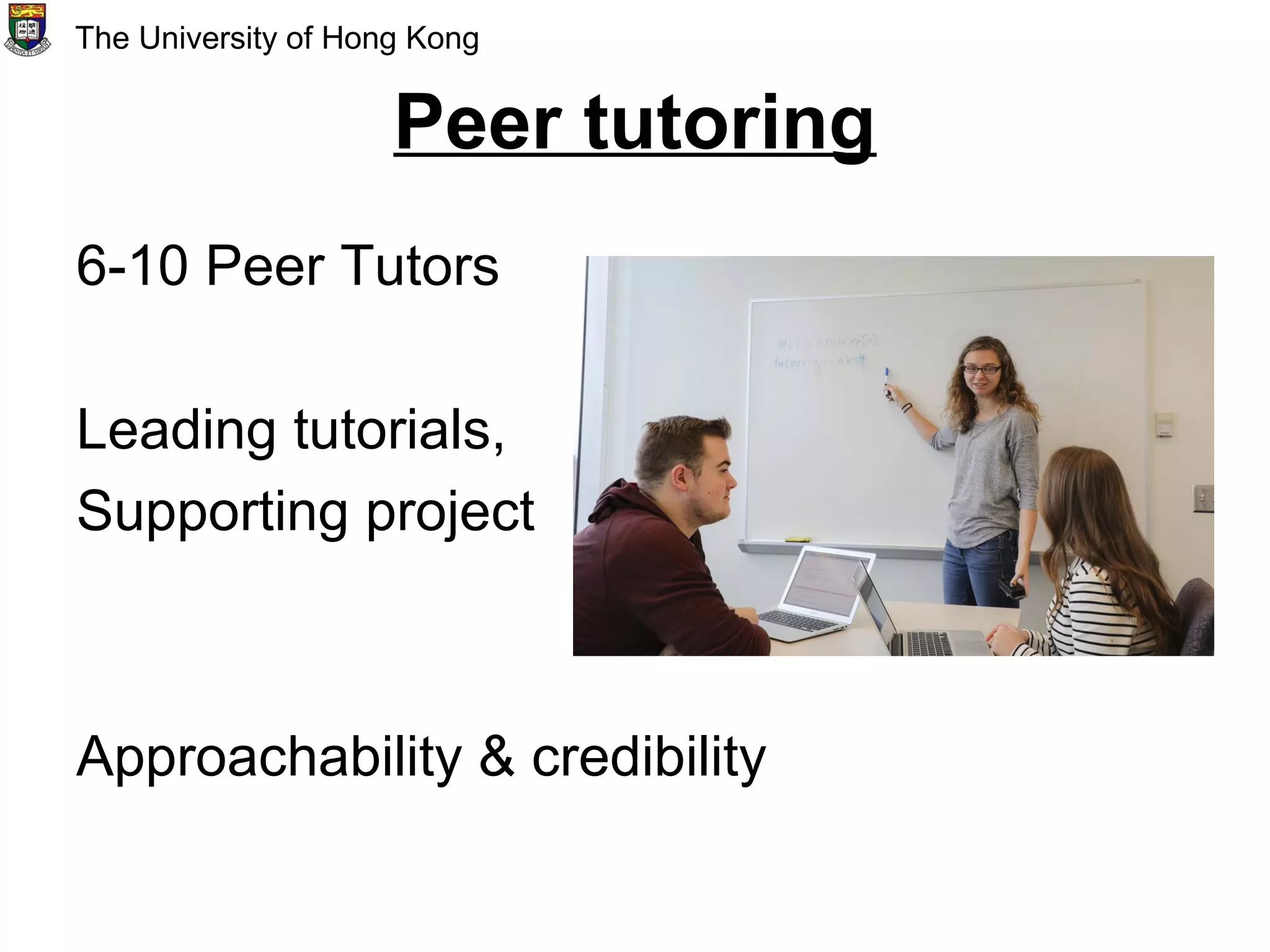
Peer tutoring
6-10 Peer Tutors
Leading tutorials,
Supporting project
Approachability & credibility
The University of Hong Kong
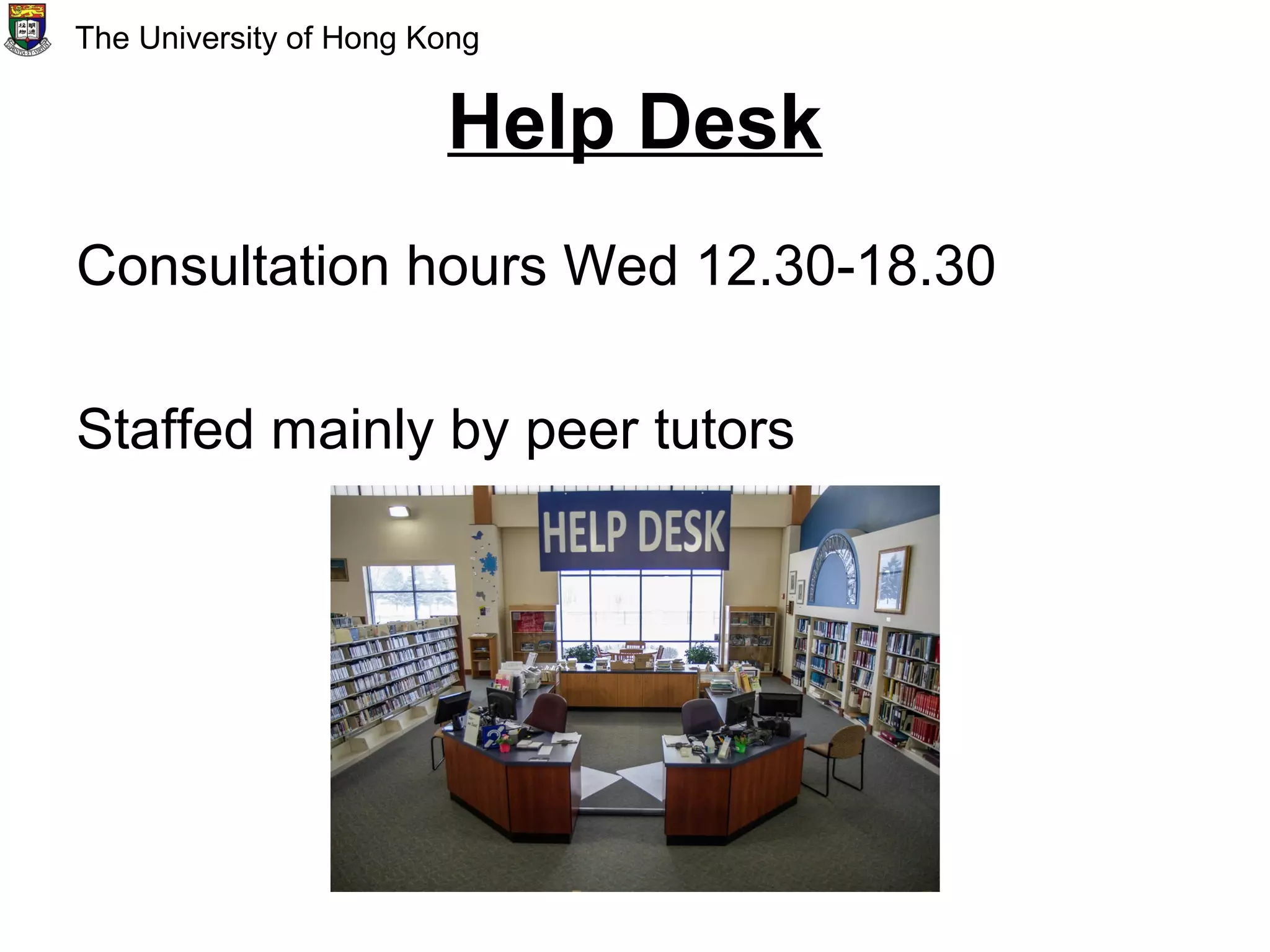
Help Desk
Consultation hours Wed 12.30-18.30
Staffed mainly by peer tutors
The University of Hong Kong
Moodle quizzes & forum
Quizzes with instant automated feedback
Student-generated Moodle forum
The University of Hong Kong
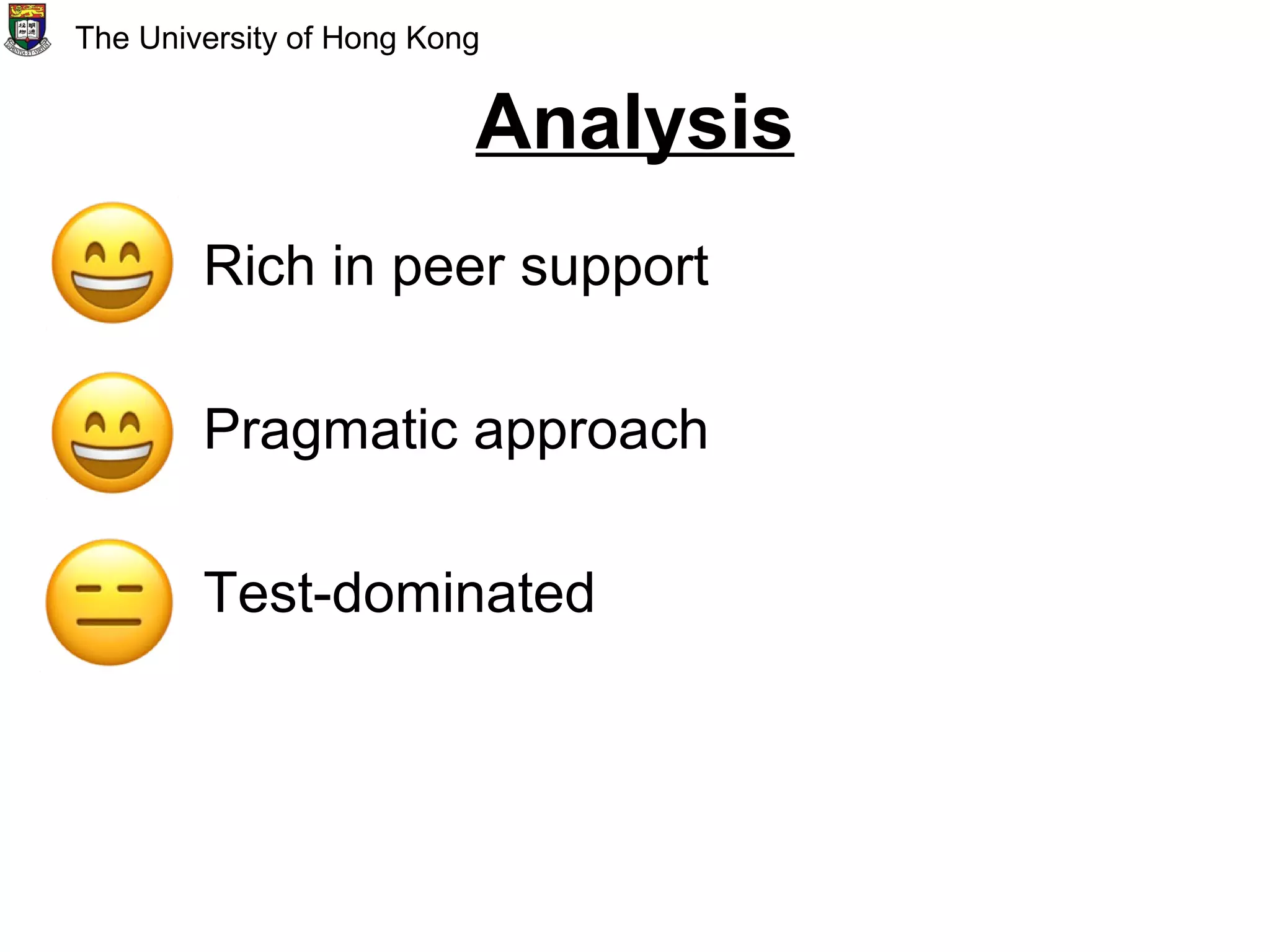
Analysis
Rich in peer support
Pragmatic approach
Test-dominated
The University of Hong Kong
Implications
The University of Hong Kong
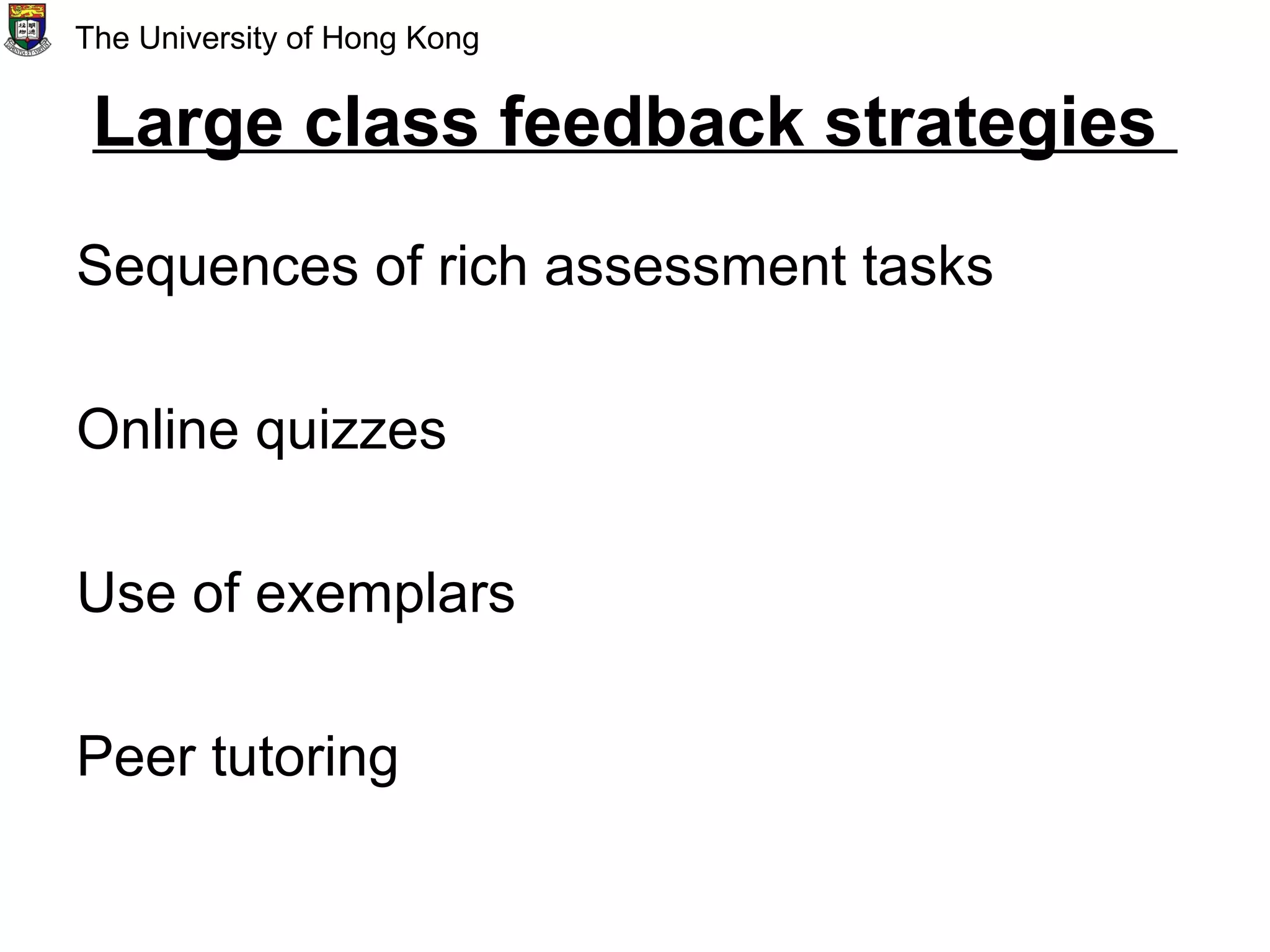
Large class feedback strategies
Sequences of rich assessment tasks
Online quizzes
Use of exemplars
Peer tutoring
The University of Hong Kong
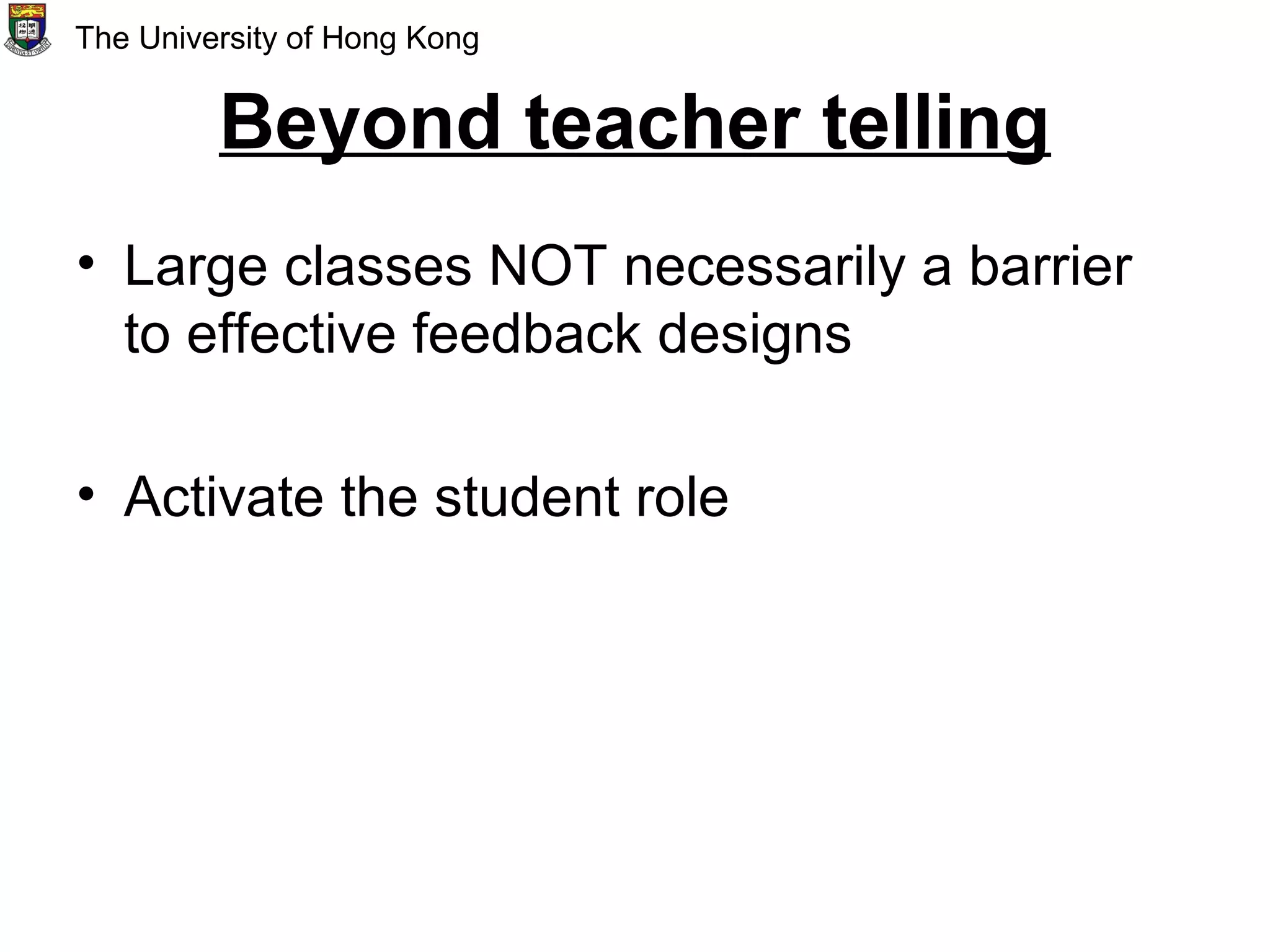
Beyond teacher telling
• Large classes NOT necessarily a barrier
to effective feedback designs
• Activate the student role
The University of Hong Kong
Key recommendations
Design for student uptake
Minimise teacher telling
Involve students actively
Develop feedback literacy
The University of Hong Kong
QUESTIONS
&
COMMENTS
The University of Hong Kong
References
Boud, D. & Molloy, E. (2013). Rethinking models of feedback for learning: The challenge of design.
Assessment & Evaluation in Higher Education, 38(6), 698-712.
Broadbent, J., Panadero, E., & Boud, D. (2018). Implementing summative assessment with a
formative flavour: A case study in a large class. Assessment & Evaluation in Higher
Education, 43(2), 307-322.
Carless, D. & Boud, D. (2018). The development of student feedback literacy: Enabling uptake of
feedback. Assessment & Evaluation in Higher Education,
https://doi.org/10.1080/02602938.2018.1463354.
Carless, D., Salter, D., Yang, M., & Lam, J. (2011). Developing sustainable feedback practices.
Studies in Higher Education, 36(4), 395-407.
Filius, R. et al. (2019). Audio peer feedback to promote deep learning in online education. Journal of
Computer Assisted Learning. https://onlinelibrary.wiley.com/doi/full/10.1111/jcal.12363
Nicol, D., Thomson, A., & Breslin, C. (2014). Rethinking feedback practices in higher education: A
peer review perspective. Assessment & Evaluation in Higher Education, 39(1), 102-122.
Sadler, D.R. (2015). Backwards assessment explanations: Implications for teaching and assessment
practice. In D. Lebler et al. (Eds.), Assessment in music education. (pp.9-19). Cham: Springer.
Winstone, N. & Carless, D. (2019, in press). Designing effective feedback processes in higher
education: A learning-focused approach. London: Routledge.
The University of Hong Kong
THANK YOU
The University of Hong Kong
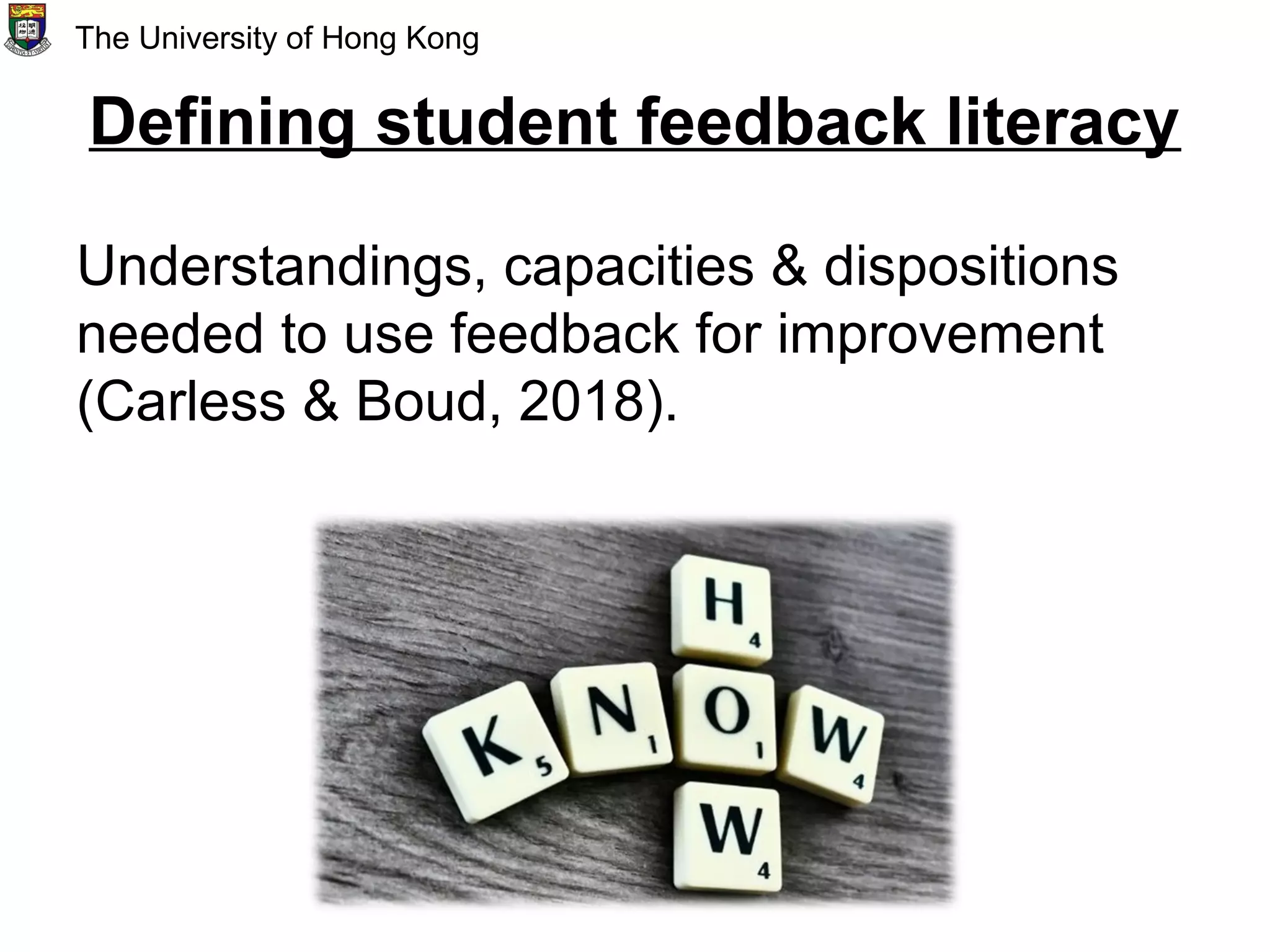
Defining student feedback literacy
Understandings, capacities & dispositions
needed to use feedback for improvement
(Carless & Boud, 2018).
The University of Hong Kong
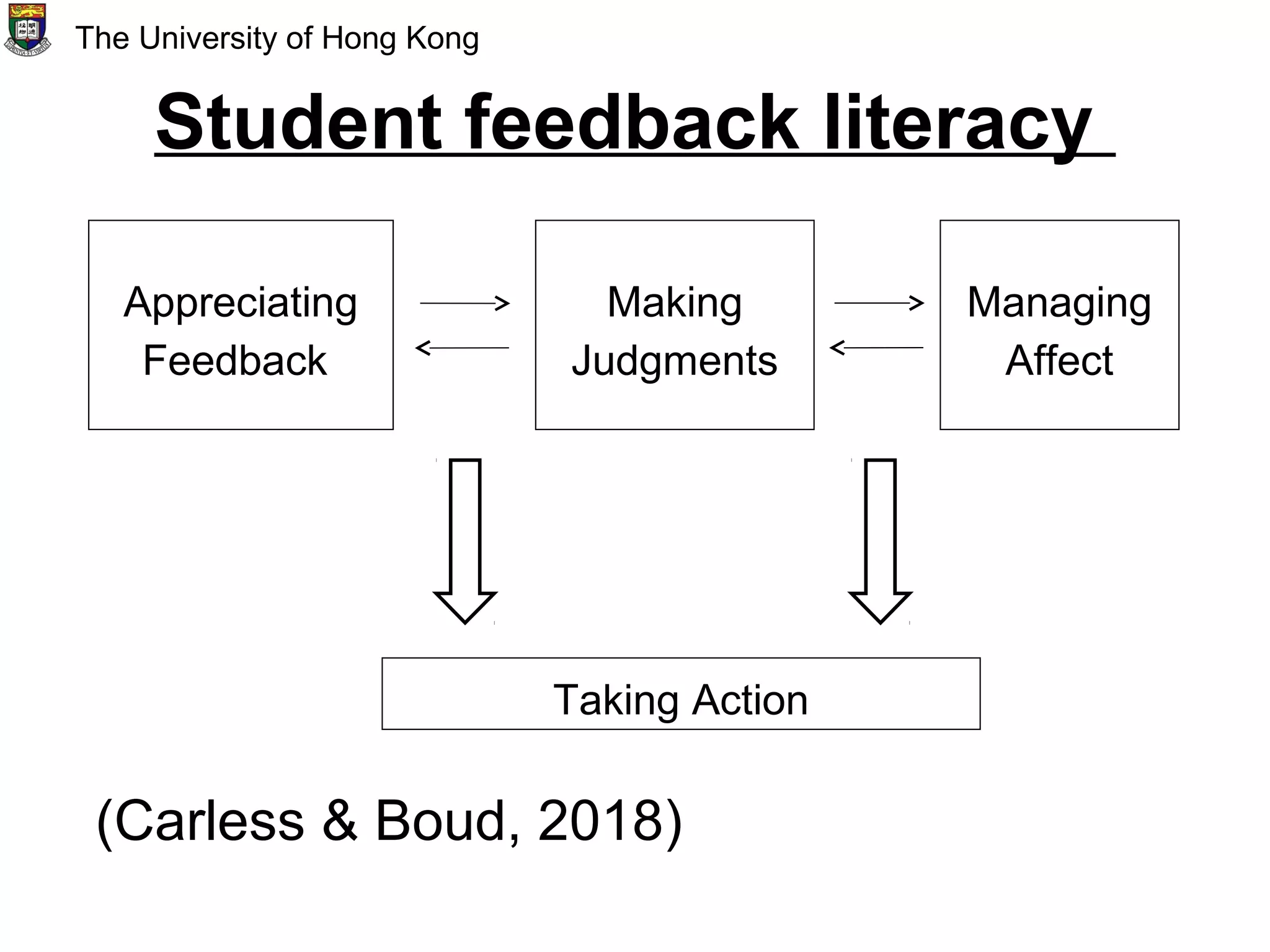
Student feedback literacy
The University of Hong Kong
Making
Judgments
Appreciating
Feedback
Managing
Affect
Taking Action
(Carless & Boud, 2018)
Students as partners
Feedback processes aligned with students’
needs and preferences
The University of Hong Kong
Feedback designs
Feedback as aspect of curriculum design
not an episodic mechanism delivered by
teachers to learners (Boud & Molloy, 2013)
The University of Hong Kong
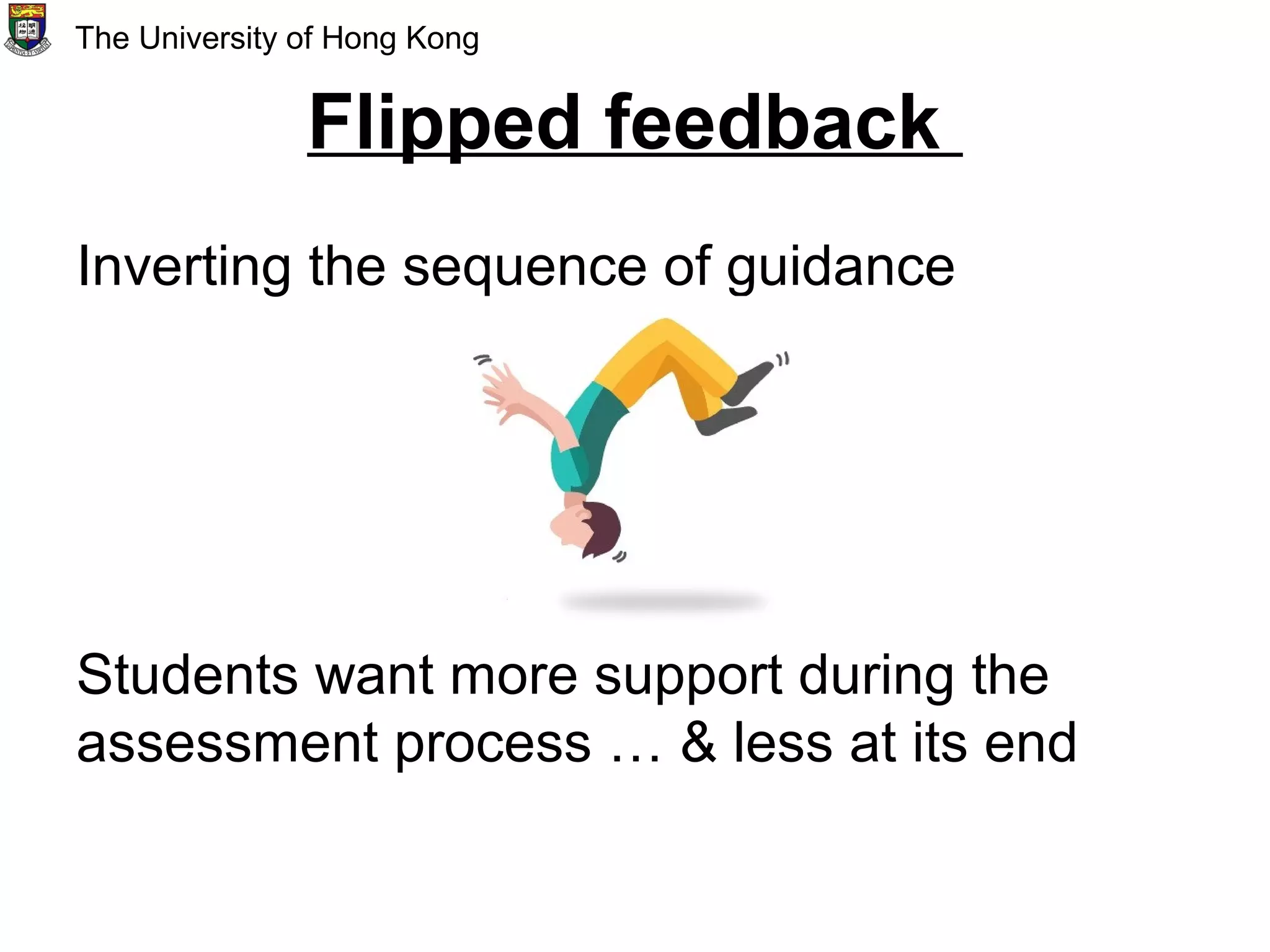
Flipped feedback
Inverting the sequence of guidance
Students want more support during the
assessment process … & less at its end
The University of Hong Kong

Designing feedback processes for large classes

  • 1.
    Designing feedback processes forlarge classes Professor David Carless, University of Hong Kong, Nottingham Ningbo, May 10, 2019 The University of Hong Kong
  • 2.
    Overview 1. Feedback concepts& challenges 2. Designs for large classes 3. Implications for practice The University of Hong Kong
  • 3.
  • 4.
    Student growth What arewe hoping to achieve through feedback processes? The University of Hong Kong
  • 5.
    Key aim offeedback processes To enhance student ability to self-monitor their work in progress The University of Hong Kong
  • 6.
    Sustainable feedback Enhancing studentrole to seek, generate & use feedback (Carless et al., 2011) The University of Hong Kong
  • 7.
    Feedback as information Informationabout performance or understanding The University of Hong Kong
  • 8.
    Limits of Feedbackas telling “Learners do not always learn much purely from being told, even when they are told repeatedly in the kindest possible way” (Sadler, 2015, p. 16) The University of Hong Kong
  • 9.
    Student frustrations Information oftencomes at the end of teaching sequences and it is too late for students to act The University of Hong Kong
  • 10.
    Feedback as action Learnersusing comments for improvement to close feedback loops (Boud & Molloy, 2013) The University of Hong Kong
  • 11.
    Social constructivism Action onfeedback is developed through learner agency, interaction & co- construction The University of Hong Kong
  • 12.
    Information  action (Winstone& Carless, 2019) The University of Hong Kong
  • 13.
  • 14.
    EXAMPLE 1 PSYCHOLOGY OFHEALTH BEHAVIOR – 1300 STUDENTS DEAKIN UNIVERSITY The University of Hong Kong
  • 15.
    Assessment design Online quizzes10% Three linked journal entries 45% Final exam 45% (applying knowledge learnt in journals) The University of Hong Kong
  • 16.
    Aligned assessment design Threejournal entries where students produce 2 minute video & reflect on their health behavior changes (800 words) The University of Hong Kong
  • 17.
    Use of exemplars Videoexplanation of rubric + Online exemplar The University of Hong Kong
  • 18.
    3 forms offeedback 1. Grade aligned with rubric 2. Written explanation linked to LOs 3. 5 minute audio file (25 sessional staff) The University of Hong Kong
  • 19.
    Audio feedback Timely: 7days before next entry is due Enables rapport & nuance You can talk faster than you can write The University of Hong Kong
  • 20.
  • 21.
    Analysis Well-designed task sequence Useof audio feedback Mainly ‘Teacher-telling’ The University of Hong Kong
  • 22.
    Audio peer feedback Moreactive student role Comparing own work with that of peers (Filius et al., 2019) The University of Hong Kong
  • 23.
    Composing peer feedback Providingfeedback more cognitively engaging than receiving feedback (e.g. Nicol et al., 2014) The University of Hong Kong
  • 24.
    EXAMPLE 2 SCIENCE –300 STUDENTS UNIVERSITY OF HONG KONG The University of Hong Kong
  • 25.
    Assessment design Group project40% Mid-semester test 20% Final exam 40% The University of Hong Kong
  • 26.
    Feedback design Staged groupproject Peer tutoring Help Desk Moodle quizzes & forum The University of Hong Kong
  • 27.
    Group Project Outline (5%) oral presentation (17.5%)  final report (17.5%) Staged design to promote feedback uptake The University of Hong Kong
  • 28.
    Peer tutoring 6-10 PeerTutors Leading tutorials, Supporting project Approachability & credibility The University of Hong Kong
  • 29.
    Help Desk Consultation hoursWed 12.30-18.30 Staffed mainly by peer tutors The University of Hong Kong
  • 30.
    Moodle quizzes &forum Quizzes with instant automated feedback Student-generated Moodle forum The University of Hong Kong
  • 31.
    Analysis Rich in peersupport Pragmatic approach Test-dominated The University of Hong Kong
  • 32.
  • 33.
    Large class feedbackstrategies Sequences of rich assessment tasks Online quizzes Use of exemplars Peer tutoring The University of Hong Kong
  • 34.
    Beyond teacher telling •Large classes NOT necessarily a barrier to effective feedback designs • Activate the student role The University of Hong Kong
  • 35.
    Key recommendations Design forstudent uptake Minimise teacher telling Involve students actively Develop feedback literacy The University of Hong Kong
  • 36.
  • 37.
    References Boud, D. &Molloy, E. (2013). Rethinking models of feedback for learning: The challenge of design. Assessment & Evaluation in Higher Education, 38(6), 698-712. Broadbent, J., Panadero, E., & Boud, D. (2018). Implementing summative assessment with a formative flavour: A case study in a large class. Assessment & Evaluation in Higher Education, 43(2), 307-322. Carless, D. & Boud, D. (2018). The development of student feedback literacy: Enabling uptake of feedback. Assessment & Evaluation in Higher Education, https://doi.org/10.1080/02602938.2018.1463354. Carless, D., Salter, D., Yang, M., & Lam, J. (2011). Developing sustainable feedback practices. Studies in Higher Education, 36(4), 395-407. Filius, R. et al. (2019). Audio peer feedback to promote deep learning in online education. Journal of Computer Assisted Learning. https://onlinelibrary.wiley.com/doi/full/10.1111/jcal.12363 Nicol, D., Thomson, A., & Breslin, C. (2014). Rethinking feedback practices in higher education: A peer review perspective. Assessment & Evaluation in Higher Education, 39(1), 102-122. Sadler, D.R. (2015). Backwards assessment explanations: Implications for teaching and assessment practice. In D. Lebler et al. (Eds.), Assessment in music education. (pp.9-19). Cham: Springer. Winstone, N. & Carless, D. (2019, in press). Designing effective feedback processes in higher education: A learning-focused approach. London: Routledge. The University of Hong Kong
  • 38.
  • 39.
    Defining student feedbackliteracy Understandings, capacities & dispositions needed to use feedback for improvement (Carless & Boud, 2018). The University of Hong Kong
  • 40.
    Student feedback literacy TheUniversity of Hong Kong Making Judgments Appreciating Feedback Managing Affect Taking Action (Carless & Boud, 2018)
  • 41.
    Students as partners Feedbackprocesses aligned with students’ needs and preferences The University of Hong Kong
  • 42.
    Feedback designs Feedback asaspect of curriculum design not an episodic mechanism delivered by teachers to learners (Boud & Molloy, 2013) The University of Hong Kong
  • 43.
    Flipped feedback Inverting thesequence of guidance Students want more support during the assessment process … & less at its end The University of Hong Kong
  • 44.

Editor's Notes

  • #24 http://i811.photobucket.com/albums/zz31/angelsofhope_picture/Kinder/r8w2fc.jpg