OML751 TESTING OF MATERIALS
M.KARTHIKEYAN
ASSISTANT PROFESSOR
DEPARTMENT OF MECHANICAL ENGINEERING
AAA COLLEGE OF ENGINEERING & TECHNOLOGY, SIVAKASI
karthikeyan@aaacet.ac.in
UNIT V OTHER TESTING
1. Thermal Testing: Differential scanning calorimetry,
2. Differential thermal analysis. Thermo-mechanical and
3. Dynamic mechanical analysis:
4. Chemical Testing: X-Ray Fluorescence
5. Inductively Coupled Plasma-Optical Emission Spectroscopy and
6. Inductively Coupled Plasma-Mass Spectrometry.
INDUCTIVELY COUPLED PLASMA-OPTICAL
EMISSION SPECTROSCOPY
 Inductively coupled plasma atomic emission spectroscopy (ICP-
AES), also referred to as inductively coupled plasma optical
emission spectrometry (ICP-OES), is an analytical technique
used for the detection of chemical elements.
 It is a type of emission spectroscopy that uses the inductively
coupled plasma to produce excited atoms and ions that
emit electromagnetic radiation at wavelengths characteristic of
a particular element.
 The plasma is a high temperature source of ionized source gas
(often argon).
 The plasma is sustained and maintained by inductive coupling
from cooled electrical coils at megahertz frequencies.
 The source temperature is in the range from 6000 to 10,000 K.
 The intensity of the emissions from various wavelengths of light
are proportional to the concentrations of the elements within
the sample.
PRINCIPLE
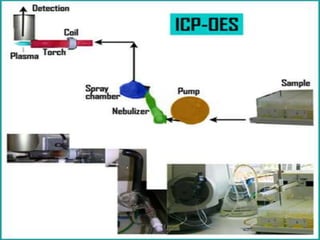
 The solution to analyze is conducted by a peristaltic pump
though a nebulizer into a spray chamber.
 The produced aerosol is lead into an argon plasma. Plasma is the
forth state of matter, next to the solid, liquid and gaseous state.
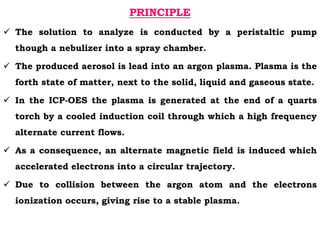
 In the ICP-OES the plasma is generated at the end of a quarts
torch by a cooled induction coil through which a high frequency
alternate current flows.
 As a consequence, an alternate magnetic field is induced which
accelerated electrons into a circular trajectory.
 Due to collision between the argon atom and the electrons
ionization occurs, giving rise to a stable plasma.
 The plasma is extremely hot, 6000-7000 K. In the induction
zone it can even reach 10000 K.
 In the torch desolvation, atomization and ionizations of the
sample takes place.
 Due to the thermic energy taken up by the electrons, they reach
a higher "excited" state.
 When the electrons drop back to ground level energy is liberated
as light (photons).
 Each element has an own characteristic emission spectrum that
is measured with a spectrometer.
 The light intensity on the wavelength is measured and with the
calibration calculated into a concentration.
TYPICAL INDUSTRIES USING ICP-OES
 Environmental testing
 Food and drinks
 Materials
 Minerals
 Glass, ceramics and refractories
 Healthcare.
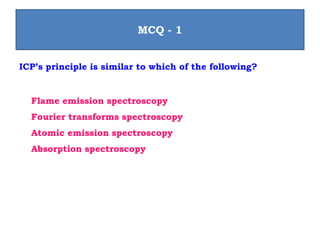
ICP’s principle is similar to which of the following?
Flame emission spectroscopy
Fourier transforms spectroscopy
Atomic emission spectroscopy
Absorption spectroscopy
MCQ - 1
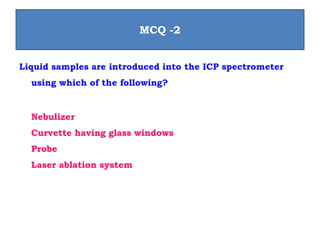
Liquid samples are introduced into the ICP spectrometer
using which of the following?
Nebulizer
Curvette having glass windows
Probe
Laser ablation system
MCQ -2
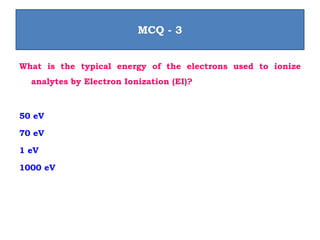
What is the typical energy of the electrons used to ionize
analytes by Electron Ionization (EI)?
50 eV
70 eV
1 eV
1000 eV
MCQ - 3
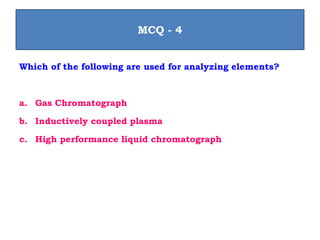
Which of the following are used for analyzing elements?
a. Gas Chromatograph
b. Inductively coupled plasma
c. High performance liquid chromatograph
MCQ - 4
The most common type of ion detector found in ICP system
is which of the following?
Faraday cup collector
Channeltron
Micro-channel plate
Flame ionization detector
MCQ -5

Inductively Coupled Plasma-Optical Emission Spectroscopy

  • 1.
    OML751 TESTING OFMATERIALS M.KARTHIKEYAN ASSISTANT PROFESSOR DEPARTMENT OF MECHANICAL ENGINEERING AAA COLLEGE OF ENGINEERING & TECHNOLOGY, SIVAKASI karthikeyan@aaacet.ac.in
  • 2.
    UNIT V OTHERTESTING 1. Thermal Testing: Differential scanning calorimetry, 2. Differential thermal analysis. Thermo-mechanical and 3. Dynamic mechanical analysis: 4. Chemical Testing: X-Ray Fluorescence 5. Inductively Coupled Plasma-Optical Emission Spectroscopy and 6. Inductively Coupled Plasma-Mass Spectrometry.
  • 3.
    INDUCTIVELY COUPLED PLASMA-OPTICAL EMISSIONSPECTROSCOPY  Inductively coupled plasma atomic emission spectroscopy (ICP- AES), also referred to as inductively coupled plasma optical emission spectrometry (ICP-OES), is an analytical technique used for the detection of chemical elements.  It is a type of emission spectroscopy that uses the inductively coupled plasma to produce excited atoms and ions that emit electromagnetic radiation at wavelengths characteristic of a particular element.  The plasma is a high temperature source of ionized source gas (often argon).
  • 4.
     The plasmais sustained and maintained by inductive coupling from cooled electrical coils at megahertz frequencies.  The source temperature is in the range from 6000 to 10,000 K.  The intensity of the emissions from various wavelengths of light are proportional to the concentrations of the elements within the sample.
  • 6.
    PRINCIPLE  The solutionto analyze is conducted by a peristaltic pump though a nebulizer into a spray chamber.  The produced aerosol is lead into an argon plasma. Plasma is the forth state of matter, next to the solid, liquid and gaseous state.  In the ICP-OES the plasma is generated at the end of a quarts torch by a cooled induction coil through which a high frequency alternate current flows.  As a consequence, an alternate magnetic field is induced which accelerated electrons into a circular trajectory.  Due to collision between the argon atom and the electrons ionization occurs, giving rise to a stable plasma.
  • 7.
     The plasmais extremely hot, 6000-7000 K. In the induction zone it can even reach 10000 K.  In the torch desolvation, atomization and ionizations of the sample takes place.  Due to the thermic energy taken up by the electrons, they reach a higher "excited" state.  When the electrons drop back to ground level energy is liberated as light (photons).  Each element has an own characteristic emission spectrum that is measured with a spectrometer.  The light intensity on the wavelength is measured and with the calibration calculated into a concentration.
  • 8.
    TYPICAL INDUSTRIES USINGICP-OES  Environmental testing  Food and drinks  Materials  Minerals  Glass, ceramics and refractories  Healthcare.
  • 9.
    ICP’s principle issimilar to which of the following? Flame emission spectroscopy Fourier transforms spectroscopy Atomic emission spectroscopy Absorption spectroscopy MCQ - 1
  • 10.
    Liquid samples areintroduced into the ICP spectrometer using which of the following? Nebulizer Curvette having glass windows Probe Laser ablation system MCQ -2
  • 11.
    What is thetypical energy of the electrons used to ionize analytes by Electron Ionization (EI)? 50 eV 70 eV 1 eV 1000 eV MCQ - 3
  • 12.
    Which of thefollowing are used for analyzing elements? a. Gas Chromatograph b. Inductively coupled plasma c. High performance liquid chromatograph MCQ - 4
  • 13.
    The most commontype of ion detector found in ICP system is which of the following? Faraday cup collector Channeltron Micro-channel plate Flame ionization detector MCQ -5