A SUMMER TRAINING PROJECT REPORT
On
“SALES AND MARKETING IN ILP OVERSEAS”
In partial fulfillment for the award of the degree
Of
Master of Business Administration (MBA)
In
Marketing
Under the guidance of Submitted by
Ms. Harshita Jha SHAILENDRA SAKYA
Assistant professor MBA 2nd
YEAR
To
Department of Management & Studies
S R Group of Institutions
Dr. A P J Abdul Kalam Technical University, Lucknow
Session 2023-24
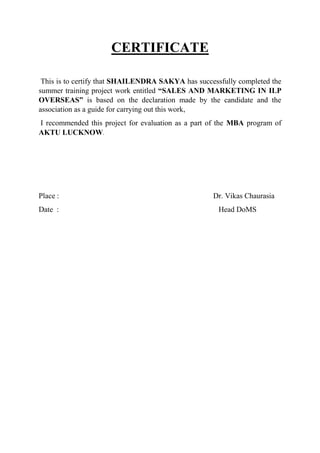
CERTIFICATE
This is to certify that SHAILENDRA SAKYA has successfully completed the
summer training project work entitled “SALES AND MARKETING IN ILP
OVERSEAS” is based on the declaration made by the candidate and the
association as a guide for carrying out this work,
I recommended this project for evaluation as a part of the MBA program of
AKTU LUCKNOW.
Place : Dr. Vikas Chaurasia
Date : Head DoMS
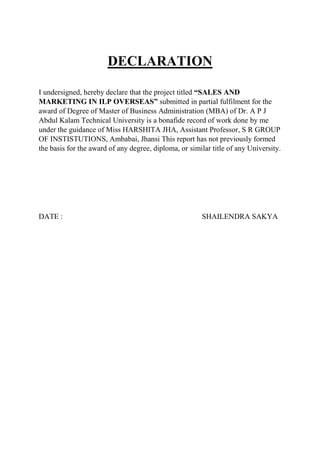
DECLARATION
I undersigned, hereby declare that the project titled “SALES AND
MARKETING IN ILP OVERSEAS” submitted in partial fulfilment for the
award of Degree of Master of Business Administration (MBA) of Dr. A P J
Abdul Kalam Technical University is a bonafide record of work done by me
under the guidance of Miss HARSHITA JHA, Assistant Professor, S R GROUP
OF INSTISTUTIONS, Ambabai, Jhansi This report has not previously formed
the basis for the award of any degree, diploma, or similar title of any University.
DATE : SHAILENDRA SAKYA
ACKNOWLEDGEMENT
Through this acknowledgement I express my sincere gratitude towards all those
people who helped me in this project, which has been a learning experience. This
space wouldn’t be enough to extend my warm gratitude towards my project guide
Miss HARSHITA JHA for efforts in coordinating with my work and guiding in
right direction. I escalate a heartfelt regards to our Institution Head Dr Vikas
Chaurasia for giving me the essential hand in concluding this work. It would be
injustice to proceed without acknowledging those vital supports I received from
my beloved classmates and friends, without whom I would have been half done.
I also use this space to offer my sincere love to my parents and all others who had
been there, helping me walk through this work.
SHAILENDRA SAKYA
PREFACE
To achieve partial and concrete results, it is necessary the theoretical knowledge
must be supplemented with practical environment.
Keeping that view in mind that I have completed my training work regarding
“SALES AND MARKETING IN ILP OVERSEAS” by doing the research
work I have learnt a lot of things which would be really helpful for me in future.
The experience in decision making and practical knowledge e has contributed
greatly to my growth.
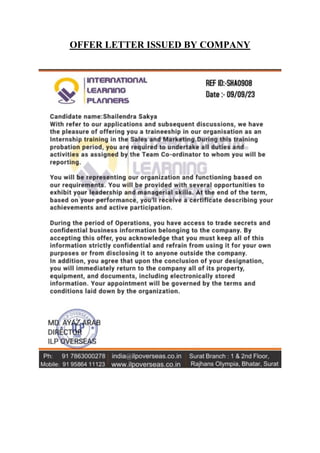
OFFER LETTER ISSUED BY COMPANY
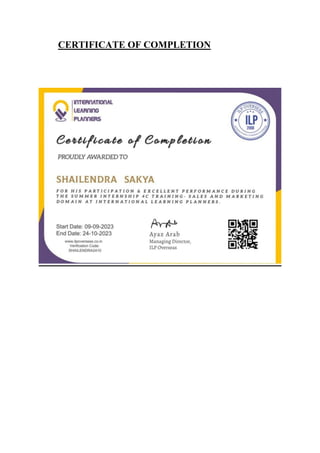
CERTIFICATE OF COMPLETION
LETTER OF RECOMMENDATION
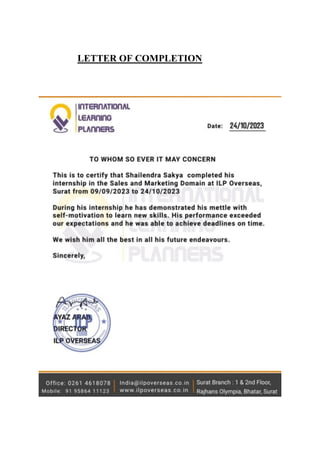
LETTER OF COMPLETION
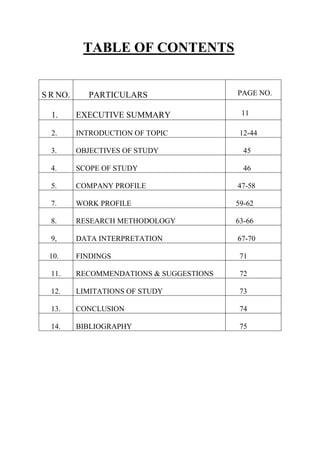
TABLE OF CONTENTS
S R NO. PARTICULARS PAGE NO.
1. EXECUTIVE SUMMARY 11
2. INTRODUCTION OF TOPIC 12-44
3. OBJECTIVES OF STUDY 45
4. SCOPE OF STUDY 46
5. COMPANY PROFILE 47-58
7. WORK PROFILE 59-62
8. RESEARCH METHODOLOGY 63-66
9, DATA INTERPRETATION 67-70
10. FINDINGS 71
11. RECOMMENDATIONS & SUGGESTIONS 72
12. LIMITATIONS OF STUDY 73
13. CONCLUSION 74
14. BIBLIOGRAPHY 75
EXECUTIVE SUMMARY
First of all a telephonic interview is conducted for internship. I realised that
interviewer is looking for a dedicated sales and marketing intern during the first
few minutes of the telephonic interview. As l got selected I realised this was a
crucial phase of my life. I was a part of Sales and Marketing Team at ILP
OVERSEAS.
First phase of my internship was about getting familiar with the roles and
responsibilities offered by ILP OVERSEAS as well as the Environment (People
& Processes) at ILP OVERSEAS. After a few days, I was put into a team of Sales
and Marketing domain in which I have to do sales with different organisations of
Gujrat by cold callings for promoting companies products and services.
I worked on Sales & Marketing, Public Relations, Team Building, Collaboration
with team members. Mainly It was dynamic profile and various tasks were
already planned for me by Mr Ayaz Arab Sir, that included doing sales with
different organisations of Gujrat by cold callings which gave me the opportunity
to learn various concepts of Marketing theoretically and practically too.
This was a great achievement for me because as I have only theoretical
knowledge of all Marketing concepts but here I gain practical knowledge too.
It was a very exciting journey of six weeks. And I got sample opportunities to
learn and apply my knowledge which I got. It helped me a lot to contribute to the
growth of business. Also along with core learning regarding Sales & Marketing,
this internship improved my creative abilities and marketing skills
At the end, I was very confident that I learnt this new Marketing model in this
Sales & Marketing domain.
INTRODUCTION OF TOPIC
SALES AND MARKETING
Marketing and sales management deal with an understanding of customer needs.
It includes the response to them through the development, production, and sales
of goods and services and the impact on customers’ needs following the strategic
purposes of the organization.
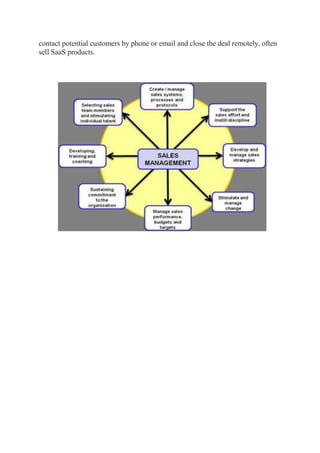
What is sales management?
Sales management is the management of activities and processes relating to
effectively planning, coordinating, implementing, controlling, and evaluating an
organisation's sales performance. Sales management is a core business process in
most organisations. Sales managers and those in related roles support a
company’s revenue generation and profits.
Sales management is the process of leading, motivating, and influencing people
to achieve sales objectives. The sales manager manages the entire sales cycle,
including forecasting and budgeting sales revenue, recruitment, selection of sales
personnel, and ensuring everyone receives proper training and performance
evaluations.
Effective sales management requires a thorough understanding of the sales
process and how you can employ different techniques to drive sales. By carefully
analysing key performance indicators (KPIs), optimising your selling approach,
and enhancing your team with the right competencies and tools to succeed, you
can turn your sales department into a profit-generating department.
The process of evolving a sales force, synchronizing sales operations, and
executing sales techniques that assist a business to consistently achieve its sales
targets is called sales management. Precise sales management processes are
essential when it comes to boosting sales performance for any size of the
operation or any industry. the sales management process can be the difference
between surviving and flourishing in an increasingly competitive marketplace.
There are three aspects of sales management within the sales process:
 Sales Operations which involves building the sales team. Salespeople need to
be great at selling the company’s product. Set targets, assign territories, establish
goals and counsel them throughout the process.
 Sales Strategy entails defining the sales process. A sales cycle is an essential
part of every business. It is a series of tasks that help a company’s product reach
its users. Therefore, having a sales pipeline, or sales funnel, will make that easier
to complete these tasks. With the standard sales funnel the number of deals in the
funnel, the average size of a deal in the funnel, closure ratio, sales velocity, etc.
can be measured.
 Sales Analysis or reporting is what enables an assessment of the current efforts
vis-a-vis the targets. It involves sales metrics or quantifiable indicators that help
measure each aspect of sales operations
 The Sales and Marketing departments in the organization are
quintessentially linked. While the marketing function of an organization
positions itself to establish the needs of the actual and prospective
customers and also the most important task of product promotion, the
sales department engages in active selling of the company’s products to
customers.
Aspects of Sales Management
Sales Management relates to the process of constituting a marketing team,
coordinating sales activities, and implementing sales techniques. The
basic goal of sales management is to assist businesses to achieve their
sales goals.
Objectives of Sales Management
A sales manager’s responsibility is to set long-term goals and objectives for their
team. By understanding how sales objectives fit into the organisation, you’ll
better understand the big picture and can communicate better with senior
management. Some of the main goals of sales management include:
 Revenue generation
 Increased sales volume
 Sustained profits
 Sales department growth
 Market leadership
 Prospect conversions
 Motivating the sales force
 Enhancement of sales and profit
 increasing customer base
 Enhancing upsells and cross-sells
 Motivating the sales rep to increase productivity
Emerging Trends in Sales management
 Customer Satisfaction will assume the top position in the list of key sales
metrics. A deeper look into the customer journey will allow the sales reps to
track the lifetime value of the customers. Sales professions can increase their
professional competencies to meet future job demands by completing a certified
sales & marketing course.
 Customer engagement will grow on emerging channels like SMS, mobile chat,
and video chat.
 The role of AI is not to replace them but rather to reduce the burden of tedious
tasks and empower them to deliver enhanced customer and brand experience.
The secret of effective sales management is the continuous adaption to and areas
of improvement that are found in the stages of planning, monitoring & tracking
as well as consequently eliminating all weaknesses. Marketing management has
increased in sophistication and it is practical for marketing strategy policymakers
to focus on emerging technologies, patterns, and methods.
Types of sales management
While some selling forms are about maximising sales volume (numbers), others
are driving revenue through high-value accounts. Some sales jobs have a short
sales cycle completed over the phone, whilst others have sales processes that take
months or even years. Each type of sale involves different skills and activities, so
finding your niche is essential.
 B2C sales management: Business-to-consumer (B2C) sales involve selling
goods and services directly to consumers. B2C sales often drive leads from
aggressive marketing strategies.
 B2B sales management: Business-to-business (B2B) sales involve selling goods
and services directly to other businesses. B2B sales tend to involve higher-value
products with longer sales cycles.
 Enterprise sales management: Enterprise sales involve selling complex goods
or services directly to large companies. Companies that sell enterprise solutions
may have multiple teams for different aspects of the deal, such as sales engineers
and inside and outside sales teams.
 SaaS sales management: Software as a service (SaaS) companies sell software
or applications over the web, usually by subscription. Inside sales teams, who
contact potential customers by phone or email and close the deal remotely, often
sell SaaS products.
MARKETING MANAGEMENT
Marketing is the process of identifying customers and "creating, communicating,
delivering, and exchanging" goods and services for the satisfaction and retention
of those customers. It is one of the primary components of business
management and commerce.
Marketing is typically conducted by the seller, typically a retailer or
manufacturer. Products can be marketed to other businesses (B2B) or directly to
consumers (B2C)
In this context, marketing can be defined as "the management process that seeks
to maximise returns to shareholders by developing relationships with valued
customers and creating a competitive advantage".
Types of Marketing :-
Where your marketing campaigns live depends entirely on where your customers
spend their time. It's up to you to conduct market research that determines which
types of marketing -- and which mix of tools within each type -- is best for
building your brand. Here are several types of marketing that are relevant today,
some of which have stood the test of time:
 Internet marketing: Inspired by an Excedrin product campaign that took place
online, the very idea of having a presence on the internet for business reasons is
a type of marketing in and of itself.
 Search engine optimization: Abbreviated "SEO," this is the process of
optimizing content on a website so that it appears in search engine results. It's
used by marketers to attract people who perform searches that imply they're
interested in learning about a particular industry.
 Blog marketing: Blogs are no longer exclusive to the individual writer. Brands
now publish blogs to write about their industry and nurture the interest of
potential customers who browse the internet for information.
 Social media marketing: Businesses can use Facebook, Instagram, Twitter,
LinkedIn, and similar social networks to create impressions on their audience
over time.
 Print marketing: As newspapers and magazines get better at understanding who
subscribes to their print material, businesses continue to sponsor articles,
photography, and similar content in the publications their customers are reading.
 Search engine marketing: This type of marketing is a bit different than SEO,
which is described above. Businesses can now pay a search engine to place links
on pages of its index that get high exposure to their audience. (It's a concept called
"pay-per-click" -- I'll show you an example of this in the next section).
 video marketing: While there were once just commercials, marketers now
put money into creating and publishing all kinds of videos that entertain
and educate their core customers.
Marketing is “the action or business of promoting and selling products or
services, including market research and advertising.” This is a simple but also
relatively shallow definition. Modern marketing is much broader, including many
specific disciplines. Examples include Content Marketing, Social Media
Marketing, Digital Marketing, Newsletter Marketing, account-based marketing,
and other areas offline and online.
The classic definition by Jerome McCarthy, made in 1960, uses the “4P” concept.
Also called the marketing mix:
 Product or Service
 Price
 Place or Distribution
 Promotion or Communication
The godfather of marketing, Philip Kotler, has defined marketing as “a social
and managerial process by which individuals and groups obtain what they want
and need through creating, offering, and exchanging products of value with
others.”
Marketing is the process of getting the public educated on and excited about an
organization’s products and services. A marketing team’s efforts in market
research and consumer trends guides the strategy behind other aspects of the
business and helps companies to consistently meet the needs of consumers.
The different aspects of Marketing management are:-
 Advertising
 Branding
 Copywriting
 Customer relationship Management
 Direct marketing
 Internet Marketing
Benefits of Marketing :-
Generating brand awareness: Marketing helps increase the consumers'
acquaintance with brands' motives and products. Marketing helps in bridging a
loyal customer base.
Generation of traffic: Different methods of online marketing helps in the
generation of traffic and leads, which increases the brand's sales in the long run.
Increases revenue: Through website optimization, creating email campaigns
and regulating marketing strategies, brands increase revenue and sales.
Developing Trust: It has been observed that brands with strong marketing
campaigns and internet presence aids in building trust, which leads to increased
purchases and loyal consumers.
Tracks metrics: Studying the market and business of a brand, in general, is
important when developing marketing campaigns. Therefore, tracking metrics
helps check the brand's progress and adapt marketing strategies accordingly to
optimize sales.
Marketing can include activities like:
 Selection of a target audience
 Selection of certain attributes or themes to emphasize in advertising
 Operation of advertising campaigns
 Attendance at trade shows and public events
 Design of products and packaging to be more attractive to buyers
 Selection of the terms of sale, such as price, discounts, warranty, and return
policy
 Product placement in media or with people believed to influence the buying
habits of others
 Contracts with retailers, wholesale distributors, or resellers
 Attempts to create awareness of, loyalty to, and positive feelings about a
brand
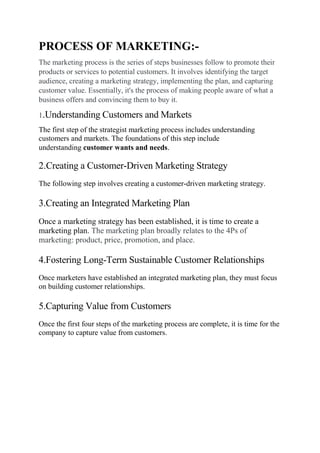
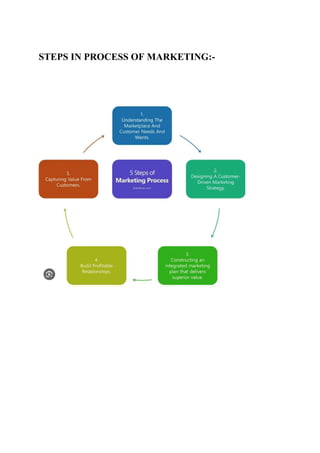
PROCESS OF MARKETING:-
The marketing process is the series of steps businesses follow to promote their
products or services to potential customers. It involves identifying the target
audience, creating a marketing strategy, implementing the plan, and capturing
customer value. Essentially, it's the process of making people aware of what a
business offers and convincing them to buy it.
1.Understanding Customers and Markets
The first step of the strategist marketing process includes understanding
customers and markets. The foundations of this step include
understanding customer wants and needs.
2.Creating a Customer-Driven Marketing Strategy
The following step involves creating a customer-driven marketing strategy.
3.Creating an Integrated Marketing Plan
Once a marketing strategy has been established, it is time to create a
marketing plan. The marketing plan broadly relates to the 4Ps of
marketing: product, price, promotion, and place.
4.Fostering Long-Term Sustainable Customer Relationships
Once marketers have established an integrated marketing plan, they must focus
on building customer relationships.
5.Capturing Value from Customers
Once the first four steps of the marketing process are complete, it is time for the
company to capture value from customers.
STEPS IN PROCESS OF MARKETING:-
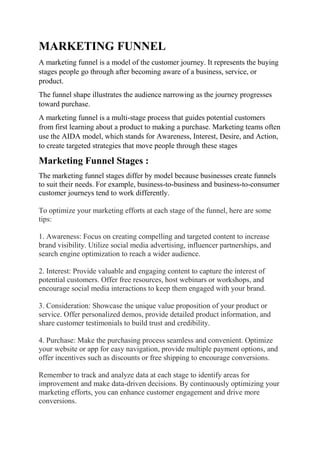
MARKETING FUNNEL
A marketing funnel is a model of the customer journey. It represents the buying
stages people go through after becoming aware of a business, service, or
product.
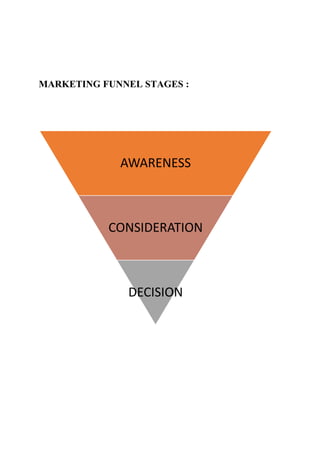
The funnel shape illustrates the audience narrowing as the journey progresses
toward purchase.
A marketing funnel is a multi-stage process that guides potential customers
from first learning about a product to making a purchase. Marketing teams often
use the AIDA model, which stands for Awareness, Interest, Desire, and Action,
to create targeted strategies that move people through these stages
Marketing Funnel Stages :
The marketing funnel stages differ by model because businesses create funnels
to suit their needs. For example, business-to-business and business-to-consumer
customer journeys tend to work differently.
To optimize your marketing efforts at each stage of the funnel, here are some
tips:
1. Awareness: Focus on creating compelling and targeted content to increase
brand visibility. Utilize social media advertising, influencer partnerships, and
search engine optimization to reach a wider audience.
2. Interest: Provide valuable and engaging content to capture the interest of
potential customers. Offer free resources, host webinars or workshops, and
encourage social media interactions to keep them engaged with your brand.
3. Consideration: Showcase the unique value proposition of your product or
service. Offer personalized demos, provide detailed product information, and
share customer testimonials to build trust and credibility.
4. Purchase: Make the purchasing process seamless and convenient. Optimize
your website or app for easy navigation, provide multiple payment options, and
offer incentives such as discounts or free shipping to encourage conversions.
Remember to track and analyze data at each stage to identify areas for
improvement and make data-driven decisions. By continuously optimizing your
marketing efforts, you can enhance customer engagement and drive more
conversions.
MARKETING FUNNEL STAGES :
AWARENESS
CONSIDERATION
DECISION
DIFFERENT FORMS OF
MARKETING:-
1. B2C marketing
B2C marketing stands for "business to consumer." This means that the target
audience is a direct consumer of the product or service. Depending on the type
of product, the sales cycle for a B2C product can be very short and the decision
making process that consumers go through is not as involved.
Most advertisements that people see are types of B2C marketing. For example,
B2C marketing strategies include:
 A TV advertisement for a candy bar
 Instagram ads for a clothing shop
 Direct mail coupons for a store
2.B2B marketing
B2B marketing stands for "business to business." This means that the company's
target audience is another company. B2B marketing typically requires a much
longer buying cycle, and is extremely strategic in terms of what customers want
and need. B2B purchases often also have an extremely high purchase intent.
This means that the target audience will be doing a lot of research before
purchasing the final product.
Many B2B strategies are often executed digitally. While there are some
instances in which B2B marketing will make its way towards more traditional
platforms, you will commonly see B2B strategies come to life on digital
channels.
Examples of B2B marketing include:
 Event marketing at trade shows
 Inbound marketing strategies
Types of traditional marketing :-
Traditional marketing encompasses strategies that have been used since the
invention of marketing itself back in the 1800s. These strategies are much more
overt, and sometimes less targeted. Take a look at the 10 most common
traditional marketing strategies.
1. Outbound marketing
When a marketing strategy is referred to as "outbound," it's focused on how the
message is being delivered. Outbound marketing happens when a company
shares their message out to an audience. Billboard advertisements are a good
example of outbound marketing—in the case of a billboard, the company is
trying to share certain information out to the people driving by.
2. Personalized marketing
Personalized marketing is a strategy in which the company uses historical data
to create a personalized experience for you. This could include direct mail that
uses your name in marketing materials or grocery stores that offer you coupons
for items you regularly purchase.
3. Direct mail
Direct mail is when companies send advertisements to a specific address. This
allows businesses to target a specific area. A good example of direct mail
marketing is a weekly grocery store advertisement.
4.Partner marketing
The partner marketing strategy requires two companies to work together to
create one cohesive message. A common example of this is a company
sponsoring something at another company. For example, a cafe may provide
free WiFi courtesy of Google.
5. Telemarketing
Telemarketing is when a company reaches out to individuals via phone calls.
This is still a common tactic, but since cell phones and caller ID have become
the norm, the success of this marketing strategy has dwindled.
6. Public relations (PR) marketing
PR marketing is a strategy where you partner with a news source to generate
more buzz around your business. PR marketing is commonly used when a
company launches a new product, has a major change of leadership, or
announces an expansion.
PR marketing might not directly promote a product, but it's a good way of
increasing brand awareness for your business. This is especially relevant in B2B
marketing, because some business buyers will make decisions based on their
understanding of your company's position in the competitive landscape.
7. Word of mouth marketing
Word of mouth marketing is a marketing strategy that relies on existing
customers referring your business to new customers. This is a hard strategy to
control, because it depends on your customers to do the leg work.
A common way to encourage customers to refer friends is to offer some kind of
incentive, such as a discount or bonus for referring your business. This is
commonly seen in small businesses that are client-based, like hair salons or
gyms. This is also starting to happen more for subscription based services such
as meal delivery services.
8. Stealth marketing
Stealth marketing is the act of marketing a good or service to someone without
them realizing they're being marketed to. A good example of this is product
placement in a movie or TV show. You may notice that certain characters in the
show only use a certain type of computer, or only drive a certain type of car.
This is because those companies paid to be featured.
9. Brand marketing
Brand marketing is a long-term form of marketing in which the goal is to
become recognizable and establish a good reputation. Brand marketing
encompasses many different facets, from visual branding to tone and voice.
To measure the effectiveness of brand marketing strategies, companies will
track their brand awareness. This metric measures how familiar the average
person is with your brand.
10. Cause marketing
Cause marketing is a strategy in which a company chooses to back a certain
cause as a way of strengthening their brand's core values.
Popular forms of Digital marketing:-
Digital marketing encompasses all marketing strategies that are implemented in
a digital format. Some of the strategies above may sometimes happen digitally,
but the following seven forms of marketing only happen online:
1. Inbound marketing
Inbound marketing is a strategy used to bring potential customers to you instead
of sharing a message out. This is a long-term strategy that involves many
different types of digital marketing tactics to encourage a potential customer to
move further down the marketing funnel.
Inbound marketing uses search engine optimization (SEO) strategies, content
marketing, and email marketing to educate and encourage potential customers
to interact with a brand or business more frequently.
2. Searching engine marketing
Search engine marketing is the strategy of utilizing search engines such as
Google. Search engine marketing can include paid advertisements such as pay-
per-click (PPC) advertisements and suggested posts. It can also include organic
SEO strategies, such as creating optimized content in the hopes of ranking .
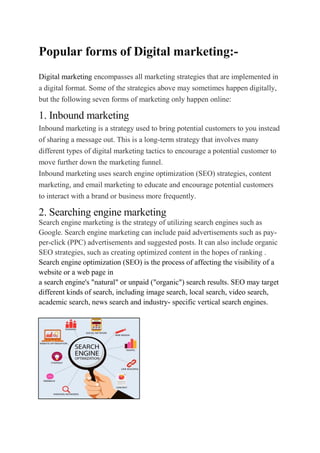
Search engine optimization (SEO) is the process of affecting the visibility of a
website or a web page in
a search engine's "natural" or unpaid ("organic") search results. SEO may target
different kinds of search, including image search, local search, video search,
academic search, news search and industry- specific vertical search engines.
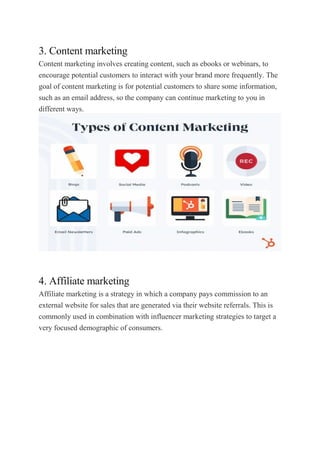
3. Content marketing
Content marketing involves creating content, such as ebooks or webinars, to
encourage potential customers to interact with your brand more frequently. The
goal of content marketing is for potential customers to share some information,
such as an email address, so the company can continue marketing to you in
different ways.
4. Affiliate marketing
Affiliate marketing is a strategy in which a company pays commission to an
external website for sales that are generated via their website referrals. This is
commonly used in combination with influencer marketing strategies to target a
very focused demographic of consumers.
5. Social media marketing
Social media marketing uses social media platforms as a key channel to share
your messaging. Social media marketing can be paid ads, organic content, or
user-generated content. Social media marketing is commonly used by
ecommerce businesses.
Sometimes, social media marketing can go viral. The major social media
platforms (at the moment) are Facebook, Instagram, Twitter, LinkedIn, Pinterest,
YouTube, and Snapchat.
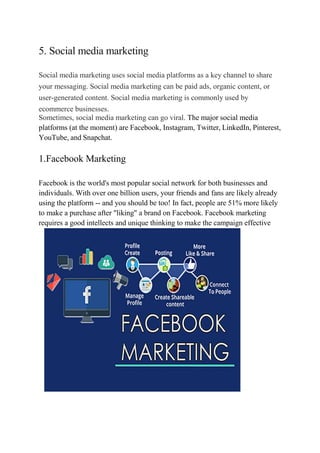
1.Facebook Marketing
Facebook is the world's most popular social network for both businesses and
individuals. With over one billion users, your friends and fans are likely already
using the platform -- and you should be too! In fact, people are 51% more likely
to make a purchase after "liking" a brand on Facebook. Facebook marketing
requires a good intellects and unique thinking to make the campaign effective
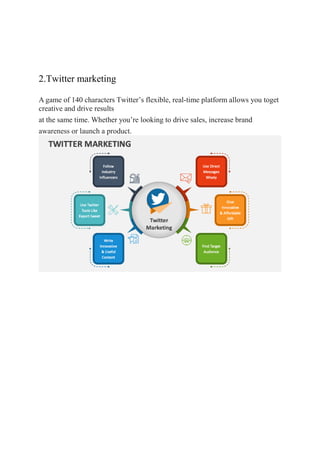
2.Twitter marketing
A game of 140 characters Twitter’s flexible, real-time platform allows you toget
creative and drive results
at the same time. Whether you’re looking to drive sales, increase brand
awareness or launch a product.
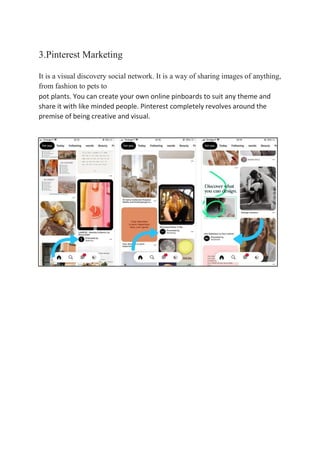
3.Pinterest Marketing
It is a visual discovery social network. It is a way of sharing images of anything,
from fashion to pets to
pot plants. You can create your own online pinboards to suit any theme and
share it with like minded people. Pinterest completely revolves around the
premise of being creative and visual.
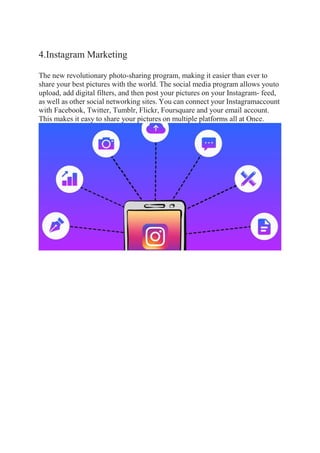
4.Instagram Marketing
The new revolutionary photo-sharing program, making it easier than ever to
share your best pictures with the world. The social media program allows youto
upload, add digital filters, and then post your pictures on your Instagram- feed,
as well as other social networking sites. You can connect your Instagramaccount
with Facebook, Twitter, Tumblr, Flickr, Foursquare and your email account.
This makes it easy to share your pictures on multiple platforms all at Once.
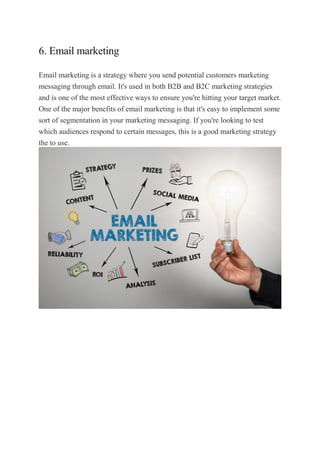
6. Email marketing
Email marketing is a strategy where you send potential customers marketing
messaging through email. It's used in both B2B and B2C marketing strategies
and is one of the most effective ways to ensure you're hitting your target market.
One of the major benefits of email marketing is that it's easy to implement some
sort of segmentation in your marketing messaging. If you're looking to test
which audiences respond to certain messages, this is a good marketing strategy
the to use.
7. Mobile marketing
Mobile marketing involves sending marketing messages via push notifications
or text messages. This tactic can be used to achieve many different goals, such
as encouraging app openings to increase daily active users or to share coupons
with discounts, like you would with email. The downside of this form of
marketing is that you need customer phone numbers, and that information is
harder to get than email addresses.
8. Experiential marketing
Experiential marketing is a marketing effort in which you hold some kind of
experiential event in an effort to promote your product or service. This is a
common tactic used for marketing TV shows or movies to create an immersive
experience for individuals.
Pop-up events are another good example of experiential marketing. It allows for
a limited engagement, so there's some sense of urgency and exclusivity to the
event itself.
9. Interactive marketing
Interactive marketing is a marketing strategy that involves some form of
interactive component during an event or face-to-face interaction. One common
technique is to play some kind of a game, such as spinning a roulette wheel or
plinko, to win a giveaway. This is common at trade shows and other in -person
events.
Effective marketing strategy :-
An effective marketing strategy is a comprehensive and cohesive plan that
comprises all the marketing tactics you use to reach your target audience.
Successful marketing strategies are effective because they are focused and
deliver a clear and concise message to customers. They consider the needs of
your target audience and how your product or service will meet those needs. An
effective marketing strategy is founded on market research and customer insight
and considers your company's objectives. It is also flexible enough to adapt to
change and evolve with your business.
It is important to note that different marketing strategies will have different
effects on those who see or experience them. For example, the best marketing
strategy to reach a younger audience may not be the best approach for reaching
an older demographic.
The importance of effective marketing:
The process of promoting your product or service to potential customers is
known as marketing. Marketing is the most effective way to drive sales or
simply raise brand awareness. It helps you attract new customers, keep old ones
coming back, and build trust with your brand. It is the foundation of any
successful business. However, getting it right can be tricky. You need to create
compelling content, come up with creative marketing strategies, and measure
your success. All of this takes time, effort, and money. As a result, you must
ensure that your efforts are effective. With the right marketing strategies, you
can increase sales, expand your customer base, and establish your brand as an
industry leader.
Researching your target audience
Before you can create an effective marketing strategy, you need to research your
target audience. A successful marketing strategy is one that is tailored to your
specific audience. It helps to consider who your target audience is and what
their needs and desires may be. Researching your target audience is a crucial
step in any successful marketing campaign. Knowing whom you're targeting
helps you create content and advertising that is tailored to their needs and
interests.
Types of marketing strategies
There are many different marketing strategies you can use to reach your target
audience. You can use various types of marketing tactics to attract new
customers and keep them coming back. To form an effective marketing
strategy, you will need to use a combination of different marketing techniques.
In order to do this, it is important to understand the different types of marketing
strategies available to you.
Developing an effective marketing plan
Once you have chosen the right marketing strategy and conducted your
research, you can start developing an effective marketing plan. Your marketing
plan should list your goals and show you how to reach them in a clear, step-by-
step way. It should take into account your specific marketing strategy and offer
a plan for implementation. Marketing plans should be flexible enough to adapt
to change and should include regular evaluation and revision. As your business
evolves, so should your marketing strategy. This is an important way to ensure
your efforts are effective and you are reaching the right customers.
Creating content to reach your target audience
After you have chosen the right marketing strategy and developed an effective
marketing plan, you need to create the content that will reach your target
audience. Content marketing is an important part of any marketing strategy and
allows you to connect with your customers on a more personal level. It is
important to create content that is relevant, engaging, and adds value. This will
help you build trust and credibility with your audience and encourage them to
buy your product or service. To reach your target audience, you can use a
variety of content types, such as blogs, eBooks, videos, podcasts, and more.
Leveraging digital marketing tactics
There are many different digital marketing tactics you can use to reach your
target audience. Digital marketing allows you to connect with your customers
and build brand awareness even when they are not in your physical store. It also
allows you to collect customer data and better understand your audience.
Measuring and evaluating your marketing efforts
In order to ensure that your marketing efforts are effective, you need to measure
and evaluate your marketing strategy regularly. This will allow you to
understand how well your efforts are working and how you can improve. You
can assess your marketing efforts using various tools, including metrics and
analytical software, surveys, focus groups, and more. You can use these tools to
measure your progress as well as to evaluate how effective your marketing
efforts are.
Social media marketing strategies
Social media marketing is a popular marketing strategy that allows you to
connect with your customers on a more personal level. It allows you to create
engaging content, such as posts, images, videos, and more, that your audience
can share with their friends and family. This will expand your reach and allow
you to connect with a wider audience.
Offline marketing strategies
Offline marketing is an often-overlooked strategy, but it can be an incredibly
effective way of reaching new customers. By taking a targeted approach, you
can ensure that your message reaches the right people. One of the best ways to
start is by conducting market research. Analyze your target audience and their
needs, and use that information to determine the best marketing channels to use.
From there, you can start to develop a comprehensive offline strategy.
EMERGING TRENDS IN SALES AND
MARKETING:-
Here are some potential emerging trends in sales and marketing for businesses-
1. Artificial Intelligence (AI) and Machine Learning: AI and machine
learning will continue to play a significant role in sales and marketing. AI-
powered chatbots, personalized recommendations, and data analytics will
become even more advanced, providing businesses with valuable insights and
automation capabilities.
2. Voice Search Optimization: As the use of voice-activated devices like smart
speakers grows, businesses will need to optimize their online content for voice
search. This includes creating voice-friendly website content and understanding
user intent in voice queries.
3. Video Marketing Domination: Video content will remain a dominant force
in marketing. Short-form videos on platforms like TikTok and Reels will
continue to gain popularity, and businesses will invest in live streaming,
interactive videos, and video ads.
4. Inclusive Marketing: Brands will place a greater emphasis on inclusivity
and diversity in their marketing campaigns. This includes representing a wide
range of backgrounds, cultures, and identities in advertisements and content.
5. Sustainability and Ethical Marketing: With increasing environmental
awareness, businesses will incorporate sustainability and ethical practices into
their marketing strategies. This includes promoting eco-friendly products and
responsible sourcing.
6. Augmented Reality (AR) and Virtual Reality (VR): AR and VR
technologies will find more applications in marketing. Businesses will create
immersive experiences for customers, allowing them to visualize products or
engage with virtual showrooms.
7. Ephemeral Content: Ephemeral content, which disappears after a short
period, will continue to grow in popularity. This format is ideal for creating a
sense of urgency and authenticity, making it suitable for promotions and
behind-the-scenes content.
8. Personalization at Scale: Advances in data analysis and automation will
enable businesses to deliver highly personalized experiences at scale. This
includes personalized emails, product recommendations, and content tailored to
individual preferences.
9. Privacy-First Marketing: As privacy regulations and consumer concerns
about data privacy increase, businesses will need to adopt privacy-first
marketing practices. They'll focus on obtaining explicit consent for data
collection and ensuring transparent data handling.
10. Collaborative Marketing: Businesses will increasingly collaborate with
influencers, micro-influencers, and other brands to expand their reach and
credibility. Co-created content and joint campaigns will be more common.
11. Content Authenticity: Authenticity will remain a crucial aspect of content
marketing. Consumers are drawn to genuine stories and real experiences, so
businesses will prioritize authentic storytelling over overly polished content.
12. Blockchain for Transparency: Blockchain technology will be used to
enhance transparency in supply chains and verify product authenticity. This can
build trust with consumers concerned about product origin and authenticity.
13. Customer Experience (CX) Optimization: Providing exceptional
customer experiences will continue to be a competitive advantage. Businesses
will invest in improving the entire customer journey, from discovery to post-
purchase support.
14. Sustainable Packaging and Green Marketing: Sustainable packaging
practices and green marketing will become more mainstream as consumers
demand eco-friendly options.
15. Niche and Local Marketing: Hyper-targeted marketing to specific niches
and local communities will be a trend, as businesses seek to connect with
smaller but highly engaged audiences.
16.Data-driven decision-making
With an increasing reliance on analytics and artificial intelligence, sales
operations are elevating their decision-making processes. Sales teams are
leveraging data to discern customer preferences and anticipate buying
behaviors, optimizing sales processes effectively. Tools like predictive analytics
for sales forecasting and predictive lead scoring, along with AI and machine
learning for sales data analysis, are becoming indispensable.
17. Sales process automation
Automation has become ubiquitous across every organization’s operations, and
SalesOps is no different. The most effective SalesOps teams are streamlining
routine tasks with automation, and Robotic Process Automation (RPA) has
become a game-changer in this regard. By reducing manual processes (and
removing the likelihood of human error), SalesOps teams can enhance
productivity and focus on more strategic activities.
Marketing automation tools, including chatbots, email marketing automation,
and CRM systems, are streamlining these repetitive tasks, allowing sales teams
to focus on more strategic activities. This trend is expected to continue with
more advanced AI-driven automation.
18.Customer-centric approach to sales
As sales representatives recoup time spent on admin, their focus shifts to more
critical endeavors – such as building relationships with prospects and existing
customers. This is a net gain for revenue, as 61% of consumers are willing pay
at least 5% more if they know they’ll have a good customer experience.
Personalization and tailored sales strategies are vital to enhancing customer
experiences through SalesOps. In the future, focusing more on the customer will
assist in building long-lasting customer relationships.
19. Integration of sales technologies
CRM, CPQ, and ERP systems are the backbone of SalesOps. Integrating these
technologies into an organization’s tech stack is crucial to creating a unified
sales ecosystem that enables smoother operations and better insights. With data
compiled across platforms, SaleOps can better understand what’s working,
what’s not, and where revenue opportunities lie.
20. Remote sales operations
The COVID-19 pandemic accelerated the shift towards remote work and virtual
selling. These days, it’s typical for sales operations to adapt to new ways of
engaging with clients, such as virtual meetings, webinars, and online demons.
Remote sales operations are not going anywhere. In fact, according to
McKinsey, 90% of organizations have embraced a variety of hybrid work
models. Even as the pandemic wanes, virtual selling will likely remain a
significant part of the sales landscape.
21. E-commerce integration
Merging e-commerce channels with traditional sales avenues is more than just a
necessity; it’s a gateway to untapped possibilities! By tapping into online
marketplaces, sprucing up digital storefronts, and rolling out online self-service
options, companies are opening doors to an enhanced customer experience.
22. Multi-channel sales strategies
Taking engagement to the next level, sales operations are weaving multi-
channel strategies into their tapestry, aiming to connect with customers
wherever they wander. This means delving into both online and offline realms,
sparking conversations through emails, social media, phone calls, and even
good old face-to-face interactions.
23. Sales analysis
Key Performance Indicators (KPIs) are evolving to meet the changing landscape
of SalesOps. Measuring the effectiveness of SalesOps and benchmarking
against industry standards are crucial for continuous improvement. In the future,
advanced analytics and AI will play a more prominent role in sales analysis,
providing deeper insights for better decision-making.
24. Social selling
Sales professionals leverage social media platforms to connect with potential
customers, share valuable content, and build relationships. These days, 56% of
sales representatives leverage social media to find new prospects. Social selling
involves using platforms like LinkedIn and Facebook to engage with prospects
in a more personalized way. Building trust and credibility through social media
can significantly impact sales success.
25. Enhance the customer experience
(to make outreach more personal). For example, a customer who starts a
conversation on a web chat can easily transition to phone or email to ensure a
tailored experience.
26. Remain agile.
Multi-channel strategies allow SalesOps to adapt to changing circumstances.
For example, during COVID-19, businesses with diverse communication
channels could pivot quickly to remote sales and virtual selling, ensuring
business continuity.
27. Improve engagement.
Engaging customers through various channels enables sales teams to nurture
leads, address inquiries, and share information about new products or
promotions.
28. Reach a diverse audience.
Different customers have different preferences and online habits.
29. Increase visibility. A prospect or customer is likelier to notice a brand if
they see it on multiple channels, and a brand has more potential to reach more
customers if it covers more channels.
OBJECTIVES OF STUDY
 To understand the process of Sales and Marketing.
 To Understand and analyse various Marketing factors
 To understand the sales and marketing structure in ILP OVERSEAS and
to study about the further aspects of improvement.
 To understand what is the advertising techniques which should be used by
ILP OVERSEAS for the promotion of their courses.
 To study about the type of job needed in Corporates in respect to the ILP
OVERSEAS courses.
 To find out the drawbacks in the development of ILPOVERSEAS.
.
SCOPE OF THE STUDY:-
• This study can be used by researchers for the further analysis and
recommendations
• The company executives can utilize the project report for the purpose of
taking marketing and company decisions.
• The training students can use the report to undergo the various aspects of
sales and marketing management.
• This study can be used to get the in depth view of sales and marketing B2B
process in an organization as ILP OVERSEAS.
• This study can be used to gain information regarding sales and marketing
policies and compliances.
COMPANY PROFILE
ILP OVERSEAS LOGO
INTERNSHIP DETAILS:-
1. Name of the student- SHAILENDRA SAKYA
2. Reference Id - SHA0908
3. Contact no. – 9721081182
4. Name of the internship organization - ILP Overseas
(International learning planners)
5. Address of the internship organisation- Surat, Gujrat
6. Start of internship - 09 August 2023
7. End of internship – 23 October 2023
8. Internship tenure- 6 weeks
9. Topic of internship report- “SALES AND MARKETING IN ILP
OVERSEAS”
INTRODUCTION OF COMPANY:-
International Learning Planners play a vital role in providing quality education
to students who are interested to study in foreign universities. At ILP we guide
each and every student through the entire IELTS exam syllabus. Moreover, we
also provide them the IELTS exam sample paper to make sure that they are
confident enough before appearing for an actual examination. Our unique
teaching methodology makes us one of the best IELTS coaching institute in entire
Surat.
The International Learning Planners team has more than 14 years of experience
in overseas education counselling, admission counselling, visa counselling,
scholarship counselling as well as coaching classes. We have successfully placed
more than 10,000 students in the world’s best colleges as well as universities.
Advancement in the field of education and its sheer diversity make ILP
OVERSEAS play a key role in international education. Our team of executives
creates appropriate and class-leading solutions based on experience, information
and industry relationships.
The ILP OVERSEAS team has more than 14 years of overseas education
counselling experience and has successfully placed more than 10,000 candidates
at universities and colleges around the world.
ILP OVERSEAS is devoted to providing direction to prospective candidates
wanting to pursue their chosen careers, thereby guiding them with a very
comprehensive umbrella of services right from the choice of college/university to
visa preparations and financial scholarships. At ILP OVERSEAS, we revel in our
ability to provide accurate information, make the right decisions, and be time and
cost-efficient while building strong relationships with candidates and universities
alike. Our management is of the firm belief that in today’s fast and highly
competitive times, to stand still is the same as moving backward. Productivity
and Performance is everything. Our principle is to offer each and every student
the same world-class service that our clientele has come to expect of us.
We take pride in the fact ILP OVERSEAS Alumni have graduated from
universities as prestigious as Harvard University (USA), University of Oxford
(UK), London School of Economics and Political Science (UK), University of
Toronto (Canada), Stanford University (Canada), INSEAD (France), University
of Pennsylvania (USA), Cornell University, Carnegie Mellon University (USA)
and many more.
PRINCIPLES:-
“Our principle is to offer each and every student the same world-class service that
our client has come to expect of us. The entire team makes it their prime motto to
see that the educational, as well as career objectives of our candidates are
exceeded.” – Ayaz Arab
AWARDS AND RECOGNITION
 Member of AAERI (Association of Australian Representatives in India)
 Member of NAFSA: Association of International Educators.
 Member of AFECI (Association of Foreign Educational Consultants in
India).
 Gold Member of Canadian India Education Council (CIEC)
 Member of QISAN (The International Study Abroad Network)
 IELTS Registration Centre for British Council
HIGHLIGHTS OF OUR SERVICES
 100% success rate with admission of students to colleges/universities in USA,
UK, Canada, Australia, New Zealand, Singapore, France, Switzerland and Italy.
 100% success rate with expert Visa Guidance through personalized tailor made
consulting services.
 Focus on Scholarships, bursaries and application fee waiver to help reduce your
financial burden.
 Small batch size coaching provided for IELTS, TOEFL & PTE exams to ensure
students gain high exam results.
 Personal guidance by experts for course, university and country selection based
on your, career goals, budget, and other preferences etc.
 Assistance with university/college application forms, scholarship procurement
forms, document preparation and editing of documents like essays,
recommendation letters, resume etc.
 Constant follow-up with the university admission officers for admission offer
letters, scholarships etc.
 Meeting with University delegates from over 200+ universities for direct
interviews, application fee waivers, spot admission offers and scholarships.
 Free services for admissions and visa guidance processing to all the 200+
universities/colleges we represent in over 10 countries.
BRIEF HISTORY OF ILP OVERSEAS:-
ILP Overseas founded in 2007.
International Learning Planners play a vital role in providing quality education
to students who are interested to study in foreign universities. ILP Overseas
focuses on providing a meaningful semester and abroad experience for college-
age volunteers which makes a difference by helping children in foreign countries.
At ILP Overseas we guide every student through the entire exam syllabus.
Moreover, we also provide them the sample paper to make sure that they are
confident enough before appearing for an actual examination.
We provide unique teaching methodology makes them one of the best coaching
institute The International Learning Planners team has more than 14 years of
experience in overseas education counselling, admission counselling, visa
counselling, scholarship counselling well as coaching classes. They have
successfully placed more than 10,000 students in the world’s best colleges as well
as universities around the world.
MISION VISION OBJECTIVES
Mission statement:
To offer each and every student the same world-class service that our client has
come to expect of us. The entire team makes it their prime motto to see that the
educational, as well as career objectives of our candidates are exceeded Vision
statement:
Vision:
To enhance and increase vocational education in India and in foreign countries
also and so businesses can work better together and increase their value.
Objectives:
To provide quality education to students who are interested to study in foreign
universities.
Benefits of ILP Overseas:-
 ILP Overseas gives Career changing opportunities: ILP Overseas wants to work
on students in the States after graduation or not, the knowledge and diploma you
will acquire can serve as a great recommendation for companies worldwide.
 ILP Overseas mainly focuses on Approach towards education: ILP Overseas
focus more on practical approach & emphasize more on new talents and they also
focus more on theoretical approach towards education.
 ILP Overseas provides Training sessions to students for free: ILP Overseas
provides various course options, peculiarities to the students from the very
beginning, and free training sessions to students for free whereas, It helps students
to pursue new knowledge of various bodies.
 .ILP Overseas provides FUNDS & SCHOLARSHIPS: ILP provides pursuing
education abroad is expensive in overall terms (food, travel), etc. & they provide
a varied number of scholarships to the students and it benefits every single student
to pursue education abroad.
 ILP Overseas helps teenagers to experience new countries and lifestyles = A
huge benefit of studying abroad is gaining life experience in different countries
and cultures. ILP overseas provides students to experience new countries and
lifestyles.
 ILP Overseas helps in Getting a higher quality of education: One of the main
reasons ILP Overseas study abroad is the standard of teaching. Having access to
a higher level of education can help students in their chosen career helps students
get a high quality of education.
 ILP Overseas helps to Apply for further study abroad: ILP Overseas gives an
important aspect of search students who are further studying abroad. So, students
have the benefits to view different country means you will have international
connections and fresh ideas on topics.
 ILP Overseas helps in Admission Counselling: International Learning Planners
also known as ILP is one of the largest and most well-known foreign education
consultants in India. ILP is renowned throughout the world for its admission
counselling.
 ILP Overseas helps to provide VISA facilities: International Learning Planners
has a team of the best visa counsellors in India. There are International Learning
Planners has a team of the best visa counsellors in India. There are very well
trained and have more than 14 years of experience in the visa counselling process.
 ILP Overseas helps to support students: ILP Overseas even though we have a
team of experts, we understand that studying abroad for the first time can be a
huge challenge for most of us. So, ILP provides a host of support services to
young students.
 ILP Overseas provides the best coaching classes: International Learning
Planners provide in-depth knowledge for all the examinations such as GRE,
GMAT, IELTS, and many more. They provide the best coaching classes for all
students.
 ILP Overseas helps in providing foreign education consultants: The
International Learning Planners team has more than 14 years of experience in
overseas education counselling, admission counselling, visa counselling,
scholarship counselling as well as coaching classes.
to ensure that each student's academic and professional goals are met. The
company invests a significant portion of our work to ensuring that candidates get
accepted into the college or institution of their choice. The company also offers
comprehensive guidance for a wide range of undergraduate, graduate, diploma,
postgraduate diploma, and certificate programs.
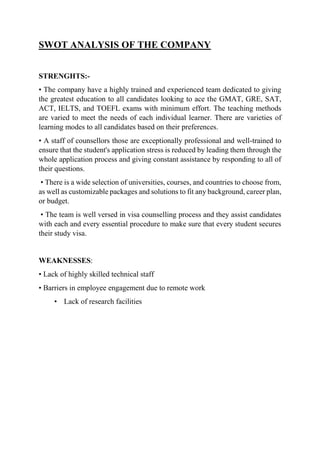
SWOT ANALYSIS OF THE COMPANY
STRENGHTS:-
• The company have a highly trained and experienced team dedicated to giving
the greatest education to all candidates looking to ace the GMAT, GRE, SAT,
ACT, IELTS, and TOEFL exams with minimum effort. The teaching methods
are varied to meet the needs of each individual learner. There are varieties of
learning modes to all candidates based on their preferences.
• A staff of counsellors those are exceptionally professional and well-trained to
ensure that the student's application stress is reduced by leading them through the
whole application process and giving constant assistance by responding to all of
their questions.
• There is a wide selection of universities, courses, and countries to choose from,
as well as customizable packages and solutions to fit any background, career plan,
or budget.
• The team is well versed in visa counselling process and they assist candidates
with each and every essential procedure to make sure that every student secures
their study visa.
WEAKNESSES:
• Lack of highly skilled technical staff
• Barriers in employee engagement due to remote work
• Lack of research facilities
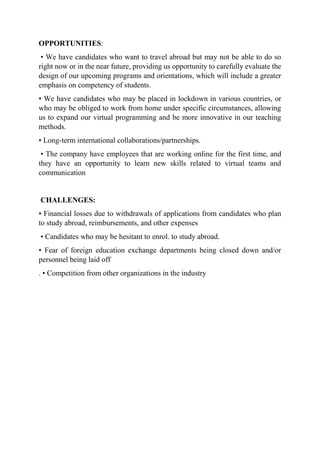
OPPORTUNITIES:
• We have candidates who want to travel abroad but may not be able to do so
right now or in the near future, providing us opportunity to carefully evaluate the
design of our upcoming programs and orientations, which will include a greater
emphasis on competency of students.
• We have candidates who may be placed in lockdown in various countries, or
who may be obliged to work from home under specific circumstances, allowing
us to expand our virtual programming and be more innovative in our teaching
methods.
• Long-term international collaborations/partnerships.
• The company have employees that are working online for the first time, and
they have an opportunity to learn new skills related to virtual teams and
communication
CHALLENGES:
• Financial losses due to withdrawals of applications from candidates who plan
to study abroad, reimbursements, and other expenses
• Candidates who may be hesitant to enrol. to study abroad.
• Fear of foreign education exchange departments being closed down and/or
personnel being laid off
. • Competition from other organizations in the industry
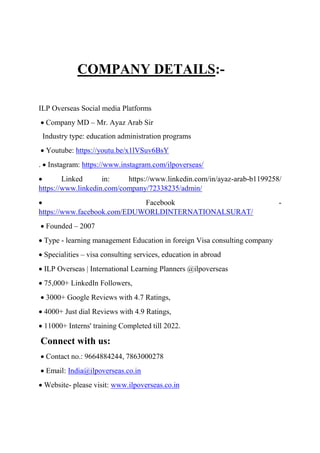
COMPANY DETAILS:-
ILP Overseas Social media Platforms
 Company MD – Mr. Ayaz Arab Sir
Industry type: education administration programs
 Youtube: https://youtu.be/x1lVSuv6BsY
.  Instagram: https://www.instagram.com/ilpoverseas/
 Linked in: https://www.linkedin.com/in/ayaz-arab-b1199258/
https://www.linkedin.com/company/72338235/admin/
 Facebook -
https://www.facebook.com/EDUWORLDINTERNATIONALSURAT/
 Founded – 2007
 Type - learning management Education in foreign Visa consulting company
 Specialities – visa consulting services, education in abroad
 ILP Overseas | International Learning Planners @ilpoverseas
 75,000+ LinkedIn Followers,
 3000+ Google Reviews with 4.7 Ratings,
 4000+ Just dial Reviews with 4.9 Ratings,
 11000+ Interns' training Completed till 2022.
Connect with us:
 Contact no.: 9664884244, 7863000278
 Email: India@ilpoverseas.co.in
 Website- please visit: www.ilpoverseas.co.in
WORK PROFILE
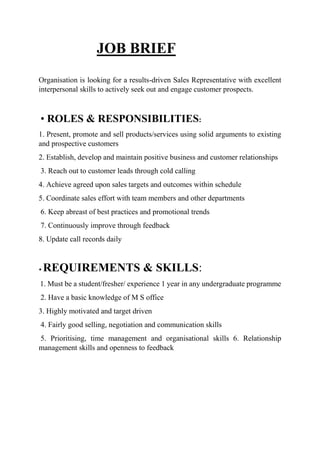
JOB BRIEF
Organisation is looking for a results-driven Sales Representative with excellent
interpersonal skills to actively seek out and engage customer prospects.
• ROLES & RESPONSIBILITIES:
1. Present, promote and sell products/services using solid arguments to existing
and prospective customers
2. Establish, develop and maintain positive business and customer relationships
3. Reach out to customer leads through cold calling
4. Achieve agreed upon sales targets and outcomes within schedule
5. Coordinate sales effort with team members and other departments
6. Keep abreast of best practices and promotional trends
7. Continuously improve through feedback
8. Update call records daily
• REQUIREMENTS & SKILLS:
1. Must be a student/fresher/ experience 1 year in any undergraduate programme
2. Have a basic knowledge of M S office
3. Highly motivated and target driven
4. Fairly good selling, negotiation and communication skills
5. Prioritising, time management and organisational skills 6. Relationship
management skills and openness to feedback
PERKS & BENEFITS:
1. Receive quality master classes in regards to learning manual
2. Get trained in various at sales related tasks and perform hands on tasks, to learn
practically
3. Participate and receive performance certificates for the months and weekends
4. Get a verified website international certificate of completion, letter of
completion and letter of recommendation (performance based)
5. Also get a chance to earn incentives performance based
6. Get clear and to the point mentoring in your lacking areas
7. Also, grab the chance to experience the roles at various hierarchies of the
domain, and learning corporate culture
8. Convenient and concise – i.e. work from anywhere at you own times, which
will make you competitive and reliant in the job market.
MY EXPERIENCE IN ILP OVERSEAS AS SALES AND
MARKETING INTERN:-
During this internship, I had the opportunity to dive deep into the world of sales
and marketing. From market research to developing marketing strategies, from
building relationships with clients to analysing sales data, I've had hands-on
experience in various aspects of the field. These experiences have not only
broadened my understanding but also sharpened my skills in communication,
problem-solving, and critical thinking.
Starting from day 1 it was an amazing and overwhelming experience of working
in this prestigious organisation. A big thanks to all the core team members and
Ayaz Arab Sir for always motivating me to do more, achieve more, learn more.
When it comes to my ROLES and RESPONSIBILITIES so I have to do sales on
daily basis for our organisation perspective.
I have to make calls to different organisations of different cities of Gujrat and to
engage them with us. I used to make 50-60 calls daily basis depending on my
mentor providing the list of callings for promoting our products. It although
increases my communication skills, interpersonal skills, leadership skills, and
marketing communication skills.
Also to provide complete and appropriate solutions for every customer in order
to boost top-line revenue growth, customer acquisition levels and profitability.
1. Present, promote and sell products/services using solid arguments to existing
and prospective customers
2. Establish, develop and maintain positive business and customer relationships
3. Reach out to customer leads through cold calling
4. Achieve agreed upon sales targets and outcomes within schedule
5. Coordinate sales effort with team members and other departments
6. Keep abreast of best practices and promotional trends
7. Continuously improve through feedback
8. Update call records daily.
Lastly, I want to express my gratitude to the organization for giving me this
opportunity. This internship has been a stepping stone in my career journey, and
I am excited to take the skills and knowledge I've acquired here and apply them
to future endeavors.
To all my fellow interns, congratulations on completing this internship! We have
all worked hard and grown so much during this time. Let's celebrate our
achievements and look forward to the bright future ahead.
RESEARCH METHODOLOGY
Business research is a systematic enquiry that provides information to guide
business decision and aimed to solve managerial problems. Business research is
of recent origin and it is largely supported by business organizations that hopes
to achieve competitive advantages Research Methodology is a way to
systematically solve the problems. It may be understood as a science of studying
how research is done scientifically. It include the overall research design, the
sampling procedure, data collection method and analysis procedure.
1. Title:-
To study, evaluate and analyse sales and marketing process in ILP OVERSEAS
2.Objectives of study:-
 To understand process of sales and marketing in ILP OVERSEAS.
 To Understand and analyse various Marketing factors.
The research design refers to the overall strategy that you choose to integrate the
different components of the study in a coherent and logical way, thereby, ensuring
you will effectively address the research problem; it constitutes the blueprint for
the collection, measurement, and analysis of data. A well-planned research design
helps ensure that your methods match your research objectives and that you use
the right kind of analysis for your data.
A well-designed research study should have a clear and well-defined research
question, a detailed plan for collecting data, and a method for analysing and
interpreting the results. A well-thought-out research design addresses all these
features.
Here we have used EXPLORATORY research design.
A research design is the specification of methods and procedures for acquiring
the information needed to structure or solve the problem. It is the overall
operational pattern or framework of the project that stimulates what information
is to be collected from which
source and by what procedure. On the basis of major purpose of our investigation
the EXPLORATORY RESEARCH was found to be most suitable. This kind of
research has the primary objective of development of insights into the problem.
It studies the main area where the problem lies and also tries to evaluate
appropriate courses of action.
Sampling:-
 Sampling type - Simple Random Probability technique
 Sample Population – 784
DATA COLLECTION
Both Primary and Secondary sources of data have been used in this research
report. So MIXED DATA is used in this research. The key point here is that the
data you collect is unique to you and your research and, until you publish, no one
else has access to it.
PRIMARY DATA-
Data that has been generated by the researcher himself/herself, surveys,
interviews, experiments, specially designed for understanding and solving the
research problem at hand. The primary data is also called raw data which is
collected first hand by the researchers. The primary data is collected according to
the objectives laid out by the research.
The data that is collected first hand by someone specifically for the purpose of
facilitating the study is known as primary data.
 PRIMARY SOURCES
The data required for the study has been collected from OBSERVATIONS
SECONDARY DATA -
Secondary data is the data that has already been collected through primary
sources and made readily available for researchers to use for their own research.
SECONDARY SOURCES: The secondary data has been collected from:
 Company brochure
 Internet
 websites (company)
 Organizational Reports and records
 Case Studies
 Business magazines
 Books
 Journals on e-learning Industry
RESEARCH METHOD-
In investigating the Consultative Sales concept, a descriptive method in form of
personal observation has been chosen. The observations were carried out in order
to get a deep comparative knowledge regarding the different practices and
processes at the ILP OVERSEAS company. Subjectivity that may creep into the
research has been kept in mind at all times and efforts have been made to make
the research as objective as the research methodology permits.
I have chosen the Observation methods of data collection due to limited time in
hand. While designing data-collection procedure, adequate safeguards against
bias and unreliability must be ensured. I have examined the collected data for
completeness, comprehensibility, consistently and reliability. I have also
gathered secondary data which has already been collected and analysed.
So in this research the data is collected from respondents through
OBSERVATIONS.
OBSERVATIONAL RESEARCH
A wide ranging set of research techniques aimed at observing consumers
interacting naturally with their surroundings including products and services in
use. A key advantage of observation research is that often the respondent or
consumer is unaware that they are being observed, allowing their behaviour to be
observed naturally. A personal observation was carried out to gain a vision into
the behavioural patterns of the business executive while on a sales call with the
client, before and after training. Consent was gained from the Industry Mentor to
carry out the research on such lines.
Procedure and Techniques
The business development executive was observed during the sales meetings
with the clients through a viewing window for 20-30 minutes. A behavioural
checklist was used to record each instance of a listed behaviour during the
meeting.
DATA INTERPRETATION
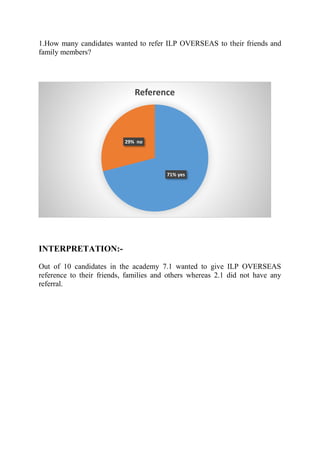
1.How many candidates wanted to refer ILP OVERSEAS to their friends and
family members?
INTERPRETATION:-
Out of 10 candidates in the academy 7.1 wanted to give ILP OVERSEAS
reference to their friends, families and others whereas 2.1 did not have any
referral.
71% yes
29% no
Reference
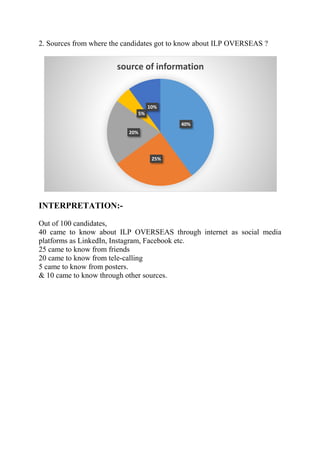
2. Sources from where the candidates got to know about ILP OVERSEAS ?
INTERPRETATION:-
Out of 100 candidates,
40 came to know about ILP OVERSEAS through internet as social media
platforms as LinkedIn, Instagram, Facebook etc.
25 came to know from friends
20 came to know from tele-calling
5 came to know from posters.
& 10 came to know through other sources.
40%
25%
20%
5%
10%
source of information
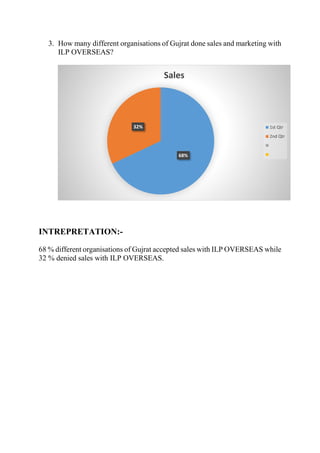
3. How many different organisations of Gujrat done sales and marketing with
ILP OVERSEAS?
INTREPRETATION:-
68 % different organisations of Gujrat accepted sales with ILP OVERSEAS while
32 % denied sales with ILP OVERSEAS.
68%
32%
Sales
1st Qtr
2nd Qtr
FINDINGS
 The prescreening process is done well in order to get the good talent
pool.
 All the company policies are strictly followed at any point of time.
 It more that consumes a lot of time.
 Company provides good facilities for both applicants as well as
employee.
RECOMMENDATIONS&
SUGGESTIONS:-
 40 % of the candidates came to know about ILP OVERSEAS from internet
so; the promotion must be mainly focussed on internet.
 Candidates rating on an average were 3.91 which means there is a further
scope of improvement.
 Candidates reference is one of the major source of getting more.
 There should be few techniques while counselling to take out reference
from the candidates.
 Library and canteen facilities should be improved.
 Management should cooperate with interns in every aspect of internship
clearing all their doubts and solution to their problems.
 Sales and marketing process should be improved.
LIMITATIONS OF STUDY
Here are some limitations of the study which are as follows: -
1. Lack of available or reliable data
2. Limited access to information
3. Lack of context
4. Limited flexibility
5. Selection biasness
6. Cultural related biasness
7. Limited access to resources as financial resources
8. Lack of time
9. Sample size selection biasness
10. Limited access to data collection methods
11.Number of clients were less.
CONCLUSIONS
At this moment I have reached to the end of this research on the topic “SALES
AND MARKETING IN ILP OVERSEAS.”
Now I have an idea of how a sales and marketing in a company works. By
research I also came to know that the candidates are placed on the daily basis. I
have a deeper understanding of its logical design.
I have only a theoretical knowledge regarding sales and Marketing concepts in
any organisation but after doing this internship I go deeper with practical aspect
of all these concepts and exceptionally helped me a lot in developing
interpersonnel and marketing skills as well.
This Summer Internship project has helped me gain huge practical knowledge
which can't be gained only through books. This experience gave me an
opportunity to learn new things which provided me a peek into the corporate
culture. Being a fresher, I would never be exposed to a corporate environment if
it were not for this project. I thank ILP OVERSEAS for giving me the chance to
work with them as a summer intern and showing me the path of knowledge and
experience which will help me succeed in my career and enter into a bright fun.
As a whole it’s that this paperwork report has introduced benefits in the placement
procedure. May this summer training project (STP) helps in understanding
candidates mind set in further development in the promotion and advertising of a
company.
BIBLIOGRAPHY
.
 Research Methodology –C.R. Kothari.
 www.ilpoverseas.com
 https://www.ama.org/the-definition-of-marketing-what-is-marketing/
 https://builtin.com/marketing
 https://www.deskera.com/blog/pr-marketing/
 https://blog.hubspot.com/marketing/public-relations-definition
 https://unacademy.com/content/difference-between/primary-and-
secondary-data/
 https://www.geeksforgeeks.org/difference-between-primary-and-
secondary-data/

Marketing internship report file for MBA

  • 1.
    A SUMMER TRAININGPROJECT REPORT On “SALES AND MARKETING IN ILP OVERSEAS” In partial fulfillment for the award of the degree Of Master of Business Administration (MBA) In Marketing Under the guidance of Submitted by Ms. Harshita Jha SHAILENDRA SAKYA Assistant professor MBA 2nd YEAR To Department of Management & Studies S R Group of Institutions Dr. A P J Abdul Kalam Technical University, Lucknow Session 2023-24
  • 2.
    CERTIFICATE This is tocertify that SHAILENDRA SAKYA has successfully completed the summer training project work entitled “SALES AND MARKETING IN ILP OVERSEAS” is based on the declaration made by the candidate and the association as a guide for carrying out this work, I recommended this project for evaluation as a part of the MBA program of AKTU LUCKNOW. Place : Dr. Vikas Chaurasia Date : Head DoMS
  • 3.
    DECLARATION I undersigned, herebydeclare that the project titled “SALES AND MARKETING IN ILP OVERSEAS” submitted in partial fulfilment for the award of Degree of Master of Business Administration (MBA) of Dr. A P J Abdul Kalam Technical University is a bonafide record of work done by me under the guidance of Miss HARSHITA JHA, Assistant Professor, S R GROUP OF INSTISTUTIONS, Ambabai, Jhansi This report has not previously formed the basis for the award of any degree, diploma, or similar title of any University. DATE : SHAILENDRA SAKYA
  • 4.
    ACKNOWLEDGEMENT Through this acknowledgementI express my sincere gratitude towards all those people who helped me in this project, which has been a learning experience. This space wouldn’t be enough to extend my warm gratitude towards my project guide Miss HARSHITA JHA for efforts in coordinating with my work and guiding in right direction. I escalate a heartfelt regards to our Institution Head Dr Vikas Chaurasia for giving me the essential hand in concluding this work. It would be injustice to proceed without acknowledging those vital supports I received from my beloved classmates and friends, without whom I would have been half done. I also use this space to offer my sincere love to my parents and all others who had been there, helping me walk through this work. SHAILENDRA SAKYA
  • 5.
    PREFACE To achieve partialand concrete results, it is necessary the theoretical knowledge must be supplemented with practical environment. Keeping that view in mind that I have completed my training work regarding “SALES AND MARKETING IN ILP OVERSEAS” by doing the research work I have learnt a lot of things which would be really helpful for me in future. The experience in decision making and practical knowledge e has contributed greatly to my growth.
  • 6.
  • 7.
  • 8.
  • 9.
  • 10.
    TABLE OF CONTENTS SR NO. PARTICULARS PAGE NO. 1. EXECUTIVE SUMMARY 11 2. INTRODUCTION OF TOPIC 12-44 3. OBJECTIVES OF STUDY 45 4. SCOPE OF STUDY 46 5. COMPANY PROFILE 47-58 7. WORK PROFILE 59-62 8. RESEARCH METHODOLOGY 63-66 9, DATA INTERPRETATION 67-70 10. FINDINGS 71 11. RECOMMENDATIONS & SUGGESTIONS 72 12. LIMITATIONS OF STUDY 73 13. CONCLUSION 74 14. BIBLIOGRAPHY 75
  • 11.
    EXECUTIVE SUMMARY First ofall a telephonic interview is conducted for internship. I realised that interviewer is looking for a dedicated sales and marketing intern during the first few minutes of the telephonic interview. As l got selected I realised this was a crucial phase of my life. I was a part of Sales and Marketing Team at ILP OVERSEAS. First phase of my internship was about getting familiar with the roles and responsibilities offered by ILP OVERSEAS as well as the Environment (People & Processes) at ILP OVERSEAS. After a few days, I was put into a team of Sales and Marketing domain in which I have to do sales with different organisations of Gujrat by cold callings for promoting companies products and services. I worked on Sales & Marketing, Public Relations, Team Building, Collaboration with team members. Mainly It was dynamic profile and various tasks were already planned for me by Mr Ayaz Arab Sir, that included doing sales with different organisations of Gujrat by cold callings which gave me the opportunity to learn various concepts of Marketing theoretically and practically too. This was a great achievement for me because as I have only theoretical knowledge of all Marketing concepts but here I gain practical knowledge too. It was a very exciting journey of six weeks. And I got sample opportunities to learn and apply my knowledge which I got. It helped me a lot to contribute to the growth of business. Also along with core learning regarding Sales & Marketing, this internship improved my creative abilities and marketing skills At the end, I was very confident that I learnt this new Marketing model in this Sales & Marketing domain.
  • 12.
  • 13.
    SALES AND MARKETING Marketingand sales management deal with an understanding of customer needs. It includes the response to them through the development, production, and sales of goods and services and the impact on customers’ needs following the strategic purposes of the organization. What is sales management? Sales management is the management of activities and processes relating to effectively planning, coordinating, implementing, controlling, and evaluating an organisation's sales performance. Sales management is a core business process in most organisations. Sales managers and those in related roles support a company’s revenue generation and profits. Sales management is the process of leading, motivating, and influencing people to achieve sales objectives. The sales manager manages the entire sales cycle, including forecasting and budgeting sales revenue, recruitment, selection of sales personnel, and ensuring everyone receives proper training and performance evaluations. Effective sales management requires a thorough understanding of the sales process and how you can employ different techniques to drive sales. By carefully analysing key performance indicators (KPIs), optimising your selling approach, and enhancing your team with the right competencies and tools to succeed, you can turn your sales department into a profit-generating department. The process of evolving a sales force, synchronizing sales operations, and executing sales techniques that assist a business to consistently achieve its sales targets is called sales management. Precise sales management processes are essential when it comes to boosting sales performance for any size of the operation or any industry. the sales management process can be the difference between surviving and flourishing in an increasingly competitive marketplace. There are three aspects of sales management within the sales process:  Sales Operations which involves building the sales team. Salespeople need to be great at selling the company’s product. Set targets, assign territories, establish goals and counsel them throughout the process.
  • 14.
     Sales Strategyentails defining the sales process. A sales cycle is an essential part of every business. It is a series of tasks that help a company’s product reach its users. Therefore, having a sales pipeline, or sales funnel, will make that easier to complete these tasks. With the standard sales funnel the number of deals in the funnel, the average size of a deal in the funnel, closure ratio, sales velocity, etc. can be measured.  Sales Analysis or reporting is what enables an assessment of the current efforts vis-a-vis the targets. It involves sales metrics or quantifiable indicators that help measure each aspect of sales operations  The Sales and Marketing departments in the organization are quintessentially linked. While the marketing function of an organization positions itself to establish the needs of the actual and prospective customers and also the most important task of product promotion, the sales department engages in active selling of the company’s products to customers. Aspects of Sales Management Sales Management relates to the process of constituting a marketing team, coordinating sales activities, and implementing sales techniques. The basic goal of sales management is to assist businesses to achieve their sales goals. Objectives of Sales Management A sales manager’s responsibility is to set long-term goals and objectives for their team. By understanding how sales objectives fit into the organisation, you’ll better understand the big picture and can communicate better with senior management. Some of the main goals of sales management include:  Revenue generation  Increased sales volume  Sustained profits  Sales department growth  Market leadership  Prospect conversions  Motivating the sales force  Enhancement of sales and profit
  • 15.
     increasing customerbase  Enhancing upsells and cross-sells  Motivating the sales rep to increase productivity Emerging Trends in Sales management  Customer Satisfaction will assume the top position in the list of key sales metrics. A deeper look into the customer journey will allow the sales reps to track the lifetime value of the customers. Sales professions can increase their professional competencies to meet future job demands by completing a certified sales & marketing course.  Customer engagement will grow on emerging channels like SMS, mobile chat, and video chat.  The role of AI is not to replace them but rather to reduce the burden of tedious tasks and empower them to deliver enhanced customer and brand experience. The secret of effective sales management is the continuous adaption to and areas of improvement that are found in the stages of planning, monitoring & tracking as well as consequently eliminating all weaknesses. Marketing management has increased in sophistication and it is practical for marketing strategy policymakers to focus on emerging technologies, patterns, and methods. Types of sales management While some selling forms are about maximising sales volume (numbers), others are driving revenue through high-value accounts. Some sales jobs have a short sales cycle completed over the phone, whilst others have sales processes that take months or even years. Each type of sale involves different skills and activities, so finding your niche is essential.  B2C sales management: Business-to-consumer (B2C) sales involve selling goods and services directly to consumers. B2C sales often drive leads from aggressive marketing strategies.  B2B sales management: Business-to-business (B2B) sales involve selling goods and services directly to other businesses. B2B sales tend to involve higher-value products with longer sales cycles.  Enterprise sales management: Enterprise sales involve selling complex goods or services directly to large companies. Companies that sell enterprise solutions may have multiple teams for different aspects of the deal, such as sales engineers and inside and outside sales teams.  SaaS sales management: Software as a service (SaaS) companies sell software or applications over the web, usually by subscription. Inside sales teams, who
  • 16.
    contact potential customersby phone or email and close the deal remotely, often sell SaaS products.
  • 17.
    MARKETING MANAGEMENT Marketing isthe process of identifying customers and "creating, communicating, delivering, and exchanging" goods and services for the satisfaction and retention of those customers. It is one of the primary components of business management and commerce. Marketing is typically conducted by the seller, typically a retailer or manufacturer. Products can be marketed to other businesses (B2B) or directly to consumers (B2C) In this context, marketing can be defined as "the management process that seeks to maximise returns to shareholders by developing relationships with valued customers and creating a competitive advantage". Types of Marketing :- Where your marketing campaigns live depends entirely on where your customers spend their time. It's up to you to conduct market research that determines which types of marketing -- and which mix of tools within each type -- is best for building your brand. Here are several types of marketing that are relevant today, some of which have stood the test of time:  Internet marketing: Inspired by an Excedrin product campaign that took place online, the very idea of having a presence on the internet for business reasons is a type of marketing in and of itself.  Search engine optimization: Abbreviated "SEO," this is the process of optimizing content on a website so that it appears in search engine results. It's used by marketers to attract people who perform searches that imply they're interested in learning about a particular industry.  Blog marketing: Blogs are no longer exclusive to the individual writer. Brands now publish blogs to write about their industry and nurture the interest of potential customers who browse the internet for information.  Social media marketing: Businesses can use Facebook, Instagram, Twitter, LinkedIn, and similar social networks to create impressions on their audience over time.  Print marketing: As newspapers and magazines get better at understanding who subscribes to their print material, businesses continue to sponsor articles, photography, and similar content in the publications their customers are reading.  Search engine marketing: This type of marketing is a bit different than SEO, which is described above. Businesses can now pay a search engine to place links on pages of its index that get high exposure to their audience. (It's a concept called "pay-per-click" -- I'll show you an example of this in the next section).
  • 18.
     video marketing:While there were once just commercials, marketers now put money into creating and publishing all kinds of videos that entertain and educate their core customers. Marketing is “the action or business of promoting and selling products or services, including market research and advertising.” This is a simple but also relatively shallow definition. Modern marketing is much broader, including many specific disciplines. Examples include Content Marketing, Social Media Marketing, Digital Marketing, Newsletter Marketing, account-based marketing, and other areas offline and online. The classic definition by Jerome McCarthy, made in 1960, uses the “4P” concept. Also called the marketing mix:  Product or Service  Price  Place or Distribution  Promotion or Communication The godfather of marketing, Philip Kotler, has defined marketing as “a social and managerial process by which individuals and groups obtain what they want and need through creating, offering, and exchanging products of value with others.” Marketing is the process of getting the public educated on and excited about an organization’s products and services. A marketing team’s efforts in market research and consumer trends guides the strategy behind other aspects of the business and helps companies to consistently meet the needs of consumers. The different aspects of Marketing management are:-  Advertising  Branding  Copywriting  Customer relationship Management  Direct marketing  Internet Marketing
  • 19.
    Benefits of Marketing:- Generating brand awareness: Marketing helps increase the consumers' acquaintance with brands' motives and products. Marketing helps in bridging a loyal customer base. Generation of traffic: Different methods of online marketing helps in the generation of traffic and leads, which increases the brand's sales in the long run. Increases revenue: Through website optimization, creating email campaigns and regulating marketing strategies, brands increase revenue and sales. Developing Trust: It has been observed that brands with strong marketing campaigns and internet presence aids in building trust, which leads to increased purchases and loyal consumers. Tracks metrics: Studying the market and business of a brand, in general, is important when developing marketing campaigns. Therefore, tracking metrics helps check the brand's progress and adapt marketing strategies accordingly to optimize sales. Marketing can include activities like:  Selection of a target audience  Selection of certain attributes or themes to emphasize in advertising  Operation of advertising campaigns  Attendance at trade shows and public events  Design of products and packaging to be more attractive to buyers  Selection of the terms of sale, such as price, discounts, warranty, and return policy  Product placement in media or with people believed to influence the buying habits of others  Contracts with retailers, wholesale distributors, or resellers  Attempts to create awareness of, loyalty to, and positive feelings about a brand
  • 20.
    PROCESS OF MARKETING:- Themarketing process is the series of steps businesses follow to promote their products or services to potential customers. It involves identifying the target audience, creating a marketing strategy, implementing the plan, and capturing customer value. Essentially, it's the process of making people aware of what a business offers and convincing them to buy it. 1.Understanding Customers and Markets The first step of the strategist marketing process includes understanding customers and markets. The foundations of this step include understanding customer wants and needs. 2.Creating a Customer-Driven Marketing Strategy The following step involves creating a customer-driven marketing strategy. 3.Creating an Integrated Marketing Plan Once a marketing strategy has been established, it is time to create a marketing plan. The marketing plan broadly relates to the 4Ps of marketing: product, price, promotion, and place. 4.Fostering Long-Term Sustainable Customer Relationships Once marketers have established an integrated marketing plan, they must focus on building customer relationships. 5.Capturing Value from Customers Once the first four steps of the marketing process are complete, it is time for the company to capture value from customers.
  • 21.
    STEPS IN PROCESSOF MARKETING:-
  • 22.
    MARKETING FUNNEL A marketingfunnel is a model of the customer journey. It represents the buying stages people go through after becoming aware of a business, service, or product. The funnel shape illustrates the audience narrowing as the journey progresses toward purchase. A marketing funnel is a multi-stage process that guides potential customers from first learning about a product to making a purchase. Marketing teams often use the AIDA model, which stands for Awareness, Interest, Desire, and Action, to create targeted strategies that move people through these stages Marketing Funnel Stages : The marketing funnel stages differ by model because businesses create funnels to suit their needs. For example, business-to-business and business-to-consumer customer journeys tend to work differently. To optimize your marketing efforts at each stage of the funnel, here are some tips: 1. Awareness: Focus on creating compelling and targeted content to increase brand visibility. Utilize social media advertising, influencer partnerships, and search engine optimization to reach a wider audience. 2. Interest: Provide valuable and engaging content to capture the interest of potential customers. Offer free resources, host webinars or workshops, and encourage social media interactions to keep them engaged with your brand. 3. Consideration: Showcase the unique value proposition of your product or service. Offer personalized demos, provide detailed product information, and share customer testimonials to build trust and credibility. 4. Purchase: Make the purchasing process seamless and convenient. Optimize your website or app for easy navigation, provide multiple payment options, and offer incentives such as discounts or free shipping to encourage conversions. Remember to track and analyze data at each stage to identify areas for improvement and make data-driven decisions. By continuously optimizing your marketing efforts, you can enhance customer engagement and drive more conversions.
  • 23.
    MARKETING FUNNEL STAGES: AWARENESS CONSIDERATION DECISION
  • 24.
    DIFFERENT FORMS OF MARKETING:- 1.B2C marketing B2C marketing stands for "business to consumer." This means that the target audience is a direct consumer of the product or service. Depending on the type of product, the sales cycle for a B2C product can be very short and the decision making process that consumers go through is not as involved. Most advertisements that people see are types of B2C marketing. For example, B2C marketing strategies include:  A TV advertisement for a candy bar  Instagram ads for a clothing shop  Direct mail coupons for a store 2.B2B marketing B2B marketing stands for "business to business." This means that the company's target audience is another company. B2B marketing typically requires a much longer buying cycle, and is extremely strategic in terms of what customers want and need. B2B purchases often also have an extremely high purchase intent. This means that the target audience will be doing a lot of research before purchasing the final product. Many B2B strategies are often executed digitally. While there are some instances in which B2B marketing will make its way towards more traditional platforms, you will commonly see B2B strategies come to life on digital channels. Examples of B2B marketing include:  Event marketing at trade shows  Inbound marketing strategies
  • 25.
    Types of traditionalmarketing :- Traditional marketing encompasses strategies that have been used since the invention of marketing itself back in the 1800s. These strategies are much more overt, and sometimes less targeted. Take a look at the 10 most common traditional marketing strategies. 1. Outbound marketing When a marketing strategy is referred to as "outbound," it's focused on how the message is being delivered. Outbound marketing happens when a company shares their message out to an audience. Billboard advertisements are a good example of outbound marketing—in the case of a billboard, the company is trying to share certain information out to the people driving by. 2. Personalized marketing Personalized marketing is a strategy in which the company uses historical data to create a personalized experience for you. This could include direct mail that uses your name in marketing materials or grocery stores that offer you coupons for items you regularly purchase. 3. Direct mail Direct mail is when companies send advertisements to a specific address. This allows businesses to target a specific area. A good example of direct mail marketing is a weekly grocery store advertisement. 4.Partner marketing The partner marketing strategy requires two companies to work together to create one cohesive message. A common example of this is a company sponsoring something at another company. For example, a cafe may provide free WiFi courtesy of Google.
  • 26.
    5. Telemarketing Telemarketing iswhen a company reaches out to individuals via phone calls. This is still a common tactic, but since cell phones and caller ID have become the norm, the success of this marketing strategy has dwindled. 6. Public relations (PR) marketing PR marketing is a strategy where you partner with a news source to generate more buzz around your business. PR marketing is commonly used when a company launches a new product, has a major change of leadership, or announces an expansion. PR marketing might not directly promote a product, but it's a good way of increasing brand awareness for your business. This is especially relevant in B2B marketing, because some business buyers will make decisions based on their understanding of your company's position in the competitive landscape. 7. Word of mouth marketing Word of mouth marketing is a marketing strategy that relies on existing customers referring your business to new customers. This is a hard strategy to control, because it depends on your customers to do the leg work. A common way to encourage customers to refer friends is to offer some kind of incentive, such as a discount or bonus for referring your business. This is commonly seen in small businesses that are client-based, like hair salons or gyms. This is also starting to happen more for subscription based services such as meal delivery services. 8. Stealth marketing Stealth marketing is the act of marketing a good or service to someone without them realizing they're being marketed to. A good example of this is product placement in a movie or TV show. You may notice that certain characters in the show only use a certain type of computer, or only drive a certain type of car. This is because those companies paid to be featured. 9. Brand marketing
  • 27.
    Brand marketing isa long-term form of marketing in which the goal is to become recognizable and establish a good reputation. Brand marketing encompasses many different facets, from visual branding to tone and voice. To measure the effectiveness of brand marketing strategies, companies will track their brand awareness. This metric measures how familiar the average person is with your brand. 10. Cause marketing Cause marketing is a strategy in which a company chooses to back a certain cause as a way of strengthening their brand's core values.
  • 28.
    Popular forms ofDigital marketing:- Digital marketing encompasses all marketing strategies that are implemented in a digital format. Some of the strategies above may sometimes happen digitally, but the following seven forms of marketing only happen online: 1. Inbound marketing Inbound marketing is a strategy used to bring potential customers to you instead of sharing a message out. This is a long-term strategy that involves many different types of digital marketing tactics to encourage a potential customer to move further down the marketing funnel. Inbound marketing uses search engine optimization (SEO) strategies, content marketing, and email marketing to educate and encourage potential customers to interact with a brand or business more frequently. 2. Searching engine marketing Search engine marketing is the strategy of utilizing search engines such as Google. Search engine marketing can include paid advertisements such as pay- per-click (PPC) advertisements and suggested posts. It can also include organic SEO strategies, such as creating optimized content in the hopes of ranking . Search engine optimization (SEO) is the process of affecting the visibility of a website or a web page in a search engine's "natural" or unpaid ("organic") search results. SEO may target different kinds of search, including image search, local search, video search, academic search, news search and industry- specific vertical search engines.
  • 29.
    3. Content marketing Contentmarketing involves creating content, such as ebooks or webinars, to encourage potential customers to interact with your brand more frequently. The goal of content marketing is for potential customers to share some information, such as an email address, so the company can continue marketing to you in different ways. 4. Affiliate marketing Affiliate marketing is a strategy in which a company pays commission to an external website for sales that are generated via their website referrals. This is commonly used in combination with influencer marketing strategies to target a very focused demographic of consumers.
  • 30.
    5. Social mediamarketing Social media marketing uses social media platforms as a key channel to share your messaging. Social media marketing can be paid ads, organic content, or user-generated content. Social media marketing is commonly used by ecommerce businesses. Sometimes, social media marketing can go viral. The major social media platforms (at the moment) are Facebook, Instagram, Twitter, LinkedIn, Pinterest, YouTube, and Snapchat. 1.Facebook Marketing Facebook is the world's most popular social network for both businesses and individuals. With over one billion users, your friends and fans are likely already using the platform -- and you should be too! In fact, people are 51% more likely to make a purchase after "liking" a brand on Facebook. Facebook marketing requires a good intellects and unique thinking to make the campaign effective
  • 31.
    2.Twitter marketing A gameof 140 characters Twitter’s flexible, real-time platform allows you toget creative and drive results at the same time. Whether you’re looking to drive sales, increase brand awareness or launch a product.
  • 32.
    3.Pinterest Marketing It isa visual discovery social network. It is a way of sharing images of anything, from fashion to pets to pot plants. You can create your own online pinboards to suit any theme and share it with like minded people. Pinterest completely revolves around the premise of being creative and visual.
  • 33.
    4.Instagram Marketing The newrevolutionary photo-sharing program, making it easier than ever to share your best pictures with the world. The social media program allows youto upload, add digital filters, and then post your pictures on your Instagram- feed, as well as other social networking sites. You can connect your Instagramaccount with Facebook, Twitter, Tumblr, Flickr, Foursquare and your email account. This makes it easy to share your pictures on multiple platforms all at Once.
  • 34.
    6. Email marketing Emailmarketing is a strategy where you send potential customers marketing messaging through email. It's used in both B2B and B2C marketing strategies and is one of the most effective ways to ensure you're hitting your target market. One of the major benefits of email marketing is that it's easy to implement some sort of segmentation in your marketing messaging. If you're looking to test which audiences respond to certain messages, this is a good marketing strategy the to use.
  • 35.
    7. Mobile marketing Mobilemarketing involves sending marketing messages via push notifications or text messages. This tactic can be used to achieve many different goals, such as encouraging app openings to increase daily active users or to share coupons with discounts, like you would with email. The downside of this form of marketing is that you need customer phone numbers, and that information is harder to get than email addresses.
  • 36.
    8. Experiential marketing Experientialmarketing is a marketing effort in which you hold some kind of experiential event in an effort to promote your product or service. This is a common tactic used for marketing TV shows or movies to create an immersive experience for individuals. Pop-up events are another good example of experiential marketing. It allows for a limited engagement, so there's some sense of urgency and exclusivity to the event itself. 9. Interactive marketing Interactive marketing is a marketing strategy that involves some form of interactive component during an event or face-to-face interaction. One common technique is to play some kind of a game, such as spinning a roulette wheel or plinko, to win a giveaway. This is common at trade shows and other in -person events. Effective marketing strategy :- An effective marketing strategy is a comprehensive and cohesive plan that comprises all the marketing tactics you use to reach your target audience. Successful marketing strategies are effective because they are focused and deliver a clear and concise message to customers. They consider the needs of your target audience and how your product or service will meet those needs. An effective marketing strategy is founded on market research and customer insight and considers your company's objectives. It is also flexible enough to adapt to change and evolve with your business. It is important to note that different marketing strategies will have different effects on those who see or experience them. For example, the best marketing strategy to reach a younger audience may not be the best approach for reaching an older demographic.
  • 37.
    The importance ofeffective marketing: The process of promoting your product or service to potential customers is known as marketing. Marketing is the most effective way to drive sales or simply raise brand awareness. It helps you attract new customers, keep old ones coming back, and build trust with your brand. It is the foundation of any successful business. However, getting it right can be tricky. You need to create compelling content, come up with creative marketing strategies, and measure your success. All of this takes time, effort, and money. As a result, you must ensure that your efforts are effective. With the right marketing strategies, you can increase sales, expand your customer base, and establish your brand as an industry leader. Researching your target audience Before you can create an effective marketing strategy, you need to research your target audience. A successful marketing strategy is one that is tailored to your specific audience. It helps to consider who your target audience is and what their needs and desires may be. Researching your target audience is a crucial step in any successful marketing campaign. Knowing whom you're targeting helps you create content and advertising that is tailored to their needs and interests. Types of marketing strategies There are many different marketing strategies you can use to reach your target audience. You can use various types of marketing tactics to attract new customers and keep them coming back. To form an effective marketing strategy, you will need to use a combination of different marketing techniques. In order to do this, it is important to understand the different types of marketing strategies available to you. Developing an effective marketing plan Once you have chosen the right marketing strategy and conducted your research, you can start developing an effective marketing plan. Your marketing plan should list your goals and show you how to reach them in a clear, step-by- step way. It should take into account your specific marketing strategy and offer a plan for implementation. Marketing plans should be flexible enough to adapt to change and should include regular evaluation and revision. As your business evolves, so should your marketing strategy. This is an important way to ensure your efforts are effective and you are reaching the right customers.
  • 38.
    Creating content toreach your target audience After you have chosen the right marketing strategy and developed an effective marketing plan, you need to create the content that will reach your target audience. Content marketing is an important part of any marketing strategy and allows you to connect with your customers on a more personal level. It is important to create content that is relevant, engaging, and adds value. This will help you build trust and credibility with your audience and encourage them to buy your product or service. To reach your target audience, you can use a variety of content types, such as blogs, eBooks, videos, podcasts, and more. Leveraging digital marketing tactics There are many different digital marketing tactics you can use to reach your target audience. Digital marketing allows you to connect with your customers and build brand awareness even when they are not in your physical store. It also allows you to collect customer data and better understand your audience. Measuring and evaluating your marketing efforts In order to ensure that your marketing efforts are effective, you need to measure and evaluate your marketing strategy regularly. This will allow you to understand how well your efforts are working and how you can improve. You can assess your marketing efforts using various tools, including metrics and analytical software, surveys, focus groups, and more. You can use these tools to measure your progress as well as to evaluate how effective your marketing efforts are. Social media marketing strategies Social media marketing is a popular marketing strategy that allows you to connect with your customers on a more personal level. It allows you to create engaging content, such as posts, images, videos, and more, that your audience can share with their friends and family. This will expand your reach and allow you to connect with a wider audience.
  • 39.
    Offline marketing strategies Offlinemarketing is an often-overlooked strategy, but it can be an incredibly effective way of reaching new customers. By taking a targeted approach, you can ensure that your message reaches the right people. One of the best ways to start is by conducting market research. Analyze your target audience and their needs, and use that information to determine the best marketing channels to use. From there, you can start to develop a comprehensive offline strategy.
  • 40.
    EMERGING TRENDS INSALES AND MARKETING:- Here are some potential emerging trends in sales and marketing for businesses- 1. Artificial Intelligence (AI) and Machine Learning: AI and machine learning will continue to play a significant role in sales and marketing. AI- powered chatbots, personalized recommendations, and data analytics will become even more advanced, providing businesses with valuable insights and automation capabilities. 2. Voice Search Optimization: As the use of voice-activated devices like smart speakers grows, businesses will need to optimize their online content for voice search. This includes creating voice-friendly website content and understanding user intent in voice queries. 3. Video Marketing Domination: Video content will remain a dominant force in marketing. Short-form videos on platforms like TikTok and Reels will continue to gain popularity, and businesses will invest in live streaming, interactive videos, and video ads. 4. Inclusive Marketing: Brands will place a greater emphasis on inclusivity and diversity in their marketing campaigns. This includes representing a wide range of backgrounds, cultures, and identities in advertisements and content. 5. Sustainability and Ethical Marketing: With increasing environmental awareness, businesses will incorporate sustainability and ethical practices into their marketing strategies. This includes promoting eco-friendly products and responsible sourcing. 6. Augmented Reality (AR) and Virtual Reality (VR): AR and VR technologies will find more applications in marketing. Businesses will create immersive experiences for customers, allowing them to visualize products or engage with virtual showrooms. 7. Ephemeral Content: Ephemeral content, which disappears after a short period, will continue to grow in popularity. This format is ideal for creating a sense of urgency and authenticity, making it suitable for promotions and behind-the-scenes content. 8. Personalization at Scale: Advances in data analysis and automation will enable businesses to deliver highly personalized experiences at scale. This
  • 41.
    includes personalized emails,product recommendations, and content tailored to individual preferences. 9. Privacy-First Marketing: As privacy regulations and consumer concerns about data privacy increase, businesses will need to adopt privacy-first marketing practices. They'll focus on obtaining explicit consent for data collection and ensuring transparent data handling. 10. Collaborative Marketing: Businesses will increasingly collaborate with influencers, micro-influencers, and other brands to expand their reach and credibility. Co-created content and joint campaigns will be more common. 11. Content Authenticity: Authenticity will remain a crucial aspect of content marketing. Consumers are drawn to genuine stories and real experiences, so businesses will prioritize authentic storytelling over overly polished content. 12. Blockchain for Transparency: Blockchain technology will be used to enhance transparency in supply chains and verify product authenticity. This can build trust with consumers concerned about product origin and authenticity. 13. Customer Experience (CX) Optimization: Providing exceptional customer experiences will continue to be a competitive advantage. Businesses will invest in improving the entire customer journey, from discovery to post- purchase support. 14. Sustainable Packaging and Green Marketing: Sustainable packaging practices and green marketing will become more mainstream as consumers demand eco-friendly options. 15. Niche and Local Marketing: Hyper-targeted marketing to specific niches and local communities will be a trend, as businesses seek to connect with smaller but highly engaged audiences. 16.Data-driven decision-making With an increasing reliance on analytics and artificial intelligence, sales operations are elevating their decision-making processes. Sales teams are leveraging data to discern customer preferences and anticipate buying behaviors, optimizing sales processes effectively. Tools like predictive analytics for sales forecasting and predictive lead scoring, along with AI and machine learning for sales data analysis, are becoming indispensable.
  • 42.
    17. Sales processautomation Automation has become ubiquitous across every organization’s operations, and SalesOps is no different. The most effective SalesOps teams are streamlining routine tasks with automation, and Robotic Process Automation (RPA) has become a game-changer in this regard. By reducing manual processes (and removing the likelihood of human error), SalesOps teams can enhance productivity and focus on more strategic activities. Marketing automation tools, including chatbots, email marketing automation, and CRM systems, are streamlining these repetitive tasks, allowing sales teams to focus on more strategic activities. This trend is expected to continue with more advanced AI-driven automation. 18.Customer-centric approach to sales As sales representatives recoup time spent on admin, their focus shifts to more critical endeavors – such as building relationships with prospects and existing customers. This is a net gain for revenue, as 61% of consumers are willing pay at least 5% more if they know they’ll have a good customer experience. Personalization and tailored sales strategies are vital to enhancing customer experiences through SalesOps. In the future, focusing more on the customer will assist in building long-lasting customer relationships. 19. Integration of sales technologies CRM, CPQ, and ERP systems are the backbone of SalesOps. Integrating these technologies into an organization’s tech stack is crucial to creating a unified sales ecosystem that enables smoother operations and better insights. With data compiled across platforms, SaleOps can better understand what’s working, what’s not, and where revenue opportunities lie. 20. Remote sales operations The COVID-19 pandemic accelerated the shift towards remote work and virtual selling. These days, it’s typical for sales operations to adapt to new ways of engaging with clients, such as virtual meetings, webinars, and online demons. Remote sales operations are not going anywhere. In fact, according to McKinsey, 90% of organizations have embraced a variety of hybrid work models. Even as the pandemic wanes, virtual selling will likely remain a significant part of the sales landscape.
  • 43.
    21. E-commerce integration Merginge-commerce channels with traditional sales avenues is more than just a necessity; it’s a gateway to untapped possibilities! By tapping into online marketplaces, sprucing up digital storefronts, and rolling out online self-service options, companies are opening doors to an enhanced customer experience. 22. Multi-channel sales strategies Taking engagement to the next level, sales operations are weaving multi- channel strategies into their tapestry, aiming to connect with customers wherever they wander. This means delving into both online and offline realms, sparking conversations through emails, social media, phone calls, and even good old face-to-face interactions. 23. Sales analysis Key Performance Indicators (KPIs) are evolving to meet the changing landscape of SalesOps. Measuring the effectiveness of SalesOps and benchmarking against industry standards are crucial for continuous improvement. In the future, advanced analytics and AI will play a more prominent role in sales analysis, providing deeper insights for better decision-making. 24. Social selling Sales professionals leverage social media platforms to connect with potential customers, share valuable content, and build relationships. These days, 56% of sales representatives leverage social media to find new prospects. Social selling involves using platforms like LinkedIn and Facebook to engage with prospects in a more personalized way. Building trust and credibility through social media can significantly impact sales success. 25. Enhance the customer experience (to make outreach more personal). For example, a customer who starts a conversation on a web chat can easily transition to phone or email to ensure a tailored experience.
  • 44.
    26. Remain agile. Multi-channelstrategies allow SalesOps to adapt to changing circumstances. For example, during COVID-19, businesses with diverse communication channels could pivot quickly to remote sales and virtual selling, ensuring business continuity. 27. Improve engagement. Engaging customers through various channels enables sales teams to nurture leads, address inquiries, and share information about new products or promotions. 28. Reach a diverse audience. Different customers have different preferences and online habits. 29. Increase visibility. A prospect or customer is likelier to notice a brand if they see it on multiple channels, and a brand has more potential to reach more customers if it covers more channels.
  • 45.
    OBJECTIVES OF STUDY To understand the process of Sales and Marketing.  To Understand and analyse various Marketing factors  To understand the sales and marketing structure in ILP OVERSEAS and to study about the further aspects of improvement.  To understand what is the advertising techniques which should be used by ILP OVERSEAS for the promotion of their courses.  To study about the type of job needed in Corporates in respect to the ILP OVERSEAS courses.  To find out the drawbacks in the development of ILPOVERSEAS. .
  • 46.
    SCOPE OF THESTUDY:- • This study can be used by researchers for the further analysis and recommendations • The company executives can utilize the project report for the purpose of taking marketing and company decisions. • The training students can use the report to undergo the various aspects of sales and marketing management. • This study can be used to get the in depth view of sales and marketing B2B process in an organization as ILP OVERSEAS. • This study can be used to gain information regarding sales and marketing policies and compliances.
  • 47.
  • 48.
  • 49.
    INTERNSHIP DETAILS:- 1. Nameof the student- SHAILENDRA SAKYA 2. Reference Id - SHA0908 3. Contact no. – 9721081182 4. Name of the internship organization - ILP Overseas (International learning planners) 5. Address of the internship organisation- Surat, Gujrat 6. Start of internship - 09 August 2023 7. End of internship – 23 October 2023 8. Internship tenure- 6 weeks 9. Topic of internship report- “SALES AND MARKETING IN ILP OVERSEAS”
  • 50.
    INTRODUCTION OF COMPANY:- InternationalLearning Planners play a vital role in providing quality education to students who are interested to study in foreign universities. At ILP we guide each and every student through the entire IELTS exam syllabus. Moreover, we also provide them the IELTS exam sample paper to make sure that they are confident enough before appearing for an actual examination. Our unique teaching methodology makes us one of the best IELTS coaching institute in entire Surat. The International Learning Planners team has more than 14 years of experience in overseas education counselling, admission counselling, visa counselling, scholarship counselling as well as coaching classes. We have successfully placed more than 10,000 students in the world’s best colleges as well as universities. Advancement in the field of education and its sheer diversity make ILP OVERSEAS play a key role in international education. Our team of executives creates appropriate and class-leading solutions based on experience, information and industry relationships. The ILP OVERSEAS team has more than 14 years of overseas education counselling experience and has successfully placed more than 10,000 candidates at universities and colleges around the world. ILP OVERSEAS is devoted to providing direction to prospective candidates wanting to pursue their chosen careers, thereby guiding them with a very comprehensive umbrella of services right from the choice of college/university to visa preparations and financial scholarships. At ILP OVERSEAS, we revel in our ability to provide accurate information, make the right decisions, and be time and cost-efficient while building strong relationships with candidates and universities alike. Our management is of the firm belief that in today’s fast and highly competitive times, to stand still is the same as moving backward. Productivity and Performance is everything. Our principle is to offer each and every student the same world-class service that our clientele has come to expect of us. We take pride in the fact ILP OVERSEAS Alumni have graduated from universities as prestigious as Harvard University (USA), University of Oxford (UK), London School of Economics and Political Science (UK), University of Toronto (Canada), Stanford University (Canada), INSEAD (France), University of Pennsylvania (USA), Cornell University, Carnegie Mellon University (USA) and many more.
  • 51.
    PRINCIPLES:- “Our principle isto offer each and every student the same world-class service that our client has come to expect of us. The entire team makes it their prime motto to see that the educational, as well as career objectives of our candidates are exceeded.” – Ayaz Arab AWARDS AND RECOGNITION  Member of AAERI (Association of Australian Representatives in India)  Member of NAFSA: Association of International Educators.  Member of AFECI (Association of Foreign Educational Consultants in India).  Gold Member of Canadian India Education Council (CIEC)  Member of QISAN (The International Study Abroad Network)  IELTS Registration Centre for British Council HIGHLIGHTS OF OUR SERVICES  100% success rate with admission of students to colleges/universities in USA, UK, Canada, Australia, New Zealand, Singapore, France, Switzerland and Italy.  100% success rate with expert Visa Guidance through personalized tailor made consulting services.  Focus on Scholarships, bursaries and application fee waiver to help reduce your financial burden.  Small batch size coaching provided for IELTS, TOEFL & PTE exams to ensure students gain high exam results.  Personal guidance by experts for course, university and country selection based on your, career goals, budget, and other preferences etc.  Assistance with university/college application forms, scholarship procurement forms, document preparation and editing of documents like essays, recommendation letters, resume etc.  Constant follow-up with the university admission officers for admission offer letters, scholarships etc.
  • 52.
     Meeting withUniversity delegates from over 200+ universities for direct interviews, application fee waivers, spot admission offers and scholarships.  Free services for admissions and visa guidance processing to all the 200+ universities/colleges we represent in over 10 countries. BRIEF HISTORY OF ILP OVERSEAS:- ILP Overseas founded in 2007. International Learning Planners play a vital role in providing quality education to students who are interested to study in foreign universities. ILP Overseas focuses on providing a meaningful semester and abroad experience for college- age volunteers which makes a difference by helping children in foreign countries. At ILP Overseas we guide every student through the entire exam syllabus. Moreover, we also provide them the sample paper to make sure that they are confident enough before appearing for an actual examination. We provide unique teaching methodology makes them one of the best coaching institute The International Learning Planners team has more than 14 years of experience in overseas education counselling, admission counselling, visa counselling, scholarship counselling well as coaching classes. They have successfully placed more than 10,000 students in the world’s best colleges as well as universities around the world.
  • 53.
    MISION VISION OBJECTIVES Missionstatement: To offer each and every student the same world-class service that our client has come to expect of us. The entire team makes it their prime motto to see that the educational, as well as career objectives of our candidates are exceeded Vision statement: Vision: To enhance and increase vocational education in India and in foreign countries also and so businesses can work better together and increase their value. Objectives: To provide quality education to students who are interested to study in foreign universities.
  • 54.
    Benefits of ILPOverseas:-  ILP Overseas gives Career changing opportunities: ILP Overseas wants to work on students in the States after graduation or not, the knowledge and diploma you will acquire can serve as a great recommendation for companies worldwide.  ILP Overseas mainly focuses on Approach towards education: ILP Overseas focus more on practical approach & emphasize more on new talents and they also focus more on theoretical approach towards education.  ILP Overseas provides Training sessions to students for free: ILP Overseas provides various course options, peculiarities to the students from the very beginning, and free training sessions to students for free whereas, It helps students to pursue new knowledge of various bodies.  .ILP Overseas provides FUNDS & SCHOLARSHIPS: ILP provides pursuing education abroad is expensive in overall terms (food, travel), etc. & they provide a varied number of scholarships to the students and it benefits every single student to pursue education abroad.  ILP Overseas helps teenagers to experience new countries and lifestyles = A huge benefit of studying abroad is gaining life experience in different countries and cultures. ILP overseas provides students to experience new countries and lifestyles.  ILP Overseas helps in Getting a higher quality of education: One of the main reasons ILP Overseas study abroad is the standard of teaching. Having access to a higher level of education can help students in their chosen career helps students get a high quality of education.  ILP Overseas helps to Apply for further study abroad: ILP Overseas gives an important aspect of search students who are further studying abroad. So, students have the benefits to view different country means you will have international connections and fresh ideas on topics.  ILP Overseas helps in Admission Counselling: International Learning Planners also known as ILP is one of the largest and most well-known foreign education consultants in India. ILP is renowned throughout the world for its admission counselling.  ILP Overseas helps to provide VISA facilities: International Learning Planners has a team of the best visa counsellors in India. There are International Learning
  • 55.
    Planners has ateam of the best visa counsellors in India. There are very well trained and have more than 14 years of experience in the visa counselling process.  ILP Overseas helps to support students: ILP Overseas even though we have a team of experts, we understand that studying abroad for the first time can be a huge challenge for most of us. So, ILP provides a host of support services to young students.  ILP Overseas provides the best coaching classes: International Learning Planners provide in-depth knowledge for all the examinations such as GRE, GMAT, IELTS, and many more. They provide the best coaching classes for all students.  ILP Overseas helps in providing foreign education consultants: The International Learning Planners team has more than 14 years of experience in overseas education counselling, admission counselling, visa counselling, scholarship counselling as well as coaching classes. to ensure that each student's academic and professional goals are met. The company invests a significant portion of our work to ensuring that candidates get accepted into the college or institution of their choice. The company also offers comprehensive guidance for a wide range of undergraduate, graduate, diploma, postgraduate diploma, and certificate programs.
  • 56.
    SWOT ANALYSIS OFTHE COMPANY STRENGHTS:- • The company have a highly trained and experienced team dedicated to giving the greatest education to all candidates looking to ace the GMAT, GRE, SAT, ACT, IELTS, and TOEFL exams with minimum effort. The teaching methods are varied to meet the needs of each individual learner. There are varieties of learning modes to all candidates based on their preferences. • A staff of counsellors those are exceptionally professional and well-trained to ensure that the student's application stress is reduced by leading them through the whole application process and giving constant assistance by responding to all of their questions. • There is a wide selection of universities, courses, and countries to choose from, as well as customizable packages and solutions to fit any background, career plan, or budget. • The team is well versed in visa counselling process and they assist candidates with each and every essential procedure to make sure that every student secures their study visa. WEAKNESSES: • Lack of highly skilled technical staff • Barriers in employee engagement due to remote work • Lack of research facilities
  • 57.
    OPPORTUNITIES: • We havecandidates who want to travel abroad but may not be able to do so right now or in the near future, providing us opportunity to carefully evaluate the design of our upcoming programs and orientations, which will include a greater emphasis on competency of students. • We have candidates who may be placed in lockdown in various countries, or who may be obliged to work from home under specific circumstances, allowing us to expand our virtual programming and be more innovative in our teaching methods. • Long-term international collaborations/partnerships. • The company have employees that are working online for the first time, and they have an opportunity to learn new skills related to virtual teams and communication CHALLENGES: • Financial losses due to withdrawals of applications from candidates who plan to study abroad, reimbursements, and other expenses • Candidates who may be hesitant to enrol. to study abroad. • Fear of foreign education exchange departments being closed down and/or personnel being laid off . • Competition from other organizations in the industry
  • 58.
    COMPANY DETAILS:- ILP OverseasSocial media Platforms  Company MD – Mr. Ayaz Arab Sir Industry type: education administration programs  Youtube: https://youtu.be/x1lVSuv6BsY .  Instagram: https://www.instagram.com/ilpoverseas/  Linked in: https://www.linkedin.com/in/ayaz-arab-b1199258/ https://www.linkedin.com/company/72338235/admin/  Facebook - https://www.facebook.com/EDUWORLDINTERNATIONALSURAT/  Founded – 2007  Type - learning management Education in foreign Visa consulting company  Specialities – visa consulting services, education in abroad  ILP Overseas | International Learning Planners @ilpoverseas  75,000+ LinkedIn Followers,  3000+ Google Reviews with 4.7 Ratings,  4000+ Just dial Reviews with 4.9 Ratings,  11000+ Interns' training Completed till 2022. Connect with us:  Contact no.: 9664884244, 7863000278  Email: India@ilpoverseas.co.in  Website- please visit: www.ilpoverseas.co.in
  • 59.
  • 60.
    JOB BRIEF Organisation islooking for a results-driven Sales Representative with excellent interpersonal skills to actively seek out and engage customer prospects. • ROLES & RESPONSIBILITIES: 1. Present, promote and sell products/services using solid arguments to existing and prospective customers 2. Establish, develop and maintain positive business and customer relationships 3. Reach out to customer leads through cold calling 4. Achieve agreed upon sales targets and outcomes within schedule 5. Coordinate sales effort with team members and other departments 6. Keep abreast of best practices and promotional trends 7. Continuously improve through feedback 8. Update call records daily • REQUIREMENTS & SKILLS: 1. Must be a student/fresher/ experience 1 year in any undergraduate programme 2. Have a basic knowledge of M S office 3. Highly motivated and target driven 4. Fairly good selling, negotiation and communication skills 5. Prioritising, time management and organisational skills 6. Relationship management skills and openness to feedback
  • 61.
    PERKS & BENEFITS: 1.Receive quality master classes in regards to learning manual 2. Get trained in various at sales related tasks and perform hands on tasks, to learn practically 3. Participate and receive performance certificates for the months and weekends 4. Get a verified website international certificate of completion, letter of completion and letter of recommendation (performance based) 5. Also get a chance to earn incentives performance based 6. Get clear and to the point mentoring in your lacking areas 7. Also, grab the chance to experience the roles at various hierarchies of the domain, and learning corporate culture 8. Convenient and concise – i.e. work from anywhere at you own times, which will make you competitive and reliant in the job market. MY EXPERIENCE IN ILP OVERSEAS AS SALES AND MARKETING INTERN:- During this internship, I had the opportunity to dive deep into the world of sales and marketing. From market research to developing marketing strategies, from building relationships with clients to analysing sales data, I've had hands-on experience in various aspects of the field. These experiences have not only broadened my understanding but also sharpened my skills in communication, problem-solving, and critical thinking. Starting from day 1 it was an amazing and overwhelming experience of working in this prestigious organisation. A big thanks to all the core team members and Ayaz Arab Sir for always motivating me to do more, achieve more, learn more. When it comes to my ROLES and RESPONSIBILITIES so I have to do sales on daily basis for our organisation perspective. I have to make calls to different organisations of different cities of Gujrat and to engage them with us. I used to make 50-60 calls daily basis depending on my mentor providing the list of callings for promoting our products. It although increases my communication skills, interpersonal skills, leadership skills, and marketing communication skills.
  • 62.
    Also to providecomplete and appropriate solutions for every customer in order to boost top-line revenue growth, customer acquisition levels and profitability. 1. Present, promote and sell products/services using solid arguments to existing and prospective customers 2. Establish, develop and maintain positive business and customer relationships 3. Reach out to customer leads through cold calling 4. Achieve agreed upon sales targets and outcomes within schedule 5. Coordinate sales effort with team members and other departments 6. Keep abreast of best practices and promotional trends 7. Continuously improve through feedback 8. Update call records daily. Lastly, I want to express my gratitude to the organization for giving me this opportunity. This internship has been a stepping stone in my career journey, and I am excited to take the skills and knowledge I've acquired here and apply them to future endeavors. To all my fellow interns, congratulations on completing this internship! We have all worked hard and grown so much during this time. Let's celebrate our achievements and look forward to the bright future ahead.
  • 63.
  • 64.
    Business research isa systematic enquiry that provides information to guide business decision and aimed to solve managerial problems. Business research is of recent origin and it is largely supported by business organizations that hopes to achieve competitive advantages Research Methodology is a way to systematically solve the problems. It may be understood as a science of studying how research is done scientifically. It include the overall research design, the sampling procedure, data collection method and analysis procedure. 1. Title:- To study, evaluate and analyse sales and marketing process in ILP OVERSEAS 2.Objectives of study:-  To understand process of sales and marketing in ILP OVERSEAS.  To Understand and analyse various Marketing factors. The research design refers to the overall strategy that you choose to integrate the different components of the study in a coherent and logical way, thereby, ensuring you will effectively address the research problem; it constitutes the blueprint for the collection, measurement, and analysis of data. A well-planned research design helps ensure that your methods match your research objectives and that you use the right kind of analysis for your data. A well-designed research study should have a clear and well-defined research question, a detailed plan for collecting data, and a method for analysing and interpreting the results. A well-thought-out research design addresses all these features. Here we have used EXPLORATORY research design. A research design is the specification of methods and procedures for acquiring the information needed to structure or solve the problem. It is the overall operational pattern or framework of the project that stimulates what information is to be collected from which source and by what procedure. On the basis of major purpose of our investigation the EXPLORATORY RESEARCH was found to be most suitable. This kind of research has the primary objective of development of insights into the problem. It studies the main area where the problem lies and also tries to evaluate appropriate courses of action. Sampling:-
  • 65.
     Sampling type- Simple Random Probability technique  Sample Population – 784 DATA COLLECTION Both Primary and Secondary sources of data have been used in this research report. So MIXED DATA is used in this research. The key point here is that the data you collect is unique to you and your research and, until you publish, no one else has access to it. PRIMARY DATA- Data that has been generated by the researcher himself/herself, surveys, interviews, experiments, specially designed for understanding and solving the research problem at hand. The primary data is also called raw data which is collected first hand by the researchers. The primary data is collected according to the objectives laid out by the research. The data that is collected first hand by someone specifically for the purpose of facilitating the study is known as primary data.  PRIMARY SOURCES The data required for the study has been collected from OBSERVATIONS SECONDARY DATA - Secondary data is the data that has already been collected through primary sources and made readily available for researchers to use for their own research. SECONDARY SOURCES: The secondary data has been collected from:  Company brochure  Internet  websites (company)  Organizational Reports and records  Case Studies  Business magazines  Books  Journals on e-learning Industry
  • 66.
    RESEARCH METHOD- In investigatingthe Consultative Sales concept, a descriptive method in form of personal observation has been chosen. The observations were carried out in order to get a deep comparative knowledge regarding the different practices and processes at the ILP OVERSEAS company. Subjectivity that may creep into the research has been kept in mind at all times and efforts have been made to make the research as objective as the research methodology permits. I have chosen the Observation methods of data collection due to limited time in hand. While designing data-collection procedure, adequate safeguards against bias and unreliability must be ensured. I have examined the collected data for completeness, comprehensibility, consistently and reliability. I have also gathered secondary data which has already been collected and analysed. So in this research the data is collected from respondents through OBSERVATIONS. OBSERVATIONAL RESEARCH A wide ranging set of research techniques aimed at observing consumers interacting naturally with their surroundings including products and services in use. A key advantage of observation research is that often the respondent or consumer is unaware that they are being observed, allowing their behaviour to be observed naturally. A personal observation was carried out to gain a vision into the behavioural patterns of the business executive while on a sales call with the client, before and after training. Consent was gained from the Industry Mentor to carry out the research on such lines. Procedure and Techniques The business development executive was observed during the sales meetings with the clients through a viewing window for 20-30 minutes. A behavioural checklist was used to record each instance of a listed behaviour during the meeting.
  • 67.
  • 68.
    1.How many candidateswanted to refer ILP OVERSEAS to their friends and family members? INTERPRETATION:- Out of 10 candidates in the academy 7.1 wanted to give ILP OVERSEAS reference to their friends, families and others whereas 2.1 did not have any referral. 71% yes 29% no Reference
  • 69.
    2. Sources fromwhere the candidates got to know about ILP OVERSEAS ? INTERPRETATION:- Out of 100 candidates, 40 came to know about ILP OVERSEAS through internet as social media platforms as LinkedIn, Instagram, Facebook etc. 25 came to know from friends 20 came to know from tele-calling 5 came to know from posters. & 10 came to know through other sources. 40% 25% 20% 5% 10% source of information
  • 70.
    3. How manydifferent organisations of Gujrat done sales and marketing with ILP OVERSEAS? INTREPRETATION:- 68 % different organisations of Gujrat accepted sales with ILP OVERSEAS while 32 % denied sales with ILP OVERSEAS. 68% 32% Sales 1st Qtr 2nd Qtr
  • 71.
    FINDINGS  The prescreeningprocess is done well in order to get the good talent pool.  All the company policies are strictly followed at any point of time.  It more that consumes a lot of time.  Company provides good facilities for both applicants as well as employee.
  • 72.
    RECOMMENDATIONS& SUGGESTIONS:-  40 %of the candidates came to know about ILP OVERSEAS from internet so; the promotion must be mainly focussed on internet.  Candidates rating on an average were 3.91 which means there is a further scope of improvement.  Candidates reference is one of the major source of getting more.  There should be few techniques while counselling to take out reference from the candidates.  Library and canteen facilities should be improved.  Management should cooperate with interns in every aspect of internship clearing all their doubts and solution to their problems.  Sales and marketing process should be improved.
  • 73.
    LIMITATIONS OF STUDY Hereare some limitations of the study which are as follows: - 1. Lack of available or reliable data 2. Limited access to information 3. Lack of context 4. Limited flexibility 5. Selection biasness 6. Cultural related biasness 7. Limited access to resources as financial resources 8. Lack of time 9. Sample size selection biasness 10. Limited access to data collection methods 11.Number of clients were less.
  • 74.
    CONCLUSIONS At this momentI have reached to the end of this research on the topic “SALES AND MARKETING IN ILP OVERSEAS.” Now I have an idea of how a sales and marketing in a company works. By research I also came to know that the candidates are placed on the daily basis. I have a deeper understanding of its logical design. I have only a theoretical knowledge regarding sales and Marketing concepts in any organisation but after doing this internship I go deeper with practical aspect of all these concepts and exceptionally helped me a lot in developing interpersonnel and marketing skills as well. This Summer Internship project has helped me gain huge practical knowledge which can't be gained only through books. This experience gave me an opportunity to learn new things which provided me a peek into the corporate culture. Being a fresher, I would never be exposed to a corporate environment if it were not for this project. I thank ILP OVERSEAS for giving me the chance to work with them as a summer intern and showing me the path of knowledge and experience which will help me succeed in my career and enter into a bright fun. As a whole it’s that this paperwork report has introduced benefits in the placement procedure. May this summer training project (STP) helps in understanding candidates mind set in further development in the promotion and advertising of a company.
  • 75.
    BIBLIOGRAPHY .  Research Methodology–C.R. Kothari.  www.ilpoverseas.com  https://www.ama.org/the-definition-of-marketing-what-is-marketing/  https://builtin.com/marketing  https://www.deskera.com/blog/pr-marketing/  https://blog.hubspot.com/marketing/public-relations-definition  https://unacademy.com/content/difference-between/primary-and- secondary-data/  https://www.geeksforgeeks.org/difference-between-primary-and- secondary-data/