Method Development
Gamal A. Hamid
Thanks
To everyone who has helped us with support,
new books, hard/soft ware And over the internet Special
thanks for Thermo
http://www.thermofisher.com
3
Contents
• Introduction
• MD plan
• Optimization design
• HPLC MD
• Column performance tests
• Data in chromeleon
INTRODUCTION
5
Definitions
• Analyte:
The component of a system to be an analyzed.
• Analysis
Is the process of breaking a complex or substance into smaller
parts in order to gain a better understanding of it.
• Method
A systematic procedure, technique, or way of doing something,
especially in accordance with a definite plan (ordered sequence
of fixed steps)
6
Test method
• A definitive procedure for the identification, measurement, and evaluation of a material,
product, system, or service that produces a test result. [ASTM D4392-87]
• The appropriate methods should include:-
o Sampling,
o Handling,
o Transport,
o Storage and
o Sample preparation.
The laboratory shall have instructions on the use and operation of all relevant equipment.[ISO 17025]
7
Minimum method information
a) Appropriate identification;
b) Scope;
c) Description of the type of item to be tested or calibrated;
d) Parameters or quantities and ranges to be determined;
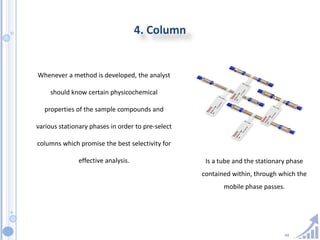
e) Apparatus and equipment, including technical performance requirements;
f) Reference standards and reference materials required;
g) Environmental conditions required and any stabilization period needed;
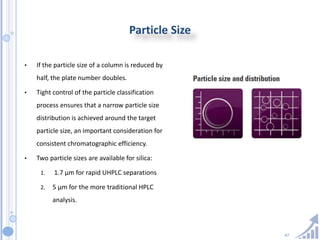
h) Description of the procedure, including
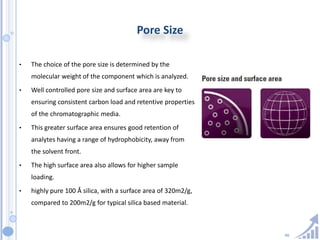
• Affixing of identification marks, handling, transporting, storing and preparation of items,
• Checks to be made before the work is started,
• Checks that the equipment is working properly and, where required, calibration and
adjustment of the equipment before each use,
• The method of recording the observations and results,
• Any safety measures to be observed;
i) Criteria and/or requirements for approval/rejection;
j) Data to be recorded and method of analysis and presentation;
k) The uncertainty or the procedure for estimating uncertainty. [ISO 17025]
8
Standard methods
Appropriate methods that have been published either in
international, regional or national standards, or by reputable
technical organizations, or in relevant scientific texts or
journals.
9
Non-standard method
• A new method or method not covered by
standard methods.
• The method should be developed and
validated appropriately before use.
10
Valid method
5.4.5.1 Validation
• Is the confirmation by examination and the provision of
objective evidence that the particular requirements for a
specific intended use are fulfilled.
5.4.5.2 The laboratory shall validate:
• Non-standard methods,
• Laboratory-designed/developed methods,
• Standard methods used outside their intended scope,
• Modifications of standard methods
to confirm that the methods are fit for the intended use.
11
Method development
Method Development is a steps process that
determines test method capabilities through selection
and optimization of analytical test parameters.
• It provides a high degree of assurance that the test
method will meet or surpass the established
requirements.
• The method developed shall have been validated
appropriately before use.
• As method-development proceeds, regular review
should be carried out.
12
Importance of Method development
• Improvements in performance testing can
be made by employing method
development principles to standard test
methods, when applied to new products
or materials.
• During the method development process,
the optimum test parameters are
identified to ensure applicability and
reliability of the data.
METHOD DEVELOPMENT PLAN
14
ISO 17025
5.4.2 Selection of methods
• Laboratory-developed methods or methods adopted by
the laboratory may also be used if they are appropriate for
the intended use and if they are validated.
5.4.3 Laboratory-developed methods
• The introduction of test and calibration methods developed by
the laboratory for its own use shall be:
* A planned activity
* Shall be assigned to qualified personnel equipped with
adequate resources.
Plans shall be updated as development proceeds and effective
communication amongst all personnel involved shall be ensured.
15
The method development plan
1. Studying the sample
2. Establish method Goals
3. Literature Review
4. Select an Approach
5. Optimize the Method
6. Finalize the Method
16
1. Studying the sample
Collection of the available data about the samples
• Sample composition.
• Sample handling and storage.
• Physical properties.
• Chemical properties.
• Reaction with the environment.
• Responding with the used equipment's.
• Other properties.
17
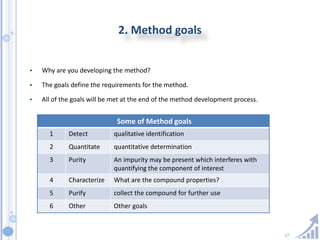
2. Method goals
• Why are you developing the method?
• The goals define the requirements for the method.
• All of the goals will be met at the end of the method development process.
Some of Method goals
1 Detect qualitative identification
2 Quantitate quantitative determination
3 Purity An impurity may be present which interferes with
quantifying the component of interest
4 Characterize What are the compound properties?
5 Purify collect the compound for further use
6 Other Other goals
18
3. Literature Review
• Conduct research to determine if the analysis has been performed before.
• Previously developed methods with quantitation and sample matrices that are
close to your requirements can form a starting point for your method.
Resources to consult include:
• Internet
• United States Pharmacopeia (USP)
• FDA requirements
• EPA requirements
• USDA methods
• Colleagues
• Professional/technical journals and meetings
• Corporate application notes
19
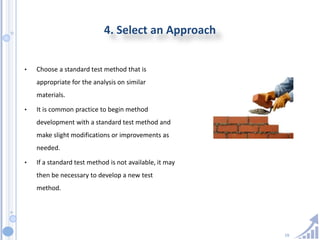
4. Select an Approach
• Choose a standard test method that is
appropriate for the analysis on similar
materials.
• It is common practice to begin method
development with a standard test method and
make slight modifications or improvements as
needed.
• If a standard test method is not available, it may
then be necessary to develop a new test
method.
20
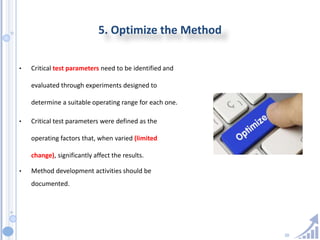
5. Optimize the Method
• Critical test parameters need to be identified and
evaluated through experiments designed to
determine a suitable operating range for each one.
• Critical test parameters were defined as the
operating factors that, when varied (limited
change), significantly affect the results.
• Method development activities should be
documented.
21
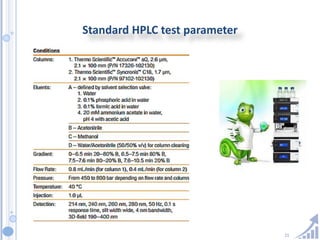
Standard HPLC test parameter
22
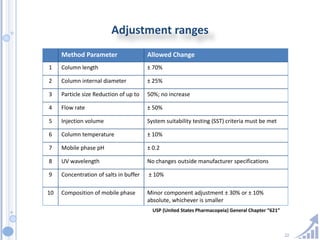
Adjustment ranges
Method Parameter Allowed Change
1 Column length ± 70%
2 Column internal diameter ± 25%
3 Particle size Reduction of up to 50%; no increase
4 Flow rate ± 50%
5 Injection volume System suitability testing (SST) criteria must be met
6 Column temperature ± 10%
7 Mobile phase pH ± 0.2
8 UV wavelength No changes outside manufacturer specifications
9 Concentration of salts in buffer ± 10%
10 Composition of mobile phase Minor component adjustment ± 30% or ± 10%
absolute, whichever is smaller
USP (United States Pharmacopeia) General Chapter “621”
23
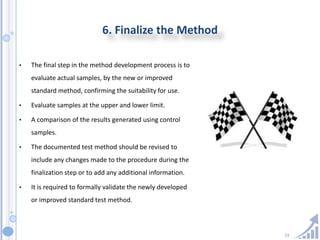
6. Finalize the Method
• The final step in the method development process is to
evaluate actual samples, by the new or improved
standard method, confirming the suitability for use.
• Evaluate samples at the upper and lower limit.
• A comparison of the results generated using control
samples.
• The documented test method should be revised to
include any changes made to the procedure during the
finalization step or to add any additional information.
• It is required to formally validate the newly developed
or improved standard test method.
OPTIMIZATION DESIGN
25
DOE Design of experiment
• DOE is a formal mathematical method for
systematically planning and conducting scientific
studies that change experimental variables together
in order to determine their effect of a given
response. R. C. Baker
• Design of experiments (DOE) is a well-proven
characterization approach within product and
process development and a key aspect of quality by
design.
26
DOE for MD
Recently, more attention has been placed on applying
DOE to analytical methods. DOE for analytical methods
has three major applications:
1. Method development for new methods or
those that need improvement,
2. Method validation, and quantitation of the
influence of analytical methods on product
and process acceptance
3. And out-of-specification (OOS) rates.
27
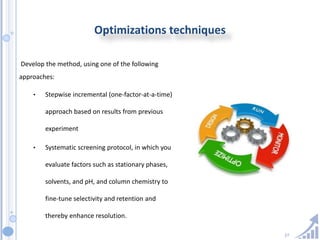
Optimizations techniques
Develop the method, using one of the following
approaches:
• Stepwise incremental (one-factor-at-a-time)
approach based on results from previous
experiment
• Systematic screening protocol, in which you
evaluate factors such as stationary phases,
solvents, and pH, and column chemistry to
fine-tune selectivity and retention and
thereby enhance resolution.
28
One factor at a time (OFAT)
• DOE provides information about the
interaction of factors and the way the
total system works, something not
obtainable through testing one factor at a
time (OFAT) while holding other factors
constant.
29
Linear Models with One Independent Variable
• Consider a linear model of the form
y = ax + b.
• In this model, y and x are the measured dependent and independent variables, and a and b are
parameters to be determined.
• A set of data should be taken which covers the desired range of y and x.
• For example, y could be the measured viscosity of a liquid (), and x could be the corresponding
measured temperature of the liquid (T).
• If the line will not fit the data well (R2 will not be near 1.0), thus, we need to modify the model.
• Now, we could vary x at random and measure the resulting y values
30
Linear Models with Two or More Independent
Variables
• A linear model of such a system could be written as:
z = ax + by + c.
• For example, the dependent variable could be the density of a gas of fixed
composition, with the independent variables being the temperature and pressure of
the gas.
• Now, we could vary x and y at random and measure the resulting z values (trial and
error), but there is a better way.
• This method is called factorial design.
31
Factorial design
• Factorial design is an experiment whose design consists
of two or more factors, each with discrete possible
values or "levels", and whose experimental units take
on all possible combinations of these levels across all
such factors.
• For the vast majority of factorial experiments, each
factor has only two levels. For example, with two
factors each taking two levels, a factorial experiment
would have four treatment combinations in total, and
is usually called a 2×2 factorial design.
HPLC METHOD DEVELOPMENT
33
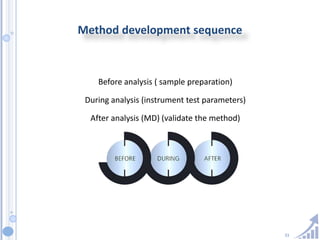
Method development sequence
Before analysis ( sample preparation)
During analysis (instrument test parameters)
After analysis (MD) (validate the method)
34
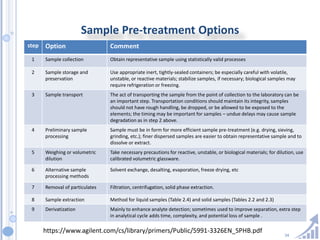
Sample Pre-treatment Options
step Option Comment
1 Sample collection Obtain representative sample using statistically valid processes
2 Sample storage and
preservation
Use appropriate inert, tightly-sealed containers; be especially careful with volatile,
unstable, or reactive materials; stabilize samples, if necessary; biological samples may
require refrigeration or freezing.
3 Sample transport The act of transporting the sample from the point of collection to the laboratory can be
an important step. Transportation conditions should maintain its integrity, samples
should not have rough handling, be dropped, or be allowed to be exposed to the
elements; the timing may be important for samples – undue delays may cause sample
degradation as in step 2 above.
4 Preliminary sample
processing
Sample must be in form for more efficient sample pre-treatment (e.g. drying, sieving,
grinding, etc.); finer dispersed samples are easier to obtain representative sample and to
dissolve or extract.
5 Weighing or volumetric
dilution
Take necessary precautions for reactive, unstable, or biological materials; for dilution, use
calibrated volumetric glassware.
6 Alternative sample
processing methods
Solvent exchange, desalting, evaporation, freeze drying, etc
7 Removal of particulates Filtration, centrifugation, solid phase extraction.
8 Sample extraction Method for liquid samples (Table 2.4) and solid samples (Tables 2.2 and 2.3)
9 Derivatization Mainly to enhance analyte detection; sometimes used to improve separation, extra step
in analytical cycle adds time, complexity, and potential loss of sample .
https://www.agilent.com/cs/library/primers/Public/5991-3326EN_SPHB.pdf
35
HPLC instrument
HPLC
• Is a form of liquid chromatography to separate
compounds to identify and quantify each component
that are dissolved in solution.
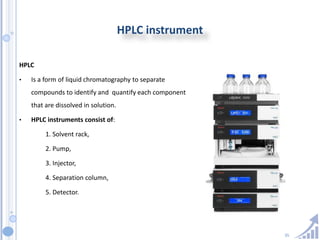
• HPLC instruments consist of:
1. Solvent rack,
2. Pump,
3. Injector,
4. Separation column,
5. Detector.
36
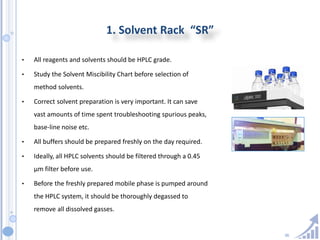
1. Solvent Rack “SR”
• All reagents and solvents should be HPLC grade.
• Study the Solvent Miscibility Chart before selection of
method solvents.
• Correct solvent preparation is very important. It can save
vast amounts of time spent troubleshooting spurious peaks,
base-line noise etc.
• All buffers should be prepared freshly on the day required.
• Ideally, all HPLC solvents should be filtered through a 0.45
µm filter before use.
• Before the freshly prepared mobile phase is pumped around
the HPLC system, it should be thoroughly degassed to
remove all dissolved gasses.
37
Buffer
• It is not necessary to fully suppress ionization for success with HPLC – 90% suppression is
generally considered adequate when sufficient buffer capacity is employed in the mobile
phase.
• The buffering capacity of any mobile phase is related to the prepared molarity and how
close the desired eluent pH is to the pK of the buffering ion.
• Buffering is typically effective at up to 1 pH unit above or below the pK of the buffering ion.
See the reference section, p 110 for a chart with pK and pH ranges for common buffers.
• Chromatographers may also choose a non-buffered mobile phase for pH modification. It is
not unusual for acidic analytes to be chromatographed with simple acid solutions, where the
concentration of acid is sufficient to create a much lower pH than needed.
• On the alkaline side, choices are limited. TEA (triethylamine) is not freely water soluble and
has a high pK (11) and ammonia itself dissolves freely but also has a pK too high for most
columns.
38
Rules for mixing buffers
• Use a good pH meter. Calibrate your pH meter, bracketing your target pH. This is
key for reliably measuring pH with a pH meter.
• Make sure your reagents are as fresh as possible.
• Start by dissolving the solid in the liquid, very close to the final volume desired.
After you have adjusted the mixture to the pH you need, then add additional liquid
to bring your solution to the right volume.
• pH adjustments should be made to the aqueous solution before addition of the
organic. There is no reliable way to measure pH after adding the organic.
• When your buffer solution is complete, filter it before using it in your HPLC, to
remove any particulates that may have been in the water or in the solid buffer. Use
a 0.45 µm filter for most HPLC applications; use a 0.22 µm filter for UHPLC
applications.
39
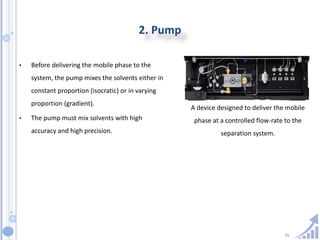
2. Pump
A device designed to deliver the mobile
phase at a controlled flow-rate to the
separation system.
• Before delivering the mobile phase to the
system, the pump mixes the solvents either in
constant proportion (isocratic) or in varying
proportion (gradient).
• The pump must mix solvents with high
accuracy and high precision.
40
Flow rate
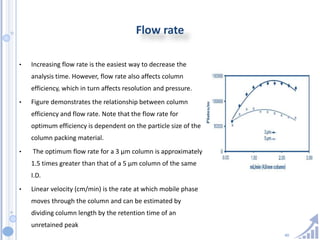
• Increasing flow rate is the easiest way to decrease the
analysis time. However, flow rate also affects column
efficiency, which in turn affects resolution and pressure.
• Figure demonstrates the relationship between column
efficiency and flow rate. Note that the flow rate for
optimum efficiency is dependent on the particle size of the
column packing material.
• The optimum flow rate for a 3 µm column is approximately
1.5 times greater than that of a 5 µm column of the same
I.D.
• Linear velocity (cm/min) is the rate at which mobile phase
moves through the column and can be estimated by
dividing column length by the retention time of an
unretained peak
41
Flow rate optimization
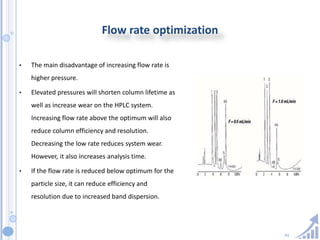
• The main disadvantage of increasing flow rate is
higher pressure.
• Elevated pressures will shorten column lifetime as
well as increase wear on the HPLC system.
Increasing flow rate above the optimum will also
reduce column efficiency and resolution.
Decreasing the low rate reduces system wear.
However, it also increases analysis time.
• If the flow rate is reduced below optimum for the
particle size, it can reduce efficiency and
resolution due to increased band dispersion.
42
3. Injector “autosampler”
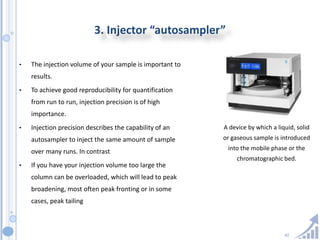
• The injection volume of your sample is important to
results.
• To achieve good reproducibility for quantification
from run to run, injection precision is of high
importance.
• Injection precision describes the capability of an
autosampler to inject the same amount of sample
over many runs. In contrast
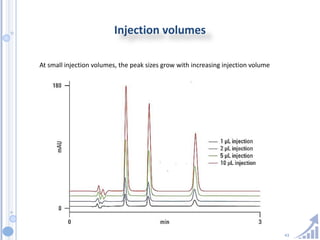
• If you have your injection volume too large the
column can be overloaded, which will lead to peak
broadening, most often peak fronting or in some
cases, peak tailing
A device by which a liquid, solid
or gaseous sample is introduced
into the mobile phase or the
chromatographic bed.
43
Injection volumes
At small injection volumes, the peak sizes grow with increasing injection volume
44
4. Column
Whenever a method is developed, the analyst
should know certain physicochemical
properties of the sample compounds and
various stationary phases in order to pre-select
columns which promise the best selectivity for
effective analysis. Is a tube and the stationary phase
contained within, through which the
mobile phase passes.
45
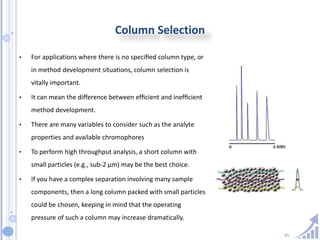
Column Selection
• For applications where there is no specified column type, or
in method development situations, column selection is
vitally important.
• It can mean the difference between efficient and inefficient
method development.
• There are many variables to consider such as the analyte
properties and available chromophores
• To perform high throughput analysis, a short column with
small particles (e.g., sub-2 µm) may be the best choice.
• If you have a complex separation involving many sample
components, then a long column packed with small particles
could be chosen, keeping in mind that the operating
pressure of such a column may increase dramatically.
46
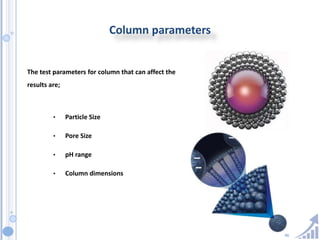
Column parameters
The test parameters for column that can affect the
results are;
• Particle Size
• Pore Size
• pH range
• Column dimensions
47
Particle Size
• If the particle size of a column is reduced by
half, the plate number doubles.
• Tight control of the particle classification
process ensures that a narrow particle size
distribution is achieved around the target
particle size, an important consideration for
consistent chromatographic efficiency.
• Two particle sizes are available for silica:
1. 1.7 μm for rapid UHPLC separations
2. 5 μm for the more traditional HPLC
analysis.
48
Pore Size
• The choice of the pore size is determined by the
molecular weight of the component which is analyzed.
• Well controlled pore size and surface area are key to
ensuring consistent carbon load and retentive properties
of the chromatographic media.
• This greater surface area ensures good retention of
analytes having a range of hydrophobicity, away from
the solvent front.
• The high surface area also allows for higher sample
loading.
• highly pure 100 Å silica, with a surface area of 320m2/g,
compared to 200m2/g for typical silica based material.
49
Column packing
• The pore size of the packing is important since the molecules must 'fit' into the porous
structure in order to interact with the stationary phase.
• Smaller pore size packings (pore size 80 to 120Å) are best for small molecules with
molecular weights up to a molecular weight of 2000. For larger molecules with MW over
2000, wider pore packings are required; for example, a popular pore size for proteins is
300Å.
• For most separations, stainless steel column hardware is sufficient. However, if you are
analyzing fragile molecules that may interact with the metal surface such as certain types of
biomolecules, then column materials such as PEEK or glass-lined stainless steel might be
used. For the separation of trace cations, sometimes PEEK columns are the most inert.
Note, though, that PEEK columns are limited to 400 bar
50
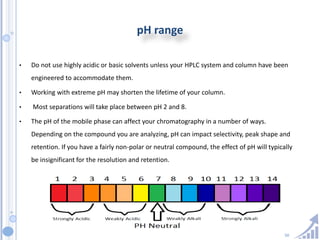
pH range
• Do not use highly acidic or basic solvents unless your HPLC system and column have been
engineered to accommodate them.
• Working with extreme pH may shorten the lifetime of your column.
• Most separations will take place between pH 2 and 8.
• The pH of the mobile phase can affect your chromatography in a number of ways.
Depending on the compound you are analyzing, pH can impact selectivity, peak shape and
retention. If you have a fairly non-polar or neutral compound, the effect of pH will typically
be insignificant for the resolution and retention.
51
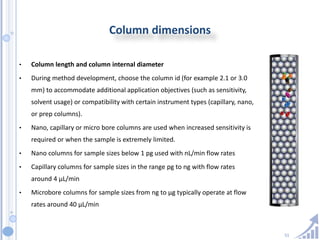
Column dimensions
• Column length and column internal diameter
• During method development, choose the column id (for example 2.1 or 3.0
mm) to accommodate additional application objectives (such as sensitivity,
solvent usage) or compatibility with certain instrument types (capillary, nano,
or prep columns).
• Nano, capillary or micro bore columns are used when increased sensitivity is
required or when the sample is extremely limited.
• Nano columns for sample sizes below 1 pg used with nL/min flow rates
• Capillary columns for sample sizes in the range pg to ng with flow rates
around 4 µL/min
• Microbore columns for sample sizes from ng to µg typically operate at flow
rates around 40 µL/min
52
Column compartment
Increasing the separation temperature is used to;
• Shorten the analysis time,
• To improve separation efficiency,
• To achieve a lower system backpressure,
• Or, in special cases, to obtain alternative
selectivity's with polar sample compounds.
Generally, The average separation temperature
determines retention times, selectivity, efficiency, and
resolution of a liquid chromatographic separation.
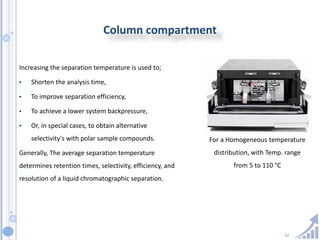
For a Homogeneous temperature
distribution, with Temp. range
from 5 to 110 °C
53
5. Detector
• Selected according to the nature of the analytes.
• A wide variety of detector types can be integrated in an LC
system.
• The most common detector types are based on
absorption, fluorescence, refractive index, evaporative
light scattering and mass spectrometry.
• Detector types differ in terms of sensitivity, selectivity,
and linear range. Sensitivity defines the lowest
concentration of a compound that can be detected.
Selectivity determines how specific a detector can be for a
certain compound.
• The linear range describes the concentration range of a
compound, in which the detector delivers a linear
response signal.
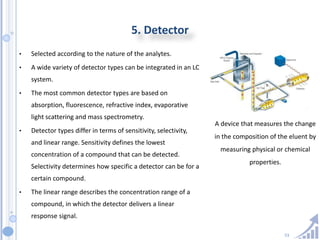
A device that measures the change
in the composition of the eluent by
measuring physical or chemical
properties.
54
Chromophores
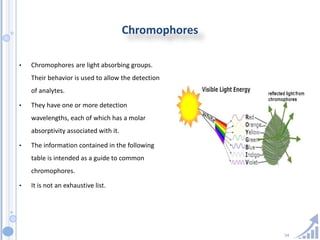
• Chromophores are light absorbing groups.
Their behavior is used to allow the detection
of analytes.
• They have one or more detection
wavelengths, each of which has a molar
absorptivity associated with it.
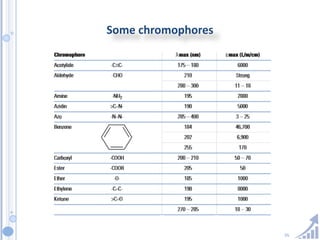
• The information contained in the following
table is intended as a guide to common
chromophores.
• It is not an exhaustive list.
55
Some chromophores
56
Compounds collections
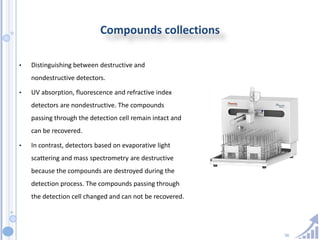
• Distinguishing between destructive and
nondestructive detectors.
• UV absorption, fluorescence and refractive index
detectors are nondestructive. The compounds
passing through the detection cell remain intact and
can be recovered.
• In contrast, detectors based on evaporative light
scattering and mass spectrometry are destructive
because the compounds are destroyed during the
detection process. The compounds passing through
the detection cell changed and can not be recovered.
57
Final method parameters
CHROMATOGRAPHIC
PERFORMANCE TESTS
59
Resolution (R)
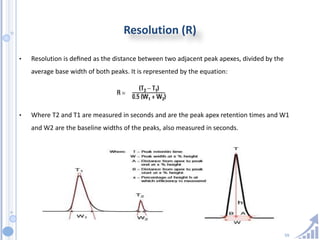
• Resolution is defined as the distance between two adjacent peak apexes, divided by the
average base width of both peaks. It is represented by the equation:
• Where T2 and T1 are measured in seconds and are the peak apex retention times and W1
and W2 are the baseline widths of the peaks, also measured in seconds.
60
Factors affecting resolution
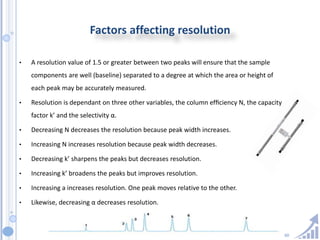
• A resolution value of 1.5 or greater between two peaks will ensure that the sample
components are well (baseline) separated to a degree at which the area or height of
each peak may be accurately measured.
• Resolution is dependant on three other variables, the column efficiency N, the capacity
factor k’ and the selectivity α.
• Decreasing N decreases the resolution because peak width increases.
• Increasing N increases resolution because peak width decreases.
• Decreasing k’ sharpens the peaks but decreases resolution.
• Increasing k’ broadens the peaks but improves resolution.
• Increasing a increases resolution. One peak moves relative to the other.
• Likewise, decreasing α decreases resolution.
61
Column efficiency (N)
• Column efficiency, or the theoretical plate count, is a
measure of peak band spreading.
• The lower the level of band spreading, the higher the
column efficiency and vice versa.
Important:
• The column efficiency figure quoted on the supplied
certificate of analysis is actually the efficiency for the
column AND HPLC system.
• If the efficiency calculation is repeated on a different
instrument when the column is new, it is very likely that
there will be a difference between the certificated value of
N and your new calculated value of N. This difference is not
due to the column but the instrument
62
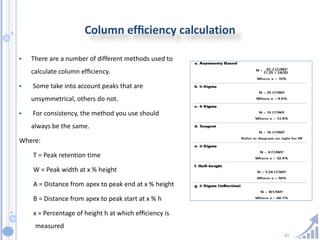
Column efficiency calculation
• There are a number of different methods used to
calculate column efficiency.
• Some take into account peaks that are
unsymmetrical, others do not.
• For consistency, the method you use should
always be the same.
Where:
T = Peak retention time
W = Peak width at x % height
A = Distance from apex to peak end at x % height
B = Distance from apex to peak start at x % h
x = Percentage of height h at which efficiency is
measured
63
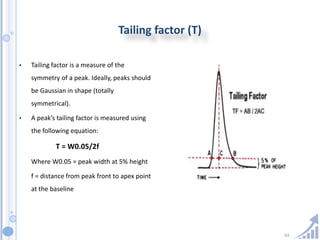
Tailing factor (T)
• Tailing factor is a measure of the
symmetry of a peak. Ideally, peaks should
be Gaussian in shape (totally
symmetrical).
• A peak’s tailing factor is measured using
the following equation:
T = W0.05/2f
Where W0.05 = peak width at 5% height
f = distance from peak front to apex point
at the baseline
64
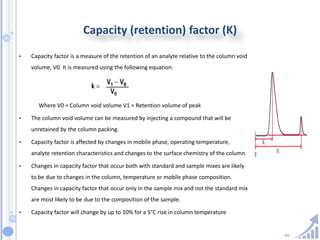
Capacity (retention) factor (K)
• Capacity factor is a measure of the retention of an analyte relative to the column void
volume, V0. It is measured using the following equation:
Where V0 = Column void volume V1 = Retention volume of peak
• The column void volume can be measured by injecting a compound that will be
unretained by the column packing.
• Capacity factor is affected by changes in mobile phase, operating temperature,
analyte retention characteristics and changes to the surface chemistry of the column.
• Changes in capacity factor that occur both with standard and sample mixes are likely
to be due to changes in the column, temperature or mobile phase composition.
Changes in capacity factor that occur only in the sample mix and not the standard mix
are most likely to be due to the composition of the sample.
• Capacity factor will change by up to 10% for a 5°C rise in column temperature
65
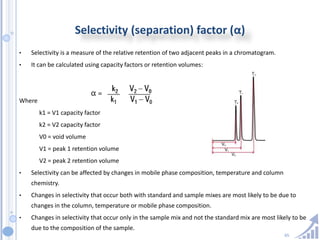
Selectivity (separation) factor (α)
• Selectivity is a measure of the relative retention of two adjacent peaks in a chromatogram.
• It can be calculated using capacity factors or retention volumes:
Where
k1 = V1 capacity factor
k2 = V2 capacity factor
V0 = void volume
V1 = peak 1 retention volume
V2 = peak 2 retention volume
• Selectivity can be affected by changes in mobile phase composition, temperature and column
chemistry.
• Changes in selectivity that occur both with standard and sample mixes are most likely to be due to
changes in the column, temperature or mobile phase composition.
• Changes in selectivity that occur only in the sample mix and not the standard mix are most likely to be
due to the composition of the sample.
DATA IN CHROMELEON
67
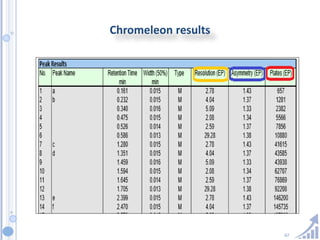
Chromeleon results
68
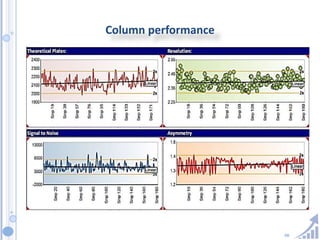
Column performance
69
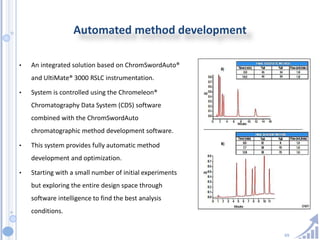
Automated method development
• An integrated solution based on ChromSwordAuto®
and UltiMate® 3000 RSLC instrumentation.
• System is controlled using the Chromeleon®
Chromatography Data System (CDS) software
combined with the ChromSwordAuto
chromatographic method development software.
• This system provides fully automatic method
development and optimization.
• Starting with a small number of initial experiments
but exploring the entire design space through
software intelligence to find the best analysis
conditions.
Thanks
gamal_a_hamid@Hotmail.com

Method development

  • 1.
  • 2.
    Thanks To everyone whohas helped us with support, new books, hard/soft ware And over the internet Special thanks for Thermo http://www.thermofisher.com
  • 3.
    3 Contents • Introduction • MDplan • Optimization design • HPLC MD • Column performance tests • Data in chromeleon
  • 4.
  • 5.
    5 Definitions • Analyte: The componentof a system to be an analyzed. • Analysis Is the process of breaking a complex or substance into smaller parts in order to gain a better understanding of it. • Method A systematic procedure, technique, or way of doing something, especially in accordance with a definite plan (ordered sequence of fixed steps)
  • 6.
    6 Test method • Adefinitive procedure for the identification, measurement, and evaluation of a material, product, system, or service that produces a test result. [ASTM D4392-87] • The appropriate methods should include:- o Sampling, o Handling, o Transport, o Storage and o Sample preparation. The laboratory shall have instructions on the use and operation of all relevant equipment.[ISO 17025]
  • 7.
    7 Minimum method information a)Appropriate identification; b) Scope; c) Description of the type of item to be tested or calibrated; d) Parameters or quantities and ranges to be determined; e) Apparatus and equipment, including technical performance requirements; f) Reference standards and reference materials required; g) Environmental conditions required and any stabilization period needed; h) Description of the procedure, including • Affixing of identification marks, handling, transporting, storing and preparation of items, • Checks to be made before the work is started, • Checks that the equipment is working properly and, where required, calibration and adjustment of the equipment before each use, • The method of recording the observations and results, • Any safety measures to be observed; i) Criteria and/or requirements for approval/rejection; j) Data to be recorded and method of analysis and presentation; k) The uncertainty or the procedure for estimating uncertainty. [ISO 17025]
  • 8.
    8 Standard methods Appropriate methodsthat have been published either in international, regional or national standards, or by reputable technical organizations, or in relevant scientific texts or journals.
  • 9.
    9 Non-standard method • Anew method or method not covered by standard methods. • The method should be developed and validated appropriately before use.
  • 10.
    10 Valid method 5.4.5.1 Validation •Is the confirmation by examination and the provision of objective evidence that the particular requirements for a specific intended use are fulfilled. 5.4.5.2 The laboratory shall validate: • Non-standard methods, • Laboratory-designed/developed methods, • Standard methods used outside their intended scope, • Modifications of standard methods to confirm that the methods are fit for the intended use.
  • 11.
    11 Method development Method Developmentis a steps process that determines test method capabilities through selection and optimization of analytical test parameters. • It provides a high degree of assurance that the test method will meet or surpass the established requirements. • The method developed shall have been validated appropriately before use. • As method-development proceeds, regular review should be carried out.
  • 12.
    12 Importance of Methoddevelopment • Improvements in performance testing can be made by employing method development principles to standard test methods, when applied to new products or materials. • During the method development process, the optimum test parameters are identified to ensure applicability and reliability of the data.
  • 13.
  • 14.
    14 ISO 17025 5.4.2 Selectionof methods • Laboratory-developed methods or methods adopted by the laboratory may also be used if they are appropriate for the intended use and if they are validated. 5.4.3 Laboratory-developed methods • The introduction of test and calibration methods developed by the laboratory for its own use shall be: * A planned activity * Shall be assigned to qualified personnel equipped with adequate resources. Plans shall be updated as development proceeds and effective communication amongst all personnel involved shall be ensured.
  • 15.
    15 The method developmentplan 1. Studying the sample 2. Establish method Goals 3. Literature Review 4. Select an Approach 5. Optimize the Method 6. Finalize the Method
  • 16.
    16 1. Studying thesample Collection of the available data about the samples • Sample composition. • Sample handling and storage. • Physical properties. • Chemical properties. • Reaction with the environment. • Responding with the used equipment's. • Other properties.
  • 17.
    17 2. Method goals •Why are you developing the method? • The goals define the requirements for the method. • All of the goals will be met at the end of the method development process. Some of Method goals 1 Detect qualitative identification 2 Quantitate quantitative determination 3 Purity An impurity may be present which interferes with quantifying the component of interest 4 Characterize What are the compound properties? 5 Purify collect the compound for further use 6 Other Other goals
  • 18.
    18 3. Literature Review •Conduct research to determine if the analysis has been performed before. • Previously developed methods with quantitation and sample matrices that are close to your requirements can form a starting point for your method. Resources to consult include: • Internet • United States Pharmacopeia (USP) • FDA requirements • EPA requirements • USDA methods • Colleagues • Professional/technical journals and meetings • Corporate application notes
  • 19.
    19 4. Select anApproach • Choose a standard test method that is appropriate for the analysis on similar materials. • It is common practice to begin method development with a standard test method and make slight modifications or improvements as needed. • If a standard test method is not available, it may then be necessary to develop a new test method.
  • 20.
    20 5. Optimize theMethod • Critical test parameters need to be identified and evaluated through experiments designed to determine a suitable operating range for each one. • Critical test parameters were defined as the operating factors that, when varied (limited change), significantly affect the results. • Method development activities should be documented.
  • 21.
  • 22.
    22 Adjustment ranges Method ParameterAllowed Change 1 Column length ± 70% 2 Column internal diameter ± 25% 3 Particle size Reduction of up to 50%; no increase 4 Flow rate ± 50% 5 Injection volume System suitability testing (SST) criteria must be met 6 Column temperature ± 10% 7 Mobile phase pH ± 0.2 8 UV wavelength No changes outside manufacturer specifications 9 Concentration of salts in buffer ± 10% 10 Composition of mobile phase Minor component adjustment ± 30% or ± 10% absolute, whichever is smaller USP (United States Pharmacopeia) General Chapter “621”
  • 23.
    23 6. Finalize theMethod • The final step in the method development process is to evaluate actual samples, by the new or improved standard method, confirming the suitability for use. • Evaluate samples at the upper and lower limit. • A comparison of the results generated using control samples. • The documented test method should be revised to include any changes made to the procedure during the finalization step or to add any additional information. • It is required to formally validate the newly developed or improved standard test method.
  • 24.
  • 25.
    25 DOE Design ofexperiment • DOE is a formal mathematical method for systematically planning and conducting scientific studies that change experimental variables together in order to determine their effect of a given response. R. C. Baker • Design of experiments (DOE) is a well-proven characterization approach within product and process development and a key aspect of quality by design.
  • 26.
    26 DOE for MD Recently,more attention has been placed on applying DOE to analytical methods. DOE for analytical methods has three major applications: 1. Method development for new methods or those that need improvement, 2. Method validation, and quantitation of the influence of analytical methods on product and process acceptance 3. And out-of-specification (OOS) rates.
  • 27.
    27 Optimizations techniques Develop themethod, using one of the following approaches: • Stepwise incremental (one-factor-at-a-time) approach based on results from previous experiment • Systematic screening protocol, in which you evaluate factors such as stationary phases, solvents, and pH, and column chemistry to fine-tune selectivity and retention and thereby enhance resolution.
  • 28.
    28 One factor ata time (OFAT) • DOE provides information about the interaction of factors and the way the total system works, something not obtainable through testing one factor at a time (OFAT) while holding other factors constant.
  • 29.
    29 Linear Models withOne Independent Variable • Consider a linear model of the form y = ax + b. • In this model, y and x are the measured dependent and independent variables, and a and b are parameters to be determined. • A set of data should be taken which covers the desired range of y and x. • For example, y could be the measured viscosity of a liquid (), and x could be the corresponding measured temperature of the liquid (T). • If the line will not fit the data well (R2 will not be near 1.0), thus, we need to modify the model. • Now, we could vary x at random and measure the resulting y values
  • 30.
    30 Linear Models withTwo or More Independent Variables • A linear model of such a system could be written as: z = ax + by + c. • For example, the dependent variable could be the density of a gas of fixed composition, with the independent variables being the temperature and pressure of the gas. • Now, we could vary x and y at random and measure the resulting z values (trial and error), but there is a better way. • This method is called factorial design.
  • 31.
    31 Factorial design • Factorialdesign is an experiment whose design consists of two or more factors, each with discrete possible values or "levels", and whose experimental units take on all possible combinations of these levels across all such factors. • For the vast majority of factorial experiments, each factor has only two levels. For example, with two factors each taking two levels, a factorial experiment would have four treatment combinations in total, and is usually called a 2×2 factorial design.
  • 32.
  • 33.
    33 Method development sequence Beforeanalysis ( sample preparation) During analysis (instrument test parameters) After analysis (MD) (validate the method)
  • 34.
    34 Sample Pre-treatment Options stepOption Comment 1 Sample collection Obtain representative sample using statistically valid processes 2 Sample storage and preservation Use appropriate inert, tightly-sealed containers; be especially careful with volatile, unstable, or reactive materials; stabilize samples, if necessary; biological samples may require refrigeration or freezing. 3 Sample transport The act of transporting the sample from the point of collection to the laboratory can be an important step. Transportation conditions should maintain its integrity, samples should not have rough handling, be dropped, or be allowed to be exposed to the elements; the timing may be important for samples – undue delays may cause sample degradation as in step 2 above. 4 Preliminary sample processing Sample must be in form for more efficient sample pre-treatment (e.g. drying, sieving, grinding, etc.); finer dispersed samples are easier to obtain representative sample and to dissolve or extract. 5 Weighing or volumetric dilution Take necessary precautions for reactive, unstable, or biological materials; for dilution, use calibrated volumetric glassware. 6 Alternative sample processing methods Solvent exchange, desalting, evaporation, freeze drying, etc 7 Removal of particulates Filtration, centrifugation, solid phase extraction. 8 Sample extraction Method for liquid samples (Table 2.4) and solid samples (Tables 2.2 and 2.3) 9 Derivatization Mainly to enhance analyte detection; sometimes used to improve separation, extra step in analytical cycle adds time, complexity, and potential loss of sample . https://www.agilent.com/cs/library/primers/Public/5991-3326EN_SPHB.pdf
  • 35.
    35 HPLC instrument HPLC • Isa form of liquid chromatography to separate compounds to identify and quantify each component that are dissolved in solution. • HPLC instruments consist of: 1. Solvent rack, 2. Pump, 3. Injector, 4. Separation column, 5. Detector.
  • 36.
    36 1. Solvent Rack“SR” • All reagents and solvents should be HPLC grade. • Study the Solvent Miscibility Chart before selection of method solvents. • Correct solvent preparation is very important. It can save vast amounts of time spent troubleshooting spurious peaks, base-line noise etc. • All buffers should be prepared freshly on the day required. • Ideally, all HPLC solvents should be filtered through a 0.45 µm filter before use. • Before the freshly prepared mobile phase is pumped around the HPLC system, it should be thoroughly degassed to remove all dissolved gasses.
  • 37.
    37 Buffer • It isnot necessary to fully suppress ionization for success with HPLC – 90% suppression is generally considered adequate when sufficient buffer capacity is employed in the mobile phase. • The buffering capacity of any mobile phase is related to the prepared molarity and how close the desired eluent pH is to the pK of the buffering ion. • Buffering is typically effective at up to 1 pH unit above or below the pK of the buffering ion. See the reference section, p 110 for a chart with pK and pH ranges for common buffers. • Chromatographers may also choose a non-buffered mobile phase for pH modification. It is not unusual for acidic analytes to be chromatographed with simple acid solutions, where the concentration of acid is sufficient to create a much lower pH than needed. • On the alkaline side, choices are limited. TEA (triethylamine) is not freely water soluble and has a high pK (11) and ammonia itself dissolves freely but also has a pK too high for most columns.
  • 38.
    38 Rules for mixingbuffers • Use a good pH meter. Calibrate your pH meter, bracketing your target pH. This is key for reliably measuring pH with a pH meter. • Make sure your reagents are as fresh as possible. • Start by dissolving the solid in the liquid, very close to the final volume desired. After you have adjusted the mixture to the pH you need, then add additional liquid to bring your solution to the right volume. • pH adjustments should be made to the aqueous solution before addition of the organic. There is no reliable way to measure pH after adding the organic. • When your buffer solution is complete, filter it before using it in your HPLC, to remove any particulates that may have been in the water or in the solid buffer. Use a 0.45 µm filter for most HPLC applications; use a 0.22 µm filter for UHPLC applications.
  • 39.
    39 2. Pump A devicedesigned to deliver the mobile phase at a controlled flow-rate to the separation system. • Before delivering the mobile phase to the system, the pump mixes the solvents either in constant proportion (isocratic) or in varying proportion (gradient). • The pump must mix solvents with high accuracy and high precision.
  • 40.
    40 Flow rate • Increasingflow rate is the easiest way to decrease the analysis time. However, flow rate also affects column efficiency, which in turn affects resolution and pressure. • Figure demonstrates the relationship between column efficiency and flow rate. Note that the flow rate for optimum efficiency is dependent on the particle size of the column packing material. • The optimum flow rate for a 3 µm column is approximately 1.5 times greater than that of a 5 µm column of the same I.D. • Linear velocity (cm/min) is the rate at which mobile phase moves through the column and can be estimated by dividing column length by the retention time of an unretained peak
  • 41.
    41 Flow rate optimization •The main disadvantage of increasing flow rate is higher pressure. • Elevated pressures will shorten column lifetime as well as increase wear on the HPLC system. Increasing flow rate above the optimum will also reduce column efficiency and resolution. Decreasing the low rate reduces system wear. However, it also increases analysis time. • If the flow rate is reduced below optimum for the particle size, it can reduce efficiency and resolution due to increased band dispersion.
  • 42.
    42 3. Injector “autosampler” •The injection volume of your sample is important to results. • To achieve good reproducibility for quantification from run to run, injection precision is of high importance. • Injection precision describes the capability of an autosampler to inject the same amount of sample over many runs. In contrast • If you have your injection volume too large the column can be overloaded, which will lead to peak broadening, most often peak fronting or in some cases, peak tailing A device by which a liquid, solid or gaseous sample is introduced into the mobile phase or the chromatographic bed.
  • 43.
    43 Injection volumes At smallinjection volumes, the peak sizes grow with increasing injection volume
  • 44.
    44 4. Column Whenever amethod is developed, the analyst should know certain physicochemical properties of the sample compounds and various stationary phases in order to pre-select columns which promise the best selectivity for effective analysis. Is a tube and the stationary phase contained within, through which the mobile phase passes.
  • 45.
    45 Column Selection • Forapplications where there is no specified column type, or in method development situations, column selection is vitally important. • It can mean the difference between efficient and inefficient method development. • There are many variables to consider such as the analyte properties and available chromophores • To perform high throughput analysis, a short column with small particles (e.g., sub-2 µm) may be the best choice. • If you have a complex separation involving many sample components, then a long column packed with small particles could be chosen, keeping in mind that the operating pressure of such a column may increase dramatically.
  • 46.
    46 Column parameters The testparameters for column that can affect the results are; • Particle Size • Pore Size • pH range • Column dimensions
  • 47.
    47 Particle Size • Ifthe particle size of a column is reduced by half, the plate number doubles. • Tight control of the particle classification process ensures that a narrow particle size distribution is achieved around the target particle size, an important consideration for consistent chromatographic efficiency. • Two particle sizes are available for silica: 1. 1.7 μm for rapid UHPLC separations 2. 5 μm for the more traditional HPLC analysis.
  • 48.
    48 Pore Size • Thechoice of the pore size is determined by the molecular weight of the component which is analyzed. • Well controlled pore size and surface area are key to ensuring consistent carbon load and retentive properties of the chromatographic media. • This greater surface area ensures good retention of analytes having a range of hydrophobicity, away from the solvent front. • The high surface area also allows for higher sample loading. • highly pure 100 Å silica, with a surface area of 320m2/g, compared to 200m2/g for typical silica based material.
  • 49.
    49 Column packing • Thepore size of the packing is important since the molecules must 'fit' into the porous structure in order to interact with the stationary phase. • Smaller pore size packings (pore size 80 to 120Å) are best for small molecules with molecular weights up to a molecular weight of 2000. For larger molecules with MW over 2000, wider pore packings are required; for example, a popular pore size for proteins is 300Å. • For most separations, stainless steel column hardware is sufficient. However, if you are analyzing fragile molecules that may interact with the metal surface such as certain types of biomolecules, then column materials such as PEEK or glass-lined stainless steel might be used. For the separation of trace cations, sometimes PEEK columns are the most inert. Note, though, that PEEK columns are limited to 400 bar
  • 50.
    50 pH range • Donot use highly acidic or basic solvents unless your HPLC system and column have been engineered to accommodate them. • Working with extreme pH may shorten the lifetime of your column. • Most separations will take place between pH 2 and 8. • The pH of the mobile phase can affect your chromatography in a number of ways. Depending on the compound you are analyzing, pH can impact selectivity, peak shape and retention. If you have a fairly non-polar or neutral compound, the effect of pH will typically be insignificant for the resolution and retention.
  • 51.
    51 Column dimensions • Columnlength and column internal diameter • During method development, choose the column id (for example 2.1 or 3.0 mm) to accommodate additional application objectives (such as sensitivity, solvent usage) or compatibility with certain instrument types (capillary, nano, or prep columns). • Nano, capillary or micro bore columns are used when increased sensitivity is required or when the sample is extremely limited. • Nano columns for sample sizes below 1 pg used with nL/min flow rates • Capillary columns for sample sizes in the range pg to ng with flow rates around 4 µL/min • Microbore columns for sample sizes from ng to µg typically operate at flow rates around 40 µL/min
  • 52.
    52 Column compartment Increasing theseparation temperature is used to; • Shorten the analysis time, • To improve separation efficiency, • To achieve a lower system backpressure, • Or, in special cases, to obtain alternative selectivity's with polar sample compounds. Generally, The average separation temperature determines retention times, selectivity, efficiency, and resolution of a liquid chromatographic separation. For a Homogeneous temperature distribution, with Temp. range from 5 to 110 °C
  • 53.
    53 5. Detector • Selectedaccording to the nature of the analytes. • A wide variety of detector types can be integrated in an LC system. • The most common detector types are based on absorption, fluorescence, refractive index, evaporative light scattering and mass spectrometry. • Detector types differ in terms of sensitivity, selectivity, and linear range. Sensitivity defines the lowest concentration of a compound that can be detected. Selectivity determines how specific a detector can be for a certain compound. • The linear range describes the concentration range of a compound, in which the detector delivers a linear response signal. A device that measures the change in the composition of the eluent by measuring physical or chemical properties.
  • 54.
    54 Chromophores • Chromophores arelight absorbing groups. Their behavior is used to allow the detection of analytes. • They have one or more detection wavelengths, each of which has a molar absorptivity associated with it. • The information contained in the following table is intended as a guide to common chromophores. • It is not an exhaustive list.
  • 55.
  • 56.
    56 Compounds collections • Distinguishingbetween destructive and nondestructive detectors. • UV absorption, fluorescence and refractive index detectors are nondestructive. The compounds passing through the detection cell remain intact and can be recovered. • In contrast, detectors based on evaporative light scattering and mass spectrometry are destructive because the compounds are destroyed during the detection process. The compounds passing through the detection cell changed and can not be recovered.
  • 57.
  • 58.
  • 59.
    59 Resolution (R) • Resolutionis defined as the distance between two adjacent peak apexes, divided by the average base width of both peaks. It is represented by the equation: • Where T2 and T1 are measured in seconds and are the peak apex retention times and W1 and W2 are the baseline widths of the peaks, also measured in seconds.
  • 60.
    60 Factors affecting resolution •A resolution value of 1.5 or greater between two peaks will ensure that the sample components are well (baseline) separated to a degree at which the area or height of each peak may be accurately measured. • Resolution is dependant on three other variables, the column efficiency N, the capacity factor k’ and the selectivity α. • Decreasing N decreases the resolution because peak width increases. • Increasing N increases resolution because peak width decreases. • Decreasing k’ sharpens the peaks but decreases resolution. • Increasing k’ broadens the peaks but improves resolution. • Increasing a increases resolution. One peak moves relative to the other. • Likewise, decreasing α decreases resolution.
  • 61.
    61 Column efficiency (N) •Column efficiency, or the theoretical plate count, is a measure of peak band spreading. • The lower the level of band spreading, the higher the column efficiency and vice versa. Important: • The column efficiency figure quoted on the supplied certificate of analysis is actually the efficiency for the column AND HPLC system. • If the efficiency calculation is repeated on a different instrument when the column is new, it is very likely that there will be a difference between the certificated value of N and your new calculated value of N. This difference is not due to the column but the instrument
  • 62.
    62 Column efficiency calculation •There are a number of different methods used to calculate column efficiency. • Some take into account peaks that are unsymmetrical, others do not. • For consistency, the method you use should always be the same. Where: T = Peak retention time W = Peak width at x % height A = Distance from apex to peak end at x % height B = Distance from apex to peak start at x % h x = Percentage of height h at which efficiency is measured
  • 63.
    63 Tailing factor (T) •Tailing factor is a measure of the symmetry of a peak. Ideally, peaks should be Gaussian in shape (totally symmetrical). • A peak’s tailing factor is measured using the following equation: T = W0.05/2f Where W0.05 = peak width at 5% height f = distance from peak front to apex point at the baseline
  • 64.
    64 Capacity (retention) factor(K) • Capacity factor is a measure of the retention of an analyte relative to the column void volume, V0. It is measured using the following equation: Where V0 = Column void volume V1 = Retention volume of peak • The column void volume can be measured by injecting a compound that will be unretained by the column packing. • Capacity factor is affected by changes in mobile phase, operating temperature, analyte retention characteristics and changes to the surface chemistry of the column. • Changes in capacity factor that occur both with standard and sample mixes are likely to be due to changes in the column, temperature or mobile phase composition. Changes in capacity factor that occur only in the sample mix and not the standard mix are most likely to be due to the composition of the sample. • Capacity factor will change by up to 10% for a 5°C rise in column temperature
  • 65.
    65 Selectivity (separation) factor(α) • Selectivity is a measure of the relative retention of two adjacent peaks in a chromatogram. • It can be calculated using capacity factors or retention volumes: Where k1 = V1 capacity factor k2 = V2 capacity factor V0 = void volume V1 = peak 1 retention volume V2 = peak 2 retention volume • Selectivity can be affected by changes in mobile phase composition, temperature and column chemistry. • Changes in selectivity that occur both with standard and sample mixes are most likely to be due to changes in the column, temperature or mobile phase composition. • Changes in selectivity that occur only in the sample mix and not the standard mix are most likely to be due to the composition of the sample.
  • 66.
  • 67.
  • 68.
  • 69.
    69 Automated method development •An integrated solution based on ChromSwordAuto® and UltiMate® 3000 RSLC instrumentation. • System is controlled using the Chromeleon® Chromatography Data System (CDS) software combined with the ChromSwordAuto chromatographic method development software. • This system provides fully automatic method development and optimization. • Starting with a small number of initial experiments but exploring the entire design space through software intelligence to find the best analysis conditions.
  • 70.