Pharmaceutical Care


       Akram Ahmad
       2nd Pharm.D(P.B.)
       Department of Pharmacy
       Practice.
       Annamalai University
Pharmaceutical care
 The pharmaceutical care is defined as “The
  responsible provision of drug therapy for the
  purpose of achieving definite therapeutic
  outcomes that improve the patients quality of
  life”
 These outcomes are :
 Cure of the disease
 Elimination or reduction of patient`s
  symptomology
 Arresting or slowing of a disease process
Basic Elements of Pharmaceutical
    Care
 Patient oriented
 Both acute and chronic problems addressed
 Stress on prevention of drug related problems
 Documented system on patients record need
  and care.
 Offering continuous care in systematic way.
 Taking help of other health care providers in
  integrating the care provided.
 Highly accuntable and responsible
 Emphasis on optimizing patients health quality
  of life.
Basic Elements of Pharmaceutical
Care(conti..)
 Emphasis on patient`s health education and
  health promotion.
 Pharmaceutical care involves the process
  through which a pharmacist cooperates with a
  patient and other professionals in
  designing,implementing and monitoring a
  therapeutic plan that will produce specific
  therapeutic outcomes for the patients.
 Three major functions
Conti…
 1-Identifying potential and actual drug-
  related problems.
 2-Pesolving actual drug-related
  problems and
 3-Preventing potential drug-related
  problems.
 The pharmacist ,who is the central
  figure of pharmaceutical care,then he
  has the following functions to perform
Function of Pharmacist To
Perform
 1-Collection of patient data.
 2-Identification of problems.
 3-Establishing outcome goals through
  a good therapeutic plan
 4-Evaluating treatment alternatives,by
  monitoring and modifying therapeutic
  plan.
 5-Individualising drug regimens.
 6-Monitoring outcomes.
Types of Pharmaceutical Care
 SOAP Analysis
 CORE Pharmacotherapy plan
 FARM Analysis.
 PRIME Pharmacotherapy plan
 P-Pharmaceutical based problems’
 1-pt not receving a prescribed drug
 2-routine monitoring ( lab data)
 R-risks ,to patients- ADR
Format of a SOAP note:
 The SOAP format is the one used most
  often by medical practitioners; however,
  when used within the pharmaceutical
  care context, the content of the sections
  must be revised to match the
  pharmacist’s legal scope of practice.
 S=subjective findings
Exp-chief complaints and duration or
  severity of symptoms.
O=objective findings
Exp-laboratory data, weight, height, blood
 pressure, and pulse.
A=assesment
Diagnogsis or possible explanations for the
 patients medical problems.
P=Plan
Drug regimen or surgical procedure
CORE
 C=Condition or patient need, it may
  include nonmedical conditions or need
  and is thus not a reiteration of the
  current medical problem.
 O=outcome, desired for the condition or
  needs.
1. Patient outcomes (POEMS: patient-
  oriented evidence that matters)
 There are generally five category of
  patient outcome:
1. Mortality
2. Morbidity
A)-related to disease process,
B)-related to medication/ treatment plan
3. Behavior
4. Economic
5. Quality of life
 Therapeutic end point (surrogate markers;
  DOES: disease oriented evidence)
 A) a therapeutic end point represents the
  pharmacological or therapeutic effects that is
  expected, ultimately, to achieve the desired
  outcome.
 B)more than one end point is usually needed
  to achieve an outcome-for example, both
  near normal glycemic control and
  normalization of blood pressure are
  necessary to significant reduce the risk of
 R=regimen to achieve desired outcome
1. Therapeutic regimens
Existing therapy
Initial therapy
2. Goal setting and behavior regimens
a. Identify the type of goal being set, such
    as the following
Start a new positive action-exercise
    program
Increase the frequency or intensity of a
    positive action- drink 2 more cup of
CORE-Analysis
 Stop or decrease- stop smoking
 Continue an action that is perfect-
  continue to exercise 30 min a day, every
  day.
b)State the behavior goal in terms that are
  clear, specific and reasonable.
E=Evaluation parameter to assess
  outcome achievement.
1. Efficacy parameters
2. Toxicity parameters- ADRs, allergic
   reactions, or toxicity is not occuring.
FARM NOTE
 Formulate a FARM note or SOAP note to
  describe and document the interventions
  intented or provided by the pharmacist.
  Some healthcare facility may specific one
  format over the other;
 F= findings
The patient-specific information that gives a
  basis for, or leads to, the recognition of a
  pharmacotherapy problem or indication for
  pharmacist intervention, finding include
  subjective and objective information about
  the patient.
   A=assessment
   a.) any additional information that is needed
    to best access the problem to make
    recommendations
   B) the severity, priority or urgency of the
    problem
   C) the short-term and long term goals of the
    problam
   Short term goals: eliminate symptoms,
    lower BP to 140/90 mm Hg within 6 weeks,
    manage acute asthma flareup without
    requiring hospitalization.
 R= resolution (including prevention)
The intervention plan includes actual or
  proposed action by pharmacist
1. observing, reassessing
2. Counseling
3. Making recommendations to the patients
4. Informing the prescriber
5. Making recommendations to the
   prescriber
6. Withholding medication or advising
   against use
 M=monitoring and follow up.
1. The parameter to be followed
   (pain, depressed mood, serum potassium
   level)
2. The intent of the monitoring
   (efficacy, toxicity, adverse event)
3. How the parameter will be monitored
   (patient interview, serum drug
   level, physical examination)
4. Frequency of monitoring (weekly, monthly)
5. Duration of monitoring (weekly, monthly)
6. Duration of monitoring (until resolved, while
   on antibiotic, until resolved them monthly
   for 1 year)
 Anticipated or desired finding (no pain,
  euglycemia, healing of lesion)
 Decision point to alter therapy when or
  if outcome is not achieved (pain still
  present after 3 days, mild
  hypoglycemia more than two times a
  week)
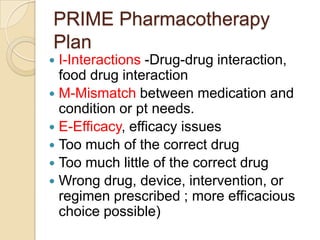
PRIME Pharmacotherapy
Plan
 I-Interactions -Drug-drug interaction,
  food drug interaction
 M-Mismatch between medication and
  condition or pt needs.
 E-Efficacy, efficacy issues
 Too much of the correct drug
 Too much little of the correct drug
 Wrong drug, device, intervention, or
  regimen prescribed ; more efficacious
  choice possible)
THANK YOU

Pharmaceutical care

  • 1.
    Pharmaceutical Care Akram Ahmad 2nd Pharm.D(P.B.) Department of Pharmacy Practice. Annamalai University
  • 2.
    Pharmaceutical care  Thepharmaceutical care is defined as “The responsible provision of drug therapy for the purpose of achieving definite therapeutic outcomes that improve the patients quality of life”  These outcomes are :  Cure of the disease  Elimination or reduction of patient`s symptomology  Arresting or slowing of a disease process
  • 3.
    Basic Elements ofPharmaceutical Care  Patient oriented  Both acute and chronic problems addressed  Stress on prevention of drug related problems  Documented system on patients record need and care.  Offering continuous care in systematic way.  Taking help of other health care providers in integrating the care provided.  Highly accuntable and responsible  Emphasis on optimizing patients health quality of life.
  • 4.
    Basic Elements ofPharmaceutical Care(conti..)  Emphasis on patient`s health education and health promotion.  Pharmaceutical care involves the process through which a pharmacist cooperates with a patient and other professionals in designing,implementing and monitoring a therapeutic plan that will produce specific therapeutic outcomes for the patients.  Three major functions
  • 5.
    Conti…  1-Identifying potentialand actual drug- related problems.  2-Pesolving actual drug-related problems and  3-Preventing potential drug-related problems.  The pharmacist ,who is the central figure of pharmaceutical care,then he has the following functions to perform
  • 6.
    Function of PharmacistTo Perform  1-Collection of patient data.  2-Identification of problems.  3-Establishing outcome goals through a good therapeutic plan  4-Evaluating treatment alternatives,by monitoring and modifying therapeutic plan.  5-Individualising drug regimens.  6-Monitoring outcomes.
  • 7.
    Types of PharmaceuticalCare  SOAP Analysis  CORE Pharmacotherapy plan  FARM Analysis.  PRIME Pharmacotherapy plan  P-Pharmaceutical based problems’  1-pt not receving a prescribed drug  2-routine monitoring ( lab data)  R-risks ,to patients- ADR
  • 8.
    Format of aSOAP note:  The SOAP format is the one used most often by medical practitioners; however, when used within the pharmaceutical care context, the content of the sections must be revised to match the pharmacist’s legal scope of practice.  S=subjective findings Exp-chief complaints and duration or severity of symptoms.
  • 9.
    O=objective findings Exp-laboratory data,weight, height, blood pressure, and pulse. A=assesment Diagnogsis or possible explanations for the patients medical problems. P=Plan Drug regimen or surgical procedure
  • 10.
    CORE  C=Condition orpatient need, it may include nonmedical conditions or need and is thus not a reiteration of the current medical problem.  O=outcome, desired for the condition or needs. 1. Patient outcomes (POEMS: patient- oriented evidence that matters)
  • 11.
     There aregenerally five category of patient outcome: 1. Mortality 2. Morbidity A)-related to disease process, B)-related to medication/ treatment plan 3. Behavior 4. Economic 5. Quality of life
  • 12.
     Therapeutic endpoint (surrogate markers; DOES: disease oriented evidence)  A) a therapeutic end point represents the pharmacological or therapeutic effects that is expected, ultimately, to achieve the desired outcome.  B)more than one end point is usually needed to achieve an outcome-for example, both near normal glycemic control and normalization of blood pressure are necessary to significant reduce the risk of
  • 13.
     R=regimen toachieve desired outcome 1. Therapeutic regimens Existing therapy Initial therapy 2. Goal setting and behavior regimens a. Identify the type of goal being set, such as the following Start a new positive action-exercise program Increase the frequency or intensity of a positive action- drink 2 more cup of
  • 14.
    CORE-Analysis  Stop ordecrease- stop smoking  Continue an action that is perfect- continue to exercise 30 min a day, every day. b)State the behavior goal in terms that are clear, specific and reasonable. E=Evaluation parameter to assess outcome achievement. 1. Efficacy parameters 2. Toxicity parameters- ADRs, allergic reactions, or toxicity is not occuring.
  • 15.
    FARM NOTE  Formulatea FARM note or SOAP note to describe and document the interventions intented or provided by the pharmacist. Some healthcare facility may specific one format over the other;  F= findings The patient-specific information that gives a basis for, or leads to, the recognition of a pharmacotherapy problem or indication for pharmacist intervention, finding include subjective and objective information about the patient.
  • 16.
    A=assessment  a.) any additional information that is needed to best access the problem to make recommendations  B) the severity, priority or urgency of the problem  C) the short-term and long term goals of the problam  Short term goals: eliminate symptoms, lower BP to 140/90 mm Hg within 6 weeks, manage acute asthma flareup without requiring hospitalization.
  • 17.
     R= resolution(including prevention) The intervention plan includes actual or proposed action by pharmacist 1. observing, reassessing 2. Counseling 3. Making recommendations to the patients 4. Informing the prescriber 5. Making recommendations to the prescriber 6. Withholding medication or advising against use
  • 18.
     M=monitoring andfollow up. 1. The parameter to be followed (pain, depressed mood, serum potassium level) 2. The intent of the monitoring (efficacy, toxicity, adverse event) 3. How the parameter will be monitored (patient interview, serum drug level, physical examination) 4. Frequency of monitoring (weekly, monthly) 5. Duration of monitoring (weekly, monthly) 6. Duration of monitoring (until resolved, while on antibiotic, until resolved them monthly for 1 year)
  • 19.
     Anticipated ordesired finding (no pain, euglycemia, healing of lesion)  Decision point to alter therapy when or if outcome is not achieved (pain still present after 3 days, mild hypoglycemia more than two times a week)
  • 20.
    PRIME Pharmacotherapy Plan  I-Interactions-Drug-drug interaction, food drug interaction  M-Mismatch between medication and condition or pt needs.  E-Efficacy, efficacy issues  Too much of the correct drug  Too much little of the correct drug  Wrong drug, device, intervention, or regimen prescribed ; more efficacious choice possible)
  • 21.