Prepared by – Shagufta Farooqui
Assistant Professor
Department of Pharmacology
Nanded Pharmacy College, Nanded
Congestive Heart Failure
It is a Condition Where heart is not able to pump sufficient
blood to various parts of the body.
It is Chronic progressive Condition where heart is
unable to pump blood enough through the body to meet
the body’s need for blood and oxygen.
Symptoms
Causes
Arrhythmias
Myocardial Infraction
Hypertension
Atherosclerosis
Infection
obesity
Alcohol and tobacco use
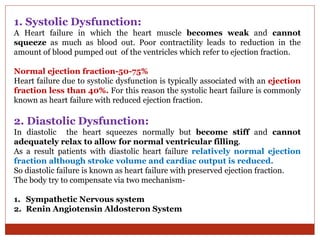
1. Systolic Dysfunction:
A Heart failure in which the heart muscle becomes weak and cannot
squeeze as much as blood out. Poor contractility leads to reduction in the
amount of blood pumped out of the ventricles which refer to ejection fraction.
Normal ejection fraction-50-75%
Heart failure due to systolic dysfunction is typically associated with an ejection
fraction less than 40%. For this reason the systolic heart failure is commonly
known as heart failure with reduced ejection fraction.
2. Diastolic Dysfunction:
In diastolic the heart squeezes normally but become stiff and cannot
adequately relax to allow for normal ventricular filling.
As a result patients with diastolic heart failure relatively normal ejection
fraction although stroke volume and cardiac output is reduced.
So diastolic failure is known as heart failure with preserved ejection fraction.
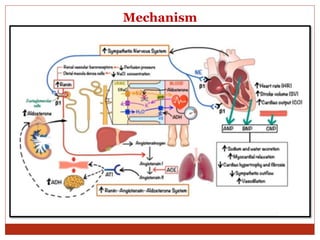
The body try to compensate via two mechanism-
1. Sympathetic Nervous system
2. Renin Angiotensin Aldosteron System
Mechanism
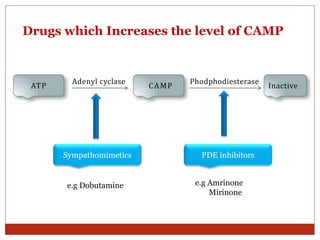
ATP CAMP Inactive
Adenyl cyclase Phodphodiesterase
Sympathomimetics PDE inhibitors
e.g Dobutamine e.g Amrinone
Mirinone
Drugs which Increases the level of CAMP
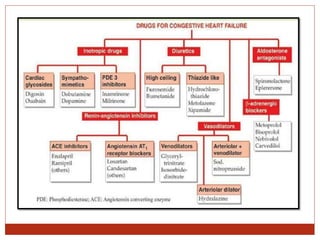
Cardiac Glycosides
They are group of chemically similar compounds that can increase the
contractility of the heart muscle and therefore are used in the
treatment of heart failure.
A. Digitalis
1. Digitalis Purpurea- Digitoxin
2.Digitalis lanata- Digoxin
Family- Scrophulariaceae
B. Strophanthus
1. Strophanthus Kombe- Strophanthin
2. Strophanthus gratus- ovabin
C. Thevetia
1.Thevetia Nerifolia
Apocynacea
D. Squill
Bulb of urgeniea indica kunth.
Family-Liliaceae
Ionotropic Agents: Which increase force of contraction. It Increase
cardiac output e.g Digoxin and Dobutamine
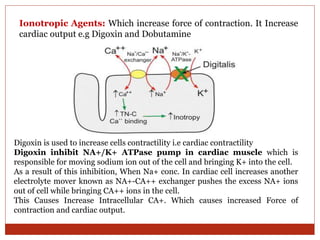
Digoxin is used to increase cells contractility i.e cardiac contractility
Digoxin inhibit NA+/K+ ATPase pump in cardiac muscle which is
responsible for moving sodium ion out of the cell and bringing K+ into the cell.
As a result of this inhibition, When Na+ conc. In cardiac cell increases another
electrolyte mover known as NA+-CA++ exchanger pushes the excess NA+ ions
out of cell while bringing CA++ ions in the cell.
This Causes Increase Intracellular CA+. Which causes increased Force of
contraction and cardiac output.
Pharmacokinetics:
Cardiac Glycosides are high Plasma Protein Bound Drugs.
Hence They have very longer duration of action.
Cardiac Glycosides are having very narrow therapeutic
index. Hence drugs are highly toxic.
Side effects:
1.Hypokalemia
2. Cumulative toxicity
3.Nausea Vomiting
4. Visual Disturbance
Antidote-Digibind
Beta Blockers:
Heart failure is accompanied by an increase activation of sympathetic
nervous system.
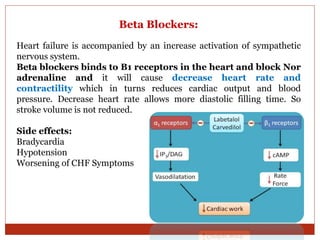
Beta blockers binds to B1 receptors in the heart and block Nor
adrenaline and it will cause decrease heart rate and
contractility which in turns reduces cardiac output and blood
pressure. Decrease heart rate allows more diastolic filling time. So
stroke volume is not reduced.
Side effects:
Bradycardia
Hypotension
Worsening of CHF Symptoms
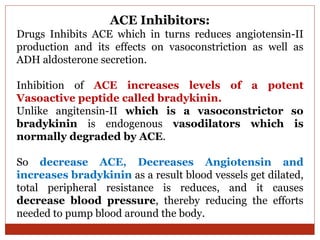
ACE Inhibitors:
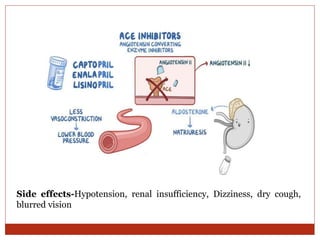
Drugs Inhibits ACE which in turns reduces angiotensin-II
production and its effects on vasoconstriction as well as
ADH aldosterone secretion.
Inhibition of ACE increases levels of a potent
Vasoactive peptide called bradykinin.
Unlike angitensin-II which is a vasoconstrictor so
bradykinin is endogenous vasodilators which is
normally degraded by ACE.
So decrease ACE, Decreases Angiotensin and
increases bradykinin as a result blood vessels get dilated,
total peripheral resistance is reduces, and it causes
decrease blood pressure, thereby reducing the efforts
needed to pump blood around the body.
Side effects-Hypotension, renal insufficiency, Dizziness, dry cough,
blurred vision
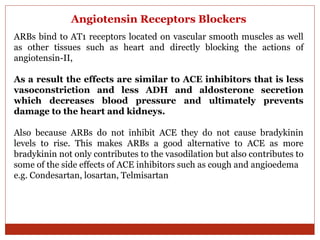
Angiotensin Receptors Blockers
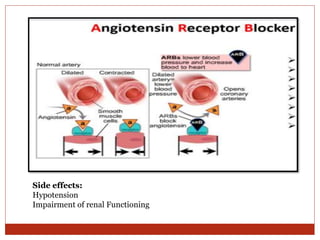
ARBs bind to AT1 receptors located on vascular smooth muscles as well
as other tissues such as heart and directly blocking the actions of
angiotensin-II,
As a result the effects are similar to ACE inhibitors that is less
vasoconstriction and less ADH and aldosterone secretion
which decreases blood pressure and ultimately prevents
damage to the heart and kidneys.
Also because ARBs do not inhibit ACE they do not cause bradykinin
levels to rise. This makes ARBs a good alternative to ACE as more
bradykinin not only contributes to the vasodilation but also contributes to
some of the side effects of ACE inhibitors such as cough and angioedema
e.g. Condesartan, losartan, Telmisartan
Side effects:
Hypotension
Impairment of renal Functioning
Aldosterone Antagonist
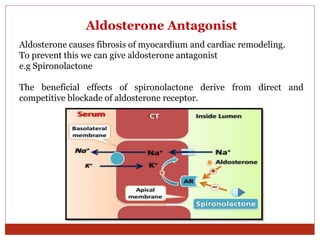
Aldosterone causes fibrosis of myocardium and cardiac remodeling.
To prevent this we can give aldosterone antagonist
e.g Spironolactone
The beneficial effects of spironolactone derive from direct and
competitive blockade of aldosterone receptor.
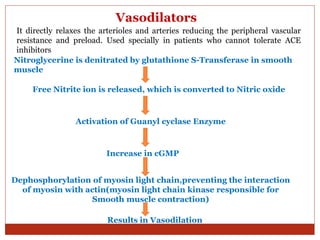
Vasodilators
It directly relaxes the arterioles and arteries reducing the peripheral vascular
resistance and preload. Used specially in patients who cannot tolerate ACE
inhibitors
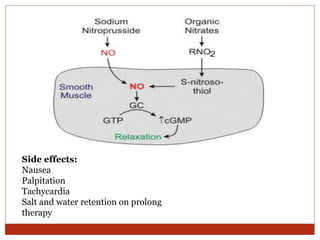
Nitroglycerine is denitrated by glutathione S-Transferase in smooth
muscle
Free Nitrite ion is released, which is converted to Nitric oxide
Activation of Guanyl cyclase Enzyme
Increase in cGMP
Dephosphorylation of myosin light chain,preventing the interaction
of myosin with actin(myosin light chain kinase responsible for
Smooth muscle contraction)
Results in Vasodilation
Side effects:
Nausea
Palpitation
Tachycardia
Salt and water retention on prolong
therapy
THANK YOU

CONGESTIVE HEART FAILURE.pptx

  • 1.
    Prepared by –Shagufta Farooqui Assistant Professor Department of Pharmacology Nanded Pharmacy College, Nanded
  • 2.
    Congestive Heart Failure Itis a Condition Where heart is not able to pump sufficient blood to various parts of the body. It is Chronic progressive Condition where heart is unable to pump blood enough through the body to meet the body’s need for blood and oxygen.
  • 3.
  • 4.
  • 5.
    1. Systolic Dysfunction: AHeart failure in which the heart muscle becomes weak and cannot squeeze as much as blood out. Poor contractility leads to reduction in the amount of blood pumped out of the ventricles which refer to ejection fraction. Normal ejection fraction-50-75% Heart failure due to systolic dysfunction is typically associated with an ejection fraction less than 40%. For this reason the systolic heart failure is commonly known as heart failure with reduced ejection fraction. 2. Diastolic Dysfunction: In diastolic the heart squeezes normally but become stiff and cannot adequately relax to allow for normal ventricular filling. As a result patients with diastolic heart failure relatively normal ejection fraction although stroke volume and cardiac output is reduced. So diastolic failure is known as heart failure with preserved ejection fraction. The body try to compensate via two mechanism- 1. Sympathetic Nervous system 2. Renin Angiotensin Aldosteron System
  • 6.
  • 8.
    ATP CAMP Inactive Adenylcyclase Phodphodiesterase Sympathomimetics PDE inhibitors e.g Dobutamine e.g Amrinone Mirinone Drugs which Increases the level of CAMP
  • 9.
    Cardiac Glycosides They aregroup of chemically similar compounds that can increase the contractility of the heart muscle and therefore are used in the treatment of heart failure. A. Digitalis 1. Digitalis Purpurea- Digitoxin 2.Digitalis lanata- Digoxin Family- Scrophulariaceae B. Strophanthus 1. Strophanthus Kombe- Strophanthin 2. Strophanthus gratus- ovabin C. Thevetia 1.Thevetia Nerifolia Apocynacea D. Squill Bulb of urgeniea indica kunth. Family-Liliaceae
  • 10.
    Ionotropic Agents: Whichincrease force of contraction. It Increase cardiac output e.g Digoxin and Dobutamine Digoxin is used to increase cells contractility i.e cardiac contractility Digoxin inhibit NA+/K+ ATPase pump in cardiac muscle which is responsible for moving sodium ion out of the cell and bringing K+ into the cell. As a result of this inhibition, When Na+ conc. In cardiac cell increases another electrolyte mover known as NA+-CA++ exchanger pushes the excess NA+ ions out of cell while bringing CA++ ions in the cell. This Causes Increase Intracellular CA+. Which causes increased Force of contraction and cardiac output.
  • 11.
    Pharmacokinetics: Cardiac Glycosides arehigh Plasma Protein Bound Drugs. Hence They have very longer duration of action. Cardiac Glycosides are having very narrow therapeutic index. Hence drugs are highly toxic. Side effects: 1.Hypokalemia 2. Cumulative toxicity 3.Nausea Vomiting 4. Visual Disturbance Antidote-Digibind
  • 12.
    Beta Blockers: Heart failureis accompanied by an increase activation of sympathetic nervous system. Beta blockers binds to B1 receptors in the heart and block Nor adrenaline and it will cause decrease heart rate and contractility which in turns reduces cardiac output and blood pressure. Decrease heart rate allows more diastolic filling time. So stroke volume is not reduced. Side effects: Bradycardia Hypotension Worsening of CHF Symptoms
  • 13.
    ACE Inhibitors: Drugs InhibitsACE which in turns reduces angiotensin-II production and its effects on vasoconstriction as well as ADH aldosterone secretion. Inhibition of ACE increases levels of a potent Vasoactive peptide called bradykinin. Unlike angitensin-II which is a vasoconstrictor so bradykinin is endogenous vasodilators which is normally degraded by ACE. So decrease ACE, Decreases Angiotensin and increases bradykinin as a result blood vessels get dilated, total peripheral resistance is reduces, and it causes decrease blood pressure, thereby reducing the efforts needed to pump blood around the body.
  • 14.
    Side effects-Hypotension, renalinsufficiency, Dizziness, dry cough, blurred vision
  • 15.
    Angiotensin Receptors Blockers ARBsbind to AT1 receptors located on vascular smooth muscles as well as other tissues such as heart and directly blocking the actions of angiotensin-II, As a result the effects are similar to ACE inhibitors that is less vasoconstriction and less ADH and aldosterone secretion which decreases blood pressure and ultimately prevents damage to the heart and kidneys. Also because ARBs do not inhibit ACE they do not cause bradykinin levels to rise. This makes ARBs a good alternative to ACE as more bradykinin not only contributes to the vasodilation but also contributes to some of the side effects of ACE inhibitors such as cough and angioedema e.g. Condesartan, losartan, Telmisartan
  • 16.
  • 17.
    Aldosterone Antagonist Aldosterone causesfibrosis of myocardium and cardiac remodeling. To prevent this we can give aldosterone antagonist e.g Spironolactone The beneficial effects of spironolactone derive from direct and competitive blockade of aldosterone receptor.
  • 18.
    Vasodilators It directly relaxesthe arterioles and arteries reducing the peripheral vascular resistance and preload. Used specially in patients who cannot tolerate ACE inhibitors Nitroglycerine is denitrated by glutathione S-Transferase in smooth muscle Free Nitrite ion is released, which is converted to Nitric oxide Activation of Guanyl cyclase Enzyme Increase in cGMP Dephosphorylation of myosin light chain,preventing the interaction of myosin with actin(myosin light chain kinase responsible for Smooth muscle contraction) Results in Vasodilation
  • 19.
  • 20.