HYPERTENSION
By
NGULAKEH BLAISE ALOT
HND,BNS,MAR1
PLAN OF WORK
 Introduction
 Definition
 Classification/types of hypertension
 Risk factors
 Pathophysiology
 Clinical manifestation
 Assessment and Diagnosis
 Management
 Hypertensive Crisis
 Complications
 Conclusion
INTRODUCTION
 Blood pressure is the force exerted by
circulating blood against the walls of the
body’s arteries, the major blood vessels
in the body. Hypertension is when blood
pressure is too high.
 Blood pressure is written as two
numbers. The first “systolic”
(represents the pressure in blood
vessels when the heart contracts or
beats
 The second “diastolic” (represents the
pressure in the vessels when the heart
rest between beats).
INTRODUCTION
 Blood pressure is the product of cardiac
output multiplied by peripheral resistance.
 BP= CO x PVR
 Cardiac output is the product of the heart
rate multiplied by the stroke volume
 CO= HR x SV
 High blood pressure, known as
hypertension, can result from a change in
cardiac output, a change in peripheral
resistance, or both.
DEFINITION
 Hypertension is a systolic blood
pressure greater than 140 mmHg and
a diastolic pressure greater than 90
mmHg over a sustained period, based
on the average of two or more blood
pressure measurements taken in two
or more contacts with the health care
provider after an initial screening.
CLASSIFICATION/TYPES OF
HYPERTENSION
Primary hypertension
 Also called essential hypertension
 This is the type of hypertension in
which the reason for the elevation in
blood pressure is idiopathic.
 This form of high blood pressure is
often due to obesity, family history and
unhealthy diet. The condition is
reversible with life style changes and
drugs
CLASSIFICATION/TYPES OF
HYPERTENSION
Secondary hypertension
 Secondary hypertension is high blood
pressure caused by another condition
or disease.
 Conditions that may cause secondary
hypertension include kidney and
adrenal disease, thyroid problems and
obstructive sleep apnea.
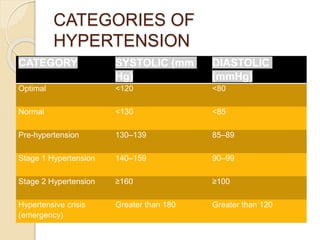
CATEGORIES OF
HYPERTENSION
CATEGORY SYSTOLIC (mm
Hg)
DIASTOLIC
(mmHg)
Optimal <120 <80
Normal <130 <85
Pre-hypertension 130–139 85–89
Stage 1 Hypertension 140–159 90–99
Stage 2 Hypertension ≥160 ≥100
Hypertensive crisis
(emergency)
Greater than 180 Greater than 120
RISK FATORS
 Obesity
 Age: above 50 years of age
 Alcohol, smoking and diabetes
mellitus
 Family history
 Sedentary life style
 Diet: excessive intake of sodium(salt)
 Stress
 Gender(greater in men than in
women)
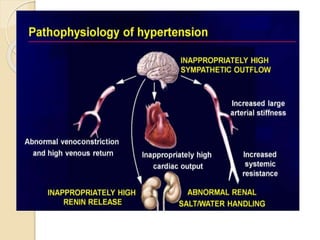
PATHOPHYSIOLOGY
 hypertension is a multifactorial
condition and the specific cause is not
known.
 For hypertension to occur, there must
be a change in one or more factors
affecting peripheral resistance or
cardiac output.
 Stimulation of the vas-motor center
results in impulses travelling down
over the sympathetic nervous system
PATHOPHYSIOLOGY
 There is the release of catecholamines;(
adrenaline and nor-adrenaline) which result in
constriction of blood vessels.
 At the same time the sympathetic nervous
system to blood vessels is stimulated and the
adrenal medulla.
 Vasoconstrictor effects also result to ischaemia of
the kidney releasing renin. Renin helps in the
conversion of angiotensinogen to angiotensin (II),
which is a potent vasoconstrictor.
 This angiotensin in turn stimulate the release of
Aldosterone by the adrenal medulla.
 This hormone then increase sodium and water
retention by kidney tubules
PATHOPHYSIOLOGY
 This in turn increase water and electrolyte
concentration in blood vessel wall to a level
which enhance vasoconstriction response of
the blood vessel.
 When artherosclerotic disease of the large
blood vessel occurs in addition to HTA, the
prognosis is poorer. Vasoconstrictor effect in
the brain leads to thrombosis causing
thrombo-embolic stroke or cerebro vascular
accident (CVA).
 Increase pressure in the blood vessel of the
brain may lead to rupture i.e hemorrhagic
stroke
CLINICAL MANIFESTATIONS
 Hypertension is
sometimes called
“the silent killer”
because people who
have it are often
symptom free.
 Some patients may
manifest the
following:
 retinal changes
 Left ventricular
hypertrophy
 Pathologic changes
in the kidneys
 Dizziness
 Chest pain
 Severe headache
 Irregular heart beat
 Blurred vision
 Fatigue
 Nausea/vomiting
 Papilledema
ASSESSMENT AND
DIAGNOSTIC EVALUATION
 History collection and physical examination: The retinas and
other related part are examined, and laboratory studies are
performed to assess possible target organ damage.
 Para clinical examinations: Routine examinations include:
 urinalysis, blood chemistry (ie, analysis of sodium, potassium,
creatinine,
 fasting glucose
 Total and high-density lipoprotein [HDL] cholesterol levels),
 lead electrocardiogram.
 Left ventricular hypertrophy can be assessed by echocardiography.
 Renal damage may be suggested by elevations in BUN and
creatinine levels or by microalbuminuria or macroalbuminuria.
Additional studies, such as creatinine clearance, renin level, urine
tests, and 24-hour urine protein, may be performed
MANAGEMENT
 Drugs alone cannot be used to
manage hypertension; treatment of
hypertension can be classified into two
Life style/dietary modifications
Pharmacological therapy
MANAGEMENT
Life style/dietary modifications
 The life style modifications needed to
be employed in the management of
hypertension include:
 Exercise
 Dietary sodium reduction
 Mechanisms to reduce weight
 Stress management measures
 Avoidance of a sedentary life style
MANAGEMENT
 PHARMACOLOGIC THERAPY
 For patients with uncomplicated
hypertension and no specific indications
for another medication, the
recommended initial medications include
diuretics, beta-blockers, or calcium
channel blockers.
 Patients are first given low doses of
medication. If blood pressure does not
fall to less than 140/90 mm Hg, the dose
is increased gradually, and additional
medications are included as necessary
to achieve control.
MANAGEMENT
 Drugs commonly used in the
treatment of hypertension:
1. Diuretics
2. Calcium channel blockers
3. Beta-Blockers propranolol)
4. Angiotensin II Receptor Blockers
5. Angiotensin-Converting Enzyme
Inhibitors
1
Diuretics
MANAGEMENT
a) Thiazide Diuretics
 Major Action: Decrease of blood volume, renal
blood flow, and cardiac output Depletion of
extracellular fluid Negative sodium balance (from
natriuresis), mild hypokalemia Directly affect
vascular smooth muscle
 Advantages: Effective orally, effective during
long-term administration, Mild side effects
Enhance other antihypertensive medications,
Counter sodium retention effect of other
antihypertensive medications.
 Contraindications: Gout, known sensitivity to
sulfonamide derived medications, and severely
impaired kidney function
MANAGEMENT
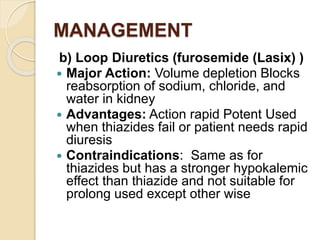
b) Loop Diuretics (furosemide (Lasix) )
 Major Action: Volume depletion Blocks
reabsorption of sodium, chloride, and
water in kidney
 Advantages: Action rapid Potent Used
when thiazides fail or patient needs rapid
diuresis
 Contraindications: Same as for
thiazides but has a stronger hypokalemic
effect than thiazide and not suitable for
prolong used except other wise
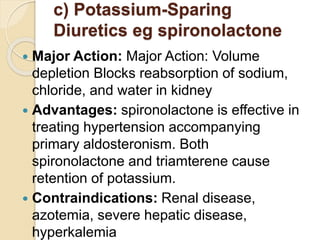
c) Potassium-Sparing
Diuretics eg spironolactone
 Major Action: Major Action: Volume
depletion Blocks reabsorption of sodium,
chloride, and water in kidney
 Advantages: spironolactone is effective in
treating hypertension accompanying
primary aldosteronism. Both
spironolactone and triamterene cause
retention of potassium.
 Contraindications: Renal disease,
azotemia, severe hepatic disease,
hyperkalemia
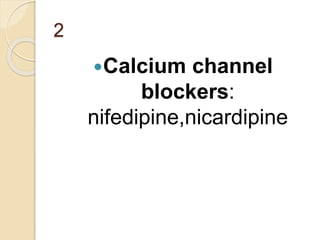
2
Calcium channel
blockers:
nifedipine,nicardipine
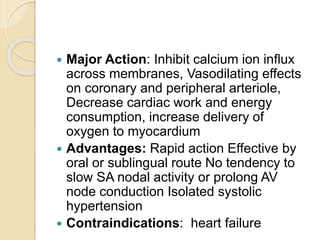
 Major Action: Inhibit calcium ion influx
across membranes, Vasodilating effects
on coronary and peripheral arteriole,
Decrease cardiac work and energy
consumption, increase delivery of
oxygen to myocardium
 Advantages: Rapid action Effective by
oral or sublingual route No tendency to
slow SA nodal activity or prolong AV
node conduction Isolated systolic
hypertension
 Contraindications: heart failure
 3. Angiotensin-Converting Enzyme
Inhibitors eg captopril
 Major Action: Inhibits conversion of
angiotensin I to angiotensin II Lower total
peripheral resistance
 Advantages: Fewer cardiovascular side
effects Can be used with thiazide diuretic
and digitalis Hypotension can be reversed
by fluid replacement.
 Contraindications: Renal impairment,
pregnancy
 4. Angiotensin II Receptor Blocker
e.g candesartan
 Major Action: Major Action: Block the
effects of angiotensin II at the receptor
Reduce peripheral resistance
 Advantages: Minimal side effects.
 Contraindications: : Pregnancy,
renovascular disease
 Effects and nursing considerations:
Monitor for hypokalemia
5.
 BETA-BLOCKERS
E,g propanolol
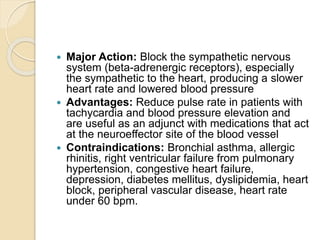
 Major Action: Block the sympathetic nervous
system (beta-adrenergic receptors), especially
the sympathetic to the heart, producing a slower
heart rate and lowered blood pressure
 Advantages: Reduce pulse rate in patients with
tachycardia and blood pressure elevation and
are useful as an adjunct with medications that act
at the neuroeffector site of the blood vessel
 Contraindications: Bronchial asthma, allergic
rhinitis, right ventricular failure from pulmonary
hypertension, congestive heart failure,
depression, diabetes mellitus, dyslipidemia, heart
block, peripheral vascular disease, heart rate
under 60 bpm.
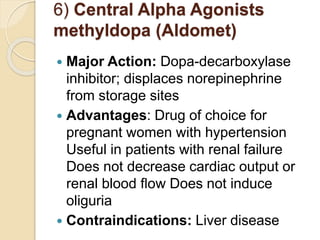
6) Central Alpha Agonists
methyldopa (Aldomet)
 Major Action: Dopa-decarboxylase
inhibitor; displaces norepinephrine
from storage sites
 Advantages: Drug of choice for
pregnant women with hypertension
Useful in patients with renal failure
Does not decrease cardiac output or
renal blood flow Does not induce
oliguria
 Contraindications: Liver disease
HYPERTENSIVE CRISES
Definition
 It is a clinical syndrome that is
associated with abrupt increase in
blood pressure, relative to the
patient’s baseline, causing acute or
rapidly progressing end-organ
damage.
 There are two hypertensive crises that
require immediate intervention:
Hypertensive emergency and
Hypertensive urgency.
HYPERTENSIVE CRISES
 Hypertensive emergencies and
urgencies may occur in patients
whose hypertension has been poorly
controlled or in those who have
abruptly discontinued their
medications.
HYPERTENSIVE CRISES
 Hypertensive Emergency
 It is a severe elevation in blood pressure(above
180/120mmHg) complicated by impending or
progressive target organ dysfuntion involving
neurological, cardiac or renal systems
 Conditions associated with hypertensive
emergency include acute myocardial infarction,
dissecting aortic aneurysm, and intracranial
hemorrhage.
 The medications of choice in hypertensive
emergencies are those that have an immediate
effect such as Intravenous vasodilators, including
sodium nitroprusside (Nipride, Nitropress),
nicardipine hydrochloride
HYPERTENSIVE CRISES
Hypertensive Urgency
 It is a situation in which there is acute
severe elevation in blood pressure above
180/120mmHg without evidence of end
stage organ damage.
 Hypertensive urgencies are managed with
oral doses of fast-acting agents such as
loop diuretics (bumetanide [Bumex],
furosemide [Lasix]), beta-blockers
propranolol (Inderal), Metoprolol
(Lopressor), Nadolol (Corgard),
NURSING MANAGEMENT
 Nursing management of a
hypertensive patient follows the
nursing process. A complete
assessment of the patient is
necessary in other to establish a good
nursing diagnosis.
 The role of diet and life style
modification should be given. IEC of
the patient’s condition should also be
given particular attention.
NURSING MANAGEMENT
NURSING DIAGNOSES
 Based on the assessment data,
nursing diagnoses for the patient may
include the following:
Deficient knowledge regarding the
relation between the treatment
regimen and control of the disease
process
Non compliance with therapeutic
regimen related to side effects of
prescribed therapy
NURSING MANAGEMENT
 NURSING DIAGNOSES
Insufficient physiological or
psychological energy to endure or
complete required daily activity
evidence by weakness ECG changes
Intake of nutrients that exceeds
metabolic needs, evidence by a 10-
20% increase in weight more than the
ideal for his/her height and frame.
COMPLICATIONS
 Left ventricular hypertrophy
 Myocardial infarction Heart failure
 TIAs
 Cerebrovascular accident (stroke or
brain attack)
 Renal insufficiency and failure
 Retinal hemorrhage
CONLUSION
 “The silent killer” as it is often called
because most people who have it are
often symptom free is a chronic disease
in which proper management is essential
for a healthy life. It is important that,
regular monitoring of blood pressure be
practice by all adult and those with family
history for hypertension in order to early
diagnosed any existing HTA and initiate
early treatment hence preventing it
complications and enhancing the quality
of life
hypertension.pptx

hypertension.pptx

  • 1.
  • 2.
    PLAN OF WORK Introduction  Definition  Classification/types of hypertension  Risk factors  Pathophysiology  Clinical manifestation  Assessment and Diagnosis  Management  Hypertensive Crisis  Complications  Conclusion
  • 3.
    INTRODUCTION  Blood pressureis the force exerted by circulating blood against the walls of the body’s arteries, the major blood vessels in the body. Hypertension is when blood pressure is too high.  Blood pressure is written as two numbers. The first “systolic” (represents the pressure in blood vessels when the heart contracts or beats  The second “diastolic” (represents the pressure in the vessels when the heart rest between beats).
  • 4.
    INTRODUCTION  Blood pressureis the product of cardiac output multiplied by peripheral resistance.  BP= CO x PVR  Cardiac output is the product of the heart rate multiplied by the stroke volume  CO= HR x SV  High blood pressure, known as hypertension, can result from a change in cardiac output, a change in peripheral resistance, or both.
  • 5.
    DEFINITION  Hypertension isa systolic blood pressure greater than 140 mmHg and a diastolic pressure greater than 90 mmHg over a sustained period, based on the average of two or more blood pressure measurements taken in two or more contacts with the health care provider after an initial screening.
  • 6.
    CLASSIFICATION/TYPES OF HYPERTENSION Primary hypertension Also called essential hypertension  This is the type of hypertension in which the reason for the elevation in blood pressure is idiopathic.  This form of high blood pressure is often due to obesity, family history and unhealthy diet. The condition is reversible with life style changes and drugs
  • 7.
    CLASSIFICATION/TYPES OF HYPERTENSION Secondary hypertension Secondary hypertension is high blood pressure caused by another condition or disease.  Conditions that may cause secondary hypertension include kidney and adrenal disease, thyroid problems and obstructive sleep apnea.
  • 8.
    CATEGORIES OF HYPERTENSION CATEGORY SYSTOLIC(mm Hg) DIASTOLIC (mmHg) Optimal <120 <80 Normal <130 <85 Pre-hypertension 130–139 85–89 Stage 1 Hypertension 140–159 90–99 Stage 2 Hypertension ≥160 ≥100 Hypertensive crisis (emergency) Greater than 180 Greater than 120
  • 9.
    RISK FATORS  Obesity Age: above 50 years of age  Alcohol, smoking and diabetes mellitus  Family history  Sedentary life style  Diet: excessive intake of sodium(salt)  Stress  Gender(greater in men than in women)
  • 10.
    PATHOPHYSIOLOGY  hypertension isa multifactorial condition and the specific cause is not known.  For hypertension to occur, there must be a change in one or more factors affecting peripheral resistance or cardiac output.  Stimulation of the vas-motor center results in impulses travelling down over the sympathetic nervous system
  • 11.
    PATHOPHYSIOLOGY  There isthe release of catecholamines;( adrenaline and nor-adrenaline) which result in constriction of blood vessels.  At the same time the sympathetic nervous system to blood vessels is stimulated and the adrenal medulla.  Vasoconstrictor effects also result to ischaemia of the kidney releasing renin. Renin helps in the conversion of angiotensinogen to angiotensin (II), which is a potent vasoconstrictor.  This angiotensin in turn stimulate the release of Aldosterone by the adrenal medulla.  This hormone then increase sodium and water retention by kidney tubules
  • 12.
    PATHOPHYSIOLOGY  This inturn increase water and electrolyte concentration in blood vessel wall to a level which enhance vasoconstriction response of the blood vessel.  When artherosclerotic disease of the large blood vessel occurs in addition to HTA, the prognosis is poorer. Vasoconstrictor effect in the brain leads to thrombosis causing thrombo-embolic stroke or cerebro vascular accident (CVA).  Increase pressure in the blood vessel of the brain may lead to rupture i.e hemorrhagic stroke
  • 14.
    CLINICAL MANIFESTATIONS  Hypertensionis sometimes called “the silent killer” because people who have it are often symptom free.  Some patients may manifest the following:  retinal changes  Left ventricular hypertrophy  Pathologic changes in the kidneys  Dizziness  Chest pain  Severe headache  Irregular heart beat  Blurred vision  Fatigue  Nausea/vomiting  Papilledema
  • 15.
    ASSESSMENT AND DIAGNOSTIC EVALUATION History collection and physical examination: The retinas and other related part are examined, and laboratory studies are performed to assess possible target organ damage.  Para clinical examinations: Routine examinations include:  urinalysis, blood chemistry (ie, analysis of sodium, potassium, creatinine,  fasting glucose  Total and high-density lipoprotein [HDL] cholesterol levels),  lead electrocardiogram.  Left ventricular hypertrophy can be assessed by echocardiography.  Renal damage may be suggested by elevations in BUN and creatinine levels or by microalbuminuria or macroalbuminuria. Additional studies, such as creatinine clearance, renin level, urine tests, and 24-hour urine protein, may be performed
  • 16.
    MANAGEMENT  Drugs alonecannot be used to manage hypertension; treatment of hypertension can be classified into two Life style/dietary modifications Pharmacological therapy
  • 17.
    MANAGEMENT Life style/dietary modifications The life style modifications needed to be employed in the management of hypertension include:  Exercise  Dietary sodium reduction  Mechanisms to reduce weight  Stress management measures  Avoidance of a sedentary life style
  • 18.
    MANAGEMENT  PHARMACOLOGIC THERAPY For patients with uncomplicated hypertension and no specific indications for another medication, the recommended initial medications include diuretics, beta-blockers, or calcium channel blockers.  Patients are first given low doses of medication. If blood pressure does not fall to less than 140/90 mm Hg, the dose is increased gradually, and additional medications are included as necessary to achieve control.
  • 19.
    MANAGEMENT  Drugs commonlyused in the treatment of hypertension: 1. Diuretics 2. Calcium channel blockers 3. Beta-Blockers propranolol) 4. Angiotensin II Receptor Blockers 5. Angiotensin-Converting Enzyme Inhibitors
  • 20.
  • 21.
    MANAGEMENT a) Thiazide Diuretics Major Action: Decrease of blood volume, renal blood flow, and cardiac output Depletion of extracellular fluid Negative sodium balance (from natriuresis), mild hypokalemia Directly affect vascular smooth muscle  Advantages: Effective orally, effective during long-term administration, Mild side effects Enhance other antihypertensive medications, Counter sodium retention effect of other antihypertensive medications.  Contraindications: Gout, known sensitivity to sulfonamide derived medications, and severely impaired kidney function
  • 22.
    MANAGEMENT b) Loop Diuretics(furosemide (Lasix) )  Major Action: Volume depletion Blocks reabsorption of sodium, chloride, and water in kidney  Advantages: Action rapid Potent Used when thiazides fail or patient needs rapid diuresis  Contraindications: Same as for thiazides but has a stronger hypokalemic effect than thiazide and not suitable for prolong used except other wise
  • 23.
    c) Potassium-Sparing Diuretics egspironolactone  Major Action: Major Action: Volume depletion Blocks reabsorption of sodium, chloride, and water in kidney  Advantages: spironolactone is effective in treating hypertension accompanying primary aldosteronism. Both spironolactone and triamterene cause retention of potassium.  Contraindications: Renal disease, azotemia, severe hepatic disease, hyperkalemia
  • 24.
  • 25.
     Major Action:Inhibit calcium ion influx across membranes, Vasodilating effects on coronary and peripheral arteriole, Decrease cardiac work and energy consumption, increase delivery of oxygen to myocardium  Advantages: Rapid action Effective by oral or sublingual route No tendency to slow SA nodal activity or prolong AV node conduction Isolated systolic hypertension  Contraindications: heart failure
  • 26.
     3. Angiotensin-ConvertingEnzyme Inhibitors eg captopril
  • 27.
     Major Action:Inhibits conversion of angiotensin I to angiotensin II Lower total peripheral resistance  Advantages: Fewer cardiovascular side effects Can be used with thiazide diuretic and digitalis Hypotension can be reversed by fluid replacement.  Contraindications: Renal impairment, pregnancy
  • 28.
     4. AngiotensinII Receptor Blocker e.g candesartan
  • 29.
     Major Action:Major Action: Block the effects of angiotensin II at the receptor Reduce peripheral resistance  Advantages: Minimal side effects.  Contraindications: : Pregnancy, renovascular disease  Effects and nursing considerations: Monitor for hypokalemia
  • 30.
  • 31.
     Major Action:Block the sympathetic nervous system (beta-adrenergic receptors), especially the sympathetic to the heart, producing a slower heart rate and lowered blood pressure  Advantages: Reduce pulse rate in patients with tachycardia and blood pressure elevation and are useful as an adjunct with medications that act at the neuroeffector site of the blood vessel  Contraindications: Bronchial asthma, allergic rhinitis, right ventricular failure from pulmonary hypertension, congestive heart failure, depression, diabetes mellitus, dyslipidemia, heart block, peripheral vascular disease, heart rate under 60 bpm.
  • 32.
    6) Central AlphaAgonists methyldopa (Aldomet)  Major Action: Dopa-decarboxylase inhibitor; displaces norepinephrine from storage sites  Advantages: Drug of choice for pregnant women with hypertension Useful in patients with renal failure Does not decrease cardiac output or renal blood flow Does not induce oliguria  Contraindications: Liver disease
  • 33.
  • 34.
    Definition  It isa clinical syndrome that is associated with abrupt increase in blood pressure, relative to the patient’s baseline, causing acute or rapidly progressing end-organ damage.  There are two hypertensive crises that require immediate intervention: Hypertensive emergency and Hypertensive urgency.
  • 35.
    HYPERTENSIVE CRISES  Hypertensiveemergencies and urgencies may occur in patients whose hypertension has been poorly controlled or in those who have abruptly discontinued their medications.
  • 36.
    HYPERTENSIVE CRISES  HypertensiveEmergency  It is a severe elevation in blood pressure(above 180/120mmHg) complicated by impending or progressive target organ dysfuntion involving neurological, cardiac or renal systems  Conditions associated with hypertensive emergency include acute myocardial infarction, dissecting aortic aneurysm, and intracranial hemorrhage.  The medications of choice in hypertensive emergencies are those that have an immediate effect such as Intravenous vasodilators, including sodium nitroprusside (Nipride, Nitropress), nicardipine hydrochloride
  • 37.
    HYPERTENSIVE CRISES Hypertensive Urgency It is a situation in which there is acute severe elevation in blood pressure above 180/120mmHg without evidence of end stage organ damage.  Hypertensive urgencies are managed with oral doses of fast-acting agents such as loop diuretics (bumetanide [Bumex], furosemide [Lasix]), beta-blockers propranolol (Inderal), Metoprolol (Lopressor), Nadolol (Corgard),
  • 38.
    NURSING MANAGEMENT  Nursingmanagement of a hypertensive patient follows the nursing process. A complete assessment of the patient is necessary in other to establish a good nursing diagnosis.  The role of diet and life style modification should be given. IEC of the patient’s condition should also be given particular attention.
  • 39.
    NURSING MANAGEMENT NURSING DIAGNOSES Based on the assessment data, nursing diagnoses for the patient may include the following: Deficient knowledge regarding the relation between the treatment regimen and control of the disease process Non compliance with therapeutic regimen related to side effects of prescribed therapy
  • 40.
    NURSING MANAGEMENT  NURSINGDIAGNOSES Insufficient physiological or psychological energy to endure or complete required daily activity evidence by weakness ECG changes Intake of nutrients that exceeds metabolic needs, evidence by a 10- 20% increase in weight more than the ideal for his/her height and frame.
  • 41.
    COMPLICATIONS  Left ventricularhypertrophy  Myocardial infarction Heart failure  TIAs  Cerebrovascular accident (stroke or brain attack)  Renal insufficiency and failure  Retinal hemorrhage
  • 42.
    CONLUSION  “The silentkiller” as it is often called because most people who have it are often symptom free is a chronic disease in which proper management is essential for a healthy life. It is important that, regular monitoring of blood pressure be practice by all adult and those with family history for hypertension in order to early diagnosed any existing HTA and initiate early treatment hence preventing it complications and enhancing the quality of life