Pharmacotherapy
Hypertension
RVS Chaitanya koppala
Defined as:
Condition where blood pressure is elevated to an extent that
clinical benefit is obtained from blood pressure lowering
&
140/90 mmHg is considered the upper limit of normal
(treatment threshold or targets)
• Hypertension is largely a condition of older individuals
• Diastolic pressure peaks at age of 50
• Systolic pressure continues to increase with advancing age
• Risk of cardiovascular disease double for every 20/10mmHg rise in
blood pressure
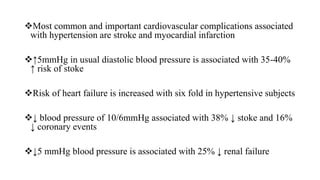
Most common and important cardiovascular complications associated
with hypertension are stroke and myocardial infarction
↑5mmHg in usual diastolic blood pressure is associated with 35-40%
↑ risk of stoke
Risk of heart failure is increased with six fold in hypertensive subjects
↓ blood pressure of 10/6mmHg associated with 38% ↓ stoke and 16%
↓ coronary events
↓5 mmHg blood pressure is associated with 25% ↓ renal failure
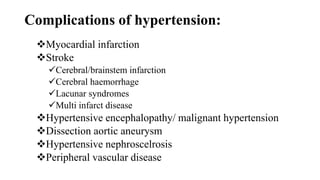
Complications of hypertension:
Myocardial infarction
Stroke
Cerebral/brainstem infarction
Cerebral haemorrhage
Lacunar syndromes
Multi infarct disease
Hypertensive encephalopathy/ malignant hypertension
Dissection aortic aneurysm
Hypertensive nephroscelrosis
Peripheral vascular disease
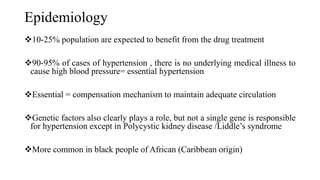
Epidemiology
10-25% population are expected to benefit from the drug treatment
90-95% of cases of hypertension , there is no underlying medical illness to
cause high blood pressure= essential hypertension
Essential = compensation mechanism to maintain adequate circulation
Genetic factors also clearly plays a role, but not a single gene is responsible
for hypertension except in Polycystic kidney disease /Liddle’s syndrome
More common in black people of African (Caribbean origin)
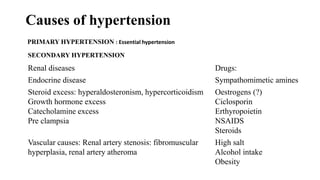
Causes of hypertension
PRIMARY HYPERTENSION : Essential hypertension
SECONDARY HYPERTENSION
Renal diseases Drugs:
Endocrine disease Sympathomimetic amines
Steroid excess: hyperaldosteronism, hypercorticoidism
Growth hormone excess
Catecholamine excess
Pre clampsia
Oestrogens (?)
Ciclosporin
Erthyropoietin
NSAIDS
Steroids
Vascular causes: Renal artery stenosis: fibromuscular
hyperplasia, renal artery atheroma
High salt
Alcohol intake
Obesity
Regulation of Blood pressure
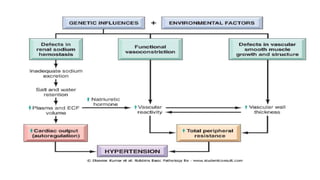
Mean blood pressure is the product of Cardiac output and total
peripheral resistance
In most hypertensive individuals no change in cardiac output but
increase in peripheral resistance (?)
Control of blood pressure is important and number of homeostatic
reflexes are evolved to provide the BP homeostatis
Minute to minute increase in BP – baroreceptor reflex
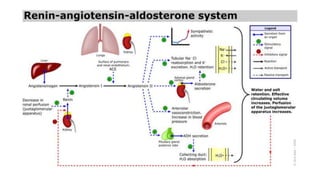
Longer term regulation – renin-angiotensin- aldosterone system(salt,
water and blood pressure control)
Long term increase in shear stress also causes the vascular remodeling
Nitric oxide overcome by increased sensitivity to vasoconstrictor
endothelin (increases peripheral resistance)
Atrial natriuretic peptide
Bradykinin
Antidiuretic hormone
Clinical presentation
• Severe cases may present – Headache, visual disturbance or evidence
of target organ damage ( stroke, ischaemic heart disease or renal
failure)
• Malignant hypertension : accelerated/uncommon/ emergency, usually
>220/120mmHg evidence of Small vessel damage
• Fundoscopy: papilloedema (optic disc swelling), haemorrhages and
exudates
• Renal damage: haematuria, proteinuria and impaired renal function
• Hypertensive encephalopathy: small vessel damage in brain/ cerebral
oedema- confusion, headache, visual loss, seizures and coma
• MRI shows extensive white matter changes
• Requires hospital admission and rapid control of blood pressure over
12-24h towards normal levels
Management of hypertension
Diagnosis of hypertension:
All adults have their blood pressure check for every 5 years
Those with high blood pressure 130-139mmHg systolic and 85-89 mmHg
diastolic should have annual measurement
Measurement of blood pressure:
Well maintained sphygmomanometer of validated accuracy
Measured in both arms
In sitting and standing positions
In relaxed condition
Accurate sized cuff should be used
White coat hypertension (?)
Assessment of hypertensive patient
Secondary causes
Contributing factors:
Evidence of end organ damage
Determination of cardiovascular risk
Secondary causes
Renal damage (haematuria, polyuria)
Phaeochromocytoma (headache, postural dizziness, syncope)
Physical examination: abdominal bruits (renal artery stenosis)
Radiofemoral delay (coarctation of aorta)
Palpable kidneys (polycystic kidney disease)
Laboratory analysis (full blood count, electrolytes , urea , creatinine
and urinalysis)
Ultrasound of abdomen
Isotope regimen for suspected renal disease
• Renin levels suppressed by Beta blockers
• Aldosterone by ACE inhibiotors and receptor antagonists
• Very high aldosterone /renin ratio- conn’s syndrome or primary
hyperaldosteronism, cause by benign adenoma/ simple hyperphlasia
• CT/ MRI scanning shows images of tumours
Contributing factors:
Should be assessed for possible contributing factors and possible
factors such as obesity, excess alcohol or excess salt intake and lack of
exercise
Provoked by use of drugs (OTC drugs cold and flu remedies)
Smoking, diabetes and hyperlipidaemia
Family history of cardiovascular disease
Evidence of end organ damage:
Optic fundi- retinal damage
ECG – detect left ventricular hypertrophy/ ischaemic heart disease
Urine analysis for microalbuminaria (indicator of higher risk of future
end stage renal disease and overall vascular risk)
Determination of cardiovascular risk:
Patients with documented atheromatous vascular disease
(MI/Stroke/angina/ peripheral vascular disease)
Type 2 Diabetes over 40 years of age = coronary equivalent
Non diabetic patients with MI
Non diabetic patients without cardiovascular disease necessary to
estimate the cardiovascular risk (microalbuminuria increase 2-3 folds
cardiovascular risk)
Treatment
Non pharmacological approaches
Pharmacological approaches
Ancillary drug treatment
Non pharmacological treatment
• Patients with mild hypertension in the range of 140-159/90-100mmHg
offered lifestyle advice
• Over weight- weight loss reduces BP about 2.5/1.5mmHg/kg
• DASH (dietary approaches to stop hypertension) found to lower BP
significantly 4.5/2.7mmHg
• DASH- fruit, vegetables, low fat dairy products, fish, low fat poultry
and whole grains, minimizing red meat, confectionary and sweetened
drinks
• Subjects should reduce their salt intake (6g NaCl)
• Significant hidden salt in the processed meat, ready meals, cheese and even
bread
• Control intake of calories and saturated fat
• Regular aerobic exercise (min 30mins)
• Alcohol intake 2 units for females and 3 units for male
• Smoking should be quit, or else reduce the units
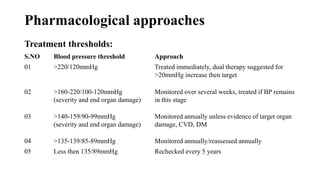
Pharmacological approaches
Treatment thresholds:
S.NO Blood pressure threshold Approach
01 >220/120mmHg Treated immediately, dual therapy suggested for
>20mmHg increase then target
02 >160-220/100-120mmHg
(severity and end organ damage)
Monitored over several weeks, treated if BP remains
in this stage
03 >140-159/90-99mmHg
(severity and end organ damage)
Monitored annually unless evidence of target organ
damage, CVD, DM
04 >135-139/85-89mmHg Monitored annually/reassessed annually
05 Less then 135/89mmHg Rechecked every 5 years
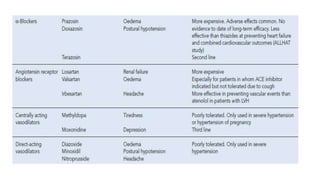
Other agents:
Minoxidil: powerful antihypertensive drug, indicated in severe
peripheral oedema and reflex tachycardia (* women ?)
Hydralazine: add on for resistant hypertension therapy
Sodium nitroprusside: direct acting arterial and venous dilator /
intravenous infusion/ blood pressure during anaesthesia
Aliskiren: ? antagonist
Darusentan: endothelin antagonist undergoing clinical trials in
resistant hypertension.
Ancillary treatment
ASPIRIN:
• Use reduces CV events at the expense of an increase in GIT complications
• Blood pressure should be controlled (<150/90mmHg) before aspirin.
• It should be restricted to the patients who have no contraindication and
either :
Evidence of established vascular disease
No evident of CVD but who are over 50 yrs of age
No evident of target organ damage
10 year CVD risk >20%
Lipid lowering therapy:
• Increasing evidence from the clinical trials of the benefit of lipid
lowering drug treatment in patients with hypertension
• Atorvastatin 10mg reduction in CHD and stroke
• LLT with statins should be prescribed to patients
Under 80 years of age
With cholesterol >3.5mmol/L,
Pre existing vascular disease,
10 years CV risk of >20%
Drug selection:
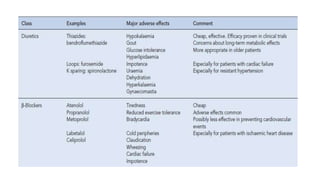
Drugs should be chosen on the basis of efficacy, safety, convenience and
cost
Efficacy:
Evidence from the large scale clinical trials
Short term studies only generates hypothesis and should be used to change
current strategies
Safety:
Drugs need to take on long term, so should be with long established safety
records
Recognize the importance of symptomatic adverse effects since these may
reduce adherance
Convenience:
Once daily preparation is more adherence than more frequent regimens
Conscious of the cost of individual preparations
Combination of low doses of anti hypertensive drugs are often better
tolerated than single drugs taken in large doses
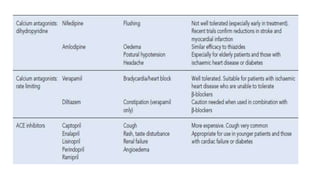
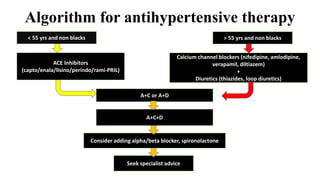
Algorithm for antihypertensive therapy
< 55 yrs and non blacks > 55 yrs and non blacks
ACE Inhibitors
(capto/enala/lisino/perindo/rami-PRIL)
Calcium channel blockers (nifedipine, amlodipine,
verapamil, diltiazem)
+
Diuretics (thiazides, loop diuretics)
A+C or A+D
A+C+D
Consider adding alpha/beta blocker, spironolactone
Seek specialist advice
Thank you

Pharmacotherapy for hypertension

  • 1.
  • 2.
    Defined as: Condition whereblood pressure is elevated to an extent that clinical benefit is obtained from blood pressure lowering & 140/90 mmHg is considered the upper limit of normal (treatment threshold or targets)
  • 3.
    • Hypertension islargely a condition of older individuals • Diastolic pressure peaks at age of 50 • Systolic pressure continues to increase with advancing age • Risk of cardiovascular disease double for every 20/10mmHg rise in blood pressure
  • 4.
    Most common andimportant cardiovascular complications associated with hypertension are stroke and myocardial infarction ↑5mmHg in usual diastolic blood pressure is associated with 35-40% ↑ risk of stoke Risk of heart failure is increased with six fold in hypertensive subjects ↓ blood pressure of 10/6mmHg associated with 38% ↓ stoke and 16% ↓ coronary events ↓5 mmHg blood pressure is associated with 25% ↓ renal failure
  • 5.
    Complications of hypertension: Myocardialinfarction Stroke Cerebral/brainstem infarction Cerebral haemorrhage Lacunar syndromes Multi infarct disease Hypertensive encephalopathy/ malignant hypertension Dissection aortic aneurysm Hypertensive nephroscelrosis Peripheral vascular disease
  • 6.
    Epidemiology 10-25% population areexpected to benefit from the drug treatment 90-95% of cases of hypertension , there is no underlying medical illness to cause high blood pressure= essential hypertension Essential = compensation mechanism to maintain adequate circulation Genetic factors also clearly plays a role, but not a single gene is responsible for hypertension except in Polycystic kidney disease /Liddle’s syndrome More common in black people of African (Caribbean origin)
  • 7.
    Causes of hypertension PRIMARYHYPERTENSION : Essential hypertension SECONDARY HYPERTENSION Renal diseases Drugs: Endocrine disease Sympathomimetic amines Steroid excess: hyperaldosteronism, hypercorticoidism Growth hormone excess Catecholamine excess Pre clampsia Oestrogens (?) Ciclosporin Erthyropoietin NSAIDS Steroids Vascular causes: Renal artery stenosis: fibromuscular hyperplasia, renal artery atheroma High salt Alcohol intake Obesity
  • 9.
    Regulation of Bloodpressure Mean blood pressure is the product of Cardiac output and total peripheral resistance In most hypertensive individuals no change in cardiac output but increase in peripheral resistance (?) Control of blood pressure is important and number of homeostatic reflexes are evolved to provide the BP homeostatis
  • 10.
    Minute to minuteincrease in BP – baroreceptor reflex Longer term regulation – renin-angiotensin- aldosterone system(salt, water and blood pressure control) Long term increase in shear stress also causes the vascular remodeling Nitric oxide overcome by increased sensitivity to vasoconstrictor endothelin (increases peripheral resistance) Atrial natriuretic peptide Bradykinin Antidiuretic hormone
  • 12.
    Clinical presentation • Severecases may present – Headache, visual disturbance or evidence of target organ damage ( stroke, ischaemic heart disease or renal failure) • Malignant hypertension : accelerated/uncommon/ emergency, usually >220/120mmHg evidence of Small vessel damage
  • 13.
    • Fundoscopy: papilloedema(optic disc swelling), haemorrhages and exudates • Renal damage: haematuria, proteinuria and impaired renal function • Hypertensive encephalopathy: small vessel damage in brain/ cerebral oedema- confusion, headache, visual loss, seizures and coma • MRI shows extensive white matter changes • Requires hospital admission and rapid control of blood pressure over 12-24h towards normal levels
  • 14.
    Management of hypertension Diagnosisof hypertension: All adults have their blood pressure check for every 5 years Those with high blood pressure 130-139mmHg systolic and 85-89 mmHg diastolic should have annual measurement Measurement of blood pressure: Well maintained sphygmomanometer of validated accuracy Measured in both arms In sitting and standing positions In relaxed condition Accurate sized cuff should be used White coat hypertension (?)
  • 15.
    Assessment of hypertensivepatient Secondary causes Contributing factors: Evidence of end organ damage Determination of cardiovascular risk
  • 16.
    Secondary causes Renal damage(haematuria, polyuria) Phaeochromocytoma (headache, postural dizziness, syncope) Physical examination: abdominal bruits (renal artery stenosis) Radiofemoral delay (coarctation of aorta) Palpable kidneys (polycystic kidney disease) Laboratory analysis (full blood count, electrolytes , urea , creatinine and urinalysis) Ultrasound of abdomen Isotope regimen for suspected renal disease
  • 17.
    • Renin levelssuppressed by Beta blockers • Aldosterone by ACE inhibiotors and receptor antagonists • Very high aldosterone /renin ratio- conn’s syndrome or primary hyperaldosteronism, cause by benign adenoma/ simple hyperphlasia • CT/ MRI scanning shows images of tumours
  • 18.
    Contributing factors: Should beassessed for possible contributing factors and possible factors such as obesity, excess alcohol or excess salt intake and lack of exercise Provoked by use of drugs (OTC drugs cold and flu remedies) Smoking, diabetes and hyperlipidaemia Family history of cardiovascular disease
  • 19.
    Evidence of endorgan damage: Optic fundi- retinal damage ECG – detect left ventricular hypertrophy/ ischaemic heart disease Urine analysis for microalbuminaria (indicator of higher risk of future end stage renal disease and overall vascular risk)
  • 20.
    Determination of cardiovascularrisk: Patients with documented atheromatous vascular disease (MI/Stroke/angina/ peripheral vascular disease) Type 2 Diabetes over 40 years of age = coronary equivalent Non diabetic patients with MI Non diabetic patients without cardiovascular disease necessary to estimate the cardiovascular risk (microalbuminuria increase 2-3 folds cardiovascular risk)
  • 21.
  • 22.
    Non pharmacological treatment •Patients with mild hypertension in the range of 140-159/90-100mmHg offered lifestyle advice • Over weight- weight loss reduces BP about 2.5/1.5mmHg/kg • DASH (dietary approaches to stop hypertension) found to lower BP significantly 4.5/2.7mmHg • DASH- fruit, vegetables, low fat dairy products, fish, low fat poultry and whole grains, minimizing red meat, confectionary and sweetened drinks
  • 23.
    • Subjects shouldreduce their salt intake (6g NaCl) • Significant hidden salt in the processed meat, ready meals, cheese and even bread • Control intake of calories and saturated fat • Regular aerobic exercise (min 30mins) • Alcohol intake 2 units for females and 3 units for male • Smoking should be quit, or else reduce the units
  • 24.
    Pharmacological approaches Treatment thresholds: S.NOBlood pressure threshold Approach 01 >220/120mmHg Treated immediately, dual therapy suggested for >20mmHg increase then target 02 >160-220/100-120mmHg (severity and end organ damage) Monitored over several weeks, treated if BP remains in this stage 03 >140-159/90-99mmHg (severity and end organ damage) Monitored annually unless evidence of target organ damage, CVD, DM 04 >135-139/85-89mmHg Monitored annually/reassessed annually 05 Less then 135/89mmHg Rechecked every 5 years
  • 28.
    Other agents: Minoxidil: powerfulantihypertensive drug, indicated in severe peripheral oedema and reflex tachycardia (* women ?) Hydralazine: add on for resistant hypertension therapy Sodium nitroprusside: direct acting arterial and venous dilator / intravenous infusion/ blood pressure during anaesthesia Aliskiren: ? antagonist Darusentan: endothelin antagonist undergoing clinical trials in resistant hypertension.
  • 29.
    Ancillary treatment ASPIRIN: • Usereduces CV events at the expense of an increase in GIT complications • Blood pressure should be controlled (<150/90mmHg) before aspirin. • It should be restricted to the patients who have no contraindication and either : Evidence of established vascular disease No evident of CVD but who are over 50 yrs of age No evident of target organ damage 10 year CVD risk >20%
  • 30.
    Lipid lowering therapy: •Increasing evidence from the clinical trials of the benefit of lipid lowering drug treatment in patients with hypertension • Atorvastatin 10mg reduction in CHD and stroke • LLT with statins should be prescribed to patients Under 80 years of age With cholesterol >3.5mmol/L, Pre existing vascular disease, 10 years CV risk of >20%
  • 31.
    Drug selection: Drugs shouldbe chosen on the basis of efficacy, safety, convenience and cost Efficacy: Evidence from the large scale clinical trials Short term studies only generates hypothesis and should be used to change current strategies Safety: Drugs need to take on long term, so should be with long established safety records Recognize the importance of symptomatic adverse effects since these may reduce adherance
  • 32.
    Convenience: Once daily preparationis more adherence than more frequent regimens Conscious of the cost of individual preparations Combination of low doses of anti hypertensive drugs are often better tolerated than single drugs taken in large doses
  • 33.
    Algorithm for antihypertensivetherapy < 55 yrs and non blacks > 55 yrs and non blacks ACE Inhibitors (capto/enala/lisino/perindo/rami-PRIL) Calcium channel blockers (nifedipine, amlodipine, verapamil, diltiazem) + Diuretics (thiazides, loop diuretics) A+C or A+D A+C+D Consider adding alpha/beta blocker, spironolactone Seek specialist advice
  • 34.