OPTOM FASLU MUHAMMED
.
What is Hypertension
Hypertension is also referred to as high blood
pressure or high BP in common terms
It is a medical condition in which the arterial
blood pressure is elevated.
It is termed as silent killer – Patients
asymptomatic - leads to fatal complications
Definition
Greater than 140 mm hg of systolic blood pressure
and
or
more than 90 mm hg of diastolic blood pressure
at least on 2 of 3 occasions while measuring the
pressure.
1. How to measure
blood pressure?
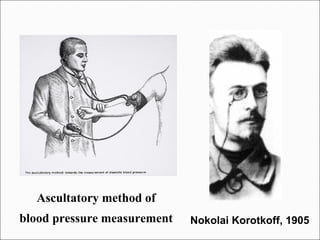
Nokolai Korotkoff, 1905
Ascultatory method of
blood pressure measurement
How to measure Blood pressure???
Always measure B.P when the patient is completely
relaxed.
The instrument used is mercury
sphygmomanometer .
The cuff of the apparatus should cover up to three –
fourth of his arm.
How to measure Blood
pressure???
The tubings must be parallel to arteries of the arm.
You must then inflate it until there is radial pulse
depression.
Then deflate and measure the value.
The sound as korotkoff sound
Details in the video link and audio link
http://www.youtube.com/watch?v=u6saTO8_o2g&feature=related
http://www.thinklabsmedical.com/stethoscope_community/Sound_Library
Terms
What is Systolic blood pressure- upper limit of
the pressure at which korotko’s sounds start
appearing ---state of contraction in heart.
Diastolic blood pressure is the lower limit of
sounds heard - state of relaxation in peripheral
blood vessels.
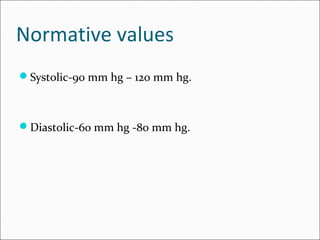
Normative values
Systolic-90 mm hg – 120 mm hg.
Diastolic-60 mm hg -80 mm hg.
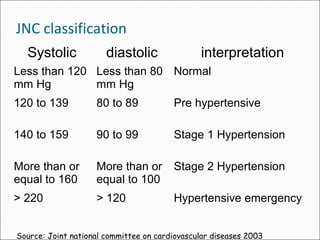
JNC classification
Systolic diastolic interpretation
Less than 120
mm Hg
Less than 80
mm Hg
Normal
120 to 139 80 to 89 Pre hypertensive
140 to 159 90 to 99 Stage 1 Hypertension
More than or
equal to 160
More than or
equal to 100
Stage 2 Hypertension
> 220 > 120 Hypertensive emergency
Source: Joint national committee on cardiovascular diseases 2003
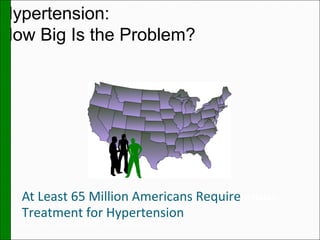
Nearly 1 in 3 adults (31%) in the US has hypertension
Fields LE et al. Hypertension. 2004;44:398-404.
Hypertension:
How Big Is the Problem?
At Least 65 Million Americans Require
Treatment for Hypertension
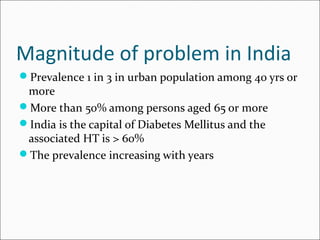
Magnitude of problem in India
Prevalence 1 in 3 in urban population among 40 yrs or
more
More than 50% among persons aged 65 or more
India is the capital of Diabetes Mellitus and the
associated HT is > 60%
The prevalence increasing with years
Types of Hypertension
The most common cause for Hypertension is
idiopathic and hence if the cause is not known it is
called as primary or essential Hypertension--90%
If it is secondary to other diseases -it is called as
secondary hypertension.-10%
Pathophysiology
The main reason is vasoconstriction which occurs due
to sympathetic over-activity
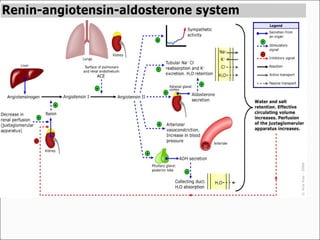
An overactive renin – angiotensin system leads to
vasoconstriction and retention of sodium and water.
ESSENTIAL HTN
Benign(chronic)
Rise in B.P is slight to moderate
Complications: heart failure, cerebrovascular accident
or MI
Risk factors
Malignant (accelerated)
Rapid & aggressive acceleration
Diastolic pressure in excess of 120 mmHg
Eg: haemorrhages into the retina, pappillo-edema &
progressive renal disease- cardiac failure
SECONDARY(ACCELERATED)
Kidney disease: retention of salt and water
Endocrine disorders:
Secretion of excess aldosterone and cortisol
stimulates the retention of excess sodium & water by
the kidneys, raising the Blood volume & pressure
Endocrine causes
 Acromegaly - increased secretion of growth
hormone in adults.
Cushings syndrome – increased secretion of
steroid hormone in children and adults .
Pheochromocytoma - tumor of adrenal medulla.
Drug such as corticosteroid and hormones like
estrogen.
Renal causes of Hypertension
Glomerulo nephritis-- acute or chronic or / and infective
or non infective.
. Bacterial infection of kidney-chronic pylo-nephritis.
. Polycystic kidney disease – It is a genetic cystic disorder of the
kidney.
Apart from these any renal disease which can cause renal
failure like Diabetes Mellitus will result in secondary hyper
tension.
Risk factors
Primary hypertension
Age (older the risk is higher)
Diet (High salt intake/ fatty diet)
Physical activity (sedentary life style)
Alcohol >15ml /day
Obesity----BMI>30
Drugs (steroids, oral contraceptives)
Stress - Chronic job stress
Family history—overcrowding
Ethnic groups- black africans
Males
Diagnosis of Hypertension
The gold standard for hypertension is only clinical
measurement using mercury sphygmomanometer
But we need to do investigations to rule out
secondary causes
Better to screen everyone above 40 years every year
and every six months if there is a risk factor
Hypertensive at first visit
In the first measurement if there is >220 mm hg of
systolic pressure and >120 mm hg of diastolic pressure
then we can call the patient as hypertensive - an
emergency.
Symptoms
No specific symptoms in majority.
weakness
Sub-occipital headache
Restlessness.
Sleepiness.
Dizziness.
Epistaxis– nose bleed
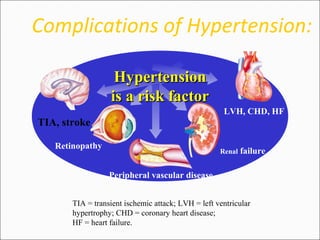
TIA = transient ischemic attack; LVH = left ventricular
hypertrophy; CHD = coronary heart disease;
HF = heart failure.
Retinopathy
Renal failure
Peripheral vascular disease
Complications of Hypertension:
LVH, CHD, HF
TIA, stroke
HypertensionHypertension
is a risk factoris a risk factor
Complications
• Myocardial infarction (Heart attack) or
coronary artery disease
• Cerebro vascular accident / stroke
• Left ventricular hypertrophy causes cardiac
failure
• Renal failure
• Hypertensive Retinopathy
Investigations
• We have to rule out secondary hypertension by
investigating for other diseases.
• Renal – urine microscopy is done to detect the
presence of albumin.
• Presence of RBC, Cast is an indications of
glomerulo- nephritis.
• Excess of WBC indicates kidney infection.
• Renal doppler / technicium scan (nuclear scan) is
done to know about blood supply to the kidney.
 Most patients will experience better control if they
modify diet and exercise.
 Physician advice sometimes works and should
always be given along with a follow-up visit
appointment to monitor both blood pressure and
lifestyle change efforts.
 Most of us do not do lifestyle counseling beyond
simple advice and admonishment – the time factor
is a problem.
 Nevertheless, lifestyle modification is at the top of
medical management.
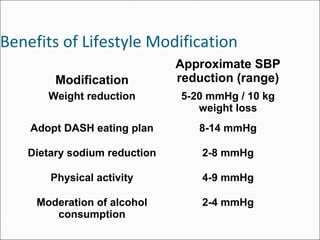
Modification
Approximate SBP
reduction (range)
Weight reduction 5-20 mmHg / 10 kg
weight loss
Adopt DASH eating plan 8-14 mmHg
Dietary sodium reduction 2-8 mmHg
Physical activity 4-9 mmHg
Moderation of alcohol
consumption
2-4 mmHg
Benefits of Lifestyle Modification
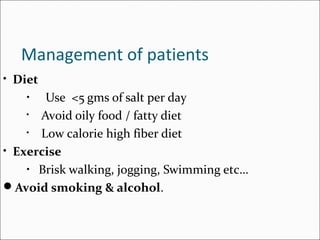
Management of patients
• Diet
• Use <5 gms of salt per day
• Avoid oily food / fatty diet
• Low calorie high fiber diet
• Exercise
• Brisk walking, jogging, Swimming etc…
Avoid smoking & alcohol.
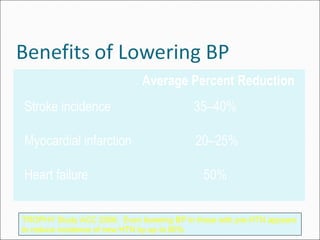
Average Percent Reduction
Stroke incidence 35–40%
Myocardial infarction 20–25%
Heart failure 50%
TROPHY Study ACC 2006: Even lowering BP in those with pre-HTN appears
to reduce incidence of new HTN by up to 60%
Drugs For Hypertension
• Usually divided into 4 categories:
• Diuretics
• ACE (Angiotensin converting enzyme) inhibitors and AT
receptor blockers
• Beta blockers
• CCB (calcium channel blockers)
• vasodilators
ACE inhibitors
Blocks the conversion of Angiotensin to Renin by inhibiting
angiotensin converting enzyme Eg: Enalapril , Lisinopril.
• Side effects
• Produce dry cough
• Altered taste sensations (dysguesia)
AT receptors blocker
• More potent than ACE inhibitors - it blocks the
receptors on which enzymes will act Eg :
Losartan
Beta blockers
Beta 1:cardiac selective ( Eg: Atenolol )
Non cardiac selective beta blockers
( Eg:Timolol, Propanalol).
Beta blockers with intrinsic
sympathomimetic activity.
Beta Blockers
• Mechanism of action:
• Acts on the beta adrenergic receptors.
Side effects:
• Can precipitate asthma in asthmatics-Beta
receptors are present on the bronchus causing broncho
constriction.
• Decreases the cardiac output as well as the heart
rate.
• Can increase the cholesterol level.
• Can mask hypoglycemia in diabetics
Calcium channel blockers(CCB)
Allows peripheral vaso dilatation
Causes decrease in the peripheral vascular
resistance
Very safe during pregnancy
 Eg: Nifidepine, Amlodepine.
Side effect: Postural hypotension, Headache,
Edema, Tachycardia
Other drugs
• Diuretics Eg: Thiazide diuretics, Hydro chlor
thiazide
• Alpha blockers: Prazosin
• Vasodilators: Hydralazine and sodium nitroprusside
• Centrally acting drugs: Methyldopa, Arkamine
Management of Hypertension
• Depends upon the blood pressure
• If person is pre-hypertensive or stage 1 is – life
style modification should be done first.
• Diet and exercises are first modes to control
mild hypertension
• If Blood pressure is high – Polypharmacy 3 or 4
drugs can be given.
Some guidelines for drugs
• If the patient has
• Renal problem – ACE inhibitors
• Diabetes mellitus – ACE inhibitors
• Asthma – ACE inhibitors
• Diabetic / pregnancy – CCB
• Anxiety /hyperthyroidism – Beta blockers
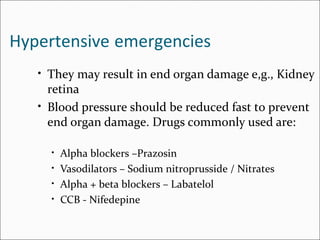
Hypertensive emergencies
• They may result in end organ damage e,g., Kidney
retina
• Blood pressure should be reduced fast to prevent
end organ damage. Drugs commonly used are:
• Alpha blockers –Prazosin
• Vasodilators – Sodium nitroprusside / Nitrates
• Alpha + beta blockers – Labatelol
• CCB - Nifedepine
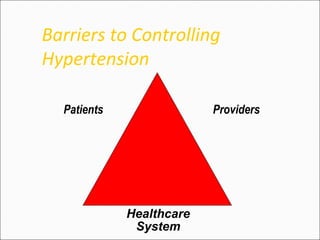
Barriers to Controlling
Hypertension
Healthcare
System
Patients Providers
The Initial Confrontation of the HTN
Problem
Upon making a diagnosis of HTN, tell patient
the BP reading and what it should be (provide a
written copy).
Prepare patient for the probable necessity for
polypharmacy to control BP with a minimum
of side effects
Advise Home BP measurement (135/85
mmHg is considered to be hypertensive).
Table 28. JNC 7 Report. Hypertension. 2003;42(6):1240.
Self-Measurement of BP
 Provides information useful for:
1. assessing response to antihypertensive Rx
2. improving adherence with therapy
3. evaluating white-coat HTN
 Home BP is more strongly related to target
organ damage and has better prognostic
accuracy than office BP.
Thank you for your
patience

Essential hypertension

  • 1.
  • 2.
    What is Hypertension Hypertensionis also referred to as high blood pressure or high BP in common terms It is a medical condition in which the arterial blood pressure is elevated. It is termed as silent killer – Patients asymptomatic - leads to fatal complications
  • 3.
    Definition Greater than 140mm hg of systolic blood pressure and or more than 90 mm hg of diastolic blood pressure at least on 2 of 3 occasions while measuring the pressure.
  • 4.
    1. How tomeasure blood pressure?
  • 5.
    Nokolai Korotkoff, 1905 Ascultatorymethod of blood pressure measurement
  • 6.
    How to measureBlood pressure??? Always measure B.P when the patient is completely relaxed. The instrument used is mercury sphygmomanometer . The cuff of the apparatus should cover up to three – fourth of his arm.
  • 7.
    How to measureBlood pressure??? The tubings must be parallel to arteries of the arm. You must then inflate it until there is radial pulse depression. Then deflate and measure the value. The sound as korotkoff sound Details in the video link and audio link http://www.youtube.com/watch?v=u6saTO8_o2g&feature=related http://www.thinklabsmedical.com/stethoscope_community/Sound_Library
  • 8.
    Terms What is Systolicblood pressure- upper limit of the pressure at which korotko’s sounds start appearing ---state of contraction in heart. Diastolic blood pressure is the lower limit of sounds heard - state of relaxation in peripheral blood vessels.
  • 9.
    Normative values Systolic-90 mmhg – 120 mm hg. Diastolic-60 mm hg -80 mm hg.
  • 10.
    JNC classification Systolic diastolicinterpretation Less than 120 mm Hg Less than 80 mm Hg Normal 120 to 139 80 to 89 Pre hypertensive 140 to 159 90 to 99 Stage 1 Hypertension More than or equal to 160 More than or equal to 100 Stage 2 Hypertension > 220 > 120 Hypertensive emergency Source: Joint national committee on cardiovascular diseases 2003
  • 11.
    Nearly 1 in3 adults (31%) in the US has hypertension Fields LE et al. Hypertension. 2004;44:398-404. Hypertension: How Big Is the Problem? At Least 65 Million Americans Require Treatment for Hypertension
  • 12.
    Magnitude of problemin India Prevalence 1 in 3 in urban population among 40 yrs or more More than 50% among persons aged 65 or more India is the capital of Diabetes Mellitus and the associated HT is > 60% The prevalence increasing with years
  • 13.
    Types of Hypertension Themost common cause for Hypertension is idiopathic and hence if the cause is not known it is called as primary or essential Hypertension--90% If it is secondary to other diseases -it is called as secondary hypertension.-10%
  • 14.
    Pathophysiology The main reasonis vasoconstriction which occurs due to sympathetic over-activity An overactive renin – angiotensin system leads to vasoconstriction and retention of sodium and water.
  • 15.
    ESSENTIAL HTN Benign(chronic) Rise inB.P is slight to moderate Complications: heart failure, cerebrovascular accident or MI Risk factors
  • 16.
    Malignant (accelerated) Rapid &aggressive acceleration Diastolic pressure in excess of 120 mmHg Eg: haemorrhages into the retina, pappillo-edema & progressive renal disease- cardiac failure
  • 17.
    SECONDARY(ACCELERATED) Kidney disease: retentionof salt and water Endocrine disorders: Secretion of excess aldosterone and cortisol stimulates the retention of excess sodium & water by the kidneys, raising the Blood volume & pressure
  • 18.
    Endocrine causes  Acromegaly- increased secretion of growth hormone in adults. Cushings syndrome – increased secretion of steroid hormone in children and adults . Pheochromocytoma - tumor of adrenal medulla. Drug such as corticosteroid and hormones like estrogen.
  • 19.
    Renal causes ofHypertension Glomerulo nephritis-- acute or chronic or / and infective or non infective. . Bacterial infection of kidney-chronic pylo-nephritis. . Polycystic kidney disease – It is a genetic cystic disorder of the kidney. Apart from these any renal disease which can cause renal failure like Diabetes Mellitus will result in secondary hyper tension.
  • 21.
    Risk factors Primary hypertension Age(older the risk is higher) Diet (High salt intake/ fatty diet) Physical activity (sedentary life style) Alcohol >15ml /day Obesity----BMI>30 Drugs (steroids, oral contraceptives) Stress - Chronic job stress Family history—overcrowding Ethnic groups- black africans Males
  • 22.
    Diagnosis of Hypertension Thegold standard for hypertension is only clinical measurement using mercury sphygmomanometer But we need to do investigations to rule out secondary causes Better to screen everyone above 40 years every year and every six months if there is a risk factor
  • 23.
    Hypertensive at firstvisit In the first measurement if there is >220 mm hg of systolic pressure and >120 mm hg of diastolic pressure then we can call the patient as hypertensive - an emergency.
  • 24.
    Symptoms No specific symptomsin majority. weakness Sub-occipital headache Restlessness. Sleepiness. Dizziness. Epistaxis– nose bleed
  • 25.
    TIA = transientischemic attack; LVH = left ventricular hypertrophy; CHD = coronary heart disease; HF = heart failure. Retinopathy Renal failure Peripheral vascular disease Complications of Hypertension: LVH, CHD, HF TIA, stroke HypertensionHypertension is a risk factoris a risk factor
  • 26.
    Complications • Myocardial infarction(Heart attack) or coronary artery disease • Cerebro vascular accident / stroke • Left ventricular hypertrophy causes cardiac failure • Renal failure • Hypertensive Retinopathy
  • 27.
    Investigations • We haveto rule out secondary hypertension by investigating for other diseases. • Renal – urine microscopy is done to detect the presence of albumin. • Presence of RBC, Cast is an indications of glomerulo- nephritis. • Excess of WBC indicates kidney infection. • Renal doppler / technicium scan (nuclear scan) is done to know about blood supply to the kidney.
  • 29.
     Most patientswill experience better control if they modify diet and exercise.  Physician advice sometimes works and should always be given along with a follow-up visit appointment to monitor both blood pressure and lifestyle change efforts.  Most of us do not do lifestyle counseling beyond simple advice and admonishment – the time factor is a problem.  Nevertheless, lifestyle modification is at the top of medical management.
  • 30.
    Modification Approximate SBP reduction (range) Weightreduction 5-20 mmHg / 10 kg weight loss Adopt DASH eating plan 8-14 mmHg Dietary sodium reduction 2-8 mmHg Physical activity 4-9 mmHg Moderation of alcohol consumption 2-4 mmHg Benefits of Lifestyle Modification
  • 31.
    Management of patients •Diet • Use <5 gms of salt per day • Avoid oily food / fatty diet • Low calorie high fiber diet • Exercise • Brisk walking, jogging, Swimming etc… Avoid smoking & alcohol.
  • 32.
    Average Percent Reduction Strokeincidence 35–40% Myocardial infarction 20–25% Heart failure 50% TROPHY Study ACC 2006: Even lowering BP in those with pre-HTN appears to reduce incidence of new HTN by up to 60%
  • 33.
    Drugs For Hypertension •Usually divided into 4 categories: • Diuretics • ACE (Angiotensin converting enzyme) inhibitors and AT receptor blockers • Beta blockers • CCB (calcium channel blockers) • vasodilators
  • 34.
    ACE inhibitors Blocks theconversion of Angiotensin to Renin by inhibiting angiotensin converting enzyme Eg: Enalapril , Lisinopril. • Side effects • Produce dry cough • Altered taste sensations (dysguesia)
  • 35.
    AT receptors blocker •More potent than ACE inhibitors - it blocks the receptors on which enzymes will act Eg : Losartan
  • 36.
    Beta blockers Beta 1:cardiacselective ( Eg: Atenolol ) Non cardiac selective beta blockers ( Eg:Timolol, Propanalol). Beta blockers with intrinsic sympathomimetic activity.
  • 37.
    Beta Blockers • Mechanismof action: • Acts on the beta adrenergic receptors. Side effects: • Can precipitate asthma in asthmatics-Beta receptors are present on the bronchus causing broncho constriction. • Decreases the cardiac output as well as the heart rate. • Can increase the cholesterol level. • Can mask hypoglycemia in diabetics
  • 38.
    Calcium channel blockers(CCB) Allowsperipheral vaso dilatation Causes decrease in the peripheral vascular resistance Very safe during pregnancy  Eg: Nifidepine, Amlodepine. Side effect: Postural hypotension, Headache, Edema, Tachycardia
  • 39.
    Other drugs • DiureticsEg: Thiazide diuretics, Hydro chlor thiazide • Alpha blockers: Prazosin • Vasodilators: Hydralazine and sodium nitroprusside • Centrally acting drugs: Methyldopa, Arkamine
  • 40.
    Management of Hypertension •Depends upon the blood pressure • If person is pre-hypertensive or stage 1 is – life style modification should be done first. • Diet and exercises are first modes to control mild hypertension • If Blood pressure is high – Polypharmacy 3 or 4 drugs can be given.
  • 41.
    Some guidelines fordrugs • If the patient has • Renal problem – ACE inhibitors • Diabetes mellitus – ACE inhibitors • Asthma – ACE inhibitors • Diabetic / pregnancy – CCB • Anxiety /hyperthyroidism – Beta blockers
  • 42.
    Hypertensive emergencies • Theymay result in end organ damage e,g., Kidney retina • Blood pressure should be reduced fast to prevent end organ damage. Drugs commonly used are: • Alpha blockers –Prazosin • Vasodilators – Sodium nitroprusside / Nitrates • Alpha + beta blockers – Labatelol • CCB - Nifedepine
  • 43.
  • 44.
    The Initial Confrontationof the HTN Problem Upon making a diagnosis of HTN, tell patient the BP reading and what it should be (provide a written copy). Prepare patient for the probable necessity for polypharmacy to control BP with a minimum of side effects Advise Home BP measurement (135/85 mmHg is considered to be hypertensive). Table 28. JNC 7 Report. Hypertension. 2003;42(6):1240.
  • 45.
    Self-Measurement of BP Provides information useful for: 1. assessing response to antihypertensive Rx 2. improving adherence with therapy 3. evaluating white-coat HTN  Home BP is more strongly related to target organ damage and has better prognostic accuracy than office BP.
  • 46.
    Thank you foryour patience

Editor's Notes

  • #12 A recent analysis of National Health and Nutrition Examination Survey (NHANES) data from 1999 to 2000 reported a 3.7% increase in the prevalence of hypertension compared with 1988 to 1994.1 In a recent study, data from NHANES and the US Census Bureau were used to estimate hypertension burden, prevalence rates, and trends relative to 1988 to 1994 for US adults in 1999 to 2000.2 The study found that at least 65 million US adults (nearly 1 in 3 adults, or 31.3%) had hypertension during that time period.2 Assuming continuing trends, the figures would be even higher for 2004.
  • #26 Hypertension is an important contributing risk factor for end-organ damage and subsequent increases in morbidity and mortality. The goal in treating hypertension is to prevent cardiovascular and renal complications. Even small elevations above optimal blood pressure (BP) values (&amp;lt;120/80 mm Hg) increase the likelihood of developing hypertension (BP ≥140/90 mm Hg) and incurring target-organ damage. Chronic elevations of BP lead to target-organ damage and the development of cardiovascular and renal diseases, including retinopathy, peripheral vascular disease, stroke, coronary heart disease, heart failure, left-ventricular hypertrophy, and renal failure. Signs of target-organ damage herald a poorer prognosis and may present in the heart, blood vessels, kidneys, brain, or eyes. Later consequences include cardiac, cerebrovascular, vascular, and renal morbidities and death. Because of the complex nature of hypertension, it is not surprising that single antihypertensive agents normalize BP for less than a majority of hypertensive patients. Reference Cushman WC. J Clin Hypertens. 2003;5(suppl):14-22.
  • #30 [The purpose of this slide is to lead in to lifestyle modifications and to commiserate with the difficulty of dealing with patients over this issue.] Now let’s turn to the difficult issue of lifestyle for a moment.
  • #31 As you can see, lifestyle modification can be very effective in helping to reduce blood pressure, especially if these modifications are used in combination. However, these modifications have been difficult for us to implement in many patients. There are some more effective ways to approach these changes, which we’ll discuss in a few minutes.
  • #44 In a global effort, patients, providers, and the healthcare system must make their contributions to get hypertension to goal.