


بسم الله الرحمن الرحيم
WarfarinCoumadin® the most common anticoagulant drugBy Taher HaddadKing Faisal UniversityCollege of Clinical Pharmacy
OutlinesBackgroundWhat is Warfarin?Mechanism of ActionPharmacokineticIndicationsDosage and AdministrationWarfarinMonitoringAdverse EffectsDrug InteractionsOverdose Management
BackgroundIn the early 20th century, bis-hydroxycoumarin(dicumarol)  was discovered after cows livestock  had eaten spoiled Sweet clover and died of a hemorrhagic disease.
Today, coumarin derivatives are used therapeutically as anticoagulants and commercially as rodenticides. Warfarinis the most common oral anticoagulant used today.
Approximately 2 million people in the U.S. start taking warfarin each year.What is Warfarin?Warfarin is an oral coumarin anticoagulant widely used to control and prevent thromboembolic disorders.
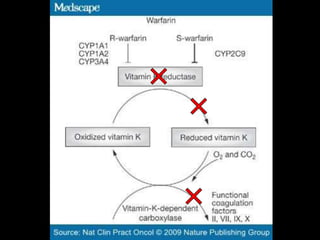
Warfarin is clinically available as a racemic mixture of R- and S-warfarin. The S-enantiomer has 3–5 times greater anticoagulation potency than its optical congener R-warfarin.Mechanism of ActionWarfarin acts by antagonizing the antihemorrhagic  effect of vitamin K.
It inhibits hepatic synthesis of vitamin K dependent coagulation factors II, VII, IX, and Xby inhibiting vitamin K1 -2,3 epoxidereductase, preventing vitamin K from being reduced to its active form.
PharmacokineticThe oral bioavailability of warfarinis nearly 100%.
It is highly bound (approximately 99%) to plasma protein, mainly albumin. (The high degree of protein binding is one of several mechanisms whereby other drugs interact with warfarin)
Warfarin is distributed to the liver, lungs, spleen, and kidneys. It does not appear to be distributed to breast milk in significant amounts. It crosses the placenta and is a known teratogen.
The duration of anticoagulant effect after a single dose of warfarin is usually 5-7 days.Pharmacokinetic (cont’d)			Warfarin is metabolized by hepatic cytochrome     P-450 (CYP) isoenzymesto inactive metabolites, which are excreted in the bile. (It also is metabolized by reductases to reduced metabolites “warfarin alcohols” , which are excreted in the kidneys).
Warfarin metabolism may be altered in the presence of hepatic dysfunction or advanced age but is not affected by renal impairment.Indicationsprophylaxis and/or treatment of venous thrombosis and its extension, and pulmonary embolism.prophylaxis and/or treatment of the thromboembolic complications associated with atrial fibrillation and/or cardiac valve replacement.to reduce the risk of death, recurrent myocardial infarction, and thromboembolic events such as stroke or systemic embolization after myocardial infarction.
Dosage and AdministrationAdults: PO 2-5 mg/day initially; adjust daily dose according to PT or INR determinations. Usual maintenance dose is 2-10 mg/day.
The IV dosages would be the same as those would be used orally. Administer as a slow bolus injection over 1 to 2 min in a peripheral vein.WarfarinMonitoringProthrombin time (PT) — The most commonly used test to measure the effect of warfarin. It measures the time it takes for the clotting mechanism to progress. Normal range (12–15 seconds).
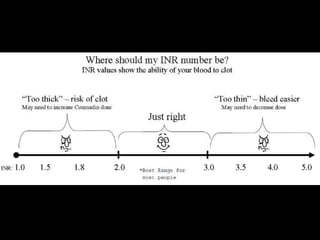
International Normalized Ratio (INR) — The INR is a way of expressing the PT in a standardized way; this ensures that results obtained by different laboratories can be reliably compared.The longer it takes the blood to clot, the higher the PT and INR. In most cases the target INR range will be 2 to 3, although other ranges may be chosen if there are special circumstances.
Adverse EffectsHematologic: hemoptysis, bruising, epistaxis, bleeding gums, hematouria or blood in stool.
Cardiovascular: hypotension, syncope, vasculitis.
CNS: dizziness, fatigue, headache, lethargy.