











o YOUNAS CHANDIO D-
17-CH-25
o HASNAT ALI CHANG D-
17-CH-27
o RAFIQUE AHMED D-17-
CH-47
HYDROGEN
GAS
INTRODUCTION OF HYDROGEN
o Hydrogen gas was first artificially produced in the
early 16th
century by the reaction of acids on metals.
o Hydrogen means “water-former”.
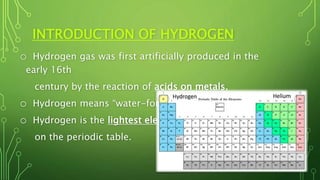
o Hydrogen is the lightest element
on the periodic table.
INTRODUCTION OF HYDROGEN
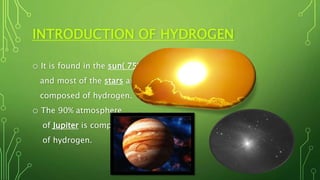
o It is found in the sun( 75%)
and most of the stars are
composed of hydrogen.
o The 90% atmosphere
of Jupiter is compose
of hydrogen.
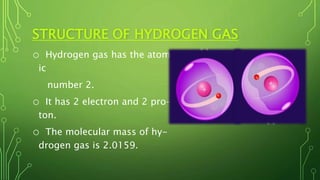
o Hydrogen gas has the atom-
ic
number 2.
o It has 2 electron and 2 pro-
ton.
o The molecular mass of hy-
drogen gas is 2.0159.
STRUCTURE OF HYDROGEN GAS
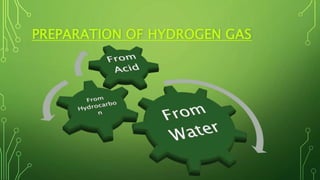
PREPARATION OF HYDROGEN GAS
(CONT’D)
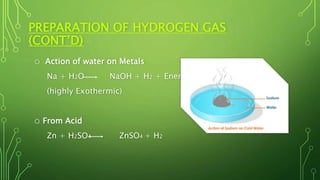
o Action of water on Metals
Na + H2O NaOH + H2 + Energy
(highly Exothermic)
o From Acid
Zn + H2SO4 ZnSO4 + H2
PREPARATION OF HYDROGEN GAS
(CONT’D)
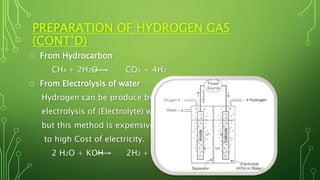
o From Hydrocarbon
CH4 + 2H2O CO2 + 4H2
o From Electrolysis of water
Hydrogen can be produce by
electrolysis of (Electrolyte) water
but this method is expensive due
to high Cost of electricity.
2 H2O + KOH 2H2 + O2
PREPARATION OF HYDROGEN GAS
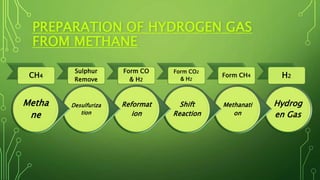
FROM METHANE
Hydrog
en Gas
Methanati
on
Shift
Reaction
Reformat
ion
Desulfuriza
tion
Metha
ne
CH4
Sulphur
Remove
Form CO
& H2
Form CO2
& H2
Form CH4 H2
PREPARATION OF HYDROGEN GAS
FROM METHANE
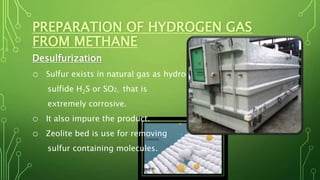
Desulfurization
o Sulfur exists in natural gas as hydrogen
sulfide H2S or SO2, that is
extremely corrosive.
o It also impure the product.
o Zeolite bed is use for removing
sulfur containing molecules.
PREPARATION OF HYDROGEN GAS
FROM METHANE
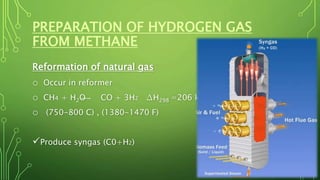
Reformation of natural gas
o Occur in reformer
o CH4 + H2O CO + 3H2 ∆H298 =206 kj/mol
o (750-800 C) , (1380-1470 F)
Produce syngas (C0+H2)
PREPARATION OF HYDROGEN GAS
FROM METHANE
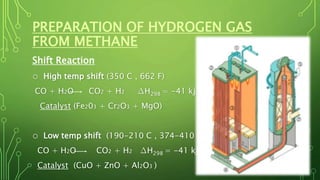
Shift Reaction
o High temp shift (350 C , 662 F)
CO + H2O CO2 + H2 ∆H298 = -41 kj/mol
Catalyst (Fe203 + Cr2O3 + MgO)
o Low temp shift (190-210 C , 374-410 F)
CO + H2O CO2 + H2 ∆H298 = -41 kj/mol
Catalyst (CuO + ZnO + Al2O3 )
PREPARATION OF HYDROGEN GAS
FROM METHANE
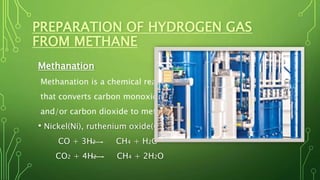
Methanation
Methanation is a chemical reaction
that converts carbon monoxide
and/or carbon dioxide to methane.
• Nickel(Ni), ruthenium oxide(O2Ru)
CO + 3H2 CH4 + H2O
CO2 + 4H2 CH4 + 2H2O
PREPARATION OF HYDROGEN GAS FROM
METHANE
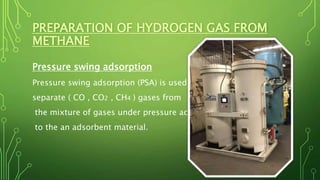
Pressure swing adsorption
Pressure swing adsorption (PSA) is used to
separate ( CO , CO2 , CH4 ) gases from
the mixture of gases under pressure according
to the an adsorbent material.
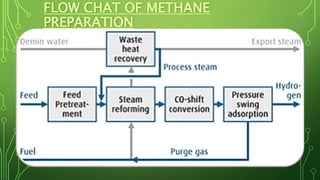
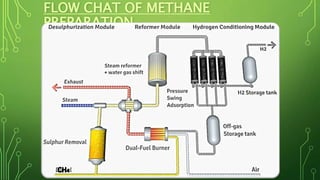
FLOW CHAT OF METHANE
PREPARATION
FLOW CHAT OF METHANE
PREPARATION
DETAIL
Desulfurization
Sulfur exists in natural gas as hydrogen sulfide H2S or SO2, that is
extremely corrosive.
The gas mixture of natural gas that contain sulfur is passed under
pressure through a vessel containing an adsorbent bed of zeolite that
attracts sulfur containing compound more strongly than methane, part
or all of the sulfur containing compound will stay in the bed, and the
gas exiting the vessel.
Reformation of natural gas
The first step of the process involves methane reacting with steam at
750-800 C to produce a synthesis gas (syngas),a mixture primarily
made up of hydrogen gas (H2) and carbon monoxide (CO).
Shift Reaction
In the second step, know as a water gas shift reaction.
DETAIL
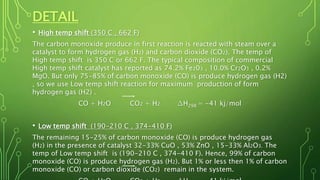
• High temp shift (350 C , 662 F)
The carbon monoxide produce in first reaction is reacted with steam over a
catalyst to form hydrogen gas (H2) and carbon dioxide (CO2). The temp of
High temp shift is 350 C or 662 F. The typical composition of commercial
High temp shift catalyst has reported as 74.2% Fe203 , 10.0% Cr2O3 , 0.2%
MgO. But only 75-85% of carbon monoxide (CO) is produce hydrogen gas (H2)
, so we use Low temp shift reaction for maximum production of form
hydrogen gas (H2) .
CO + H2O CO2 + H2 ∆H298 = -41 kj/mol
• Low temp shift (190-210 C , 374-410 F)
The remaining 15-25% of carbon monoxide (CO) is produce hydrogen gas
(H2) in the presence of catalyst 32-33% CuO , 53% ZnO , 15-33% Al2O3. The
temp of Low temp shift is (190-210 C , 374-410 F). Hence, 99% of carbon
monoxide (CO) is produce hydrogen gas (H2). But 1% or less then 1% of carbon
monoxide (CO) or carbon dioxide (CO2) remain in the system.
DETAIL
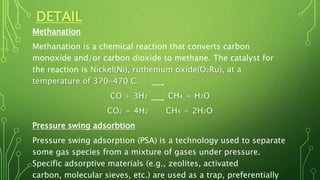
Methanation
Methanation is a chemical reaction that converts carbon
monoxide and/or carbon dioxide to methane. The catalyst for
the reaction is Nickel(Ni), ruthenium oxide(O2Ru), at a
temperature of 370-470 C.
CO + 3H2 CH4 + H2O
CO2 + 4H2 CH4 + 2H2O
Pressure swing adsorbtion
Pressure swing adsorption (PSA) is a technology used to separate
some gas species from a mixture of gases under pressure.
Specific adsorptive materials (e.g., zeolites, activated
carbon, molecular sieves, etc.) are used as a trap, preferentially
VIDEO
VIDEO
Younas , Hasnat , Rafique , Ali ,
Ahmed
VIDEO
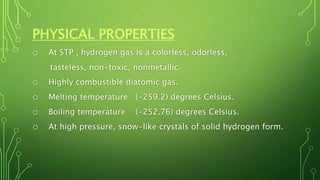
PHYSICAL PROPERTIES
o At STP , hydrogen gas is a colorless, odorless,
tasteless, non-toxic, nonmetallic.
o Highly combustible diatomic gas.
o Melting temperature (-259.2) degrees Celsius.
o Boiling temperature (-252.76) degrees Celsius.
o At high pressure, snow-like crystals of solid hydrogen form.
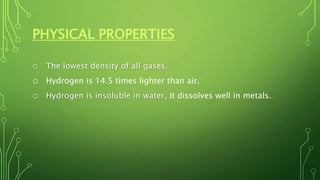
PHYSICAL PROPERTIES
o The lowest density of all gases.
o Hydrogen is 14.5 times lighter than air.
o Hydrogen is insoluble in water, it dissolves well in metals.
VIDEO
GAS INDUSTRY IN PAKISTAN
• Ghani gases
• Linde gases
• Bp Pakistan Exploration And Production Inc
• United Energy Pakistan Ltd.
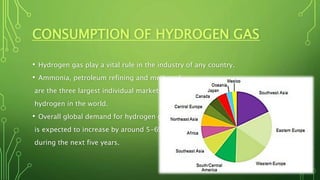
CONSUMPTION OF HYDROGEN GAS
• Hydrogen gas play a vital rule in the industry of any country.
• Ammonia, petroleum refining and methanol
are the three largest individual markets for
hydrogen in the world.
• Overall global demand for hydrogen gas
is expected to increase by around 5-6%
during the next five years.
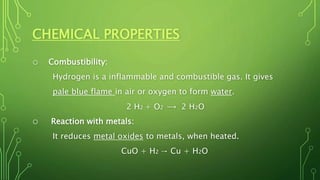
CHEMICAL PROPERTIES
o Combustibility:
Hydrogen is a inflammable and combustible gas. It gives
pale blue flame in air or oxygen to form water.
2 H2 + O2 ⟶ 2 H2O
o Reaction with metals:
It reduces metal oxides to metals, when heated.
CuO + H2 → Cu + H2O
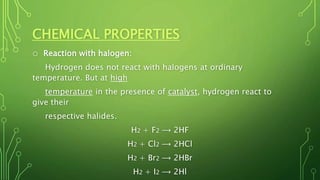
CHEMICAL PROPERTIES
o Reaction with halogen:
Hydrogen does not react with halogens at ordinary
temperature. But at high
temperature in the presence of catalyst, hydrogen react to
give their
respective halides.
H2 + F2 ⟶ 2HF
H2 + Cl2 ⟶ 2HCl
H2 + Br2 ⟶ 2HBr
H2 + I2 ⟶ 2Hl
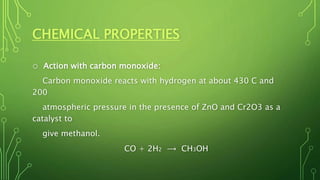
CHEMICAL PROPERTIES
o Action with carbon monoxide:
Carbon monoxide reacts with hydrogen at about 430 C and
200
atmospheric pressure in the presence of ZnO and Cr2O3 as a
catalyst to
give methanol.
CO + 2H2 ⟶ CH3OH
USES
 Rocket fuel
o NASA is the largest user of
hydrogen as a fuel.
o NASA began using liquid
hydrogen in the 1950s as
a rocket fuel.
USES
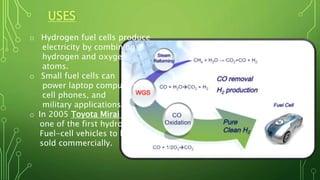
o Hydrogen fuel cells produce
electricity by combining
hydrogen and oxygen
atoms.
o Small fuel cells can
power laptop computers,
cell phones, and
military applications.
o In 2005 Toyota Mirai is
one of the first hydrogen
Fuel-cell vehicles to be
sold commercially.
USES
These buses are a marvel of hydrogen technology, emitting only
water rather than belching out harmful pollutants. Hydrogen
Station Opened April 24, 2003. Only station in the world
operating at a conventional gasoline station (has full commercial
license).
USES
o Filling balloons and airships.
May 6, 1937, airship caught fire
and was destroyed, there were
35 peoples (13 passengers and
22 crewmen) were killed.
o Make ammonia for agricultural
fertilizer (the Haber process).
N2 + 3 H2 2 NH3
USES
o Used as carrier phase in gas
chromatography.
o It is use for the production
of plastics.
o Protective atmosphere for
making flat glass sheets.
USES
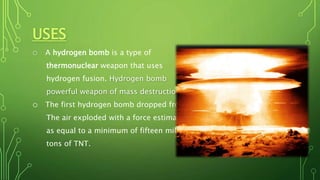
o A hydrogen bomb is a type of
thermonuclear weapon that uses
hydrogen fusion. Hydrogen bomb
powerful weapon of mass destruction.
o The first hydrogen bomb dropped from
The air exploded with a force estimated
as equal to a minimum of fifteen million
tons of TNT.
REFERENCES
ohttps://en.wikipedia.org/wiki/Hydrogen
ohttp://www.rsc.org/periodic-table/element/1/hydrogen
ohttps://www.studyread.com/uses-of-hydrogen
ohttps://azchemistry.com/hydrogen-uses
ohttp://www.igem.org.uk/media/232929/Hydrogen-Report-
Complete-web.pdf
ohttp://www.need.org/Files/curriculum/infobook/HydrogenS.pdf
ohttps://www.energy.gov/sites/prod/files/2014/09/f18/fcto_hydroge
n_production_fs_0.pdf
ohttps://www.lenntech.com/periodic/elements/h.htm#ixzz5BFfJS2B2
Hydrogen gas
Hydrogen gas

Hydrogen gas

  • 1.
    o YOUNAS CHANDIOD- 17-CH-25 o HASNAT ALI CHANG D- 17-CH-27 o RAFIQUE AHMED D-17- CH-47 HYDROGEN GAS
  • 2.
    INTRODUCTION OF HYDROGEN oHydrogen gas was first artificially produced in the early 16th century by the reaction of acids on metals. o Hydrogen means “water-former”. o Hydrogen is the lightest element on the periodic table.
  • 3.
    INTRODUCTION OF HYDROGEN oIt is found in the sun( 75%) and most of the stars are composed of hydrogen. o The 90% atmosphere of Jupiter is compose of hydrogen.
  • 4.
    o Hydrogen gashas the atom- ic number 2. o It has 2 electron and 2 pro- ton. o The molecular mass of hy- drogen gas is 2.0159. STRUCTURE OF HYDROGEN GAS
  • 5.
  • 6.
    PREPARATION OF HYDROGENGAS (CONT’D) o Action of water on Metals Na + H2O NaOH + H2 + Energy (highly Exothermic) o From Acid Zn + H2SO4 ZnSO4 + H2
  • 7.
    PREPARATION OF HYDROGENGAS (CONT’D) o From Hydrocarbon CH4 + 2H2O CO2 + 4H2 o From Electrolysis of water Hydrogen can be produce by electrolysis of (Electrolyte) water but this method is expensive due to high Cost of electricity. 2 H2O + KOH 2H2 + O2
  • 8.
    PREPARATION OF HYDROGENGAS FROM METHANE Hydrog en Gas Methanati on Shift Reaction Reformat ion Desulfuriza tion Metha ne CH4 Sulphur Remove Form CO & H2 Form CO2 & H2 Form CH4 H2
  • 9.
    PREPARATION OF HYDROGENGAS FROM METHANE Desulfurization o Sulfur exists in natural gas as hydrogen sulfide H2S or SO2, that is extremely corrosive. o It also impure the product. o Zeolite bed is use for removing sulfur containing molecules.
  • 10.
    PREPARATION OF HYDROGENGAS FROM METHANE Reformation of natural gas o Occur in reformer o CH4 + H2O CO + 3H2 ∆H298 =206 kj/mol o (750-800 C) , (1380-1470 F) Produce syngas (C0+H2)
  • 11.
    PREPARATION OF HYDROGENGAS FROM METHANE Shift Reaction o High temp shift (350 C , 662 F) CO + H2O CO2 + H2 ∆H298 = -41 kj/mol Catalyst (Fe203 + Cr2O3 + MgO) o Low temp shift (190-210 C , 374-410 F) CO + H2O CO2 + H2 ∆H298 = -41 kj/mol Catalyst (CuO + ZnO + Al2O3 )
  • 12.
    PREPARATION OF HYDROGENGAS FROM METHANE Methanation Methanation is a chemical reaction that converts carbon monoxide and/or carbon dioxide to methane. • Nickel(Ni), ruthenium oxide(O2Ru) CO + 3H2 CH4 + H2O CO2 + 4H2 CH4 + 2H2O
  • 13.
    PREPARATION OF HYDROGENGAS FROM METHANE Pressure swing adsorption Pressure swing adsorption (PSA) is used to separate ( CO , CO2 , CH4 ) gases from the mixture of gases under pressure according to the an adsorbent material.
  • 14.
    FLOW CHAT OFMETHANE PREPARATION
  • 15.
    FLOW CHAT OFMETHANE PREPARATION
  • 16.
    DETAIL Desulfurization Sulfur exists innatural gas as hydrogen sulfide H2S or SO2, that is extremely corrosive. The gas mixture of natural gas that contain sulfur is passed under pressure through a vessel containing an adsorbent bed of zeolite that attracts sulfur containing compound more strongly than methane, part or all of the sulfur containing compound will stay in the bed, and the gas exiting the vessel. Reformation of natural gas The first step of the process involves methane reacting with steam at 750-800 C to produce a synthesis gas (syngas),a mixture primarily made up of hydrogen gas (H2) and carbon monoxide (CO). Shift Reaction In the second step, know as a water gas shift reaction.
  • 17.
    DETAIL • High tempshift (350 C , 662 F) The carbon monoxide produce in first reaction is reacted with steam over a catalyst to form hydrogen gas (H2) and carbon dioxide (CO2). The temp of High temp shift is 350 C or 662 F. The typical composition of commercial High temp shift catalyst has reported as 74.2% Fe203 , 10.0% Cr2O3 , 0.2% MgO. But only 75-85% of carbon monoxide (CO) is produce hydrogen gas (H2) , so we use Low temp shift reaction for maximum production of form hydrogen gas (H2) . CO + H2O CO2 + H2 ∆H298 = -41 kj/mol • Low temp shift (190-210 C , 374-410 F) The remaining 15-25% of carbon monoxide (CO) is produce hydrogen gas (H2) in the presence of catalyst 32-33% CuO , 53% ZnO , 15-33% Al2O3. The temp of Low temp shift is (190-210 C , 374-410 F). Hence, 99% of carbon monoxide (CO) is produce hydrogen gas (H2). But 1% or less then 1% of carbon monoxide (CO) or carbon dioxide (CO2) remain in the system.
  • 18.
    DETAIL Methanation Methanation is achemical reaction that converts carbon monoxide and/or carbon dioxide to methane. The catalyst for the reaction is Nickel(Ni), ruthenium oxide(O2Ru), at a temperature of 370-470 C. CO + 3H2 CH4 + H2O CO2 + 4H2 CH4 + 2H2O Pressure swing adsorbtion Pressure swing adsorption (PSA) is a technology used to separate some gas species from a mixture of gases under pressure. Specific adsorptive materials (e.g., zeolites, activated carbon, molecular sieves, etc.) are used as a trap, preferentially
  • 19.
  • 20.
    VIDEO Younas , Hasnat, Rafique , Ali , Ahmed
  • 21.
  • 22.
    PHYSICAL PROPERTIES o AtSTP , hydrogen gas is a colorless, odorless, tasteless, non-toxic, nonmetallic. o Highly combustible diatomic gas. o Melting temperature (-259.2) degrees Celsius. o Boiling temperature (-252.76) degrees Celsius. o At high pressure, snow-like crystals of solid hydrogen form.
  • 23.
    PHYSICAL PROPERTIES o Thelowest density of all gases. o Hydrogen is 14.5 times lighter than air. o Hydrogen is insoluble in water, it dissolves well in metals.
  • 24.
  • 25.
    GAS INDUSTRY INPAKISTAN • Ghani gases • Linde gases • Bp Pakistan Exploration And Production Inc • United Energy Pakistan Ltd.
  • 26.
    CONSUMPTION OF HYDROGENGAS • Hydrogen gas play a vital rule in the industry of any country. • Ammonia, petroleum refining and methanol are the three largest individual markets for hydrogen in the world. • Overall global demand for hydrogen gas is expected to increase by around 5-6% during the next five years.
  • 27.
    CHEMICAL PROPERTIES o Combustibility: Hydrogenis a inflammable and combustible gas. It gives pale blue flame in air or oxygen to form water. 2 H2 + O2 ⟶ 2 H2O o Reaction with metals: It reduces metal oxides to metals, when heated. CuO + H2 → Cu + H2O
  • 28.
    CHEMICAL PROPERTIES o Reactionwith halogen: Hydrogen does not react with halogens at ordinary temperature. But at high temperature in the presence of catalyst, hydrogen react to give their respective halides. H2 + F2 ⟶ 2HF H2 + Cl2 ⟶ 2HCl H2 + Br2 ⟶ 2HBr H2 + I2 ⟶ 2Hl
  • 29.
    CHEMICAL PROPERTIES o Actionwith carbon monoxide: Carbon monoxide reacts with hydrogen at about 430 C and 200 atmospheric pressure in the presence of ZnO and Cr2O3 as a catalyst to give methanol. CO + 2H2 ⟶ CH3OH
  • 30.
    USES  Rocket fuel oNASA is the largest user of hydrogen as a fuel. o NASA began using liquid hydrogen in the 1950s as a rocket fuel.
  • 31.
    USES o Hydrogen fuelcells produce electricity by combining hydrogen and oxygen atoms. o Small fuel cells can power laptop computers, cell phones, and military applications. o In 2005 Toyota Mirai is one of the first hydrogen Fuel-cell vehicles to be sold commercially.
  • 32.
    USES These buses area marvel of hydrogen technology, emitting only water rather than belching out harmful pollutants. Hydrogen Station Opened April 24, 2003. Only station in the world operating at a conventional gasoline station (has full commercial license).
  • 33.
    USES o Filling balloonsand airships. May 6, 1937, airship caught fire and was destroyed, there were 35 peoples (13 passengers and 22 crewmen) were killed. o Make ammonia for agricultural fertilizer (the Haber process). N2 + 3 H2 2 NH3
  • 34.
    USES o Used ascarrier phase in gas chromatography. o It is use for the production of plastics. o Protective atmosphere for making flat glass sheets.
  • 35.
    USES o A hydrogenbomb is a type of thermonuclear weapon that uses hydrogen fusion. Hydrogen bomb powerful weapon of mass destruction. o The first hydrogen bomb dropped from The air exploded with a force estimated as equal to a minimum of fifteen million tons of TNT.
  • 36.