Mrs.B.Kavitha M.Sc (N),
Professor
Aswini College of Nursing, Thrissur
ASSESSMENT AND
PLANNING IN NURSING
EDUCATION
INTRODUCTION
In an education system, it is understood that assessment is
only for the students, but on the other hand, the Assessment
of teachers is also an important aspect of the education
system that ensures teachers are providing high-quality
instruction to students. The assessment process can be used
to provide feedback and support for professional
development, to inform decisions about teacher retention or
promotion, or to evaluate teacher effectiveness for
accountability purposes.
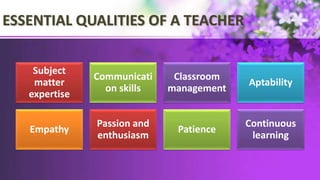
ESSENTIAL QUALITIES OF A TEACHER
Subject
matter
expertise
Communicati
on skills
Classroom
management
Aptability
Empathy
Passion and
enthusiasm
Patience
Continuous
learning
Subject matter expertise: Good teachers have a deep understanding
of the subjects they teach. They are knowledgeable about the
content and are able to explain it in a way that is understandable to
their students.
Communication skills: Good teachers are able to communicate
clearly and effectively, both verbally and in writing. They are able to
explain complex ideas in simple terms and are good listeners.
Classroom management: Good teachers are able to create a positive
learning environment. They are able to manage classroom behavior,
maintain order, and ensure that all students are engaged and
participating.
Aptability: Teaching requires a great deal of flexibility. Good teachers
are able to adapt their teaching style and lesson plans to meet the
needs of individual students and respond to unexpected situations
Empathy: Good teachers are empathetic and understanding of their
students' needs and concerns. They are able to create a safe and
supportive learning environment where all students feel valued and
respected.
Passion and enthusiasm: Good teachers are passionate about
teaching and enthusiastic about their subject matter. They can
inspire and motivate their students to learn and explore new ideas
Patience: Teaching can be challenging, and good teachers are patient
and understanding with their students. They can remain calm and
composed even in difficult situations
Continuous learning: Good teachers are committed to continuous
development. They stay up-to-date with the latest research and
technique in their field and are constantly looking for ways to
improve their teaching practices.
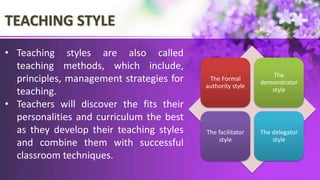
TEACHING STYLE
The Formal
authority style
The
demonstrator
style
The facilitator
style
The delegator
style
• Teaching styles are also called
teaching methods, which include,
principles, management strategies for
teaching.
• Teachers will discover the fits their
personalities and curriculum the best
as they develop their teaching styles
and combine them with successful
classroom techniques.
Formal authority style:
• The authority model is teacher-centered and frequently entails lengthy lecture session
way presentations. Students are expected to take notes or absorb information
• Pros:
– This style is acceptable for certain higher-education disciplines and auditorium with
large groups of students.
– The pure lecture style is most suitable for subjects like history which necessitate
memorization of key facts, dates, names, etc
• Cons:
– It's a questionable model for teaching children because there is little or no
interaction with the teacher, so it is a better approach for older, more mature
students
– The students will get boredom easily.
Demonstrator style
• The demonstrator retains the formal authority role by showing students what
they need to know.
• The demonstrator is a lot like the lecturer, but their lessons include multimedia
presentations, activities, and demonstrations. (Math, Science, Music)
• Pros.
– This style gives teachers opportunities to incorporate a variety of formats
including lectures and multimedia presentations
• Cons
– Although it's well-suited for teaching mathematics, music, physical
education or arts and crafts, it is difficult to accommodate students'
individual needs in larger classroom
Facilitator style
• Facilitators promote self-learning and help students develop critical
thinking skill and retain knowledge that leads to self-actualization.
• Pros:
– This style trains students to ask questions and helps develop skills to
find answer and solution through exploration, it is ideal for teaching
science and similar subjects
• Cons:
– Challenges teachers to interact with students and prompt them toward
discovery rather than lecturing facts and testing knowledge through
memorization. So it's a bit harder to measure success in tangible terms.
Delegator style
• The delegator style is best suited for curricula that require lab activities,
such as chemistry and biology, or subjects that warrant peer feedback, like
debate and creative writing
• Pros:
– Guided discovery and inquiry-based learning place the teacher in an
observer role that inspires students by working in tandem toward
common goals.
• Cons:
– Considered a modern style of teaching, it is sometimes criticized as
eroding teacher authority. As a delegator, the teacher acts more as a
consultant rather than the traditional authority figure.
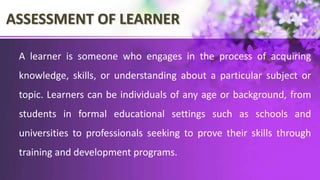
ASSESSMENT OF LEARNER
A learner is someone who engages in the process of acquiring
knowledge, skills, or understanding about a particular subject or
topic. Learners can be individuals of any age or background, from
students in formal educational settings such as schools and
universities to professionals seeking to prove their skills through
training and development programs.
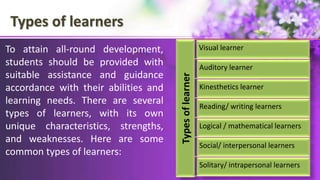
Types of learners
To attain all-round development,
students should be provided with
suitable assistance and guidance
accordance with their abilities and
learning needs. There are several
types of learners, with its own
unique characteristics, strengths,
and weaknesses. Here are some
common types of learners:
Types
of
learner
Visual learner
Auditory learner
Kinesthetics learner
Reading/ writing learners
Logical / mathematical learners
Social/ interpersonal learners
Solitary/ intrapersonal learners
• Visual learners: These learners process information best through
visual aids such as diagrams. charts, or videos. They benefit from
seeing information in a visual format, and may have difficulty with
verbal instructions or lectures.
• Auditory learners: These learners process information best through
sound and spoken language. They benefit from lectures,
discussions, and verbal explanations, and may have difficulty with
visual aids or written instructions.
• Kinesthetic learners: These learners process information best
through physical and hands-on experience. They benefit from
activities such as role-playing, simulations or experiments, and may
have difficulty with passive learning activities such as lectures or
reading.
• Reading/writing learners: These learners process information best
through written language. They benefit from reading and taking
notes, and may have difficulty with oral instruction or group
discussion.
• Logical /mathematical learners: These learners process information's best
through Logic and reasoning. They benefit from problem solving activities,
patterns and classification, and may have difficulty with abstract concepts or
creative thinking.
• Social/interpersonal learners: These learners process information best
through interaction and communication with others. They benefit from group
discussions, collaborative activities and feedback from others, and may have
difficulty with solitary learning activities
• Solitary/intrapersonal learners: These learners process information best
through independent study and reflection. They benefit from quiet, self-
directed activities such as reading or journaling and may have difficulty with
group activities or distractions
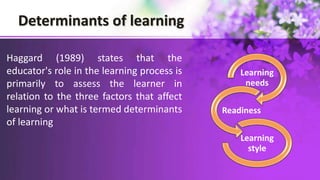
Determinants of learning
Learning
needs
Readiness
Learning
style
Haggard (1989) states that the
educator's role in the learning process is
primarily to assess the learner in
relation to the three factors that affect
learning or what is termed determinants
of learning
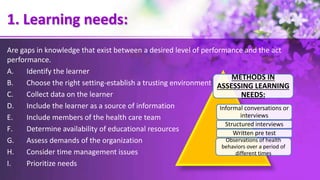
1. Learning needs:
Are gaps in knowledge that exist between a desired level of performance and the act
performance.
A. Identify the learner
B. Choose the right setting-establish a trusting environment
C. Collect data on the learner
D. Include the learner as a source of information
E. Include members of the health care team
F. Determine availability of educational resources
G. Assess demands of the organization
H. Consider time management issues
I. Prioritize needs
METHODS IN
ASSESSING LEARNING
NEEDS:
Informal conversations or
interviews
Structured interviews
Written pre test
Observations of health
behaviors over a period of
different times
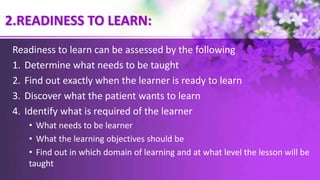
2.READINESS TO LEARN:
Readiness to learn can be assessed by the following
1. Determine what needs to be taught
2. Find out exactly when the learner is ready to learn
3. Discover what the patient wants to learn
4. Identify what is required of the learner
• What needs to be learner
• What the learning objectives should be
• Find out in which domain of learning and at what level the lesson will be
taught
Four types of readiness to learn (PEEK)
1. P-Physical readiness:
A. Measures of ability: Adequate strength, flexibility, and endurance are needed to teach
a patient how to walk on crutches and for him/her to be ready to learn. At the same time,
measures requiring visual and auditory acuity of a patient also affect the learning
readiness especially if the senses of sight and hearing are impaired.
B. Complexity of task: The difficulty level of the subject or the task to be mastered:
psychomotor skills require varying degrees of manual dexterity and physical energy
output but once acquired or mastered, they are usually retained better and longer than
learning in the cognitive and affective domains.
C. Environmental effects: Refers to an environment conducive to learning, free from noise
and other distractions that may affect the physical readiness to learn.
D. Health status - Person in a state of good health or ill health? Does he still have the
energy or motivation to learn?
2. E-Emotional readiness
A. Anxiety level may or may not be a
hindrance to learning. Some degree of
anxiety may motivate a person to learn but
a low degree of anxiety will interfere with
readiness to learn
B. Support system
C. Motivation.
D. Risk-taking behaviors
E. Frame of mind
F. Developmental stage
3. E-Experimental readiness
A.Level of aspiration
B.Past coping mechanism
C.Cultural background
D.Locus of control
E.Orientation
A.Parochial
B.Cosmopolitan orientation
4. K-Knowledge readiness
A Present knowledge base
B. Cognitive ability
3.Learning styles
• Characteristics of cognitive, affective, and physiological
behaviors are stable indicators of how learners perceive,
interact with, and respond to the environment.
• Learning style also represents both inherited
characteristics and environmental influences. As a result
of our hereditary equipment, most people develop
learning styles that emphasize some learning abilities over
others.
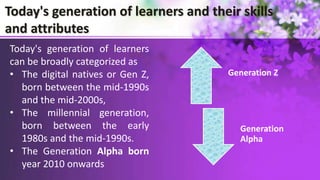
Today's generation of learners and their skills
and attributes
Generation Z
Generation
Alpha
Today's generation of learners
can be broadly categorized as
• The digital natives or Gen Z,
born between the mid-1990s
and the mid-2000s,
• The millennial generation,
born between the early
1980s and the mid-1990s.
• The Generation Alpha born
year 2010 onwards
GENERATION Z
• These two generations have grown up in a digital age, surrounded
by technology, social media, and the internet, and have
developed different learning preferences and behaviors compared
to previous generations.
• Knowledge about this group continues to emerge, but it's been
identified as the most technologically savvy of all generations.
They were born with the internet and began using interactive
technology before entering school.
SKILLS AND ATTRIBUTES OF GENERATION Z
• Are more pragmatic
• Read less and have shorter attention spans than previous generations.
• Interactive games and app will help them to reinforce important
information
• If communicating by e-mail, limit them to 140 characters to ensure
information is presented concisely.
• Rather than having a wall of pamphlets, a digital library of infographics
accessible via the patient portal and short, shareable videos is most
effective.
• When communicating with gen z learner, use texting, face-to-face video
chat, or social media as appropriate
• To avoid information overload, provide evidence-based resources
to help them identify credible sources.
• Effective individual learning would best from technology-based
resources.
• To support individual learning styles, practice providers should ask
new patients whether they prefer printed or online teaching
materials and notes.
• As a nurse, understanding the particular characteristics associated
with generations will help to tailor teaching methods to the styles
most effective for individual learning
GENERATION ALPHA
Generation Alpha includes those born from 2010 onwards who have
grown up in a fully digital world. Mark MeCrindle coined the term. He
explains that “it conforms to the scientific nomenclature of using the
Greek alphabet instead of the Latin alphabet and there was no point
in going back to A, after all, they are the first generation born fully into
the 21st century and therefore they are the start of something new,
not a return to the old".
Skills and Attributes of Generation Alpha
The characteristics are
• Independents: They are independent when it comes to making their
own decisions and managing their digital identities, and they expect
their individual needs and preferences to be taken into account
• Visuals: Video will be their preferred format. In addition, video games
will boost their visual skills, improving eye-hand coordination and the
ability to easily switch tasks.
Skills and attributes
• Hyperconnected: Alpha children are permanently connected. Such
is their attention to new technologies that it become a way of life.
• Technological: Being hyper-connected, they become experts in the
use of new technologies, which facilitates their digital learning and
opens up a wide range of possibilities
• Diverse: In this case, diversity not only refers to demographics, such
as ethnicity and gender but also to tastes, lifestyles, and points of
view.
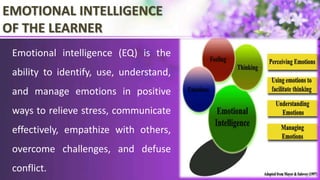
EMOTIONAL INTELLIGENCE
OF THE LEARNER
Emotional intelligence (EQ) is the
ability to identify, use, understand,
and manage emotions in positive
ways to relieve stress, communicate
effectively, empathize with others,
overcome challenges, and defuse
conflict.
• DEFINITION: Emotional intelligence refers to a person's ability to
perceive, process, and regulate emotional information effectively
both with oneself and others and to use this information to guide
one’s thinking, action and influence those of others– Meyer Salovey
• Emotional Intelligence is all about self-management, self-awareness,
and understanding people around. The major aspect of emotional
intelligence is relationship management.
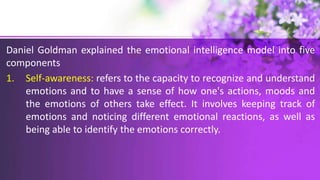
COMPONENTS OF EI
Self
awareness
Self-
regulation
Social
skills
Empathy motivation
Daniel Goldman explained the emotional intelligence model into five
components
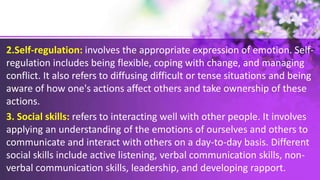
1. Self-awareness: refers to the capacity to recognize and understand
emotions and to have a sense of how one's actions, moods and
the emotions of others take effect. It involves keeping track of
emotions and noticing different emotional reactions, as well as
being able to identify the emotions correctly.
2.Self-regulation: involves the appropriate expression of emotion. Self-
regulation includes being flexible, coping with change, and managing
conflict. It also refers to diffusing difficult or tense situations and being
aware of how one's actions affect others and take ownership of these
actions.
3. Social skills: refers to interacting well with other people. It involves
applying an understanding of the emotions of ourselves and others to
communicate and interact with others on a day-to-day basis. Different
social skills include active listening, verbal communication skills, non-
verbal communication skills, leadership, and developing rapport.
4. Empathy: refers to being able to understand how other people are
feeling. This component of Emotional Intelligence enables an individual
to respond appropriately to other people based on recognizing their
emotions. It enables people to sense power dynamics that play a part
in all social relationships, but also most especially in workplace
relations.
5. Motivation: refers to Intrinsic motivation means that an individual
is driven to meet personal needs and goals, rather than being
motivated by external rewards such as money, fame, and recognition
IMPORTANCE
OF
EI
FOR
LEARNERS
Better communications
Improved social skills
Enhanced self awareness
Better stress management
Improved conflict resolution
ROLE OF TEACHER IN IMPROVING EMOTIONAL
INTELLIGENCE IN LEARNERS
Creating positive classroom environment
Teaching emotional awareness
Encouraging self- reflection
Providing opportunities for social emotional learning
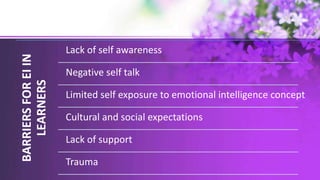
BARRIERS
FOR
EI
IN
LEARNERS
Lack of self awareness
Negative self talk
Limited self exposure to emotional intelligence concept
Cultural and social expectations
Lack of support
Trauma
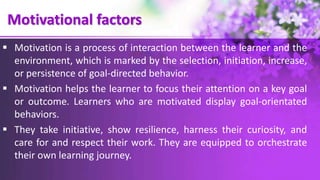
Motivational factors
 Motivation is a process of interaction between the learner and the
environment, which is marked by the selection, initiation, increase,
or persistence of goal-directed behavior.
 Motivation helps the learner to focus their attention on a key goal
or outcome. Learners who are motivated display goal-orientated
behaviors.
 They take initiative, show resilience, harness their curiosity, and
care for and respect their work. They are equipped to orchestrate
their own learning journey.
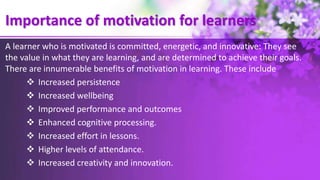
Importance of motivation for learners
A learner who is motivated is committed, energetic, and innovative: They see
the value in what they are learning, and are determined to achieve their goals.
There are innumerable benefits of motivation in learning. These include
 Increased persistence
 Increased wellbeing
 Improved performance and outcomes
 Enhanced cognitive processing.
 Increased effort in lessons.
 Higher levels of attendance.
 Increased creativity and innovation.
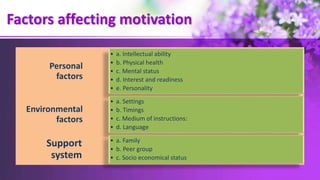
Factors affecting motivation
Personal
factors
• a. Intellectual ability
• b. Physical health
• c. Mental status
• d. Interest and readiness
• e. Personality
Environmental
factors
• a. Settings
• b. Timings
• c. Medium of instructions:
• d. Language
Support
system
• a. Family
• b. Peer group
• c. Socio economical status
REFERNCES
Lakshmi Prasanna. Educational technology /Nursing
education. frontline publication. 2024.Pg no.69-81
 Sankaranarayanan B. teachers manual of effective
teaching in the digital age . worthreads
Publications;2023 Pg no: 313-380

Assessment and Planning in Educational technology.pptx

  • 1.
    Mrs.B.Kavitha M.Sc (N), Professor AswiniCollege of Nursing, Thrissur ASSESSMENT AND PLANNING IN NURSING EDUCATION
  • 2.
    INTRODUCTION In an educationsystem, it is understood that assessment is only for the students, but on the other hand, the Assessment of teachers is also an important aspect of the education system that ensures teachers are providing high-quality instruction to students. The assessment process can be used to provide feedback and support for professional development, to inform decisions about teacher retention or promotion, or to evaluate teacher effectiveness for accountability purposes.
  • 3.
    ESSENTIAL QUALITIES OFA TEACHER Subject matter expertise Communicati on skills Classroom management Aptability Empathy Passion and enthusiasm Patience Continuous learning
  • 4.
    Subject matter expertise:Good teachers have a deep understanding of the subjects they teach. They are knowledgeable about the content and are able to explain it in a way that is understandable to their students. Communication skills: Good teachers are able to communicate clearly and effectively, both verbally and in writing. They are able to explain complex ideas in simple terms and are good listeners.
  • 5.
    Classroom management: Goodteachers are able to create a positive learning environment. They are able to manage classroom behavior, maintain order, and ensure that all students are engaged and participating. Aptability: Teaching requires a great deal of flexibility. Good teachers are able to adapt their teaching style and lesson plans to meet the needs of individual students and respond to unexpected situations
  • 6.
    Empathy: Good teachersare empathetic and understanding of their students' needs and concerns. They are able to create a safe and supportive learning environment where all students feel valued and respected. Passion and enthusiasm: Good teachers are passionate about teaching and enthusiastic about their subject matter. They can inspire and motivate their students to learn and explore new ideas
  • 7.
    Patience: Teaching canbe challenging, and good teachers are patient and understanding with their students. They can remain calm and composed even in difficult situations Continuous learning: Good teachers are committed to continuous development. They stay up-to-date with the latest research and technique in their field and are constantly looking for ways to improve their teaching practices.
  • 8.
    TEACHING STYLE The Formal authoritystyle The demonstrator style The facilitator style The delegator style • Teaching styles are also called teaching methods, which include, principles, management strategies for teaching. • Teachers will discover the fits their personalities and curriculum the best as they develop their teaching styles and combine them with successful classroom techniques.
  • 9.
    Formal authority style: •The authority model is teacher-centered and frequently entails lengthy lecture session way presentations. Students are expected to take notes or absorb information • Pros: – This style is acceptable for certain higher-education disciplines and auditorium with large groups of students. – The pure lecture style is most suitable for subjects like history which necessitate memorization of key facts, dates, names, etc • Cons: – It's a questionable model for teaching children because there is little or no interaction with the teacher, so it is a better approach for older, more mature students – The students will get boredom easily.
  • 10.
    Demonstrator style • Thedemonstrator retains the formal authority role by showing students what they need to know. • The demonstrator is a lot like the lecturer, but their lessons include multimedia presentations, activities, and demonstrations. (Math, Science, Music) • Pros. – This style gives teachers opportunities to incorporate a variety of formats including lectures and multimedia presentations • Cons – Although it's well-suited for teaching mathematics, music, physical education or arts and crafts, it is difficult to accommodate students' individual needs in larger classroom
  • 11.
    Facilitator style • Facilitatorspromote self-learning and help students develop critical thinking skill and retain knowledge that leads to self-actualization. • Pros: – This style trains students to ask questions and helps develop skills to find answer and solution through exploration, it is ideal for teaching science and similar subjects • Cons: – Challenges teachers to interact with students and prompt them toward discovery rather than lecturing facts and testing knowledge through memorization. So it's a bit harder to measure success in tangible terms.
  • 12.
    Delegator style • Thedelegator style is best suited for curricula that require lab activities, such as chemistry and biology, or subjects that warrant peer feedback, like debate and creative writing • Pros: – Guided discovery and inquiry-based learning place the teacher in an observer role that inspires students by working in tandem toward common goals. • Cons: – Considered a modern style of teaching, it is sometimes criticized as eroding teacher authority. As a delegator, the teacher acts more as a consultant rather than the traditional authority figure.
  • 13.
    ASSESSMENT OF LEARNER Alearner is someone who engages in the process of acquiring knowledge, skills, or understanding about a particular subject or topic. Learners can be individuals of any age or background, from students in formal educational settings such as schools and universities to professionals seeking to prove their skills through training and development programs.
  • 14.
    Types of learners Toattain all-round development, students should be provided with suitable assistance and guidance accordance with their abilities and learning needs. There are several types of learners, with its own unique characteristics, strengths, and weaknesses. Here are some common types of learners: Types of learner Visual learner Auditory learner Kinesthetics learner Reading/ writing learners Logical / mathematical learners Social/ interpersonal learners Solitary/ intrapersonal learners
  • 15.
    • Visual learners:These learners process information best through visual aids such as diagrams. charts, or videos. They benefit from seeing information in a visual format, and may have difficulty with verbal instructions or lectures. • Auditory learners: These learners process information best through sound and spoken language. They benefit from lectures, discussions, and verbal explanations, and may have difficulty with visual aids or written instructions.
  • 16.
    • Kinesthetic learners:These learners process information best through physical and hands-on experience. They benefit from activities such as role-playing, simulations or experiments, and may have difficulty with passive learning activities such as lectures or reading. • Reading/writing learners: These learners process information best through written language. They benefit from reading and taking notes, and may have difficulty with oral instruction or group discussion.
  • 17.
    • Logical /mathematicallearners: These learners process information's best through Logic and reasoning. They benefit from problem solving activities, patterns and classification, and may have difficulty with abstract concepts or creative thinking. • Social/interpersonal learners: These learners process information best through interaction and communication with others. They benefit from group discussions, collaborative activities and feedback from others, and may have difficulty with solitary learning activities • Solitary/intrapersonal learners: These learners process information best through independent study and reflection. They benefit from quiet, self- directed activities such as reading or journaling and may have difficulty with group activities or distractions
  • 18.
    Determinants of learning Learning needs Readiness Learning style Haggard(1989) states that the educator's role in the learning process is primarily to assess the learner in relation to the three factors that affect learning or what is termed determinants of learning
  • 19.
    1. Learning needs: Aregaps in knowledge that exist between a desired level of performance and the act performance. A. Identify the learner B. Choose the right setting-establish a trusting environment C. Collect data on the learner D. Include the learner as a source of information E. Include members of the health care team F. Determine availability of educational resources G. Assess demands of the organization H. Consider time management issues I. Prioritize needs METHODS IN ASSESSING LEARNING NEEDS: Informal conversations or interviews Structured interviews Written pre test Observations of health behaviors over a period of different times
  • 20.
    2.READINESS TO LEARN: Readinessto learn can be assessed by the following 1. Determine what needs to be taught 2. Find out exactly when the learner is ready to learn 3. Discover what the patient wants to learn 4. Identify what is required of the learner • What needs to be learner • What the learning objectives should be • Find out in which domain of learning and at what level the lesson will be taught
  • 21.
    Four types ofreadiness to learn (PEEK) 1. P-Physical readiness: A. Measures of ability: Adequate strength, flexibility, and endurance are needed to teach a patient how to walk on crutches and for him/her to be ready to learn. At the same time, measures requiring visual and auditory acuity of a patient also affect the learning readiness especially if the senses of sight and hearing are impaired. B. Complexity of task: The difficulty level of the subject or the task to be mastered: psychomotor skills require varying degrees of manual dexterity and physical energy output but once acquired or mastered, they are usually retained better and longer than learning in the cognitive and affective domains. C. Environmental effects: Refers to an environment conducive to learning, free from noise and other distractions that may affect the physical readiness to learn. D. Health status - Person in a state of good health or ill health? Does he still have the energy or motivation to learn?
  • 22.
    2. E-Emotional readiness A.Anxiety level may or may not be a hindrance to learning. Some degree of anxiety may motivate a person to learn but a low degree of anxiety will interfere with readiness to learn B. Support system C. Motivation. D. Risk-taking behaviors E. Frame of mind F. Developmental stage 3. E-Experimental readiness A.Level of aspiration B.Past coping mechanism C.Cultural background D.Locus of control E.Orientation A.Parochial B.Cosmopolitan orientation 4. K-Knowledge readiness A Present knowledge base B. Cognitive ability
  • 23.
    3.Learning styles • Characteristicsof cognitive, affective, and physiological behaviors are stable indicators of how learners perceive, interact with, and respond to the environment. • Learning style also represents both inherited characteristics and environmental influences. As a result of our hereditary equipment, most people develop learning styles that emphasize some learning abilities over others.
  • 24.
    Today's generation oflearners and their skills and attributes Generation Z Generation Alpha Today's generation of learners can be broadly categorized as • The digital natives or Gen Z, born between the mid-1990s and the mid-2000s, • The millennial generation, born between the early 1980s and the mid-1990s. • The Generation Alpha born year 2010 onwards
  • 25.
    GENERATION Z • Thesetwo generations have grown up in a digital age, surrounded by technology, social media, and the internet, and have developed different learning preferences and behaviors compared to previous generations. • Knowledge about this group continues to emerge, but it's been identified as the most technologically savvy of all generations. They were born with the internet and began using interactive technology before entering school.
  • 26.
    SKILLS AND ATTRIBUTESOF GENERATION Z • Are more pragmatic • Read less and have shorter attention spans than previous generations. • Interactive games and app will help them to reinforce important information • If communicating by e-mail, limit them to 140 characters to ensure information is presented concisely. • Rather than having a wall of pamphlets, a digital library of infographics accessible via the patient portal and short, shareable videos is most effective. • When communicating with gen z learner, use texting, face-to-face video chat, or social media as appropriate
  • 27.
    • To avoidinformation overload, provide evidence-based resources to help them identify credible sources. • Effective individual learning would best from technology-based resources. • To support individual learning styles, practice providers should ask new patients whether they prefer printed or online teaching materials and notes. • As a nurse, understanding the particular characteristics associated with generations will help to tailor teaching methods to the styles most effective for individual learning
  • 28.
    GENERATION ALPHA Generation Alphaincludes those born from 2010 onwards who have grown up in a fully digital world. Mark MeCrindle coined the term. He explains that “it conforms to the scientific nomenclature of using the Greek alphabet instead of the Latin alphabet and there was no point in going back to A, after all, they are the first generation born fully into the 21st century and therefore they are the start of something new, not a return to the old".
  • 29.
    Skills and Attributesof Generation Alpha The characteristics are • Independents: They are independent when it comes to making their own decisions and managing their digital identities, and they expect their individual needs and preferences to be taken into account • Visuals: Video will be their preferred format. In addition, video games will boost their visual skills, improving eye-hand coordination and the ability to easily switch tasks.
  • 30.
    Skills and attributes •Hyperconnected: Alpha children are permanently connected. Such is their attention to new technologies that it become a way of life. • Technological: Being hyper-connected, they become experts in the use of new technologies, which facilitates their digital learning and opens up a wide range of possibilities • Diverse: In this case, diversity not only refers to demographics, such as ethnicity and gender but also to tastes, lifestyles, and points of view.
  • 31.
    EMOTIONAL INTELLIGENCE OF THELEARNER Emotional intelligence (EQ) is the ability to identify, use, understand, and manage emotions in positive ways to relieve stress, communicate effectively, empathize with others, overcome challenges, and defuse conflict.
  • 32.
    • DEFINITION: Emotionalintelligence refers to a person's ability to perceive, process, and regulate emotional information effectively both with oneself and others and to use this information to guide one’s thinking, action and influence those of others– Meyer Salovey • Emotional Intelligence is all about self-management, self-awareness, and understanding people around. The major aspect of emotional intelligence is relationship management.
  • 33.
  • 34.
    Daniel Goldman explainedthe emotional intelligence model into five components 1. Self-awareness: refers to the capacity to recognize and understand emotions and to have a sense of how one's actions, moods and the emotions of others take effect. It involves keeping track of emotions and noticing different emotional reactions, as well as being able to identify the emotions correctly.
  • 35.
    2.Self-regulation: involves theappropriate expression of emotion. Self- regulation includes being flexible, coping with change, and managing conflict. It also refers to diffusing difficult or tense situations and being aware of how one's actions affect others and take ownership of these actions. 3. Social skills: refers to interacting well with other people. It involves applying an understanding of the emotions of ourselves and others to communicate and interact with others on a day-to-day basis. Different social skills include active listening, verbal communication skills, non- verbal communication skills, leadership, and developing rapport.
  • 36.
    4. Empathy: refersto being able to understand how other people are feeling. This component of Emotional Intelligence enables an individual to respond appropriately to other people based on recognizing their emotions. It enables people to sense power dynamics that play a part in all social relationships, but also most especially in workplace relations. 5. Motivation: refers to Intrinsic motivation means that an individual is driven to meet personal needs and goals, rather than being motivated by external rewards such as money, fame, and recognition
  • 37.
    IMPORTANCE OF EI FOR LEARNERS Better communications Improved socialskills Enhanced self awareness Better stress management Improved conflict resolution
  • 38.
    ROLE OF TEACHERIN IMPROVING EMOTIONAL INTELLIGENCE IN LEARNERS Creating positive classroom environment Teaching emotional awareness Encouraging self- reflection Providing opportunities for social emotional learning
  • 39.
    BARRIERS FOR EI IN LEARNERS Lack of selfawareness Negative self talk Limited self exposure to emotional intelligence concept Cultural and social expectations Lack of support Trauma
  • 40.
    Motivational factors  Motivationis a process of interaction between the learner and the environment, which is marked by the selection, initiation, increase, or persistence of goal-directed behavior.  Motivation helps the learner to focus their attention on a key goal or outcome. Learners who are motivated display goal-orientated behaviors.  They take initiative, show resilience, harness their curiosity, and care for and respect their work. They are equipped to orchestrate their own learning journey.
  • 41.
    Importance of motivationfor learners A learner who is motivated is committed, energetic, and innovative: They see the value in what they are learning, and are determined to achieve their goals. There are innumerable benefits of motivation in learning. These include  Increased persistence  Increased wellbeing  Improved performance and outcomes  Enhanced cognitive processing.  Increased effort in lessons.  Higher levels of attendance.  Increased creativity and innovation.
  • 42.
    Factors affecting motivation Personal factors •a. Intellectual ability • b. Physical health • c. Mental status • d. Interest and readiness • e. Personality Environmental factors • a. Settings • b. Timings • c. Medium of instructions: • d. Language Support system • a. Family • b. Peer group • c. Socio economical status
  • 43.
    REFERNCES Lakshmi Prasanna. Educationaltechnology /Nursing education. frontline publication. 2024.Pg no.69-81  Sankaranarayanan B. teachers manual of effective teaching in the digital age . worthreads Publications;2023 Pg no: 313-380