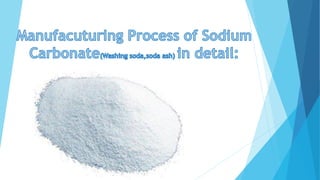
SODIUM CARBONATE
NA2CO3
INTRODUCTION:
Sodium Carbonate is the disodium salt
of carbonic acid with alkalinizing
property.
Chemical Formula: Na2CO3
Molar Mass: 105.98844 g
Mass Percent: Na 43.381 %; C 11.332 %;
O 45.286 %
Also Know as
Washing Soda
Soda Ash
Soda Crystal
Occurrence:
 Occurs as Crystalline dehydrate.
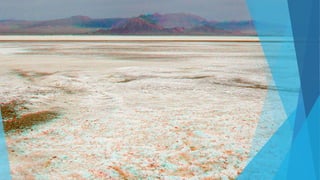
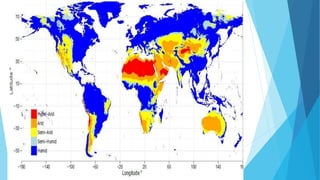
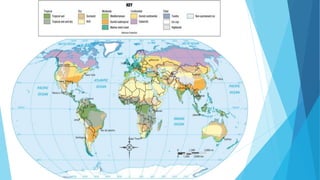
 A great amount of sodium carbonate occur
naturally only in arid regions because it has high
solubility in water.
 the country that posses the greatest amount of
sodium carbonate is Egypt, whose land is vastly
dry.
PROPERTIES:
Inorganic compound
Internal Enthalpy of solution is -28.1
kJ/mol
Melting Point is 851o C (1,564o F)
 Density is 2.53 g/cm3.
Odorless.
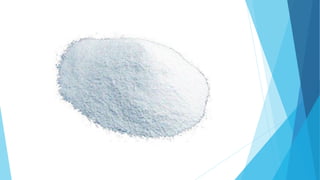
Grayish White Powder.
Properties:
 Hygroscopic means when it exposed to air, it can
spontaneously absorb water molecules.
 Soluble in water
 Slightly soluble in Alcohol
 Alkaline Taste
 Effervescence
 When it is placed in a slightly acidic solution,
it decomposes and forms bubbles.
USES OF SODIUM CARBONATE:
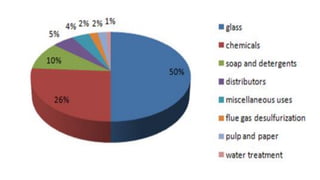
 The main uses of sodium carbonate are as
water softener, food processing aid, pH
modifier, swimming pool chemical and
electrolyte. It is also used in the manufacture
of glass, paper, soaps and detergents, and
many other useful chemicals.
MANY USES OF SODIUM CARBONATE
IN OUR DAILY LIFE
 LAUNDRY SOAP.
 DISHWASHER.
 MOPPING SOLUTION.
 UNCLOG DRAINS.
 FRESHER DRAIN AND TRAPS.
 HARDWATER DEPOSITS REMOVER.
MANUFACTURING OF NA2CO3:
 THE MOST COMMONLY TWO METHODS USED IN
MANUFACTURING OF SODIUM CARBONATE.
•LEBLANC PROCESS
•SOLVAY PROCESS
METHODS:
MANUFACTURING OF NA2CO3
LEBLANC MATHOD:
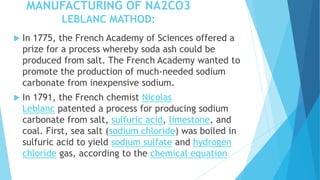
 In 1775, the French Academy of Sciences offered a
prize for a process whereby soda ash could be
produced from salt. The French Academy wanted to
promote the production of much-needed sodium
carbonate from inexpensive sodium.
 In 1791, the French chemist Nicolas
Leblanc patented a process for producing sodium
carbonate from salt, sulfuric acid, limestone, and
coal. First, sea salt (sodium chloride) was boiled in
sulfuric acid to yield sodium sulfate and hydrogen
chloride gas, according to the chemical equation
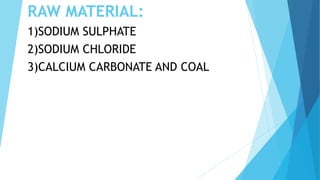
RAW MATERIAL:
1)SODIUM SULPHATE
2)SODIUM CHLORIDE
3)CALCIUM CARBONATE AND COAL
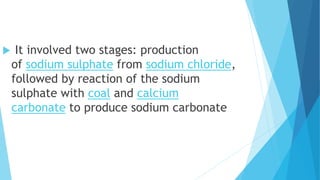
 It involved two stages: production
of sodium sulphate from sodium chloride,
followed by reaction of the sodium
sulphate with coal and calcium
carbonate to produce sodium carbonate
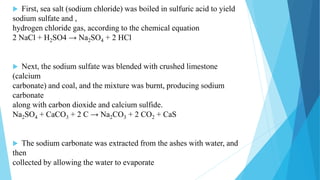
 First, sea salt (sodium chloride) was boiled in sulfuric acid to yield
sodium sulfate and ,
hydrogen chloride gas, according to the chemical equation
2 NaCl + H2SO4 → Na2SO4 + 2 HCl
 Next, the sodium sulfate was blended with crushed limestone
(calcium
carbonate) and coal, and the mixture was burnt, producing sodium
carbonate
along with carbon dioxide and calcium sulfide.
Na2SO4 + CaCO3 + 2 C → Na2CO3 + 2 CO2 + CaS
 The sodium carbonate was extracted from the ashes with water, and
then
collected by allowing the water to evaporate
SOLVAY PROCESS:
In 1861, the Belgian industrial
chemist Ernest Solvay developed a method
to convert sodium chloride to sodium
carbonate using ammonia. The Solvay
process centered around a large hollow
tower. At the bottom, calcium carbonate
(limestone) was heated to release carbon
dioxide:
ADVANTAGES:
1)It is cheap process.
2)Raw material easily available.
3)CO2 recover in Calcination tower and
Ammonia also recover in Ammonia
Recovery Tower.
4)Pollution free.
5)Only 1 waste product that is CaCl2
6)Na2CO3 of very high purities obtained.
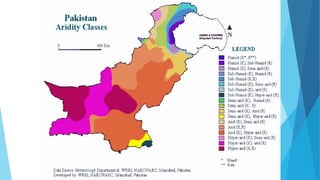
7)Pakistan is self sufficient in Na2Co3.
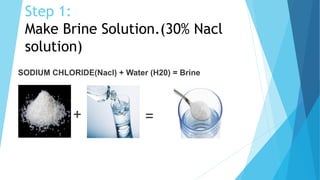
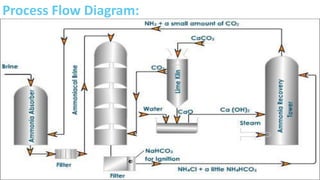
Step 1:
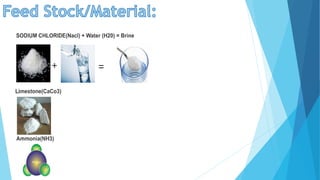
Make Brine Solution.(30% Nacl
solution)
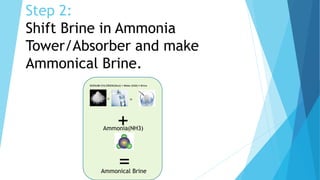
Step 2:
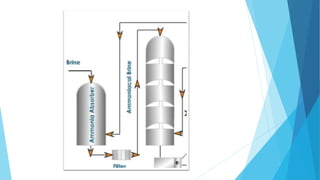
Shift Brine in Ammonia
Tower/Absorber and make
Ammonical Brine.
+Ammonia(NH3)
=Ammonical Brine
Step 3:
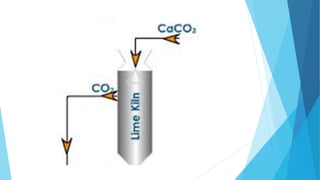
In lime Kiln we decompose
limstone at high temperature
950–1100 °C by heating and make
quick/burnt lime and CO2. Then
pass CO2 gas in Carbonation
Tower from bottom.
CaCO3(s) ---->CaO(s) + CO2(g)
Step 4:
After filteration of Ammonical brine passes it
to Carbonation Tower from the top.
(because ammonical brine is in liquid form
and CO2 in gas form)
NH3(aq) +H2O(l) + CO2(g) ----> NH4HCO3(s)
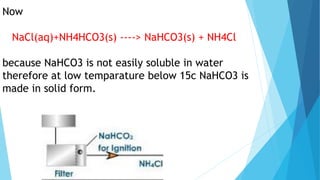
Now
NaCl(aq)+NH4HCO3(s) ----> NaHCO3(s) + NH4Cl
because NaHCO3 is not easily soluble in water
therefore at low temparature below 15c NaHCO3 is
made in solid form.
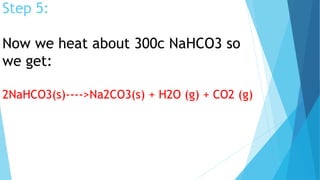
Step 5:
Now we heat about 300c NaHCO3 so
we get:
2NaHCO3(s)---->Na2CO3(s) + H2O (g) + CO2 (g)
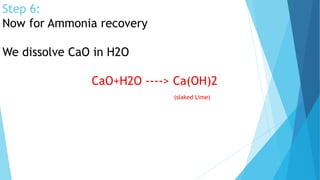
Step 6:
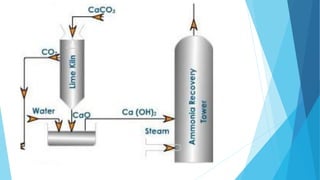
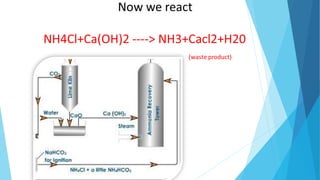
Now for Ammonia recovery
We dissolve CaO in H2O
CaO+H2O ----> Ca(OH)2
(slaked Lime)
Process Flow Diagram:
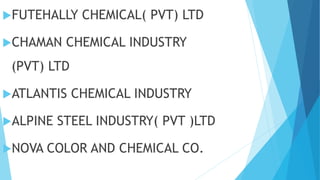
LIST OF INDUSTRIES IN PAKISTAN
FUTEHALLY CHEMICAL( PVT) LTD
CHAMAN CHEMICAL INDUSTRY
(PVT) LTD
ATLANTIS CHEMICAL INDUSTRY
ALPINE STEEL INDUSTRY( PVT )LTD
NOVA COLOR AND CHEMICAL CO.
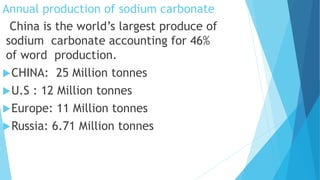
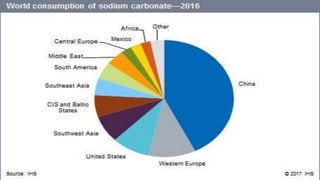
Annual production of sodium carbonate
China is the world’s largest produce of
sodium carbonate accounting for 46%
of word production.
CHINA: 25 Million tonnes
U.S : 12 Million tonnes
Europe: 11 Million tonnes
Russia: 6.71 Million tonnes
Reference:
www.smartstudyedu.com
www.ilmlidunya.com
Sodium carbonate

Sodium carbonate

  • 1.
  • 2.
    INTRODUCTION: Sodium Carbonate isthe disodium salt of carbonic acid with alkalinizing property. Chemical Formula: Na2CO3 Molar Mass: 105.98844 g Mass Percent: Na 43.381 %; C 11.332 %; O 45.286 %
  • 3.
    Also Know as WashingSoda Soda Ash Soda Crystal
  • 5.
    Occurrence:  Occurs asCrystalline dehydrate.  A great amount of sodium carbonate occur naturally only in arid regions because it has high solubility in water.  the country that posses the greatest amount of sodium carbonate is Egypt, whose land is vastly dry.
  • 11.
    PROPERTIES: Inorganic compound Internal Enthalpyof solution is -28.1 kJ/mol Melting Point is 851o C (1,564o F)  Density is 2.53 g/cm3. Odorless. Grayish White Powder.
  • 12.
    Properties:  Hygroscopic meanswhen it exposed to air, it can spontaneously absorb water molecules.  Soluble in water  Slightly soluble in Alcohol  Alkaline Taste  Effervescence  When it is placed in a slightly acidic solution, it decomposes and forms bubbles.
  • 13.
    USES OF SODIUMCARBONATE:  The main uses of sodium carbonate are as water softener, food processing aid, pH modifier, swimming pool chemical and electrolyte. It is also used in the manufacture of glass, paper, soaps and detergents, and many other useful chemicals.
  • 14.
    MANY USES OFSODIUM CARBONATE IN OUR DAILY LIFE  LAUNDRY SOAP.  DISHWASHER.  MOPPING SOLUTION.  UNCLOG DRAINS.  FRESHER DRAIN AND TRAPS.  HARDWATER DEPOSITS REMOVER.
  • 16.
    MANUFACTURING OF NA2CO3: THE MOST COMMONLY TWO METHODS USED IN MANUFACTURING OF SODIUM CARBONATE. •LEBLANC PROCESS •SOLVAY PROCESS METHODS:
  • 17.
    MANUFACTURING OF NA2CO3 LEBLANCMATHOD:  In 1775, the French Academy of Sciences offered a prize for a process whereby soda ash could be produced from salt. The French Academy wanted to promote the production of much-needed sodium carbonate from inexpensive sodium.  In 1791, the French chemist Nicolas Leblanc patented a process for producing sodium carbonate from salt, sulfuric acid, limestone, and coal. First, sea salt (sodium chloride) was boiled in sulfuric acid to yield sodium sulfate and hydrogen chloride gas, according to the chemical equation
  • 18.
    RAW MATERIAL: 1)SODIUM SULPHATE 2)SODIUMCHLORIDE 3)CALCIUM CARBONATE AND COAL
  • 19.
     It involvedtwo stages: production of sodium sulphate from sodium chloride, followed by reaction of the sodium sulphate with coal and calcium carbonate to produce sodium carbonate
  • 20.
     First, seasalt (sodium chloride) was boiled in sulfuric acid to yield sodium sulfate and , hydrogen chloride gas, according to the chemical equation 2 NaCl + H2SO4 → Na2SO4 + 2 HCl  Next, the sodium sulfate was blended with crushed limestone (calcium carbonate) and coal, and the mixture was burnt, producing sodium carbonate along with carbon dioxide and calcium sulfide. Na2SO4 + CaCO3 + 2 C → Na2CO3 + 2 CO2 + CaS  The sodium carbonate was extracted from the ashes with water, and then collected by allowing the water to evaporate
  • 21.
    SOLVAY PROCESS: In 1861,the Belgian industrial chemist Ernest Solvay developed a method to convert sodium chloride to sodium carbonate using ammonia. The Solvay process centered around a large hollow tower. At the bottom, calcium carbonate (limestone) was heated to release carbon dioxide:
  • 22.
    ADVANTAGES: 1)It is cheapprocess. 2)Raw material easily available. 3)CO2 recover in Calcination tower and Ammonia also recover in Ammonia Recovery Tower. 4)Pollution free. 5)Only 1 waste product that is CaCl2 6)Na2CO3 of very high purities obtained. 7)Pakistan is self sufficient in Na2Co3.
  • 27.
    Step 1: Make BrineSolution.(30% Nacl solution)
  • 28.
    Step 2: Shift Brinein Ammonia Tower/Absorber and make Ammonical Brine. +Ammonia(NH3) =Ammonical Brine
  • 29.
    Step 3: In limeKiln we decompose limstone at high temperature 950–1100 °C by heating and make quick/burnt lime and CO2. Then pass CO2 gas in Carbonation Tower from bottom. CaCO3(s) ---->CaO(s) + CO2(g)
  • 31.
    Step 4: After filterationof Ammonical brine passes it to Carbonation Tower from the top. (because ammonical brine is in liquid form and CO2 in gas form) NH3(aq) +H2O(l) + CO2(g) ----> NH4HCO3(s)
  • 33.
    Now NaCl(aq)+NH4HCO3(s) ----> NaHCO3(s)+ NH4Cl because NaHCO3 is not easily soluble in water therefore at low temparature below 15c NaHCO3 is made in solid form.
  • 34.
    Step 5: Now weheat about 300c NaHCO3 so we get: 2NaHCO3(s)---->Na2CO3(s) + H2O (g) + CO2 (g)
  • 35.
    Step 6: Now forAmmonia recovery We dissolve CaO in H2O CaO+H2O ----> Ca(OH)2 (slaked Lime)
  • 38.
  • 39.
    LIST OF INDUSTRIESIN PAKISTAN
  • 40.
    FUTEHALLY CHEMICAL( PVT)LTD CHAMAN CHEMICAL INDUSTRY (PVT) LTD ATLANTIS CHEMICAL INDUSTRY ALPINE STEEL INDUSTRY( PVT )LTD NOVA COLOR AND CHEMICAL CO.
  • 41.
    Annual production ofsodium carbonate China is the world’s largest produce of sodium carbonate accounting for 46% of word production. CHINA: 25 Million tonnes U.S : 12 Million tonnes Europe: 11 Million tonnes Russia: 6.71 Million tonnes
  • 43.