Silicates and Allied Products
Silicates:
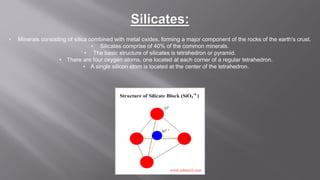
• Minerals consisting of silica combined with metal oxides, forming a major component of the rocks of the earth's crust.
• Silicates comprise of 40% of the common minerals.
• The basic structure of silicates is tetrahedron or pyramid.
• There are four oxygen atoms, one located at each corner of a regular tetrahedron.
• A single silicon atom is located at the center of the tetrahedron.
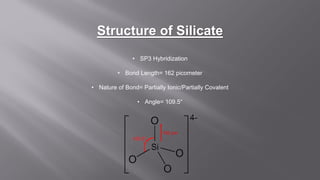
Structure of Silicate
• SP3 Hybridization
• Bond Length= 162 picometer
• Nature of Bond= Partially Ionic/Partially Covalent
• Angle= 109.5°
Types of Silicates:
• Ortho Silicates
• Pyro Silicates
• Sheet Silicates
• Ring Silicates
• Single and double Chain Silicates
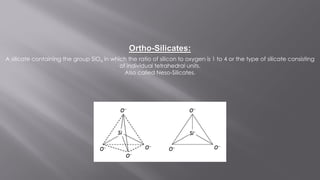
A silicate containing the group SiO4 in which the ratio of silicon to oxygen is 1 to 4 or the type of silicate consisting
of individual tetrahedral units.
Also called Neso-Silicates.
Ortho-Silicates:
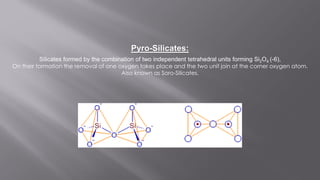
Silicates formed by the combination of two independent tetrahedral units forming Si2O4 (-6),
On their formation the removal of one oxygen takes place and the two unit join at the corner oxygen atom.
Also known as Soro-Silicates.
Pyro-Silicates:
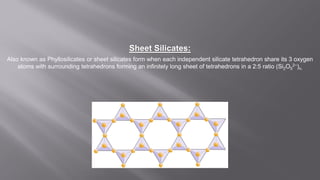
Also known as Phyllosilicates or sheet silicates form when each independent silicate tetrahedron share its 3 oxygen
atoms with surrounding tetrahedrons forming an infinitely long sheet of tetrahedrons in a 2:5 ratio (Si2O5
2−)n.
Sheet Silicates:
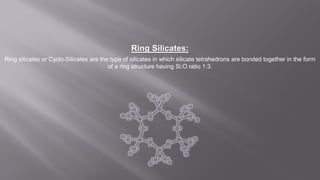
Ring silicates or Cyclo-Silicates are the type of silicates in which silicate tetrahedrons are bonded together in the form
of a ring structure having Si:O ratio 1:3.
Ring Silicates:
Chain silicates also known as inosilicates are the silicates appears to be in the form of chains tetrahedrons, having a
Si:O ratio 1:3 in single chain (SiO3
2−)n and 4:11 (Si4O11
6−)n in double chain structures
Chain Silicates:
Uses of Silicates:
Silicates are the most abundant class of minerals on Earth. Hence it has many uses, which are given below.
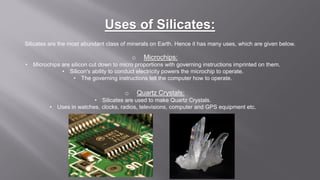
o Microchips:
• Microchips are silicon cut down to micro proportions with governing instructions imprinted on them.
• Silicon's ability to conduct electricity powers the microchip to operate.
• The governing instructions tell the computer how to operate.
o Quartz Crystals:
• Silicates are used to make Quartz Crystals.
• Uses in watches, clocks, radios, televisions, computer and GPS equipment etc.
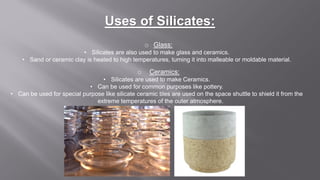
o Glass:
• Silicates are also used to make glass and ceramics.
• Sand or ceramic clay is heated to high temperatures, turning it into malleable or moldable material.
o Ceramics:
• Silicates are used to make Ceramics.
• Can be used for common purposes like pottery.
• Can be used for special purpose like silicate ceramic tiles are used on the space shuttle to shield it from the
extreme temperatures of the outer atmosphere.
Uses of Silicates:
 There are many allied products of Silicates, in which some of
them are given below
 Sodium Silicate
 Aluminum Silicate
 Ethyl silicate
 POTASSIUM SILICATE
 Calcium silicate
Sodium silicate is the common name for compounds with the
formula (Na2SiO2).Also known as water glass or liquid glass.
Uses;
Aadhesives, detergents, ingredients in cleaning compounds,,
binders, and unique coatings, as well as coagulant aids,
anticorrosive, catalyst bases
• Uses of Sodium Silicate:
• In the manufacture of Silica Gel:
• Sodium Silicate Liquid is extensively used as a raw material in the manufacture of silica gel.
• In Foundry:
• These chemicals is used as core binders in foundry.
• In mining and construction:
• The chemical is used as a concrete setting additive in mining and construction applications.
• In mineral, paint, pigment processing
• Sodium Silicate Liquid is widely used as a coating extender in the processing of minerals, paint and pigments.
Properties of Sodium Silicate:
• Alkalinity:
The Silicate Liquid can neutralize acidic soils, emulsify fats and breakdown proteins due to their high
alkalinity.
• Buffering capacity:
The high buffering capacity of chemical helps maintain the optimum pH even in the presence of acidic compounds or dilution.
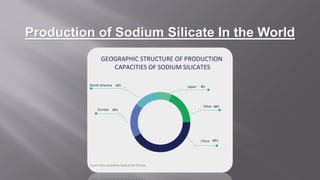
Production of Sodium Silicate In the World
Sodium Silicate Industries In Pakistan
• Captain Chemical Industries
• National Silicate And Allied Industries
• AL-Khair Industries
• Sultan Trading Company
• Peshawar Chemicals
• AlQaim Sodium Silicate Industry
Allied Products Of Silicates
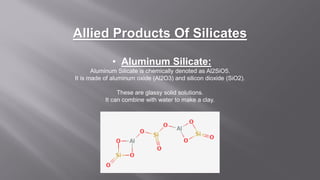
• Aluminum Silicate:
Aluminum Silicate is chemically denoted as Al2SiO5.
It is made of aluminum oxide (Al2O3) and silicon dioxide (SiO2).
These are glassy solid solutions.
It can combine with water to make a clay.
 ceramics industry as a refractory
 manufacture electrical insulating materials
 heating elements.
 making spark plugs, inks, adhesives & plastics
 Used for making rubbers, board & ceiling tile coatings
 Used as a catalyst
Properties of Aluminum Silicate:
• Resistance to Heat.
• High Efficiency and Durability.
• The density is 2.8 to 2.9 g/cm.
• It’s specific gravity is b/w 3.8-8.
• It has a hardness of 1-2 on the Mohs scale of mineral hardness.
• The colors of Aluminum silicate are white, red, brown, orange and green.
All of which have the chemical formula Al2SiO5.
Aluminum Silicate Industries In Pakistan
• Team Distributor (SMC-PVT) LTD.
• ARV Traders
• Aluminum Scrap Co. LTD.
• Natural Source Ltd
• Farooq Chemical Industry
• Akso Aluminum And Glass
 Surface coatings based on ethyl silicate binders are categorised
as inorganic coatings, whereas the conventional surface
coatings which are mainly based on organic binders are referred
to as organic coatings
Uses;
coatings based on ethyl silicate are quite successful for the
protection of steel against corrosion under severe exposing
conditions
 Potassium silicate is the name for a family of inorganic
compound. The most common potassium silicate has the
formula K2SiO3, samples of which contain varying amounts
of water. These are white solids or colorless solutions
 Potassium Silicate Powder (Potassium Salt of Silicic acid) is a
source of highly soluble potassium and silicon ions. It is used in
agriculture. Potassium Silicate Powder forms is easily available
to the plant via irrigation.
 Calcium silicate is a white free-flowing powder. It can be derived
from naturally occurring limestone.
 Calcium silicate is used as an anticaking agent in food
preparation.
 High-temperature insulation
 Passive fire protection
 It is used as a sealant
 As a component of cement
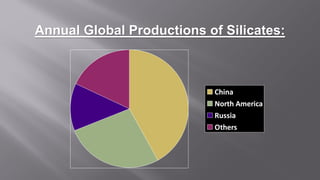
Annual Global Production of Silicates:
• China is the world largest silicates producer It produce 52 million tons per year (Around 45%).
• US is second largest silicates producer it produce 44 million tons per year.
• Russia produce 33 million tons per year.
• Pakistan produce about only 10 million tons annually.
China
North America
Russia
Others
Annual Global Productions of Silicates:
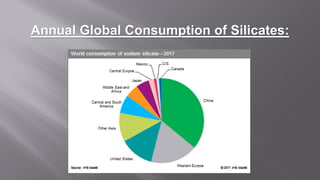
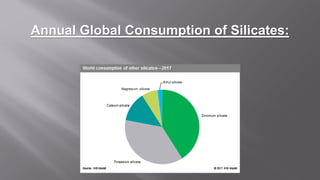
Annual Global Consumption of Silicates:
References
• storify.com/JigneshPatel123/properties-and-uses-of-sodium-silicate-liquid-glas
• silmaco.com/production-process
• businessbook.pk/category/sodium-silicate-3150
• primaryinfo.com/industry/aluminium-silicate.htm
• sunkemindustries.com/Chemical_Products.php?id=11
• reade.com/products/aluminum-silicate-powder
• meritnation.com/ask-answer/question/what-are-pyrosilicates-and-
cyclicsilicates/the-p-block-elements/3536298
• https://ihsmarkit.com/products/silicates-chemical-economics-handbook.html
Silicates and allied products

Silicates and allied products

  • 1.
  • 2.
    Silicates: • Minerals consistingof silica combined with metal oxides, forming a major component of the rocks of the earth's crust. • Silicates comprise of 40% of the common minerals. • The basic structure of silicates is tetrahedron or pyramid. • There are four oxygen atoms, one located at each corner of a regular tetrahedron. • A single silicon atom is located at the center of the tetrahedron.
  • 3.
    Structure of Silicate •SP3 Hybridization • Bond Length= 162 picometer • Nature of Bond= Partially Ionic/Partially Covalent • Angle= 109.5°
  • 4.
    Types of Silicates: •Ortho Silicates • Pyro Silicates • Sheet Silicates • Ring Silicates • Single and double Chain Silicates
  • 5.
    A silicate containingthe group SiO4 in which the ratio of silicon to oxygen is 1 to 4 or the type of silicate consisting of individual tetrahedral units. Also called Neso-Silicates. Ortho-Silicates:
  • 6.
    Silicates formed bythe combination of two independent tetrahedral units forming Si2O4 (-6), On their formation the removal of one oxygen takes place and the two unit join at the corner oxygen atom. Also known as Soro-Silicates. Pyro-Silicates:
  • 7.
    Also known asPhyllosilicates or sheet silicates form when each independent silicate tetrahedron share its 3 oxygen atoms with surrounding tetrahedrons forming an infinitely long sheet of tetrahedrons in a 2:5 ratio (Si2O5 2−)n. Sheet Silicates:
  • 8.
    Ring silicates orCyclo-Silicates are the type of silicates in which silicate tetrahedrons are bonded together in the form of a ring structure having Si:O ratio 1:3. Ring Silicates:
  • 9.
    Chain silicates alsoknown as inosilicates are the silicates appears to be in the form of chains tetrahedrons, having a Si:O ratio 1:3 in single chain (SiO3 2−)n and 4:11 (Si4O11 6−)n in double chain structures Chain Silicates:
  • 10.
    Uses of Silicates: Silicatesare the most abundant class of minerals on Earth. Hence it has many uses, which are given below. o Microchips: • Microchips are silicon cut down to micro proportions with governing instructions imprinted on them. • Silicon's ability to conduct electricity powers the microchip to operate. • The governing instructions tell the computer how to operate. o Quartz Crystals: • Silicates are used to make Quartz Crystals. • Uses in watches, clocks, radios, televisions, computer and GPS equipment etc.
  • 11.
    o Glass: • Silicatesare also used to make glass and ceramics. • Sand or ceramic clay is heated to high temperatures, turning it into malleable or moldable material. o Ceramics: • Silicates are used to make Ceramics. • Can be used for common purposes like pottery. • Can be used for special purpose like silicate ceramic tiles are used on the space shuttle to shield it from the extreme temperatures of the outer atmosphere. Uses of Silicates:
  • 12.
     There aremany allied products of Silicates, in which some of them are given below  Sodium Silicate  Aluminum Silicate  Ethyl silicate  POTASSIUM SILICATE  Calcium silicate
  • 13.
    Sodium silicate isthe common name for compounds with the formula (Na2SiO2).Also known as water glass or liquid glass. Uses; Aadhesives, detergents, ingredients in cleaning compounds,, binders, and unique coatings, as well as coagulant aids, anticorrosive, catalyst bases
  • 14.
    • Uses ofSodium Silicate: • In the manufacture of Silica Gel: • Sodium Silicate Liquid is extensively used as a raw material in the manufacture of silica gel. • In Foundry: • These chemicals is used as core binders in foundry. • In mining and construction: • The chemical is used as a concrete setting additive in mining and construction applications. • In mineral, paint, pigment processing • Sodium Silicate Liquid is widely used as a coating extender in the processing of minerals, paint and pigments.
  • 15.
    Properties of SodiumSilicate: • Alkalinity: The Silicate Liquid can neutralize acidic soils, emulsify fats and breakdown proteins due to their high alkalinity. • Buffering capacity: The high buffering capacity of chemical helps maintain the optimum pH even in the presence of acidic compounds or dilution.
  • 16.
    Production of SodiumSilicate In the World
  • 17.
    Sodium Silicate IndustriesIn Pakistan • Captain Chemical Industries • National Silicate And Allied Industries • AL-Khair Industries • Sultan Trading Company • Peshawar Chemicals • AlQaim Sodium Silicate Industry
  • 18.
    Allied Products OfSilicates • Aluminum Silicate: Aluminum Silicate is chemically denoted as Al2SiO5. It is made of aluminum oxide (Al2O3) and silicon dioxide (SiO2). These are glassy solid solutions. It can combine with water to make a clay.
  • 19.
     ceramics industryas a refractory  manufacture electrical insulating materials  heating elements.  making spark plugs, inks, adhesives & plastics  Used for making rubbers, board & ceiling tile coatings  Used as a catalyst
  • 20.
    Properties of AluminumSilicate: • Resistance to Heat. • High Efficiency and Durability. • The density is 2.8 to 2.9 g/cm. • It’s specific gravity is b/w 3.8-8. • It has a hardness of 1-2 on the Mohs scale of mineral hardness. • The colors of Aluminum silicate are white, red, brown, orange and green. All of which have the chemical formula Al2SiO5.
  • 21.
    Aluminum Silicate IndustriesIn Pakistan • Team Distributor (SMC-PVT) LTD. • ARV Traders • Aluminum Scrap Co. LTD. • Natural Source Ltd • Farooq Chemical Industry • Akso Aluminum And Glass
  • 22.
     Surface coatingsbased on ethyl silicate binders are categorised as inorganic coatings, whereas the conventional surface coatings which are mainly based on organic binders are referred to as organic coatings Uses; coatings based on ethyl silicate are quite successful for the protection of steel against corrosion under severe exposing conditions
  • 23.
     Potassium silicateis the name for a family of inorganic compound. The most common potassium silicate has the formula K2SiO3, samples of which contain varying amounts of water. These are white solids or colorless solutions
  • 24.
     Potassium SilicatePowder (Potassium Salt of Silicic acid) is a source of highly soluble potassium and silicon ions. It is used in agriculture. Potassium Silicate Powder forms is easily available to the plant via irrigation.
  • 25.
     Calcium silicateis a white free-flowing powder. It can be derived from naturally occurring limestone.  Calcium silicate is used as an anticaking agent in food preparation.  High-temperature insulation  Passive fire protection  It is used as a sealant  As a component of cement
  • 26.
    Annual Global Productionof Silicates: • China is the world largest silicates producer It produce 52 million tons per year (Around 45%). • US is second largest silicates producer it produce 44 million tons per year. • Russia produce 33 million tons per year. • Pakistan produce about only 10 million tons annually.
  • 27.
  • 28.
  • 29.
  • 30.
    References • storify.com/JigneshPatel123/properties-and-uses-of-sodium-silicate-liquid-glas • silmaco.com/production-process •businessbook.pk/category/sodium-silicate-3150 • primaryinfo.com/industry/aluminium-silicate.htm • sunkemindustries.com/Chemical_Products.php?id=11 • reade.com/products/aluminum-silicate-powder • meritnation.com/ask-answer/question/what-are-pyrosilicates-and- cyclicsilicates/the-p-block-elements/3536298 • https://ihsmarkit.com/products/silicates-chemical-economics-handbook.html