Hydrogen Production The Energy of Tomorrow Grounded by  The Technology of Today
One of the greatest problems facing the development of hydrogen-powered cars remains the production of hydrogen. With the technology that we currently possess, hydrogen production is either expensive and impractical or just as bad for the environment as current fossil fuels. Scientists continue to work on new and viable means of producing energy-usable hydrogen.
STEAM REFORMING 
Steam Reforming “Hydrogen!  Hydrogen! My planet for some hydrogen!” The most widely used means of practical hydrogen production is through steam reforming. Steam reforming involves reacting methane with steam at high temperatures (750°-800° C). This produces a synthesis gas made up of H 2  and     Carbon Monoxide  
Steam Reforming cont. To convert the CO into further Hydrogen, the steam reforming process has a second step, in which the Carbon Monoxide is reacted with steam over a nickel catalyst. This second steaming occurs in two stages: The High Temperature Shift, which occurs at temperatures of 350° C, and the Low Temperature Shift, which occurs at 210° C. The by-product?    CARBON DIOXIDE  
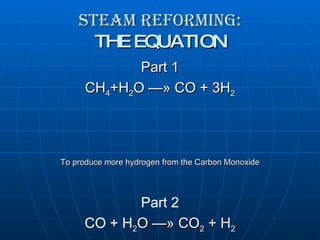
Steam Reforming: THE EQUATION Part 1 CH 4 +H 2 O —» CO + 3H 2 To produce more hydrogen from the Carbon Monoxide Part 2 CO + H 2 O —» CO 2  + H 2
ELECTROLYSIS + 
Electrolysis E for effort A further means of Hydrogen production is ELECTROLYSIS. Electrolysis is the process in which an ionic compound is broken down into its component elements by passing an electric current through it.
Electrolysis cont. This process can be used to break down water into hydrogen and oxygen. The equation is below: 2H 2 O  —»  2H 2  + O 2
Problems with Electrolysis The main problem with electrolysis is that it is adapted only to small quantities of water, completely impractical for powering a fuel cell. For it to be viable, there would need to be vast leaps in the field of maximizing electrolysis output while miniaturizing the process.
BACTERIA  In the Future . . .
Bacteria It’s coming . . . We swear . . . An experimental, but very promising prospect in hydrogen production is in harnessing hydrogen-producing bacteria. The advantage of this process would be that the only fuel source that would have to be stored would be the alimentation of the bacteria.  Some promising examples of research in this field are . . .
Modified E. Coli Virus On January 31, 2008, it was announced in Science Daily that Thomas Wood, a Professor at Texas A&M, had genetically modified a sample of E. Coli virus to produce Hydrogen gas when fed natural sugars from corn crops.  The current form of this virus can produce 140 times the amount produced by normal nitrogen-fixing process. Professor Wood continues to work on these specimens, with the goal of improving the output of the virus with a smaller input of sugar.
Nitrogen-fixing bacteria A more down-to-earth bacteria fuel is the use of nitrogen-fixing bacteria.  The process of nitrogen fixation is a vital part of plant growth, and produces hydrogen among other products.  Technology for identifying this bacteria is patent pending.
CONCLUSION The technology to produce viable hydrogen has been around for a long time. The technology to produce viable hydrogen  practically and eco-neutrally  is a long way away. Barring an unexpected leap forward in human thinking and scientific process, usable methods of hydrogen production are due around 2012.

Hydrogen Production

  • 1.
    Hydrogen Production TheEnergy of Tomorrow Grounded by The Technology of Today
  • 2.
    One of thegreatest problems facing the development of hydrogen-powered cars remains the production of hydrogen. With the technology that we currently possess, hydrogen production is either expensive and impractical or just as bad for the environment as current fossil fuels. Scientists continue to work on new and viable means of producing energy-usable hydrogen.
  • 3.
  • 4.
    Steam Reforming “Hydrogen! Hydrogen! My planet for some hydrogen!” The most widely used means of practical hydrogen production is through steam reforming. Steam reforming involves reacting methane with steam at high temperatures (750°-800° C). This produces a synthesis gas made up of H 2 and  Carbon Monoxide 
  • 5.
    Steam Reforming cont.To convert the CO into further Hydrogen, the steam reforming process has a second step, in which the Carbon Monoxide is reacted with steam over a nickel catalyst. This second steaming occurs in two stages: The High Temperature Shift, which occurs at temperatures of 350° C, and the Low Temperature Shift, which occurs at 210° C. The by-product?  CARBON DIOXIDE 
  • 6.
    Steam Reforming: THEEQUATION Part 1 CH 4 +H 2 O —» CO + 3H 2 To produce more hydrogen from the Carbon Monoxide Part 2 CO + H 2 O —» CO 2 + H 2
  • 7.
  • 8.
    Electrolysis E foreffort A further means of Hydrogen production is ELECTROLYSIS. Electrolysis is the process in which an ionic compound is broken down into its component elements by passing an electric current through it.
  • 9.
    Electrolysis cont. Thisprocess can be used to break down water into hydrogen and oxygen. The equation is below: 2H 2 O —» 2H 2 + O 2
  • 10.
    Problems with ElectrolysisThe main problem with electrolysis is that it is adapted only to small quantities of water, completely impractical for powering a fuel cell. For it to be viable, there would need to be vast leaps in the field of maximizing electrolysis output while miniaturizing the process.
  • 11.
    BACTERIA  Inthe Future . . .
  • 12.
    Bacteria It’s coming. . . We swear . . . An experimental, but very promising prospect in hydrogen production is in harnessing hydrogen-producing bacteria. The advantage of this process would be that the only fuel source that would have to be stored would be the alimentation of the bacteria. Some promising examples of research in this field are . . .
  • 13.
    Modified E. ColiVirus On January 31, 2008, it was announced in Science Daily that Thomas Wood, a Professor at Texas A&M, had genetically modified a sample of E. Coli virus to produce Hydrogen gas when fed natural sugars from corn crops. The current form of this virus can produce 140 times the amount produced by normal nitrogen-fixing process. Professor Wood continues to work on these specimens, with the goal of improving the output of the virus with a smaller input of sugar.
  • 14.
    Nitrogen-fixing bacteria Amore down-to-earth bacteria fuel is the use of nitrogen-fixing bacteria. The process of nitrogen fixation is a vital part of plant growth, and produces hydrogen among other products. Technology for identifying this bacteria is patent pending.
  • 15.
    CONCLUSION The technologyto produce viable hydrogen has been around for a long time. The technology to produce viable hydrogen practically and eco-neutrally is a long way away. Barring an unexpected leap forward in human thinking and scientific process, usable methods of hydrogen production are due around 2012.