1
In the name of God
Fischer_Tropsch
synthesis
department of Chemical engineering
Isfahan university of technology
2017
2
Presented by :
Shadi Razmara
(shadi.razmara16@gmail.com)
department of Chemical engineering
Isfahan university of technology
Isfahan - Iran
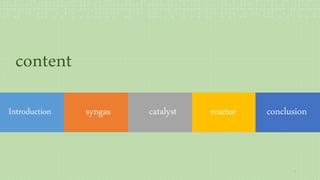
syngasIntroduction catalyst reactor conclusion
content
3
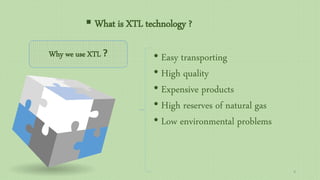
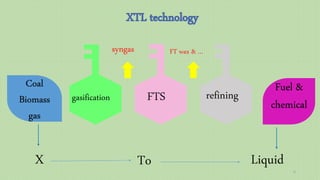
 What is XTL technology ?
• Easy transporting
• High quality
• Expensive products
• High reserves of natural gas
• Low environmental problems
Why we use XTL ?
4
Coal
Biomass
gas
Fuel &
chemical
X LiquidTo
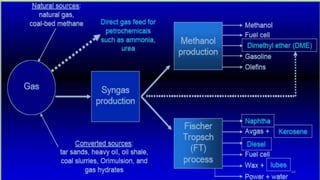
refininggasification FTS
syngas FT wax & …
5
6
7
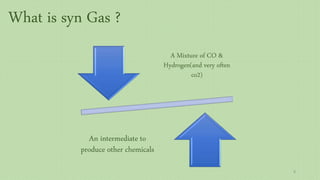
A Mixture of CO &
Hydrogen(and very often
co2)
An intermediate to
produce other chemicals
What is syn Gas ?
8
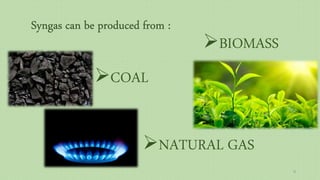
COAL
BIOMASS
NATURAL GAS
9
10
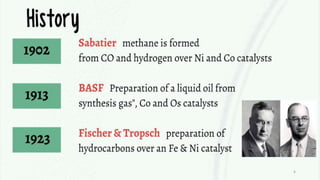
1
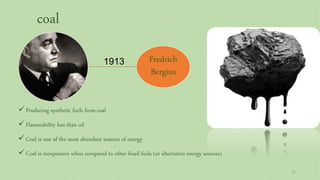
Fredrich
Bergius
1913
 Producing synthetic fuels from coal
 Flammability less than oil
 Coal is one of the most abundant sources of energy
 Coal is inexpensive when compared to other fossil fuels (or alternative energy sources)
coal
11
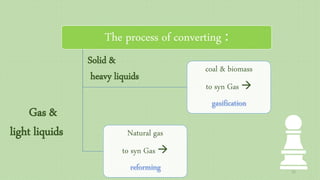
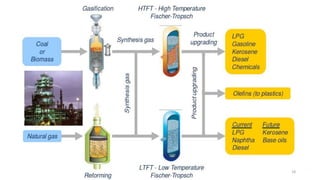
The process of converting :
coal & biomass
to syn Gas 
Natural gas
to syn Gas 
Solid &
heavy liquids
Gas &
light liquids
12
13
A. reforming
Natural gas
 is a gas consisting primarily of methane
Also contains other hydrocarbons – ethane, propane,…
 It is an important fuel source, a major feedstock for fertilizers,
and a potent greenhouse gas
 Natural gas is used extensively in residential, commercial and
industrial applications
14
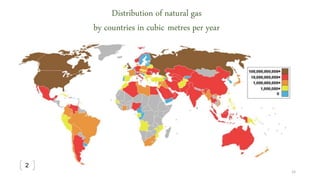
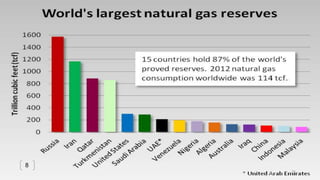
Distribution of natural gas
by countries in cubic metres per year
15
2
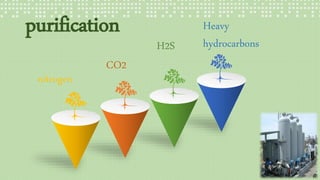
purification
nitrogen
CO2
H2S
Heavy
hydrocarbons
16
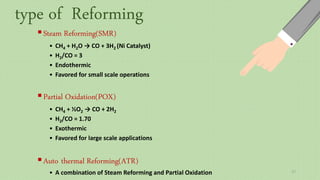
Steam Reforming(SMR)
• CH4 + H2O → CO + 3H2 (Ni Catalyst)
• H2/CO = 3
• Endothermic
• Favored for small scale operations
Partial Oxidation(POX)
• CH4 + ½O2 → CO + 2H2
• H2/CO ≈ 1.70
• Exothermic
• Favored for large scale applications
Auto thermal Reforming(ATR)
• A combination of Steam Reforming and Partial Oxidation
type of Reforming
17
18
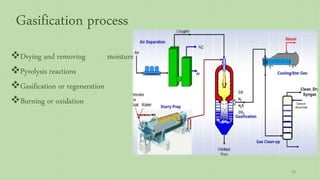
Drying and removing moisture
Pyrolysis reactions
Gasification or regeneration
Burning or oxidation
Gasification process
19
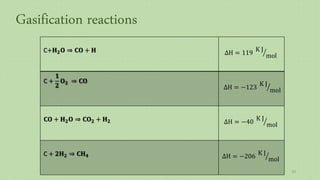
Gasification reactions
C+𝐇 𝟐 𝐎 ⇒ 𝐂𝐎 + 𝐇 ΔH = 119
K J
mol
C +
𝟏
𝟐
𝐎 𝟐 ⇒ 𝐂𝐎
ΔH = −123
K J
mol
𝐂𝐎 + 𝐇 𝟐 𝐎 ⇒ 𝐂𝐎 𝟐 + 𝐇 𝟐 ΔH = −40
K J
mol
C + 𝟐𝐇 𝟐 ⇒ 𝐂𝐇 𝟒 ΔH = −206
K J
mol
20
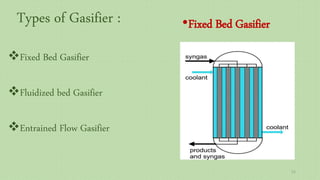
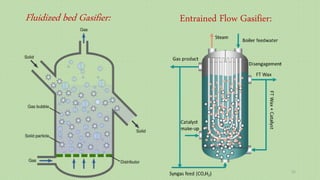
Types of Gasifier : •Fixed Bed Gasifier
Fixed Bed Gasifier
Fluidized bed Gasifier
Entrained Flow Gasifier
21
Entrained Flow Gasifier:Fluidized bed Gasifier:
22
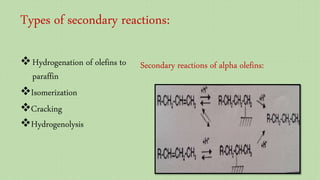
Types of secondary reactions:
Secondary reactions of alpha olefins:Hydrogenation of olefins to
paraffin
Isomerization
Cracking
Hydrogenolysis
23
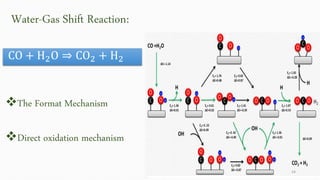
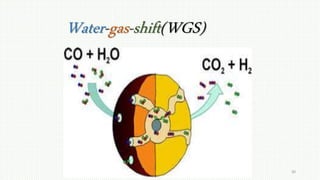
Water-Gas Shift Reaction:
The Format Mechanism
Direct oxidation mechanism
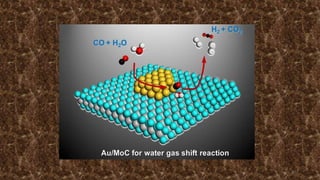
CO + H2O ⇒ CO2 + H2
24
Effective factors on secondary reactions :
penetration: Infiltration constraints affect the movement of reactive
substances to active catalytic sites, as well as the disposal of products from these
active sites.
Solubility:The liquid and vapor levels and high-boiling point products for
the proper design of phase-gas processes and kinetic modeling of this kind of
Hanoi reactor.
Physical Adsorption: Physical absorption is an intermediate state
between chemical absorption and gas flux under the influence of Van der Waals
gravity forces. 25
26
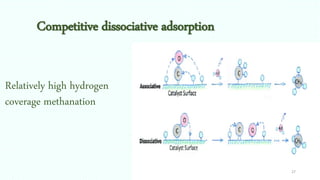
Competitive dissociative adsorption
Relatively high hydrogen
coverage methanation
27
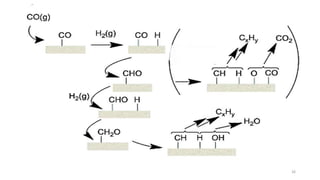
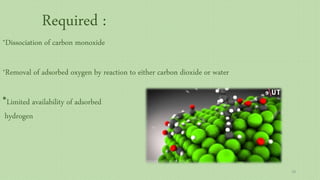
Required :
*Dissociation of carbon monoxide
*Removal of adsorbed oxygen by reaction to either carbon dioxide or water
*Limited availability of adsorbed
hydrogen
28
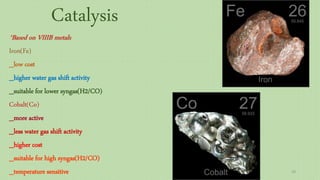
Catalysis
*Based on VIIIB metals
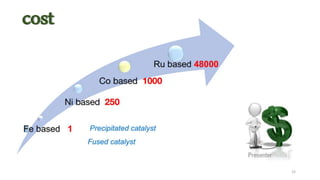
Iron(Fe)
_low cost
_higher water gas shift activity
_suitable for lower syngas(H2/CO)
Cobalt(Co)
_more active
_less water gas shift activity
_higher cost
_suitable for high syngas(H2/CO)
_temperature sensitive 29
Water-gas-shift(WGS)
30
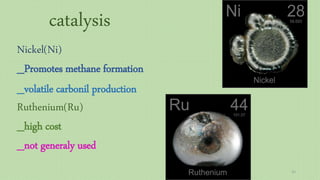
catalysis
Nickel(Ni)
_Promotes methane formation
_volatile carbonil production
Ruthenium(Ru)
_high cost
_not generaly used
31
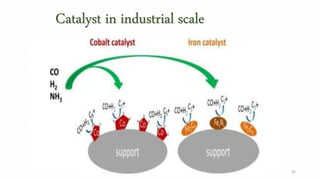
Catalyst in industrial scale
32
cost
33
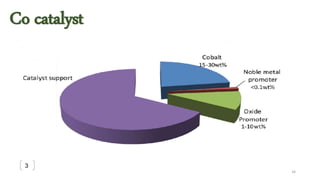
Co catalyst
34
3
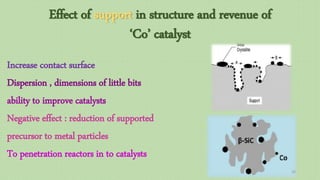
Effect of support in structure and revenue of
‘Co’ catalyst
Increase contact surface
Dispersion , dimensions of little bits
ability to improve catalysts
Negative effect : reduction of supported
precursor to metal particles
To penetration reactors in to catalysts
35
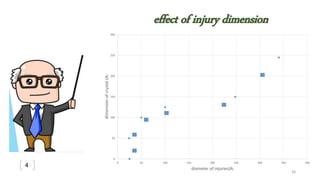
0
50
100
150
200
250
300
0 50 100 150 200 250 300 350 400
dimensionofcrystal(A)
diameter of injuries(A)
effect of injury dimension
36
4
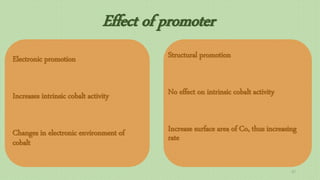
Effect of promoter
Electronic promotion
Increases intrinsic cobalt activity
Changes in electronic environment of
cobalt
Structural promotion
No effect on intrinsic cobalt activity
Increase surface area of Co, thus increasing
rate
37
38
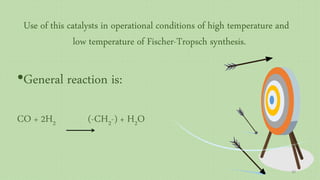
Use of this catalysts in operational conditions of high temperature and
low temperature of Fischer-Tropsch synthesis.
•General reaction is:
CO + 2H2 (-CH2-) + H2O
39
40
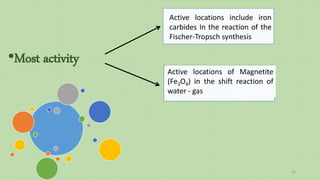
•Most activity
Active locations include iron
carbides In the reaction of the
Fischer-Tropsch synthesis
Active locations of Magnetite
(Fe3O4) in the shift reaction of
water - gas
41
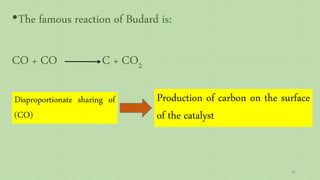
•The famous reaction of Budard is:
CO + CO C + CO2
Disproportionate sharing of
(CO)
Production of carbon on the surface
of the catalyst
42
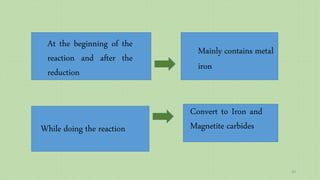
At the beginning of the
reaction and after the
reduction
Mainly contains metal
iron
While doing the reaction
Convert to Iron and
Magnetite carbides
43
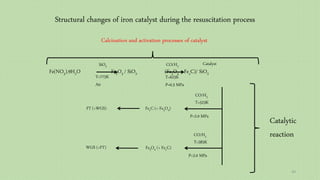
Fe(NO3).9H2O Fe2O3 / SiO2 (Fe3O4 + FexC)/ SiO2
SiO2
T=773K
Air
CO/H2
T=623K
P=0.3 MPa
Catalyst
P=2.0 MPa
CO/H2
T=523K
FexC (+ Fe3O4)FT (+WGS)
P=2.0 MPa
CO/H2
T=583K
Fe3O4 (+ FexC)WGS (+FT)
Catalytic
reaction
Calcination and activation processes of catalyst
Structural changes of iron catalyst during the resuscitation process
44
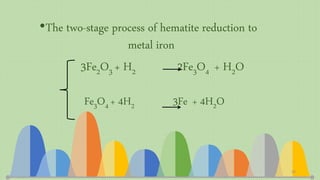
•The two-stage process of hematite reduction to
metal iron
3Fe2O3 + H2 2Fe3O4 + H2O
Fe3O4 + 4H2 3Fe + 4H2O
45
Evaluation of the possibility of revival hematite to
metal iron
Thermodynamic relationship of
the revival process ΔG = nRT ln[(PH2O/ PH2)/(PH2O/ PH2)eq]
46
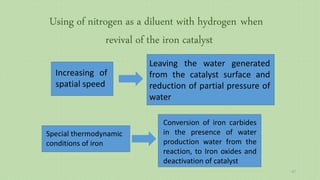
Using of nitrogen as a diluent with hydrogen when
revival of the iron catalyst
Leaving the water generated
from the catalyst surface and
reduction of partial pressure of
water
Increasing of
spatial speed
Special thermodynamic
conditions of iron
Conversion of iron carbides
in the presence of water
production water from the
reaction, to Iron oxides and
deactivation of catalyst
47
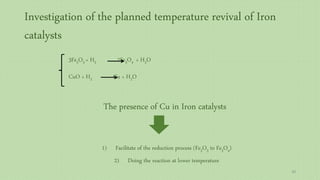
Investigation of the planned temperature revival of Iron
catalysts
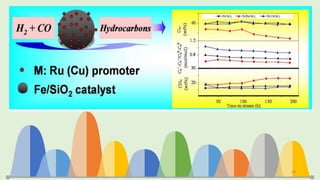
The presence of Cu in Iron catalysts
1) Facilitate of the reduction process (Fe2O3 to Fe3O4)
2) Doing the reaction at lower temperature
3Fe2O3 + H2 2Fe3O4 + H2O
CuO + H2 Cu + H2O
48
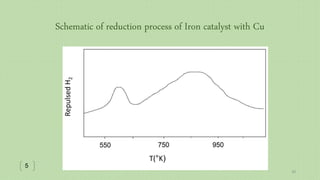
Schematic of reduction process of Iron catalyst with Cu
RepulsedH2
T(°K)
49
5
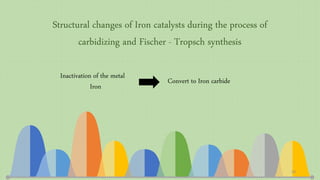
Structural changes of Iron catalysts during the process of
carbidizing and Fischer - Tropsch synthesis
Inactivation of the metal
Iron
Convert to Iron carbide
50
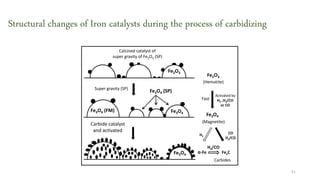
Structural changes of Iron catalysts during the process of carbidizing
Fe2O3
Fe3O4 (FM) Fe3O4
Fe3O4 (SP)
Fe2O3
Fast
(Hematite)
Activated by
H2 ,H2/CO
or CO
Fe3O4
(Magnetite)
α-Fe
H2/CO
FexC
H2
CO
H2/CO
Carbides
Carbide catalyst
and activated
Fe3O4
Super gravity (SP)
Calcined catalyst of
super gravity of Fe2O3 (SP)
51
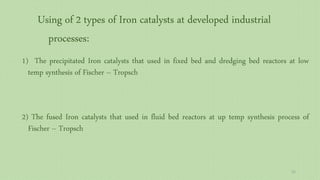
1) The precipitated Iron catalysts that used in fixed bed and dredging bed reactors at low
temp synthesis of Fischer – Tropsch
2) The fused Iron catalysts that used in fluid bed reactors at up temp synthesis process of
Fischer – Tropsch
Using of 2 types of Iron catalysts at developed industrial
processes:
52
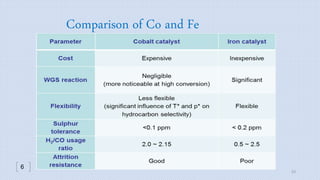
Comparison of Co and Fe
53
6
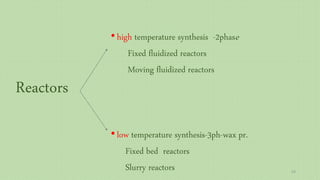
Reactors
•high temperature synthesis -2phase
Fixed fluidized reactors
Moving fluidized reactors
•low temperature synthesis-3ph-wax pr.
Fixed bed reactors
Slurry reactors 54
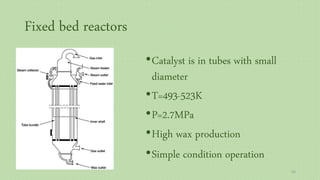
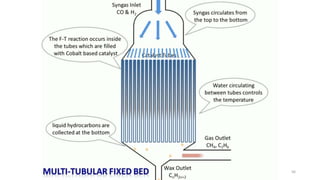
Fixed bed reactors
•Catalyst is in tubes with small
diameter
•T=493-523K
•P=2.7MPa
•High wax production
•Simple condition operation
55
56
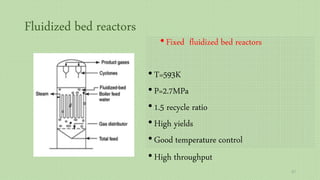
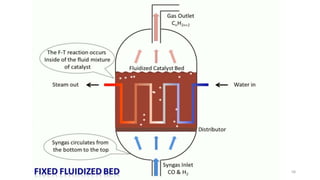
Fluidized bed reactors
•Fixed fluidized bed reactors
•T=593K
•P=2.7MPa
•1.5 recycle ratio
•High yields
•Good temperature control
•High throughput
57
58
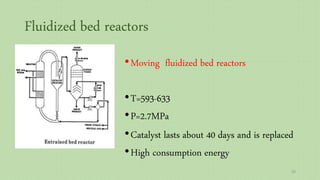
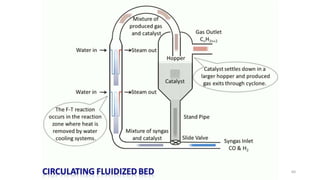
Fluidized bed reactors
•Moving fluidized bed reactors
•T=593-633
•P=2.7MPa
•Catalyst lasts about 40 days and is replaced
•High consumption energy
59
60
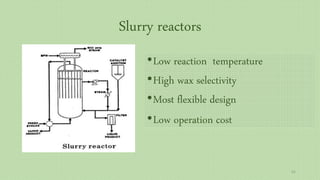
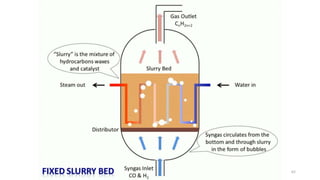
Slurry reactors
•Low reaction temperature
•High wax selectivity
•Most flexible design
•Low operation cost
61
62
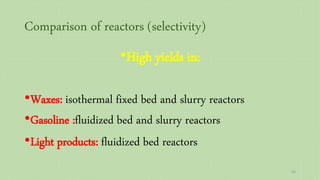
Comparison of reactors (selectivity)
•High yields in:
•Waxes: isothermal fixed bed and slurry reactors
•Gasoline :fluidized bed and slurry reactors
•Light products: fluidized bed reactors
63
64
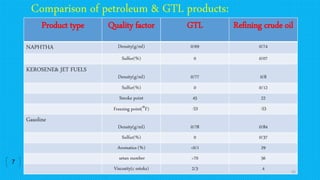
Comparison of petroleum & GTL products:
Product type Quality factor GTL Refining crude oil
NAPHTHA Density(g/ml) 0/69 0/74
Sulfur(%) 0 0/07
KEROSENE& JET FUELS
Density(g/ml) 0/77 0/8
Sulfur(%) 0 0/12
Smoke point 45 22
Freezing point(°F) -53 -53
Gasoline
Density(g/ml) 0/78 0/84
Sulfur(%) 0 0/37
Aromatics (%) <0/1 29
setan number >70 56
Viscosity(c estoks) 2/3 4 65
7
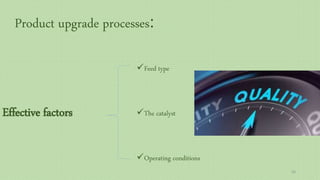
Product upgrade processes:
Effective factors
Feed type
The catalyst
Operating conditions
66
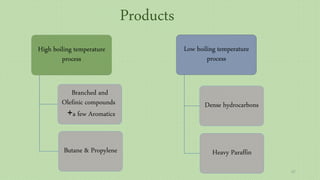
High boiling temperature
process
Branched and
Olefinic compounds
+a few Aromatics
Butane & Propylene
Low boiling temperature
process
Dense hydrocarbons
Heavy Paraffin
Products
67
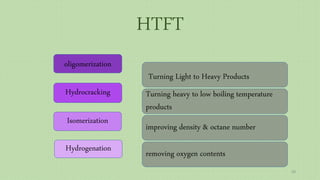
HTFT
Hydrocracking
Isomerization
Hydrogenation
oligomerization
Turning Light to Heavy Products
Turning heavy to low boiling temperature
products
improving density & octane number
removing oxygen contents
68
Product process(low temperature)
69
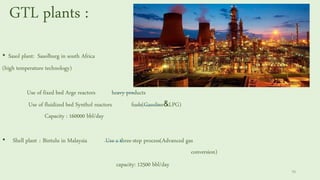
GTL plants :
• Sasol plant: Sasolburg in south Africa
(high temperature technology)
Use of fixed bed Arge reactors heavy products
Use of fluidized bed Synthol reactors fuels(Gasoline&LPG)
Capacity : 160000 bbl/day
• Shell plant : Bintulu in Malaysia Use a three-step process(Advanced gas
conversion)
capacity: 12500 bbl/day
70
71
8
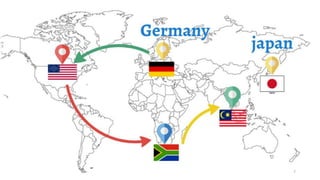
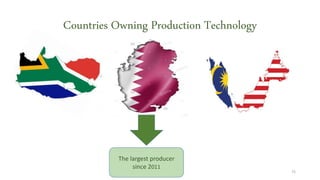
Countries Owning Production Technology
The largest producer
since 2011
72
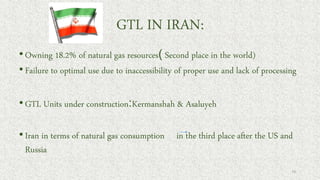
GTL IN IRAN:
•Owning 18.2% of natural gas resources) Second place in the world)
•Failure to optimal use due to inaccessibility of proper use and lack of processing
•GTL Units under construction:Kermanshah & Asaluyeh
•Iran in terms of natural gas consumption in the third place after the US and
Russia
73
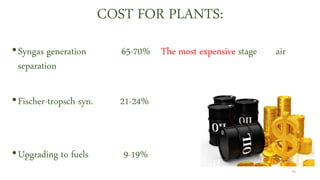
COST FOR PLANTS:
•Syngas generation 65-70% The most expensive stage air
separation
•Fischer-tropsch syn. 21-24%
•Upgrading to fuels 9-19%
74
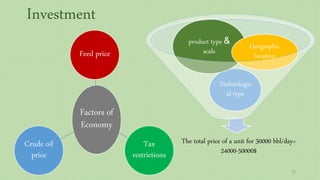
Investment
The total price of a unit for 30000 bbl/day=
24000-50000$
Technologic
al type
product type &
scale
Geographic
location
Factors of
Economy
Feed price
Tax
restrictions
Crude oil
price
75
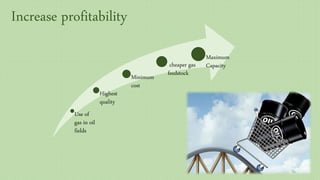
Increase profitability
Use of
gas in oil
fields
Highest
quality
Minimum
cost
cheaper gas
feedstock
Maximum
Capacity
76
77
References
1.Steynberg,A.P & M. E. Dry. ‘’ fischer tropsch technology’’ NO 152.Amsterdam , Elsevier,2004
2.http://www.mizenaft.com/fa/doc/news/13767
3. https://www.omicsonline.org/hydrogenation-of-co-on-cobalt-catalyst-in-fischer-tropsch-synthesis-2157-
7544.1000113.php?aid=4732
4.Khodakov, A. Y. ‘’FT synthesis : relation between of cobalt catalyst & their catalytic performance . 144 p. 251
5.J .Xu .C . H . Bartholomew . ‘’temperature programmed hydrogenation . J . Phys. Chem . B 109. p.2392
6. Design, synthesis, and use of cobalt-based Fischer-Tropsch synthesis catalysts (Iglesia, 1997)
7. ‫ایران‬ ‫انرژی‬ ‫نشریه‬/‫هشتم‬ ‫سال‬/‫شماره‬18/‫ال‬ ‫تی‬ ‫جی‬ ‫فناوری‬ ‫اقتصادی‬ ‫بررسی‬
8. ‫نفت‬ ‫صنعت‬ ‫تجهیزات‬ ‫نشریه‬/‫شماره‬1
9.www.fischer-tropsch.org
10.High quality diesel via the Fischer–Tropsch process – a review (Dry, 2001)
11. ‫سنتزی‬ ‫های‬ ‫سوخت‬ ‫تولید‬ ‫برای‬ ‫راهی‬ ‫تروپش‬ ‫فیشر‬ ‫سنتز‬.‫پور‬ ‫نخعی‬ ‫علی‬.‫نفت‬ ‫صنعت‬ ‫پژوهشگاه‬
78
Thank you!

Fischer tropsch

  • 1.
    1 In the nameof God Fischer_Tropsch synthesis department of Chemical engineering Isfahan university of technology 2017
  • 2.
    2 Presented by : ShadiRazmara (shadi.razmara16@gmail.com) department of Chemical engineering Isfahan university of technology Isfahan - Iran
  • 3.
  • 4.
     What isXTL technology ? • Easy transporting • High quality • Expensive products • High reserves of natural gas • Low environmental problems Why we use XTL ? 4
  • 5.
  • 6.
  • 7.
  • 8.
    A Mixture ofCO & Hydrogen(and very often co2) An intermediate to produce other chemicals What is syn Gas ? 8
  • 9.
  • 10.
  • 11.
    Fredrich Bergius 1913  Producing syntheticfuels from coal  Flammability less than oil  Coal is one of the most abundant sources of energy  Coal is inexpensive when compared to other fossil fuels (or alternative energy sources) coal 11
  • 12.
    The process ofconverting : coal & biomass to syn Gas  Natural gas to syn Gas  Solid & heavy liquids Gas & light liquids 12
  • 13.
  • 14.
    Natural gas  isa gas consisting primarily of methane Also contains other hydrocarbons – ethane, propane,…  It is an important fuel source, a major feedstock for fertilizers, and a potent greenhouse gas  Natural gas is used extensively in residential, commercial and industrial applications 14
  • 15.
    Distribution of naturalgas by countries in cubic metres per year 15 2
  • 16.
  • 17.
    Steam Reforming(SMR) • CH4+ H2O → CO + 3H2 (Ni Catalyst) • H2/CO = 3 • Endothermic • Favored for small scale operations Partial Oxidation(POX) • CH4 + ½O2 → CO + 2H2 • H2/CO ≈ 1.70 • Exothermic • Favored for large scale applications Auto thermal Reforming(ATR) • A combination of Steam Reforming and Partial Oxidation type of Reforming 17
  • 18.
  • 19.
    Drying and removingmoisture Pyrolysis reactions Gasification or regeneration Burning or oxidation Gasification process 19
  • 20.
    Gasification reactions C+𝐇 𝟐𝐎 ⇒ 𝐂𝐎 + 𝐇 ΔH = 119 K J mol C + 𝟏 𝟐 𝐎 𝟐 ⇒ 𝐂𝐎 ΔH = −123 K J mol 𝐂𝐎 + 𝐇 𝟐 𝐎 ⇒ 𝐂𝐎 𝟐 + 𝐇 𝟐 ΔH = −40 K J mol C + 𝟐𝐇 𝟐 ⇒ 𝐂𝐇 𝟒 ΔH = −206 K J mol 20
  • 21.
    Types of Gasifier: •Fixed Bed Gasifier Fixed Bed Gasifier Fluidized bed Gasifier Entrained Flow Gasifier 21
  • 22.
  • 23.
    Types of secondaryreactions: Secondary reactions of alpha olefins:Hydrogenation of olefins to paraffin Isomerization Cracking Hydrogenolysis 23
  • 24.
    Water-Gas Shift Reaction: TheFormat Mechanism Direct oxidation mechanism CO + H2O ⇒ CO2 + H2 24
  • 25.
    Effective factors onsecondary reactions : penetration: Infiltration constraints affect the movement of reactive substances to active catalytic sites, as well as the disposal of products from these active sites. Solubility:The liquid and vapor levels and high-boiling point products for the proper design of phase-gas processes and kinetic modeling of this kind of Hanoi reactor. Physical Adsorption: Physical absorption is an intermediate state between chemical absorption and gas flux under the influence of Van der Waals gravity forces. 25
  • 26.
  • 27.
    Competitive dissociative adsorption Relativelyhigh hydrogen coverage methanation 27
  • 28.
    Required : *Dissociation ofcarbon monoxide *Removal of adsorbed oxygen by reaction to either carbon dioxide or water *Limited availability of adsorbed hydrogen 28
  • 29.
    Catalysis *Based on VIIIBmetals Iron(Fe) _low cost _higher water gas shift activity _suitable for lower syngas(H2/CO) Cobalt(Co) _more active _less water gas shift activity _higher cost _suitable for high syngas(H2/CO) _temperature sensitive 29
  • 30.
  • 31.
    catalysis Nickel(Ni) _Promotes methane formation _volatilecarbonil production Ruthenium(Ru) _high cost _not generaly used 31
  • 32.
  • 33.
  • 34.
  • 35.
    Effect of supportin structure and revenue of ‘Co’ catalyst Increase contact surface Dispersion , dimensions of little bits ability to improve catalysts Negative effect : reduction of supported precursor to metal particles To penetration reactors in to catalysts 35
  • 36.
    0 50 100 150 200 250 300 0 50 100150 200 250 300 350 400 dimensionofcrystal(A) diameter of injuries(A) effect of injury dimension 36 4
  • 37.
    Effect of promoter Electronicpromotion Increases intrinsic cobalt activity Changes in electronic environment of cobalt Structural promotion No effect on intrinsic cobalt activity Increase surface area of Co, thus increasing rate 37
  • 38.
  • 39.
    Use of thiscatalysts in operational conditions of high temperature and low temperature of Fischer-Tropsch synthesis. •General reaction is: CO + 2H2 (-CH2-) + H2O 39
  • 40.
  • 41.
    •Most activity Active locationsinclude iron carbides In the reaction of the Fischer-Tropsch synthesis Active locations of Magnetite (Fe3O4) in the shift reaction of water - gas 41
  • 42.
    •The famous reactionof Budard is: CO + CO C + CO2 Disproportionate sharing of (CO) Production of carbon on the surface of the catalyst 42
  • 43.
    At the beginningof the reaction and after the reduction Mainly contains metal iron While doing the reaction Convert to Iron and Magnetite carbides 43
  • 44.
    Fe(NO3).9H2O Fe2O3 /SiO2 (Fe3O4 + FexC)/ SiO2 SiO2 T=773K Air CO/H2 T=623K P=0.3 MPa Catalyst P=2.0 MPa CO/H2 T=523K FexC (+ Fe3O4)FT (+WGS) P=2.0 MPa CO/H2 T=583K Fe3O4 (+ FexC)WGS (+FT) Catalytic reaction Calcination and activation processes of catalyst Structural changes of iron catalyst during the resuscitation process 44
  • 45.
    •The two-stage processof hematite reduction to metal iron 3Fe2O3 + H2 2Fe3O4 + H2O Fe3O4 + 4H2 3Fe + 4H2O 45
  • 46.
    Evaluation of thepossibility of revival hematite to metal iron Thermodynamic relationship of the revival process ΔG = nRT ln[(PH2O/ PH2)/(PH2O/ PH2)eq] 46
  • 47.
    Using of nitrogenas a diluent with hydrogen when revival of the iron catalyst Leaving the water generated from the catalyst surface and reduction of partial pressure of water Increasing of spatial speed Special thermodynamic conditions of iron Conversion of iron carbides in the presence of water production water from the reaction, to Iron oxides and deactivation of catalyst 47
  • 48.
    Investigation of theplanned temperature revival of Iron catalysts The presence of Cu in Iron catalysts 1) Facilitate of the reduction process (Fe2O3 to Fe3O4) 2) Doing the reaction at lower temperature 3Fe2O3 + H2 2Fe3O4 + H2O CuO + H2 Cu + H2O 48
  • 49.
    Schematic of reductionprocess of Iron catalyst with Cu RepulsedH2 T(°K) 49 5
  • 50.
    Structural changes ofIron catalysts during the process of carbidizing and Fischer - Tropsch synthesis Inactivation of the metal Iron Convert to Iron carbide 50
  • 51.
    Structural changes ofIron catalysts during the process of carbidizing Fe2O3 Fe3O4 (FM) Fe3O4 Fe3O4 (SP) Fe2O3 Fast (Hematite) Activated by H2 ,H2/CO or CO Fe3O4 (Magnetite) α-Fe H2/CO FexC H2 CO H2/CO Carbides Carbide catalyst and activated Fe3O4 Super gravity (SP) Calcined catalyst of super gravity of Fe2O3 (SP) 51
  • 52.
    1) The precipitatedIron catalysts that used in fixed bed and dredging bed reactors at low temp synthesis of Fischer – Tropsch 2) The fused Iron catalysts that used in fluid bed reactors at up temp synthesis process of Fischer – Tropsch Using of 2 types of Iron catalysts at developed industrial processes: 52
  • 53.
    Comparison of Coand Fe 53 6
  • 54.
    Reactors •high temperature synthesis-2phase Fixed fluidized reactors Moving fluidized reactors •low temperature synthesis-3ph-wax pr. Fixed bed reactors Slurry reactors 54
  • 55.
    Fixed bed reactors •Catalystis in tubes with small diameter •T=493-523K •P=2.7MPa •High wax production •Simple condition operation 55
  • 56.
  • 57.
    Fluidized bed reactors •Fixedfluidized bed reactors •T=593K •P=2.7MPa •1.5 recycle ratio •High yields •Good temperature control •High throughput 57
  • 58.
  • 59.
    Fluidized bed reactors •Movingfluidized bed reactors •T=593-633 •P=2.7MPa •Catalyst lasts about 40 days and is replaced •High consumption energy 59
  • 60.
  • 61.
    Slurry reactors •Low reactiontemperature •High wax selectivity •Most flexible design •Low operation cost 61
  • 62.
  • 63.
    Comparison of reactors(selectivity) •High yields in: •Waxes: isothermal fixed bed and slurry reactors •Gasoline :fluidized bed and slurry reactors •Light products: fluidized bed reactors 63
  • 64.
  • 65.
    Comparison of petroleum& GTL products: Product type Quality factor GTL Refining crude oil NAPHTHA Density(g/ml) 0/69 0/74 Sulfur(%) 0 0/07 KEROSENE& JET FUELS Density(g/ml) 0/77 0/8 Sulfur(%) 0 0/12 Smoke point 45 22 Freezing point(°F) -53 -53 Gasoline Density(g/ml) 0/78 0/84 Sulfur(%) 0 0/37 Aromatics (%) <0/1 29 setan number >70 56 Viscosity(c estoks) 2/3 4 65 7
  • 66.
    Product upgrade processes: Effectivefactors Feed type The catalyst Operating conditions 66
  • 67.
    High boiling temperature process Branchedand Olefinic compounds +a few Aromatics Butane & Propylene Low boiling temperature process Dense hydrocarbons Heavy Paraffin Products 67
  • 68.
    HTFT Hydrocracking Isomerization Hydrogenation oligomerization Turning Light toHeavy Products Turning heavy to low boiling temperature products improving density & octane number removing oxygen contents 68
  • 69.
  • 70.
    GTL plants : •Sasol plant: Sasolburg in south Africa (high temperature technology) Use of fixed bed Arge reactors heavy products Use of fluidized bed Synthol reactors fuels(Gasoline&LPG) Capacity : 160000 bbl/day • Shell plant : Bintulu in Malaysia Use a three-step process(Advanced gas conversion) capacity: 12500 bbl/day 70
  • 71.
  • 72.
    Countries Owning ProductionTechnology The largest producer since 2011 72
  • 73.
    GTL IN IRAN: •Owning18.2% of natural gas resources) Second place in the world) •Failure to optimal use due to inaccessibility of proper use and lack of processing •GTL Units under construction:Kermanshah & Asaluyeh •Iran in terms of natural gas consumption in the third place after the US and Russia 73
  • 74.
    COST FOR PLANTS: •Syngasgeneration 65-70% The most expensive stage air separation •Fischer-tropsch syn. 21-24% •Upgrading to fuels 9-19% 74
  • 75.
    Investment The total priceof a unit for 30000 bbl/day= 24000-50000$ Technologic al type product type & scale Geographic location Factors of Economy Feed price Tax restrictions Crude oil price 75
  • 76.
    Increase profitability Use of gasin oil fields Highest quality Minimum cost cheaper gas feedstock Maximum Capacity 76
  • 77.
    77 References 1.Steynberg,A.P & M.E. Dry. ‘’ fischer tropsch technology’’ NO 152.Amsterdam , Elsevier,2004 2.http://www.mizenaft.com/fa/doc/news/13767 3. https://www.omicsonline.org/hydrogenation-of-co-on-cobalt-catalyst-in-fischer-tropsch-synthesis-2157- 7544.1000113.php?aid=4732 4.Khodakov, A. Y. ‘’FT synthesis : relation between of cobalt catalyst & their catalytic performance . 144 p. 251 5.J .Xu .C . H . Bartholomew . ‘’temperature programmed hydrogenation . J . Phys. Chem . B 109. p.2392 6. Design, synthesis, and use of cobalt-based Fischer-Tropsch synthesis catalysts (Iglesia, 1997) 7. ‫ایران‬ ‫انرژی‬ ‫نشریه‬/‫هشتم‬ ‫سال‬/‫شماره‬18/‫ال‬ ‫تی‬ ‫جی‬ ‫فناوری‬ ‫اقتصادی‬ ‫بررسی‬ 8. ‫نفت‬ ‫صنعت‬ ‫تجهیزات‬ ‫نشریه‬/‫شماره‬1 9.www.fischer-tropsch.org 10.High quality diesel via the Fischer–Tropsch process – a review (Dry, 2001) 11. ‫سنتزی‬ ‫های‬ ‫سوخت‬ ‫تولید‬ ‫برای‬ ‫راهی‬ ‫تروپش‬ ‫فیشر‬ ‫سنتز‬.‫پور‬ ‫نخعی‬ ‫علی‬.‫نفت‬ ‫صنعت‬ ‫پژوهشگاه‬
  • 78.