Chapter 13 Air & Atmosphere
Joseph Priestley  Conducted experiments and observations of different kinds of air First person to isolate oxygen Made the first carbonated soft drink!
What does air consist of?  Air is a  mixture  of several gases. As air is a mixture, its  composition varies from time to time and from place to place .  Gas Composition by volume Nitrogen 79% Oxygen 20% Noble gases (mainly argon) & carbon dioxide 1%
Separation of Air into its Components Air is first  cooled  and  compressed  into liquid.  Liquid air is then separated into its constituents (or fractions) by  fractional distillation .
Common air pollutants & its effects Air Pollution
Air Pollution Air pollution  is the condition in which air contains  a high concentration of certain chemicals  that  may harm living things or damage non-living things . Air pollution is caused by solid particles and poisonous gases in the air.  These air pollutants include  carbon monoxide, oxides of nitrogen  and  sulphur dioxide . Click on the video on Air Pollution.
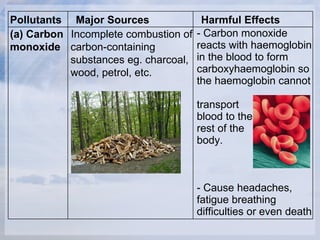
Pollutants Major Sources Harmful Effects (a) Carbon monoxide Incomplete combustion of carbon-containing substances eg. charcoal, wood, petrol, etc. Carbon monoxide reacts with haemoglobin in the blood to form carboxyhaemoglobin so the haemoglobin cannot  transport  blood to the  rest of the  body. - Cause headaches, fatigue breathing difficulties or even death
Pollutants Major Sources Harmful Effects (b) Oxides of nitrogen (eg. nitrogen monoxide, NO & nitrogen dioxide, NO 2 . 1)   Reactions that occur in car engines ( internal combustion engines) 2) From lightning Nitrogen reacts with oxygen in the air to form nitrogen monoxide. N 2  (g) + O 2  (g)    2NO (g) Nitrogen monoxide reacts with oxygen to form nitrogen dioxide (NO 2 ). 2NO (g) + O 2  (g)    2NO 2  (g) 1) Eye irritation 2) Breathing difficulties 3) Lung inflammation (bronchitis) 4) Acid rain
Pollutants Major Sources Harmful Effects (c) Sulfur dioxide combustion of sulfur containing fossil fuels (especially coal) 2) volcano eruptions Sulfur reacts with oxygen in the air to form sulfur dioxide. S (g) + O 2  (g)    2SO 2  (g) 1) Eye irritation 2) Breathing difficulties 3) Lung inflammation (bronchitis) 4) Acid rain
Other air pollutants include  - unburnt hydrocarbons - methane  - ozone Other Pollutants   Unburnt hydrocarbons  are released in car exhaust.  Methane  is a  colourless and odourless gas  produced when plant and animal matter  decay .  It is also produced from the  decay of rubbish in landfills .  Methane is a  greenhouse gas .
Acid Rain Effects of Air Pollution
Rain usually has a pH that is slightly below 7.  Why? Carbon dioxide in the air dissolves in rainwater to form  carbonic acid, which is a weak acid. However, acid rain has a pH value of 4 or less.
Click on the animation on Acid Rain
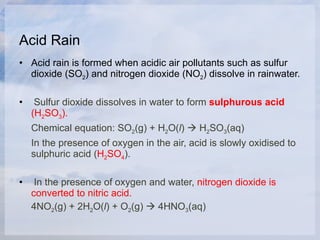
Acid Rain Acid rain is formed when acidic air pollutants such as sulfur dioxide (SO 2 ) and nitrogen dioxide (NO 2 ) dissolve in rainwater. Sulfur dioxide dissolves in water to form  sulphurous acid  (H 2 SO 3 ).   Chemical equation: SO 2 (g) + H 2 O( l )    H 2 SO 3 (aq) In the presence of oxygen in the air, acid is slowly oxidised to sulphuric acid ( H 2 SO 4 ).   In the presence of oxygen and water,  nitrogen dioxide is converted to nitric acid.   4NO 2 (g) + 2H 2 O( l ) + O 2 (g)    4HNO 3 (aq)
Effects of acid rain Corrodes metal structures such as fences and bridges Reacts with carbonates  in marble and limestone.  Reduces pH  value of natural water bodies to below 4 , which will  kill fish and other aquatic life.  Leaches   important nutrients  from the soil  and destroys plants.
Reducing effects of Acid Rain
Catalytic Converters  Attached to the exhaust system of a car.  Contains  catalysts  - platinum and rhodium.
Catalytic converters involve the use of  redox reaction : 1. Carbon monoxide is oxidised to carbon dioxide. Oxides of nitrogen are reduced to nitrogen. Eg. Nitrogen monoxide + carbon monoxide    nitrogen + carbon dioxide 2 NO (g) + 2 CO (g)    N 2  (g) + 2CO 2  (g) Unburnt hydrocarbons are oxidised to carbon dioxide and water. Eg. Octane + oxygen    carbon dioxide + water vapour 2 C 8 H 18  (g) + 25 O 2    16 CO 2  (g) + 18 H 2 O (g) Catalytic Converters
In the long run… The best way to control air pollution is to … burn less fossil fuels.
2 ways of minimising the effects of sulfur dioxide pollution: Flue Gas Desulfurisation 1. Remove sulfur from fossil fuels before burning. However, this method is too expensive and difficult. 2. Remove sulfur dioxide from the waste gases  (flue gases)  from burning. - Process known as  desulfurisation
What Happens in Desulfurisation? Sulfur dioxide reacts with an aqueous suspension of  calcium carbonate  to form solid  calcium sulfite . CaCO 3 (s) + SO 2 (g)    CaSO 3 (s) + CO 2 (g) The calcium sulfite is further oxidised to  calcium sulfate  by atmospheric oxygen. CaSO 3 (s) + O 2 (g)    2CaSO 4 (s)
Control of Air Pollution in Singapore •  Prohibition  of the use of open  fires  for the disposal of domestic and industrial wastes •  Introduction of  unleaded petrol  and phasing out of leaded petrol •  Reduction  of the permissible level of  sulfur  in  diesel  •  Fitting of all petrol-driven vehicles with  catalytic converters
Depletion of the Ozone Layer
Is our ozone layer being depleted?
What is ozone? Ozone is a bluish, very reactive gas, whose molecule is made by three oxygen atoms .  At low altitudes, it can cause breathing difficulties and photochemical smog. However, in the stratosphere, the ozone layer shields us from  ultraviolet radiation  from the sun.  Note: UV radiation can cause skin cancer, genetic mutations and cataracts. Click on the video on Ozone.
What is causing the depletion of ozone in the stratosphere? Chlorofluorocarbons (CFCs) .  - compounds containing the elements carbon, fluorine and chlorine.  - widely used as  propellants for aerosols  and as  coolants in refrigerators and air conditioners .
 
The Carbon Cycle  Click on the video on Carbon cycle The mechanism that maintains the level of carbon dioxide in the atmosphere  is called the  carbon cycle .
What processes  produce  carbon dioxide? Respiration  During respiration, carbon and hydrogen compounds in food are converted into carbon dioxide and water.  C 6 H 12 O 6 (aq) + 6O 2 (g)     6CO 2 (g) + 6H 2 O( l ) + energy  2. Combustion of fuels Most fuels contain both carbon and hydrogen. When these fuels are burnt, carbon dioxide and water are produced. CH 4 (g) + 2O 2 (g)     CO 2 (g) + 2H 2 O( l ) Heat energy is also given off.
Photosynthesis   During photosynthesis, green plants convert carbon dioxide and water into glucose and oxygen in the presence of sunlight.    6CO 2 (g) + 6H 2 O( l )     C 6 H 12 O 6 (aq) + 6O 2 (g)  What processes  remove  carbon dioxide?
What are the other types of greenhouse gases? Methane (CH 4 ) and nitrous oxide (N 2 O)
The Greenhouse Effect The natural greenhouse effect is crucial for maintaining the proper temperature needed to sustain life on Earth.  Without these greenhouse gases, Earth’s surface temperature would be –40 °C and it would be permanently covered with ice.
Global Warming Greenhouse gases, such as carbon dioxide, are building up rapidly in the atmosphere. Why? Human activities like the  burning of fossil fuels and large scale cutting down of forests
Global Warming Therefore, carbon dioxide is being added to the atmosphere at a higher rate than photosynthesis can remove the excess gas. The effect of carbon dioxide build-up is  an increase in the Earth’s average temperature .     global warming
Consequences of Global Warming •  a   decrease in crop yields world-wide   because the areas that are currently covered by vegetation may become deserts,  •  the  melting of large quantities of ice   in the North Pole and South Pole. This will cause the levels of oceans to rise and  flood  low-lying countries such as the Netherlands.  •  the  rapid evaporation of water   from the Earth’s surface. When this happens, carbon dioxide dissolved in the oceans will be driven out into the atmosphere. This adds further to the greenhouse effect.  Click on the video on global warming.

Atmosphere And Environment (4 E1)

  • 1.
    Chapter 13 Air& Atmosphere
  • 2.
    Joseph Priestley Conducted experiments and observations of different kinds of air First person to isolate oxygen Made the first carbonated soft drink!
  • 3.
    What does airconsist of? Air is a mixture of several gases. As air is a mixture, its composition varies from time to time and from place to place . Gas Composition by volume Nitrogen 79% Oxygen 20% Noble gases (mainly argon) & carbon dioxide 1%
  • 4.
    Separation of Airinto its Components Air is first cooled and compressed into liquid. Liquid air is then separated into its constituents (or fractions) by fractional distillation .
  • 5.
    Common air pollutants& its effects Air Pollution
  • 6.
    Air Pollution Airpollution is the condition in which air contains a high concentration of certain chemicals that may harm living things or damage non-living things . Air pollution is caused by solid particles and poisonous gases in the air. These air pollutants include carbon monoxide, oxides of nitrogen and sulphur dioxide . Click on the video on Air Pollution.
  • 7.
    Pollutants Major SourcesHarmful Effects (a) Carbon monoxide Incomplete combustion of carbon-containing substances eg. charcoal, wood, petrol, etc. Carbon monoxide reacts with haemoglobin in the blood to form carboxyhaemoglobin so the haemoglobin cannot transport blood to the rest of the body. - Cause headaches, fatigue breathing difficulties or even death
  • 8.
    Pollutants Major SourcesHarmful Effects (b) Oxides of nitrogen (eg. nitrogen monoxide, NO & nitrogen dioxide, NO 2 . 1) Reactions that occur in car engines ( internal combustion engines) 2) From lightning Nitrogen reacts with oxygen in the air to form nitrogen monoxide. N 2 (g) + O 2 (g)  2NO (g) Nitrogen monoxide reacts with oxygen to form nitrogen dioxide (NO 2 ). 2NO (g) + O 2 (g)  2NO 2 (g) 1) Eye irritation 2) Breathing difficulties 3) Lung inflammation (bronchitis) 4) Acid rain
  • 9.
    Pollutants Major SourcesHarmful Effects (c) Sulfur dioxide combustion of sulfur containing fossil fuels (especially coal) 2) volcano eruptions Sulfur reacts with oxygen in the air to form sulfur dioxide. S (g) + O 2 (g)  2SO 2 (g) 1) Eye irritation 2) Breathing difficulties 3) Lung inflammation (bronchitis) 4) Acid rain
  • 10.
    Other air pollutantsinclude - unburnt hydrocarbons - methane - ozone Other Pollutants Unburnt hydrocarbons are released in car exhaust. Methane is a colourless and odourless gas produced when plant and animal matter decay . It is also produced from the decay of rubbish in landfills . Methane is a greenhouse gas .
  • 11.
    Acid Rain Effectsof Air Pollution
  • 12.
    Rain usually hasa pH that is slightly below 7. Why? Carbon dioxide in the air dissolves in rainwater to form carbonic acid, which is a weak acid. However, acid rain has a pH value of 4 or less.
  • 13.
    Click on theanimation on Acid Rain
  • 14.
    Acid Rain Acidrain is formed when acidic air pollutants such as sulfur dioxide (SO 2 ) and nitrogen dioxide (NO 2 ) dissolve in rainwater. Sulfur dioxide dissolves in water to form sulphurous acid (H 2 SO 3 ). Chemical equation: SO 2 (g) + H 2 O( l )  H 2 SO 3 (aq) In the presence of oxygen in the air, acid is slowly oxidised to sulphuric acid ( H 2 SO 4 ). In the presence of oxygen and water, nitrogen dioxide is converted to nitric acid. 4NO 2 (g) + 2H 2 O( l ) + O 2 (g)  4HNO 3 (aq)
  • 15.
    Effects of acidrain Corrodes metal structures such as fences and bridges Reacts with carbonates in marble and limestone. Reduces pH value of natural water bodies to below 4 , which will kill fish and other aquatic life. Leaches important nutrients from the soil and destroys plants.
  • 16.
  • 17.
    Catalytic Converters Attached to the exhaust system of a car. Contains catalysts - platinum and rhodium.
  • 18.
    Catalytic converters involvethe use of redox reaction : 1. Carbon monoxide is oxidised to carbon dioxide. Oxides of nitrogen are reduced to nitrogen. Eg. Nitrogen monoxide + carbon monoxide  nitrogen + carbon dioxide 2 NO (g) + 2 CO (g)  N 2 (g) + 2CO 2 (g) Unburnt hydrocarbons are oxidised to carbon dioxide and water. Eg. Octane + oxygen  carbon dioxide + water vapour 2 C 8 H 18 (g) + 25 O 2  16 CO 2 (g) + 18 H 2 O (g) Catalytic Converters
  • 19.
    In the longrun… The best way to control air pollution is to … burn less fossil fuels.
  • 20.
    2 ways ofminimising the effects of sulfur dioxide pollution: Flue Gas Desulfurisation 1. Remove sulfur from fossil fuels before burning. However, this method is too expensive and difficult. 2. Remove sulfur dioxide from the waste gases (flue gases) from burning. - Process known as desulfurisation
  • 21.
    What Happens inDesulfurisation? Sulfur dioxide reacts with an aqueous suspension of calcium carbonate to form solid calcium sulfite . CaCO 3 (s) + SO 2 (g)  CaSO 3 (s) + CO 2 (g) The calcium sulfite is further oxidised to calcium sulfate by atmospheric oxygen. CaSO 3 (s) + O 2 (g)  2CaSO 4 (s)
  • 22.
    Control of AirPollution in Singapore • Prohibition of the use of open fires for the disposal of domestic and industrial wastes • Introduction of unleaded petrol and phasing out of leaded petrol • Reduction of the permissible level of sulfur in diesel • Fitting of all petrol-driven vehicles with catalytic converters
  • 23.
    Depletion of theOzone Layer
  • 24.
    Is our ozonelayer being depleted?
  • 25.
    What is ozone?Ozone is a bluish, very reactive gas, whose molecule is made by three oxygen atoms . At low altitudes, it can cause breathing difficulties and photochemical smog. However, in the stratosphere, the ozone layer shields us from ultraviolet radiation from the sun. Note: UV radiation can cause skin cancer, genetic mutations and cataracts. Click on the video on Ozone.
  • 26.
    What is causingthe depletion of ozone in the stratosphere? Chlorofluorocarbons (CFCs) . - compounds containing the elements carbon, fluorine and chlorine. - widely used as propellants for aerosols and as coolants in refrigerators and air conditioners .
  • 27.
  • 28.
    The Carbon Cycle Click on the video on Carbon cycle The mechanism that maintains the level of carbon dioxide in the atmosphere is called the carbon cycle .
  • 29.
    What processes produce carbon dioxide? Respiration During respiration, carbon and hydrogen compounds in food are converted into carbon dioxide and water. C 6 H 12 O 6 (aq) + 6O 2 (g)  6CO 2 (g) + 6H 2 O( l ) + energy 2. Combustion of fuels Most fuels contain both carbon and hydrogen. When these fuels are burnt, carbon dioxide and water are produced. CH 4 (g) + 2O 2 (g)  CO 2 (g) + 2H 2 O( l ) Heat energy is also given off.
  • 30.
    Photosynthesis During photosynthesis, green plants convert carbon dioxide and water into glucose and oxygen in the presence of sunlight. 6CO 2 (g) + 6H 2 O( l )  C 6 H 12 O 6 (aq) + 6O 2 (g) What processes remove carbon dioxide?
  • 31.
    What are theother types of greenhouse gases? Methane (CH 4 ) and nitrous oxide (N 2 O)
  • 32.
    The Greenhouse EffectThe natural greenhouse effect is crucial for maintaining the proper temperature needed to sustain life on Earth. Without these greenhouse gases, Earth’s surface temperature would be –40 °C and it would be permanently covered with ice.
  • 33.
    Global Warming Greenhousegases, such as carbon dioxide, are building up rapidly in the atmosphere. Why? Human activities like the burning of fossil fuels and large scale cutting down of forests
  • 34.
    Global Warming Therefore,carbon dioxide is being added to the atmosphere at a higher rate than photosynthesis can remove the excess gas. The effect of carbon dioxide build-up is an increase in the Earth’s average temperature .  global warming
  • 35.
    Consequences of GlobalWarming • a decrease in crop yields world-wide because the areas that are currently covered by vegetation may become deserts, • the melting of large quantities of ice in the North Pole and South Pole. This will cause the levels of oceans to rise and flood low-lying countries such as the Netherlands. • the rapid evaporation of water from the Earth’s surface. When this happens, carbon dioxide dissolved in the oceans will be driven out into the atmosphere. This adds further to the greenhouse effect. Click on the video on global warming.