Foster Wheeler
Hydrogen
Production
Presented By: Ashok Paliwal
12210008
Contents
 Introduction
 Need of Hydrogen
 Hydrogen Production
 Steam Reforming
 Terrace Wall Steam Reformer
 Conclusion
Introduction
 Hydrogen use has become integral feature of
most refineries.
 This has been made necessary by the increase
in hydro treating and hydrocracking, including
the treatment of progressively heavier feed
stocks.
 As hydrogen production grows, a better
understanding of the capabilities and
requirements of the modern hydrogen plant
becomes ever more useful to the refiner..
NEED OF HYDROGEN
 There has been a continual increase in refinery
hydrogen demand over the last several decades. This
is a result of two outside forces acting on the refining
industry: environmental regulations and feedstock
shortages.
 Refiners are left with an oversupply of heavy, high-
sulfur oil, and in order to make lighter, cleaner, and
more salable products, they need to add hydrogen or
reject carbon.
 Within this trend there are many individual factors
depending on location, complexity of the refinery, etc.
HYDROGEN PRODUCTION
 Hydrogen has historically been produced in
catalytic reforming, as a by-product of the
production of the high-octane aromatic
compounds used in gasoline.
 Where by-product hydrogen production has not
been adequate, hydrogen has been manufactured
by steam reforming. In some cases partial
oxidation has been used, particularly where
heavy oil is available at low cost.
 The heavier and the sourer the crudes, the larger
the hydrogen requirement.
HYDROGEN PRODUCTION
 Steam Reforming. In steam reforming, light
hydrocarbons such as methane are reacted with steam
to form hydrogen:
 CH4 + H2O→ 3H2 + CO
DELTA H = 227 kJ/ (g.mol), where DELTA H is the heat
of reaction.
 The reaction is typically carried out at approximately
870°C over a nickel catalyst packed into the tubes of a
reforming furnace. Because of the high temperature,
hydrocarbons also undergo a complex series of
cracking reactions, plus the reaction of carbon with
steam.
HYDROGEN PRODUCTION
 Carbon is produced on the catalyst at the same time that
hydrocarbon is reformed to hydro- gen and CO. With natural gas
or similar feedstock, reforming predominates and the car- bon
can be removed by reaction with steam as fast as it is formed.
When heavier feed stocks are used, the carbon is not removed
fast enough and builds up. Carbon can also be formed where the
reforming reaction does not keep pace with heat input, and a hot
spot is formed.
 To avoid carbon buildup, alkali materials, usually some form of
potash, are added to the catalyst when heavy feeds are to be
used. These promote the carbon-steam reaction and help keep
the catalyst clean. The reforming furnace is also designed to
produce uniform heat input to the catalyst tubes, to avoid coking
from local hot spots.
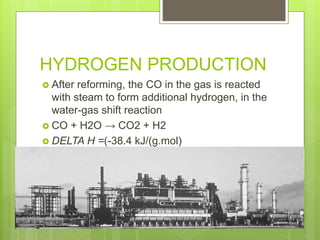
HYDROGEN PRODUCTION
 After reforming, the CO in the gas is reacted
with steam to form additional hydrogen, in the
water-gas shift reaction
 CO + H2O → CO2 + H2
 DELTA H =(-38.4 kJ/(g.mol)
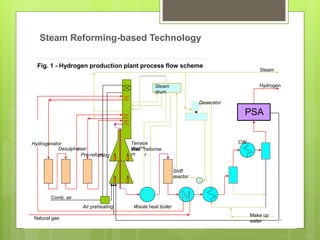
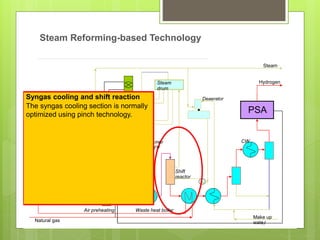
Steam Reforming-based Technology
Fig. 1 - Hydrogen production plant process flow scheme
Steam
Deaerator
CWTerrace
WallTM
Hydrogenator
reforme
rming
Shift
reactor
8
Steam
drum
Hydrogen
PSA
Desulphuriser
Pre-reform
stea
m
Comb. air
Air preheating Waste heat boiler
Make up
water
Natural gas
Steam
Steam drum Hydrogen
Deaerat
or
PSA
Steam Reformer CW
D l h i T W llTerrace WallTM
Steam Reforming-based Technolgy
Hydrogenato
r Desulphurize
r ng
Shift
reactor
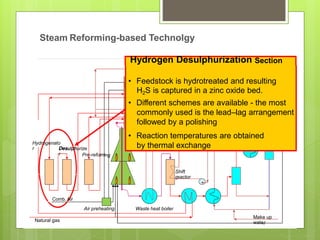
Hydrogen Desulphurization Section
• Feedstock is hydrotreated and resulting
H2S is captured in a zinc oxide bed.
• Different schemes are available - the most
commonly used is the lead–lag arrangement
followed by a polishing
• Reaction temperatures are obtained
by thermal exchangeDesulph
Pre-reformi
Comb. Air
Air preheating Waste heat boiler
Make up
wate9rNatural gas
Steam drum Hydrogen
Deaerat
or
PSA
f i ti i b fi i l t f i
d t
am Reformer CW
D l h i T W ll
Steam reforming based Technology
Hydrogenato
r Desulphurize
r
Terrac
eng
Shift
reactor
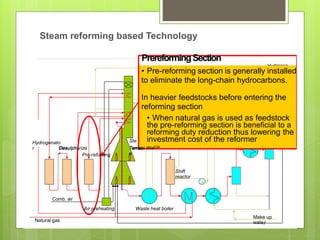
PrereformingSection
• Pre-reforming section is generally installed
to eliminate the long-chain hydrocarbons.
In heavier feedstocks before entering the
reforming section
• When natural gas is used as feedstock
the pre-reforming section is beneficial to a
reforming duty reduction thus lowering the
investment cost of the reformerSte
Desulph
Pre-reformi
Terrace WallTM
Comb. air
Air preheating Waste heat boiler
Make up
wate10rNatural gas
flow scheme Steam
team drum Hydrogen
WallDeaerator
PSA
t
f
Steam Reforming-based Technology
section
CWWallT
M
steam
reformer
Hydrogenato
r Desulphurize
r ng
Shift
reactor
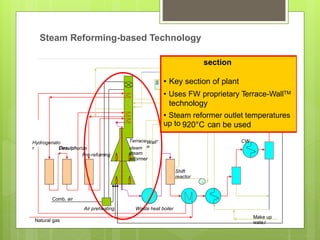
• Key section of plantS
• Uses FW proprietary Terrace-WallTM
technology
• Steam reformer outlet temperatures
up to 920°C can be used
Terrace-
Desulph
Pre-reformi
steam
Comb. air
Air preheating Waste heat boiler
Make up
wate11rNatural gas
Hydrogenator Steam
Refor D l h i T W llDesulphurizer Terrace
Wal
Pre-Reforming
ITS
Comb. Air
Steam Reforming-based Technology
Steam
CW
Shift
reactor
Steam
drum
Hydrogen
Syngas cooling and shift reaction
The syngas cooling section is normally
optimized using pinch technology.
Deaerator
PSA
mer
lTM
Air preheating Waste heat boiler
Make up
wate12rNatural gas
Press re S ing Absorption
ogenator Steam Reformer
D l h i T W llDesulphurizer Terrace WallTM
Pre-Reforming
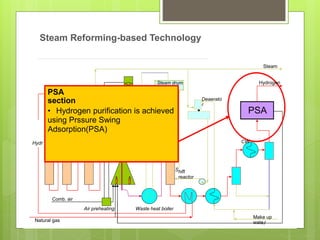
Steam Reforming-based Technology
Steam
PSA
section Deaerato
r
CWHydr
hift
reactor
Steam drum Hydrogen
• Hydrogen purification is achieved
using Prssure Swing
Adsorption(PSA)
PSA
S
Comb. air
Air preheating Waste heat boiler
Make up
wate13rNatural gas
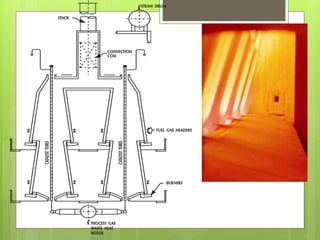
Terrace Wall Steam Reformer
 Side-fired heater with burners located along
lateral walls with flames vertically arranged.
 Radiant section comprising a firebox with a single
row of catalyst tubes with two terraces on both
sides of the tubes on which the burners are
installed.
 Catalyst tubes are flanged at the top to allow
loading and unloading of the catalyst.
Key Advantages
 The inclined ‘terrace walls’ are uniformly
heated vertically by the rising flow of hot
gases.
 Each terrace capable of being independently
heated to provide the particular heat flux
desired in its zone.
 Molecular and radiant convention sections
reducing construction time and cost.
Key Advantages
 Can operate in natural draft mode keeping the
full hydrogen production.
 Very compact design reducing the plot area.
Leading to:
• Lower operating cost
• Lower maintenance cost
• Lower investment cost
Conclusion
 Hydrogen is vital for a modern refinery
operation
 Hydrogen generated as by-product in the
refinery process units is not enough to cover
needs. Additional reliable hydrogen must be
produced.

Ppt fw hydrogen production

  • 1.
  • 2.
    Contents  Introduction  Needof Hydrogen  Hydrogen Production  Steam Reforming  Terrace Wall Steam Reformer  Conclusion
  • 3.
    Introduction  Hydrogen usehas become integral feature of most refineries.  This has been made necessary by the increase in hydro treating and hydrocracking, including the treatment of progressively heavier feed stocks.  As hydrogen production grows, a better understanding of the capabilities and requirements of the modern hydrogen plant becomes ever more useful to the refiner..
  • 4.
    NEED OF HYDROGEN There has been a continual increase in refinery hydrogen demand over the last several decades. This is a result of two outside forces acting on the refining industry: environmental regulations and feedstock shortages.  Refiners are left with an oversupply of heavy, high- sulfur oil, and in order to make lighter, cleaner, and more salable products, they need to add hydrogen or reject carbon.  Within this trend there are many individual factors depending on location, complexity of the refinery, etc.
  • 5.
    HYDROGEN PRODUCTION  Hydrogenhas historically been produced in catalytic reforming, as a by-product of the production of the high-octane aromatic compounds used in gasoline.  Where by-product hydrogen production has not been adequate, hydrogen has been manufactured by steam reforming. In some cases partial oxidation has been used, particularly where heavy oil is available at low cost.  The heavier and the sourer the crudes, the larger the hydrogen requirement.
  • 6.
    HYDROGEN PRODUCTION  SteamReforming. In steam reforming, light hydrocarbons such as methane are reacted with steam to form hydrogen:  CH4 + H2O→ 3H2 + CO DELTA H = 227 kJ/ (g.mol), where DELTA H is the heat of reaction.  The reaction is typically carried out at approximately 870°C over a nickel catalyst packed into the tubes of a reforming furnace. Because of the high temperature, hydrocarbons also undergo a complex series of cracking reactions, plus the reaction of carbon with steam.
  • 7.
    HYDROGEN PRODUCTION  Carbonis produced on the catalyst at the same time that hydrocarbon is reformed to hydro- gen and CO. With natural gas or similar feedstock, reforming predominates and the car- bon can be removed by reaction with steam as fast as it is formed. When heavier feed stocks are used, the carbon is not removed fast enough and builds up. Carbon can also be formed where the reforming reaction does not keep pace with heat input, and a hot spot is formed.  To avoid carbon buildup, alkali materials, usually some form of potash, are added to the catalyst when heavy feeds are to be used. These promote the carbon-steam reaction and help keep the catalyst clean. The reforming furnace is also designed to produce uniform heat input to the catalyst tubes, to avoid coking from local hot spots.
  • 8.
    HYDROGEN PRODUCTION  Afterreforming, the CO in the gas is reacted with steam to form additional hydrogen, in the water-gas shift reaction  CO + H2O → CO2 + H2  DELTA H =(-38.4 kJ/(g.mol)
  • 9.
    Steam Reforming-based Technology Fig.1 - Hydrogen production plant process flow scheme Steam Deaerator CWTerrace WallTM Hydrogenator reforme rming Shift reactor 8 Steam drum Hydrogen PSA Desulphuriser Pre-reform stea m Comb. air Air preheating Waste heat boiler Make up water Natural gas
  • 10.
    Steam Steam drum Hydrogen Deaerat or PSA SteamReformer CW D l h i T W llTerrace WallTM Steam Reforming-based Technolgy Hydrogenato r Desulphurize r ng Shift reactor Hydrogen Desulphurization Section • Feedstock is hydrotreated and resulting H2S is captured in a zinc oxide bed. • Different schemes are available - the most commonly used is the lead–lag arrangement followed by a polishing • Reaction temperatures are obtained by thermal exchangeDesulph Pre-reformi Comb. Air Air preheating Waste heat boiler Make up wate9rNatural gas
  • 11.
    Steam drum Hydrogen Deaerat or PSA fi ti i b fi i l t f i d t am Reformer CW D l h i T W ll Steam reforming based Technology Hydrogenato r Desulphurize r Terrac eng Shift reactor PrereformingSection • Pre-reforming section is generally installed to eliminate the long-chain hydrocarbons. In heavier feedstocks before entering the reforming section • When natural gas is used as feedstock the pre-reforming section is beneficial to a reforming duty reduction thus lowering the investment cost of the reformerSte Desulph Pre-reformi Terrace WallTM Comb. air Air preheating Waste heat boiler Make up wate10rNatural gas
  • 12.
    flow scheme Steam teamdrum Hydrogen WallDeaerator PSA t f Steam Reforming-based Technology section CWWallT M steam reformer Hydrogenato r Desulphurize r ng Shift reactor • Key section of plantS • Uses FW proprietary Terrace-WallTM technology • Steam reformer outlet temperatures up to 920°C can be used Terrace- Desulph Pre-reformi steam Comb. air Air preheating Waste heat boiler Make up wate11rNatural gas
  • 13.
    Hydrogenator Steam Refor Dl h i T W llDesulphurizer Terrace Wal Pre-Reforming ITS Comb. Air Steam Reforming-based Technology Steam CW Shift reactor Steam drum Hydrogen Syngas cooling and shift reaction The syngas cooling section is normally optimized using pinch technology. Deaerator PSA mer lTM Air preheating Waste heat boiler Make up wate12rNatural gas
  • 14.
    Press re Sing Absorption ogenator Steam Reformer D l h i T W llDesulphurizer Terrace WallTM Pre-Reforming Steam Reforming-based Technology Steam PSA section Deaerato r CWHydr hift reactor Steam drum Hydrogen • Hydrogen purification is achieved using Prssure Swing Adsorption(PSA) PSA S Comb. air Air preheating Waste heat boiler Make up wate13rNatural gas
  • 15.
    Terrace Wall SteamReformer  Side-fired heater with burners located along lateral walls with flames vertically arranged.  Radiant section comprising a firebox with a single row of catalyst tubes with two terraces on both sides of the tubes on which the burners are installed.  Catalyst tubes are flanged at the top to allow loading and unloading of the catalyst.
  • 17.
    Key Advantages  Theinclined ‘terrace walls’ are uniformly heated vertically by the rising flow of hot gases.  Each terrace capable of being independently heated to provide the particular heat flux desired in its zone.  Molecular and radiant convention sections reducing construction time and cost.
  • 18.
    Key Advantages  Canoperate in natural draft mode keeping the full hydrogen production.  Very compact design reducing the plot area. Leading to: • Lower operating cost • Lower maintenance cost • Lower investment cost
  • 19.
    Conclusion  Hydrogen isvital for a modern refinery operation  Hydrogen generated as by-product in the refinery process units is not enough to cover needs. Additional reliable hydrogen must be produced.