o Younas Chandio D-17-CH-25
o Hasnat ali chang D-17-CH-27
o Rafique ahmed D-17-CH-47
o Ali hyder D-17-CH-61
o Muhammad Ahmed D-17-CH-71
Introduction of Nitrogen Gas
• It was first discovered and isolated by Scottish
physician Daniel Rutherford in 1772.
• English word “nitrogen” entered the language in
1794.
• Nitrogen gas is a chemical compound with
symbol N2.
Introduction of Nitrogen Gas
• Dinitrogen forms about 78% of Earth's atmosphere,
making it the most abundant uncombined element.
• Nitrogen occurs in all organisms, primarily in amino
acids, proteins, chlorophyll, in the nucleic
acids (DNA and RNA) and other biomolecules.
• The human body contains about 3% nitrogen by mass.
• It is so inert at standard temperature and pressure that it
was termed "azote" (meaning “without life”).
78%
21%
1%
Nitrogen
Oxygen
Other
History
• Nitrogenous timeline
– 1867, Dynamite is invented. Notroglycerin is highly unstable
liquid , likely to explode with slightest shock.
– 1900, TNT The explosive yield of TNT is considered to be
the standard measure of bombs and other explosives. It is used as a
weapon in World war I (1914).TNT is more power full then
Dynamite.
– 1940 World War II, two weapon introduce as a explosive,
RDX (hexahydro-1,3,5-trinitro 1,3,5-triazine)
PETN (pentaerythritoltetranitrate)
– 1945 Ammonium Nitrate, it is know as potential explosive power.
It is not safe to handle.
– 1957, ANFO (Ammonium Nirate Fuel Oil) explosive is developed
by mixing of ammonium nitrate and liquid fuel oil. ANFO is
relatively safe to handle.
Structure of Nitrogen Gas
• The extremely strong triple bond in elemental nitrogen
(N≡N)
• It is the second strongest bond in any diatomic
molecule after carbon monoxide.
Preparation of Nitrogen gas
Method of preparation
• Polymeric Membrane
• Pressure Swing Adsorption or PSA
• Cryogenic distillation
Preparation of Nitrogen gas
form cryogenic distillation
• Technology for separating air into its primary components
like nitrogen by cryogenic distillation has been practiced
for over 100 years.
• Cryogenic distillation of air for preparation of
nitrogen is one of the most popular air separation process,
used frequently in medium to large scale plants.
• It is the most cost effective technology for high
production rate plants.
Process
• Compression of air
• Air cooling
• Purification of air
• Cooling of air
• Separation of air (distillation)
• Withdrawal and storage
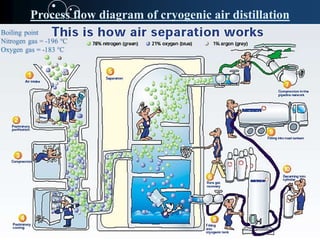
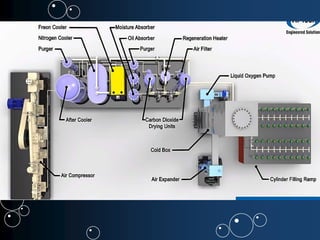
Process flow diagram of cryogenic air distillation
Process
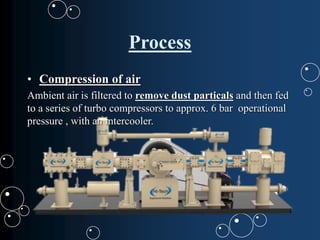
• Compression of air
Ambient air is filtered to remove dust particals and then fed
to a series of turbo compressors to approx. 6 bar operational
pressure , with an intercooler.
Process
• Air cooling :
Process air is cooled with direct contact of chilled water. Cooling
water is prepared in an evaporation cooler against dry
oxygen/nitrogen waste gas from rectification process.
Process
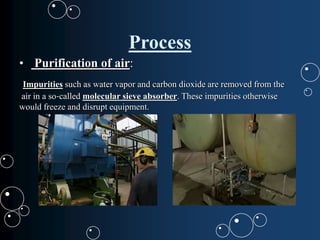
• Purification of air:
Impurities such as water vapor and carbon dioxide are removed from the
air in a so‐called molecular sieve absorber. These impurities otherwise
would freeze and disrupt equipment.
Process
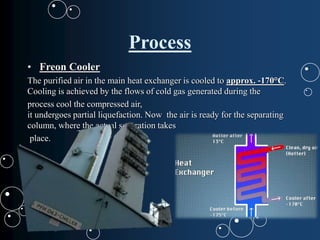
• Freon Cooler
The purified air in the main heat exchanger is cooled to approx. ‐170°C.
Cooling is achieved by the flows of cold gas generated during the
process cool the compressed air,
it undergoes partial liquefaction. Now the air is ready for the separating
column, where the actual separation takes
place.
Process
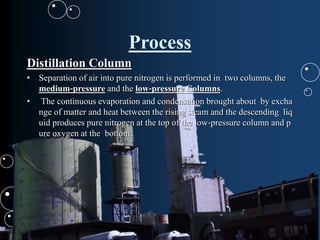
Distillation Column
• Separation of air into pure nitrogen is performed in two columns, the
medium‐pressure and the low‐pressure Columns.
• The continuous evaporation and condensation brought about by excha
nge of matter and heat between the rising steam and the descending liq
uid produces pure nitrogen at the top of the low‐pressure column and p
ure oxygen at the bottom.
Process
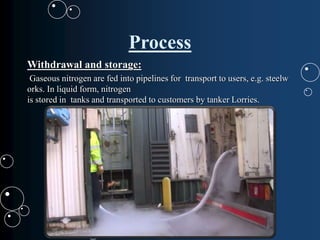
Withdrawal and storage:
Gaseous nitrogen are fed into pipelines for transport to users, e.g. steelw
orks. In liquid form, nitrogen
is stored in tanks and transported to customers by tanker Lorries.
Video
Process flow diagram of cryogenic air distillation
Boiling point
Nitrogen gas = -196 °C
Oxygen gas = -183 °C
Cryogenic Distillation
• Advantages
– Can generate liquid nitrogen for storage on site.
– Produce very high purity nitrogen.
– Low amount of electricity per unit nitrogen.
• Disadvantages
– High capital cost.
– Large site space and utility requirements.
– Long start-up and shutdown.
Physical Properties
• At standard temperature and pressure, two atoms of the
element bind to form dinitrogen N2.
• Incombustible, diatomic gas.
• Molecular Weight (lb/mol) 28.01.
• It does not burn.
• Colourless
• Odorless
• Tasteless
Physical Properties
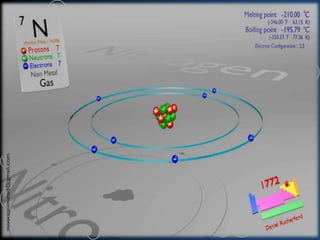
• Melting point −210.0°C
• Boiling point −195.795°C
• It is slightly lighter than air.
• Gas Density @ STP is 0.0725 (lb/ft3).
• Specific Gravity 0.967.
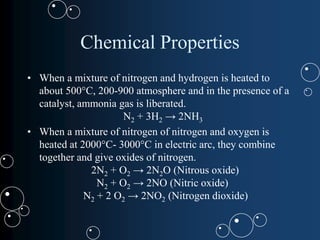
Chemical Properties
• When a mixture of nitrogen and hydrogen is heated to
about 500°C, 200-900 atmosphere and in the presence of a
catalyst, ammonia gas is liberated.
N2 + 3H2 → 2NH3
• When a mixture of nitrogen of nitrogen and oxygen is
heated at 2000°C- 3000°C in electric arc, they combine
together and give oxides of nitrogen.
2N2 + O2 → 2N2O (Nitrous oxide)
N2 + O2 → 2NO (Nitric oxide)
N2 + 2 O2 → 2NO2 (Nitrogen dioxide)
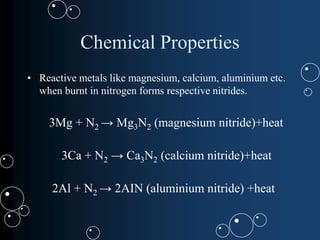
Chemical Properties
• Reactive metals like magnesium, calcium, aluminium etc.
when burnt in nitrogen forms respective nitrides.
3Mg + N2 → Mg3N2 (magnesium nitride)+heat
3Ca + N2 → Ca3N2 (calcium nitride)+heat
2Al + N2 → 2AIN (aluminium nitride) +heat
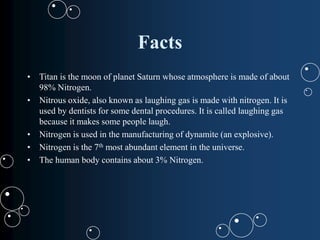
Facts
• Titan is the moon of planet Saturn whose atmosphere is made of about
98% Nitrogen.
• Nitrous oxide, also known as laughing gas is made with nitrogen. It is
used by dentists for some dental procedures. It is called laughing gas
because it makes some people laugh.
• Nitrogen is used in the manufacturing of dynamite (an explosive).
• Nitrogen is the 7th most abundant element in the universe.
• The human body contains about 3% Nitrogen.
Gas industry in Pakistan
• Ghani gases
• Linde gases
• Bp Pakistan Exploration And Production Inc
• United Energy Pakistan Ltd.
Consumption of Nitrogen gas
Uses
• It is use to Modified Atmosphere Packaging of foods.
– Food lasts longer
– Looks better
– Keeps taste
– Allows transportation
– It helps slow down bacterial growth and other spoilage
mechanisms
• Liquid nitrogen is a useful coolant.
• It is uses related to fertilizer, dynamite, medical anesthetic
and even car racing.
Uses
• Fill gas for aircraft tyres.
• Liquid nitrogen is often used to provide the necessary
refrigeration.
• Liquid nitrogen Reactor cooling and temperature control
systems.
• Nitrogen is used to freeze blood, as well as viruses for
vaccination.
• Liquid nitrogen is also used in some MRI (Magnetic
Resonance Imaging) devices.
Reference
• https://uscylgas.com/five-every-day-uses-of-nitrogen-gases/
• https://www.online-sciences.com/the-matter/what-are-the-properties-of-nitrogen-gas/
• https://www.slideshare.net/search/slideshow?searchfrom=header&q=separation+of+air
&ud=any&ft=all&lang=**&sort=
• https://www.engr.uvic.ca/~struchtr/2010Energy_O2_membrane.pdf
• https://www.onsitegas.com/blog/2018/01/08/nitrogen-gas-uses/
• http://www.elmemesser.ee/assets/media/201329/6e27e50c6bb269822edcdbc76f2deab3.p
df
• http://www.airproducts.com/~/media/files/pdf/company/safetygram-2.pdf
• http://rastgar-co.com/wp-content/uploads/2016/10/CompAir-Nitrogen-Generation-Syst
• https://www.kullabs.com/classes/subjects/units/lessons/notes/note-detail/817em-
Presentation.pdf
Nitrogen gas.
Nitrogen gas.

Nitrogen gas.

  • 1.
    o Younas ChandioD-17-CH-25 o Hasnat ali chang D-17-CH-27 o Rafique ahmed D-17-CH-47 o Ali hyder D-17-CH-61 o Muhammad Ahmed D-17-CH-71
  • 2.
    Introduction of NitrogenGas • It was first discovered and isolated by Scottish physician Daniel Rutherford in 1772. • English word “nitrogen” entered the language in 1794. • Nitrogen gas is a chemical compound with symbol N2.
  • 3.
    Introduction of NitrogenGas • Dinitrogen forms about 78% of Earth's atmosphere, making it the most abundant uncombined element. • Nitrogen occurs in all organisms, primarily in amino acids, proteins, chlorophyll, in the nucleic acids (DNA and RNA) and other biomolecules. • The human body contains about 3% nitrogen by mass. • It is so inert at standard temperature and pressure that it was termed "azote" (meaning “without life”). 78% 21% 1% Nitrogen Oxygen Other
  • 4.
    History • Nitrogenous timeline –1867, Dynamite is invented. Notroglycerin is highly unstable liquid , likely to explode with slightest shock. – 1900, TNT The explosive yield of TNT is considered to be the standard measure of bombs and other explosives. It is used as a weapon in World war I (1914).TNT is more power full then Dynamite. – 1940 World War II, two weapon introduce as a explosive, RDX (hexahydro-1,3,5-trinitro 1,3,5-triazine) PETN (pentaerythritoltetranitrate) – 1945 Ammonium Nitrate, it is know as potential explosive power. It is not safe to handle. – 1957, ANFO (Ammonium Nirate Fuel Oil) explosive is developed by mixing of ammonium nitrate and liquid fuel oil. ANFO is relatively safe to handle.
  • 5.
    Structure of NitrogenGas • The extremely strong triple bond in elemental nitrogen (N≡N) • It is the second strongest bond in any diatomic molecule after carbon monoxide.
  • 7.
    Preparation of Nitrogengas Method of preparation • Polymeric Membrane • Pressure Swing Adsorption or PSA • Cryogenic distillation
  • 8.
    Preparation of Nitrogengas form cryogenic distillation • Technology for separating air into its primary components like nitrogen by cryogenic distillation has been practiced for over 100 years. • Cryogenic distillation of air for preparation of nitrogen is one of the most popular air separation process, used frequently in medium to large scale plants. • It is the most cost effective technology for high production rate plants.
  • 9.
    Process • Compression ofair • Air cooling • Purification of air • Cooling of air • Separation of air (distillation) • Withdrawal and storage
  • 10.
    Process flow diagramof cryogenic air distillation
  • 11.
    Process • Compression ofair Ambient air is filtered to remove dust particals and then fed to a series of turbo compressors to approx. 6 bar operational pressure , with an intercooler.
  • 12.
    Process • Air cooling: Process air is cooled with direct contact of chilled water. Cooling water is prepared in an evaporation cooler against dry oxygen/nitrogen waste gas from rectification process.
  • 13.
    Process • Purification ofair: Impurities such as water vapor and carbon dioxide are removed from the air in a so‐called molecular sieve absorber. These impurities otherwise would freeze and disrupt equipment.
  • 14.
    Process • Freon Cooler Thepurified air in the main heat exchanger is cooled to approx. ‐170°C. Cooling is achieved by the flows of cold gas generated during the process cool the compressed air, it undergoes partial liquefaction. Now the air is ready for the separating column, where the actual separation takes place.
  • 15.
    Process Distillation Column • Separationof air into pure nitrogen is performed in two columns, the medium‐pressure and the low‐pressure Columns. • The continuous evaporation and condensation brought about by excha nge of matter and heat between the rising steam and the descending liq uid produces pure nitrogen at the top of the low‐pressure column and p ure oxygen at the bottom.
  • 16.
    Process Withdrawal and storage: Gaseousnitrogen are fed into pipelines for transport to users, e.g. steelw orks. In liquid form, nitrogen is stored in tanks and transported to customers by tanker Lorries.
  • 18.
  • 19.
    Process flow diagramof cryogenic air distillation Boiling point Nitrogen gas = -196 °C Oxygen gas = -183 °C
  • 20.
    Cryogenic Distillation • Advantages –Can generate liquid nitrogen for storage on site. – Produce very high purity nitrogen. – Low amount of electricity per unit nitrogen. • Disadvantages – High capital cost. – Large site space and utility requirements. – Long start-up and shutdown.
  • 21.
    Physical Properties • Atstandard temperature and pressure, two atoms of the element bind to form dinitrogen N2. • Incombustible, diatomic gas. • Molecular Weight (lb/mol) 28.01. • It does not burn. • Colourless • Odorless • Tasteless
  • 22.
    Physical Properties • Meltingpoint −210.0°C • Boiling point −195.795°C • It is slightly lighter than air. • Gas Density @ STP is 0.0725 (lb/ft3). • Specific Gravity 0.967.
  • 23.
    Chemical Properties • Whena mixture of nitrogen and hydrogen is heated to about 500°C, 200-900 atmosphere and in the presence of a catalyst, ammonia gas is liberated. N2 + 3H2 → 2NH3 • When a mixture of nitrogen of nitrogen and oxygen is heated at 2000°C- 3000°C in electric arc, they combine together and give oxides of nitrogen. 2N2 + O2 → 2N2O (Nitrous oxide) N2 + O2 → 2NO (Nitric oxide) N2 + 2 O2 → 2NO2 (Nitrogen dioxide)
  • 24.
    Chemical Properties • Reactivemetals like magnesium, calcium, aluminium etc. when burnt in nitrogen forms respective nitrides. 3Mg + N2 → Mg3N2 (magnesium nitride)+heat 3Ca + N2 → Ca3N2 (calcium nitride)+heat 2Al + N2 → 2AIN (aluminium nitride) +heat
  • 25.
    Facts • Titan isthe moon of planet Saturn whose atmosphere is made of about 98% Nitrogen. • Nitrous oxide, also known as laughing gas is made with nitrogen. It is used by dentists for some dental procedures. It is called laughing gas because it makes some people laugh. • Nitrogen is used in the manufacturing of dynamite (an explosive). • Nitrogen is the 7th most abundant element in the universe. • The human body contains about 3% Nitrogen.
  • 26.
    Gas industry inPakistan • Ghani gases • Linde gases • Bp Pakistan Exploration And Production Inc • United Energy Pakistan Ltd.
  • 27.
  • 28.
    Uses • It isuse to Modified Atmosphere Packaging of foods. – Food lasts longer – Looks better – Keeps taste – Allows transportation – It helps slow down bacterial growth and other spoilage mechanisms • Liquid nitrogen is a useful coolant. • It is uses related to fertilizer, dynamite, medical anesthetic and even car racing.
  • 29.
    Uses • Fill gasfor aircraft tyres. • Liquid nitrogen is often used to provide the necessary refrigeration. • Liquid nitrogen Reactor cooling and temperature control systems. • Nitrogen is used to freeze blood, as well as viruses for vaccination. • Liquid nitrogen is also used in some MRI (Magnetic Resonance Imaging) devices.
  • 30.
    Reference • https://uscylgas.com/five-every-day-uses-of-nitrogen-gases/ • https://www.online-sciences.com/the-matter/what-are-the-properties-of-nitrogen-gas/ •https://www.slideshare.net/search/slideshow?searchfrom=header&q=separation+of+air &ud=any&ft=all&lang=**&sort= • https://www.engr.uvic.ca/~struchtr/2010Energy_O2_membrane.pdf • https://www.onsitegas.com/blog/2018/01/08/nitrogen-gas-uses/ • http://www.elmemesser.ee/assets/media/201329/6e27e50c6bb269822edcdbc76f2deab3.p df • http://www.airproducts.com/~/media/files/pdf/company/safetygram-2.pdf • http://rastgar-co.com/wp-content/uploads/2016/10/CompAir-Nitrogen-Generation-Syst • https://www.kullabs.com/classes/subjects/units/lessons/notes/note-detail/817em- Presentation.pdf