1
Supuni Nandasiri
BS/2013/100
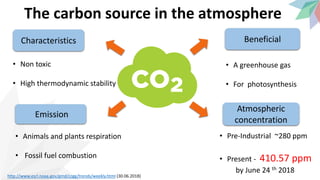
The carbon source in the atmosphere
Atmospheric
concentration
• Pre-Industrial ~280 ppm
• Present - 410.57 ppm
by June 24 th 2018
Beneficial
• A greenhouse gas
• For photosynthesis
Emission
• Animals and plants respiration
• Fossil fuel combustion
http://www.esrl.noaa.gov/gmd/ccgg/trends/weekly.html (30.06.2018)
Characteristics
• Non toxic
• High thermodynamic stability
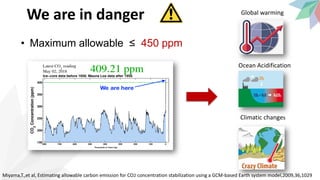
We are in danger
• Maximum allowable ≤ 450 ppm
Global warming
Climatic changes
Ocean Acidification
Miyama,T.,et al, Estimating allowable carbon emission for CO2 concentration stabilization using a GCM-based Earth system model,2009,36,1029
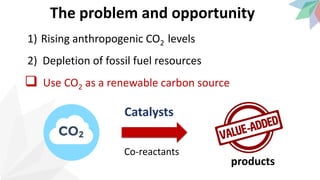
The problem and opportunity
1) Rising anthropogenic CO2 levels
 Use CO2 as a renewable carbon source
Catalysts
Co-reactants
products
2) Depletion of fossil fuel resources
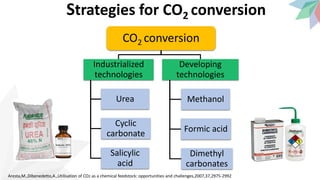
CO2 conversion
Industrialized
technologies
Urea
Cyclic
carbonate
Salicylic
acid
Developing
technologies
Methanol
Formic acid
Dimethyl
carbonates
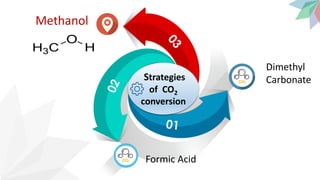
Strategies for CO2 conversion
Aresta,M.,Dibenedetto,A.,Utilisation of CO2 as a chemical feedstock: opportunities and challenges,2007,37,2975-2992
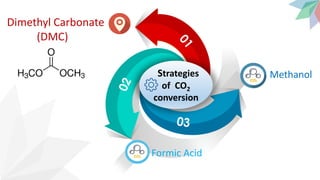
Dimethyl Carbonate
(DMC)
Strategies
of CO2
conversion
Methanol
Formic Acid
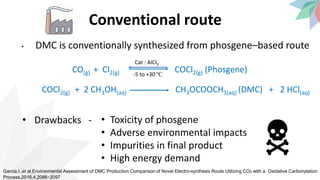
Conventional route
• Toxicity of phosgene
• Adverse environmental impacts
• Impurities in final product
• High energy demand
• Drawbacks -
Garcia,I.,et al,Environmental Assessment of DMC Production Comparison of Novel Electro-synthesis Route Utilizing CO2 with a Oxidative Carbonylation
Process,2016,4,2088−2097
Cat : AlCl3
• DMC is conventionally synthesized from phosgene–based route
CO(g) + Cl2(g) COCl2(g) (Phosgene)
COCl2(g) + 2 CH3OH(aq) CH3OCOOCH3(aq) (DMC) + 2 HCl(aq)
-5 to +30 ºC
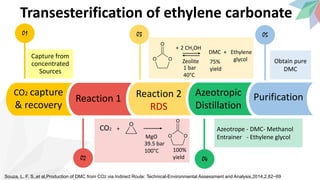
Transesterification of ethylene carbonate
Souza, L. F. S.,et al,Production of DMC from CO2 via Indirect Route: Technical-Environmental Assessment and Analysis,2014,2,62−69
01
Capture from
concentrated
Sources
CO2 capture
& recovery
03
O
O O
+
Zeolite
1 bar
40°C
75%
yield
DMC + Ethylene
glycol
2 CH3OH
Reaction 2
RDS
02
CO2 +
O
O
O OMgO
39.5 bar
100°C 100%
yield
Reaction 1
04
Azeotrope - DMC- Methanol
Entrainer - Ethylene glycol
Azeotropic
Distillation
05
Obtain pure
DMC
Purification
Is It Sustainable ?
100% atom efficiency - No deleterious waste
High Efficiency
No use of Hazardous chemicals
Utilization of renewable raw materials
Souza, L. F. S,et al, Production of DMC from CO2 via Indirect Route: Technical-Environmental Assessment and Analysis, 2014, 2, 62−69
Strategies
of CO2
conversion
Methanol
Dimethyl Carbonate
Formic Acid
Conventional route
Commonly formic acid is synthesized by CO and H2O via methyl formate
• Need high amount of energy
The hydrolysis equilibrium is relatively unfavorable
• The CO used in the process is obtained from fossil resources
Artz,J,et al, Sustainable Conversion of Carbon Dioxide: An Integrated Review of Catalysis and Life Cycle Assessment,2018,118,435-436
CH3OH(l) + CO(g) HCOOCH3(l)
Cat:(NaOMe)
80 °C,45 atm
HCOOCH3 (l) + H2O(l) HCOOH(aq) + CH3OH(aq)
CO2H2
Supercritical CO2 phase
CO2 + H2
CO2 HCOOH
CO2 + H2 HCOOH
HCOOH
P or T
Ionic Liquid Phase
Stabilizing base + Catalyst
Recycle
Mobile
phase
Stationary
phase
Continuous-flow hydrogenation of supercritical CO2
Wesselbaum,et al,Continuous-Flow Hydrogenation of Carbon Dioxide to Pure Formic Acid using an scCO2 with Immobilized Catalyst and Base.2012, 51, 8585−8588
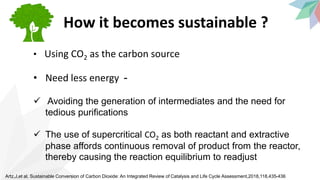
• Using CO2 as the carbon source
• Need less energy -
 Avoiding the generation of intermediates and the need for
tedious purifications
 The use of supercritical CO2 as both reactant and extractive
phase affords continuous removal of product from the reactor,
thereby causing the reaction equilibrium to readjust
How it becomes sustainable ?
Artz,J,et al, Sustainable Conversion of Carbon Dioxide: An Integrated Review of Catalysis and Life Cycle Assessment,2018,118,435-436
Strategies
of CO2
conversion
Methanol
Dimethyl
Carbonate
Formic Acid
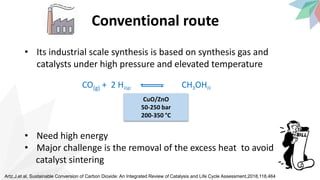
Conventional route
• Its industrial scale synthesis is based on synthesis gas and
catalysts under high pressure and elevated temperature
• Need high energy
• Major challenge is the removal of the excess heat to avoid
catalyst sintering
Artz,J,et al, Sustainable Conversion of Carbon Dioxide: An Integrated Review of Catalysis and Life Cycle Assessment,2018,118,464
CuO/ZnO
50-250 bar
200-350 °C
CO(g) + 2 H2(g) CH3OH(l)
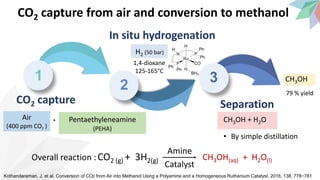
1
Air
(400 ppm CO2 )
+ Pentaethyleneamine
(PEHA)
CO2 capture
2
In situ hydrogenation
H2 (50 bar)
1,4-dioxane
125-165°C
Overall reaction :CO2 (g) + 3H2(g)
Amine
Catalyst
CH3OH(aq) + H2O(l)
CO2 capture from air and conversion to methanol
Kothandaraman, J, et al, Conversion of CO2 from Air into Methanol Using a Polyamine and a Homogeneous Ruthenium Catalyst. 2016, 138, 778−781
CH3OH
Separation
3
CH3OH + H2O
• By simple distillation
79 % yield
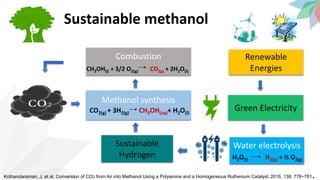
Renewable
Energies
Sustainable methanol
Kothandaraman, J, et al, Conversion of CO2 from Air into Methanol Using a Polyamine and a Homogeneous Ruthenium Catalyst. 2016, 138, 778−781.
Green Electricity
Water electrolysis
H2O(l) H2(g) + ½ O2(g)
Methanol synthesis
CO2(g) + 3H2(g) CH3OH(aq)+ H2O(l)
Sustainable
Hydrogen
Combustion
CH3OH(l) + 3/2 O2(g) CO2g) + 2H2O(l)
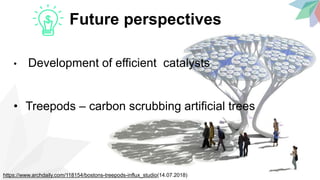
Future perspectives
• Development of efficient catalysts
• Treepods – carbon scrubbing artificial trees
https://www.archdaily.com/118154/bostons-treepods-influx_studio(14.07.2018)
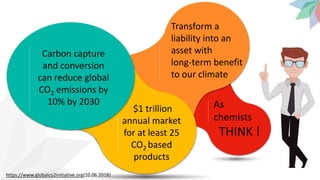
As
chemists
THINK !
Transform a
liability into an
asset with
long-term benefit
to our climate
$1 trillion
annual market
for at least 25
CO2 based
products
Carbon capture
and conversion
can reduce global
CO2 emissions by
10% by 2030
https://www.globalco2initiative.org(10.06.2018)
20
THANK YOU !

Co2 conversion

  • 1.
  • 2.
    The carbon sourcein the atmosphere Atmospheric concentration • Pre-Industrial ~280 ppm • Present - 410.57 ppm by June 24 th 2018 Beneficial • A greenhouse gas • For photosynthesis Emission • Animals and plants respiration • Fossil fuel combustion http://www.esrl.noaa.gov/gmd/ccgg/trends/weekly.html (30.06.2018) Characteristics • Non toxic • High thermodynamic stability
  • 3.
    We are indanger • Maximum allowable ≤ 450 ppm Global warming Climatic changes Ocean Acidification Miyama,T.,et al, Estimating allowable carbon emission for CO2 concentration stabilization using a GCM-based Earth system model,2009,36,1029
  • 4.
    The problem andopportunity 1) Rising anthropogenic CO2 levels  Use CO2 as a renewable carbon source Catalysts Co-reactants products 2) Depletion of fossil fuel resources
  • 5.
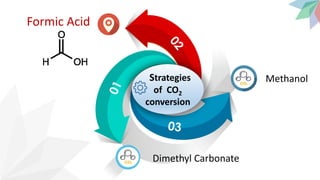
    CO2 conversion Industrialized technologies Urea Cyclic carbonate Salicylic acid Developing technologies Methanol Formic acid Dimethyl carbonates Strategiesfor CO2 conversion Aresta,M.,Dibenedetto,A.,Utilisation of CO2 as a chemical feedstock: opportunities and challenges,2007,37,2975-2992
  • 6.
  • 7.
    Conventional route • Toxicityof phosgene • Adverse environmental impacts • Impurities in final product • High energy demand • Drawbacks - Garcia,I.,et al,Environmental Assessment of DMC Production Comparison of Novel Electro-synthesis Route Utilizing CO2 with a Oxidative Carbonylation Process,2016,4,2088−2097 Cat : AlCl3 • DMC is conventionally synthesized from phosgene–based route CO(g) + Cl2(g) COCl2(g) (Phosgene) COCl2(g) + 2 CH3OH(aq) CH3OCOOCH3(aq) (DMC) + 2 HCl(aq) -5 to +30 ºC
  • 8.
    Transesterification of ethylenecarbonate Souza, L. F. S.,et al,Production of DMC from CO2 via Indirect Route: Technical-Environmental Assessment and Analysis,2014,2,62−69 01 Capture from concentrated Sources CO2 capture & recovery 03 O O O + Zeolite 1 bar 40°C 75% yield DMC + Ethylene glycol 2 CH3OH Reaction 2 RDS 02 CO2 + O O O OMgO 39.5 bar 100°C 100% yield Reaction 1 04 Azeotrope - DMC- Methanol Entrainer - Ethylene glycol Azeotropic Distillation 05 Obtain pure DMC Purification
  • 9.
    Is It Sustainable? 100% atom efficiency - No deleterious waste High Efficiency No use of Hazardous chemicals Utilization of renewable raw materials Souza, L. F. S,et al, Production of DMC from CO2 via Indirect Route: Technical-Environmental Assessment and Analysis, 2014, 2, 62−69
  • 10.
  • 11.
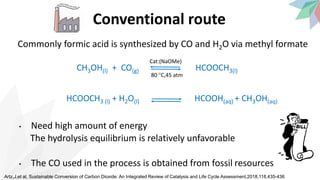
    Conventional route Commonly formicacid is synthesized by CO and H2O via methyl formate • Need high amount of energy The hydrolysis equilibrium is relatively unfavorable • The CO used in the process is obtained from fossil resources Artz,J,et al, Sustainable Conversion of Carbon Dioxide: An Integrated Review of Catalysis and Life Cycle Assessment,2018,118,435-436 CH3OH(l) + CO(g) HCOOCH3(l) Cat:(NaOMe) 80 °C,45 atm HCOOCH3 (l) + H2O(l) HCOOH(aq) + CH3OH(aq)
  • 12.
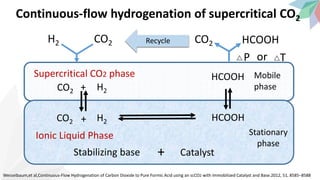
    CO2H2 Supercritical CO2 phase CO2+ H2 CO2 HCOOH CO2 + H2 HCOOH HCOOH P or T Ionic Liquid Phase Stabilizing base + Catalyst Recycle Mobile phase Stationary phase Continuous-flow hydrogenation of supercritical CO2 Wesselbaum,et al,Continuous-Flow Hydrogenation of Carbon Dioxide to Pure Formic Acid using an scCO2 with Immobilized Catalyst and Base.2012, 51, 8585−8588
  • 13.
    • Using CO2as the carbon source • Need less energy -  Avoiding the generation of intermediates and the need for tedious purifications  The use of supercritical CO2 as both reactant and extractive phase affords continuous removal of product from the reactor, thereby causing the reaction equilibrium to readjust How it becomes sustainable ? Artz,J,et al, Sustainable Conversion of Carbon Dioxide: An Integrated Review of Catalysis and Life Cycle Assessment,2018,118,435-436
  • 14.
  • 15.
    Conventional route • Itsindustrial scale synthesis is based on synthesis gas and catalysts under high pressure and elevated temperature • Need high energy • Major challenge is the removal of the excess heat to avoid catalyst sintering Artz,J,et al, Sustainable Conversion of Carbon Dioxide: An Integrated Review of Catalysis and Life Cycle Assessment,2018,118,464 CuO/ZnO 50-250 bar 200-350 °C CO(g) + 2 H2(g) CH3OH(l)
  • 16.
    1 Air (400 ppm CO2) + Pentaethyleneamine (PEHA) CO2 capture 2 In situ hydrogenation H2 (50 bar) 1,4-dioxane 125-165°C Overall reaction :CO2 (g) + 3H2(g) Amine Catalyst CH3OH(aq) + H2O(l) CO2 capture from air and conversion to methanol Kothandaraman, J, et al, Conversion of CO2 from Air into Methanol Using a Polyamine and a Homogeneous Ruthenium Catalyst. 2016, 138, 778−781 CH3OH Separation 3 CH3OH + H2O • By simple distillation 79 % yield
  • 17.
    Renewable Energies Sustainable methanol Kothandaraman, J,et al, Conversion of CO2 from Air into Methanol Using a Polyamine and a Homogeneous Ruthenium Catalyst. 2016, 138, 778−781. Green Electricity Water electrolysis H2O(l) H2(g) + ½ O2(g) Methanol synthesis CO2(g) + 3H2(g) CH3OH(aq)+ H2O(l) Sustainable Hydrogen Combustion CH3OH(l) + 3/2 O2(g) CO2g) + 2H2O(l)
  • 18.
    Future perspectives • Developmentof efficient catalysts • Treepods – carbon scrubbing artificial trees https://www.archdaily.com/118154/bostons-treepods-influx_studio(14.07.2018)
  • 19.
    As chemists THINK ! Transform a liabilityinto an asset with long-term benefit to our climate $1 trillion annual market for at least 25 CO2 based products Carbon capture and conversion can reduce global CO2 emissions by 10% by 2030 https://www.globalco2initiative.org(10.06.2018)
  • 20.