Hydrogen Safety  Training Program Presented by:  BOC Gases NATIONAL TRAINING CENTER
Hydrogen... What Do You Know About It? Is it the Bad Boy of the Gas World?
HYDROGEN BOMB
HINDENBURG
THE FIRE
The passengers and crew had only seconds to react. Some jumped out of the windows, some fell. Since the  Hindenburg  was still 300 feet (roughly equal to 30 stories) in the air when it caught fire, many of these passengers did not survive the fall. Other passengers got wedged inside the ship by moving furniture and fallen passengers. Other passengers and crew jumped from the ship once it neared the ground. Even others were rescued from the burning bulk after it had hit the ground.  Considering the quickness of the catastrophe, it is amazing that only 35 of the 97 men and women on board, plus one member of the ground crew, died in the  Hindenburg  disaster.  Though it was assumed at the time that the fire was caused by a hydrogen gas leak ignited by a spark of static electricity, the cause of the disaster is  still controversial .
Fabric, Not Filling, to Blame Hydrogen Exonerated in Hindenburg Disaster
SPACE SHUTTLE CHALLENGER
O RING FAILURE
Hydrogen... The Fuel of the Future


HYDROGEN FACTS Chemical Symbol :  H 2 CAS Registry Number :  1333-74-0 DOT Classification :  Flammable Gas DOT Label  :  Flammable Gas Transport Canada Classification :  2.1 UN Number :  UN 1049 ( compressed gas ) UN 1966 (refrigerated liquid )
H   PHYSICAL PROPERTIES Gas at atmospheric temperature and pressure Extremely flammable Colorless Odorless Tasteless
Smallest molecule Lightest specific density (14 times lighter than air) Non-toxic, simple asphyxiant Non-corrosive Metallurgical:  hydrogen embrittlement Normal boiling point:  -423.0 °F H   PHYSICAL PROPERTIES   cont.
Cryogenic Burns:  Damage can result from exposure to cold gases Lightest of All Chemical Elements:  Most abundant substance in the universe Our sun is a nuclear reactor in which hydrogen continuously fuses into helium.  Fusion process creates heat which warms our earth. H   PHYSICAL PROPERTIES   cont.
Hydrogen liquid weight is only 0.5906 LB. per gallon Gaseous hydrogen is always present where there is liquid hydrogen Hydrogen gas burns with a pale blue color (almost invisible) Low temperature of liquid hydrogen can solidify any gas except helium H   PHYSICAL PROPERTIES   cont.
Hydrogen liquid has a low density Every pound vaporized yields 192 scf of gas A pound of liquid nitrogen yields only 13.8 scf of gas On a weight basis, gas yield of hydrogen is almost 14 times as much as that  of nitrogen A gallon of liquid hydrogen requires only 114.71 BTU’s of heat to vaporize it.  By contrast a gallon of liquid nitrogen requires 578 BTU’s. H   PHYSICAL PROPERTIES   cont.
SPECIFIC HEAT VALUES The amount of heat required to raise the temperature of hydrogen gas differs very little from that of nitrogen To heat 1,000 cu. ft. of hydrogen at constant pressure 1°F requires 17.8 Btu’s Same temperature change for nitrogen requires 18 Btu’s
DENSITY Density decreases as temperature increases.  If hydrogen liquid remains in the cryogenic vessel for an extended period of time it will turn to gas.
HYDROGEN CHEMISTRY An atom of hydrogen has the simplest of structures Hydrogen has a nucleus of one proton with a single electron orbiting about it Both proton and electron are spinning on their own axis At room temperature, hydrogen has a normal or equilibrium composition of 75% in the ortho and 25% in the para form If hydrogen gas is liquefied and stored, it gradually shifts in composition until it reaches an equilibrium when only 0.21% is ortho and 99.79% is para The shift in structure from ortho to para creates heat
HYDROGEN LIQUEFACTION Compressed Dried Purified Cooled Expanded Liquefied
HOW IS HYDROGEN MANUFACTURED? Catalytic reforming of hydrocarbons (natural gas is CH 4 ) Dissociation of ammonia (NH 3 ) Chlorine and sodium chlorate production Electrolysis of water (H 2 O)
BOC GASES MANUFACTURING FACILITY IN MAGOG, QUEBEC, CANADA Hydrogen gas at Magog is a by-product of sodium chlorate production Magog is a 15 ton per day plant which equals 5.76 mmcf Magog’s storage capacity is 50.7 million gallons
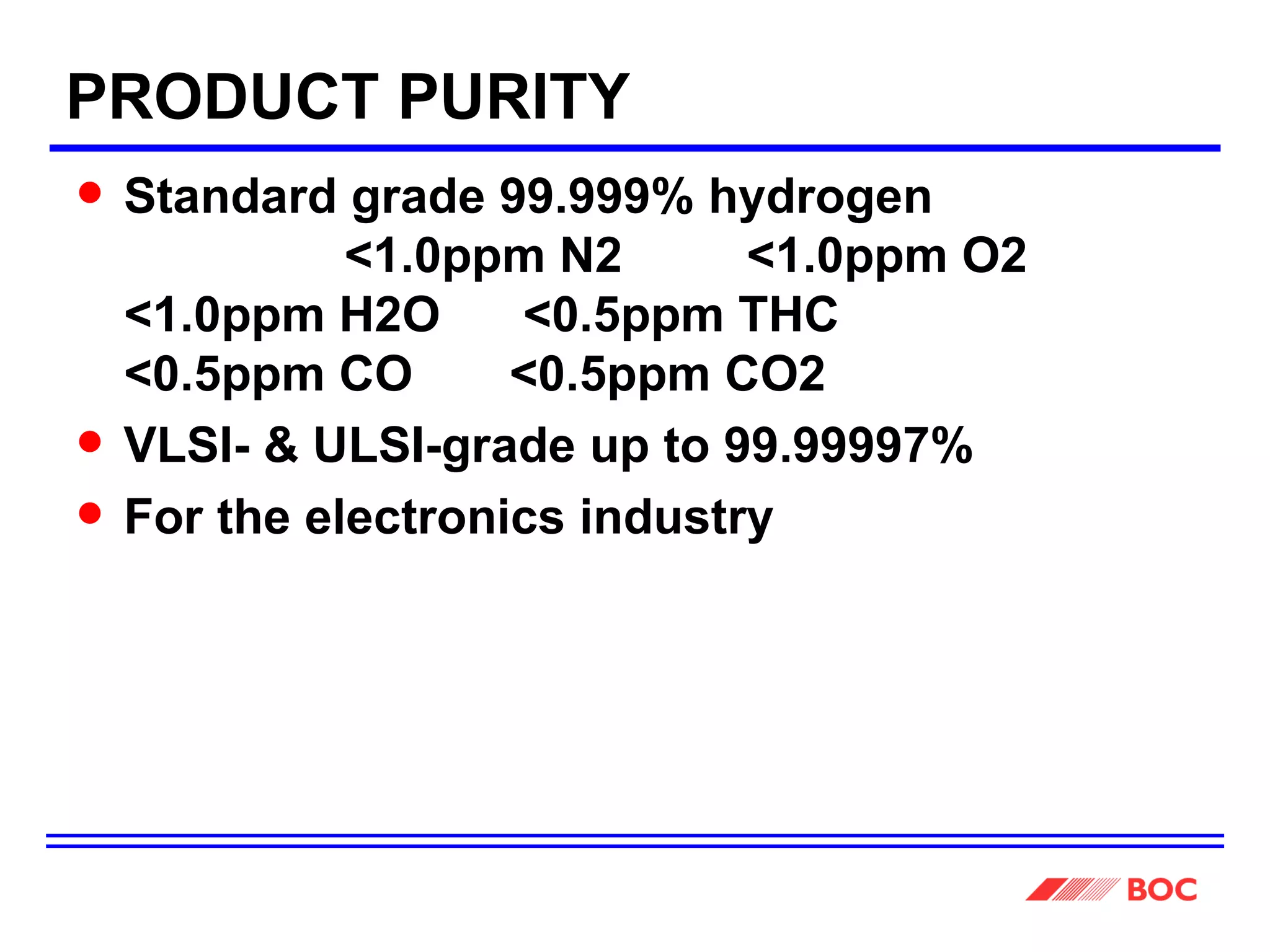
PRODUCT PURITY Standard grade 99.999% hydrogen  <1.0ppm N2  <1.0ppm O2  <1.0ppm H2O  <0.5ppm THC  <0.5ppm CO  <0.5ppm CO2 VLSI- & ULSI-grade up to 99.99997% For the electronics industry
HYDROGEN USES Fuel (oxy-hydrogen flame, NASA) Chemical synthesis (ammonia,  methanol) Petroleum refining Hydrogenation of edible  organic oils Reduction of oxygen (controlled atmosphere in metalworking furnaces, electronics production, float glass)
HYDROGEN HAZARDS Flammability Asphyxiant Cold contact Pressure Expansion ratios
DON’T ADD WATER
EXPOSIVE LIMITS OF COMBUSTIBLE GASES WHEN MIXED WITH AIR
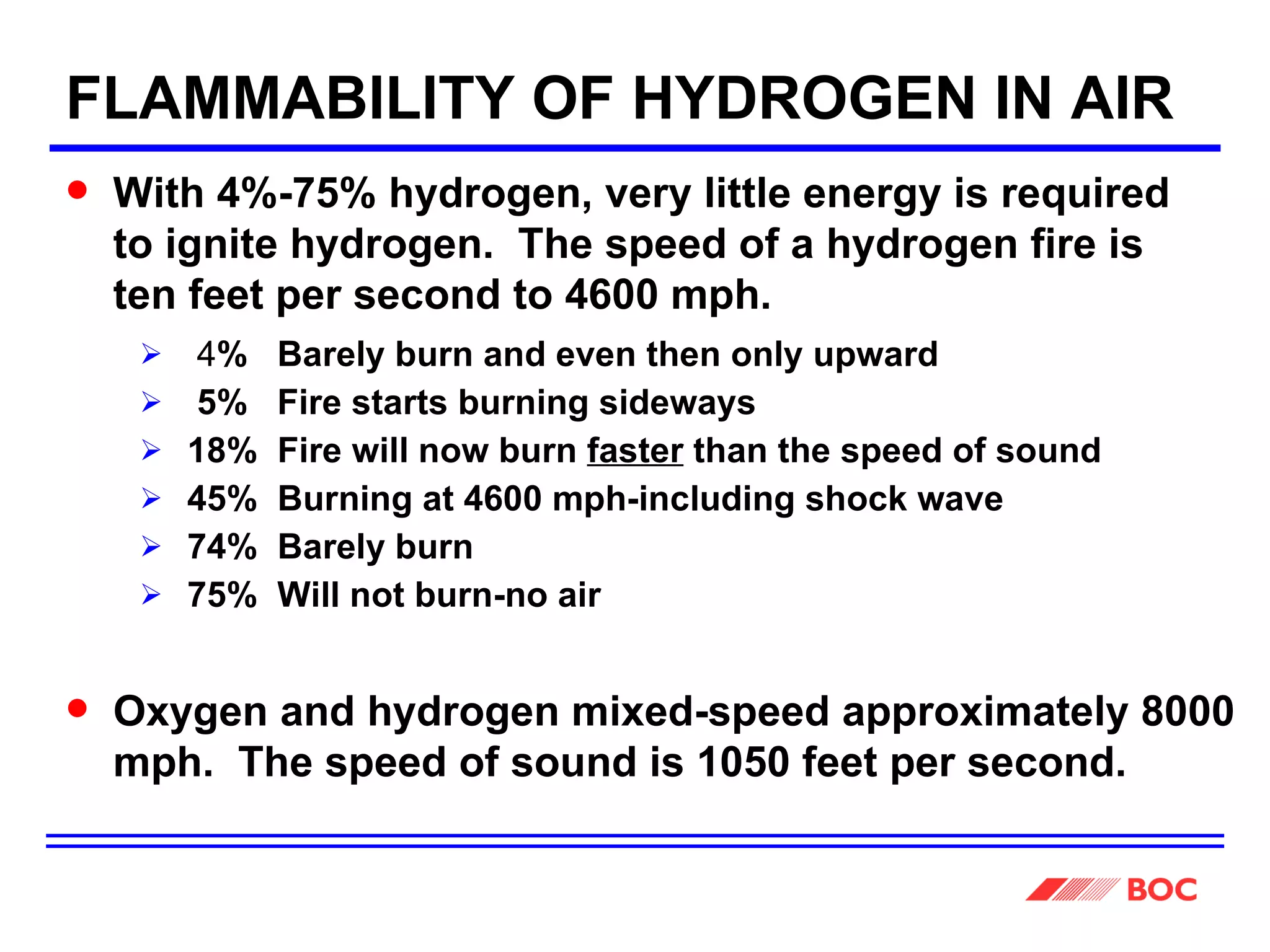
FLAMMABILITY OF HYDROGEN IN AIR 4 %  Barely burn and even then only upward 5%  Fire starts burning sideways 18%  Fire will now burn  faster  than the speed of sound 45%  Burning at 4600 mph-including shock wave 74%  Barely burn 75%  Will not burn-no air  With 4%-75% hydrogen, very little energy is required to ignite hydrogen.  The speed of a hydrogen fire is ten feet per second to 4600 mph. Oxygen and hydrogen mixed-speed approximately 8000 mph.  The speed of sound is 1050 feet per second.
H   FLAMMABILITY-SAFETY PRECAUTIONS Precautions:  Eliminate ignition sources NO SMOKING!  NO OPEN FLAMES! Use only non-sparking tools No synthetic clothing (nylon, etc.) Electrical equipment-explosion proof, intrinsically safe or purged Bonding and grounding
HYDROGEN FIRES Hydrogen Fires: Shut off hydrogen source and allow fire to burn out Small fires can be extinguished with carbon dioxide or water spray
HYDROGEN FIRES    cont. A hydrogen flame is invisible under many conditions Hydrogen flames cause little damage from radiation Hydrogen flames can burn in a strong wind and be stretched out away from its source a number of feet Any venting should be done carefully to prevent accumulation in pockets which may cause an explosive mixture
HYDROGEN FIRE FIGHTING Shut off the source and allow the fire to burn out Daylight fires can be detected by heat waves or a broom If the fire is extinguished before all the gas burns off, watch for pockets which may suddenly re-ignite Very small fires can be controlled with carbon dioxide and water spray Larger fires may be controlled with steam and/or nitrogen
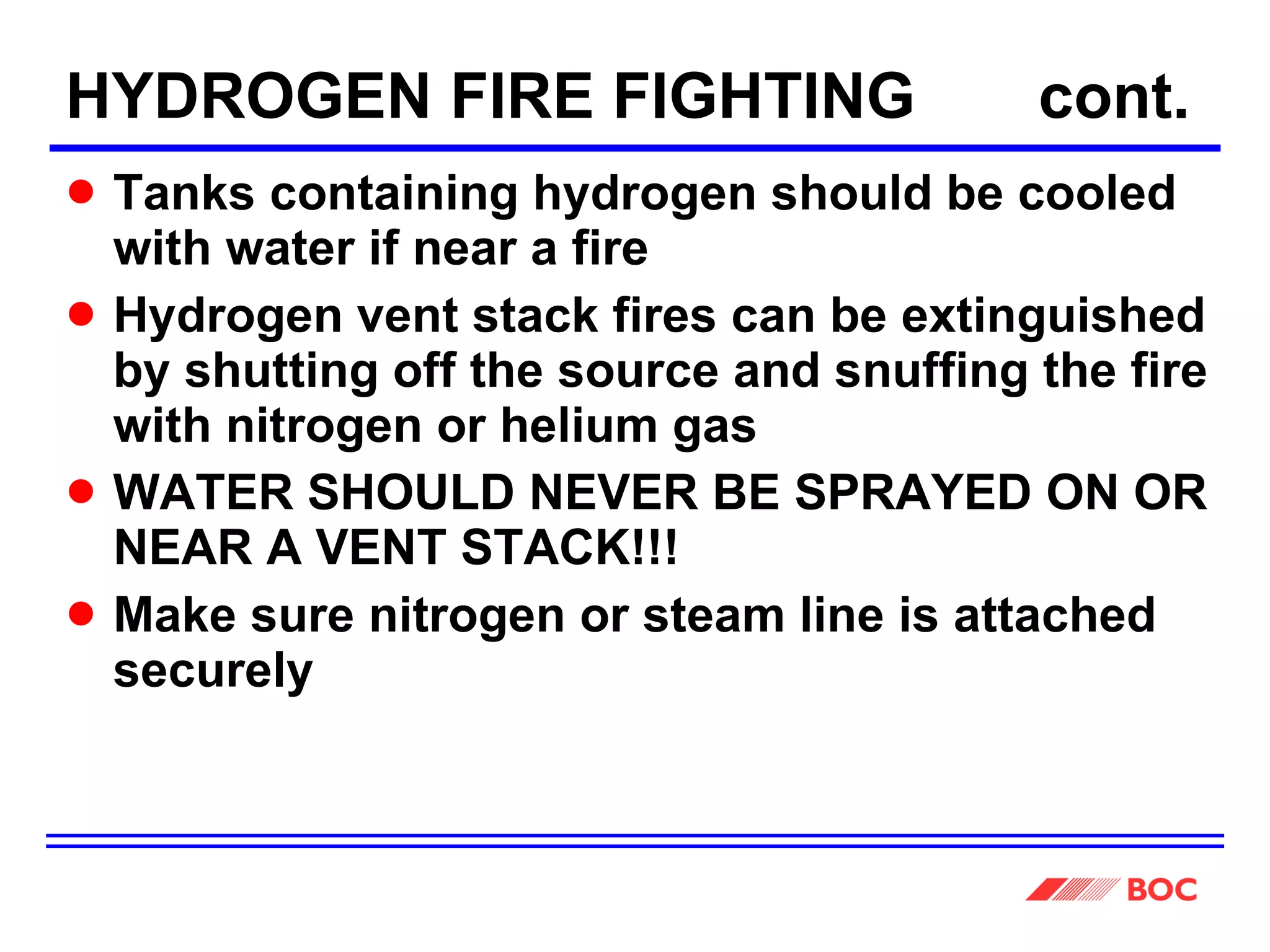
HYDROGEN FIRE FIGHTING  cont. Tanks containing hydrogen should be cooled with water if near a fire Hydrogen vent stack fires can be extinguished by shutting off the source and snuffing the fire with nitrogen or helium gas WATER SHOULD NEVER BE SPRAYED ON OR NEAR A VENT STACK!!! Make sure nitrogen or steam line is attached securely
FIRE FIGHTING EQUIPMENT A fire extinguisher should be located within the boundaries of the installation An adequate water supply, fire extinguisher (either dry chemical or carbon dioxide) and a fire blanket should be in the proximity of a hydrogen station It is helpful to keep a straw broom nearby to detect flames during daylight hours
HYDROGEN AS AN ASPHYXIANT Hydrogen is an asphyxiant.  It can displace oxygen, causing an oxygen deficient atmosphere. Symptoms of an oxygen deficient atmosphere could include : Headache Dizziness Breathing Difficulty Nausea Unconsciousness   Proper ventilation is a must! Do not be caught in an oxygen deficient atmosphere.
COLD CONTACT Liquid (-423 °F) or gaseous hydrogen can cause tissue freezing or frostbite Frozen tissues are painless and appear waxy yellow Remove restrictive clothing and immerse affected part in warm water (approximately 105°F) Do not rub frozen parts, tissue damage may result Never use dry heat
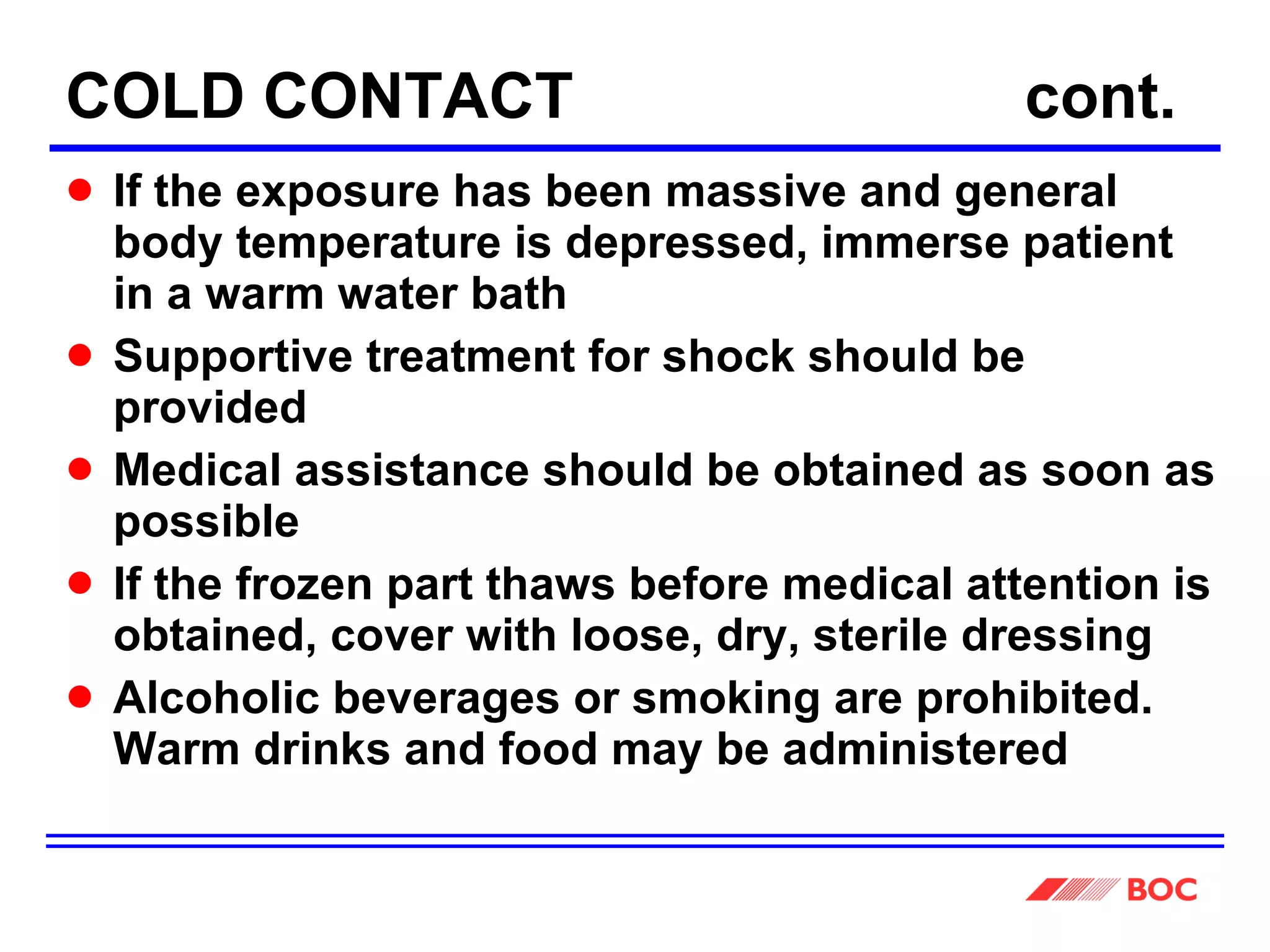
COLD CONTACT    cont. If the exposure has been massive and general body temperature is depressed, immerse patient in a warm water bath Supportive treatment for shock should be provided Medical assistance should be obtained as soon as possible  If the frozen part thaws before medical attention is obtained, cover with loose, dry, sterile dressing Alcoholic beverages or smoking are prohibited.  Warm drinks and food may be administered
PERSONAL PROTECTIVE CLOTHING Loose fitting gloves Steel toed shoes Hard hat Ear protection  Cotton or Nomex 3 overalls worn outside of boots Eye protection Long sleeves (should not be rolled up while working )
HIGH PRESSURE HAZARDS Liquid hydrogen storage tank maximum allowable working pressure (mawp) is 175 psi Hydrogen cylinders, storage tubes, and tube trailers: up to 3000 psi Stand clear of pressure relief devices Do not open pressurized fittings or break pressurized lines
EXPANSION RATIO OF HYDROGEN The expansion ratio of hydrogen from a liquid to a gas is 850:1 Never trap liquid hydrogen in a system Always install pressure relief devices where liquid could get trapped
SPILLS Small spills of liquid hydrogen disperse quickly Any spill should be considered a potential fire Large spills cause ground freezing, hydrogen will not vaporize quickly.  Evacuate area until spill has dissipated Use water spray to reduce fog and diffuse vapors Cold hydrogen vapor above a spill or frozen ground is slightly heavier than air Air moving over a spill may carry hydrogen gas some distance before it warms enough to rise
SPILLS    cont. Clouds of gas can quickly become huge fire balls with tragic results Always lay out an escape route when there is a spill NO SMOKING, NO FIRES, AND NO OPEN FLAMES!!!!!!! Do not touch spill Stop leak where it can be done safely without risk to personnel
EMBRITTLEMENT Cold liquid or gaseous hydrogen can cause materials to become embrittled Materials not intended or designed for use with cryogens can become a hazard Never use materials that are not rated for the temperatures and pressures of hydrogen service
AIR CONDENSATION Surfaces cooled by liquid hydrogen can be cold enough to cause atmospheric air to condense Air will liquefy at -317°F Because Nitrogen boils off before oxygen, the result can be an oxygen enriched liquid If this liquid drips onto a combustible surface, such as asphalt, an explosive mixture could result Make sure that all surfaces that this liquid could come into contact with is cleaned according to oxygen-cleaned standards
LIQUEFIED AIR - 317 F - 423 F LOX
THERMAL STRESS Cryogenic piping must contain sufficient flexibility to withstand the thermal stress related to the cool down to operating temperature This can be accomplished with suitable pipe routing or expansion joints Motion of the pipeline due to pressurization and thermal contraction can be reliably predicted Temperature fluctuations during cool down are not as easily predicted Unequal cooling of piping systems can stress pipelines and cause damage or system failure
GENERAL REQUIREMENTS Federal/state/local regulations Nationally recognized standards Site preparation Concrete pad Fencing/Bumpers Utilities
GENERAL SITE REQUIREMENTS Atmospheric conditions Clearance from exposures Underground interference Overhead interference Trailer access Spill apron Grounding of all equipment
UTILITIES Electrical Phone  Water Lighting
FEDERAL  REGS & STANDARDS NFPA 50A, 50B, 86C CGA G-5, G-5.3, G-5.4  29 CFR 1910.103 EPA BOCA OSHA ASME DOT UFC
REFERENCES AND REGULATIONS UFC:   Uniform Fire Code SFPC:   Standard Fire Prevention Code SBCCI:   Southern Building Code    Congress International UBPVL:   Uniform Boiler and Pressure    Vessel Laws ASME:   American Society of Mechanical    Engineers
REFERENCES AND REGULATIONS State and municipal fire and building codes Corporate standards Insurance company standards BOC Gases standards Hydrogen Piping Specifications Hydrogen Safety & Loss Prevention
REFERENCES AND REGS    cont. BOC Gases National Training Center Hydrogen Training Manual BOC Gases Loss Control Manual BOC Gases Oxygen Compatibility Source Manual BOC Gases Customer Station Inspection procedure-IES-P-INS-001 BOC Site Access Standard IES-S-STE-001
EQUIPMENT FOR H   SERVICE Suitable for temperature Suitable for pressure Material construction Cleaned for hydrogen service Cv factor for flow velocities Leak rate Pumping systems
LABELING AND MARKINGS The Corporate Identification Logo Product Identification Product Hazard Warning CAS Number UNC Number NFPA Fire Diamond Safety Venting Decals Flammable Gas Warning No Smoking No Open Flames
LABELING AND MARKINGS  cont. Personal Protection Pipeline Labeling Authorized Personnel Pressure Vessel Identification Corporate Identification Number Emergency Information Valve and Component Identification Annual Safety Inspection Vent Stack Purge Identification Static Ground Connection
MATERIALS SATISFACTORY 300 Series Stainless Steel Monel Invar Copper Brass Aluminum (with exceptions) UNSATISFACTORY Carbon Steel Plastics Nickel Steel
EXPLOSION PROOF METERS MSA Model 3 Calibrated for Hydrogen MSA Model Passport Personal Alarm Cosmotector Model XPO-317
TRAINING BOC Gases policy requires that all people working with hydrogen be trained in accordance with BOC standards OSHA’s Code of Federal Regulations, 29-1910.103 states “ you must be trained and familiar with proper practices associated with the construction and use of a hydrogen system”
CUSTOMER TRAINING MSDS (Material Safety Data Sheet) General site review Emergency contact information
8 CAUSES OF HYDROGEN MISHAPS Procedural deficiencies Planning deficiencies Material failure Design deficiencies Operation and work area deficiencies Malfunction Materials incompatibility Contamination
STACK FIRE (controlled burn)
DON'T PANIC!
TANK SAFETIES (Pressure Relief Devices)
STACK PIPING ALL SAFETIES
STACK HEIGHT
SECOND STACK ON SOME TANKS
INDUSTRIAL FURNACE OPERATION Flammable Atmosphere Introduction: Purge furnace with nitrogen until all chambers are below 1% oxygen Ignite pilots and flame curtains Verify furnace temp. > 1400°F Proceed with hydrogen introduction
Flammable Atmosphere Removal: Establish nitrogen purge flow Stop hydrogen flow Verify that the furnace contains less than 2% hydrogen Lower   furnace temperature to below 1400°F INDUSTRIAL FURNACE OPERATION
Additional Safety Interlocks: Low nitrogen tank level Low nitrogen pressure Low nitrogen flow Low hydrogen flow INDUSTRIAL FURNACE OPERATION
QUESTIONS?
Thank You & Be Safe

H2 Safety

  • 1.
    Hydrogen Safety Training Program Presented by: BOC Gases NATIONAL TRAINING CENTER
  • 2.
    Hydrogen... What DoYou Know About It? Is it the Bad Boy of the Gas World?
  • 3.
  • 4.
  • 5.
  • 6.
    The passengers andcrew had only seconds to react. Some jumped out of the windows, some fell. Since the Hindenburg was still 300 feet (roughly equal to 30 stories) in the air when it caught fire, many of these passengers did not survive the fall. Other passengers got wedged inside the ship by moving furniture and fallen passengers. Other passengers and crew jumped from the ship once it neared the ground. Even others were rescued from the burning bulk after it had hit the ground. Considering the quickness of the catastrophe, it is amazing that only 35 of the 97 men and women on board, plus one member of the ground crew, died in the Hindenburg disaster. Though it was assumed at the time that the fire was caused by a hydrogen gas leak ignited by a spark of static electricity, the cause of the disaster is still controversial .
  • 7.
    Fabric, Not Filling,to Blame Hydrogen Exonerated in Hindenburg Disaster
  • 8.
  • 9.
  • 10.
    Hydrogen... The Fuelof the Future
  • 11.
  • 12.
  • 13.
  • 14.
  • 15.
  • 16.
  • 17.
  • 18.
  • 19.
    HYDROGEN FACTS ChemicalSymbol : H 2 CAS Registry Number : 1333-74-0 DOT Classification : Flammable Gas DOT Label : Flammable Gas Transport Canada Classification : 2.1 UN Number : UN 1049 ( compressed gas ) UN 1966 (refrigerated liquid )
  • 20.
    H  PHYSICAL PROPERTIES Gas at atmospheric temperature and pressure Extremely flammable Colorless Odorless Tasteless
  • 21.
    Smallest molecule Lightestspecific density (14 times lighter than air) Non-toxic, simple asphyxiant Non-corrosive Metallurgical: hydrogen embrittlement Normal boiling point: -423.0 °F H  PHYSICAL PROPERTIES cont.
  • 22.
    Cryogenic Burns: Damage can result from exposure to cold gases Lightest of All Chemical Elements: Most abundant substance in the universe Our sun is a nuclear reactor in which hydrogen continuously fuses into helium. Fusion process creates heat which warms our earth. H  PHYSICAL PROPERTIES cont.
  • 23.
    Hydrogen liquid weightis only 0.5906 LB. per gallon Gaseous hydrogen is always present where there is liquid hydrogen Hydrogen gas burns with a pale blue color (almost invisible) Low temperature of liquid hydrogen can solidify any gas except helium H  PHYSICAL PROPERTIES cont.
  • 24.
    Hydrogen liquid hasa low density Every pound vaporized yields 192 scf of gas A pound of liquid nitrogen yields only 13.8 scf of gas On a weight basis, gas yield of hydrogen is almost 14 times as much as that of nitrogen A gallon of liquid hydrogen requires only 114.71 BTU’s of heat to vaporize it. By contrast a gallon of liquid nitrogen requires 578 BTU’s. H  PHYSICAL PROPERTIES cont.
  • 25.
    SPECIFIC HEAT VALUESThe amount of heat required to raise the temperature of hydrogen gas differs very little from that of nitrogen To heat 1,000 cu. ft. of hydrogen at constant pressure 1°F requires 17.8 Btu’s Same temperature change for nitrogen requires 18 Btu’s
  • 26.
    DENSITY Density decreasesas temperature increases. If hydrogen liquid remains in the cryogenic vessel for an extended period of time it will turn to gas.
  • 27.
    HYDROGEN CHEMISTRY Anatom of hydrogen has the simplest of structures Hydrogen has a nucleus of one proton with a single electron orbiting about it Both proton and electron are spinning on their own axis At room temperature, hydrogen has a normal or equilibrium composition of 75% in the ortho and 25% in the para form If hydrogen gas is liquefied and stored, it gradually shifts in composition until it reaches an equilibrium when only 0.21% is ortho and 99.79% is para The shift in structure from ortho to para creates heat
  • 28.
    HYDROGEN LIQUEFACTION CompressedDried Purified Cooled Expanded Liquefied
  • 29.
    HOW IS HYDROGENMANUFACTURED? Catalytic reforming of hydrocarbons (natural gas is CH 4 ) Dissociation of ammonia (NH 3 ) Chlorine and sodium chlorate production Electrolysis of water (H 2 O)
  • 30.
    BOC GASES MANUFACTURINGFACILITY IN MAGOG, QUEBEC, CANADA Hydrogen gas at Magog is a by-product of sodium chlorate production Magog is a 15 ton per day plant which equals 5.76 mmcf Magog’s storage capacity is 50.7 million gallons
  • 31.
    PRODUCT PURITY Standardgrade 99.999% hydrogen <1.0ppm N2 <1.0ppm O2 <1.0ppm H2O <0.5ppm THC <0.5ppm CO <0.5ppm CO2 VLSI- & ULSI-grade up to 99.99997% For the electronics industry
  • 32.
    HYDROGEN USES Fuel(oxy-hydrogen flame, NASA) Chemical synthesis (ammonia, methanol) Petroleum refining Hydrogenation of edible organic oils Reduction of oxygen (controlled atmosphere in metalworking furnaces, electronics production, float glass)
  • 33.
    HYDROGEN HAZARDS FlammabilityAsphyxiant Cold contact Pressure Expansion ratios
  • 34.
  • 35.
    EXPOSIVE LIMITS OFCOMBUSTIBLE GASES WHEN MIXED WITH AIR
  • 36.
    FLAMMABILITY OF HYDROGENIN AIR 4 % Barely burn and even then only upward 5% Fire starts burning sideways 18% Fire will now burn faster than the speed of sound 45% Burning at 4600 mph-including shock wave 74% Barely burn 75% Will not burn-no air With 4%-75% hydrogen, very little energy is required to ignite hydrogen. The speed of a hydrogen fire is ten feet per second to 4600 mph. Oxygen and hydrogen mixed-speed approximately 8000 mph. The speed of sound is 1050 feet per second.
  • 37.
    H  FLAMMABILITY-SAFETY PRECAUTIONS Precautions: Eliminate ignition sources NO SMOKING! NO OPEN FLAMES! Use only non-sparking tools No synthetic clothing (nylon, etc.) Electrical equipment-explosion proof, intrinsically safe or purged Bonding and grounding
  • 38.
    HYDROGEN FIRES HydrogenFires: Shut off hydrogen source and allow fire to burn out Small fires can be extinguished with carbon dioxide or water spray
  • 39.
    HYDROGEN FIRES cont. A hydrogen flame is invisible under many conditions Hydrogen flames cause little damage from radiation Hydrogen flames can burn in a strong wind and be stretched out away from its source a number of feet Any venting should be done carefully to prevent accumulation in pockets which may cause an explosive mixture
  • 40.
    HYDROGEN FIRE FIGHTINGShut off the source and allow the fire to burn out Daylight fires can be detected by heat waves or a broom If the fire is extinguished before all the gas burns off, watch for pockets which may suddenly re-ignite Very small fires can be controlled with carbon dioxide and water spray Larger fires may be controlled with steam and/or nitrogen
  • 41.
    HYDROGEN FIRE FIGHTING cont. Tanks containing hydrogen should be cooled with water if near a fire Hydrogen vent stack fires can be extinguished by shutting off the source and snuffing the fire with nitrogen or helium gas WATER SHOULD NEVER BE SPRAYED ON OR NEAR A VENT STACK!!! Make sure nitrogen or steam line is attached securely
  • 42.
    FIRE FIGHTING EQUIPMENTA fire extinguisher should be located within the boundaries of the installation An adequate water supply, fire extinguisher (either dry chemical or carbon dioxide) and a fire blanket should be in the proximity of a hydrogen station It is helpful to keep a straw broom nearby to detect flames during daylight hours
  • 43.
    HYDROGEN AS ANASPHYXIANT Hydrogen is an asphyxiant. It can displace oxygen, causing an oxygen deficient atmosphere. Symptoms of an oxygen deficient atmosphere could include : Headache Dizziness Breathing Difficulty Nausea Unconsciousness Proper ventilation is a must! Do not be caught in an oxygen deficient atmosphere.
  • 44.
    COLD CONTACT Liquid(-423 °F) or gaseous hydrogen can cause tissue freezing or frostbite Frozen tissues are painless and appear waxy yellow Remove restrictive clothing and immerse affected part in warm water (approximately 105°F) Do not rub frozen parts, tissue damage may result Never use dry heat
  • 45.
    COLD CONTACT cont. If the exposure has been massive and general body temperature is depressed, immerse patient in a warm water bath Supportive treatment for shock should be provided Medical assistance should be obtained as soon as possible If the frozen part thaws before medical attention is obtained, cover with loose, dry, sterile dressing Alcoholic beverages or smoking are prohibited. Warm drinks and food may be administered
  • 46.
    PERSONAL PROTECTIVE CLOTHINGLoose fitting gloves Steel toed shoes Hard hat Ear protection Cotton or Nomex 3 overalls worn outside of boots Eye protection Long sleeves (should not be rolled up while working )
  • 47.
    HIGH PRESSURE HAZARDSLiquid hydrogen storage tank maximum allowable working pressure (mawp) is 175 psi Hydrogen cylinders, storage tubes, and tube trailers: up to 3000 psi Stand clear of pressure relief devices Do not open pressurized fittings or break pressurized lines
  • 48.
    EXPANSION RATIO OFHYDROGEN The expansion ratio of hydrogen from a liquid to a gas is 850:1 Never trap liquid hydrogen in a system Always install pressure relief devices where liquid could get trapped
  • 49.
    SPILLS Small spillsof liquid hydrogen disperse quickly Any spill should be considered a potential fire Large spills cause ground freezing, hydrogen will not vaporize quickly. Evacuate area until spill has dissipated Use water spray to reduce fog and diffuse vapors Cold hydrogen vapor above a spill or frozen ground is slightly heavier than air Air moving over a spill may carry hydrogen gas some distance before it warms enough to rise
  • 50.
    SPILLS cont. Clouds of gas can quickly become huge fire balls with tragic results Always lay out an escape route when there is a spill NO SMOKING, NO FIRES, AND NO OPEN FLAMES!!!!!!! Do not touch spill Stop leak where it can be done safely without risk to personnel
  • 51.
    EMBRITTLEMENT Cold liquidor gaseous hydrogen can cause materials to become embrittled Materials not intended or designed for use with cryogens can become a hazard Never use materials that are not rated for the temperatures and pressures of hydrogen service
  • 52.
    AIR CONDENSATION Surfacescooled by liquid hydrogen can be cold enough to cause atmospheric air to condense Air will liquefy at -317°F Because Nitrogen boils off before oxygen, the result can be an oxygen enriched liquid If this liquid drips onto a combustible surface, such as asphalt, an explosive mixture could result Make sure that all surfaces that this liquid could come into contact with is cleaned according to oxygen-cleaned standards
  • 53.
    LIQUEFIED AIR -317 F - 423 F LOX
  • 54.
    THERMAL STRESS Cryogenicpiping must contain sufficient flexibility to withstand the thermal stress related to the cool down to operating temperature This can be accomplished with suitable pipe routing or expansion joints Motion of the pipeline due to pressurization and thermal contraction can be reliably predicted Temperature fluctuations during cool down are not as easily predicted Unequal cooling of piping systems can stress pipelines and cause damage or system failure
  • 55.
    GENERAL REQUIREMENTS Federal/state/localregulations Nationally recognized standards Site preparation Concrete pad Fencing/Bumpers Utilities
  • 56.
    GENERAL SITE REQUIREMENTSAtmospheric conditions Clearance from exposures Underground interference Overhead interference Trailer access Spill apron Grounding of all equipment
  • 57.
  • 58.
    FEDERAL REGS& STANDARDS NFPA 50A, 50B, 86C CGA G-5, G-5.3, G-5.4 29 CFR 1910.103 EPA BOCA OSHA ASME DOT UFC
  • 59.
    REFERENCES AND REGULATIONSUFC: Uniform Fire Code SFPC: Standard Fire Prevention Code SBCCI: Southern Building Code Congress International UBPVL: Uniform Boiler and Pressure Vessel Laws ASME: American Society of Mechanical Engineers
  • 60.
    REFERENCES AND REGULATIONSState and municipal fire and building codes Corporate standards Insurance company standards BOC Gases standards Hydrogen Piping Specifications Hydrogen Safety & Loss Prevention
  • 61.
    REFERENCES AND REGS cont. BOC Gases National Training Center Hydrogen Training Manual BOC Gases Loss Control Manual BOC Gases Oxygen Compatibility Source Manual BOC Gases Customer Station Inspection procedure-IES-P-INS-001 BOC Site Access Standard IES-S-STE-001
  • 62.
    EQUIPMENT FOR H SERVICE Suitable for temperature Suitable for pressure Material construction Cleaned for hydrogen service Cv factor for flow velocities Leak rate Pumping systems
  • 63.
    LABELING AND MARKINGSThe Corporate Identification Logo Product Identification Product Hazard Warning CAS Number UNC Number NFPA Fire Diamond Safety Venting Decals Flammable Gas Warning No Smoking No Open Flames
  • 64.
    LABELING AND MARKINGS cont. Personal Protection Pipeline Labeling Authorized Personnel Pressure Vessel Identification Corporate Identification Number Emergency Information Valve and Component Identification Annual Safety Inspection Vent Stack Purge Identification Static Ground Connection
  • 65.
    MATERIALS SATISFACTORY 300Series Stainless Steel Monel Invar Copper Brass Aluminum (with exceptions) UNSATISFACTORY Carbon Steel Plastics Nickel Steel
  • 66.
    EXPLOSION PROOF METERSMSA Model 3 Calibrated for Hydrogen MSA Model Passport Personal Alarm Cosmotector Model XPO-317
  • 67.
    TRAINING BOC Gasespolicy requires that all people working with hydrogen be trained in accordance with BOC standards OSHA’s Code of Federal Regulations, 29-1910.103 states “ you must be trained and familiar with proper practices associated with the construction and use of a hydrogen system”
  • 68.
    CUSTOMER TRAINING MSDS(Material Safety Data Sheet) General site review Emergency contact information
  • 69.
    8 CAUSES OFHYDROGEN MISHAPS Procedural deficiencies Planning deficiencies Material failure Design deficiencies Operation and work area deficiencies Malfunction Materials incompatibility Contamination
  • 70.
  • 71.
  • 72.
    TANK SAFETIES (PressureRelief Devices)
  • 73.
  • 74.
  • 75.
    SECOND STACK ONSOME TANKS
  • 76.
    INDUSTRIAL FURNACE OPERATIONFlammable Atmosphere Introduction: Purge furnace with nitrogen until all chambers are below 1% oxygen Ignite pilots and flame curtains Verify furnace temp. > 1400°F Proceed with hydrogen introduction
  • 77.
    Flammable Atmosphere Removal:Establish nitrogen purge flow Stop hydrogen flow Verify that the furnace contains less than 2% hydrogen Lower furnace temperature to below 1400°F INDUSTRIAL FURNACE OPERATION
  • 78.
    Additional Safety Interlocks:Low nitrogen tank level Low nitrogen pressure Low nitrogen flow Low hydrogen flow INDUSTRIAL FURNACE OPERATION
  • 79.
  • 80.
    Thank You &Be Safe

Editor's Notes

  • #21 _____________________________________________________________________________________________________________________________________________________________________________________________________________________________________________________________________________________________________________________________________________________________________________________________________________________________________________________________________________________________________________________________________________________________________________________________________________________________________________________________________________________________________________________
  • #22 _____________________________________________________________________________________________________________________________________________________________________________________________________________________________________________________________________________________________________________________________________________________________________________________________________________________________________________________________________________________________________________________________________________________________________________________________________________________________________________________________________________________________________________________
  • #23 _____________________________________________________________________________________________________________________________________________________________________________________________________________________________________________________________________________________________________________________________________________________________________________________________________________________________________________________________________________________________________________________________________________________________________________________________________________________________________________________________________________________________________________________
  • #27 _____________________________________________________________________________________________________________________________________________________________________________________________________________________________________________________________________________________________________________________________________________________________________________________________________________________________________________________________________________________________________________________________________________________________________________________________________________________________________________________________________________________________________________________