Sodium Hydroxide
➢Sodium Hydroxide is a very basic compound
that is used mostly in the chemical industry.
In this presentation, you will learn more about
the uses, history and general facts
aboutSodium Hydroxide.
 Sodium hydroxide, also known as lye and caustic soda, is an
inorganic compound
 with the formula NaOH.
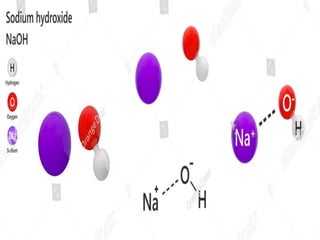
 It is a white solid ionic compound consisting of sodium
cations Na+ and hydroxide
 anions OH−.
 Sodium Hydroxide was discovered by Humphrey Day while
in England in the year
 1807.
 The event or experiment that was used for this discovery is
unknown. For quite a
 few years after its discovery it was considered an
elementary substance and was
 called a fixes alkali
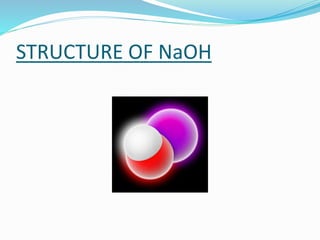
STRUCTURE OF NaOH
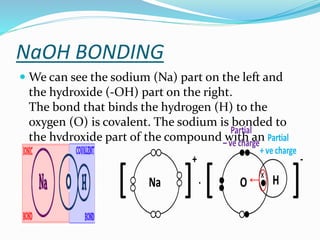
NaOH BONDING
 We can see the sodium (Na) part on the left and
the hydroxide (-OH) part on the right.
The bond that binds the hydrogen (H) to the
oxygen (O) is covalent. The sodium is bonded to
the hydroxide part of the compound with an
ionic bond.
USES
 Manufacture soaps
 Rayon
 Paper
 Explosives
 petroleum products
PHYSICAL PROPERTIES:
 Chemical formula:NaOH
 Molecular weight:40.01
 Synonyms:White caustic,
caustic soda, soda lye, lye
 Melting point:318. 4°C
 Boiling point:1390°C
 Specific gravity:2.13
 Solubility:
 Soluble in water, ethanol
and glycerol; insoluble in
acetone and ether
 General characteristics:
 White deliquescent solid
Raw Materials:
 NaCl (sodium hydroxide)
 H2O (water)
PRODUCTION OF NaOH
NaOH is produced by so many methods but some of the following methods are following:
➢ REVERSE OF NEUTRALIZATION
➢ CASTNER-KELLNER PROCESS
➢ NELSON CELL
REVERSE OF NEUTRALIZATION
NaCl +H2O →HCl + NaOH
Castner–Kellner process
➢PRINCIPLE
In castner-kellner method NaOH is prepared by the
electrolysis of aqueous solution of NaCl (Brine).
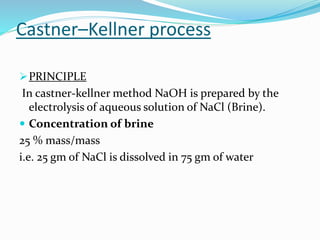
 Concentration of brine
25 % mass/mass
i.e. 25 gm of NaCl is dissolved in 75 gm of water
Castner-kellner cell
It is a rectangular tank of steel. Inside of tank is lined
with "ebonite“. Anode is made of titanium. Flowing
layer of mercury (Hg) at the bottom of tank serves as
cathode.
.
Details of process
 Ionization of NaCl
2NaCl → 2Na+ + 2Cl-
When electric current is passed through brine, +ve and
-ve ions migrate towards their respective electrodes.
Na+ions are discharged at mercury cathode. The
sodium deposited at mercury forms
SODIUM AMALGAM. Chlorine produced at the
anode is removed from the top of the cell.
Reaction at cathode
2Na+ +2 e- → 2Na
Na forms amalgam.Na + Hg è Na/Hg
Na+ ions are discharged in preference to H+ ions due to
high over voltage.
Reaction at anode
2Cl-→ Cl2 + 2e-
Formation of NaOH
Amalgam moves to another chamber called "denuder",
where it is treated with water to produce
NaOH which is in liquid state. Solid NaOH is
obtained by the evaporation of this solution.2Na/Hg +
2H2O → 2NaOH + H2 + 2Hg
PFD DIAGRAM
Advantages of castner's process
 NaOH obtained is highly pure.
 The process is very efficient
 Possible reaction between NaOH and Cl2 is avoided as
NaOH is obtained in a separated chamber.
Disadvantages
 High electricity consumption.
 Environmental pollution due to escape of Hg vapours.
NELSON CELL:
➢Principle:
Electrolyte used in this process is aqueous NaCl (Brine).
Working:
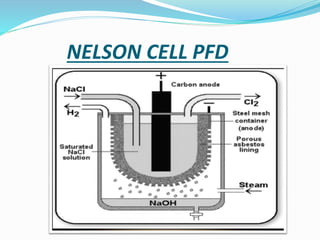
Porous diaphragm of asbestos or metal oxide with polymer
separates anode and cathode compartments. Diaphragm
prevents hydroxide ions entering anode compartment and
prevents chloride ions entering cathode compartment.
Reaction At Anode
 At the anode, carbon or titanium coated with Ru-Ti oxide, where
 the chlorine ion are oxidized.
 Saturated brine enters into the anode compartment and produces
 chlorine gas.
Cl-1→ Cl2 + 2e
Reaction At Cathode
 The saturated flows the diaphragm and into the cathode compartment.
 At the cathode, steel mesh, hydrogen gas and hydroxide are produced.
 2H2O + 2e → H2 +OH
 Na+ migrates across diaphragm to cathode compartment combining
with OH-to form NaOH
Overall cell reaction:
2H2O(l)+ 2Cl-(aq)+ 2Na+(aq)→2Na+(aq)+ 2OH-(aq)+ H2(g)+
Cl2(g)
 Sodium hydroxide NaOH(s)can be crystallized out.
NELSON CELL PFD
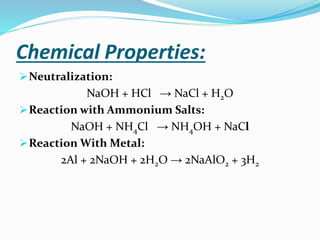
Chemical Properties:
➢Neutralization:
NaOH + HCl → NaCl + H2O
➢Reaction with Ammonium Salts:
NaOH + NH4Cl → NH4OH + NaCl
➢Reaction With Metal:
2Al + 2NaOH + 2H2O → 2NaAlO2 + 3H2
INDUSTRIES IN PAKISTAN
SITARA CHEMICALS
TUFAIL CHEMICALS
ICI PAKISTAN
PAK CHEMICALS
COSMO INTERNATIONALS
REFRENCES
 https://www.mustakbil.com/companies/pakistan/che
micals
 https://www.slideshare.net/yenwen/manufacture-of-
sodium-hydroxide
 https://www.slideshare.net/bejoybj/applicatiosn-of-
sodium-hydroxide-caustic-soda
 Google.com/images
‫شکریہ‬
Any Question…???
IF ANY QUESTION:
Contact:
Rao Shahriyar Ali;
03144517113
Moiz Ur Rehman;
03369269090
Bilal Jatt;
03083303302
Khaleel;
03030216945

Sodium hydroxide

  • 2.
  • 3.
    ➢Sodium Hydroxide isa very basic compound that is used mostly in the chemical industry. In this presentation, you will learn more about the uses, history and general facts aboutSodium Hydroxide.
  • 4.
     Sodium hydroxide,also known as lye and caustic soda, is an inorganic compound  with the formula NaOH.  It is a white solid ionic compound consisting of sodium cations Na+ and hydroxide  anions OH−.  Sodium Hydroxide was discovered by Humphrey Day while in England in the year  1807.  The event or experiment that was used for this discovery is unknown. For quite a  few years after its discovery it was considered an elementary substance and was  called a fixes alkali
  • 6.
  • 8.
    NaOH BONDING  Wecan see the sodium (Na) part on the left and the hydroxide (-OH) part on the right. The bond that binds the hydrogen (H) to the oxygen (O) is covalent. The sodium is bonded to the hydroxide part of the compound with an ionic bond.
  • 9.
    USES  Manufacture soaps Rayon  Paper  Explosives  petroleum products
  • 10.
    PHYSICAL PROPERTIES:  Chemicalformula:NaOH  Molecular weight:40.01  Synonyms:White caustic, caustic soda, soda lye, lye  Melting point:318. 4°C  Boiling point:1390°C  Specific gravity:2.13  Solubility:  Soluble in water, ethanol and glycerol; insoluble in acetone and ether  General characteristics:  White deliquescent solid
  • 11.
    Raw Materials:  NaCl(sodium hydroxide)  H2O (water)
  • 12.
    PRODUCTION OF NaOH NaOHis produced by so many methods but some of the following methods are following: ➢ REVERSE OF NEUTRALIZATION ➢ CASTNER-KELLNER PROCESS ➢ NELSON CELL REVERSE OF NEUTRALIZATION NaCl +H2O →HCl + NaOH
  • 13.
    Castner–Kellner process ➢PRINCIPLE In castner-kellnermethod NaOH is prepared by the electrolysis of aqueous solution of NaCl (Brine).  Concentration of brine 25 % mass/mass i.e. 25 gm of NaCl is dissolved in 75 gm of water
  • 14.
    Castner-kellner cell It isa rectangular tank of steel. Inside of tank is lined with "ebonite“. Anode is made of titanium. Flowing layer of mercury (Hg) at the bottom of tank serves as cathode.
  • 15.
  • 16.
    Details of process Ionization of NaCl 2NaCl → 2Na+ + 2Cl- When electric current is passed through brine, +ve and -ve ions migrate towards their respective electrodes. Na+ions are discharged at mercury cathode. The sodium deposited at mercury forms SODIUM AMALGAM. Chlorine produced at the anode is removed from the top of the cell.
  • 17.
    Reaction at cathode 2Na++2 e- → 2Na Na forms amalgam.Na + Hg è Na/Hg Na+ ions are discharged in preference to H+ ions due to high over voltage.
  • 18.
    Reaction at anode 2Cl-→Cl2 + 2e- Formation of NaOH Amalgam moves to another chamber called "denuder", where it is treated with water to produce NaOH which is in liquid state. Solid NaOH is obtained by the evaporation of this solution.2Na/Hg + 2H2O → 2NaOH + H2 + 2Hg
  • 19.
  • 20.
    Advantages of castner'sprocess  NaOH obtained is highly pure.  The process is very efficient  Possible reaction between NaOH and Cl2 is avoided as NaOH is obtained in a separated chamber.
  • 21.
    Disadvantages  High electricityconsumption.  Environmental pollution due to escape of Hg vapours.
  • 22.
    NELSON CELL: ➢Principle: Electrolyte usedin this process is aqueous NaCl (Brine). Working: Porous diaphragm of asbestos or metal oxide with polymer separates anode and cathode compartments. Diaphragm prevents hydroxide ions entering anode compartment and prevents chloride ions entering cathode compartment.
  • 23.
    Reaction At Anode At the anode, carbon or titanium coated with Ru-Ti oxide, where  the chlorine ion are oxidized.  Saturated brine enters into the anode compartment and produces  chlorine gas. Cl-1→ Cl2 + 2e Reaction At Cathode  The saturated flows the diaphragm and into the cathode compartment.  At the cathode, steel mesh, hydrogen gas and hydroxide are produced.  2H2O + 2e → H2 +OH  Na+ migrates across diaphragm to cathode compartment combining with OH-to form NaOH
  • 24.
    Overall cell reaction: 2H2O(l)+2Cl-(aq)+ 2Na+(aq)→2Na+(aq)+ 2OH-(aq)+ H2(g)+ Cl2(g)  Sodium hydroxide NaOH(s)can be crystallized out.
  • 25.
  • 26.
    Chemical Properties: ➢Neutralization: NaOH +HCl → NaCl + H2O ➢Reaction with Ammonium Salts: NaOH + NH4Cl → NH4OH + NaCl ➢Reaction With Metal: 2Al + 2NaOH + 2H2O → 2NaAlO2 + 3H2
  • 27.
    INDUSTRIES IN PAKISTAN SITARACHEMICALS TUFAIL CHEMICALS ICI PAKISTAN PAK CHEMICALS COSMO INTERNATIONALS
  • 28.
    REFRENCES  https://www.mustakbil.com/companies/pakistan/che micals  https://www.slideshare.net/yenwen/manufacture-of- sodium-hydroxide https://www.slideshare.net/bejoybj/applicatiosn-of- sodium-hydroxide-caustic-soda  Google.com/images
  • 29.
  • 30.
  • 31.
    IF ANY QUESTION: Contact: RaoShahriyar Ali; 03144517113 Moiz Ur Rehman; 03369269090 Bilal Jatt; 03083303302 Khaleel; 03030216945