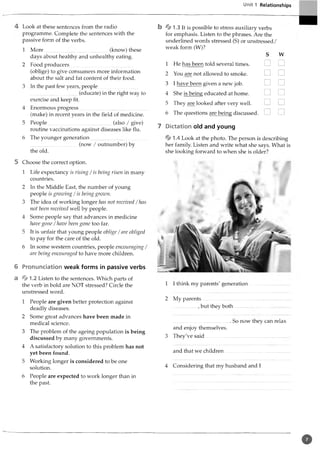
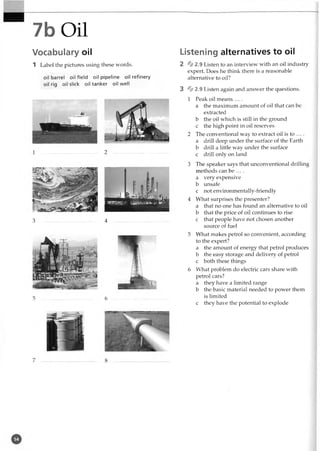
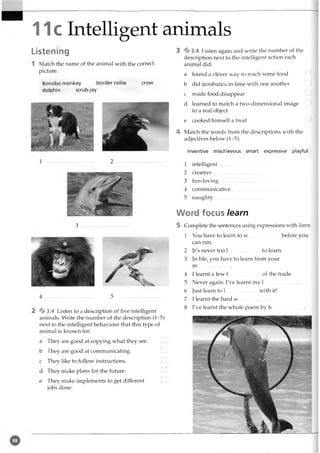
Contents
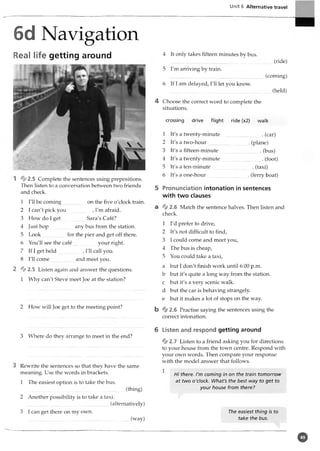
Unit 1 Relationships page 4
Unit 2 Storytelling page 12
Unit 3 Science and technology page 20
Unit 4 Art and creativity page 28
Unit5 Development page 36
Unit 6 Alternative travel page 44
Unit 7 Natural resources page 52
Unit 8 The news page 60
Unit 9 Talented people page 68
Unit 10 Customs and behaviour page 76
Unit 11 Knowledge and learning page 84
Unit 12 The economy page 92
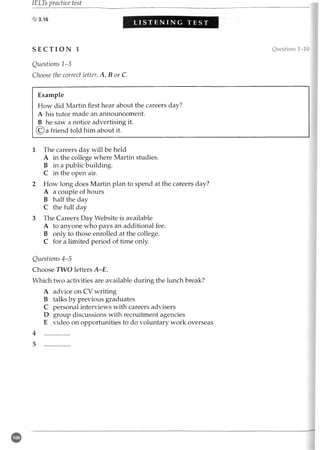
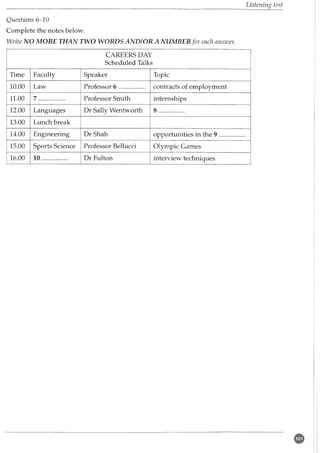
lELTs practice test page 100
Audioscripts page 114
Answer key page 133
Unit 1 Relationships
1a A tradition in decline?
Reading friendships
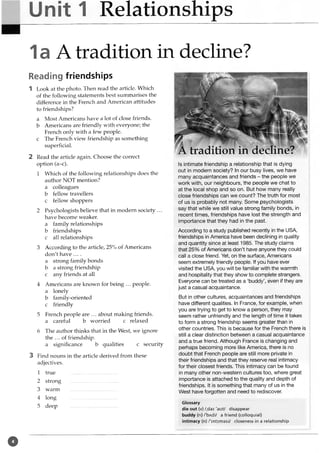
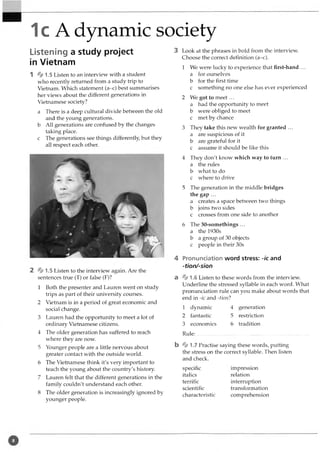
1 Look at the photo. Then read the article. Which
of the following statements best summarises the
difference in the French and American attitudes
to friendships?
a Most Americans have a lot of close friends,
b Americans are friendly with everyone; the
French only with a few people,
c The French view friendship as something
superficial.
2 Read the article again. Choose the correct
option (a-c).
1 Which of the following relationships does the
author NOT mention?
a colleagues
b fellow travellers
c fellow shoppers
2 Psychologists believe that in modern society ...
have become weaker.
a family relationships
b friendships
c all relationships
3 According to the article, 25% of Americans
don't have ....
a strong family bonds
b a strong friendship
c any friends at all
4 Americans are known for being ... people,
a lonely
b family-oriented
c friendly
5 French people are ... about making friends,
a careful b worried c relaxed
6 The author thinks that in the West, we ignore
the ... of friendship.
a significance b qualities c security
3 Find nouns in the article derived from these
adjectives.
1 true .............. ......................
2 strong ...... ......................._
......
3 warm .....................................
4 long .....................................
5 deep .....................................
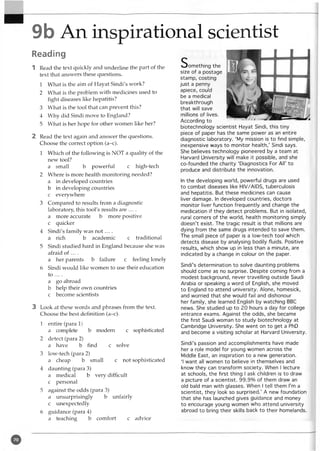
Is intimate friendship a relationship that is dying
out in modern society? In our busy lives, we have
many acquaintances and friends - the people we
work with, our neighbours, the people we chat to
at the local shop and so on. But how many really
close friendships can we count? The truth for most
of us is probably not many. Some psychologists
say that while we still value strong family bonds, in
recent times, friendships have lost the strength and
importance that they had in the past.
According to a study published recently in the USA,
friendships in America have been declining in quality
and quantity since at least 1985. The study claims
that 25% of Americans don’t have anyone they could
call a close friend. Yet, on the surface, Americans
seem extremely friendly people. If you have ever
visited the USA, you will be familiar with the warmth
and hospitality that they show to complete strangers.
Everyone can be treated as a ‘buddy’, even if they are
just a casual acquaintance.
But in other cultures, acquaintances and friendships
have different qualities. In France, for example, when
you are trying to get to know a person, they may
seem rather unfriendly and the length of time it takes
to form a strong friendship seems greater than in
other countries. This is because for the French there is
still a clear distinction between a casual acquaintance
and a true friend. Although France is changing and
perhaps becoming more like America, there is no
doubt that French people are still more private in
their friendships and that they reserve real intimacy
for their closest friends. This intimacy can be found
in many other non-western cultures too, where great
importance is attached to the quality and depth of
friendships. It is something that many of us in the
West have forgotten and need to rediscover.
Glossary
die out (v)/,dai'aut/ disappear
buddy (n) /'bAdi/ a friend (colloquial)
intimacy (n) /'intxmasi/ closeness in a relationship
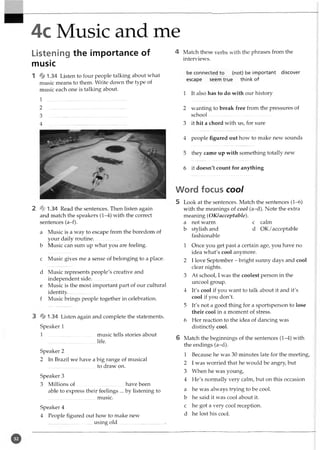
tradition in decline?
o
Grammar present tenses review
4 Look at the article. Find examples of the following.
1 two progressive changes (present continuous)
2 two everyday activities (present simple)
3 two recent events with an impact on the
present (present perfect simple)
4 one event that started in the past and continues
now (present perfect continuous)
5 Complete the questions from a survey on
friendship. Use present tenses.
1 What person or people.........................
.........................(you / spend) most time with
recently?
2 ..................................................(you / consider) this
person or people to be close friends?
3 How many really close friends
(you / have)?
4 Would you say your friendship circle
(increase) or not?
5 ....... .......................................... (you/make) any new
friends in the past month?
6 How long..................................................(you /
know) your closest friend?
7 How often ................................................ (you /
see) this person?
8 Generally, what qualities............... .
.........................(you / look for) in a friend?
Vocabulary friends: nouns
and phrasal verbs
6 Look at the article again. Find the adjectives that
collocate with these words. You may use the
adjectives more than once.
friendship
2 a ...................... bond
3 a ...................... f friend
4 a ...................... stranger
5 a ...................... acquaintance
7 Which word in each group does NOT collocate
with the single word next to it? Cross out
the word.
1 a mutualfriend/respect / student/ interest
2 a fellow student/ companion/scientist/ traveller
3 a close acquaintance/relationship /friend/relative
4 aflat /faithful/travel companion
5 a(n) odd/ happy/ blood couple
6 a(n)fair-weather/ old/ passing friend
8 Complete the sentences. Use the best collocation
from Exercises 6 and 7.
1 Travelling alone can have its advantages,
but I always prefer to have a
2 They are a very :
Kate is a highly-educated scientific researcher
and Dan is a professional footballer who left
school when he was fifteen.
3 Relationships where one person thinks
they are better than the other don't
work, but in this case they have a great
for each other.
4 Malcolm is probably my best friend. We were
at university.
5 I don't really consider Ann to be a
..................................................: she's the mother of
my brother-in-law's wife.
9 Complete the phrasal verbs. Choose the
correct option.
1 I used to hang out with/around John a lot at
college because we were both keen swimmers.
2 I'm meeting with / up with a group of colleagues
on Friday. Would you like to join us?
3 I don't get off / on very well with my new boss.
He's really difficult to work with.
4 Do you want to come across / round to my house
and watch the football? It starts at 8 p.m.
5 It's very important to stand by / with your
friends when they are in trouble.
6 Some people are very good at keeping up with /
on with their old friends. I've lost touch with
practically all the people I knew at college.
7 Jane and I were friends at school, but when we
met we just seemed to pick off/ up from where
we left off 20 years ago.
8 It's your 30th birthday next month. What kind
of celebration are you going for / after?
1b Young and old
Listening the ageing
population
1 .1 Listen to an extract from a radio programme
about the ageing population. Are the sentences
true (T) or false (F)?
1 People are not having so many children as in
the past.
2 People don't eat and exercise as healthily as in
the past.
3 Older people are not as much at risk from
deadly diseases as they were in the past.
4 The average age that anyone in the world can
expect to live to is now around 80.
5 In the future, the money to support the old will
come from the younger generation.
6 The ageing population will help bring families
closer together.
2 ^ 1 .1 Complete the sentences with nouns. Then
listen to the programme again and check.
Reasons for the ageing population
1 The birth.... .............................. has declined over
the last 20 years.
2 60 years ago, there was a baby............................;
these 'baby boomers' are now reaching
..................................... age-
3 Improved....................................: people eat more
healthily these days.
4 Healthier.....................................: not only do
people eat better, they are also more aware of
the need to keep fit.
5 Advances in medicine have increased life
..................................... to around 80 in the
developed world.
6 People are given routine
against life-threatening diseases, e.g. flu jabs
for the elderly.
Grammar the passive
3 Rewrite the sentences from the active to the
passive form.
1 Governments are forcing people to
work longer.
People........... ......... ......................................... to
work longer.
2 Governments have raised the age of retirement
in many countries.
The age of retirement
in many countries.
3 People don't consider someone to be old until
they are about 80.
Someone.............................................................. to be
old until they are about 80.
4 The government is encouraging each family to
have more children.
Each fam ily...............................................................to
have more children.
5 The government reduces taxes for families with
more than two children.
Taxes __ for
families with more than two children.
6 The public have not welcomed the idea of
working longer for less money.
The idea of working longer for less money
by the public.
o
Unit 1 Relationships
Look at these sentences from the radio
programme. Complete the sentences with the
passive form of the verbs.
1 M ore.....................................................(know) these
days about healthy and unhealthy eating.
2 Food producers.................................................
(oblige) to give consumers more information
about the salt and fat content of their food.
3 In the past few years, people
.....................................(educate) in the right way to
exercise and keep fit.
4 Enormous progress
(make) in recent years in the field of medicine.
5 People................................................... (also / give)
routine vaccinations against diseases like flu.
6 The younger generation
(now / outnumber) by
the old.
5 Choose the correct option.
1 Life expectancy is rising /is being risen in many
countries.
2 In the Middle East, the number of young
people is growing /is being grown.
3 The idea of working longer has not received /has
not been received well by people.
4 Some people say that advances in medicine
have gone /have been gone too far.
5 It is unfair that young people oblige / are obliged
to pay for the care of the old.
6 In some western countries, people encouraging /
are being encouraged to have more children.
6 Pronunciation weak forms in passive verbs
a % 1.2 Listen to the sentences. Which parts of
the verb in bold are NOT stressed? Circle the
unstressed word.
1 People are given better protection against
deadly diseases.
2 Some great advances have been made in
medical science.
3 The problem of the ageing population is being
discussed by many governments.
4 A satisfactory solution to this problem has not
yet been found.
5 Working longer is considered to be one
solution.
6 People are expected to work longer than in
the past.
b*1.3 It is possible to stress auxiliary verbs
for emphasis. Listen to the phrases. Are the
underlined words stressed (S) or unstressed/
weak form (W)?
W
1 He has been told several times.
2 You are not allowed to smoke.
3 I have been given a new job.
4 She is being educated at home.
5 They are looked after very well.
6 The questions are being discussed.
7 Dictation old and young
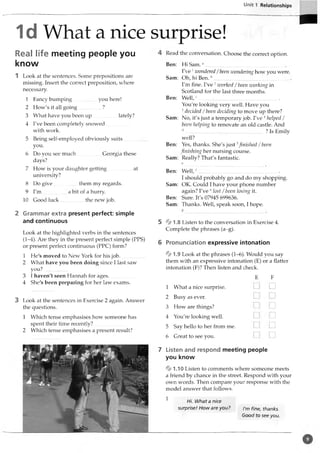
1.4Look at the photo. The person is describing
her family Listen and write what she says. What is
she looking forward to when she is older?
1 I think my parents' generation
2 My parents
.................. , but they both
and enjoy themselves.
3 They've said
. So now they can relax
and that we children
4 Considering that my husband and I
o
1c A dynamic society
Listening a study project
in Vietnam
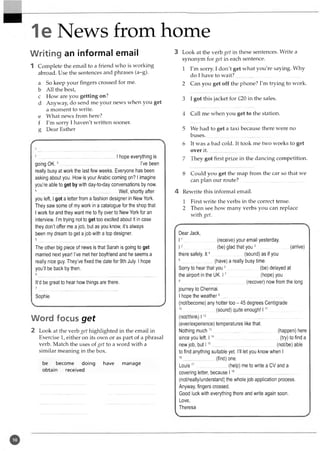
1 % 1.5Listen to an interview with a student
who recently returned from a study trip to
Vietnam. Which statement (a-c) best summarises
her views about the different generations in
Vietnamese society?
a There is a deep cultural divide between the old
and the young generations,
b All generations are confused by the changes
taking place,
c The generations see things differently, but they
all respect each other.
% 1.5 Listen to the interview again. Are the
sentences true (T) or false (F)?
1 Both the presenter and Lauren went on study
trips as part of their university courses.
2 Vietnam is in a period of great economic and
social change.
3 Lauren had the opportunity to meet a lot of
ordinary Vietnamese citizens.
4 The older generation has suffered to reach
where they are now.
5 Younger people are a little nervous about
greater contact with the outside world.
6 The Vietnamese think it's very important to
teach the young about the country's history.
7 Lauren felt that the different generations in the
family couldn't understand each other.
8 The older generation is increasingly ignored by
younger people.
3 Look at the phrases in bold from the interview.
Choose the correct definition (a-c).
1 We were lucky to experience that first-hand ...
a for ourselves
b for the first time
c something no one else has ever experienced
2 We got to meet ...
a had the opportunity to meet
b were obliged to meet
c met by chance
3 They take this new wealth for granted ...
a are suspicious of it
b are grateful for it
c assume it should be like this
4 They don't know which way to turn ...
a the rules
b what to do
c where to drive
5 The generation in the middle bridges
the gap ...
a creates a space between two things
b joins two sides
c crosses from one side to another
6 The 30-somethings ...
a the 1930s
b a group of 30 objects
c people in their 30s
4 Pronunciation word stress: -/c and
-tion/sion
a % 1.6 Listen to these words from the interview.
Underline the stressed syllable in each word. What
pronunciation rule can you make about words that
end in -ic and -tion?
1 dynamic
2 fantastic
3 economics
Rule:.................
4 generation
5 restriction
6 tradition
b % 1.7 Practise saying these words, putting
the stress on the correct syllable. Then listen
and check.
specific
italics
terrific
scientific
characteristic
impression
relation
interruption
transformation
comprehension
Unit 1 Relationships
1d What a nice surprise!
Real life meeting people you
know
1 Look at the sentences. Some prepositions are
missing. Insert the correct preposition, where
necessary.
1 Fancy bumping..................you here!
2 How's it all going ?
3 What have you been u p .................. lately?
4 I've been completely snow ed..................
with work.
5 Being self-employed obviously suits.................
you.
6 Do you see much Georgia these
days?
7 How is your daughter getting.................. at
university?
8 Do give them my regards.
9 I'm .................. a bit of a hurry
10 Good luck the new job.
2 Grammar extra present perfect: simple
and continuous
Look at the highlighted verbs in the sentences
(1-4). Are they in the present perfect simple (PPS)
or present perfect continuous (PPC) form?
1 He's moved to New York for his job.
2 What have you been doing since I last saw
you?..................
3 I haven't seen Hannah for ages...................
4 She's been preparing for her law exams.
3 Look at the sentences in Exercise 2 again. Answer
the questions.
1 Which tense emphasises how someone has
spent their time recently?.........................
2 Which tense emphasises a present result?
-L
= Read the conversation. Choose the correct option.
Ben: 1li Sam.a................................
I've 1wondered /been wondering how you were.
Sain: Oh, hi Ben. b............................ ......... .................
I'm fine. I'v e2worked /been working in
Scotland for the last three months.
Ben: W ell,c.............................................................. .
You're looking very well. Have you
3 decided /been deciding to move up there?
Sam: No, it's just a temporary job. I've 4helped /
been helping to renovate an old castle. And
d......................... ................. ........... ......? Is Emily
well?
Ben: Yes, thanks. She's ju st5finished /been
finishing her nursing course.
Sam: Really? That's fantastic.
e
Ben: W ell,f.............................................................. .
I should probably go and do my shopping.
Sam: OK. Could I have your phone number
again? I've 6lost /been losing it.
Ben: Sure. It's 07945 699636.
Sam: Thanks. Well, speak soon, I hope.
5 *1.8 Listen to the conversation in Exercise 4.
Complete the phrases (a-g).
6 Pronunciation expressive intonation
* 1 . 9 Look at the phrases (1-6). Would you say
them with an expressive intonation (E) or a flatter
intonation (F)? Then listen and check.
E F
1 What a nice surprise.
2 Busy as ever.
3 How are things?
4 You're looking well.
5 Say hello to her from me.
6 Great to see you.
7 Listen and respond meeting people
you know
% 1.10 Listen to comments where someone meets
a friend by chance in the street. Respond with your
own words. Then compare your response with the
model answer that follows.
^ Hi. What a nice
surprise! How are you? rm fjner thanks.
Good to see you.
1e News from home
Writing an informal email
1 Complete the email to a friend who is working
abroad. Use the sentences and phrases (a-g).
a So keep your fingers crossed for me.
b All the best,
c How are you getting on?
d Anyway, do send me your news when you get
a moment to write,
e What news from here?
f I'm sorry I haven't written sooner,
g Dear Esther
2....................................... ................. ........I hope everything is
going O K .3................................................................... -...I’ve been
really busy at work the last few weeks. Everyone has been
asking about you. How is your Arabic coming on? I imagine
you’re able to get by with day-to-day conversations by now.
4....................................................................... Well, shortly after
you left, I got a letter from a fashion designer in New York.
They saw some of my work in a catalogue for the shop that
I work for and they want me to fly over to New York for an
interview. I’m trying not to get too excited about it in case
they don’t offer me a job, but as you know, it’s always
been my dream to get a job with a top designer.
The other big piece of news is that Sarah is going to get
married next year! I’ve met her boyfriend and he seems a
really nice guy. They’ve fixed the date for 9th July. I hope
you’ll be back by then.
It’d be great to hear how things are there.
Sophie
Word focus get
2 Look at the verb get highlighted in the email in
Exercise 1, either on its own or as part of a phrasal
verb. Match the uses of get to a word with a
similar meaning in the box.
be become doing have manage
obtain received
3 Look at the verb get in these sentences. Write a
synonym for get in each sentence.
1 I'm sorry. I don't get what you're saying. Why
do I have to w ait?..................................................
2 Can you get off the phone? I'm trying to work.
3 I got this jacket for £20 in the sales.
4 Call me when you get to the station.
5 We had to get a taxi because there were no
buses...................................................
6 It was a bad cold. It took me two weeks to get
over it.
7 They got first prize in the dancing competition.
8 Could you get the map from the car so that we
can plan our route?..................................................
4 Rewrite this informal email.
1 First write the verbs in the correct tense.
2 Then see how many verbs you can replace
with get.
Dear Jack,
11..........
I2
.....................(receive) your email yesterday.
....................(be) glad that you 3.................................(arrive)
there safely. It4 ............................ (sound) as if you
5.............................(have) a really busy time.
Sorry to hear that you 6.............................(be) delayed at
the airport in the UK. 17.............................(hope) you
8..........................................................(recover) now from the long
journey to Chennai.
I hope the w eather9..........................................................
(not/become) any hotter too - 45 degrees Centigrade
10.............................(sound) quite enough! 111..............................
(not/think) 112..........................................................................................
(ever/experience) temperatures like that.
Nothing much 13..........................................................(happen) here
since you left. 114............................................................(try) to find a
new job, but 115..........................................................(not/be) able
to find anything suitable yet. I’ll let you know when I
16.............................(find) one.
L o u is17.............................(help) me to write a CV and a
covering letter, because 118..........................................................
(not/really/understand) the whole job application process.
Anyway, fingers crossed.
Good luck with everything there and write again soon.
Love,
Theresa
Unit 1 Relationships
Wordbuilding forming adjectives from nouns
1 Complete the table. Form adjectives from the nouns and verbs below.
care conservation control child decision depend difference dominate entrepreneur fool
help humour industry intellect self love play practice re-spe-c-t sense study
-ful -ish -ive -ious/-ous -ent/-ant -aI -ing
respectful foolish sensitive studious dependent entrepreneurial caring
2 Complete this interview about a family using
adjectives from Exercise 1.
Are you a close family?
Yes, we are. We all have our own lives and careers so we are ♦
n o t1................................... on each other, but we remain very
close.
Why do you think that is?
We were brought up in a very2................................... and loving
environment and taught to look after each other.
Is there a clear head of the family?
It’s quite a 3................................... and traditional family in many
ways. My father is certainly th e 4................................... figure - he
gives the orders.
And do you all share a particular family trait?
We’re all quite5................................... and down-to-earth people:
good with our hands
Is there someone in the family you admire especially?
My uncle, who’s a historian. He’s m ore6...................................
and quite a deep thinker, but he can also be very
1 He tells some very funny stories.
Has your family influenced your own path in life?
Yes. My father is an inventor and I think I have inherited his
8......... . spirit. I set up my own business when I was
22. He’s also very hard-working and we are9...................................
types too.
Learning skills extending
your vocabulary
3 You can extend your vocabulary by making word
families. Look at the word decide. How many
words can you think of that are related to it?
Complete the words and expressions.
• different parts of speech: decision (noun),
decisive (adjective),1.....................................
(adverb)
• collocations: make a decision,
2 ............................... a decision
• opposites: indecision, 3.....................................
• synonyms: make up your mind, come to a
4
4 Now write a word family for another word.
Choose two from the list.
fortune immigration influence obey
respect support
Check!
5 Do the quiz. Choose the correct option. All
answers appear in Student's Book Unit 1.
1 Orang-utans are unusual in that they like to ... .
a spend time with other animals
b share their food
c live independently
2 A fair-weather friend is someone who ....
a helps you in difficult situations
b makes a bad situation better
c is only a friend in good times
3 In which passive sentence is there NO agent?
a Bella has been raised in China.
b The right brands are selected by Bella,
c Her parents are confused by all the changes
taking place in China.
4 The adjective from the noun rebel is ... .
a rebelful b rebel Iient c rebellious
5 An expression for saying you are overloaded with
work is to be ... .
a snowed up
b snowed in
c snowed under
o
Unit 2 Storytelling
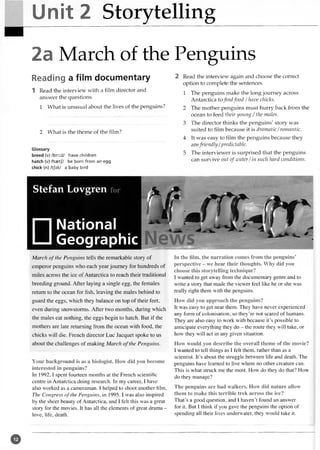
2a March of the Penguins
Reading a film documentary
1 Read the interview with a film director and
answer the questions.
1 What is unusual about the lives of the penguins?
2 What is the theme of the film?
Glossary
breed (v) /bri:d/ have children
hatch (v) /haetf/ be born from an egg
chick (n) /tjik/ a baby bird
2 Read the interview again and choose the correct
option to complete the sentences.
1 The penguins make the long journey across
Antarctica tofind food /have chicks.
2 The mother penguins must hurry back from the
ocean to feed their young / the males.
3 The director thinks the penguins' story was
suited to film because it is dramatic/romantic.
4 It was easy to film the penguins because they
arefriendly/predictable.
5 The interviewer is surprised that the penguins
can survive out of water/in such hard conditions.
Stefan Lovgren for
□National
Geographic
March o f the Penguins tells the remarkable story of
emperor penguins who each year journey for hundreds of
miles across the ice of Antarctica to reach their traditional
breeding ground. After laying a single egg, the females
return to the ocean for fish, leaving the males behind to
guard the eggs, which they balance on top of their feet,
even during snowstorms. After two months, during which
the males eat nothing, the eggs begin to hatch. But if the
mothers are late returning from the ocean with food, the
chicks will die. French director Luc Jacquet spoke to us
about the challenges of making March o f the Penguins.
Your background is as a biologist. How did you become
interested in penguins?
In 1992,1 spent fourteen months at the French scientific
centre in Antarctica doing research. In my career, I have
also worked as a cameraman. I helped to shoot another film.
The Congress o f the Penguins, in 1995. I was also inspired
by the sheer beauty of Antarctica, and I felt this was a great
story for the movies. It has all the elements of great drama -
love, life, death.
In the film, the narration comes from the penguins’
perspective - we hear their thoughts. Why did you
choose this storytelling technique?
I wanted to get away from the documentary genre and to
write a story that made the viewer feel like he or she was
really right there with the penguins.
How did you approach the penguins?
It was easy to get near them. They have never experienced
any form of colonisation, so they’re not scared of humans.
They are also easy to work with because it’s possible to
anticipate everything they do - the route they will take, or
how they will act in any given situation.
How would you describe the overall theme of the movie?
I wanted to tell things as I felt them, rather than as a
scientist. It’s about the struggle between life and death. The
penguins have learned to live where no other creature can.
This is what struck me the most. How do they do that? How
do they manage?
The penguins are bad walkers. How did nature allow
them to make this terrible trek across the ice?
That’s a good question, and I haven’t found an answer
for it. But I think if you gave the penguins the option of
spending all their lives underwater, they would take it.
V '
o
J Look at the interview again. Find words that mean:
1 to film .....................................
2 motivated.....................................
3 a type of film .....................................
4 to predict
5 made an impression o n .....................................
Grammar past simple and
present perfect
4 Look at the film-maker's answers in the interview.
Find examples of the following:
1 his experience in general (present perfect)
2 something he did at a specific time in the past
(past simple)
3 something the penguins did in the past
that has a present result (present perfect)
3 Complete the final part of the interview using
the verbs in the present perfect simple and past
simple forms.
Some would say you have to be crazy to spend more
than a year in such an inhospitable environment.
11................ .................. ...(met) many explorers
and adventurers in my life. Some of them
2....... .............................................(spend) their careers
climbing mountains, others like to cross the desert
or the sea. 13..................................... (always / feel)
comfortable in the polar environment. On this visit,
I 4..........................................(got) a particular sense of
adventure. Yes, 15.....................................(encounter)
a lot of difficulties. But once I had been there for
a while, my body 6......................................(adapt) to
the environment. Over time, 17....................................
(learn) to deal with the terrific wind, which in
some ways is worse than the cold temperatures.
Everyone who 8.....................................(visit) the
polar regions for any length of time will tell you
this. What you have to do is to learn to minimise
body movement. So 19....................................
(not / run) anywhere when I was there. I just
10..................................... (do) everything carefully
and slowly
Vocabulary books and films
6 Complete the review of March of the Penguins using
these words.
audience accurate cast director
gripping location sentimental scenes
storyline touching
Jacquet has made a
The 1.............................
visually stunning film. But some people may find
his approach to the penguins is too
2....................................., because he has romanticised
their story by giving them a human voice.
I found it more 3................................ than many
thrillers, and more 4.......................................than
many romantic films. And all without a
5.......................... of human actors.
Filmed on 6.....................................in
Antarctica, March of the Penguins paints an
7.....................................picture of how harsh life can
be for these creatures. Behind the basic
8........................................of the struggle for survival is
a message for the9....................................... about
modem family life. It contains some extraordinary
10............. ............................................., such as the males
protecting their eggs in a raging blizzard.
7 Pronunciation the letter I
# 1.11 Look at these words. Write S if you think
the letter T is silent. Then listen and check.
1 talk............ 6 installed
? silk............ 7 folk
3 bold 8 wild
4 could 9 calm
5 calf 10 film
8 Dictation describing books and films
* 1 .12 Listen to someone describing the book
A week at the Airport. Complete the sentences.
1 T he....................................Alain de Botton's
.............................................................. , A Week at the
Airport, is Heathrow airport.
2 The...................................................................................
that passes through the airport.
3 The................................................................................ ..
with travellers and airline staff.
4 ................is that if vou are
looking for somewhere that......................................
.........................................................................../you
don't need to look any further than an airport.
2b True stories
Listening the Aron Ralston story
1 ^ 1.13 Listen to adventurer Aron Ralston's
story, which was recently made into the film,
127 Hours. Which of these sentences summarises
what he did?
a When he became trapped, Ralston panicked,
b When he became trapped, Ralston thought
carefully about what to do next,
c When he became trapped, Ralston knew
immediately what he had to do.
Glossary
boulder (n) /'baulda(r)/ a large rock or stone
wedged (adj) /wedgd/ caught between two surfaces
e.g. two walls
multi-tool (n) /'mAltitu:1
/ a tool like a Swiss army knife
numb (adj) /nAm/ unable to feel anything
2 % 1.13 Listen again and choose the best option.
1 Ralston went to Bluejohn Canyon:
a to help prepare himself for a future
mountain climb,
b to do some mountain biking,
c to do a bit of camping.
2 His hand became trapped when:
a he stood on one of the boulders,
b he dropped down onto a boulder,
c he put his arm around a boulder.
3 Ralston's options were to:
a wait for help or free his hand,
b wait for help or cut off his hand,
c free his hand or cut off his hand.
4 The first thing he tried was:
a calling for help.
b freeing his hand with his multi-tool,
c chipping away part of his trapped hand.
5 After five days, Ralston finally:
a walked out of the canyon.
b was lifted out of the Canyon by some tourists,
c walked all the way out of the National Park.
3 Look at the verbs in bold. Match the verbs with the
correct definition.
1 He stretched to reach a secure foothold,
a extended his leg
b stepped
c bent his leg
2 The boulder slid down ...
a crashed
b slipped
c rolled
3 The boulder trapped his hand, crushing it.
a causing it pain
b destroying it with pressure
c cutting it
4 He tried to shift the boulder,
a move
b break
c get on top of
5 He chipped away at the rock,
a scratched
b rubbed
c broke little pieces off
6 Dripping blood, he made his way back,
a letting large amounts escape
b letting drops fall
c trying to stop the flow
Unit 2 Storytelling
Grammar past tenses review
4 Complete the story using the correct past tense
form of the verbs in brackets.
On April 25, 2003, Aron Ralston
1 .....................................(drive) to Moab, Utah,
where he mountain-biked the famous Slickrock
Trail. He then2.....................................(make) his
way to Horseshoe Canyon. When he
3................................ (arrive), night
4............................... (fall), so he made camp.
He 5................................. (climb)
into the canyon on April 26. He
6 . (go) about five miles when
he came to a section where a series of large
boulders 7.....................................(hang), wedged
between the walls of the canyon.
He 8 .............................. (not/tell) anyone
where he was. It would be days before
anyone realised that he was missing. Ralston
9 ......... (stand) on a small stone,
facing the boulder that10.....................................
(crush) his hand. The pain was intense, but he
was determined to stay in control...
Ralston 11.....................................(wait) there for
five days. But by the time the search teams
started out, he 12....................................................
(already/decide) what he had to do ...
5 Look at the sentences. If it got dark at 6.00 p.m.,
when did Ralston arrive in each case? Match the
sentences (1-3) with the times (a-c).
1 When he arrived at Horseshoe Canyon, night
fell..............
2 When he arrived at Horseshoe Canyon, night
was falling.............
3 When he arrived at Horseshoe Canyon, night
had fallen..............
a around 6.00 p.m.
b 6.00 p.m.
c 7.00 p.m.
6 Pronunciation contracted negative forms
.14 Listen and write down the missing word,
either an auxiliary verb or a contracted negative form.
1 I ............................................been there before.
2 You............allowed to smoke.
3 I t...............the first time this has happened.
4 She the person I told you about.
5 They...............as tired from the journey as
I expected.
6 I talking about what happened to me.
7 She been waiting a long time.
8 I .....................................spoken French for years.
7 Grammar extra present tenses for narratives
a Read this short review of the film 127 Hours,
the Aron Ralston story. What tenses are used
to describe the plot of the film?
Film title: 127 Hours
Rating 8.5
Director: Danny Boyle (Slumdog Millionaire,
Trainspotting)
Actors: James Franco, Kate Mara, Amber Tamblyn
Genre: Action film
Release date: November 2010
Synopsis: Aron Ralston, a 27-year-old hiker, is
canyoneering in Utah’s remote Bluejohn Canyon.
An 800-pound boulder falls and traps his hand,
making it impossible for him to move. He hasn’t
told anyone where he is going. Based on a
true story.
► GRAMMAR EXTRA present tenses for narratives
We use present tenses to describe the plot of a book or a
film and to review them.
In the film ‘127 Hours' Aron Ralston is canyoneering in
Utah's remote Bluejohn Canyon.
An 800-pound boulder falls and traps his hand.
He hasn't told anyone where he is going.
This use of the present tense is sometimes referred to as
'the present historic'.
b Look at the grammar box. Then complete
the synopsis of a book using the verbs in the
correct tense.
Book title: To the Ends of the Earth
Author: Ranulph Fiennes
Genres: Autobiography; travel; adventure
Synopsis: The mountaineer and explorer Ranulph
Fiennes 1 .................................. (give) a personal
and gripping account of an expedition around
the world from top to bottom. The adventures
really 2 (begin) once the
group 3..................................... (reach) Antarctica
and tensions 4 (grow)
between the friends, while all the time conditions
5...................................(get) worse.
o
2c Children's stories
Listening the stories of
Oscar Wilde
1 * 1.15 Listen to a review of a collection of short
stories by Oscar Wilde. Are the sentences true (T)
or false (F)?
1 The stories were written for children.
2 The stories were published recently.
3 All the stories reveal something about human
behaviour.
4 In the story of the Happy Prince, the statue of
the prince can think, feel and speak.
5 The Happy Prince wants to help the little bird.
6 The Happy Prince has a happy ending.
Glossary
ostensibly (adv) /cst'ensibli/ apparently
swallow (n) /'swolao/ a kind of bird that migrates
eyesore (n) /'aiS3:(r)/ something unpleasant to look at
2 * 1.16 Complete the sentences. Then listen again to
the first part of the review and check your answers.
1 The stories are suitable fo r...............................and
2 They contain elements that you would find in a
traditional.................................
3 At the heart of what makes them beautiful is
their.................................
4 People who read the stories are
by them.
5 Oscar Wilde did not like to give
3 * 1.17 Read the summary of the story of
The Happy Prince. Then listen again to the
second part of the review and choose the
correct option.
The Happy Prince is 1an elegant / a shabby statue
in the centre of an old town in northern Europe.
Each day the prince 2proudly ignores /watches
closely what is happening in the town. One day,
3he stops a little swallow /a little szvallozv stops off
with him on its way to Egypt for the winter. The
prince 4asks /orders him to take the gold and
jewels from his statue to poor 5people /children
around the town. The swallow continues doing
this for some 6days /weeks. In the end, the
swallow 7is exhausted /catches cold and dies at the
foot of the statue. When the town councillors see
the statue without its gold and jewels, they decide
to 8destroy /renovate it.
Word focus keep
4 Look at the phrases with keep from the story of
The Happy Prince. Match the phrases (1^4) with the
correct meaning (a-d).
1 I still had to keep back the tears.
2 Oscar Wilde kept from giving moral lessons.
3 From where he stands, he can keep abreast of
all that is happening in the town.
4 The swallow stays for some days keeping the
prince company.
a spend time with
b prevent (someone) from doing something
c hold in and not release something
d stay in touch or up-to-date with
5 Complete the sentences using these phrases. You
will need to use the correct form. There are two
extra phrases.
keep abreast of keep an eye on keep track of
keep (someone) company keep (someone) from
keep back keep a secret keep a promise
1 Thanks for your help and sorry if I
your work.
2 Those flowers are a thank you present from
Sarah. I .............................................................. her
flat while she was away.
3 People visit my grandfather at the weekend,
but during the week there is no one to
4 My brother is travelling around the world
and he sends me emails so I can
his progress.
5 Apart from a small amount of money that
she.............................................................. for
emergencies, she spent everything she had saved.
6 It's not fair to ask someone to .............................
..............................if they know telling it will
help someone they know.
O S C A R W I L D E ’ S
T H E
H A P P Y "
P R I N C E
Unit 2 Storytelling
2d I can sympathise
Real life reacting to stories
1 Look at these situations where things have gone
wrong. Complete the sentences using the correct
form of the verb.
1 My trousers got caught on a nail and
(tear).
2 The key.....................................(break) in the lock
as I was turning it.
3 The boy put his head through the railings and
it got ....................................(stick).
4 He had ................................... (make) a big hole in
his jumper.
5 The pipe.....................................(freeze) because it
was so cold.
6 When it warmed up again, the pipe
(burst).
2 Underline the words or phrases that can begin
each reaction. Sometimes more than one answer is
possible. Then match the reactions to the situations
in Exercise 1.
a How /What a /That was nightmare!
b How /What a /That was good thinking,
c How / What a /That was embarrassing,
d How /What a /That was lucky,
e How / Poor /What a stroke of luck,
f How /Poor /What strange,
g How /Poor /What you!
h How /What /That must have been a relief,
i How /What /That must have been awkward,
j Hoiv /What /That must have been a disaster.
3 %1.18 Listen to two friends talking about a travel
story. Answer the questions.
1 What was the problem?
2 How did they resolve the problem?
3 How did the speaker feel by the end of their
ordeal?
4 #1.18 Listen again. Complete the reactions (1-6).
Use phrases a-f.
a How stressful!
b Oh, that's awful.
c I think I would have done the same thing,
d Oh no. Poor you.
e I can sympathise,
f That was a stroke of luck.
1 ............What happened?
2 ........... So did you leave her behind?
3 ............And where were you?
4 Did they make it in time?
5 .......... I hate being late when I'm travelling.
6 Did you? I don't blame you.........
5 Pronunciation linking and assimilation
a % 1.19 The following phrases are either linked
(1-4) or assimilated (the last letter of the first word
is absorbed into the opening consonant of the
second word). Listen and repeat.
1 large area 5 a burst pipe
2 immediate action 6 Great Britain
3 open air 7 hand baggage
4 cry out 8 bus shelter
b %1.2
0Now say these expressions. Then listen
and check.
1 thick undergrowth 5 pocket money
2 West Africa 6 credit card
3 dead end 7 nice shoes
4 climb up 8 first class
6 Listen and respond reacting to stories
% 1
.2
1 Listen to five people telling you news.
Respond with your own words. Then compare
your response with the model answer that follows.
1
You'll never guess what happened to me
yesterday on the bus. I started talking to this
woman who I thought was Sue, my next-door
neighbour, about my problems at work. But it
wasn't Sue, it was a complete stranger!
How embarrassing! When did you realise
it wasn't Sue?
•'"V;
2e 'Don't move!'
1 Writing skill using descriptive words
a Read this extract from a story and underline all
the verbs and expressions that describe how
people speak.
'Don't move,' she whispered, 'I think I can see
an animal in the bushes/ 'I know,' Dominic
replied anxiously. 'I can hear it too.' They
stayed where they were, waiting to see what
would appear from the bushes. Dominic, who
was clearly very frightened, moaned quietly.
'Be quiet,' muttered Cat, 'or you'll attract its
attention.' Just then, the branches parted and a
tall man in white clothes stepped out into the
clearing. 'Hello there!' he cried.
b Match the descriptive verbs (1-7) with the
phrases (a-g).
1 he cried a she said wearily
2 she moaned b she said complainingly
3 she whispered c he said loudly
4 he screamed d he shouted at the top of
5 he muttered his voice
6 she sighed e he said under his breath
7 she mumbled f she said, not enunciating
her words
S she said softly
2 Writing skill extra punctuation
a Look at the sentences (1-4). Are the statements
(a-d) true (T) or false (F)?
1 He said, 'What a surprise!'
2 'I know,' she said, 'that you don't like eating
spicy food.'
3 'Do you agree?' he asked.
4 'I don't agree,' he said.
a You must put quotation marks at the beginning
and end of each direct quotation,
b Question marks and exclamation marks
belonging to the quotation must be inside the
quotation marks,
c You always need a comma to separate the verb
of saying from the direct quotation.
d If you break a sentence of a direct quotation
and insert a verb of saying, you must put a
comma after the verb and before the next set of
quotation marks.
b Punctuate the following extract from a story
with quotation marks and commas where
necessary.
I don't think this is going to work
Christopher sighed. We've been trying to
build this canoe for three days and it still
looks like a lump of wood. The wood's too
hard he added. Actually, Christopher said Jen
encouragingly we are making some progress.
What we really need to do is find some better
tools. Just then Tom screamed I've got it!
Instead of using our penknives directly on
the wood, why don't we make some better
tools using our knives?
Writing a story
3 Write the opening paragraph of a story about two
friends' encounter with a fierce animal. Follow
these instructions:
• Begin with the most dramatic point in the
narrative.
• Use descriptive verbs of speaking and moving.
• Use some direct speech. Make sure you
punctuate it correctly.
o
Unit 2 Storytelling
Wordbuilding synonyms
1 Make pairs of close synonyms from the following
words.
an author an audience a blockbuster
a cinema to edit a film a hero
to publish a remake a sequel
Q a best-seller to cut a follow-up a heroine
a movie a multiplex a novelist
a re-release viewers to release
2 Match w7
ords from Exercise 1 with the definitions.
1 a wT
riter of stories
2 a leading female character
3 people wTio watch TV
4 a very successful book
5 to distribute a film for public viewing
6 to remove a scene from a film
7 a book or film that is the next part of the story
8 a cinema with many screens
9 a film which is distributed for a second time
10 an American word for a film
3 Look at these synonyms to do with speaking and
movement. Choose the correct definition (a or b)
for each.
1 We trudged for miles and miles in the baking
heat...................
2 We stumbled through the thick undergrowth,
desperate to find a path.
a walk almost falling forward
b walk wearily
3 He muttered something about it not being fair.
Learning skills pronunciation
4 Without good pronunciation, people can't
understand you. Read these tips to help improve
your pronunciation.
1 Don't speak too fast. It's better to be slow and
clear than fast and misunderstood.
2 Practise saying phrases and short sentences
rather than individual sounds. Listen to native
speech and try to imitate the sounds you hear.
3 Record yourself and compare your
pronunciation with a native speaker's.
4 Listen to songs in English and imitate exactly
what you hear.
5 Practise your pronunciation every day. Choose
phrases and texts you have learnt in the unit.
5 Look at these phrases from Unit 2. Follow7steps 1-3
in Exercise 4 to practise pronouncing them.
a What a nightmare!
b That must have been a relief,
c I can sympathise with that.
6 Write a mini presentation on a topic of interest to
you. Read it aloud and record yourself. Analyse
your pronunciation and note your mistakes.
Check!
7 Do the quiz. All the answers are in Student's
Book Unit 2.
4 Try not to mumble. It's very difficult to hear
what you're saying...................
a speak indistinctly because you don't want
to be heard
b speak indistinctly
5 She edged towards the door and turned the
handle slowly...................
6 She walked back slowly to the window7and
looked out. .................
a move slowly
b move slowly and carefully
Q What kind of film or book are these?
a Senna....... ..............
b The Frog Prince.......................
c The Lord the Rings
Q What were these people’s jobs?
a Peter Jackson_____________ ___
b Wilhelm Grimm.................................
c Steve Winter...................................
@ What are these three English idioms?
a a narrow escape = a close.......................
b a lucky chance = a .......................of luck
c to get a little exercise = to ......................
your legs
Unit 3 Science and technology
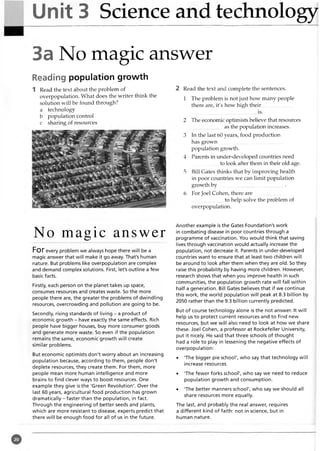
3a No magic answer
Reading population growth
1 Read the text about the problem of
overpopulation. What does the writer think the
solution will be found through?
a technology
b population control
c sharing of resources
2 Read the text and complete the sentences.
1 The problem is not just how many people
there are, it's how high their.........................
................................................... is.
2 The economic optimists believe that resources
as the population increases.
3 In the last 60 years, food production
has grow n...................................................
population growth.
4 Parents in under-developed countries need
to look after them in their old age.
5 Bill Gates thinks that by improving health
in poor countries we can limit population
growth b y ................................................... .
6 For Joel Cohen, there are..................... ...
to help solve the problem of
overpopulation.
No magic answer
Forevery problem we always hope there will be a
magic answer that will make it go away. That's human
nature. But problems like overpopulation are complex
and demand complex solutions. First, let's outline a few
basic facts.
Firstly, each person on the planet takes up space,
consumes resources and creates waste. So the more
people there are, the greater the problems of dwindling
resources, overcrowding and pollution are going to be.
Secondly, rising standards of living - a product of
economic growth - have exactly the same effects. Rich
people have bigger houses, buy more consumer goods
and generate more waste. So even if the population
remains the same, economic growth will create
similar problems.
But economic optimists don't worry about an increasing
population because, according to them, people don't
deplete resources, they create them. For them, more
people mean more human intelligence and more
brains to find clever ways to boost resources. One
example they give is the 'Green Revolution'. Over the
last 60 years, agricultural food production has grown
dramatically - faster than the population, in fact.
Through the engineering of better seeds and plants,
which are more resistant to disease, experts predict that
there will be enough food for all of us in the future.
Another example is the Gates Foundation's work
in combating disease in poor countries through a
programme of vaccination. You would think that saving
lives through vaccination would actually increase the
population, not decrease it. Parents in under-developed
countries want to ensure that at least two children will
be around to look after them when they are old. So they
raise this probability by having more children. However,
research shows that when you improve health in such
communities, the population growth rate will fall within
half a generation. Bill Gates believes that if we continue
this work, the world population will peak at 8.3 billion by
2050 rather than the 9.3 billion currently predicted.
But of course technology alone is the not answer. It will
help us to protect current resources and to find new
resources, but we will also need to look at how we share
these. Joel Cohen, a professor at Rockefeller University,
put it nicely. He said that three schools of thought
had a role to play in lessening the negative effects of
overpopulation:
• 'The bigger pie school', who say that technology will
increase resources.
• 'The fewer forks school', who say we need to reduce
population growth and consumption.
• 'The better manners school', who say we should all
share resources more equally.
The last, and probably the real answer, requires
a different kind of faith: not in science, but in
human nature.
Vocabulary verbs describing
trends
3 Find verbs in the passage that describe things
getting greater or smaller.
Greater Smaller
1 r ....................... 7 d ........................
2 b ....................... 8 d ........................
3 g ......................... 9 d .........................
4 i ....................... 10 f ........................
5 r ....................... 11 1........................
6 p ....................... 12 r
4 Complete the sentences using an appropriate verb
from Exercise 3. There is more than one possible
answer for some of the sentences.
1 The author thinks that one way or another,
we need to .....................................the amount of
resources we use.
2 The world's population is expected to continue
to .....................................until around 2050.
3 After that it will probably begin to
4 The economic optimists believe that whatever
problems overpopulation causes, we will find
a technological solution to .....................................
their impact.
5 One way to .....................................the chance
of having more children who will survive is
simply to have more children in the first place.
6 Another way is to .....................................
the amount of money invested in health
programmes in poor countries.
Grammar future forms review
5 Read these comments about the views expressed
in the article. Choose the correct option.
1 'Bill Gates argues that if you improve health,
people will have /are having fewer children. But
what he doesn't say is that the result will be /is
about to be more and more old people.'
2 'If we will rely /are going to rely on new
technology to solve this problem, then heaven
help us. New technology creates as many
problems as it solves.'
3 'I'll tell /I'm going to tell you something - 1
will be /I'm going to be very surprised if the
population growth rate won’t start /doesn't start
to fall in the next 20 years.'
4 'I'm from what the article calls "the better
manners school". There are enough resources
for everyone, but we won't solve/don't solve
the problem until we zvill share /share them
more equally.'
5 'I'm suspicious of people like Bill Gates. He
made a fortune out of business and now he
will save / is going to save the world.'
6 'Actually, I'll go / 1'm going to hear Bill Gates
speak at a climate change conference this week.
It will begin / begins on Friday.'
6 Read the conversation about plans to attend a
conference. Complete the sentences using the
appropriate future form of the verbs.
Phil: Hi, Anna.1..................................................
(you / go) to the 'Future Foods Fair' next
weekend?
Anna: Yes, 1am. How 2..................................................
(you / get) there?
Phil: 13..................................................(probably /
drive). What about you?
Anna: I haven't decided.Perhaps I
4................................(go) by train.
Phil: Don't do that - it's so expensive.
15.................................................(give) you a lift.
Anna: That would begreat. What time
6............................. (you / leave)?
Phil: Well, the conference
7............................... (start) at 10,
so I thought about 8.30.
Anna: That sounds perfect. Do you imagine it
8.................................................... (finish) by 6?
Phil: I hope so. I need to be back by 7.30.
7 Pronunciation /r/ and /1/ in American
English
% 1.22 Listen to an American speaking about
Bill Gates and other philanthropists. Complete
the text.
There's a group of philanthropists in the US - Gates,
Buffet, Rockefeller,1.........................................- who
have 2 a 3
of money to good causes over the last
The problem for them is that, because they're
so rich and 6 , people get
suspicious of their 7...................................... So when
they 8.....................................up, they often do so
9 , like they did a few years ago
in 1
0
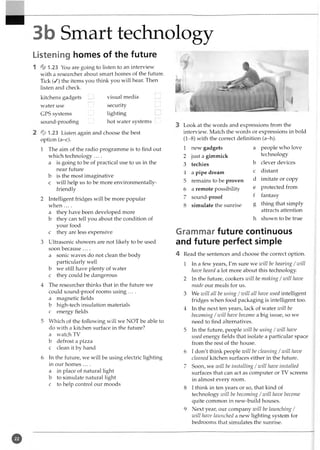
3b Smart technology
Listening homes of the future
1 41 .23 You are going to listen to an interview
with a researcher about smart homes of the future.
Tick (/) the items you think you will hear. Then
listen and check.
kitchens gadgets
water use
GPS systems
sound-proofing
visual media
security
lighting
hot water systems
% 1.23 Listen again and choose the best
option (a-c).
1 The aim of the radio programme is to find out
which technology ....
a is going to be of practical use to us in the
near future
b is the most imaginative
c will help us to be more environmentally-
friendly
2 Intelligent fridges will be more popular
when ....
a they have been developed more
b they can tell you about the condition of
your food
c they are less expensive
3 Ultrasonic showers are not likely to be used
soon because ....
a sonic waves do not clean the body
particularly well
b we still have plenty of water
c they could be dangerous
4 The researcher thinks that in the future we
could sound-proof rooms using ....
a magnetic fields
b high-tech insulation materials
c energy fields
5 Which of the following will we NOT be able to
do with a kitchen surface in the future?
a watch TV
b defrost a pizza
c clean it by hand
6 In the future, we will be using electric lighting
in our homes ....
a in place of natural light
b to simulate natural light
c to help control our moods
Look at the words and expressions from the
interview. Match the words or expressions in bold
(1-8) with the correct definition (a-h).
1 new gadgets a people who love
2 just a gimmick technology
3 techies b clever devices
4 a pipe dream c distant
5 remains to be proven d imitate or copy
6 a remote possibility e protected from
7 sound-proof f fantasy
8 simulate the sunrise g thing that simply
attracts attention
h shown to be true
Grammar future continuous
and future perfect simple
4 Read the sentences and choose the correct option.
1 In a few years, I'm sure we will be hearing /will
have heard a lot more about this technology.
2 In the future, cookers will be making /will have
made our meals for us.
3 We zvill all be using /will all have used intelligent
fridges when food packaging is intelligent too.
4 In the next ten years, lack of water zvill be
becoming /will have become a big issue, so we
need to find alternatives.
5 In the future, people will be using / will have
used energy fields that isolate a particular space
from the rest of the house.
6 I don't think people will be cleaning /zvill have
cleaned kitchen surfaces either in the future.
7 Soon, we zvill be installing /zvill have installed
surfaces that can act as computer or TV screens
in almost every room.
8 I think in ten years or so, that kind of
technology zvill be becoming /will have become
quite common in new-build houses.
9 Next year, our company zvill be launching /
will have launched a new lighting system for
bedrooms that simulates the sunrise.
Unit 3 Science and technology
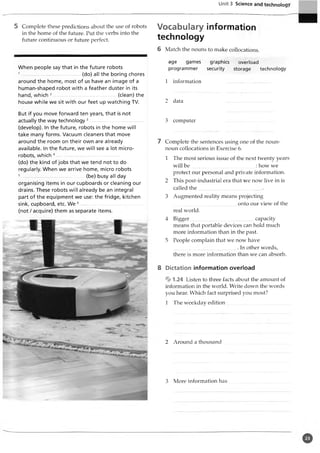
5 Complete these predictions about the use of robots
in the home of the future. Put the verbs into the
future continuous or future perfect.
When people say that in the future robots
1 .....................................(do) all the boring chores
around the home, most of us have an image of a
human-shaped robot with a feather duster in its
hand, which 2...............................................(clean) the
house while we sit with our feet up watching TV.
But if you move forward ten years, that is not
actually the way technology3........................................
(develop). In the future, robots in the home will
take many forms. Vacuum cleaners that move
around the room on their own are already
available. In the future, we will see a lot micro­
robots, which 4...............................................
(do) the kind of jobs that we tend not to do
regularly. When we arrive home, micro robots
5............................................. (be) busy all day
organising items in our cupboards or cleaning our
drains. These robots will already be an integral
part of the equipment we use: the fridge, kitchen
sink, cupboard, etc. We 6 ............................................
(not / acquire) them as separate items.
Vocabulary information
technology
6 Match the nouns to make collocations.
age games graphics overload
programmer security storage technology
1 information .....................................
2 data
3 computer
7 Complete the sentences using one of the noun­
noun collocations in Exercise 6.
1 The most serious issue of the next twenty years
will b e ................................................. : how we
protect our personal and private information.
2 This post-industrial era that we now live in is
called the______ _
________________ .
3 Augmented reality means projecting
.............................................onto our view of the
real world.
4 Bigger..................................................capacity
means that portable devices can hold much
more information than in the past.
5 People complain that we now have
............ ..................................... In other words,
there is more information than we can absorb.
8 Dictation information overload
% 1.24 Listen to three facts about the amount of
information in the world. Write down the words
you hear. Which fact surprised you most?
I The weekday edition
2 Around a thousand
3 More information has
3c The simplest ideas are
the best
Listening lifestraw
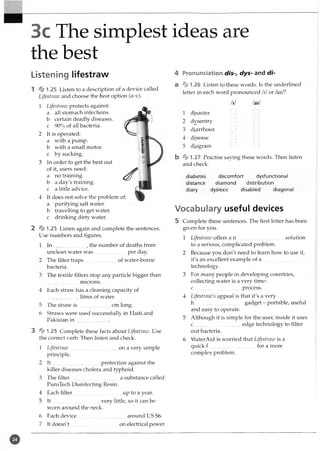
1 * 1.25 Listen to a description of a device called
Lifestraw and choose the best option (a-c).
1 Lifestraw protects against:
a all stomach infections,
b certain deadly diseases,
c 90% of all bacteria.
2 It is operated:
a with a pump,
b with a small motor,
c by sucking.
3 In order to get the best out
of it, users need:
a no training,
b a day's training,
c a little advice.
4 It does not solve the problem of:
a purifying salt water.
b travelling to get water,
c drinking dirty water.
2 *1.25 Listen again and complete the sentences.
Use numbers and figures.
In ........................., the number of deaths from
unclean water was per day.
The filter traps.........................of water-borne
bacteria.
The textile filters stop any particle bigger than
microns.
1
4 Each straw has a cleaning capacity of
litres of water.
5 The straw is ...... _
.................cm long.
6 Straws were used successfully in Haiti and
Pakistan in ........................
3 * 1 .2 5 Complete these facts about Lifestraw. Use
the correct verb. Then listen and check.
1 Lifestraw....................................... on a very simple
principle.
2 It.............................................. protection against the
killer diseases cholera and typhoid.
3 The filter.................................... a substance called
PuroTech Disinfecting Resin.
4 Each filter.....................................up to a year.
5 It......................................very little, so it can be
worn around the neck.
6 Each device................................... around US $6.
7 It doesn't .............................on electrical power.
Pronunciation dis-, dys- and di-
* 1.26 Listen to these words. Is the underlined
letter in each word pronounced /i/or /ai/?
Ill /ai/
disaster
dysentry
diarrhoea
disease
diagram
b *1.27 Practise saying these words. Then listen
and check.
diabetes discomfort dysfunctional
distance diamond distribution
diary dyslexic disabled diagonal
Vocabulary useful devices
5 Complete these sentences. The first letter has been
given for you.
1 Lifestrazv offers a n solution
to a serious, complicated problem.
2 Because you don't need to learn how to use it,
it's an excellent example of a .....................................
technology.
3 For many people in developing countries,
collecting water is a very time-
c..................................... process.
4 Lifestraw's appeal is that it's a very
h..................................... gadget - portable, useful
and easy to operate.
5 Although it is simple for the user, inside it uses
c....................... ............. edge technology to filter
out bacteria.
6 WaterAid is worried that Lifestraw is a
quick f.....................................for a more
complex problem.
Unit 3 Science and technology
3d Computers
Vocabulary computing
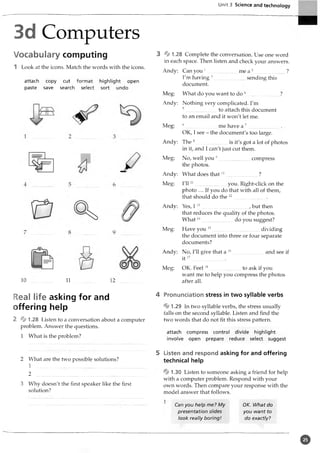
1 Look at the icons. Match the words with the icons.
attach copy cut format highlight open
paste save search select sort undo
^g=
3 % 1.28 Complete the conversation. Use one word
in each space. Then listen and check your answers.
Andy: Can you 1
I'm having 3........................
document.
Meg: What do you want to do
.me a 2........................?
sending this
Andy: Nothing very complicated. I'm
5...........................to attach this document
to an email and it won't let me.
Meg: 6....................................................me have a 7
OK, I see - the document's too large.
Andy: The 8........................................................................_
.......is it's got
in it, and I can't just cut them.
Meg: No, well you 9....................... compress
the photos.
Andy: What does that10........................ ?
Meg: I'll11.............................. you. Right-click on the
photo ... If you do that with all of them,
that should do the 1
2
Andy: Yes, 1 13..... ................................, but then
that reduces the quality of the photos.
W hat14........................ do you suggest?
Have you 15.....................................dividing
the document into three or four separate
documents?
Meg:
10 11 12
Andy: No, I'll give that a 16........................and see if
i t 17........................ .
Meg: OK. Feel1
8 to ask if you
want me to help you compress the photos
after all.
Real life asking for and
offering help
2 % 1.28 Listen to a conversation about a computer
problem. Answer the questions.
1 What is the problem?
2 What are the two possible solutions?
1
2
3 Why doesn't the first speaker like the first
solution?
4 Pronunciation stress in two syllable verbs
% 1.29 In two syllable verbs, the stress usually
falls on the second syllable. Listen and find the
two words that do not fit this stress pattern.
attach compress control divide highlight
involve open prepare reduce select suggest
5 Listen and respond asking for and offering
technical help
% 1.30 Listen to someone asking a friend for help
with a computer problem. Respond with your
own words. Then compare your response with the
model answer that follows.
1
Can you help me? My OK. What do
presentation slides you want to
look really boring! do exactly?
©
3e a technical problem
1 Writing skill being polite
Rewrite the sentences so that they are more polite.
Use the bold words.
1 Is it OK if I bring your memory stick back on
my way home from work tonight?
please __..........................................................................
2 Where can I find a battery charger for my old
phone?
happen..........................................................................
3 I want you to send a brochure for your air
conditioning units.
could ................................ .....................................
4 What is the phone number for Apricot
Computers? I can't find it anywhere,
know
5 I want to know how to download photos from
my X306 camera,
advise
6 What about reducing the price?
able.....................................................
7 I need you to come over and fix my internet
connection,
mind
What number should I call to get technical
advice?
tell ........................................................................
Word focus out o f
2 Complete the phrases with out o f in these answers
using the words below.
business date depth interest
luck order question way
a Sorry, I'm a bit out of m y......................................
there. I know about computers but not
telephone connections,
b I regret to say that a discount is out of the
d I'm afraid it's so out of that
probably no one stocks them anymore.
I'm afraid our phone system is out of
at the moment. Please
email me your number and we will call
you back asap.
Thank you, but please don't go out of your
g I will put one in the post to you today. Just out
of , where did you hear
about our company?
h I'm afraid you are out of
there. We don't deal with the X306 range.
3 Match the requests (1-8) in Exercise 1 with the
responses (a-h) in Exercise 2.
Writing short email requests
4 Write a short email to a friend about a problem
you have with your computer. Use the notes
below and polite requests.
• tried to call - no answer
• computer keeps crashing
• same problem you had?
• please email instructions to my work email
about virus removal
• or call me

J
c Unfortunately, that's because they went out of
years ago.
Unit 3 Science and technology
Wordbuilding prefixes
1 Match each prefix in box A to at least two words
in box B to form words.
□bio hyper mega micro semi ultra
Q byte chip conscious detached
degradable diversity market
sensitive sonic star violet wave
2 Which word is used to describe:
1 a very large shop?......................
2 a piece of cooking equipment?
3 a unit of computer memory?
4 a range of different plants and animals?
5 a piece of silicon with an electric circuit
printed on it?.....................................
6 a house with another house attached on one
side?.....................................
7 someone who is abnormally sensitive?
8 a kind of light?
9 above the range of human hearing?
10 a very famous entertainer?
11 non-polluting?
12 not fully awake or aware?
Wordbuilding compound
nouns (noun + noun)
3 Match a noun from box A with a noun from
box B and write the collocations.
D address battery credit data
information news repair travel
life manual protection card
technology book story advice
Learning skills personalising
new language
4 The best way to remember something is to
make it relevant to you. Read the tips and
answer the questions.
Grammar
Think about the grammar in this unit Write
sentences about:
a where you are going to go on holiday next year,
b what you are doing at the weekend,
c what your next career step is going to be.
d which person in your family will be the next to
get married,
e what you will be doing in five years’ time,
f what you hope you will have achieved in ten
years' time.
Vocabulary
a Find four words from Unit 3 that relate to your
life. What is their relevance?
b Think, in your own language, about your own
predictions for future technology. Can you
translate all the terms you used? If not, look
up the missing words in a dictionary.
Pronunciation
Think about any words in this unit that you found
difficult to pronounce,
a What were they?
b Do they remind you of any words in your own
language?
c How do they sound different?
Writing
Think of something you really need some help
with. Write a short email request in English to a
friend asking for their help.
Check!
5 Complete the sentences. Then use the first letter
of each word to make another word, which
describes the problems in Student's Book Unit 3a.
All the answers are in Student's Book Unit 3.
1 Another word for a device or tool is a
(5)
2 Thomas Malthus said that people were
'basically............... ...............'. (4)
3 In today's multi-media world, we all suffer
from 'information.............................. '. (8)
4 A great scientific advance is often called a
technological.................................(12)
5 ' technology' provides the
simplest and best solution to a problem. (11)
6 If you miss the opportunity to get something,
you are 'out of '. (4)
Word:
o
Unit 4 Art and creativity
4a What's on in London?
Vocabulary performance
1 Complete the sentences using the correct words.
act band company exhibition gallery
gig musical performance play show
theatre venue
1 We saw a great last week.
It was a kind of variety performance with
different performers. The best one was a circus
who did some amazing
tricks on a high wire.
2 I went to a ..................................... at that new
music on the High Street
last night. It was a local jazz...............................
called 'Take Two Project'. They were very
professional, I thought.
What’s on in London?
0 The Alternative Village Fete
This fete at the National Theatre Square on the
South Bank brings a modern urban flavour to the
traditional country village fete. Hosted by the
organisation 'home live art', which has a reputation
for producing art works in unusual environments,
the programme includes live art, performance art
which you can participate in with three National
Theatre actors, communal country dancing, plus
loads of food and other produce.
0 Notting Hill Carnival
The Notting Hill Carnival is the UK's biggest street
party. Featuring a parade of floats and a variety
of styles of Caribbean music, dance and food, the
carnival celebrates London's multicultural heritage.
Join the party and dance the day and night away!
It takes place in the Notting Hill district of West
London over the August bank holiday weekend.
Batman Live
Part theatre, part circus act and part pure visual and
special effects spectacle, this show is produced by
'Warner Bros Consumer Products', which should, I
suppose, tell you that it's not going to be a serious
piece of drama. In fact, it's really eye candy served
up for all the family. Although the actors do their
Have you seen the photography
at the Oxford Art
? There are some amazing
pictures in it.
My daughter has joined a dance.............................
who are going to go on tour next month. Their
first will be at the new
in the centre of town.
You know th e....................................Macbeth
by William Shakespeare. Well, the Victoria
Drama Company have turned it into a
, with singing and dancing.
©
best, the storyline is not very strong. The emphasis
is on the visual, especially the set pieces, including a
fantastic giant Joker's head.
This is Design
The Design Museum has used various examples from
its collection to make an exhibition which looks at
the impact that modern design has on our daily
lives. The collection includes classic designs like the
Swiss army knife and the Mini car, as well as more
mundane objects, such as road signs and utility
clothing. Most of the designs aren't new, but it's still
a fascinating exhibition which challenges the viewer
to take a closer look at things around us that we
usually take for granted.
The Floating Cinema
At first appearance, this event, put on by artists Nina
Pope and Karen Guthrie as part of the Createl 1
summer festival, seems to be just a screen mounted
on a boat. But there's more to it than that. Some
films are projected onto the walls of buildings next
to the canal where the boat is situated and one or
two are followed by talks or workshops so that you
can learn about the making of them in more depth.
You don't have to be able to swim to attend, but
you may get wet - the weather forecast for the
weekend isn't great!
©
Reading out and about
2 Read the What's on guide on page 28 quickly. Find
the following information.
1 Two events where you are a spectator rather
than an active participant.
2 Two events which you can dance at.
3 Two events which you can eat at.
4 An event where you can work with actors.
5 An event where you can hear an expert speak
about their work.
6 An event where different ethnic groups come
together.
7 An event that children and adults can enjoy.
8 An event that you wouldn't normally find in
a city.
3 Find words in the guide for these definitions.
1 shared or enjoyed by everyone (para 1)
2 a moving platform for performers (para 2)
3 something good to look at, but without much
usefulness (para 3)
4 everyday, normal (para 4)
5 seminar or discussion group led by an
expert (para 5)
Grammar expressions of quantity
4 Complete the sentences with expressions of
quantity. Use one word in each space.
1 There will be a small of actors
at the Alternative Village Fete.
2 There is ...............................carnival in the UK as
big as Notting Hill.
3 There were...............................amazing set pieces
in the Batman Live show.
4 There are of different classic
designs on show at the Design Museum.
5 Hardly.................................objects at the 'This is
Design' exhibition will be new for the viewer.
6 A ...............................films are accompanied by
talks and workshops to discuss them in detail.
5 Choose the correct option to complete the
sentences.
1 I really enjoyed the Alternative Village Fete -
I even did little /a little dancing.
2 There aren't much /enough events like this in
London.
3 There's a lot o f/ much international interest in the
Notting Hill Carnival. A large number o f/ A large
amount of the visitors this year were tourists.
4 I agree with the reviews - there wrere plenty o f/
much special effects in the Batman Live show, but
there were no / any strong elements in the story.
5 We visited the website, but there was a lack o f/
a little clear information about the programme.
6 You don't see several / many new things at this
exhibition, but you still learn a lot.
7 Book now, because wTien I phoned there were
hardly no / hardly any tickets left.
8 There was a bit o f/ a small number of rain at the
beginning, but it didn't spoil the show.
6 Pronunciation weak form of
4 1.31 Practise saying these sentences. Pay
attention to the weak form of of. Then listen
and check.
1 First of all, just a few words of thanks.
2 Most of the time, it's a bit of a laugh.
3 As a matter of fact, he's a friend of mine.
4 That's kind of you, but it seems like a lot
of trouble.
5 Of course it was just a bit of fun.
6 In spite of that, there were a number of
volunteers.
4b Art or vandalism?
Vocabulary types of artwork
1 Label the pictures.
graffiti installation landscape portrait sculpture sketch still life
Listening the graffiti debate
2 Look at the two photos of graffiti. Answer the
questions.
1 Can you see any difference between them?
2 Which do you find more attractive?
3 % 1.32 Listen to a radio discussion programme
about whether graffiti is vandalism or art. Answer
the questions.
1 What event in the news prompted this
discussion?
2 What is the graffiti artist Handy's view of
this event?
3 When is graffiti vandalism according to
Guy Francis?
o
Unit 4 Art and creativity
4 * 1 . 3 2 Listen again and choose the correct option
(a-c) to complete the statements.
1 In the second half of the programme, they will
be discussing:
a graffiti,
b help at work,
c unemployment.
2 Guy Francis is an expert on the subject because:
a he used to be a graffiti artist himself.
b he used to be a journalist who wrote about
the arts.
c he works for the Daily Nezvs, a graffiti
magazine.
3 Handy thinks that whether graffiti is art or
vandalism should not be decided by:
a the gallery owners,
b the public,
c the courts.
4 According to Guy Francis, Tox's work was
vandalism because:
a it was very basic and poor art.
b he broke into the property like a criminal,
c the property owners didn't want graffiti on
their property.
5 Tox's graffiti consisted of:
a writing his name and the date,
b writing imaginative images,
c drawing his name in many different colours.
6 The graffiti artist Banksy's work:
a is very popular.
b is very cheap.
c has upset many property owners.
Grammar determiners
5 Look at the first sentence in each pair. Then
complete the second sentence so that it has the
same meaning as the first.
1 I have notified all the people who were invited.
I have notified every
2 I think that both methods work.
I think that either.......................................... .
3 Almost no one came to the opening night.
Hardly...... .................................................................... .
4 We've spent every bit of our money.
We've spent a ll.............................................................
5 Each country has its own laws and rules.
A ll................................................................................... .
6 Everyone in the world is waiting to see what
will happen.
The w hole......................................................................
6 * 1 .32 Complete the sentences from the radio
discussion using these determiners. Then listen
and check.
all any both each either every
no (x2) whole
1 Is.........................case different or are there
measures we can take that will help........................
unemployed people get back to work?
2 There's difference in this case.
3 Graffiti is either art or it's vandalism. You can't
have it.........................ways.
4 If Tox had put his work in a gallery, there
wouldn't have been........................ trouble.
5 owner of that property
complained.
6 All Tox does is to write his name over and
over again. There are........................ imaginative
images at all.
7 T h e........................debate of whether it's art or
not is a different matter.
8 type of graffiti could be
considered art.
7 Complete the passage. Choose the correct option.
There is 1no /any way of telling what is art and
what is not art any more. There is a story about
a man who dropped his wallet in a modern art
gallery. When he went back to get it, he found
2 every /all the visitors gathered around, admiring
it. The message of the story is that3the whole /all
the modern art world is a trick and 4each /either
viewer needs to be told whether something is
art or not before they can admire it. But were
the people wrong to admire the wallet? If they
thought it was art, some people argue, then it was
art.5Both /either views are possible. What's yours?
8 Dictation Banksy
* 1 .3 3 Listen to a description of the work of the
graffiti artist Banksy Write down the words you
hear. Then put the sentences in the correct order.
1 The message was clear: ............................................
2 Often it carries
3 Despite not
4 Banksy, who is
5 Banksy loves to
o
4c Music and me
Listening the importance of
music
1 91 .34 Listen to four people talking about what
music means to them. Write down the type of
music each one is talking about.
1 -.....................
2 - ..................................................................
3 ................. .............................................
4 ..............................................................
2 % 1.34 Read the sentences. Then listen again
and match the speakers (1-4) with the correct
sentences (a-f).
a Music is a way to escape from the boredom of
your daily routine....................
b Music can sum up what you are feeling.
c Music gives me a sense of belonging to a place.
d Music represents people's creative and
independent side....................
e Music is the most important part of our cultural
identity....................
f Music brings people together in celebration.
3 1.34 Listen again and complete the statements.
Speaker 1
1 ..................................... music tells stories about
......................................life.
Speaker 2
2 In Brazil we have a big range of musical
to draw on.
Speaker 3
3 Millions o f......................................have been
able to express their feelings ... by listening to
......................................music.
Speaker 4
4 People figured out how to make new
...................................using o ld .....................................
4 Match these verbs with the phrases from the
interviews.
be connected to (not) be important discover
escape seem true think of
1 It also has to do with our history
2 wanting to break free from the pressures of
school..................................................
3 it hit a chord with us, for sure
4 people figured out how to make new sounds
5 they came up with something totally new
6 it doesn't count for anything
Word focus cool
5 Look at the sentences. Match the sentences (1-6)
with the meanings of cool (a-d). Note the extra
meaning (O K/acceptable).
a not warm c calm
b stylish andd OK/acceptable
fashionable
1 Once you get past a certain age, you have no
idea what's cool anymore.
2 I love September - bright sunny days and cool
clear nights.
3 At school, I was the coolest person in the
uncool group.
4 It's cool if you want to talk about it and it's
cool if you don't.
5 It's not a good thing for a sportsperson to lose
their cool in a moment of stress.
6 Her reaction to the idea of dancing was
distinctly cool.
6 Match the beginnings of the sentences (1-4) with
the endings (a-d).
1 Because he was 30 minutes late for the meeting,
2 I was worried that he would be angry, but
3 When he was young,
4 He's normally very calm, but on this occasion
a he was always trying to be cool,
b he said it was cool about it.
c he got a very cool reception,
d he lost his cool.
Unit 4 Art and creativity
4d TV favourites
Real life describing likes
and dislikes
1 .35 Listen to a conversation in which Ian
and Sue discuss a TV documentary. Answer
the questions.
1 What was the documentary about?
2 Why did Ian like it particularly?
4 Grammar extra word order with
modifying adverbs
► WORD ORDER WITH MODIFYING ADVERBS
• Adverbs that qualify adjectives come before the
adjective.
I'm not particularly keen on reality TV shows.
• Adverbs of intensity come before the main verb.
I really love musicals.
• Never separate the main verb from its direct object.
I like Bruce Parry very much. (Hike very much ...)
Look at the grammar box. Then put the words in
the correct order.
1 listen / all day / I / Bach / can / to
2 documentaries / anything / don't / for me /
do / really
3 into / really / I'm / TV / not
4 particularly / on / keen / the presenter /
not / I'm
5 I / get / reality TV shows / of / a bit / tired
6 TV / generally / watch / don't / much / I
2 ^sM.35 Listen again. Does Sue like (/) or
dislike (X) the following.
1 nature documentaries in general
2 the Tribe series
3 people who make programmes about
others living in difficult conditions
3 .35 Complete the phrases Ian and Sue use
to express their likes and dislikes. Use up to four
words in each space. Then listen again and check.
1 Oh, a nature documentary ... not really my
actually.
2 I never......................................................................
by them.
3 I'm the
presenter.
4 It................
actually.
5 I could
a bit
all dav.
6 1guess I just g et....................................
people making these programmes.
5 Pronunciation disappearing sounds
a .36 Listen to these words. Cross out the
disappearing sound in each word.
1 documentary 5 separate
2 everywhere 6 restaurant
3 specifically 7 listener
4 interest 8 general
b ^>1.36 Practise saying each word. Then listen
again and check.
6 Listen and respond describing likes
and dislikes
1.37 Listen to the questions about your likes
and dislikes. Respond with your own words. Then
compare your response with the model answer
that follows.
What do you think of mobile
phones with loud music
ringtones?
They really get on my nerves,
especially when one starts
ringing on the train or bus.
o
4e A comedy gig
Writing skill personalising your writing
Complete the features of personal and impersonal
writing using these words.
active avoid contracted formal
furthermore I, we and you it passive
share uncontracted
Personal tone Impersonal tone
a Use pronouns (e.g.
.............................. )
Use pronouns (e.g.
................................... )
b Use Use
verbs verbs
c Use ......................... Use...................................
forms (e.g. isn't) forms (e.g. is not)
d Use phrasal verbs Use...................................
verbs
e Add personal details
personal information
f Use conversational
linking phrases (e.g.
what's more)
Use formal linking
phrases (e.g.
.......................... )
g - ......— ...............................................
your feelings
Be objective in your
judgements
Writing an online review
2 Read the beginning of an online review for a
comedy show. Underline examples of the features
of personal writing (a-g) from Exercise 1. Label
the features.
Read the next paragraph of the review, which
contains some features of impersonal writing.
Rewrite the underlined words and expressions
using personal forms.
1However, we quite enjoyed the show.
And we 2were not the only ones -
3 his act seemed to be liked bv the rest
of the audience too. Brown's technique
is to 4 commence by telling a small joke -
usually some amusing observation about
daily life - which 5 it is imagined at first is
the main joke. B u t6subsequently he builds
on this by telling a joke 7that is related
to the first and then another. The effect
of 8com bining jokes like this is that, even
though each one may not be that funny
by itself, the whole sequence is 9 in reality
very funny.
Complete the review by writing the last
paragraph. Include a personal recommendation
and details of when this show is on.
I've got to admit that I'm not a big fan of
stand-up comedy. I always think that it's
a rather unnatural thing. The comedian
stands up in front of an audience who stare
at him or her as if to say, 'Come on, then,
make me laugh.' The comedian then has
a few minutes to make them laugh or the
audience will start to get restless. It's all a
bit too aggressive and combative for me.
So when I went with an old school friend
to see new British comedian Spencer Brown
last Tuesday night at the Bristol Comedy
Club, I wasn't really looking forward to it.
Unit 4 Art and creativity
Wordbuilding suffixes
1 Choose the correct suffix for each word. Then
write the words.
1 snow -scape / -ness / -ism....................... .............
2 metalwork -ist /-ship / -er....................................
3 craftsman -ism / -ship / -ness...............................
4 polite -ness / -ist / -ship....................................._~
5 saxophone -ship / -er / -ist...............— ..............
6 romantic -ness / -ism / -scape...............................
2 Write the correct nouns using the correct suffixes.
1 the style of art that created surreal paintings
2 someone who plays the guitar
3 someone who presents a show on TV
4 a painting of a city view
5 the state of being calm
6 the arts movement that championed modern
things.....................................
7 a picture showing the moon's surface
8 the ability to be a musician
9 someone who plays the trombone
10 someone who does carpentry
11 the quality of being direct.............................
12 the state of being a companion
Learning skills asking about
language
3 Sometimes to help you learn you will need to ask
your teacher or a native speaker questions about
the language. Look at the questions 1-6 and the
answers a student has given.
1 Is 'mate' a slang expression for 'friend'? Yes.
2 Do you pronounce the 'g' in 'recognition'? Yes.
3 Why do you say 'rush hour' when the traffic
isn't moving? Everyone's rushing to get home.
4 Is there a similar saying to 'to make two hits
with one stone' in English? Yes, 'to kill two
birds with one stone'.
5 Is 'You're welcome' an American or a British
expression? American, but the British use it too.
6 Does 'I wonder if you can help me' sound too
polite or is it OK? It depends on the situation:
it is very polite.
4 Look at these words and phrases from the unit.
Answer the questions.
1 Is 'cool' a slang expression?
2 How do you pronounce 'comfortable'?
3 Why do you say 'either way' but 'both ways'?
4 Is there a similar expression to 'it hits me on
the nerves' in English?
5 Is 'hip-hop' an American or a British
expression?.................................................................
6 Does 'I can't bear ... something' sound too
direct?..........................................................................
Check!
5 Do the quiz. All the answers are in Student's
Book Unit 4.
1 COMPLETE THE QUOTES.
a 'Nature has done everything for Sydney,
man nothing; man has done everything for
, nature nothing.'
b '............... ...................art is an imitation of
nature.'
c 'Rap doesn't belong t o .............
culture. It belongs here.'
2 WHAT ARE THESE WORDS BEGINNING WITH ‘F ?
a the countable equivalent of 'little'
b traditional, local m usic...................................
c a supporter or follower (especially of a sports
team or pop group)
3 WHAT ARE THE OPPOSITES OF THESE THINGS?
a a personal tone
b a little bit of luck
c warm u p .......................... ...............................
4 REARRANGE THE LETTERS TO MAKE WORDS.
a music: ig g ...................................
siclry___ ______________
b art: ketsch...................................
luscerupt
c theatre: a p ly ...................................
lamicus
o
Unit 5 Development
5a Urban development
Listening rebuilding New Grammar verb + infinitive
Orleans or -ing
3 Look at the sentences from the report about the
rebuilding work in New Orleans. Choose the
correct option.
1 In the French Quarter, everything now seems
being /to be back to normal.
2 In other areas, you keep on seeing /to see the
effects of the disaster.
3 The city's levees failed holding /to hold the big
tidal wave back.
4 About two-thirds of the residents have
managed returning /to return.
5 A few people decided resettling /to resettle
elsewhere.
6 One project proposed building /to build
150 affordable homes.
7 No one wants to risk seeing /to see their home
flood again.
8 You can't help wondering /to wonder how many
more homes could have been built.
4 Complete the table with these verbs. Some verbs
can go in more than one category.
allow ask carry onenjoy get
help hope imaginemake want
2 % 1.38 Listen to the journalist again and complete
the sentences.
1 For most tourists who visit New Orleans these
days, things seem to b e .......................................
2 Most of the damage in New Orleans was
caused by the......................................, not the
3 Most New Orleanians......................................
their city.
4 The redevelopment plan for New Orleans has
not been systematic or ...............................
5 The Lower 9th Ward was a pretty
.................. ...................area of New Orleans, even
before the storm.
6 The new homes are......................................and
environmentally-friendly.
7 The journalist thought the designs of the
buildings were very.......................................
8 Some critics say that the houses are not
verb + to + infinitive verb + someone + to +
infinitive
verb + -ing verb + someone +
infinitive
1 41 .38 Listen to a local journalist describing the
rebuilding work in New Orleans after Hurricane
Katrina. Are the sentences true (T) or false (F)?
1 A lot of rebuilding work has taken place in the
French Quarter.
2 More than half the residents who were
evacuated from the city have returned.
3 One project is helping to build affordable
homes.
4 The new homes are very simple,
practical houses.
Glossary
levee (n) /'levi/ a barrier to protect an area from flooding
spare (v) /spea/ save from something
o
5 Grammar extra verb + infinitive or -ing
a Put these verbs into the correct column in the table
in Exercise 4 on page 36.
avoid choose finish force involve
learn let (not) mind teach
b Complete the text about volunteering in
New Orleans using the correct form of the verb
in brackets.
If you want1 (visit)
New Orleans as a tourist, but would also like
to do something to help local people
2 (rebuild) their
lives while you are there, you could work
as a volunteer on a project. There are lots of
organisations that allow visitors
3 (participate) for a
week or even a few days. If you don't mind
4 (get) your hands dirty,
you could do some labouring on a building project.
Alternatively, you could choose
(work) with children
or help out at a local museum. Some of the projects
might involve6 (learn)
a few new skills, but no one will force you
7 (do) something you
feel uncomfortable with. And don't worry about
not having fun. You will have plenty of time off and
you'll also enjoy
8 (meet) New Orleanians -
something a regular tourist might find more difficult.
Vocabulary urban development
6 Complete the announcement by a city's Planning
Committee. Use these words.
centre district housing luxury
mall pedestrianised spaces waterfront
7 Match the verbs in bold in Exercise 6 with
these verbs.
1 bring up to date.....................................
2 change completely....................-................
3 damages....................................
4 knocked down.....................................
5 rebuilt.....................................
4 turn.....................................
8 Dictation a New Orleanian speaks
a % 1,39 Listen to a New Orleans resident
describing life since Hurricane Katrina. Write
down the words you hear. Is the resident happy
living in New Orleans?
The fact that...
I'm a musician
But since Hurricane Katrina,
b Underline examples of verb + infinitive or
verb + -ing in your answer in Exercise 8a.
On 2nd July, the City Council's Planning
Committee met and agreed the following actions
to transform the city:
• The centre should become a 1.................................
zone to allow shoppers and visitors to walk
around more freely
• The old shopping2.....................................in
Prince's Street, next to the river, will be
demolished. The council will invite designs
for a new 3 development in
its place. It wants the area to be redeveloped
as a mixed residential area: some
4.....................................apartments and some
affordable 5......................................
• It was also agreed that a lack of green
6..................................... spoils the appearance
of the centre. The plan is to encourage companies
to move to a new business 7....................................
in the north of the city and convert existing car
parks into garden areas.
• The council also proposes to modernise the
new leisure 8.....................................in the north of
the city.
o
5b Monterey Bay
Reading Changing places
1 Read the article about Monterey Bay. Which of the
following sentences are true of Monterey today?
a It has an important tourist industry,
b It is a cosmopolitan place,
c It has an important fishing industry,
d There is little sea-life left.
2 Read the article again. Are the sentences true (T) or
false (F). Or is there not enough information (N) to
say if the statements are true or false?
1 In the last 150 years, Monterey's main
industry has been tourism, then fishing,
then tourism again.
2 Canning was a process that was invented
in Monterey.
3 Carl Danielsen was born in Norway.
4 A lot of immigrants came to Monterey to take
advantage of the boom in fishing.
5 The reason for the disappearance of the
sardines is unclear.
6 Otters like to eat abalone.
7 It's impossible to make a living from fishing in
Monterey these days.
8 The essential character of Monterey hasn't
changed because its industry still centres
around the sea and sea-life.
3 Find words or phrases in the passage with the
following definitions.
1 in the meantime (para 1)
2 be part of the good times (para 2)
3 suddenly (para 3)
4 senior and experienced people (para 3)
5 establish, start (para 3)
6 try out (para 4)
Glossary
abalone (n) /aeba'lsuni/ a small edible shellfish
canning process (n) /'kaeniq 'prauses/ preserving food by
putting it in a tin
otter (n) /'Dts(r)/ a small river or sea animal
T
he history and developm ent of M onterey Bay is a
dynam ic one. 150 years ago tourism was its main
industry, as it is again today. But a lot of changes have
taken place in the intervening period. Carl Danielsen, a
fisherm an in Monterey for the last 60 years, describes
these changes.
‘My father was a fisherm an and his father before him.
I first started going out to sea with my daddy when I
was seven years old. In those days, there were a lot
of sardines in the sea and M onterey took advantage
of the newly-developed canning process, which meant
that enorm ous amounts of fish could be preserved
in a way that w asn’t possible before. In the 1930s,
M onterey was the world capital of the sardine canning
industry and fishing was big business here. That was
when my parents came over from Norway, along with
other im m igrants from Japan, China, Italy - you name
it. Everyone wanted to join in the party. That’s one
of the reasons that M onterey is such a cosm opolitan
place now.
Then in the 1950s, the sardines disappeared - just
like that. No one knows why. Some people say it was
because of overfishing; others say it was just part of
the natural ocean cycle. One thing is for sure, and
that is that fishing isn’t the sim ple industry it was in the
1950s - 1wish it was. There have been so many rules
and regulations since then, controlling w hat and where
you can fish. You can’t collect abalone, for example,
anym ore - unless you’re an otter, that is! O ld-tim ers like
me continue to fish, but it’s not an easy life and many
people have set up other businesses. M ost are tourist-
related, like boat trips, sightseeing trips and fishing trips,
but all of them are connected with the sea and sea-
life. W e have a fantastic range of sea-life here: otters,
whales, dolphins, and so on.
So today, tourism is the main industry here, but the
essential character of the bay hasn’t changed. The old
canning factory has become an aquarium and a research
centre for sea-life. There are lots of restaurants along the
sea front, which do great business. I’d recommend any
visitor to Monterey to sample the seafood. It’s fantastic.’
Unit 5 Development
4 Complete the sentences with the correct adjective.
Use the nouns in brackets to help you.
1 Monterey is a .....................................place.
(dynamism)
2 In the 1930s, Monterey was a more
city (industry)
3 Now it has become a n .....................................
destination for tourists, (attraction)
4 The old harbour is w ell......................................
(preservation)
5 These days, fishing is strongly
(regulation)
6 But th e..................................... character of the bay
hasn't changed, (essence)
Grammar verbs with -ing and
to + infinitive
5 Read the pairs of sentences. Do the verbs have
a change in their meaning (C) or no change in
meaning (NC)?
1 a When did they start to can sardines in
Monterey?
b When did they start canning sardines in
Monterey?____
2 a People continued to can sardines in
Monterey until the 1980s.
b People continued canning sardines in
Monterey until the 1980s.____
3 a I stopped to visit my aunt in California
last year.
b I stopped visiting my aunt in California
last year._____
4 a Did you remember to bring a guidebook?
b Did you remember bringing a guidebook?
I like to watch sea-life in the wild.
I like watching sea-life in the w ild._____
I prefer to eat fresh fish to frozen.
I prefer eating fresh fish to frozen._____
He went on to work as a fisherman.
He went on working as a fisherman._____
Every fisherman means to get up early in
the morning.
Being a fisherman means getting up early
each morning._____
6 Complete the sentences using the -ing form or
to + infinitive.
1 Carl remembers.....................................(go)
fishing with his father in the 1950s.
2 In those days, preserving fish meant
(put) them into cans.
3 In the 1950s, fishermen had to stop
.......................... .......... (catch) sardines.
4 Carl regrets.................................... (say) that
fishing is not a simple industry anymore.
5 Some older fishermen have gone on
(fish) to this day
6 They try.....................................(make) a living
from it, but it's not an easy way of life.
7 Other fishermen stopped fishing
.....................................(go) into the tourist
business.
8 Visitors to Monterey should try
.....—............................(eat) the fresh seafood.
7 Choose the correct option to complete the text.
A lot of people visit Monterey Bay before
going on 1visiting / to visit San Francisco and
Yellowstone Park in northern California. One
thing they stop 2seeing /to see are the otters
which live in the harbour. While eating your
lunch at a waterfront restaurant, you can watch
them playing in the water or trying3opening /
to open shellfish by breaking them against the
fishing boats. Although the otters don't mean
4 doing /to do any harm, it annoys the fishermen
because it means 5having /to have to paint their
boats more often!
8 Pronunciation rhyming words
% 1.40 Make pairs of rhyming words. Match the
words in box A with the word that rhymes from
box B. Then listen and check.
El China found front meant ocean
placed rule way whale where
drowned hunt minor motion sent
share taste they'll tool weigh
5c Sustainable development?
Listening eco-cities
1 4 1-41 Read the sentences about eco-cities
in China. Then listen to the interview with an
architect. Are the sentences true (T) or false (F)?
1 China is a focus for eco-cities because it has so
many new cities.
2 If you have the support of politicians, building
an eco-city is relatively simple.
3 Construction workers already have the skills
needed to build eco-cities.
4 Electric vehicles are favoured in eco-cities.
5 An eco-city must import as little energy, food
and water from outside as possible.
Glossary
pipe dream (n) /'paip dri:m/ a fantasy that will never
become reality
political will (n) /pa'litik(s)l wil/ the support of politicians
skyway (n) /'skAiwei/ a road in the air
UV light (n) /'ju:vi: lait/ ultra-violet light
2 4 1.41 Listen to the interview again and complete
the facts.
1 Number of Chinese cities of one million-plus
inhabitants by 2025:_____ ________ _____
2 In an eco-city there can be n o...................................
3 Chinese saying: 'Anything is .................................. ,
but nothing is....................................../
4 People who need to coordinate efforts:
planners, architects,..................................... firms
and local ....................................interests.
5 Another important consideration is the
.....................................that go into the building.
6 The layout should encourage people to
.....................................to work.
7 Transportation must b e .......................................
8 No energy should b e ........................................
9 Rain water is collected and made safe using
light-
10 Vegetables are grown in large.................................
Word focus pick
3 Look at the phrases with the word pick. Choose the
correct definition.
1 There's no shortage of good designs and clever
ideas out there - you can take your pick.
a relax b choose from many
c study them in your own time
2 Can I just pick up on something we mentioned
earlier, which is the question on waste?
a question b highlight c return to
3 The other difficulty is picking your way
through all the bureaucracy and regulations,
a examining b being very careful with
c finding a route through
4 Complete the sentences using the appropriate
phrase with pick from the list below.
take your pick pick holes in pick on
pick up (x2) pick your brains
1 1don't know why you always.............................
me to do these boring administrative jobs!
2 The restaurant has been very quiet, but business
w ill.................................................. in the spring.
3 Can you .............................m e..............................
from the train station at 5.30?
4 I don't mind which desk you sit at -
5 There are always people who will try to
..................................................a new eco-solution or
idea and tell you why it isn't ecological.
6 Can I ..................................................about a venue
for my parents' 25th wedding anniversary?
5 Pronunciation antepenultimate stress
a ^ 1.42 Often in words of three or more syllables,
the stress falls on the third syllable from the end.
Listen to the stress in these words and repeat.
photograph photographer analyse
analysis analytical
b % 1.43 Underline the stressed syllable in these
words. Then listen, check and repeat.
architect architectural electricity
energy generate material minimise
political sustainable sustainability
Unit 5 Development
5d A development project
Real life reaching decisions
Match phrases (1-6) from list A with phrases with
a similar meaning from list B (a-f).
A B
1 I find it ... that a That's absolutely
2 If you ask m e ,... right.
3 Is everyone OK b Not necessarily.
with that? c I agree.
4 I'd go along with d That seems ...
that. to me.
5 Let's n o t... e The way I see it,
6 Exactly. f Are we all agreed?
7 That depends. g We shouldn't...
Look at these phrases about urban features.
Write the opposites.
1 private transport
p .....................................transport
2 luxury housing
a .....................................housing
3 out-of-town shops
1...........................
4 built-up areas
shops
spaces
5 streets where cars can drive
p zones
6 places where people work
1....................................facilities
% 1.44 Listen to four conversations about
reaching decisions. Who is speaking in each
conversation? Write the correct letter (a-d).
Conversation 1
Conversation 2
Conversation 3
Conversation 4
a bankers
b councillors
c neighbours
d friends
4 % 1.44 Listen again and circle the phrase you hear.
Conversation 1
Colin: Ifind it incredible that /It seems incredible
to me that in a big city like this there aren't more
leisure facilities. We've got one rather ancient
swimming pool, a few tennis courts and a few
children's playgrounds.
Jen: I see your point. / 1know what you mean.
I think we should get together and write a
petition to the local council asking them to
do something about it.
Conversation 2
Michelle: The problem is that no developer has
any incentive to build affordable housing. They all
make far more money from luxury homes. If you
ask me, / Personally, I think it's a disgrace. What's
your view? / What do you think?
Ruth: Well, I agree, / I'd go along with that, but I'm
just not sure there's much that we, as a council,
can do about it. We ought to have / We probably need
to consider a completely different solution to the
housing problem.
Conversation 3
Liz: So, the GFC is asking for a further loan to
develop their food co-operative project. What do
you think zve should do? / What's your view?
Steve: If you ask me, /The way I see it, they
have done a good job so far and made all their
repayments on time. But it's really a question o f/ it
really depends on what they need the money for.
John: Exactly. / That's absolutely right. So, we'll
ask them to submit a more detailed proposal. Is
everyone OK with that? / Are zve all agreed on that?
Conversation 4
Alex: Have you seen the plans for that new house
across the street? It looks awful: not at all like the
other houses round here. Personally, I think / I f you
ask me, we should oppose it.
Nick: Well, zve shouldn't be / let's not be too hasty.
Ithink it would be better to talk to the new owners
first about it. We want to try to keep on good terms
with them.
5 Listen and respond reaching decisions
.45 Listen to five people expressing their
views. Respond with your own words. Then
compare your response with the model answer
that follows.
1
What do you think of that
new shopping mall they are
building in the centre of town?
Personally, I think it's
horrible. I'd prefer to see
more local shops.
o
5e Urban sprawl
Writing an opinion essay
1 Read the paragraphs from an opinion essay on
the topic 'Is urban sprawl a good thing?' Put the
paragraphs in the correct order.
1 2 ............... 3 ............... 4 ...........
A
In the heart of the city, on the other hand, life for
residents is tougher. They have no garden, there is
more pollution, and probably also more crime and
poverty. In addition, rents are high. Because of this,
more and more people aspire to live in the suburbs
and the city keeps spreading.
B
In 1965, two futurists predicted, ‘By the year 2000,
the area in the north-eastern United States between
Boston and Washington DC, a distance of 450 miles,
will form one big megalopolis.’ They were wrong,
but not far wrong! Towns and cities continue to grow
outwards. As a result, the space they occupy grows
bigger and the rural areas around them grow smaller.
This is known as ‘urban sprawl’. It seems to be a
natural phenomenon, but is it a good one and should
it be stopped?
C
There is nothing wrong with wanting to have the
best of both town and country, but unless planners
do something to reverse this trend, our city centres
will become dark and dangerous places and
eventually they will die. The only answer is to limit
urban sprawl and refocus our efforts on making our
city centres more pleasant places to live.
D
Urban sprawl takes place because people want
to have the benefits of both city and country.
In suburbia, they can have a nice home, a piece
of land, a peaceful and safe environment, and
convenient transport links into the city where,
in all probability, they work.
2 Which of the following techniques does the writer
use to begin the essay?
a giving a dramatic example of the problem
(perhaps from your own experience)
b giving some statistics that illustrate the
seriousness of the problem
c quoting what someone (often famous) has said
about this problem
3 Rewrite the opening sentence(s) to this essay using
one of the other techniques.
4 Find expressions in the essay that mean the same
as the following.
1 As well as this (para A )...............................................
2 Consequently (para A and B)
3 in contrast (para A )...............................................
5 Writing skill linking words
a Look at the examples (a-d). Notice that the linking
phrases need to be followed by a noun or the -ing
form of the verb.
a In addition to this, cities are becoming more
polluted.
b As well as this growth outwards, there is also
more congestion in cities
c Because of growing outwards, cities are taking
up valuable green space,
d As a result of cities growing outwards, we are
losing valuable green space.
b Rewrite the sentences using the linking phrases
given.
1 The house comes with three acres of land and a
swimming pool.
As well a s........................................................................
2 People have moved out of the centre because
crime has risen.
As a result o f...................................................................
3 We have a good bus service and excellent roads
into the city centre.
In addition to .................................................................
4 We are starting to redevelop city centres
because there are restrictions on building on
green spaces.
Because of ......................................................................
Unit 5 Development
Wordbuilding adverb +
adjective
1 Complete the sentences with these adverb +
adjective phrases.
cleverly designed economically disadvantaged
ethnically mixed highly cultured ill prepared
long-term unemployed politically correct
upwardly mobile
1 It is very difficult for
............................ people to get back into work,
because they lose confidence.
2 These days you have to be
.............................in your use of language so
that you don't discriminate between people of
different sex or race.
3 Nowadays, we say someone is
............................................... instead of 'poor'.
4 They are an .............. ...................................family:
her father was a miner; her ciaughter is now a
top criminal lawyer.
5 I w as.................................-...............for the
meeting. Everyone else had read all the
background information.
6 London is a very..................................................
city. You can find people from most parts of
the world living there.
7 It's a ..................................................society in
which it is common for ordinary people to
visit museums and go to the theatre.
8 The houses, although small, are
with a lot of space inside.
Wordbuilding prefix re- with
verbs and nouns
2 Complete the sentences using an appropriate
verb with the prefix re-. Use the root words below
to help you
adjust build decorate do read train
1 They are trying to .......................................their
lives after the floods.
2 I think we need to this
room - the walls are a depressing colour
3 He has left his job in banking and plans to
........-......-......-............as a teacher.
4 When you return home after a long stay
abroad, it takes time to .......................................
5 If your homework has too many
mistakes in it, the teacher will ask you
to .....................................it.
6 It's such a great book. I'v e.....................................
it four times!
Learning skills critical thinking
when you read
3 It is useful to apply critical thinking techniques
when you read a text. Read these steps:
• Always scan the text quickly to get a general
idea of the topic before you read it in detail.
• Look at who wrote it and for whom. Think
about why they wrote the text.
• Read it carefully and note down the main points.
• Does the author develop a particular theme or
argument? Is this presented logically?
• Do you agree or disagree with the argument?
• What other knowledge about the subject do
you have? Does it fit with the arguments in
the article?
• If you are interested in the topic, follow up your
reading by researching more about the subject.
4 Look back at the article on page 58 of the
Student's Book. Use the critical thinking
techniques above and write your answers.
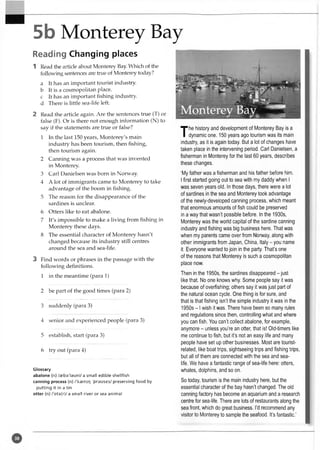
Check!
5 Do the quiz. You can find the answers in
Student's Book Unit 5.
Quiz____________
1 Which of these does NOT describe a type
of development?
a personal
b sustainable
c life
2 Which of these is NOT in Dubai?
a the world’s tallest building
b the world’s biggest shopping mall
c the world’s busiest airport
3 Kerala is a happy society because the
government has invested a lot in ... .
a agriculture
b political involvement
c health and education
4 Who were the main critics of the Nam
Theun 2 hydro-power project?
a the local villagers
b environmentalists
c the World Bank
5 Which of these phrases has the same
meaning as In addition?
a Then again
b Furthermore
c Consequently
o
Unit 6 Alternative travel
6a Staycations
Listening personal experiences
1 *2.1 Listen to four people talking about their
idea of a staycation. Write the number of the
speaker next to what's most important for them in
a staycation. There are two extra items.
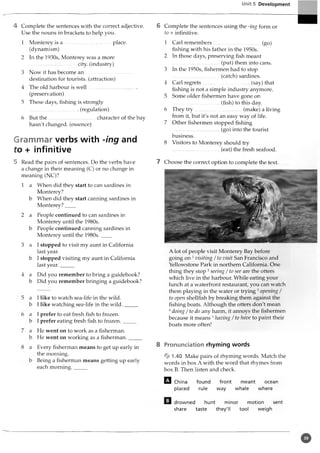
a planning your staycation
b going back to a simpler way of life
c changing your routine
d getting help at home I
...
e spoiling yourself
f filling the days with stimulating new
experiences
2 * 2 . 1 Listen again and put the number of the
speaker next to the activity they suggest. There are
two extra activities.
a spending family time just chatting and
playing
b taking your children on day trips
c learning a new sport
d enjoying the experience of shopping
for food
e eating out often
f getting a little exercise each day
3 Look at the phrases in bold from the listening.
Choose the correct definition.
1 By staying at home, you're not necessarily
going to switch off.
a forget about work
b feel out of touch with the world
c get more rest
2 I'm not trying to be prescriptive, but you must
make some rules.
a frighten you
b tell you exactly what to do
c be funny
3 My idea of a staycation is to pamper myself,
a go to the health club
b spoil myself
c do healthy things
4 I organised things to do every day. Maybe my
family thought I overdid it.
a wanted to impress people
b organised too much
c spent a lot of money
5 Modern life shouldn't dictate your routine,
a interfere with
b destroy
c control
Grammar not
4 Rewrite the phrases in bold in the negative form.
1 Let's kid ourselves that just by staying at
home, you're going to relax.
2 Answer the phone - switch on the answer phone.
3 You have to do a big weekly shop, for example.
4 It would be easier to do things to keep fit.
5 I think it's extravagant, because I know I'm
spending less than I would on holiday.
6 I hope I overdid it.
7 I tried to let the children know I was worried.
8 So you really must let modern life dictate what
you do too much.
5 Rewrite the sentences using negative forms and
the words given.
1 I won't have a coffee now, thanks.
WANT
2 It doesn't seem to me to be a great idea.
THINK
3 We shouldn't do anything to upset them.
......................................... LET
4 I'm worried that I gave her the wrong
impression.
HOPE
5 You can give the book back to me when
you like.
HAVE/IMMEDIATELY
6 Don't be late, please.
TRY
7 It is forbidden to take food into the library.
MUST
8 Have they decided to leave?
STAY
Vocabulary travel
Vocabulary phrasal verbs with
in and out
7 Complete the sentences using the correct verb.
1 Shall we in tonight and see what's
on the TV? I'm too tired to go out.
2 Please in and see us anytime.
You're always welcome.
3 I don't like out. I'd much rather
just cook a meal at home.
4 Don't out too late. You've got an
interview in the morning.
5 You wouldn't believe the bureaucracy. We had
to in about ten forms!
6 The party starts at 8 p.m. Please bring a friend
and come and in the fun!
8 Dictation staycations
% 2.2 Listen to a travel expert describing the
trend in staycations. He makes four points. Write
the words that you hear. Do you agree with him?
1 In tough economic times,
2 However, they
3 You don’t have to
4 I don’t think
Complete the description of a holiday. Write one
word in each space.
We had a great holiday, thanks. Up until
September, I had only had two days
1................................ all year. We booked a self-
2 apartment in a little
village in Pelion in the north of Greece. Pelion
has lovely 3.................................. : wooded hills
leading down to beautiful little coves and a
crystal clear sea. Our apartment was in a village
a little way up in the hills with a fantastic
4...................................of the sea. We flew with
one of the low -budget5.......................... - I
think our return flights were less than £100
each. We only took hand 6......... .........................
with us because on low-budget flights they
charge extra for each bag you take. Then we
rented a car to get us from the airport to our
accommodation. It was quite a long
7.................................. but we went through very
pretty 8 . Coming back was
expensive, though. The drive to the airport
9.................................. about three hours longer
because of roadworks. So the car hire company
charged us for an extra half day. Then the
airline said my 10...... -.......................... was too big
and it would have to go in the hold - for an
extra £80! I couldn't believe it.
6b Why volunteer?
Why volunteer?
Volunteering is one of the most rewarding ways you
can make a real difference to people who live in very
tough circumstances. Most people join us because
they want to give something back and find they get
much more in return.
VSO sends volunteers rather than money. We work
on long-term, sustainable solutions. And volunteers
are how we do it. Nothing compares with the
satisfaction of translating generosity into practical,
life-changing achievements.
Our short-term roles give experienced professionals
the opportunity to make a concentrated, high-
impact contribution to the fight against poverty.
You'll face fresh challenges, develop valuable new
skills, and experience another culture in a way few
people have the opportunity to.
Who can be a short-term volunteer?
Our placements tend to be consultancy-type roles, which are designed to achieve a specific goal or complete a
set project, so they require highly skilled professionals who can hit the ground running.The majority of short­
term roles last between four and six months.
For most of our roles, you will need at least five years'experience in your field of work, be able to stay for six
months, and be ready to leave within eighteen months of applying - sometimes at short notice.VSO matches
volunteers to placements where they are most professionally suited. It helps if you're flexible when considering
where you're willing to work.
How we'll support you
This isn't'voluntourism'- you don't have to pay to volunteer with VSO. We take care of all your expenses,from
flights and insurance through to visas and accommodation. You even get a local living allowance. For more
information, see our volunteering FAQs.
The skills we're looking for
We are currently looking for short-term volunteers in the following sectors: advocacy specialists, agricultural
specialists, business and management specialists, financial specialists,fundraisers, IT specialists, monitoring and
evaluation specialists, researchers, other specialist and one-off roles.
If you don't yet have the level of experience to undertake a short-term role, you can look at the long-term
opportunities in your area of work.
Reading VSO
1 Read the information from the VSO website.
Complete the notes about the short-term
voluntary roles.
Type of w ork:1
Skills and experience required:2
Length of stay:3
Flexibility on dates: 4
C osts:5
2 Read the information again and choose the correct
option (a-c).
1 People who want to give something back means
people who want to ... .
a repay VSO for giving them a job
b give money to the organisation
c make a contribution to society
2 Short-term volunteer jobs are open to people ...
a who like project work
b with some work expertise
c who have already worked as consultants
Unit 6 Alternative travel
3 Hit the ground running (paragraph 3) means ....
a start work immediately
b be very adaptable
c use your intelligence
4 When placing people, VSO especially takes into
account a volunteer's ....
a wishes
b willingness to work
c work background
5 Which of the following volunteer costs does
VSO NOT pay for?
a travel
b day-to-day expenses
c hotel bills
6 The article suggests that long-term posts could
be suitable for people who are ....
a less experienced travellers
b less advanced in their careers
c less confident
3 Read the information again and find adjectives
that mean:
1 satisfying (para 1 )......
2 very difficult (para 1)
3 intensive (para 3)
4 new (para 3 )................
5 fixed (para 4 )...............
6 not to be repeated (para 7 ).....................................
Grammar negative and tag
questions
4 Complete these negative questions for people who
are thinking of becoming volunteers.
1 Haven't you ever wondered (you / ever / wonder)
what it would be like to be a volunteer in
another country rather than just a tourist?
2 You clearly care about others. Why
..............................................................(you /
translate) your concerns into concrete action?
3 ..............................................................(you / would
like) to use your skills to help others?
4 ..............................................................(it / harm)
your future career to take time away from
work?
5 ..............................................................(you /
going to lose out) financially if you become a
volunteer for nine months?
6 ..............................................................(it / be) selfish
to want to do this for your own personal
development?
5 Look at the questions that a potential VSO
volunteer asks. Complete them with question tags.
1 A: You don't organise two-week volunteer
vacations,..................................................?
B: No, we don't.
2 A: But the work would be suitable for a gap-
year student,................................................... ?
B: Well, no. It's aimed at an older age group.
3 A: It isn't suitable for my 18-year-old daughter,
then,................................................... ?
B: No, I'm afraid it isn't.
4 A: But you used to take younger volunteers,
7
B: Yes, but our policy has changed.
5 A: So, as a teacher, there might be possibilities
for me to volunteer,........................ ................... ?
B: Absolutely, for a longer-term post.
6 A: And I'd have to be flexible about where and
when I could go,.................................................... ?
B: Well, of course, flexibility helps.
6 Pronunciation intonation in questions
% 2.3 Look at the questions. Does the intonation
rise (R) or fall (F) at the end? Then listen and check.
R
1 It's a fantastic idea, isn't it?
2 Wouldn't it be great if everyone
did this?
3 Have you heard of VSO?
4 You can't really make that kind of
long-term commitment, can you?
5 Didn't you do some volunteering
when you were a student?
6 I don't have the right qualifications,
do I?
7 Do you know any other organisations
like VSO?
8 It would be interesting to talk to
someone who's done it, wouldn't it?
o
6c Unusual trips
Listening a cruise with a
difference
1 % 2.4 You are going to listen to a review of a cruise.
Look at these words. Tick (/) the items you would
expect to find on a cruise ship. Then listen and
compare which items are on the NG Endeavour.
a crane
a kayak
a casino
shops
a microscope
an inflatable rubber boat
restaurants
guides
% 2.4 Listen again. How does the review describe
NG Endeavour cruises? Choose the correct the option.
1 entertaining / educational
2 reasonable / expensive
3 comfortable / uncomfortable
4 well-equipped / basic
5 exciting / monotonous
% 2.4 Complete the table with information about
the NG Endeavour. Then listen again and complete
any missing details.
Name of ship
Type of ship
Fares
Special
gadgets
On-board staff
Places it visits
Eating facilities
NG Endeavour
Cruise ship converted from a
1...................................trawler.
From to
a day
, Zodiacs
and expert
Svalbard in the Arctic circle, the
8................................. and
one room
4 Look at the transcript on page page 120-121 and
find words or expressions that mean:
1 spending time lazily and luxuriously (para 1)
2 fixed in a way that cannot be changed (para 2)
3 a good amount of (para 3)
4 rich (para 4 ) ..........................
5 easy to talk to (para 5)
6 during the whole (para 6)
Word focus mind
5 Rewrite the sentences using expressions with mind.
1 If you were thinking of a cruise, try one of
Lindblad's expeditions.
(have in mind)
2 If a bit of danger and excitement are not a
problem for you, Lindblad cruises are perfect.
(don't mind)
3 The cruises are amazing. Admittedly, they're
not cheap.
(mind you)
4 Remember that these are not typical cruises.
(bear in mind)
5 I used to think that cruises were for the old and
retired, but I've got a different opinion now.
(change one's mind)
6 I want to go on one of their cruises, but it's
quite expensive.
(be in two minds)
6 Grammar extra negative expressions
a Look at these negative expressions,
a Don't judge a book by its cover,
b No problem,
c It doesn't matter.
b Complete these common expressions using the
correct negative forms.
worry,
worries,
make sense,
way!
say a word,
work like that.
o
Unit 6 Alternative travel
6d Navigation
Real life getting around
1 2.5 Complete the sentences using prepositions.
Then listen to a conversation between two friends
and check.
1 I'll be coming on the five o'clock train.
2 I can't pick you , I'm afraid.
3 How do I get Sara's Cafe?
4 Just hop any bus from the station.
5 Look for the pier and get off there.
6 You'll see the cafe your right.
7 If I get held , I'll call you.
8 I'll come and meet you.
2 fjf2.5 Listen again and answer the questions.
1 Why can't Steve meet Joe at the station?
2 How will Joe get to the meeting point?
3 Where do they arrange to meet in the end?
I Rewrite the sentences so that they have the same
meaning. Use the words in brackets.
1 The easiest option is to take the bus.
(thing)
2 Another possibility is to take a taxi.
(alternatively)
3 I can get there on my own.
(way)
4 It only takes fifteen minutes by bus.
.........................................(ride)
5 I'm arriving by train.
(coming)
6 If I am delayed, I'll let you know.
(held)
4 Choose the correct word to complete the
situations.
crossing drive flight ride (x2) walk
1 It's a twenty-minute . (car)
2 It's a two-hour . (plane)
3 It's a fifteen-minute __.(bus)
4 It's a twenty-minute . (foot)
5 It's a ten-minute . (taxi)
6 It's a one-hour . (ferry boat)
5 Pronunciation intonation in sentences
with two clauses
cl % 2.6 Match the sentence halves. Then listen and
check.
1 I'd prefer to drive,
2 It's not difficult to find,
3 I could come and meet you,
4 The bus is cheap,
5 You could take a taxi,
a but I don't finish work until 6.00 p.m.
b but it's quite a long way from the station.
c but it's a very scenic walk.
d but the car is behaving strangely.
e but it makes a lot of stops on the way.
b % 2.6 Practise saying the sentences using the
correct intonation.
6 Listen and respond getting around
% 2.7 Listen to a friend asking you for directions
to your house from the town centre. Respond with
your own words. Then compare your response
with the model answer that follows.
1
Hi there. I'm coming in on the train tomorrow
at two o'clock. What's the best way to get to
your house from there?
The easiest thing is to
take the bus.
o
6e Unfair charges
Writing a letter of complaint
1 Read the letter of complaint and answer the
questions.
1 What is the woman's complaint?
2 What action does she want to be taken?
2-4 Clifford hardens
Oxford
ll-FVf Airlines 0Y3 2-ftSi
108 Pembroke Poad
London
W81NP
Dear Sir/Madam
I am writing to register a complaint about having to pay
etfra charges to 'four airline on a recent flight to Spain
(UZ-485 from London to Seville on 3rd May). I feel that
these charges were unjust.
At the time that I booKed this flight, 1read the terms
about luggage carefully. The terms clearly stated that each
passenger's hand luggage allowance was one bag measuring
no more than % v
- 45 >
•2.5cm and weighing up to
10 Kilograms.
On arrival at checfc-in, I informed the member of the
ground crew that my bag met these regulations, but she
insisted that the coat that I was wearing should be placed
in the bag. I attempted to pacK the coat into my bag, but it
would not fit, so I was instructed that I would have to pa^
£30 if I wished to tafce it onto the plane.
I was concerned that I was delating other passengers, and
consequently ' 0P^d to pa'f the money. Otherwise, I would
certainly have disputed the charge, as 1am now doing. It is
perfectly reasonable to wear a coat onto a plane.
(Siiven these circumstances, I would asfc you firstly to refund
the £30 to me and secondly to investigate the matter so
that you can ensure that other passengers do not encounter
the same problem.
2 Answer these questions.
1 Where is the writer writing from?
2 What is her relationship to the recipient of
the letter?...............................................................
3 What is the tone of the letter (e.g. formal/
semi-formal)?...............................................................
3 Writing skill formal language
a Find formal phrases in the letter with the same
meaning as these less formal words.
1 complain...............................................................
2 unfair....... .......................................................
3 said .....................................................-.......
4 told ............................................ -................
5 p u t...............................................................
6 tried...............................................................
7 w anted...............................................................
8 chose...............................................................
9 the situation................................................
10 look into..........................................................
b Rewrite the first paragraph of this letter of complaint
using more formal language. Use these verbs to help
you. You can change other words too.
consist give register regret serve
state suffer
Pear Sir/Madam
I'm writing to complain about the meal we got on our
flight home last weefc - flight U1332-. On the booking
confirmation it said that we would have breakfast and
lunch. Well, breakfast wasjust a cup of tea and lunch
was a tuna sandwich. £?y itself, this wouldn't have been a
problem, but both my husband and I got food poisoning
from the sandwich.
4 Now write the final paragraph of the letter,
demanding some action from the airline.
Yours faithfully
Amelia Doyle
Unit 6 Alternative travel
Wordbuilding phrasal verbs
with in and out
1 Complete the phrasal verbs using in and out.
1 Do drop and see us the next time
you're in town.
2 Stefan dropped of college last year
because he wanted to travel round the world.
3 Philippa and Sarah used to be business
partners but they fell over how to
develop the business.
4 Chris fell.................. with the wrong crowd at
college and started missing lectures.
5 Ben is taking Greta to that new
Thai restaurant tonight.
6 Sorry. Can you speak a little more slowly? I
couldn't take it a ll...................
7 I'll look and see my parents on my
way home to make sure they're OK.
8 Look..................! You're going to bang your
head on that door.
9 Is your old car still going? I thought it would
have given................. years ago.
10 I'm trying not to eat sweets, but it's very
difficult not to give to temptation.
2 Match the phrasal verbs from Exercise 1 with the
definitions (a-j).
a have a disagreement..................................................
b absorb (information)..................................................
c pay someone a (short) visit
d pay someone a (short) visit to check they are
all right..........................................................................
e become part of a social group
f be careful..............................
g surrender..............................
h arrange a social date with
i leave a course before it is finished
j stop working or functioning
Learning skills writing
in English
3 Look at the diagram showing the important
elements of writing. Complete the diagram with
these elements.
spelling link the ideas
examples
action wanted
Purpose and focus
• audience
• main message
Organisation
• arrange the parts (intro,
conclusion, etc.)
Supporting your case
• appropriate tone
Checking your writing
• meaning
• grammar
4 Look at the letter of complaint in Exercise 1 on
page 50. Answer the questions.
1 What is the main message and where in the
letter does this becomes clear?
2 What are the three main elements the letter
includes?
3 What phrases does the writer use to link the
different ideas?
4 What tone does the writer use?
5 What details make the writer's case more
persuasive?
Check!
5 Answer the questions. All the answers are in
Student's Book Unit 6.
1 How did Karen Ash have a Japanese holiday
without leaving home?
2 What are volunteers helping to build all across
North America?
3 Where can you pay to have an uncomfortable
night and be treated unkindly?
4 Where can you step right into a painting?
5 What's a way to travel from place to place
without ever paying for a bed to sleep in?
o
Unit 7 Natural resources
7 a Solving the water problem
Reading water
1 Look at the solutions for solving the water
problem. Read the text and tick (/) the solutions
that are mentioned.
...I repairing broken water pipes
...! stopping climate change
...I reusing rainwater
...I hiving fewer showers and baths
...I turning salt water into fresh water
i I making artificial rainclouds
2 Read the article and choose the best option (a-c).
1 Probably the most effective way for water
companies to reduce water consumption is:
a to fix broken water pipes,
b to limit how much water people are
allowed to use.
c to charge people according to how much
water they consume.
2 According to the author, people will buy
water-saving devices:
a if the devices are more efficient,
b if they see there is financial benefit,
c whether they have a meter or not.
3 Desalination plants have ... main
disadvantages,
a two
b three
c four
4 'Cloud seeding' is a technology that:
a manipulates natural weather patterns,
b uses the natural elements in a cloud
to produce rainfall,
c encourages cloud formation.
5 The author says that new technologies:
a will soon be able to provide a solution,
b will never provide a solution,
c cannot provide a solution at the moment.
Glossary
moisture (n) /'rmist/a/ water in the air or on the surface
of something
restriction (n) /ri'strikj(a)n/ limit
sprinkle (v) /'sprir]kl/ to cover with little pieces of a thing
Solving
thewater
Conservation
This is perhaps the
simplest and most
cost-effective solution.
Moreover, everyone
can contribute, from
the water companies to
the end-user. The water
companies can make
sure that they minimise
waste by repairing cracked pipes and by imposing
restrictions on water usage - not allowing people to use
hosepipes has been one traditional method. But more
significantly, they can also limit water consumption by
making people pay for what they use, rather than for
their connection to the water supply. If everyone had a
water meter, they would think more carefully when they
turned on the tap. With metered water, the market for
water-saving devices - low-flush toilets, efficient washing
machines and dishwashers, and water butts for collecting
rainwater - will grow by itself.
Desalination
In many parts of the world, there is not enough fresh water
but an abundance of salt water. This has encouraged
the building of desalination plants. On the face of it, this
seems to be a very neat solution. However, these plants are
incredibly expensive to build - a recent project in Hawaii
cost US $35 million. This is why not many plants have been
built in poorer regions. Also, their ecological footprint is
heavy. The process requires huge amounts of electricity.
There is also growing evidence that the high concentrations
of salt which are returned to the earth or the sea have a very
damaging effect on plant and wildlife.
New technologies
‘Cloud seeding’ is a new ‘weather modification’ technology
that scientists are developing to solve global climate change.
In this process, the clouds are sprinkled with tiny crystals
of silver iodide, which encourage moisture to collect and
condense, causing rainfall. Some sceptics wonder whether
this technology will be effective and ask what use it is going
to be in countries where there is very little cloud. Others
worry that no one has properly researched the possible
harmful effects of a concentration of silver on human health.
As one scientist amusingly put it, ‘Sometimes not every
cloud has a silver lining.’
The conclusion would seem to be that new technologies
are a long way from solving our water problems,
particularly in poorer countries. For the moment,
conservation still seems to be our best hope.
@
3 Read the article again and find words that mean: 5 Pronunciation contractions in conditionals
a a consumer (para 1 )..................................................
b something you use to water the garden or clean
the car (para 1)..................................................
c something that measures the amount of water
you consume (para 1).....................................
d something that collects water, usually in the
garden (para 1).................................... .............
e at first sight (para 2 )..................................................
f impact on the environment (para 2)
g a person who isn't convinced (para 3)
h 'there is always some good, even in a bad
thing' (para 3 ).................................................
Grammar mixed conditional
sentences
4 Complete the sentences. Put the verbs in
the correct form. Use first, second, third and
mixed conditionals.
1 If the water companies..................................................
(not / impose) restrictions on water use in the
past, there (be) water
shortages now.
2 If people....................................................... (have) to
pay according to how much water they used,
they..................................................(use) less water.
3 If companies................................. ................
(introduce) water meters, then people
..................................................(buy) more water-
saving devices.
4 If there................................................. (be) more
fresh water, w e.............. .................................. (not/
need) technologies like desalination.
5 If desalination plants
(not / be) so expensive, more of them
..................................................(be built) in poorer
countries before now.
6 If some ecosystems............................................
(not / be) damaged by pollution, people
..................................................(feel) more optimistic
about this technology.
7 Cloud seeding only
(work) if there..........................................
clouds in the sky.
8 If someone..................................
(be)
%2.8Listen to the contracted forms in these
sentences. Notice how I'd have and he'd have sound
like one word. Listen again and repeat.
1 If he asked me, I'd certainly offer to help him.
2 I'd come with you, if we could leave a little later.
3 If I'd known, I'd have told you.
4 If he was more thoughtful, he'd have
remembered your birthday
5 If it's not too late to be included, I'd like to
come to the meeting.
Vocabulary conservation verbs
6 Complete the sentences about resources using
these verbs.
conserve consume preserve protect
run out of save spend waste
1 We've
go and buy some from the shop?
2 It's very important to
milk. Can you
money in good times, so that you have some
for the bad times.
3 D on't..................................................your
energy trying to persuade the council.
They are going to build on that green space
anyway, even though they promised to
it for wildlife.
4 Using salt to food is
a very old practice.
5 The WWF has launched a campaign to
................................................. the tiger from the
threat of extinction.
6 We need to return to a simpler way of life.
We too much time
shopping and w e..................................................too
many goods.
(think) of a better idea than conservation, it
.................................................(be) in use by now.
7b Oil
Vocabulary oil
1 Label the pictures using these words.
oil barrel oilfield oil pipeline oil refinery
oil rig oil slick oil tanker oil well
3 ............................................ 4
5 ............................................ 6
Listening alternatives to oil
2 * 2 . 9 Listen to an interview with an oil industry
expert. Does he think there is a reasonable
alternative to oil?
3 % 2.9 Listen again and answer the questions.
1 Peak oil means ....
a the maximum amount of oil that can be
extracted
b the oil which is still in the ground
c the high point in oil reserves
2 The conventional way to extract oil is to ... .
a drill deep under the surface of the Earth
b drill a little way under the surface
c drill only on land
3 The speaker says that unconventional drilling
methods can be ... .
a very expensive
b unsafe
c not environmentally-friendly
4 What surprises the presenter?
a that no one has found an alternative to oil
b that the price of oil continues to rise
c that people have not chosen another
source of fuel
5 What makes petrol so convenient, according
to the expert?
a the amount of energy that petrol produces
b the easy storage and delivery of petrol
c both these things
6 What problem do electric cars share with
petrol cars?
a they have a limited range
b the basic material needed to power them
is limited
c they have the potential to explode
Unit 7 Natural resources
Grammar wish, would rather
and if only
4 Complete these sentences from the interview by
putting the verb in the correct form.
..........................................(go) on
1 We wish o il...........................................
forever.
2 I wish I ..................................................(be able) to
give you a straight answer.
3 A lot of people wish that we
..................................................(not / start) to go
down this route
4 I'm sure people would rather
...... ...........................................(have) a cheaper and
cleaner alternative.
5 If only there....................................................(be) a
cheaper, cleaner and more efficient alternative.
6 Would you rather we
(run) out of oil or lithium?
Complete the short conversations using the correct
form of the verbs given.
1 A: Would you like to drive or shall I?
B: I'd rather y o u .................................................
(drive).
2 A: Are you going to buy that new electric car?
B: If only I ................. ..............................(have)
enough money, then I'd get it tomorrow, but
it's over £20,000!
3 A: Some people think that cheap petrol is a
basic human right.
B: I know. I wish people.............................................
(stop) complaining and use their cars less.
4 A: Your new car is amazing. Doesn't it use a lot
of petrol, though?
B: Yes, it does. I wish I ...............................................
(buy) one with a smaller engine.
5 A: The oil spill was terrible. What do you think
happened to all the oil in the sea?
B: I'd rather..................................................
(not / think) about it. It's probably still
out there.
6 A: We all depend too much on the countries
who produce oil.
B: I know. I wish each country
................................................. (become) more
independent in its energy needs.
7 A: Did you see the programme about
alternative energies last night?
B: No, but I wish I ........ .........................................
(see) it. It looked really interesting.
8 A: Shall I speak to the neighbours about
parking their car in front of our garage?
B: I'd rather you..................................................
(not / speak) to them. I don't want to have
an argument.
6 Pronunciation contractions with wish
and would rather
%2.10Listen to the contracted forms in these
sentences. Notice how I'd = I had and I zvoidd,
and how we'd - we had and we would. Listen
again and repeat.
1 I wish I'd known earlier.
2 Actually, I'd rather you didn't smoke.
3 If only we'd taken the train.
4 We'd rather not wait, if possible.
5 I wish I'd left my job.
7 Dictation Canada's oil sands
;-2.11 Listen and complete the description of
an article about Canada's oil sands.
in the tar sands of Alberta
However,
as conventional methods of extraction.
As a result,....................................................
o
7c An emotive subject
Listening conservation stories
1 * 2.12 You are going to hear three people talking
about conservation projects. Listen and complete
the table.
What needs to be
protected?
Has the conservation
work been successful?
1
2 The West African
3 The black poplar
in ...................................
2 * 2.12 Listen again. Are the sentences true (T) or
false (F)? Or is there not enough information (N) to
say if the statements are true or false?
1 Every inhabitant of Cancun misses the
beautiful mangrove forest.
2 Waste water has badly damaged the coral reef
along this part of the coast.
3 In West Africa, conservationists needed to find
out where the giraffe went for food.
4 Farmers were killing the giraffes who fed on
their land.
5 People associate the word 'conservation' with
work in developing countries.
6 The decrease in the numbers of black poplar
trees has been quite sudden.
3 * 2.12 Complete the sentences about the
conservation projects using these words. Then
listen and check.
classic heroic rarest rotting sale small
wonderful victims
1 Today that forest is buried and...............................
underneath 500 hotels.
2 This place is a ............................... example of how
not to build a tourist resort.
3 Nature is for here.
4 The mangroves are not the only............................... .
5 A ...............................effort on the part of
conservationists has saved the giraffe.
6 The conservationists could then begin to
educate local people about the dangers facing
these...... ...................... . creatures.
But in fact, many conservation efforts are
...............................in scale.
The black poplar is one of Britain's
............................. species of tree.
Find words and expressions in Exercise 3 that have
these meanings:
1 very typical..................................................
2 a period of ten years..................................................
3 a person or thing against which a crime is
committed..................................................
4 placed under the ground..............................................
5 you can buy it ..................................................
6 decaying or going bad..................................................
Vocabulary strong feelings
5 Look at these words. Tick the emotive words.
back-breaking criticise deplore desperate
interested in keen on majestic obsessed with
tall tiring
6 Rewrite the text about the black poplar tree.
Replace the words in bold with a more emotive
word from the box.
deprived exploit giant most threatened
over-developed plummeting rescue wonderful
If you mention the term 'conservation efforts',
people often think of attempts to 1save
endangered animals; or to protect2poor
communities from 3big corporate organisations
which are trying to 4 use their land. But in fact,
many conservation efforts are small in scale and
many have 5positive outcomes. The black poplar
tree is one of Britain's 6rarest species and its
numbers have been 7declining for decades. That's
mainly because much of its natural habitat - the
floodplain - has been 8built on with new housing.
o
Unit 7 Natural resources
7d Is globalisation good?
Real life making your point
1 % 2.13 Listen to four people speaking about
globalisation. Are the speakers in favour (F) or
against globalisation (A)?
F A
Speaker l ... ...
Speaker 2 ... ...
Speaker 3 ... L..J
Speaker 4 ... ...
2 % 2.13 Listen again to the four speakers and
complete the summaries.
Speaker 1: Globalisation helps us all to
Speaker 2: Globalisation just helps people
Speaker 3: Globalisation is just a
Speaker 4: Globalisation has just increased
3 4 2 .13 Complete these phrases used by the
speakers. Then listen and check.
1 That's......................... th e................ ..........
2 Sorry, I ........................don't..........................that.
3 To
.
, I could live without
flowers that are imported from Africa.
4 W e're.....................................this debate all
5 .....................................if we had to grow our own
coffee in England.
6 ........................me you another
example.
7 There's n o .....................................that it has
helped the rich.
4 Which techniques did the speakers use in their
arguments? Match the speakers (1-4) with the
techniques (a-e). There is one extra technique.
humour
challenging the question
itself
speaking clearly and
slowly
illustrating with
examples
anticipating counter­
arguments
5 Pronunciation sentence stress
a 4 2.14 Underline the words that you think are
most stressed in these sentences. Then listen
and check.
1 Globalisation may have helped the rich, but it
hasn't helped the poor. (2 words)
2 Globalisation is not something that has been
invented; it's a natural phenomenon. (2 words)
3 I like having things that I can't buy locally, but I
don't actually need them. (2 words)
4 Globalisation doesn't harm poor countries; it
helps them. (2 words)
5 I wish you were right, but the facts show the
opposite. (4 words)
b 4 2 .14 Practise saying the sentences. Listen and
compare your pronunciation.
6 Listen and respond making your point
42.15 Listen to a friend asking you to give your
opinion about globalisation. Look at the points
below. Respond with your own words. Then
compare your response with the model answer
that follows.
• Stress what your opinion is.
• Reject their argument.
• Give an example.
• Challenge the question itself.
1
IMiat do you think about
globalisation?
To be honest with you, I think
it's probably a good thing.
Speaker I ............ a
Speaker 2 b
Speaker 3 ..........
Speaker 4 c
d
e
o
7e Waste
Writing a letter to the press
1 Read the letter below and answer the questions
1 What caused the writer to send the letter?
2 What does she say will happen if nothing is done?
Daily Times
Published: January 12
Sir,
I am very tired of seeing so much waste in a
world where many people 1--------------- --------------
....................—......... -........suffer shortages of food,
energy and other basic necessities.
Each day at my local supermarket, enormous
quantities of food 2------------- ----------.............................
are thrown away when it could easily be given to
charities for the homeless. People often throw
away electronic equipment,3...... ........................ ......
.................when the item is only four or
five years old. Cars 4....................................... —...... .
sit in traffic jams with their engines running,
burning fuel unnecessarily Clothes,5........................
____________, are so cheap nowadays that people
think nothing of wearing something once or twice
and then throwing it away.
How have we allowed ourselves to become so
careless about precious resources? Are we simply
too rich to care? If we do not change the way
we behave, a change of behaviour will be forced
upon us because there will be no more resources
left for us to waste.
H. Henby, Oxford
2 Writing skills giving vivid examples
a Use these words and one of the details (a-e) to
add information that makes the letter more vivid.
Insert the information in the spaces (1-5).
such as with especially which who
a items of fashion clothing
b flat-screen TVs, computers or mobile phones
c is near its sell-by date
d live in more difficult circumstances than us
e only one driver in them
b Make the short letter below more vivid by giving
more information or examples in the spaces (1-5).
Use these notes to help you.
• give more details of the building
• give examples
• describe what people do here
• give examples
• give reasons
Sir,
I agree totally with James Needham (Daily
Times, 4th May). The decision to build a new
block of flats 1.............................................................
on part of what is now Summerdine Park is
shocking. This park not only contains many
species of trees 2................................... ....... .................,
it is also one of the few green spaces in the area,
3 . There are
certainly other more suitable places to build
new housing4...............................................................
It would be better to develop areas like this
5
Word focus better
3 Match the beginning of the sentences (1-5) with
their endings (a-e).
1 You had better a than me.
2 We would be b if we kept this car until
better off it gets too expensive
3 I think it would to maintain.
be better c not mention the question
4 He always tries of waste to him. He gets
to go one better very emotional.
5 He should d than to cut down a tree
know better in a conservation area.
e to send a letter to the
local paper.
4 Complete the dialogue using the verbs in the
correct form: to + infinitive, infinitive or -ing.
Andy: I still haven't heard back from the company
that interviewed me last week for a job. Do
you think I should call them or would it be
better 1.........................(wait)?
Fran: I think you'd be better off 2.........................
(call) them. It shows you're interested,
at least.
Andy: Yeah, you're right. I'd better 3.........................
(do) that this afternoon. It's better
4.........................(know) than not.
Unit 7 Natural resources
Wordbuilding collocations
related to one word
1 Look at these noun + noun collocations. Match
them to the definitions below.
air: airbridge airforce air vent
water: water jug water leak water lily
wind: wind chill wind farm wind instrument
1 e.g. clarinet, oboe, flute
2 used for getting from the airport terminal to
the plane
3 a place where renewable energy is generated
4 the drop in temperature cause by a cold wind
5 an escape of water from a pipe or tank
6 part of the military, along with the army
and navy .................................................
7 used for serving water at the dinner table
8 a place (e.g. in a wall) where air can enter
or exit..................................................
9 a flower that grows in lakes and ponds
2 Some noun + noun collocations become one
compound noun. Look at these collocations with
sun. Which two words are opposites?
5 2.18 Read these steps for improving your
listening skills. Listen again to the first speaker
from 7d, Exercise 1 and follow the steps (1-5).
1 Write down the words you hear.
2 Read your transcript back. Does it make
grammatical sense?
3 Compare your transcript with the audioscript.
4 Note the words and sounds which have the
strongest stress. These should be the key
words that convey the meaning.
5 Note which words are clearly linked. This will
help you to distinguish them the next time
you hear them.
Check!
6 Complete the crossword using phrases about
natural resources. All the answers are in Student's
Book Unit 10.
1 2 3
4
5 6
7 8
9
10 11
12
13
sunglasses sunlight sunrise sunset suntan
Learning skills improving your
listening
3 % 2.16 A key to understanding fast native speech
is to understand stress and linking in English
pronunciation. Listen to this sentence and note
the stress and linking in it.
1 Stress: Sorry I just don't accept that.
2 Linking: Sorry^,1 just don't^, accept that.
4 ^ 2 .17 Look at these sentences. Underline the
stressed syllables and indicate where the sounds
are linked. Then listen and check.
1 Globalisation helps people in rich countries.
2 They can have goods out of season.
3 But to be honest, I don't need flowers
imported from Africa in December.
Across
1 resources which can be replaced in nature (9)
4 and 5 with its special plants and wildlife,
Madagascar has one of these (6,9)
5 see 4 Across
7 the substance which is removed from water in
the desalination process (4)
10 this American river does not reach the sea
anymore (8)
12 another word for 'conserve' (4)
13 see 11 Down
Down
1 the three Rs in conservation: reduce, ...,
recycle (5)
2 people whose job it is to cut down trees (7)
3 Ecuador wanted to be paid not to do this with
its oil (7)
6 the opposite of abundant (6)
8 this sea is a tenth of the size it was in the 1960s (4)
9 producing half a kilo of this uses 85,000 litres
of water (4)
11 and 13 Across the point where oil is taken
from the ground (3, 4)
©
Unit 8 The news
8a Photojournalism
Vocabulary the news
1 Complete the crossword with words related to
news reporting.
Across
1 and 8 a story which is both serious and
urgent (4, 4)
3 news which is less serious and not urgent (4)
7 a piece expressing the opinion of the
newspaper (9)
Down
2 any piece written in a newspaper or magazine (7)
4 a special or prominent piece in a magazine or
newspaper (8)
5 the title of the main news story, written in big
letters (8)
6 a section of the newspaper dedicated to a
particular writer (6)
1
H
2
A
3
s
4
F
5
H
6
c
7
E
8
N
Listening re-touching reality
2 2.19 Listen to an interview with a journalist
talking about altering photos. What two examples
do they discuss? Complete the descriptions.
1 T h e.........................of the February..........................
edition of National Geographic magazine.
2 A photo o f.........................Reagan and Raisa
Gorbachev in Picture magazine.
NATIONAL
GEOGRAPHIC
NAPOLEON
HUMMINGBIRDS:
THE NECTAR
CONNECTION j
% 2.19 Listen again. Are the sentences true (T) or
false (F)?
1 Photo editors changed the size of the pyramids
in the photo.
2 An editor said that the changes to the photo
were OK because it was a cover photo.
3 He also said that technology had made altering
images more acceptable.
4 Editors have said that it's acceptable to alter
covers because they advertise the book or
magazine.
5 The photographer thinks that there's no
difference between manipulating cover images
and altering news photos.
6 Picture Week changed two photos to suggest the
people in them had friendly faces.
7 People thought that the Picture Week photo was
unacceptable.
8 People are not able to distinguish between
reality and fiction.
m st forETsrw
m
rm z , mp
b
s
tv
Glossary
alter (v) /'olta/ change
digitally enhanced (adj) /'did3 it(a)li in'hainst/ improved using
digital technology
touch up (v) /tAtJ 'Ap/ make small changes to improve an image
4 Pronunciation long vowel /au/
.20 Listen to these words. Pay attention to the
long /au/ sound. Then listen again and repeat.
boat don't fellow going growing hotel
know local opposed ownphoto sofa
Grammar reporting verbs
5 Rewrite these sentences using the reporting verbs
given.
1 People said that the magazine had manipulated
reality.
People accused the magazine
2 The editor said they had altered the image.
The editor admitted..
3 But he said they hadn't done anything wrong.
But he denied
4 He said modern technology made it easy to
alter images.
He blamed
5 Some editors tell their designers that it is OK to
alter images for covers.
Some editors persuade..............................................
6 People complained, saying that they had been
given a false impression.
People complained
7 Some people say, 'Don't trust a photo if there's
anything important riding on it.'
Some people warn you............................................
6 Complete the text using the correct form of the
verbs. Use prepositions where necessary.
In the past, photographers have been criticised
1
..................................................(invade) people's
privacy o r2..................................................(take)
pictures that did not reflect the reality of a
situation. But nowadays, in the age of digital
photography, there is a new problem. How do we
know that the photo has not been altered after
it has been taken? It would be wrong to blame
the photographer 3
..................................................
(manipulate) some of the photos that appear
in our newspapers and magazines. A photo editor
might be asked 4.................................................(alter)
a photo digitally in order to make a good story. For
example, someone might suggest
5...... (touch) up the
photo of a film star's face to make them look
more attractive. Or they might urge the photo
editor6..................................................(add) an
image of a frightened child into a photo of
a street protest. You can perhaps forgive the
editor 7 (make) the
first alteration, but what about second? That
is a practice people should possibly refuse
8..................................................(accept).
Vocabulary photography
7 Match the verbs in Box A with the nouns in Box B
and write the collocations.
□ capture
open
record
see through
take
take
1
2
3 .......................
4 ............................
5 ............................
6 ....................
8 Dictation digital photography
2.21 Listen to someone talking about analogue
and digital cameras. Then complete the text.
1 Like many of his fellow professionals, photographer
Fritz Hoffman
2 A digital camera
, but an analogue camera
3 Hoffman also claims
4 That's so that
events
the lens
the moment
a photo
a snaphot
the shutter
8b News in brief
Reading good news stories
1 Read the four newspaper stories below and match
the headlines (a-d) with the stories (1-4).
a Better to give than receive
b A sense of community
c A charmed life
d An old secret
News in
brief
1 _________
In the UK street riots of 2011, it is estimated that
rioters caused over £100 million of damage to their
own communities. But for every negative, there’s
often a positive, as the case of Mr Biber, a London
barber, shows. Mr Biber’s barber shop in London,
where he has been cutting hair for 40 years, was
among those wrecked, and the 89-year-old thought
he had lost everything. But word got around and a
website to support him was set up. Donations raised
£35,000, enough to make the necessary repairs.
Moreover, people’s generosity gave Mr Biber the
encouragement to carry on doing what he loves.
2 ________
Some people believe that the secret to a long life is a
glass of red wine every day. For others, it is plenty of
exercise. But few people would claim that eating fast
food contributed to longevity. They obviously haven’t
met 100-year old Catherine Reddoch from Matamata,
New Zealand. Every day, using her zimmer frame
to support her, she walks a kilometre - a journey
which takes her one hour - to her local hamburger
cafe. Here she eats a cheeseburger and drinks a cup
of hot chocolate. Mrs Reddoch is not concerned
about the fat content of the meal. ‘I eat anything and
everything - 1 like my cheeseburgers,’ she says. It was
reported that on her 100th birthday, the cafe put a
plaque with her name on it on her usual seat.
3 _________
Secret Agent L is the brainchild of one woman,
Laura Miller. Laura’s mission is to spread kindness
in the world. She does this by doing small acts of
kindness, like leaving a flower on someone’s car
windscreen or making a nice walking stick for
someone to find when they are on a long walk.
V________________________________________
2 Write the number of the story (1-4) next to the
statements (a-f).
This story shows that:
a you can help people without spending a lot
of money........................
b there is not one right way to do something.
c you can inspire other people by your actions.
d miracles do happen.........................
e there is a good and a bad side to every
situation.........................
f people's faith in human nature can be restored.
The idea is that when someone finds these secret
gifts, it brightens up their day. It is believed that
Secret Agent L now has over 1,800 followers
around the world, all creating and sharing their
ideas for similar kind acts.
4 _________
A 21-year-old man who drove his car over the
edge of the Grand Canyon escaped with only a few
minor injuries. Witnesses said that his car had
plunged 200 feet into the mile-deep canyon before
hitting a tree which stopped it falling further. It
is not thought that he was speeding, but the cause
of the accident remains unknown. Another visitor
found him lying in the road after he had apparently
climbed back out of the canyon. The emergency
services said he was an extremely lucky man.
Glossary
plaque (n) /plaek/ a small metal sign
riot (n) /’raiat/ a violent protest
____________________ J
Unit 8 The news
3 Read the stories again and find words that mean:
destroyed (para 1)
gifts of money (para 1)
living a long time (para 2)
a walking aid for old people (para 2)
an original idea (para 3)
make more cheerful (para 3)
fell or dived (para 4)
driving too fast (para 4)
Grammar passive reporting verbs
4 Find an example of a passive reporting verb in
each story on page 62 and underline it.
5 Grammar extra tenses in passive
reporting verbs
► TENSES IN PASSIVE REPORTING VERBS
Note how these tenses are transformed from active
to passive.
People say...
People have said ...
People said ...
People had said...
It is said that...
It has been said that.
It was said that...
It had been said that.
Look at the grammar box. Rewrite these phrases
using passive reporting verbs.
1 People say that ... It is said that...
2 Everyone understands th at...
It
3 Everyone knew th at...
I t ..........................................
4 People believed th at...
I t.......................................................
5 People have estimated that ...
I t.......................................................
6 People think th at...
I t.......................................................
7 People had hoped th at...
It.......................................................
8 Everyone supposes that ...
It
6 Rewrite the sentences using passive reporting
verbs.
1 People say that for every negative, there is
always a positive.
It is said thatfor every negative, there is always a
positive.
2 People expect Mr Biber to carry on doing what
he loves.
It .................................................that Mr Biber
what he loves.
3 People used to think that a glass of red wine a
day helped you to live longer.
In the past,................................
4 Most people don't recommend eating fast food
if you want to live longer.
I t ..............................................................that you
5 People hoped that secret gifts would brighten
up someone's day.
I t ......................................... ....................that secret
gifts ............................................................................
6 People supposed that the tree prevented the car
falling further.
I t .................................................................................
7 People considered the man lucky to survive the
accident.
It that the man
8 People have reported great success with the
idea.
It the idea
very successful
Vocabulary the feel-good factor
7 Match the adjectives describing good news stories
in box A with the words that have the opposite or
a near opposite meaning in box B.
□ amusing
charming
inspiring
quirky
encouraging
optimistic
ordinary
depressing
pessimistic
serious
dreary
uninspiring
8 Pronunciation weak forms in verbs
%2.22 Listen to the auxiliary verbs in these
sentences. Note how they are pronounced using
the weak form. Listen again and repeat.
1 It was estimated that £100 million worth of
damage was caused in the riots.
2 It is believed that Secret Agent L has more than
200 followers.
3 It was thought that the driver had fallen asleep
at the wheel of his car.
4 It was expected that the injured man would
make a full recovery.
5 It has been estimated that 50% of the
population will be overweight by 2020.
6 It had been thought that diet was more
important than exercise.
©
8c Balanced reporting
Listening news reports
1 %2.23 Listen to a journalist talking about balanced
reporting. Are the sentences true (T) or false (F)?
1 National Geographic likes to report on
endangered environments.
2 The main article was about a gas pipeline.
3 The speaker thinks that journalists should give
equal space to both sides in a debate.
2 %2.23 Listen to the report again and choose the
correct option.
1 Journalists have to try to give a balanced view /
opinion and tell a good story.
2 National Geographic tries to find places where
we can marvel at the joys /wonders of nature.
3 The main article described the beauty /nature of
the white Kermode Spirit Bear.
4 A smaller article described the building of a gas
platform /pipeline.
5 Technically /Strictly speaking, it was inaccurate
to say the government had given its approval.
6 The journalists and editors in question shot /
jumped the gun in order to make their point.
7 The article highlights the dilemma / problem
for journalists.
8 Ideally the people involved would like to have
the say-so / the last word.
3 Look at the words and expressions in Exercise 2
and find words that mean:
1 in actual fact (2 words)
2 amazing and beautiful things (1 word)
3 have the final decision (4 words)
4 an impartial opinion (2 words)
5 a difficult choice (1 word)
6 be too hasty (3 words)
Word focus word
4 Look at these expressions with zvord and choose
the correct definition (a or b).
1 From the zvord go, the restaurant was full every
night.
a from when we had permission
b from the start
2 Jamie has been behaving very strangely
recently. Can you have a quiet zvord with him?
a be very strict with b talk privately to
3 Please don't say a zvord to Sarah about the cup
I broke. It's her favourite.
a don't mention b lie
4 He said I would never be a professional artist
but he had to eat his zvords.
a admit he was wrong b apologise
5 Complete the sentences using the expressions
with zvord.
don't take my word for it eat my words
from the word go gave his word
have the last word
one person's word against another's
was lost for words word of mouth
1 Our magazine gets most of its new customers
by or because
someone has read a copy in a doctor's waiting
room.
2 I assured them that it would be easy to find a
good wildlife photographer. I hope I don't have
to ______ _____________ 1___ .
3 It is ju st................................................... In the end,
the reader will have to decide who they believe.
4 If you don't believe what I'm telling you, then
.................................................. . Go and check the
facts for yourself.
5 He that he would not
publish the story before I had read it.
6 , the journalist
involved the company in the research for
the article.
7 I didn't know what to say - I ...................................
8 She's very argumentative and always has to
Unit 8 The news
8d Guess what
Real life reporting what you
heard
1 Complete the sentences. Use a verb in each space.
Do the sentences express belief (B) or disbelief (D)?
B D
I think I'd
word for it.
He generally
facts right.
her
his
3 He's not the type to
gossip.
4 ...............................no notice of
what she says.
5 It's been...............................out of
proportion.
6 I'd ...............................that with a
pinch of salt.
% 2.24 Listen to a conversation between two
friends, Jane and Annie, and answer the questions.
1 What is the news about Patrick that Jane wants
to share?
2 Who did she hear this news from?
3 What does Annie ask Jane to do with the
news? Why?
3 * 2 .24 Complete the sentences from the
conversation. Then listen again and check.
verbs: guess heard reckons seems
prepositions: about according to
adverbs: apparently supposedly
nouns: gossip pinch
1 Did you hear the good news
..................................... (preposition) Patrick?
.....................................(verb) what?
2 W ell,....................................... (adverb) he was
spotted by someone from a big theatrical
agency.
She........._...........................(verb) that it won't be
long before we see him on TV.
Well, I'd take that with a
(noun) of salt if I were you.
N o,.............................(preposition) Kate, it's
more than that.
Ihat'd be fantastic. 1......................................(verb)
that it was really difficult to get that kind of
work.
Don't worry. I'm not the type to spread
..................................... (noun). Does the agency
take a big fee?
It (verb) that they only take
10% or 15% ,.....................................(adverb).
4 Pronunciation the schwa
% 2.25 Listen to these words from the
conversation. Underline the stressed syllable and
circle the schwa /9 /sounds.
Example: s(u)ppoggdly
1 comedy
2 festival
3 apparently
4 reckon
5 according
6 difficult
7 agency
8 theatrical
5 Listen and respond reporting what you
heard
* 2.26 Listen to someone giving you some
news about government taxes. Respond after the
tone with your own words. Then compare your
response with the model answer that follows.
1
Did you hear the good
news about taxes?
Good news about taxes?
No, what happened?
©
8e Group action
Vocabulary meetings
1 Write two verbs that collocate with each noun.
attend discuss draft hold make (x2)
put forward reach weigh up write
1 .........................................................................
a meeting
2 ........................, .....................................
a suggestion
3 ..................................... , .....................................
a decision
4 ..................................... , .....................................
the options
5 ..............................-......, ......................................
a letter
2 Writing skill impersonal language
Rewrite the sentences using impersonal language.
Use the words given.
1 We all got together to discuss how to raise the
money.
A ..............................................................................(held)
2 We discussed all the things that we could do.
A ll........................................................................(options)
3 Julian suggested that we should ask the local
council for help.
O ne.............................................................. (suggestion)
4 Pete said it was better to havesome fun events.
Another........ ..........................................................(idea)
5 Several people said organising events would
take too long.
It........................................................................... (agreed)
6 No one could decide what to do about funding
the project.
...........................................................................(decision)
Writing minutes from a meeting
3 Read the minutes from a local meeting about
a waste incinerator (a plant where rubbish is
burned) in the area. Answer the questions.
1 What are the main advantages and
disadvantages of the incinerator?............................
St Paul's Residents'Association
From: Kathy Barbosa
Re: New waste incinerator
Here are the minutes from the meeting which
was held on 3 September.
V Following the government's decision to
build a new waste incinerator on the old
factory site in Quibble Street, we met to
decide what action residents could take to
oppose this new source of pollution.
^ Karen suggested that we should get
everyone in the area to sign a petition
against the proposal. Everyone agreed that
this was a good first step.
^ Tom thought we should present the
government with some alternative locations,
but no one at the meeting was able to
suggest any so the action was rejected.
^ Jo made the point that the government
wanted to use the incinerator to generate
electricity for the area, which was a good
thing for the community.
^ Kevin proposed that we could have another
kind of plant which sorted the waste for
recycling. Harry said he would research this
option and discuss it at the next meeting.
Next meeting date: 26 September
4 Replace the underlined phrases with more
impersonal ones.
1 a meeting ivas held to decide.................................
2
3
4
5
6
7
2 What action was decided on?
3 What action was rejected?
Unit 8 The news
Wordbuilding forming
adjectives from verbs
1 Complete the sentences using the verbs + -ing.
charm confuse depress inspire
refresh tire touch worry
1 It is .....................................that she is so late -
she's normally very punctual.
2 The article was rather_
_ _______________ .
You couldn't work out why the daughter had
left her family
3 It's very......................................to hear a story
about a business which doesn't just do things
to make money.
4 He is a really.....................................man - polite,
interesting and kind.
5 The story about two friends overcoming their
difficulties was very.....................................•
6 Environmental news is often..................................
but in this case the story offered hope.
7 The news featured the
story of a 14-year-old girl who got a part-time
job to help support her family.
8 It's very.....................................to follow a film
with subtitles for three hours.
2 Make adjectives using verbs + -ive.
1 good at inventing inventive (from invent)
2 good at persuading
3 good at creating
4 liking to compete
5 producing a lot
6 talking a lot
7 wanting to protect
8 not responding
Learning skills keeping a
learning diary
3 What is a learning diary and why is it a good idea
to keep one? Look at these reasons and compare
them with your own ideas.
• To Iearn from your mistakes and your
successes
• To track your progress
• To make clear targets for the next stage of
your learning
• To record what you have learnt
4 Read the following actions which can help you to
evaluate and personalise your learning.
A c t i o n s
1 Write down your experiences of learning
after each lesson: what you found easy,
what you found difficult, what was the
most important thing you Iearned.
2 Note down mistakes that you have
made before.
3 Make a note of an extract, even a sentence,
that you particularly liked and try to
memorise it.
4 Set yourself a small task based on the
language you learned in your last lesson,
e.g. describe a good news story, report
what someone said to you, or describe a
situation where somebody’s reputation
was questioned.
5 Apply the actions (1-4) for Unit 8. Then
remember to do it for your next lesson!
Check!
6 Do the quiz. You can find all the answers in
Student's Book Unit 8.
Q uiz T im e
1 C o m p le te th e s e q u o ta tio n s.
a ‘A p ictu re is w o rth a th o u sa n d w ...... ....... .................................’
b ‘G oo d n e w s d o e s n ’t s.............................. ’
c ‘B ad n e w s tra v e ls f ..............................’
2 C o m p le te th e s e se n te n c e s a b o u t th e c h a ra c te rs
in U n it 8.
a T h e p ilo t P e te r B u rk ill w e n t fro m hero
to z..............................
b S h a rb a t G u la ’s p h o to is on e o f th e m ost
i im a g e s o f o u r tim e.
c It w a s b e lie ve d th a t th e la rg e b lu e b u tte rfly
w a s e..................... ..... in B ritain.
3 C o m p le te th e p h ra s e s a b o u t th e new s,
a T h e b e st fo rm o f a d v e rtis in g is w h e n
ne w s tra v e ls by w o rd o f m ..............................
b G o o d n e w s s to rie s g e n e ra te a
f........................... fa c to r a m o n g p e o p le .
c It’s not a g o o d th in g to s.......................... g o ssip .
d T h e re w a s an a m a z in g f ................................. a b o u t
India in N a tio n a l G e o g ra p h ic th is m on th .
o
Unit 9 Talented people
9a The great communicator
Listening
1 % 2.27 Read the questions. Then listen to the
description of Ronald Reagan and complete
the answers.
1 Where was Ronald Reagan raised?
In a ............................................................................
2 What was jobs did he have before he entered
politics?
He worked as a ..........................................................
and................................................................................
3 What important historical event occurred
during his presidency?
The collapse o f................................... ...........................
4 How did people make fun of him as President?
They said h e ...................................................................
5 What made him a great communicator?
His ability to .........................................................
6 What other factor worked in his favour as
president?
It was a time of......................................................
2 % 2.27 Look at the words and phrases in bold from
the description of Ronald Reagan. Choose the correct
meaning (a or b). Then listen again and check.
1 His skills as an orator were noticed and he was
persuaded to run for Governor of California.
a a politician
b a public speaker
2 He took a hard line against communism,
a strict approach
b difficult road
3 He understood the fundamental essence
of leadership,
a real meaning
b basic problem
4 He made people feel that they mattered,
a were lucky
b were important
5 The economy thrived during his presidency,
a did badly
b did well
6 Reagan's style of communication stands out.
a is noticeable
b is old-fashioned
Vocabulary careers
3 % 2.27 Complete the sentences with the correct
verb. Then listen again to the description and
check your answers.
1 Ronald Reagan......................................from
Eureka College, Illinois with a degree in
economics and sociology.
2 He for a short while as a
radio broadcaster in Iowa.
3 He moved to Los Angeles to ....................................
a career as an actor in films and television.
4 After......................................the Republican Party
in 1962, his skills as an orator were noticed.
5 He .....................................a good job as Governor
of California.
6 He went on to ......................................President of
the United States between 1981 and 1989.
Grammar articles: the or zero
article?
4 Complete with the or zero article (-).
Countries: Japan, United Arab
Emirates, Netherlands,
______Thailand
Places: ............Amazon River,
............ countryside, Moon,
............Mount Everest
Times: ........... weekend,............. Saturday,
............April, spring
Other: breakfast, police,
poor,............biology
5 Complete the sentences with the or zero article (-). 7 Dictation careers
1 After joining............Republican Party in 1962,
his skills as an orator were noticed and he
was persuaded to run for Governor of
California.
2 He then went on to become President of
United States between............1981
and 1989.
3 He remains one o f............most popular
American presidents o f............past 50 years.
4 Ronald Reagan understood............
fundamental essence of ......leadership: that
is, that you have to be able to communicate.
5 Reagan always gave............impression that he
was listening when he was speaking to you.
6 He looked you in ............eye, smiled at you,
made you feel special.
7 He presided over a time of great
economic growth in ..........America.
8 ............ things weren't great for most
Americans and he gave them hope.
9 It obviously helped that economy
thrived during his presidency.
10 If you can connect w ith..............ordinary
person, there's very little you can do wrong.
6 Pronunciation linking vowels
a % 2.28 Listen to these phrases. What sound links
the words: /w
/, /j/or /r/?
/wl /j/ Irl
1 one idea^at a time
2 he^often spoke to
ordinary people L.J !.......I !.......!
3 dowa good job ... .............. I
4 the beginning of thewend I
_
_ i
5 an areawof outstanding
beauty L
...I ...i
6 Chinawand India ... ... !...t
7 look someone in the^eye
8 too^expensive 1
.....1 I
.
9 it's sowexciting ... ... ..I
b *2 .28 Listen again and check. Then practise
saying each phrase.
% 2.29 Listen to three people describing their
careers. Write down the words you hear. Be
careful - many of the sentences contain the
linking sounds /w
/, /
j/or /
r/
.
1 I guess I .................................................................
2 It's not easy
3 I was always told
Vocabulary qualifications
8 Complete the job interview between an interviewer
(I) and an applicant (A) using these words.
background experience knowledge
qualifications qualities talents
I: So can you tell me first a little bit about your
i ?
A: Sure. My mother's French and my father's
English. I was brought up in France and ...
I: And do you have any previous
2.....................................of journalism?
A: Yes. At university I was editor of the student
magazine and after that I worked for a local
radio station ...
I: W hat3......................................do you have?
A: I have a degree in media studies and a
diploma in ...
I: What would you say are your best
4 _ ?
A: I'm a very organised person, I'm hard­
working and I think I ...
I: Do you have any5...................................... of
European politics?
A: Well, I read the papers regularly and I take a
great interest in current affairs ...
I: And lastly. Do you have any particular
6.....................................? Things that might
make you different other candidates?
A: I'm good at learning languages and I'm a
good photographer.
9b An inspirational scientist
Reading
1 Read the text quickly and underline the part of the
text that answers these questions.
1 What is the aim of Hayat Sindi's work?
2 What is the problem with medicines used to
fight diseases like hepatitis?
3 What is the tool that can prevent this?
4 Why did Sindi move to England?
5 What is her hope for other women like her?
2 Read the text again and answer the questions.
Choose the correct option (a-c).
1 Which of the following is NOT a quality of the
new tool?
a small b powerful c high-tech
2 Where is more health monitoring needed?
a in developed countries
b in developing countries
c everywhere
3 Compared to results from a diagnostic
laboratory this tool's results are ....
a more accurate b more positive
c quicker
4 Sindi's family was n o t....
a rich b academic c traditional
5 Sindi studied hard in England because she was
afraid of ... .
a her parents b failure c feeling lonely
6 Sindi would like women to use their education
to ... .
a go abroad
b help their own countries
c become scientists
3 Look at these words and phrases from the text.
Choose the best definition (a-c).
1 entire (para 1)
a complete b modem c sophisticated
2 detect (para 2)
a have b find c solve
3 low-tech (para 2)
a cheap b small cnot sophisticated
4 daunting (para 3)
a medical b very difficult
c personal
5 against the odds (para 3)
a unsurprisingly b unfairly
c unexpectedly
6 guidance (para 4)
a teaching b comfort c advice
Som ething the
size of a postage
stamp, costing
just a penny
apiece, could
be a medical
breakthrough
that will save
millions of lives.
According to
biotechnology scientist Hayat Sindi, this tiny
piece of paper has the same power as an entire
diagnostic laboratory. ‘My mission is to find simple,
inexpensive ways to monitor health,’ Sindi says.
She believes technology pioneered by a team at
Harvard University will make it possible, and she
co-founded the charity ‘Diagnostics For All’ to
produce and distribute the innovation.
In the developing world, powerful drugs are used
to combat diseases like HIV/AIDS, tuberculosis
and hepatitis. But these medicines can cause
liver damage. In developed countries, doctors
monitor liver function frequently and change the
medication if they detect problems. But in isolated,
rural corners of the world, health monitoring simply
doesn’t exist. The tragic result is that millions are
dying from the same drugs intended to save them.
The small piece of paper is a low-tech tool which
detects disease by analysing bodily fluids. Positive
results, which show up in less than a minute, are
indicated by a change in colour on the paper.
Sindi’s determination to solve daunting problems
should come as no surprise. Despite coming from a
modest background, never travelling outside Saudi
Arabia or speaking a word of English, she moved
to England to attend university. Alone, homesick,
and worried that she would fail and dishonour
her family, she learned English by watching BBC
news. She studied up to 20 hours a day for college
entrance exams. Against the odds, she became
the first Saudi woman to study biotechnology at
Cambridge University. She went on to get a PhD
and become a visiting scholar at Harvard University.
Sindi’s passion and accomplishments have made
her a role model for young women across the
Middle East, an inspiration to a new generation.
‘I want all women to believe in themselves and
know they can transform society. When I lecture
at schools, the first thing I ask children is to draw
a picture of a scientist. 99.9% of them draw an
old bald man with glasses. When I tell them I’m a
scientist, they look so surprised.’ A new foundation
that she has launched gives guidance and money
to encourage young women who attend university
abroad to bring their skills back to their homelands.
Unit 9 Talented people
Grammar relative clauses and
reduced relative clauses
4 Look at the article again and find examples of
the following.
1 a defining relative clause using which (para 2)
2 a defining relative clause using who (para 4)
3 a non-defining relative clause using which
(para 2 )......................................................................
4 a reduced relative clause using a present
participle (para 1).................................. ........... _
5 a reduced relative clause using a past participle
(para 1 ).............................................................................
5 Write sentences using relative clauses. Use the
relative pronouns who, which, whose, where and
when. Use commas where necessary.
1 The piece of paper is the size of a postage
stamp. It could save thousands of lives.
2 The charity 'Diagnostics for All' produces the
tool. It was co-founded by Sindi.
3 The tool will be used in developing countries.
It is difficult to find clinics there.
4 People take powerful drugs to combat diseases.
These drugs can cause liver damage.
5 The results show up on the paper. The paper's
colour changes if there is a problem.
6 Sindi went to England. She was a young
woman at the time.
7 Sindi later went to Harvard. She was the
first Saudi woman to study biotechnology at
Cambridge.
8 Sindi has become a role model for other
women. They want to follow her example.
6 Replace the relative clauses in these sentences with
reduced relative clauses. Number 6 has two clauses.
1 Sindi’s low-tech tool helps people who are
suffering from the negative effects of the drugs.
2 People who live far away from hospitals and
clinics will benefit from this technology.
3 The same medicines, which have been
designed to fight disease, can also harm people.
4 Sindi, who was determined to succeed, studied
up to twenty hours a day.
5 Sindi uses her own experience to inspire other
women who wish to become scientists.
A new foundation, which was launched
recently by Sindi, offers help to young women
who want to follow a career in science.
Vocabulary personal qualities
7 The adjectives below7describe Sindi's qualities.
Find the nouns in the article from which the
adjectives are derived.
Adjective Noun
1 determined .....................................
2 accomplished .....................................
3 inspirational .....................................
4 passionate .....................................
8 Complete the summary about Sindi Hayat. Use
these adjectives.
adaptable analytical articulate daring
easy-going independent passionate patient
Sindi Hayat is 1.....................................about helping
people in developing countries. She also is an
2 speaker and supporter of
women's right to education. To be a scientist, you
have to have an 3 ____ ________ mind and to
be very4.................................... ., as it can take a long
time to get positive results from an experiment.
Sindi has an 5..........................................spirit,
demonstrated by the fact that she went to
England alone to study at university. Living
in a different culture also requires you to be
6 For Sindi, to take these risks
showed what a 7 individual
she is. Despite everything, Sindi remains a very
relaxed and 8.....................................person.
o
9c Women leaders
Listening
1 ^ 2.30 Look at the qualities of leaders below.
Which do you associate with men (M) and
which with women (W)? Listen to an interview
with an author and check.
M W
1 happy to take risks
2 good at getting things done
3 care more what others think I
_t L
......i
4 insisting on a point ... I
...i
5 good at persuading people
6 giving orders L.I
7 including others in decisions I
.J
8 good organisers I
.j
2 ^ 2 .3 0 Listen again. Are the sentences true (T)
or false (F)?
1 The interviewer thinks that whether a leader is
male or female is not the issue.
2 The author says that her claims are supported
by research.
3 The author is surprised that women, not men,
take more risks.
4 According to the author, men care more about
what others around them think.
5 The interviewer thinks that the author is
stereotyping women.
6 The author thinks that people want a more co­
operative style of leadership than in the past.
3 * 2.30 Complete the adjectives to describe the
qualities in Exercise 1. Then listen and check.
1 adventur 5 assert.............
2 effect.......... 6 persuas
3 sensi.......... 7 autocrat
4 car.......... 8 inclu.............
4 Pronunciation word stress in adjectives
ending -ive
a ^>2.31 Listen to the adjective words ending -ive
from Exercise 3. The stress falls in the same place
in each one, except for one word. What rule can
you make? Which is the odd one out?
b *2 .32 Look at these adjectives. Listen and
underlined the stressed syllable.
1 protective 4 imaginative
2 creative 5 responsive
3 perceptive 6 impulsive
Word focus long
5 Look at the sentence from the interview and its
definition. Then match the sentences (1-10) with
the correct definition (a-j).
It doesn't matter what gender a leader is, as long
as they are a good leader.
= It doesn't matter what gender a leader is,
if/provided that they are a good leader.
1 'It's been great to see you. I hope we can meet
up again before long.'
2 He stood there for what seemed like hours
and at long last someone opened the door.
3 She wasn't angry that the company paid her
poorly, but she longed for recognition.
4 They arrived long after they had intended to.
5 Jake and I go back a long way.
6 The long and short of it is that we need to
reduce our spending or we'll be in trouble.
7 He put on a long face, so I asked him what the
matter was.
8 He has come a long way since he was
working as a washer-up in his local cafe.
9 'So long,' she said, T il write to you soon.'
10 In the long term, I think we will see benefits
from all these efficiencies.
a after much waiting
b are old friends
c desired very much
d goodbye
e the main message
f looked sad
g made a lot of progress
h much later than
i over a long period of time
j soon
Unit 9 Talented people
9d Your own talents
Real life describing skills, talents
and experience
1 Complete these expressions using the correct
preposition.
1 At university, I specialised..................
photojournalism.
2 I'm very familiar your magazine.
3 I'm good spotting an interesting story.
4 I have some experience news
photography.
5 I think I'd be suited working in this
kind of environment.
6 I feel quite comfortable..................................tight
deadlines.
7 I'm very keen the idea of working
closely with other journalists.
8 I'm serious........................wanting to become a
full-time news photographer.
2 %2.33 Listen to three people describing their
skills at a job interview. What job are they
applying for?
3 * 2 .33 Listen again and answer the questions
about each of the applicants.
1 What are the skills or talents of each applicant?
Applicant 1
Applicant 2
Applicant 3
2 What does each speaker lack experience of?
Applicant 1
Applicant 2
4 Grammar extra adjective + -ing or to +
infinitive
► ADJECTIVE + ING or TO + INFINITIVE
Some adjectives can be followed by a preposition + -ing
or by an infinitive.
I'm interested in learning French.
I'm happy to show you how it works.
Look at the grammar box. Complete the sentences.
Use the correct form of the verb: -ing form or to +
infinitive.
1 I'd be keen o n ..................
in one of your trial days
2 I'll be sad ......................
3 I'm interested in .............
new places.
4 I'm excited about
research in India.
5 I'm very keen..................
abroad.
6 I'd be interested..............
more about the job.
5 Pronunciation difficult words
% 2.34 Practise saying these pairs of words. Then
listen and check your pronunciation.
1 although also
2 clothes cloth
3 private privacy
4 knowledge know-how
5 suit sweet
6 island Iceland
7 receipt recipe
8 thorough through
6 Listen and respond describing skills, talents
and experience
% 2.35 Listen to questions at an interview for a
job as a journalist with a local newspaper. Respond
with your own words. Then compare your
response with the model answer that follows.
(participate)
(leave) this place.
............(travel) to
.............. (do) field
.......(work)
........... (find out)
Applicant 3
So what did you I studied media, but I
study at university? specialised in newspaper
journalism.
9e Networking
Writing an online profile
1 Complete the personal profile using the
information below (a-f).
a Current
b Freelance marketing consultant and translator
c London Business School, UK
d Media and food
e Summary
f Past
Location: Tokyo
Industry: 2..........................................................
3...........................................................: Advising
British supermarket on market plan for Japan
• Marketing Manager, Disney, Japan -
responsible for 'Winnie the Pooh' account;
• Marketing assistant, Coca Cola, Japan;
• Translated marketing documents for various
British and US companies.
Education:
Seisen International School; Tokyo University;
Currently doing distance learning MBA.
I love projects which combine my language skills
with my experience in marketing. I am interested
in cross-cultural issues and in fun or exciting
marketing projects. You can see some examples
of my work by clicking on the links below.
2 Answer the questions.
1 What kind of work is Mitsuko interested in?
2 What languages can she speak?
3 How would you describe her level of
education?......................... ......................................
3 Writing skill writing in note form
a Look at these shortened phrases from the profile
and put them into full sentences.
1 advising British supermarket on market plan
for Japan
2 responsible for 'Winnie the Pooh' account
3 translated marketing documents for various
British and US companies
4 currently doing distance learning MBA
b The personal profile below has no shortened
phrases. Find the places where it would be
appropriate to use them and rewrite the sentences
in a shortened form.
Harry Ross
I am a specialist website designer
Current: I am designing an interactive website
for a local sports and leisure centre.
Work history: I used to work for British
Telecom as a computer programmer. Afterwards
I worked for a local hospital designing their
patient communications website. I set up my
own company in 2010.
Education: I went to Buckingham Grammar School
and Liverpool University.
I specialise in websites that use video and special
effects. Ithink that most websites are too static and
my aim is to create websites that are fun and exciting
to use. I have many good recommendations from
customers and you can see some of the websites I
have created by clicking on the links below.
Unit 9 Talented people
Wordbuilding verb (+ preposition)
+ noun collocations
1 In each of these groups, one of the verbs does
NOT collocate with the noun on the right. Put a
line through this verb.
1 follow/do/have a career
2 make/ do/attend a course
3 acquire/learn /get a skill
4 take/make/pass an exam
5 get/win/acquire promotion
6 gain/win/get experience
7 own /have /nurture a talent
8 do/work/get a job
9 gain/earn/get a qualification
10 join/set up/take on a company
2 Complete the description of someone's career by
putting a suitable verb in each space.
When I was 19 1 1........................ an exam to
get into a drama school in London, but I was
unsuccessful. At that point, I had to decide
whether to try to 2 a career in acting
or just abandon the idea and 3.........................a
completely different kind of job. All my friends
told me that 14.........................a natural talent for
acting and that I didn't need to 5.........................
a qualification to prove it. So instead, I
6....................... a small theatre company and
7..................experience of acting that way.
Just by working with other actors I was able to
8.................. new skills and two years ago I was
asked by the National Theatre to perform in a
production of Shakespeare's The Tempest. I have
never looked back!
Learning skills the language
of learning
3 When you learn a language, you often need to
ask questions about it. Look at the terms (1-8).
Then match the terms with the definitions (a-h).
1 a part of speech
2 past participle
3 an idiom
4 a colloquial expression
5 a false friend
6 a collocation
7 register
8 a euphemism
a two words that naturally go together
b a phrase whose meaning is not clear from the
individual words it is composed of
c the level of formality
d e.g. noun, verb, adjective, adverb, preposition
e a word that looks similar in two languages but
has different meanings
f the third form of the verb, e.g. 'go, went, gone'
g a word or phrase that expresses an idea more
politely or gently
h a phrase used in everyday informal speech
4 Answer these questions about words from Unit 9.
1 What is the past participle offeel? .........................
2 What part of speech is the?
3 What verb collocates with knozvledge?
4 Is grab someone's attention an idiom ?...................
5 What register is the online profile on page 74
of the Workbook?.....................................
Check!
5 Answer these questions. You can find all the
answers in Student's Book Unit 9.
1 What are these people's jobs?
2 Complete this famous quotation of Neil
Armstrong.
'That's one small for man, one
giant...............................for..................................'
3 Which of these places have the in front of them?
a Atlantic Ocean
b Korea
c .................. Florida
d ................USA
e Moon
4 What type of clause is the underlined clause in
the quotation?
a a defining relative clause
b a non-defining relative clause
c a reduced relative clause
Kira Salak, known as the real-life Lara Croft,
doesn't want to tell travel stories you have
already heard.
o
Unit 10 Customs and behaviour
10a Child behaviour
Listening growing up
1 4jj0 2.36 Listen to four people talking about
growing up and child behaviour. Match the
speakers (1-4) with the topic they are talking
about (a-f). There are two extra topics.
Speaker 1 .................. a Being the youngest in
the family
Speaker 2 .................. b Being the eldest
Speaker 3 ................ c Learning from each
other
Speaker 4 .................. d Sibling rivalry
e Home schooling
f Discipline in the home
Glossary
intervene (v) /,int9'vi:n/ get involved
sibling (n) /'siblir]/ a brother or sister
2 & 2.36 Listen again. Write the number of the
speaker (1—
4) next to the view they are expressing.
a Family arguments are perfectly healthy,
b The best results are when children learn for
themselves.
c Having to fight to get your parents' attention
can have a positive effect..............
d Children need to mix with lots of other
children...........
e Your position in the family - e.g. first child,
second child - is influential,
f Parents should try to be less involved in their
children's upbringing............
3 Look at the words and phrases in bold from the
interviews and choose the correct definition.
1 Schools don't stretch children enough,
a discipline
b challenge
c teach
2 I'm sure they mean well, but they're missing
the point.
a have good intentions
b have good ideas
c have good qualities
3 Children often squabble over toys,
a have small arguments
b lose interest
c make friendships
4 Eldest children are organising and bossy types,
a showing leadership qualities
b independent
c telling others what to do
5 Younger children are often the clowns of the
family.
a ones who aren't taken seriously
b ones who like to joke
c the less intelligent ones
6 It's normal just to leave the children to get on
with it.
a manage by themselves
b make friends with each other
c grow up
Grammar habitual actions:
present tenses, will
4 Complete the short passages about growing up
and child behaviour. Use the present simple,
present continuous and will.
1
Some parents 1................................... (take) their
children out of school because they
2.....................................(think) that they are not being
challenged enough. These parents then
3.................................... (teach) their children at
home, giving them structured lessons each day.
Som e4..................................... (follow) a programme
specially written for home schooling, others
5......................................(design) their own
programme of lessons and activities.
®
_
Parents complain that their children
6..................................... (always / fight) and
7..................................... (squabble). It is of course
the case that most children do this when they are
young. Even older siblings 8.....................................
(argue) and fight as they struggle for their parents'
approval. But psychologists 9.....................................
(say) that this is normal behaviour and it
10..................................... (help) to prepare them
for other relationships later in life.
3
There is quite a lot of literature written about the
personality traits of children according to their
birth order. First-borns 11.....................................(tend)
to be model children: conscientious and reliable
and high-achievers. They 12.....................................
(generally / follow) a career that their parents
approve of and 13.....................................(be)
successful at it. Middle children are more difficult
to categorise, but they 14.....................................
(always / follow) a different path from their elder
brother or sister. Last-borns are sociable and fun-
loving and 15.....................................(often / get) all
the attention when in a group.
5 Look at these examples of annoying behaviour.
Complete the sentences using the present
continuous with always of the verbs.
ask leave piay spend talk talk
1 A girl is on her mobile phone all the time.
She's always talking to her friends on the phone.
2 In the car, a young boy says: 'Are we nearly
there yet?'
H e .......... ............................................we're
nearly there yet.
3 A teenage girl spends ages in the bathroom
so no one else in the family can get in.
She.............................................................in the
bathroom.
4 At mealtimes, a young boy never swallowrs his
food before speaking.
H e...................................... ........................with his
mouth full.
5 A teenage boy is obsessed with computer
games.
H e.............................................................. computer
games.
6 A young girl never tidies her bedroom up.
She............................................................. her room
in a mess.
Vocabulary raising children:
verbs
6 Complete the sentences using the correct verbs.
The first letter has been given for you.
My father worked abroad for most of my
childhood so we were 1b........... ............ up by my
mother. When he came home, he used to
2 s......................us quite a lot, buying us presents
and taking us out. He never3p........................ us if
we were naughty, because he wanted enjoy to his
time with. He left it to my mum to 4d..............
us. That was tough on her, because we used to
5 d.......................her quite a lot - playing outside
when she had told us not to.
It's difficult to be a single parent looking after
your children. You are always 6n........................
them to do things, when really you want to enjoy
the time you have with them. My elder sister
7r....................... against my parents completely and
went off to live in London when she was 17.
It isn't easy being a parent. My own kids are always
8p....................... me to buy them tilings that other
children have, but I try not to 9g.....................
in to these demands. Of course when they do
something good, I m ight1
0r„.......................them
with a present, but I don't want them to be spoilt!
7 Dictation cultural differences in raising
children
% 2.37 Listen to a psychologist talking about
raising children and complete the paragraphs.
Which aspect of bringing up children do you
sympathise most with?
Everything depends o n .................................................
In other words, what
Do you want them
If so,...........................
Or do you want them to be successful individuals?
If so ,............................................................. _........................
Or is it important that they are good family
members? Then.......... ............................... ..........
o
10b Globalisation of the
food market
Reading global food
1 Read the article. Who has the globalisation of food
brought benefits for?
a Everyone from the UK to Kenya,
b People in developing countries in particular,
c The richer people in the world, but not those in
under-developed countries.
2 Read the article again and answer the questions.
1 The author thinks that the weekly family menu
in Britain 50 years ago:
a was very boring for those who had to eat it.
b used food resources carefully,
c was not very nutritious.
2 The main difference with a weekly family
menu in Britain these days is that:
a people don't plan what they are going to eat.
b people have more money to eat out.
c there is a greater choice of food.
3 The phrase 'homogenisation of taste' means:
a we all eat similar things.
b everything tastes more and more the same,
c each type of food doesn't taste as strong as it
did in the past.
4 The main reason that the price of food has
increased globally is:
a people in developing countries want more
western-style food,
b climate change has badly affected food
production,
c the general economic depression.
5 Higher food prices have caused people in the
West to:
a eat less meat,
b not eat in restaurants,
c economise on the food they eat.
GLOBALISATION
OF t h e FOOD MARKET
Globalisation has had a huge impact on eating habits all
over the world. From the UK to Kenya to China, the food
we eat today is determined by global markets and world
economic events.
If you go back 50 years, a typical working family in
Britain ate the same things every week - not that anyone
complained about it. The weekly menu was built around
the Sunday roast, when a large piece of meat - beef
or lamb, for example - was served up with seasonal
vegetables as a treat. On the following days, people used
to eat leftovers from this 'feast' in a way that clearly
avoided waste. On Monday they would have cold cuts
of meat and on Tuesday a dish made from the remains,
such as shepherd's pie. Wednesday and Thursday were
less predictable, but Friday was 'Fish and Chips' day.
Saturday was usually sausage and mash because this
was quick and easy, and then it was back to the Sunday
roast again.
Look at today's average weekly family menu in Britain and
there is no comparison. For a start, there is no average:
the element of predictability has disappeared, because
what is on offer now is not just British but international
cuisine. Chinese stirfry on Sunday, Italian lasagne on
Wednesday, Mexican tortillas on Thursday. Secondly,
seasonality is no longer a factor. If I want strawberries in
December or asparagus in March, I can buy them, because
even if it's not the season to grow them in the UK, it is in
South Africa or Chile. Eating out is not the exceptional
treat it used to be. It's fairly normal to eat out at least
once a week and to have a takeaway - perhaps a curry -
when you can't be bothered to cook.
But while globalisation may have brought more variety
to our table, at the same time global food brands have
brought a homogenisation of taste, particularly in snack
foods and fast foods. You can buy a Kit Kat anywhere
from Berne to Beijing, and no one is surprised any more
when they see MacDonald's in some provincial town far
from the USA.
This demand for Western foods, such as hamburgers
and pizza, in countries where there is rapid economic
development has had a dramatic effect on the price of
wheat and other basic food commodities. Add to this
crop failures from unfavourable weather conditions and
the result is that we are all paying more for our food.
In the West, this may cause us some inconvenience:
eating chicken, which is less expensive, instead of beef
for example, or cutting back on the number of times we
eat out, but in under-developed countries the effect has
been devastating. For a poor family in Kenya who are
used to a diet of corn, rice and beans with meat maybe
once or twice a week, the choice is not between goat or
chicken, but rather rice with beans or rice without beans.
Glossary
treat (n) /tri:t/ something special to reward people
mash (n) /maej/ mashed potatoes
Unit 10 Customs and behaviour
Grammar used to, usually,
be used to and get used to
3 Choose the correct option according to the facts in
the article.
1 Families in Britain usually eat /w ere used to
eating /used to eat the same thing every week.
2 British families zoere used to using / got used to
using /used to use the Sunday roast to make
meals for the next two days.
3 Today people in Britain are used to eating /
get used to eating /used to eat a variety of
international foods.
4 They usually eat /have got used to eating /used
to be eat whatever they want, whether it is in
season or not.
5 They usually eat out /got used to eating out / used
to eat out at least once a week.
6 People usually see / are used to seeing / got used to
seeing MacDonald's everywhere in the world
7 People in Kenya are used to eating / have got
used to eating / used to eat rice, corn, beans and a
little meat.
8 Nowadays, in tougher times, they usually eat
/ are used to eating / got used to eating just beans
and rice.
Read about an English person living 100 years ago.
Which of the underlined verbs can be replaced
with used to, would or was/were used to? Write
the alternative.
'We 1didn't cook on a stove, because we didn't
have one. We 2cooked everything over a fire.
For example, if we 3wanted to cook sausages,
we 4hung them on hooks over the fire. But if it
5 was a special occasion and we had a lot of things
to cook, then we had to take it down the road to
the hotel which 6had a proper oven and for a few
pennies they 7cooked it for us. It seems strange
now, but we 8did that whenever all the family got
round the table.'
didn't use to cook
5 Pronunciation /u:/ and /ju:/
a % 2.38 Listen to the words. Write the words in
the table.
blue consume fortune humanity humour
lunar menu rude suit truce used
usually
Vocabulary food types
6 Look at what these people ate for lunch. Which of
the following did they have? Write staple food (S),
dairy product (D), processed food (P) and fresh
fruit and vegetables (F).
1 Simon
cheese sandwich
packet of crisps
Kerry
mixed salad
grapes
can of cola
Will
rice and stir-fried
vegetables...........
instant coffee with
milk
Katie
hamburger and
chips............
strawberry
milkshake............
o
10c Body language
Listening Desmond Morris
1 & 2.40 Listen to a description of the work of
Desmond Morris. Are the sentences true (T) or
false (F)?
1 Desmond Morris studied as a zoologist and a
psychologist.
2 More than 90% of human communication is
made using speech.
3 The first example describes the body language
of Desmond Morris and a radio presenter.
4 Postural echo involves imitating someone's
facial expressions.
5 In the second situation, it would be right to use
postural echo.
6 Leaning back in your chair shows that you
feel in control.
2 2.40 Look at the diagrams and answer the
questions. Then listen again and check.
1 In the first situation, how are Desmond Morris
and the presenter sitting? Choose the correct
diagram.
2 How should the boss and the interviewee be
sitting? Choose the correct diagram.
3 % 2.40 Choose the correct option to complete the
sentences. Then listen again and check.
1 Morris's lifelong interest has been human
more/ rather than animal behaviour.
2 Unlike/As the traditional experts in human
behaviour, he is not so interested in what
people say, but rather in what they do.
3 In fact, he gives few /little attention to human
speech.
4 In another situation, though, that/such postural
echo might be inappropriate.
5 The worst/At worst, the boss would find it
deeply insulting.
4 Pronunciation unstressed syllables
2.41 Look at these words. In each word, the
second syllable is unstressed and contains the
schwa /a/sound. Listen and repeat.
action common forward human little
other posture rather student verbal
Word focus common
5 Look at the two expressions in bold in the sentence
below. Match the expressions with the correct
definition (a or b).
It may be in the common interest of both the
foreign and the national company to build a dam
here, but I am not sure it is for the common good.
a something which benefits the public
b something which benefits those involved
6 Complete the crossword with expressions
with common.
Across
4 an area where both parties agree: common ...
5 something we should all possess: common ...
Down
1 things that we all know: common ...
2 things that we all make: common ...
3 something that both parties benefit from:
common ...
4 something that benefits everyone: common ...
1
K
2
M
3
I
4
G
5
s
Unit 10 Customs and behaviour
10d Wedding customs
Vocabulary weddings
1 Write the words for these definitions.
1 a post-wedding holiday
2 promises the couple make to each other
3 a pre-wedding party for men only is a
'.........................night'
4 a covering for the bride's face............
5 what you hear when a wedding is approaching
6 the man on his wedding day
7 an offer of marriage
Real life describing traditions
2 * 2.42 Listen to the description of the custom of
dowry-giving and answer the questions.
1 What is a big dowry a sign of?
2 What did the dowry act as compensation for?
3 Which family normally gives the dowry?
4 Which family gives the dowry in Nigeria?
5 What do the guests at a Nigerian engagement
party do, as well as dancing and having fun?
6 What two things does a Nigerian dowry consist
of?
* 2.42 Complete the sentences with the words in
the box. Then listen again and check.
customary marks occasion on
rule symbolises traditional
place
1 Dowry-giving.....................................different
things, for example, a sign of wealth.
2 As a , in the past, brides
did not go out to work.
3 It's............................. for a dowry to be given
by the bride's family.
4 The engagement ceremony in Nigeria
..................................... the beginning of the
wedding celebrations.
5 The ceremony is an ..................... ...............for
people to have fun.
6 It takes......................................on the evening or a
couple of nights before the wedding itself.
7 It used to b e.....................................for money to
be thrown at the couple's feet.
8 .....................................the night of the wedding,
the bride goes back to her own house.
4 Pronunication the letter s
* 2 .43 Look at these words. Is the 's' sound /s/or
/z/? Listen and check.
/s/ /z/ /s/ /z/
1 things
2 house
brides
social
sign
clothes
7 suit
8 kiss
9 delivers
10 increase
11 realise
12 is
5 Listen and respond describing traditions
% 2.44 Listen to some questions about wedding
traditions and customs. Respond with your own
words. Then compare your response with the
model answer that follows.
1 What does the groom wear
on his wedding day?
It's traditional for the groom to
wear a morning suit and a top
hat, but these days, he can also
wear an ordinary suit
o
10e Cultural differences
1 Writing skill elision in informal writing Writing an informal email
Read the formal email (1) and the informal
version (2). There are 16 differences. Find and
underline as many as you can.
1
Dear Annabelle
It was very good to see you the other day. I
hope you had a safe journey back to Leipzig. I
forgot to mention that I am travelling to Poland
next month on business to visit a supplier. I am
unfamiliar with business customs in Poland and
wondered if there was anything that I ought to be
particularly aware of. For example, should I take
some gifts with me? Will they be offended that I
do not speak any Polish? I certainly do not want
to offend my hosts in any way.
I do not want to inconvenience you, but if you
have a moment to write a few words of advice, I
would be most grateful.
With kind regards
Paul
Hi Annabelle
Very good to see you the other day. Hope you got
back to Leipzig safely. I forgot to mention that
I'm travelling to Poland next month on business
to visit a supplier. I've really got no idea about
business customs in Poland and wondered if
there was anything I should know especially. For
example, should i take some gifts with me? Will
they be put out that I don't speak any Polish? I
certainly don't want to put my foot in it with my
hosts in any way.
I don't want to bother you, but if you've got a
moment to write a few words of advice, I'd be
really grateful.
All the best
Paul
2 Look at Annabelle's reply. Rewrite the underlined
words and phrases so that they are in a more
informal style.
Dear Paul
21enjoyed seeing you also and 3thank you very
much fo r4assisting me with my English CV.
51regret to say I don't know very much about
Polish business customs but6here is a little advice.
A small gift - a souvenir of England perhaps -
would be appreciated, I think. But7do not give
them anything too 8substantial as that would
9 cause embarrassment for them. 10You will find
that Polish business people 1
1appear to be quite
formal at a first meeting. 12That is perfectly
normal. Just spend time getting to know them
and I 1
3have no doubt th at1
4they will relax.
1
5Regarding the language, 'Milo mi' means
1
6'It is nice to meet you' and 'Dziekuje' means
'Thank you'.
171hope it all goes well. Do 1
8inform me about it
1
9on your return.
20
Yours sincerely
Annabelle
1 11
2 12
3 ................................... 13
4 ................................... 14
5 ................................... 15
6 ................................... 16
7 ................................... 17
8 ................................... 18
9 .. 19
10 20
Unit 10 Customs and behaviour
Wordbuilding word pairs
1 Make matching pairs. Match the words in box
A with their 'partners' in box B.
bride husband friends suit food
singing bits time plans pomp*
fun life
Glossary
*pomp (n) /pomp/ magnificent display
Q arrangements dancing drink ceremony
family games groom pieces soul
tie trouble wife
2 Complete the sentences with matching pairs from
Exercise 1.
1 We wanted a simple wedding, without the
.................................................. of a normal wedding.
2 Planning the wedding took ages, but it was
worth all the ...................................................
3 There's so much to organise at a wedding,
including all the..................................................
that you never think about beforehand.
4 I'm so glad weinvited James - he's always the
.................................................................... of the party.
5 It was a small wedding. We just invited a few
6 The woman usually wears a white dress and
the man wears a ................................................ .
Learning skills making full use
of your teacher
3 Use your teacher as a resource. Read these tips to
help improve your English.
1 Pay attention to the way your teacher
pronounces words and phrases and try to
imitate them.
2 Every teacher uses certain idiomatic phrases
and expressions. Ask them what they mean.
3 Ask the teacher to correct your mistakes,
particularly your pronunciation. Even teachers
can feel shy about doing this.
4 Ask your teacher what they think your main
fault in English is and how you can correct it.
5 Tell your teacher what kinds of books you like
to read and ask them to recommend some in
English.
6 Make sure that you have the vocabulary you
need (e.g. to describe your job). Ask your
teacher to supply these words.
4 Answer these questions. Then check with your
teacher. Does your teacher agree with you?
1 Can you pronounce these words from Unit 10?
a disobey
b dairy
c future
2 Which one of these do you think you have
most difficulty with?
a using the right tense
b lack of vocabulary
c pronouncing things correctly
3 What can you do well in English?
a study
b communicate at work
c get around in a foreign country
Check!
5 Complete these phrasal verbs and idiomatic
phrases. You can find all the answers in Student's
Book Unit 10.
Quiz Time
1 Try not to give ............................ to all your
children’s demands, (preposition)
2 We don’t eat much these days
because restaurants are so expensive,
(preposition)
3 Parents who are very relaxed and laid-
don’t push their children to be
high achievers, (preposition)
4 Sarah and I have a lot____ ___ common.
(preposition)
5 Bringing up children is complicated, but
if you use your common ...............you
won’t go far wrong, (noun)
6 We didn’t agree at first, but in the end we
found some com m on................. (noun)
7 Can you tell me what I should take as a
present? I don’t want to put m y.................
in it. (noun)
8 In the UK, the party that a bride has with
her friends before the wedding is called a
night, (noun)
Unit 11 Knowledge and learning
11a Conserving languages
Listening enduring voices
1 % 3.1 Listen to a description of the work of
Dr K. David Harrison and the 'Enduring Voices'
team at National Geographic. Which sentence (a-c)
best summarises their work?
a to help different people in the world to
communicate with each other
b to increase the number of languages spoken in
the world
c to save dying languages from extinction
2 % 3 .1 Read the questions. Then listen again and
choose the best option (a-c).
1 How many languages will there be in the world
in 2050?
a about 7,000
b about 3,500
c about 700
2 Bolivia is used as an example of a country with
many languages because ....
a they are so different
b it has a large population
c it has as many languages as Europe
3 Yuchi is a language spoken in Oklahoma
which ....
a has only 70 speakers
b is a dead language
c people are trying to revive
4 According to Dr Harrison, when we lose a
language, we lose a culture's ....
a knowledge of the world
b important monuments
c stories
5 Speakers of Yupik have helped us to
understand better ....
a the geography of the Arctic
b their language and culture
c the effects of climate change
6 The speaker thinks that globalisation highlights
the importance of ... .
a diversity
b finding common interests
c saving dying languages
3 *
§
*3.1 Complete the sentences from the
description using the correct form of these verbs.
Then listen again and check.
document express record save seek out
store trace
1 He is part of a National Geographic project called
'Enduring Voices' whose aim is to .........................
languages which are little known.
2 The race is on to ........................ and .........................
these languages.
3 Dr Harrison........................ these language
'hotspots'.
4 All cultures........................ their genius through
their languages and stories.
5 These languages....................... knowledge
wTiich can be of huge benefit to people today.
6 Dr Harrison and his team aim to ....................... . 1
as many languages as they can.
©
Grammar could, was able to,
manage to and succeed in
4 Look at these sentences from the description.
Choose the correct option.
1 Studies in the Oklahoma region of the USA
could discover /succeeded in discovering 26
languages.
2 By highlighting this fact, researchers
could help /were able to help the community
to keep this dying language alive.
3 Some ancient cultures could build /managed
to build large monuments by which we can
remember their achievements.
4 A book written a few years ago by Yupik elders
and scientists was able to help /managed to help
other scientists to understand how climate
change is affecting the polar ice.
5 One of the original arguments for globalisation
was that it coidd bring /managed to bring us all
closer together.
6 He coidd save /couldn't save Ubykh - a language
spoken near the Black Sea - from extinction.
5 Complete the sentences about learning a language
using could, was/were able to, manage to or succeed
in and the verb in brackets. Sometimes more than
one answer is possible.
1 The video I got was in Turkish, but
I ..............................................................(find) English
subtitles on the main menu.
2 My sister is an amazing linguist: she
..............................................................(speak) four
languages fluently by the time she was twelve.
3 Esperanto was invented to be a
world language, but supporters of it
..............................................................(never /
convince) enough people to use it.
4 When I first moved to England,
I .................................. ................... -.......(not /
understand) native speakers because they
seemed to mumble when they spoke.
5 I had a friend who was brought up speaking
three different languages, but I was never sure
if h e .......................................... -.............. . (express)
himself clearly in any of them!
6 I spent eight years learning Italian, but
when I tried to use it a couple of years ago,
I found that I .................................................
(remember) the grammar but not the
vocabulary.
Vocabulary learning
6 Match the expressions (1-8) with the correct
definition (a-h).
1 pick up a become involved in
2 take in b not know about
3 learn by trial and c learn as you go
error along
4 inspire d understand simply
5 have a basic grasp of e know about
6 engage with f absorb
7 be ignorant g motivate
8 be aware of h learn by making
mistakes
7 Complete the sentences using a verb or expression
from Exercise 6.
1 Don't worry about explaining. I'm sure I'll
.................. i t .....................
2 She's a great teacher. She really knows how to
.............................. her students.
3 I used to be completely...............................about
art, so I went on an art appreciation course.
4 I ...............................of car mechanics, but I
couldn't repair an electronic fault.
5 Mathematics is a difficult subject for some people
to...............................because it's so theoretical.
6 Sorry, that's too much information to ..................
................. all at once. Can you go through it
more slowly?
8 Dictation languages
a % 3.2 Listen to someone talking about languages,
place names and words. Write the words that
they spell.
1 a ..................................... b
2 a ..................................... b
3 a ..................................... b
4 .....................................................
5 .....................................................
b% 3 . 2 Listen again and match the words from
Exercise 8a with the correct meaning:
a a very long word in English..............................
b the name of a college in the USA
c a word for an animal in a Siberian language
d an extinct language from the USA
e a new language found in India........................
11b Memory loss
Reading memory loss
1 Read the description of three types of memory
loss quickly Match the descriptions (1-3) with the
summaries (a-c).
a When you can't recognise someone you know
b When your mind chooses to forget something it
doesn't want to remember...................
c When you deceive yourself with a false
m emory..................
1 Lacunar amnesia
This literally means a gap in the memory. People
who suffer from lacunar amnesia fail to remember
a very specific event. It usually occurs when a
person has suffered a traumatic event and their
mind chooses to blank this out. The memory is still
there in fact, but our psychological defences stop us
remembering the event to protect us from suffering
further psychological trauma.
Sarah’s story: ‘When I was a child, something
extraordinary happened at our house. My sister
and I were just about to go to bed and I was
downstairs saying goodnight to our parents. My
sister was going to say goodnight to them too, but
had gone to the kitchen to get a glass of water. At
that moment, a truck ran into the ground floor of
our house. I know that because my sister, who was
unhurt, told me afterwards. All I remember was
saying goodnight, then waking up in hospital.’
2 Prosopamnesia
Prosopamnesia is an inability to remember faces. It is
something that many people have in a mild form, but
in severe cases sufferers can forget the faces of even
close friends or associates. People can be born with
this syndrome or it can be acquired during their lives.
Philippa’s story: I ’m terrible at remembering
faces. I recall being at a conference at Berkeley
2 Read the descriptions again. Are the sentences true
(T) or false (F)? Or is there not enough information
(N) to say if the statements are true or false?
1 Lacunar amnesia is when people have had a
bad shock and don't remember what happened.
2 In these cases, the memory is erased from
the mind.
3 Sarah only remembers the moment when the
truck hit the house.
4 Prosopamnesia is a condition some people
inherit from their parents.
5 Philippa was concerned that the man who
approached her was William Child.
6 William Child was upset that she didn't
recognise him.
7 In source amnesia, people intentionally change
the source of the memory.
8 In Jon's profession it is common to meet people
with this condition.
9 The woman wanted her neighbour to be
punished for the crime.
University in California and another academic came
up and started chatting to me. I would have asked his
name, but knowing my inability to remember faces
I didn’t in case he was someone I was supposed to
know. Anyway, it turned out that we had a friend and
colleague in common. “Oh yes, I know Wiliam Child,”
I said. “We collaborated on a research project last
year. He came to dinner at my house many times.
How do you know him?” “I am Willliam Child”, the
man replied.’
3 Source amnesia
Also called ‘memory distrust syndrome’, source
amnesia occurs when a person is unable to recall
the context in which they learnt about something.
Subconsciously, they then attribute the fact to some
other, usually reliable, source. This can happen when
the real source is not reliable and the person very
much wants to believe that the fact is true.
Jon’s story: ‘I work as a lawyer, and in my line of work
I often come across people who have persuaded
themselves of a version of events that may not be
true. I had a witness who was going to give evidence
in court that her neighbour had thrown a brick at
her car. She clearly believed that this had happened,
and was determined that her neighbour wouldn’t get
away with it. But it turned out that it was not her own
memory of events, but what another neighbour had
told her.’
Unit 11 Knowledge and learning
3 Find phrasal verbs in the text on page 86 with the 6
following meanings:
1 erase (especially a memory) (para 1)
2 collided with (para 2 )...............................................
3 approached (para 4 )..................................................
4 was found (para 4 )...............................................
5 find something (without expecting to) (para 6)
6 escape without punishment (para 6)
Grammar future in the past
4 There are six examples of the 'future in the past'
forms in the text on page 86. Underline the
examples. Which of the other future in the past
forms could be used in each case?
was/were about to do was/were going to
was supposed to would do would have done
1 My sister and I were just about to go to bed ... or
were just going to go to bed ...
2 ..................................................................................
3
4
Pronunciation contrastive sentence stress
*§# 3.3 Underline the words in the first half of the
sentences that are most strongly stressed. Then
listen and check.
1 I was going to email him, but I decided it
would better to speak face to face.
2 He was supposed to get here early, but he's
already ten minutes late.
3 I would have come by train, but there's a strike
on at the moment.
4 She said she would be pleased if I talked to
him, but she seemed really angry.
5 I was about to buy a flat, but Katie said I could
rent hers for six months while she was away.
6 Liz was going to be in charge of the project, but
now she's just acting as an advisor.
b : 3.3 Underline the words in the second half
of the sentences that are most strongly stressed.
Practise saying each sentence. Then listen again
and check.
7 Grammar extra future phrases
► FUTURE PHRASES
Notice that we use other phrases with the infinitive to
talk about the future.
She's bound to want to leave early.
He's likely to change his mind.
You're unlikely to find the information here.
5 Complete the sentences using a future in the past
form. Sometimes more than one form is possible.
1 'I'm so sorry. I ............................................... ..............
(write) you a letter, but I lost your address.'
2 'I ..............................................................(just / book)
tickets to visit Munich, but then I remembered
that it was Oktoberfest and all the hotels
..............................................................(be) full.'
3 'I promised her I ..........................................................
(speak) to my boss about finding her a job, but
I forgot.'
4 'The meeting..............................................................
(last) only an hour, but just as we
..............................................................(finish), Julian
remembered that we hadn't discussed the
move to our new offices.'
5 'I .................. ...........................................(take) my
driving test sooner, but I didn't feel ready.'
6 'That's funny. I .............................................................
(just / ask) you exactly the same question.'
Look at the grammar box. Then look at phrases
(1-5) which talk about the future. Match the
phrases to the correct definition (a-e).
1 I'm sorry, but I always thought it was a terrible
idea. It was bound to fail.
2 The plane was due to take off at 7 a.m., but
poor weather meant it was delayed.
3 We thought that it was unlikely to be cold, so
we didn't take any warm clothes with us.
4 It was about to rain so we decided to eat inside,
5 The political situation was likely to get worse,
so we left the country for our own safety.
a not probable
b probable
c certain
d scheduled / expected
e on the point of
©
11c Intelligent animals
Listening
1 Match the name of the animal with the correct
picture.
Bonobo monkey border collie crow
dolphin scrub-jay
3 ....
% 3.4 Listen to a description of five intelligent
animals. Write the number of the description (1-5)
next to the intelligent behaviour that this type of
animal is known for.
a They are good at copying what they see.
b They are good at communicating.
c They like to follow instructions.
d They make plans for the future.
e They make implements to get different
jobs done.
3 % 3.4 Listen again and write the number of the
description next to the intelligent action each
animal did.
a found a clever way to reach some food
b did acrobatics in time with one another
c made food disappear
d learned to match a two-dimensional image
to a real object
e cooked himself a treat
4 Match the words from the descriptions with the
adjectives below (1-5).
inventive mischievous smart expressive playful
1 intelligent.....................................
2 creative ................................... ..
3 fun-loving.....................................
1 communicative.....................................
5 naughty....................................
Word focus learn
5 Complete the sentences using expressions with learn.
1 You have to learn to w .......................................before y
can run.
2 It's never too 1 ........................to learn.
3 In life, you have to learn from your
m ..........................
4 I learnt a few t of the trade.
5 Never again. I've learnt my 1
6 Just learn to 1 with it!
7 I learnt the hard w..........................
8 I've learnt the whole poem by h.................
Unit 11 Knowledge and learning
11d Ask the teacher
Real life getting clarification
1 Complete these phrases with the correct verb.
1 What do you...............................by 'difficult'?
2 Can you..................................up a little? I can't
hear you.
3 Can you..................................what the exam at the
end of the course involves?
4 I'm sorry. I ........................... not really with you.
5 Are you ............................. that learning the
historical dates isn't important?
6 Could you................................... me an example of
an important historian of the last century?
7 There's a lot ofinformation to
...............................in.
8 I d id n't.............................. that last word. Can
you repeat it?
2 ^3.5 Listen to a conversation between a student
and a college lecturer. Answer the questions.
1 What is thecourse?
2 What is the student worried about?
3 What does the lecturer recommend?
3 3.5 Listen again and complete the student's
questions.
1 Can you explain.....................................................
2 And are you saying that
3 Sorry, I'm not really with you. You mean
4 Could you give me an example o f.............
5 Did you say.......................................................
4 Grammar extra verbs with indirect objects
► VERBS WITH INDIRECT OBJECTS
Some verbs, e.g. tell and show can be followed by
an indirect personal object. Other verbs, e.g. say and
explain, don't always need an indirect personal object.
If you use an indirect personal object with these verbs,
you must put to before the object.
He told me about the history course.
I showed him a copy of the lecture notes.
They explained (to me) that I could find the reading
list online.
Look at the sentences below and write the
pronoun me where necessary.
1 Can you tell how many hours of
study we're expected to do each week?
Do you recommend that I should
read Stephen Hawking's book?
She said........................ that I could get most of
the books from the library.
She also explained........................ that the library
was open until 10 p.m.
Can you show how that works?
He taught........................ that I didn't always
need to write such long essays.
5 Pronunciation linking in question forms
% 3 . 6 Practise saying these sentences. Then listen
and compare your pronunciation.
1 Did you say 'Africa'?
2 Could you explain that?
3 What do you mean by 'difficult'?
4 Can you give me an example?
5 What are you saying?
6 Listen and respond getting clarification
% 3 . 7 Listen to a conversation between a teacher
and a student (you). Respond with your own
words. Then compare your response with the
model answer that follows.
1
So you wanted to ask me a
question about the exam at
the end of this course?
Yes. Can you
explain what the
exam involves?
0
11e A letter to a college
Writing an email about a
misunderstanding
1 Match the two parts of the sentences about a
misunderstanding over an application for a
course. What seems to be the problem according
to the writer?
1 The website said the deadline for entries was
20 August.
2 Despite the fact that my application arrived
in time,
3 I am not someone who does things at the
last minute.
4 While I appreciate that you have a lot of
applicants for this course,
5 Whereas most colleges seem to select
applicants on the merits of their application,
a you choose people on a 'first come, first
served' basis,
b I cannot understand why you have chosen to
ignore those people who applied after July,
c In fact, I sent in my application at the end of July
d On the contrary, I am always careful to observe
deadlines.
e I was told that I had missed the deadline.
2 Writing skill linking contrasting ideas
Rewrite these sentences from the reply to the
applicant's letter using the words given.
1 We sympathise with your situation, but it is too
late to do anything about it now. (while)
5 Most colleges would keep your application fee,
but we are refunding it to you. (whereas)
3 Look at the notes and write a letter to a college.
Include the following points.
a Reason for writing: you can't attend the
accountancy course this term.
b Misunderstanding: you thought it was an
evening class, but it's during the day.
c Effort on your part: your company would like
to give you time off, but they can't.
d Apology: probably your mistake, but these
things happen.
e Action required: want the college to refund the
money paid for the course fee.
beAr £r / Mac)am
a .......... ...............
b
c
2 Despite the fact that you sent your form in
before the deadline, we had already received
too many applications, (although)
3 You say in your letter that we have no right to
do this, but the college has the right to close the
application process early (in actual fact)
d
e
I look, -forward "ho
4 We are very careful to follow the rules. We
don't 'make up the rules as we go along' as you
suggest, (on the contrary)
Vour^
Unit 11 Knowledge and learning
Wordbuilding idiomatic
expressions
1 Read the story. What do the idiomatic expressions
in bold (1-6) mean? Match the idiomatic
expressions with the definitions (a-f).
I don't know when 1it first dawned on me
that it would be a good idea to grow my
own vegetables. I know 2it struck me some
time ago that vegetables in the shops were
getting very expensive. 3It occurred to me
that if more people grew their own, we
wouldn't have to import so many. I 4didn't
have a clue about growing plants, but then
I read a fantastic book written by woman
called Joy Larkcom. The book really5
opened my eyes. That was six years ago and
it has become more than a hobby.6It never
crossed my mind that I would become an
expert, but now a lot of neighbours come
and ask me for my advice.
a I had a strong impression
b helped me to see the truth
c was ignorant............
d I realised............
e I had the idea............
f I didn't ever think
Learning skills techniques for
memorising
2 People remember things in different ways. Some
remember better by hearing (auditory learners),
some by seeing (visual learners) and some by
doing or by action (kinaesthetic learners). It is
important to know how you remember things.
What do you remember of the following items in
Unit 11?
1 Maria Fadiman's work on conservation of
plants..............................................................................
2 How could is different from managed to.
3 The intelligence of Alex, the grey parrot.
4 Useful phrases for checking understanding.
5 Idiomatic expressions containing the word
learn..............................................................................
3 How did you remember the information? Was it
through something:
a you heard?
b you saw?
c you did?
4 Look at these tips for memorising. Tick (/) the
one(s) you feel suit you best.
a Auditory: Record five words that you need
to learn, giving each a translation or putting
them into a sentence. Then listen to them
again last thing at night,
b Visual: Draw a picture of the words that you
need to learn. Look at the pictures the following
day and see if you can remember the words,
c Kinesthetic: Work with another student and
simulate a situation that illustrates the meaning
of the word. Or think of an action that would
help you remember the word.
5 Try to memorise these words and expressions
from Unit 11 using the tips in Exercise 4.
absorb grasp gut feeling learn your lesson
a misunderstanding
Check!
6 Complete the crossword.
Across
1 Maria Fadiman's stories help students to
with the subject (6)
5 a memory remembers only what it
wants (9)
7 another word for advice (8)
8 the opposite of your 'internal' memory (8)
10 'Sorry I didn't..............your name.' (5)
Down
2 if you understand something in a simple way,
you have 'a basic ' of it (5)
3 you can manage to do o r............in doing
something (7)
4 a person who studies plants (8)
6 the opposite of knowing is being............(8)
8 one way of learning is by trial and............(5)
9 'It's never too to learn.'
o
Unit 12 The economy
12a Economics
Listening character and
economics
1 % 3.8 Listen to an economist giving his opinion
about how character affects economics. Answer
the questions.
1 Concerning attitudes to money what two types
of people does the economist describe?
2 Can we apply these stereotypes to particular
countries? Why? / Why not?
% 3.8 Listen again and choose the best option
(a-c) to complete the sentences.
1 People who are prudent spend money ....
a when they see something they really want
b when it's for something of lasting benefit
c on what's necessary
2 People who are extravagant with money say
that they want to ... .
a enjoy life while they can
b save but can't
c increase their possessions
3 Some commentators said that certain countries
who had borrowed money
a hadn't worked hard enough
b hadn't paid enough tax
c hadn't been careful with the money
4 A lender faces the possibility of losing money
and ....
a creating problems for the borrower
b going out of business
c waiting a long time for payment
5 In most developed economies people want
to ... .
a be able to borrow money
b live more comfortably
c reduce their debts
6 We need ... to behave more responsibly
a spenders
b savers
c spenders and savers
3 Match the words in box A with a synonym in
box B.
ES fund prudent transaction wages
wasteful
Q careful deal extravagant finance
salaries
Vocabulary rich and poor
4 Find and circle the words in the word search that
mean the following:
1 poor 4 expensive
2 have enough money 5 income
3 inexpensive 6comfortable
(2words) 7 very rich
R H P 1 M 0 1 N
E A R N 1 N G S
A R 1 C C F 0 T
S D C H E A P 0
0 U E S 0 F U L
N P Y B A F L E
A W E L L 0 F F
B 1 L E F R A T
L 0 A D E D E S
E S T O N R 1 A
o
Grammar focus adverbs only,
just; even, too, as well also
5 Complete the sentences with these adverbs.
Sometimes more than one adverb is possible.
also as well even just only too
1 L et's........................ consider people's attitude to
money at its simplest level.
2 Of course, savers spend money ,
b u t........................ when they can afford it.
3 People in these countries would have to work
longer hours, pay more taxes and
accept lower wages.
4 You risk losing the money but you
risk putting the borrower in a difficult
situation.
5 We need both types of person, b u t.........................
if they lend and borrowrresponsibly.
6 Write the focus adverbs in the correct place in the
sentences.
1 Some people believe that if you go through life
saving money, you will never have any fun.
ONLY
2 Some people carry on spending money when
they can't afford to. EVEN
3 You can guard against bad times by putting
aside a small amount of money each week.
JUST
4 If a few people save money, the banks won't
have any to lend. ONLY
5 I'm not the only person who has debts. Other
people have them. ALSO
6 Attitude to money is partly a cultural thing, but
it has something to do with your upbringing.
AS WELL
7 Some people are careful with money in hard
times and in good times. TOO
8 Borrowers admit that they sometimes borrow
money irresponsibly. EVEN
Vocabulary money
7 Complete these sentences with the correct noun.
Use the verbs in brackets to help you.
1 To buy the car, I had to m ake....................................
of £70 a month for five years, (pay)
2 We need to cut back on our.....................................
because the cost of living has become so high,
(spend)
3 They say that gold is a good....................................
at the moment, (invest)
4 We took out a ................................... from
the bank to finance the purchase of our
apartment, (lend)
5 If you can't afford university fees, then the
government gives you a .......................................
(give)
6 We wanted to increase our...... .............................
so that we could build an extension on our
house, (borrow)
7 The public.....................................of the USA
are counted in trillions of dollars rather than
billions, (owe)
8 Public sector workers are protesting because
their have been frozen for
the last two years, (earn)
8 Dictation money and lifestyle
% 3.9 Listen to someone talking about money and
lifestyle, and wT
rite down the words you hear.
I think that.....................................................................
It's a lifestyle
This desire
12b Cheap labour
Reading the slave economy
1 Read the article. What is the main message?
a Business does well from using cheap labour,
b All industries use cheap labour,
c The American economy has always relied on
cheap labour.
2 Look back at the article. Are the sentences true (T)
or false (F)? Or is there not enough information
(N) to say if the sentences are true or false?
1 It is only in recent years that businesses have
started moving to where labour is cheaper.
2 The colonists of the Americas needed a lot of
labour to take economic advantage of their
new territory.
Native Americans as well as African people
were used as slaves.
The practice of slavery was quite common
around the Mediterranean, even before the
colonisation of America.
African slaves seemed to work harder than
slaves from other regions.
The African slave population of the Americas
outnumbered the Europeans by more than
five to one.
The slaves in cities were treated better than
those living on the plantations.
A kind of slavery - not paying people a fair
amount of money for the work they do - still
exists in the world today
The history ofsuccessful industries has always been
a story of cheap labour. Clearly, ifyou can get people
to work for very little, your business will be more profitable. Even
in more recenttimes, you can track the movement of industry -
textiles and tuna canning are twostriking examples - tothe
places where the work can be done more cheaply.
But imagine the profits if your labourers work for nothing. In
other words, if you use slaves as the European colonial powers
of the 16th to the 19th centuries did. Those countries which had
colonised the Americas became dependent on enslaved labour
for their survival. Colonial officials believed that the land they
had ‘discovered’ in the Americas was useless without sufficient
labour to exploit it. However, since there were not sufficient
European or Native American workers, large numbers of African
people were captured and transported to the Americas to work.
The trans-Saharan slave trade had long supplied slaves from
central Africa to work on sugar plantations in the Mediterranean.
Having proved themselves competent workers in Europe, enslaved
Africans became the labour force of choice in colonial America.
Of the 6.5 million immigrants who survived the crossing of the
Atlantic and settled in the western hemisphere between 1492
and 1776, only one million were Europeans. The remaining
5.5 million were African. 80 percent of these enslaved Africans
were employed as field-workers. Women as well as children
worked. Only the very young and infirm escaped. Their ‘owners'
put them to work first on the sugar plantations, then on tobacco
plantations and, following the invention of the cotton gin in
1793, on cotton plantations. These products brought great
riches to the United States.
Even though the majority of slaves were employed in agriculture,
there were many in otherjobs - as butlers, waiters, maids,
carriage drivers, blacksmiths and stable boys. In urban areas,
such as New Orleans and Philadelphia, where they accounted
for up to a third of the population, their owners forced the slaves
to learn the trades of carpenter, stonemason, baker, etc. And
so notjust agriculture, but the whole economy came to depend
on this free labour. At the same time, the British textile industry
grew rich making clothes from America’s cheap imported cotton.
Unfortunately, even though slavery was abolished a long
time ago, the temptation to exploit people for extra profit by
employing them on low wages has not gone away.
Glossary
cotton gin (n) /'kot(s)n d3 in/ a machine that separates cotton
fibre from the seeds
plantation (n) /plasn'teif(9)n/ a farm where a crop such as
cotton is grown
stable boy (n) /'steibl b:>i/ a boy who looks after horses
Unit 12 The economy
3 Find words or expressions in the article with the
following meanings.
1 follow (para 1)
2 making a strong impression (para 1)
3 enough (para 2)
4 good at one's job (para 3)
5 favoured or preferred (para 3)
6 weak, sick or disabled (para 4)
7 someone who works with iron and metal
(para 5)
8 a skilled manual job (para 5)
Grammar causative have and
get
4 Put the words in brackets into the right form to
complete these sentences.
1 It's evident that if you can........................................
............................ (have / people / work) for
very little money, your business is going to be
more profitable.
2 Companies are always searching for a country
where they can.............................................................
(get / their work / do) more cheaply.
3 Imagine how much more profitable it is if you
..............................................................(get / your
labourers / work) for nothing.
4 The traders who sent slaves to the
Mediterranean also.....................................................
..............................(have / 10
,0
0
0slaves a year /
send) to serve owners in America.
5 The slave 'ow ners'.......................................................
..............................(get / the slaves / work) first
on the sugar plantations, then on tobacco
plantations.
6 On the plantations, the owners...............................
.........................(have / their slaves / work) as
butlers, waiters, maids, etc.
7 In urban areas, their owners............... .....................
...................... (get / them / learn) various trades.
8 In the 19th century, the British textile industry
..............................................................(have / cheap
cotton / ship) over from America.
5 Pronunciation the sounds ///, /tJ7,
III and /d3/
a %3.10 Listen to these words from the article and
complete the table.
abolished carriage cheap decision
riches sugar usually wages
b % 3.11 Now listen and check.
Vocabulary domestic jobs
6 Complete the sentences about repairs to a house.
The first letter of each verb has been given.
1 We need to get someone to f this
carpet. The shape of the room is so irregular.
2 I've asked John to p........................ up some new
shelves in the living room. He's a professional
carpenter.
3 I think we can d........................ the room
ourselves. We don't need to have it done by a
professional painter.
4 The kitchen units came in pieces and I had to
a.........................them by myself. It took me about
seven hours.
5 Can you call a roofer? The roof's still leaking
and we need to get it f..........................
6 You know that guy who t our
bathroom walls - he did a terrible job. There
are cracks everywhere.
7 Do you know anyone who can p..........................a
ceiling? We have cracks in our living room and
I'm worried the ceiling's going to come down.
8 Can you help me to h this picture
on the wall?
7 Look at these DIY jobs and match each one with
the professional who does it.
1 fixing a leaky tap a a gardener
2 rewiring a house b a plumber
3 cutting the grass c a carpenter or joiner
4 demolishing a wall d a general builder
5 fitting a new front e a decorator
door f an electrician
6 painting the
outside of a house
/;/ /tJ7 III /d3/
wash watch pleasure change
12c The world of barter
Listening an interview
1 * 3 .12 Listen to an interview with a member of
the Barter Society. What is the advantage of barter,
according to him? Choose the correct option (a-c).
a You can exchange things without paying tax.
b It opens up a whole new world of people to
do business with,
c You get a much better deal than you would if
you used cash.
Glossary
GDP (n) /,d3 i:di:'pi:/ gross domestic product
spear (n) /spia/ a long, pointed weapon used in hunting
tree surgeon (n) /'tri: ,S3:d3(a)n/ a specialist in cutting off
damaged parts of trees
2 ^ 3 .12 Listen again and choose the best option
(a-c) to complete the sentences.
1 The example of barter given by the interviewer
is an exchange of a chicken for:
a an item of clothing,
b some food,
c a weapon.
2 Barter is a system of trade that:
a all primitive societies use.
b is still used widely today,
c has always had a small group of followers.
3 'Exchange barter' is a system:
a that involves two people exchanging goods
with one another,
b that involves being a member of a club of
other barterers.
c where you exchange goods up to a
certain value.
4 Barter exchanges:
a aren't taxed.
b are taxed if they are above a certain value,
c are taxed in some countries.
5 The advantage of direct barter groups is that they:
a mean you can reach a big group of potential
customers,
b allow you to pay less tax.
c avoid currency exchange.
Word focus hard
3 Complete the text using an expression with hard.
There are two extra expressions.
hard bargain hard work hard feelings hard up
hard-headed hard luck hard done by
and short of cash,
If you are 1.............. ...............
then barter may be a good solution for you. You
don't have to be a 2
......................................business
person to make it work, because exchanges
are done in a spirit of co-operation. In direct
barter, the negotiation is friendly and there is no
question of trying to drive a 3......................................
So there are never any 4
......................................
between the barterers, with one person feeling
they have 'won' in the deal and the other feeling
4 Grammar extra hard and hardly
► HARD and HARDLY
The adjective hard has two different adverb forms: hard
and hardly.
I'm trying hard to see the advantage of it. (I'm making
a big effort.)
It hardly seems worth the effort. (It's almost NOT worth
the effort.)
Note the position of the hard and hardly in relation to
the verb.
Look at the grammar box. Then complete the
sentences using hard and hardly and the verbs in
the correct form.
1 runs / hard
a H e.................................................. He'll be very
fit if he manages to keep it up.
b H e............................................ It's more of a walk.
2 works / hard
a She............................................... now. She goes
in to the office once a week, I think.
b S h e .............................................. now. She has
a new boss who's very demanding.
3 know / hard
I ............................................ him. We've met
twice, I think.
4 thought / hard
a I ............................................... about it. It wasn't
an easy decision.
b I .........................................................about work
when I was away on holiday.
5 tried / hard
a The team ................................................... It was
as if they didn't care.
b The team ................................................. , but
they weren't good enough to win.
Unit 12 The economy
2d Organising an event
*al life negotiating
Match the expressions (1-6) with phrases with the
same meaning (a-f).
1 to be honest a
2 the key thing b
3 let's face it c
4 if I were you d
5 at the end of the day e
6 you have to f
appreciate
4 3 .13 Listen to two people in a negotiation and
answer the questions.
1 What event are they discussing?
2 What does the client try to negotiate?
% 3 .13 Complete the phrases from the
negotiation. Then listen and check.
1 We want some food but, to b e ...............................,
nothing too fancy.
2 OK, so what did you have in ...............................?
A few canapes, some sandwiches?
3 Well, I w as...............................we could have
something a bit more exciting than sandwiches.
4 Yes, that............................. be much more like it.
5 That's quite a lot, but let's it, it
is an important occasion.
6 If I were in your .............................., I'd like to
put on an event that people would remember.
7 You have to ............................. that we have to
come and set it all up and take it away anyway.
8 I see. Well, th e..............................thing for us is
that it's a nice relaxing event.
4 Pronunciation sentence stress in idiomatic
phrases
% 3.14 Listen to these phrases used in a
negotiation. Underline the words that are stressed.
Then practise saying them.
1 Can I just explain our position?
2 To tell you the truth, ...
3 If you look at it from our side, ...
4 That's going to be a bit of a sticking point.
5 To be perfectly honest, ...
6 What you have to bear in mind is ...
5 Grammar extra would
► WOULD
The function of would is to make what you say
sound more polite or diplomatic, so it is often used in
negotiations.
Yes, that would be much more like it.
Would that reduce the price a bit then?
Rewrite these sentences using zvould to make the
sentences more diplomatic.
1 I'm afraid that will be difficult for me.
2 Can you move a bit on the price?
3 Are you willing to negotiate?
4 I need to have some kind of guarantee.
5 When do you need to know?
6 I don't want to put you to any trouble.
6 Listen and respond negotiating
* 3 .1 5 You are hiring a caterer to provide food
at a party. Listen to what the caterer says and
respond with your own words. Then compare
your response with the model answer that follows.
1
So what kind of food did you
have in mind? Some sandwiches?
I was hoping we could have
some hot food too.
in your shoes
what's important
when all's said and done
to tell you the truth
you must understand
be realistic
12e A proposal
1 Writing skill sub-headings and bullet points
Look at the first extract from a report. What is the
report about?
I have now spoken on the phone to two different
caterers about the food to be served at the Annual
General Meeting (AGM). One was Angel Foods,
which is a local firm, and the other is Carrick's, a
much bigger chain of caterers that do catering in
London and other major cities all over the country.
Summary
Two caterers have been approached about food for
the AGM:
• Angel Foods, a local firm
• Carrick's, a national catering chain
2 Rewrite these extracts from the rest of the report.
Use bullet points and concise language.
1
There are several things that we ought to think
about before we make a decision. How much food
do we need to provide? How much is it going to
cost us? Do people have any special dietary needs
that we should take into consideration?
Three factors to consider
Writing a report
3 Read the report. Then rewrite it in the framework
given, making the language more concise and
using sub-headings and bullet points.
I met a caterer, Party foods Ltd., yesterday and we
discussed the food and arrangements for our office
party on 12th December and this was what they
proposed. They suggested that we have a range of
different types of sandwiches and also hot and cold
canapes. Sandwiches on their own would cost £6
per person and a mixture of sandwiches and cold
canapes would be £8 per person. If the canapes
were hot this would be an extra £2 per person - so
a total of £10 per person.
Also, if we want, they can provide drinks.
Alternatively, we can buy our own and they will
charge a small amount for serving them - I think she
said an extra £1 per person.
I think we should go for the mixture of sandwiches
and cold canapes, and then provide our own drinks.
I'd be happy to organise that part of it.
Subject: Office party 12th December
Summary
The caterer has suggested various types of food -
some hot food which will cost about £10 per
person (quite pricey, I think) and cold food which
costs about £7 per person.
The caterer
I suggest that we should go with Angel Foods,
because they seemed to understand better what we
want, and I think they will do it all for a better price.
Food
Drinks
Recommendation
Recommendation
Unit 12 The economy
Wordbuilding the + adjective
1 Can you think of the right adjective for these
groups of people in society?
1 People with a lot of money
2 People without a jo b ....................
3 People with very little money
4 People with nowhere to live......
5 People over 7 0 ..............................
6 People who are well known
7 People who can't see
8 People who can't hear................
9 People who can't read or write
the rich
10 People who are unwell
2 Which of the answers in Exercise 1 describe
people in a positive situation (P), a negative
situation (N), or neither positive or negative (X).
Learning skills using the
internet
3 The following ideas are ways you could use the
internet to help you learn. Tick (/) the ideas
you could use.
1 Listen to or watch the news in English, e.g.
on the BBC website. Note down key words as
you listen to each story. Check their meaning
online or in a dictionary. Then listen again.
2 Search for articles relevant to your interests on
newspaper websites. Read the title and the
first paragraph. Either mentally or on paper,
note down two questions you would like
answered by the article. Then read the article
and find the answers.
3 If you are not sure how to pronounce a word,
check in an online dictionary. Then practise
saying it.
4 If you listen to English or American songs,
search for the lyrics online. Follow them as
you listen to the song. Look up any words you
don't know.
5 Search for interesting quotations, sayings
and anecdotes on websites. Try to
memorise them.
4 Use the internet to find the following:
1 What does the word 'spin' mean in the context
of political news?
2 How do you pronounce 'rhythm'?
3 What are the opening lyrics to 'Big Yellow
Taxi' by Joni Mitchell?
4 A good quotation on the subject of 'success'.
Check!
Poverty is a ...................................... concept. You
can be classified as poor if you earn less than
60% of the average person.
Norway is a country that has saved money for
the future rather than.....................................it all
in its infrastructure.
The servant economy is growing in developed
countries; even people who are not very well-
off have a .....................................come and tidy
the house once a week.
In the Stone A ge,..................................... gatherers
had a kind of gift economy. This was because
they had a lot and needed little.
'At th e...... ..............................of the day' is a
commonly used phrase in negotiations.
The opposite of saving money is
it.
Word:
5 Complete the sentences about the economy using
information from Unit 12. Then use the first
letters of each word to make something that many
of us dream of having!
IELTs practice test
L I S T E N I N G T E S T M M
S E C T I O N 1 Questions 1-10
Questions 1-3
Choose the correct letter; A, B or C.
Example
How did Martin first hear about the careers day?
A his tutor made an announcement.
B he saw a notice advertising it.
(C) a friend told him about it.
1 The careers day will be held
A in the college where Martin studies.
B in a public building.
C in the open air.
2 How long does Martin plan to spend at the careers day?
A a couple of hours
B half the day
C the full day
3 The Careers Day Website is available
A to anyone who pays an additional fee.
B only to those enrolled at the college.
C for a limited period of time only.
Questions 4-5
Choose TWO letters A-E.
Which two activities are available during the lunch break?
A advice on CV writing
B talks by previous graduates
C personal interviews with careers advisers
D group discussions with recruitment agencies
E video on opportunities to do voluntary work overseas
4 ................
Listening test
Questions 6-10
Complete the notes below.
Write NO MORE THAN TWO WORDS AND/OR A NUMBER for each answer.
CAREERS DAY
Scheduled Talks
Time Faculty Speaker Topic
10.00 Law Professor 6 ................ contracts of employment
11.00 7 ................ Professor Smith internships
12.00 Languages Dr Sally Wentworth 8 ...............
13.00 Lunch break
14.00 Engineering Dr Shah opportunities in the 9 ...............
15.00 Sports Science Professor Bellucci Olympic Games
16.00 1 0 ................ Dr Fulton interview techniques