ENVIRONMENTAL CHEMISTRY
Muhammad Areeb Nafey uddin Siddiqui
Muhammad Aleem Ansari
Haadi Uddin Ahmed
Muhammad Hassaan Fawad
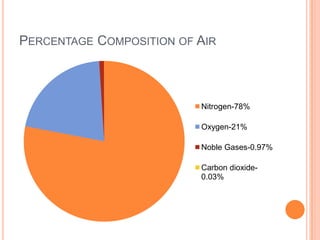
PERCENTAGE COMPOSITION OF AIR

Nitrogen-78%
Oxygen-21%
Noble Gases-0.97%
Carbon dioxide0.03%
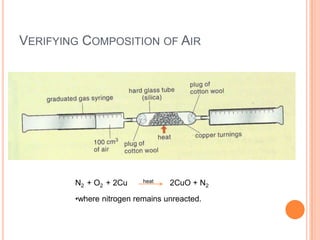
VERIFYING COMPOSITION OF AIR

N2 + O2 + 2Cu

heat

2CuO + N2

•where nitrogen remains unreacted.
VERIFYING COMPOSITION OF AIR:
PROCEDURE
100 cm3 of dry air (air is dried by passing over
anhydrous calcium chloride) filled in a graduated
gas syringe
 This air is passed back-and-forth over heated
copper using two syringes, attached on each side
of a hard glass (silica) tube (containing copper)
 On culmination of the experiment, 79 cm3 of dry gas
remains, indicating that 21 cm3 has been used by
copper
 On analysis, the remaining gas is found to be
mainly nitrogen and pink copper metal turns to
black copper (II) oxide

LIQUEFACTION OF AIR
Air is mainly comprised to two diatomic
gases, namely nitrogen, N2, and oxygen O2
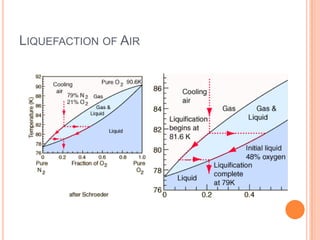
 By principle, the liquefaction point of air should lie
between those of pure N2 (77K) and pure O2
(90.6K)
 The liquefaction process begins at 81.6K (9K below
the liquefaction point of O2) and completes at 79K
(2K above the liquefaction point of N2), at one
atmospheric pressure
 Industrially, however, 200 atm. is used, so
aforementioned conditions do not necessarily
apply

LIQUEFACTION OF AIR
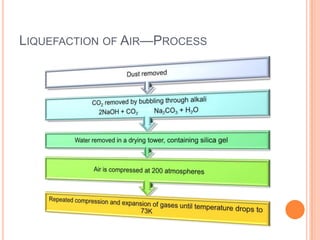
LIQUEFACTION OF AIR—PROCESS
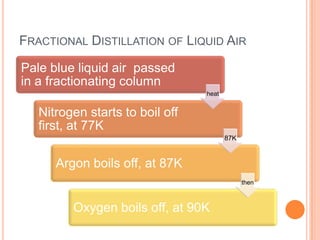
FRACTIONAL DISTILLATION OF LIQUID AIR
Pale blue liquid air passed
in a fractionating column
heat

Nitrogen starts to boil off
first, at 77K
87K

Argon boils off, at 87K
then

Oxygen boils off, at 90K
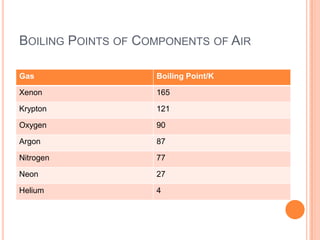
BOILING POINTS OF COMPONENTS OF AIR
Gas

Boiling Point/K

Xenon

165

Krypton

121

Oxygen

90

Argon

87

Nitrogen

77

Neon

27

Helium

4
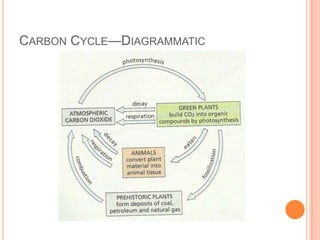
CARBON CYCLE—DIAGRAMMATIC
CARBON CYCLE
Earth’s crust contains carbon compounds
(carbonates, fuels)
 Atmosphere contains carbon in form of carbon
dioxide, mainly released by respiration:
C6H12O6 + 6O2
6CO2 + 6H2O (ΔH = -ve)
 Also released when fuels combust:
C + O2
CO2
 CO2 used by plants to manufacture sugars, in
photosynthesis:
6CO2 + 6H2O
C6H12O6 + 6O2 (ΔH = +ve)
 Decomposition and fossilization return carbon
compounds of living things to soil

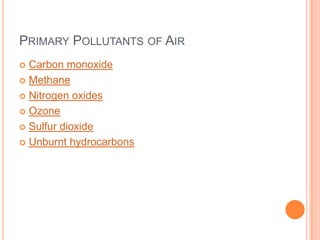
PRIMARY POLLUTANTS OF AIR
Carbon monoxide
 Methane
 Nitrogen oxides
 Ozone
 Sulfur dioxide
 Unburnt hydrocarbons

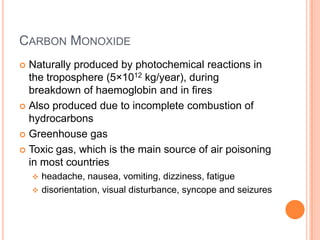
CARBON MONOXIDE
Naturally produced by photochemical reactions in
the troposphere (5×10¹² kg/year), during
breakdown of haemoglobin and in fires
 Also produced due to incomplete combustion of
hydrocarbons
 Greenhouse gas
 Toxic gas, which is the main source of air poisoning
in most countries




headache, nausea, vomiting, dizziness, fatigue
 disorientation, visual disturbance, syncope and seizures
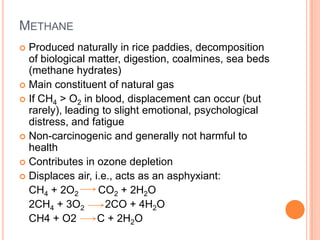
METHANE
Produced naturally in rice paddies, decomposition
of biological matter, digestion, coalmines, sea beds
(methane hydrates)
 Main constituent of natural gas
 If CH4 > O2 in blood, displacement can occur (but
rarely), leading to slight emotional, psychological
distress, and fatigue
 Non-carcinogenic and generally not harmful to
health
 Contributes in ozone depletion
 Displaces air, i.e., acts as an asphyxiant:
CH4 + 2O2
CO2 + 2H2O
2CH4 + 3O2
2CO + 4H2O
CH4 + O2
C + 2H2O

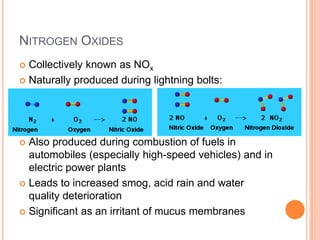
NITROGEN OXIDES
Collectively known as NOx
 Naturally produced during lightning bolts:


Also produced during combustion of fuels in
automobiles (especially high-speed vehicles) and in
electric power plants
 Leads to increased smog, acid rain and water
quality deterioration
 Significant as an irritant of mucus membranes

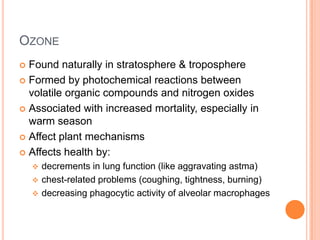
OZONE
Found naturally in stratosphere & troposphere
 Formed by photochemical reactions between
volatile organic compounds and nitrogen oxides
 Associated with increased mortality, especially in
warm season
 Affect plant mechanisms
 Affects health by:




decrements in lung function (like aggravating astma)
 chest-related problems (coughing, tightness, burning)
 decreasing phagocytic activity of alveolar macrophages
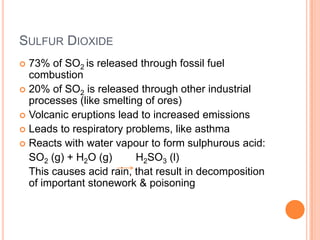
SULFUR DIOXIDE
73% of SO2 is released through fossil fuel
combustion
 20% of SO2 is released through other industrial
processes (like smelting of ores)
 Volcanic eruptions lead to increased emissions
 Leads to respiratory problems, like asthma
 Reacts with water vapour to form sulphurous acid:
SO2 (g) + H2O (g)
H2SO3 (l)
This causes acid rain, that result in decomposition
of important stonework & poisoning

UNBURNT HYDROCARBONS
Formed by low-temperature combustion of fossil
fuels, and from fuel ‘avoiding’ the flame zones in
combustion engines
 Evaporation of petroleum also leads increased
emissions
 Hydrocarbons like benzene are carcinogenic and
prevent normal cell metamorphosis
 React with UV light and combine with other
pollutants, especially NOx to form photochemical
smog

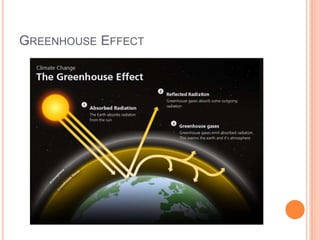
GREENHOUSE EFFECT
EFFECTS OF GREENHOUSE GASES
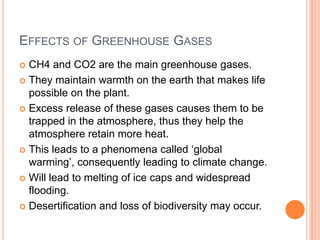
CH4 and CO2 are the main greenhouse gases.
 They maintain warmth on the earth that makes life
possible on the plant.
 Excess release of these gases causes them to be
trapped in the atmosphere, thus they help the
atmosphere retain more heat.
 This leads to a phenomena called ‘global
warming’, consequently leading to climate change.
 Will lead to melting of ice caps and widespread
flooding.
 Desertification and loss of biodiversity may occur.

THE OZONE LAYER
30,000 metres above the mean altitude of the earth;
lies in the stratosphere
 Very warm, as absorbs UV light
 Stops clouds & water vapour from escaping
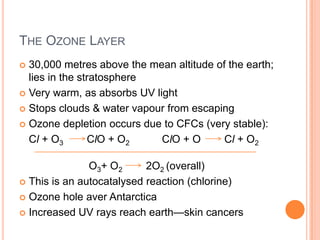
 Ozone depletion occurs due to CFCs (very stable):
Cl + O3
ClO + O2
ClO + O
Cl + O2


O 3+ O 2
2O2 (overall)
 This is an autocatalysed reaction (chlorine)
 Ozone hole aver Antarctica
 Increased UV rays reach earth—skin cancers
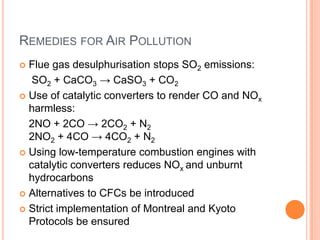
REMEDIES FOR AIR POLLUTION
Flue gas desulphurisation stops SO2 emissions:
SO2 + CaCO3 → CaSO3 + CO2
 Use of catalytic converters to render CO and NOx
harmless:
2NO + 2CO → 2CO2 + N2
2NO2 + 4CO → 4CO2 + N2
 Using low-temperature combustion engines with
catalytic converters reduces NOx and unburnt
hydrocarbons
 Alternatives to CFCs be introduced
 Strict implementation of Montreal and Kyoto
Protocols be ensured

BIBLIOGRAPHY














Chemistry—A Course for O-Level by Christopher N.
Prescott
http://hyperphysics.phyastr.gsu.edu/hbase/thermo/liqair.html
GCSE Biology by D.G. Mackean
http://en.wikipedia.org/wiki/Carbon_monoxide
http://www.ccohs.ca/oshanswers/chemicals/chem_profil
es/methane.html
http://en.wikipedia.org/wiki/Methane
http://chemwiki.ucdavis.edu/Physical_Chemistry/Acids_
and_Bases/Case_Studies/Acid_Rain/Sources_of_Nitrog
en_Oxides
http://www.epa.gov/iaq/no2.html
http://www.a2gov.org/government/publicservices/system
s_planning/Environment/soe07/cleanair/Pages/nox.aspx
http://www.epa.gov/apti/ozonehealth/population.html
http://www.epa.gov/region07/air/quality/o3health.htm
BIBLIOGRAPHY
http://www.epa.gov/airquality/sulfurdioxide/
 http://www.epa.gov/airquality/sulfurdioxide/health.ht
ml
 http://prezi.com/sp-kbyuw0v4v/methane-andunburnt-hydrocarbons-consequences-andresolutions/
 http://en.wikipedia.org/wiki/Unburned_hydrocarbon
 http://papers.sae.org/2009-01-2729/
 http://www.edfenergy.com/energyfuture/images/sch
ematic/greenhouse-effect.jpg
 Environmental Management—A Core Text for O
Level and IGCSE by John Pallister
 http://www.xtremepapers.com/revision/gcse/chemis
try/air_and_water.php


Environmental chemistry

  • 1.
    ENVIRONMENTAL CHEMISTRY Muhammad AreebNafey uddin Siddiqui Muhammad Aleem Ansari Haadi Uddin Ahmed Muhammad Hassaan Fawad
  • 2.
    PERCENTAGE COMPOSITION OFAIR Nitrogen-78% Oxygen-21% Noble Gases-0.97% Carbon dioxide0.03%
  • 3.
    VERIFYING COMPOSITION OFAIR N2 + O2 + 2Cu heat 2CuO + N2 •where nitrogen remains unreacted.
  • 4.
    VERIFYING COMPOSITION OFAIR: PROCEDURE 100 cm3 of dry air (air is dried by passing over anhydrous calcium chloride) filled in a graduated gas syringe  This air is passed back-and-forth over heated copper using two syringes, attached on each side of a hard glass (silica) tube (containing copper)  On culmination of the experiment, 79 cm3 of dry gas remains, indicating that 21 cm3 has been used by copper  On analysis, the remaining gas is found to be mainly nitrogen and pink copper metal turns to black copper (II) oxide 
  • 5.
    LIQUEFACTION OF AIR Airis mainly comprised to two diatomic gases, namely nitrogen, N2, and oxygen O2  By principle, the liquefaction point of air should lie between those of pure N2 (77K) and pure O2 (90.6K)  The liquefaction process begins at 81.6K (9K below the liquefaction point of O2) and completes at 79K (2K above the liquefaction point of N2), at one atmospheric pressure  Industrially, however, 200 atm. is used, so aforementioned conditions do not necessarily apply 
  • 6.
  • 7.
  • 8.
    FRACTIONAL DISTILLATION OFLIQUID AIR Pale blue liquid air passed in a fractionating column heat Nitrogen starts to boil off first, at 77K 87K Argon boils off, at 87K then Oxygen boils off, at 90K
  • 9.
    BOILING POINTS OFCOMPONENTS OF AIR Gas Boiling Point/K Xenon 165 Krypton 121 Oxygen 90 Argon 87 Nitrogen 77 Neon 27 Helium 4
  • 10.
  • 11.
    CARBON CYCLE Earth’s crustcontains carbon compounds (carbonates, fuels)  Atmosphere contains carbon in form of carbon dioxide, mainly released by respiration: C6H12O6 + 6O2 6CO2 + 6H2O (ΔH = -ve)  Also released when fuels combust: C + O2 CO2  CO2 used by plants to manufacture sugars, in photosynthesis: 6CO2 + 6H2O C6H12O6 + 6O2 (ΔH = +ve)  Decomposition and fossilization return carbon compounds of living things to soil 
  • 12.
    PRIMARY POLLUTANTS OFAIR Carbon monoxide  Methane  Nitrogen oxides  Ozone  Sulfur dioxide  Unburnt hydrocarbons 
  • 13.
    CARBON MONOXIDE Naturally producedby photochemical reactions in the troposphere (5×10¹² kg/year), during breakdown of haemoglobin and in fires  Also produced due to incomplete combustion of hydrocarbons  Greenhouse gas  Toxic gas, which is the main source of air poisoning in most countries   headache, nausea, vomiting, dizziness, fatigue  disorientation, visual disturbance, syncope and seizures
  • 14.
    METHANE Produced naturally inrice paddies, decomposition of biological matter, digestion, coalmines, sea beds (methane hydrates)  Main constituent of natural gas  If CH4 > O2 in blood, displacement can occur (but rarely), leading to slight emotional, psychological distress, and fatigue  Non-carcinogenic and generally not harmful to health  Contributes in ozone depletion  Displaces air, i.e., acts as an asphyxiant: CH4 + 2O2 CO2 + 2H2O 2CH4 + 3O2 2CO + 4H2O CH4 + O2 C + 2H2O 
  • 15.
    NITROGEN OXIDES Collectively knownas NOx  Naturally produced during lightning bolts:  Also produced during combustion of fuels in automobiles (especially high-speed vehicles) and in electric power plants  Leads to increased smog, acid rain and water quality deterioration  Significant as an irritant of mucus membranes 
  • 16.
    OZONE Found naturally instratosphere & troposphere  Formed by photochemical reactions between volatile organic compounds and nitrogen oxides  Associated with increased mortality, especially in warm season  Affect plant mechanisms  Affects health by:   decrements in lung function (like aggravating astma)  chest-related problems (coughing, tightness, burning)  decreasing phagocytic activity of alveolar macrophages
  • 17.
    SULFUR DIOXIDE 73% ofSO2 is released through fossil fuel combustion  20% of SO2 is released through other industrial processes (like smelting of ores)  Volcanic eruptions lead to increased emissions  Leads to respiratory problems, like asthma  Reacts with water vapour to form sulphurous acid: SO2 (g) + H2O (g) H2SO3 (l) This causes acid rain, that result in decomposition of important stonework & poisoning 
  • 18.
    UNBURNT HYDROCARBONS Formed bylow-temperature combustion of fossil fuels, and from fuel ‘avoiding’ the flame zones in combustion engines  Evaporation of petroleum also leads increased emissions  Hydrocarbons like benzene are carcinogenic and prevent normal cell metamorphosis  React with UV light and combine with other pollutants, especially NOx to form photochemical smog 
  • 19.
  • 20.
    EFFECTS OF GREENHOUSEGASES CH4 and CO2 are the main greenhouse gases.  They maintain warmth on the earth that makes life possible on the plant.  Excess release of these gases causes them to be trapped in the atmosphere, thus they help the atmosphere retain more heat.  This leads to a phenomena called ‘global warming’, consequently leading to climate change.  Will lead to melting of ice caps and widespread flooding.  Desertification and loss of biodiversity may occur. 
  • 21.
    THE OZONE LAYER 30,000metres above the mean altitude of the earth; lies in the stratosphere  Very warm, as absorbs UV light  Stops clouds & water vapour from escaping  Ozone depletion occurs due to CFCs (very stable): Cl + O3 ClO + O2 ClO + O Cl + O2  O 3+ O 2 2O2 (overall)  This is an autocatalysed reaction (chlorine)  Ozone hole aver Antarctica  Increased UV rays reach earth—skin cancers
  • 22.
    REMEDIES FOR AIRPOLLUTION Flue gas desulphurisation stops SO2 emissions: SO2 + CaCO3 → CaSO3 + CO2  Use of catalytic converters to render CO and NOx harmless: 2NO + 2CO → 2CO2 + N2 2NO2 + 4CO → 4CO2 + N2  Using low-temperature combustion engines with catalytic converters reduces NOx and unburnt hydrocarbons  Alternatives to CFCs be introduced  Strict implementation of Montreal and Kyoto Protocols be ensured 
  • 23.
    BIBLIOGRAPHY            Chemistry—A Course forO-Level by Christopher N. Prescott http://hyperphysics.phyastr.gsu.edu/hbase/thermo/liqair.html GCSE Biology by D.G. Mackean http://en.wikipedia.org/wiki/Carbon_monoxide http://www.ccohs.ca/oshanswers/chemicals/chem_profil es/methane.html http://en.wikipedia.org/wiki/Methane http://chemwiki.ucdavis.edu/Physical_Chemistry/Acids_ and_Bases/Case_Studies/Acid_Rain/Sources_of_Nitrog en_Oxides http://www.epa.gov/iaq/no2.html http://www.a2gov.org/government/publicservices/system s_planning/Environment/soe07/cleanair/Pages/nox.aspx http://www.epa.gov/apti/ozonehealth/population.html http://www.epa.gov/region07/air/quality/o3health.htm
  • 24.
    BIBLIOGRAPHY http://www.epa.gov/airquality/sulfurdioxide/  http://www.epa.gov/airquality/sulfurdioxide/health.ht ml  http://prezi.com/sp-kbyuw0v4v/methane-andunburnt-hydrocarbons-consequences-andresolutions/ http://en.wikipedia.org/wiki/Unburned_hydrocarbon  http://papers.sae.org/2009-01-2729/  http://www.edfenergy.com/energyfuture/images/sch ematic/greenhouse-effect.jpg  Environmental Management—A Core Text for O Level and IGCSE by John Pallister  http://www.xtremepapers.com/revision/gcse/chemis try/air_and_water.php 