INDUSTRY OF SUPHURIC ACID
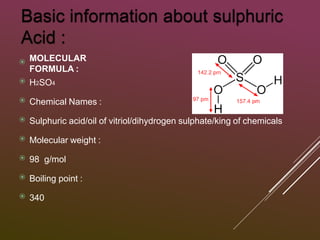
⦿ MOLECULAR
FORMULA :
⦿ H2SO4
⦿ Chemical Names :
⦿ Sulphuric acid/oil of vitriol/dihydrogen sulphate/king of chemicals
⦿ Molecular weight :
⦿ 98 g/mol
⦿ Boiling point :
⦿ 340
⦿Sulfuric acid is a colorless oily liquid.
⦿ It is soluble in water with release of heat.
⦿ It is corrosive to metals.
⦿There are two method of prepartaion :
1. Contact process
the major industrial process used to make sulphuric acid, by oxidizing
sulphur dioxide in the presence of a solid catalyst and absorbing the
resulting sulphur trioxide in water.
The Hot gases( SO2 ) evolved from burning of sulfur ore comes in
contact with catalyst bed, So the name of this process is called
contact process.
2. Lead chamber process
Produces relatively dilute acid (62%–78% H2SO4)
 Iron pyrite (FeS2)
 The mineral pyrite, or iron pyrite, also known as fool's gold, is an
iron sulfide with the chemical formula FeS₂. Pyrite is the most
abundant sulfide mineral. Pyrite's metallic luster and pale brass-
yellow hue give it a superficial resemblance to gold, hence the
well-known nickname of fool's gold
(Silicon free FeS2 contain about 53.4% S)
 Elemental sulfur
 Air
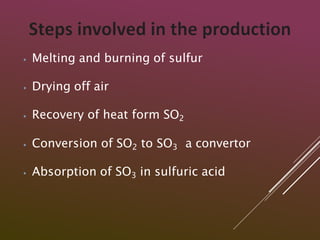
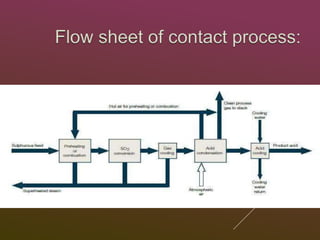
⦁ Melting and burning of sulfur
⦁ Drying off air
⦁ Recovery of heat form SO2
⦁ Conversion of SO2 to SO3 a convertor
⦁ Absorption of SO3 in sulfuric acid
S(s) + O2(g) → SO2(g)
2SO2(g) + O2(g) → 2SO3(g)
SO3(g) + H2SO4 → H2S2O7
H2S2O7(l) + H2O(l) → 2H2SO4(l)
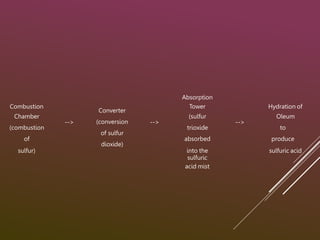
Absorption
Combustion
Chamber
(combustion
of
sulfur)
-->
Converter
(conversion
of sulfur
dioxide)
-->
Tower
(sulfur
trioxide
absorbed
into the
sulfuric
-->
Hydration of
Oleum
to
produce
sulfuric acid
acid mist
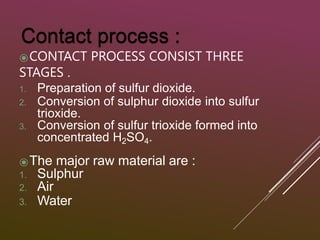
⦿CONTACT PROCESS CONSIST THREE
STAGES .
1. Preparation of sulfur dioxide.
2. Conversion of sulphur dioxide into sulfur
trioxide.
3. Conversion of sulfur trioxide formed into
concentrated H2SO4.
⦿The major raw material are :
1. Sulphur
2. Air
3. Water
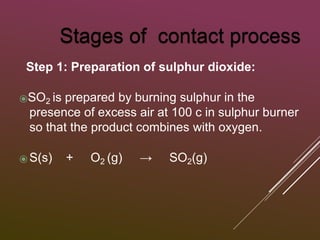
Step 1: Preparation of sulphur dioxide:
⦿SO2 is prepared by burning sulphur in the
presence of excess air at 100 c in sulphur burner
so that the product combines with oxygen.
⦿ S(s) + O2 (g) → SO2(g)
⦿Cooled the gases through cooler pipes.
⦿Passed through coarse coke filter.
⦿Then passes through cotterell electrostatic
mist precipitator.
Step 2: Preparation of sulphur trioxide:
⦿ WHEN SULPHUR DIOXIDE REACTS WITH
OXYGEN
AT A TEMPERATURE OF 400°C – 450°C AND
A PRESSURE OF 1.5-1.7 ATM IN THE
PRESENCE OF
N2O5 / vanadium pentaoxide / Asbestos as
a catalyst. This reaction is reversible in
nature.
⦿2SO2(g) + O2(g) ⇌ 2SO3(g)
⦿Cooled the gas
⦿And passed through absorption chamber
⦿Unreacted gas get back to catalytic
converter called chamber.
Step 3: Preparation of concentrated
sulphuric acid:
⦿The cooled sulfur trioxide is dissolved in
98% sulfuric acid in the absorption tower.
⦿ The acid is sprayed over the SO3 and
produces an oily liquid called oleum.
⦿H2SO4 + SO3(g) → H2S2O7
⦿Oleum tower is made up of brick- lined
steel.
⦿This is preferable over directly dissolving
sulfur trioxide in water as this forms
sulfuric acid mists, due to the large heat of
dissolution (130 kJ/mol), which are hard to
control and difficult to store. Also it is
difficult to separate the sulfuric acid gas
from others such as nitrogen
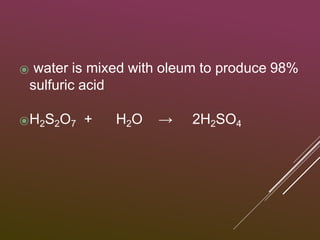
⦿ water is mixed with oleum to produce 98%
sulfuric acid
⦿H2S2O7 + H2O → 2H2SO4
⦿In Industries:
⦿It is used in the production of phosphoric
acid which is in turn used to make
phosphate fertilizers.
⦿It is used in the manufacturing of metals
such as copper, zinc etc.
⦿It is used in the making of fibers.
⦿Used in acidic drain cleaners.
⦿As a Catalyst:
⦿Used as a catalyst in the manufacturing
process of nylon.
⦿Used in the Manheim process in the
manufacturing of HCl.
⦿Used in petroleum refining.
Overview
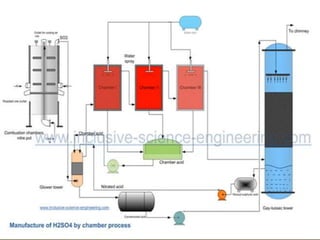
⦿This process contain several steps.
⦿Carried out in large lead lined chamber.
⦿SO2 is obtained by burnig suphur in
burner.
⦿S + O2 → SO2
⦿4 FeS2 + 11 O2 → 2 Fe2O3 + 8 SO2
In this method sulfur dioxide is oxidized by
oxygen in the air in the presence of oxides
of nitrogen. Nitrogen oxides act as
catalysts.
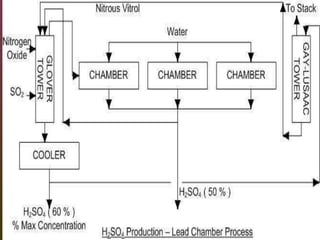
⦿Sulphur dioxide passes through lead chamber
in the presence of O2, NO, NO2
along with steam.
⦿SO2 is converted into H2SO4.
⦿Acid is 60-70% H2SO4.
⦿The plant employed in this process consist
of :
1. Pyrite burners SO2
2. Nitre pots NO
3. Lead chambers H2SO4 65-70%
4. Glover towers NOHSO4
5. Gay-lussac tower
6. Coolers
7. Purification of acid chamber
⦿Combustion of sulphur or sulphites is
carries ourt in a machenical furnace or the
flash roaster.
⦿Here the S is coverted into SO2.
⦿Contain the mixture of NaNO3 and H2SO4 .
⦿T
ower is about 15 into 50 feet .
⦿Lined with acid proof cement.
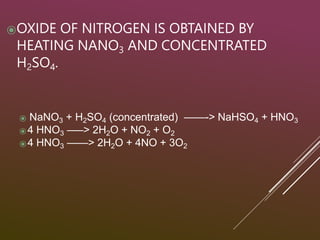
⦿OXIDE OF NITROGEN IS OBTAINED BY
HEATING NANO3 AND CONCENTRATED
H2SO4.
⦿ NaNO3 + H2SO4 (concentrated) ——-> NaHSO4 + HNO3
⦿4 HNO3 —–> 2H2O + NO2 + O2
⦿4 HNO3 ——> 2H2O + 4NO + 3O2
⦿MAJOR FUNCTION OF GLOVER
TOWER ARE :
1. Cooling the gases coming from pyrite burner
2. Conversion of some SO2 into SO3.
3. Concentrate the dilute acid.
4. Recovery of oxides of nitrogen from gay-lussac
tower.
5. Cleaning the burner gases.
⦿Box like room made up of sheet lead.
⦿No. of chmaber contain between 3-12.
⦿The gases from previous chamber enter in
lead chamber at 99 *C
⦿Chamber controlled through gase colour
changes and through temprature.
⦿Afford space and time for reaction.
⦿Conversion of SO2 into SO3.
⦿To radiate heat produced by chemical
reaction.
⦿Furnished surface for condensation of the
acid mist formed.
⦿Filled with tile with tile packing.
⦿Provide maximum area for contact.
⦿Also recover oxides of nitrogen coming
from gases coming from lead chamber.
⦿Consist No. of tanks ( at least three ).
⦿Set in series made up of sheet leads.
⦿Coils of lead pipes have cooled water in it.
⦿Firstly acid from glover tower enter the first
cooler at 130-150 *C
⦿The temprature of acid remains only 30-4- *C
at the end.
⦿CHAMBER ACID USUALLY USED
FOR
1. Fertillizers
2. Pickling of iron
3. In paints etx
 ⦿ Chamber acid contain small
amount of lead, oxides of
nitrogen, iron or aluminium
dissolved from tower.
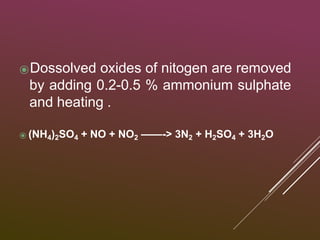
⦿Dossolved oxides of nitogen are removed
by adding 0.2-0.5 % ammonium sulphate
and heating .
⦿ (NH4)2SO4 + NO + NO2 ——-> 3N2 + H2SO4 + 3H2O
Sulfuric Acid.pptx

Sulfuric Acid.pptx

  • 1.
  • 2.
    ⦿ MOLECULAR FORMULA : ⦿H2SO4 ⦿ Chemical Names : ⦿ Sulphuric acid/oil of vitriol/dihydrogen sulphate/king of chemicals ⦿ Molecular weight : ⦿ 98 g/mol ⦿ Boiling point : ⦿ 340
  • 3.
    ⦿Sulfuric acid isa colorless oily liquid. ⦿ It is soluble in water with release of heat. ⦿ It is corrosive to metals.
  • 4.
    ⦿There are twomethod of prepartaion : 1. Contact process the major industrial process used to make sulphuric acid, by oxidizing sulphur dioxide in the presence of a solid catalyst and absorbing the resulting sulphur trioxide in water. The Hot gases( SO2 ) evolved from burning of sulfur ore comes in contact with catalyst bed, So the name of this process is called contact process. 2. Lead chamber process Produces relatively dilute acid (62%–78% H2SO4)
  • 5.
     Iron pyrite(FeS2)  The mineral pyrite, or iron pyrite, also known as fool's gold, is an iron sulfide with the chemical formula FeS₂. Pyrite is the most abundant sulfide mineral. Pyrite's metallic luster and pale brass- yellow hue give it a superficial resemblance to gold, hence the well-known nickname of fool's gold (Silicon free FeS2 contain about 53.4% S)  Elemental sulfur  Air
  • 6.
    ⦁ Melting andburning of sulfur ⦁ Drying off air ⦁ Recovery of heat form SO2 ⦁ Conversion of SO2 to SO3 a convertor ⦁ Absorption of SO3 in sulfuric acid
  • 7.
    S(s) + O2(g)→ SO2(g) 2SO2(g) + O2(g) → 2SO3(g) SO3(g) + H2SO4 → H2S2O7 H2S2O7(l) + H2O(l) → 2H2SO4(l)
  • 8.
  • 9.
    ⦿CONTACT PROCESS CONSISTTHREE STAGES . 1. Preparation of sulfur dioxide. 2. Conversion of sulphur dioxide into sulfur trioxide. 3. Conversion of sulfur trioxide formed into concentrated H2SO4. ⦿The major raw material are : 1. Sulphur 2. Air 3. Water
  • 10.
    Step 1: Preparationof sulphur dioxide: ⦿SO2 is prepared by burning sulphur in the presence of excess air at 100 c in sulphur burner so that the product combines with oxygen. ⦿ S(s) + O2 (g) → SO2(g)
  • 11.
    ⦿Cooled the gasesthrough cooler pipes. ⦿Passed through coarse coke filter. ⦿Then passes through cotterell electrostatic mist precipitator.
  • 12.
    Step 2: Preparationof sulphur trioxide: ⦿ WHEN SULPHUR DIOXIDE REACTS WITH OXYGEN AT A TEMPERATURE OF 400°C – 450°C AND A PRESSURE OF 1.5-1.7 ATM IN THE PRESENCE OF N2O5 / vanadium pentaoxide / Asbestos as a catalyst. This reaction is reversible in nature. ⦿2SO2(g) + O2(g) ⇌ 2SO3(g)
  • 13.
    ⦿Cooled the gas ⦿Andpassed through absorption chamber ⦿Unreacted gas get back to catalytic converter called chamber.
  • 14.
    Step 3: Preparationof concentrated sulphuric acid: ⦿The cooled sulfur trioxide is dissolved in 98% sulfuric acid in the absorption tower. ⦿ The acid is sprayed over the SO3 and produces an oily liquid called oleum. ⦿H2SO4 + SO3(g) → H2S2O7
  • 15.
    ⦿Oleum tower ismade up of brick- lined steel. ⦿This is preferable over directly dissolving sulfur trioxide in water as this forms sulfuric acid mists, due to the large heat of dissolution (130 kJ/mol), which are hard to control and difficult to store. Also it is difficult to separate the sulfuric acid gas from others such as nitrogen
  • 16.
    ⦿ water ismixed with oleum to produce 98% sulfuric acid ⦿H2S2O7 + H2O → 2H2SO4
  • 18.
    ⦿In Industries: ⦿It isused in the production of phosphoric acid which is in turn used to make phosphate fertilizers. ⦿It is used in the manufacturing of metals such as copper, zinc etc. ⦿It is used in the making of fibers. ⦿Used in acidic drain cleaners.
  • 19.
    ⦿As a Catalyst: ⦿Usedas a catalyst in the manufacturing process of nylon. ⦿Used in the Manheim process in the manufacturing of HCl. ⦿Used in petroleum refining.
  • 20.
    Overview ⦿This process containseveral steps. ⦿Carried out in large lead lined chamber. ⦿SO2 is obtained by burnig suphur in burner. ⦿S + O2 → SO2 ⦿4 FeS2 + 11 O2 → 2 Fe2O3 + 8 SO2
  • 21.
    In this methodsulfur dioxide is oxidized by oxygen in the air in the presence of oxides of nitrogen. Nitrogen oxides act as catalysts. ⦿Sulphur dioxide passes through lead chamber in the presence of O2, NO, NO2 along with steam. ⦿SO2 is converted into H2SO4. ⦿Acid is 60-70% H2SO4.
  • 22.
    ⦿The plant employedin this process consist of : 1. Pyrite burners SO2 2. Nitre pots NO 3. Lead chambers H2SO4 65-70% 4. Glover towers NOHSO4 5. Gay-lussac tower 6. Coolers 7. Purification of acid chamber
  • 24.
    ⦿Combustion of sulphuror sulphites is carries ourt in a machenical furnace or the flash roaster. ⦿Here the S is coverted into SO2.
  • 25.
    ⦿Contain the mixtureof NaNO3 and H2SO4 . ⦿T ower is about 15 into 50 feet . ⦿Lined with acid proof cement.
  • 26.
    ⦿OXIDE OF NITROGENIS OBTAINED BY HEATING NANO3 AND CONCENTRATED H2SO4. ⦿ NaNO3 + H2SO4 (concentrated) ——-> NaHSO4 + HNO3 ⦿4 HNO3 —–> 2H2O + NO2 + O2 ⦿4 HNO3 ——> 2H2O + 4NO + 3O2
  • 27.
    ⦿MAJOR FUNCTION OFGLOVER TOWER ARE : 1. Cooling the gases coming from pyrite burner 2. Conversion of some SO2 into SO3. 3. Concentrate the dilute acid. 4. Recovery of oxides of nitrogen from gay-lussac tower. 5. Cleaning the burner gases.
  • 28.
    ⦿Box like roommade up of sheet lead. ⦿No. of chmaber contain between 3-12. ⦿The gases from previous chamber enter in lead chamber at 99 *C ⦿Chamber controlled through gase colour changes and through temprature.
  • 29.
    ⦿Afford space andtime for reaction. ⦿Conversion of SO2 into SO3. ⦿To radiate heat produced by chemical reaction. ⦿Furnished surface for condensation of the acid mist formed.
  • 30.
    ⦿Filled with tilewith tile packing. ⦿Provide maximum area for contact. ⦿Also recover oxides of nitrogen coming from gases coming from lead chamber.
  • 31.
    ⦿Consist No. oftanks ( at least three ). ⦿Set in series made up of sheet leads. ⦿Coils of lead pipes have cooled water in it. ⦿Firstly acid from glover tower enter the first cooler at 130-150 *C ⦿The temprature of acid remains only 30-4- *C at the end.
  • 32.
    ⦿CHAMBER ACID USUALLYUSED FOR 1. Fertillizers 2. Pickling of iron 3. In paints etx  ⦿ Chamber acid contain small amount of lead, oxides of nitrogen, iron or aluminium dissolved from tower.
  • 33.
    ⦿Dossolved oxides ofnitogen are removed by adding 0.2-0.5 % ammonium sulphate and heating . ⦿ (NH4)2SO4 + NO + NO2 ——-> 3N2 + H2SO4 + 3H2O