G Mothy
3132
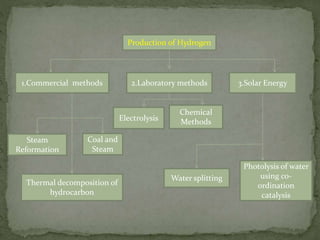
Production of Hydrogen
1.Commercial methods 2.Laboratory methods 3.Solar Energy
Steam
Reformation
Coal and
Steam
Thermal decomposition of
hydrocarbon
Electrolysis
Chemical
Methods
Water splitting
Photolysis of water
using co-
ordination
catalysis
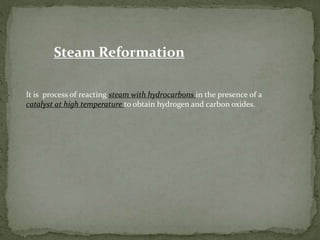
Steam Reformation
It is process of reacting steam with hydrocarbons in the presence of a
catalyst at high temperature to obtain hydrogen and carbon oxides.
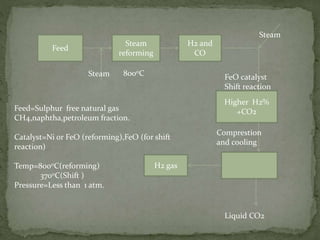
Feed
Steam
reforming
8000CSteam
H2 and
CO
Higher H2%
+CO2
Steam
FeO catalyst
Shift reaction
Comprestion
and cooling
H2 gas
Liquid CO2
Feed=Sulphur free natural gas
CH4,naphtha,petroleum fraction.
Catalyst=Ni or FeO (reforming),FeO (for shift
reaction)
Temp=8000C(reforming)
3700C(Shift )
Pressure=Less than 1 atm.
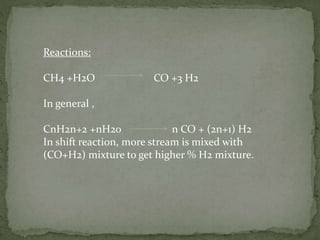
Reactions:
CH4 +H2O CO +3 H2
In general ,
CnH2n+2 +nH2o n CO + (2n+1) H2
In shift reaction, more stream is mixed with
(CO+H2) mixture to get higher % H2 mixture.
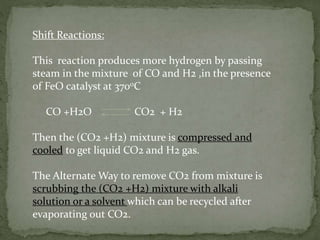
Shift Reactions:
This reaction produces more hydrogen by passing
steam in the mixture of CO and H2 ,in the presence
of FeO catalyst at 3700C
CO +H2O CO2 + H2
Then the (CO2 +H2) mixture is compressed and
cooled to get liquid CO2 and H2 gas.
The Alternate Way to remove CO2 from mixture is
scrubbing the (CO2 +H2) mixture with alkali
solution or a solvent which can be recycled after
evaporating out CO2.
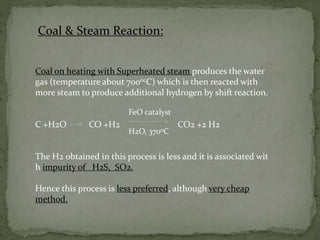
Coal & Steam Reaction:
Coal on heating with Superheated steam produces the water
gas (temperature about 7000cC) which is then reacted with
more steam to produce additional hydrogen by shift reaction.
C +H2O CO +H2 CO2 +2 H2
The H2 obtained in this process is less and it is associated wit
h impurity of H2S, SO2.
Hence this process is less preferred, although very cheap
method.
FeO catalyst
H2O, 3700C
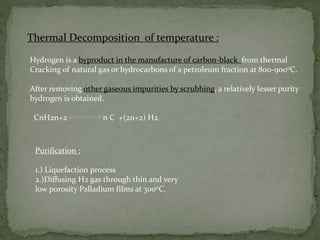
Thermal Decomposition of temperature :
Hydrogen is a byproduct in the manufacture of carbon-black from thermal
Cracking of natural gas or hydrocarbons of a petroleum fraction at 800-9000C.
After removing other gaseous impurities by scrubbing, a relatively lesser purity
hydrogen is obtained.
CnH2n+2 n C +(2n+2) H2
Purification :
1.) Liquefaction process
2.)Diffusing H2 gas through thin and very
low porosity Palladium films at 3000C.

Ppt on hydrogen preparation

  • 1.
  • 2.
    Production of Hydrogen 1.Commercialmethods 2.Laboratory methods 3.Solar Energy Steam Reformation Coal and Steam Thermal decomposition of hydrocarbon Electrolysis Chemical Methods Water splitting Photolysis of water using co- ordination catalysis
  • 3.
    Steam Reformation It isprocess of reacting steam with hydrocarbons in the presence of a catalyst at high temperature to obtain hydrogen and carbon oxides.
  • 4.
    Feed Steam reforming 8000CSteam H2 and CO Higher H2% +CO2 Steam FeOcatalyst Shift reaction Comprestion and cooling H2 gas Liquid CO2 Feed=Sulphur free natural gas CH4,naphtha,petroleum fraction. Catalyst=Ni or FeO (reforming),FeO (for shift reaction) Temp=8000C(reforming) 3700C(Shift ) Pressure=Less than 1 atm.
  • 5.
    Reactions: CH4 +H2O CO+3 H2 In general , CnH2n+2 +nH2o n CO + (2n+1) H2 In shift reaction, more stream is mixed with (CO+H2) mixture to get higher % H2 mixture.
  • 6.
    Shift Reactions: This reactionproduces more hydrogen by passing steam in the mixture of CO and H2 ,in the presence of FeO catalyst at 3700C CO +H2O CO2 + H2 Then the (CO2 +H2) mixture is compressed and cooled to get liquid CO2 and H2 gas. The Alternate Way to remove CO2 from mixture is scrubbing the (CO2 +H2) mixture with alkali solution or a solvent which can be recycled after evaporating out CO2.
  • 7.
    Coal & SteamReaction: Coal on heating with Superheated steam produces the water gas (temperature about 7000cC) which is then reacted with more steam to produce additional hydrogen by shift reaction. C +H2O CO +H2 CO2 +2 H2 The H2 obtained in this process is less and it is associated wit h impurity of H2S, SO2. Hence this process is less preferred, although very cheap method. FeO catalyst H2O, 3700C
  • 8.
    Thermal Decomposition oftemperature : Hydrogen is a byproduct in the manufacture of carbon-black from thermal Cracking of natural gas or hydrocarbons of a petroleum fraction at 800-9000C. After removing other gaseous impurities by scrubbing, a relatively lesser purity hydrogen is obtained. CnH2n+2 n C +(2n+2) H2 Purification : 1.) Liquefaction process 2.)Diffusing H2 gas through thin and very low porosity Palladium films at 3000C.