



HUMAN BEHAVIOUR AND
     PERSONALITY DEVELOPMENT
• Supervised by:
                   Ms. Sonia
                   (Lecturer, NIN)

• Presented by:
                   Monika sharma
                   (M.Sc. Nursing 1st year)
INTRODUCTION

• Human behavior refers to the range of activities
  exhibited by humans and which are influenced by
  culture, attitudes, emotions, values, ethics, authority,
  rapport and genetic factors.
Definition:

• Human behavior, in general is the potential and
  expressed capacity for physical, mental, and
  social activity during the phases of human life.
                          OR
  Behavior can be defined as a response/s which
  is observed directly/indirectly. Direct
  observation is possible by studying the
  responses of people to a work environment.
  Indirect observations are decision
ASSUMPTION:

• Individual Differences:
• A Whole Person:
• Caused Behavior (Motivation):
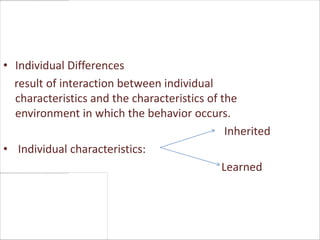
• Individual Differences
  result of interaction between individual
  characteristics and the characteristics of the
  environment in which the behavior occurs.
                                              Inherited
• Individual characteristics:
                                             Learned
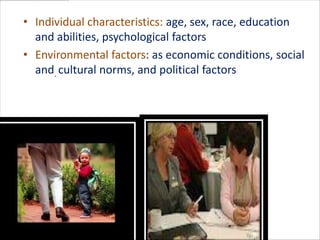
• Individual characteristics: age, sex, race, education
  and abilities, psychological factors
• Environmental factors: as economic conditions, social
  and. cultural norms, and political factors
• social environment: relationships with family, friends,
  co-workers, supervisors and subordinates and
  membership in groups such as unions
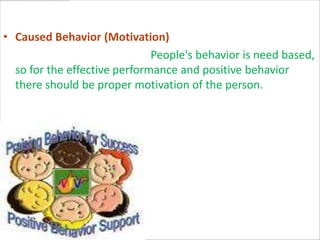
• Caused Behavior (Motivation)
                              People's behavior is need based,
  so for the effective performance and positive behavior
  there should be proper motivation of the person.
• Value of the Person (Human Dignity):
 People have to be treated with respect and as an
  individual.
 They should be recognized and treated accordingly
  to increase uniqueness of the person.
MODELS OF HUMAN BEHAVIOUR:

•   Psychoanalytic Model
•   Existential Model
•   Internal vs. External Determinants of Behavior
•   Personality vs. the Environment
•   Cognition vs. the Environment
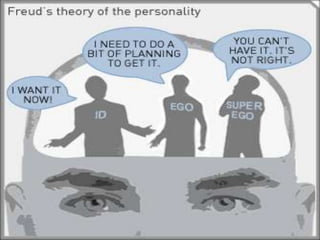
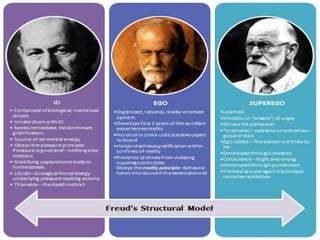
• Psychoanalytic Model (Freud):
   behavior is not always consciously explained.
  "Unconscious" is the major factor which guides the
  individual's behavior.
  behavior depends on three factors:
 id, Ego and Super ego.
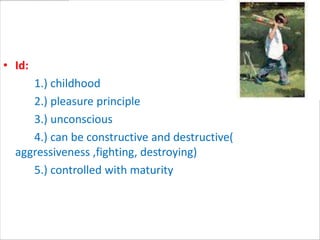
• Id:
     1.) childhood
     2.) pleasure principle
     3.) unconscious
     4.) can be constructive and destructive(
  aggressiveness ,fighting, destroying)
     5.) controlled with maturity
• Ego:
         1.) conscious stage of behaving
         2.) maintain balance between id and
              superego
•   Superego:
•   1.) represents conscience of the individual
•   2.)Based on perfection principles.
•   3.) depend upon cultural values and morals
Existential Model:

• the depersonalizing effects of environment forces
  individuals to make their own destiny. So the
  individuals shape their own identity and make their
  "existence" meaningful and worthwhile to
  themselves.

          (survival for the fittest)
Internal vs. External Determinants of Behaviour


• Internal: genetic endowment
• External: environment
Personality vs. the Environment

• Both personality and situational variables
  must be taken into account in order to explain
  an individual's behavior
Cognition vs. the Environment

• Depends upon individual's past responses

           (Stimulus and response)
need to study Human Nature :
Personality

• Acc. To Munn N.L :
  “Personality may be defined as the most
   characteristic, an integration of individual structures,
   mode of behavior, interests, attitudes, capacities,
   abilities and aptitude”.
Personality development:

•   Different on different stages
•   Childhood
•   Adolescence
•   Adulthood
•   Old age
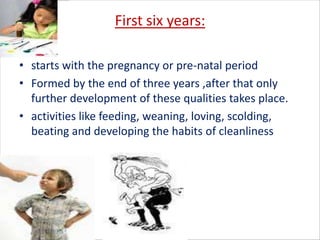
First six years:

• starts with the pregnancy or pre-natal period
• Formed by the end of three years ,after that only
  further development of these qualities takes place.
• activities like feeding, weaning, loving, scolding,
  beating and developing the habits of cleanliness
• Proper love and care -- emotional stability
• Excessive love and pampering --- unnstable and
  stubborn

• 2-3 years: friendship, determination and influencing
  others
• of 4-5 years: competitiveness develops.
Pre-adolescence or Pre-pubertal childhood

• pre-pubertal childhood
        1.) school environment affects the child.
         2.) child learns equality, freedom and
  independent.
         3.) Success and failure during adjustment in
  the group teaches good and bad habits in the child.
        4.) leans leadership quality.
Puberty and adolescence :

• maturing of sex organs
• more independent
• If child is restricted in this stage then personality
  development may stops
• development of personality
Adulthood:

• requires more adjustments
• do job, gets married and gives birth to children.
• If these are satisfactory, then personality remains
  balanced and if unsatisfactory then maintaining
  balance of personality becomes difficult.
•
Old age:

• No significant changes
THEORIES OF PERSONALITY
DEVELOPMENT:


•   Psycho-analytical theory:
•   Psychosocial theory:
•   Abrahm Maslow Theory:
•   Social Cognitive Theory:
•   TRAIT THEORY (Gordon Allport’s Trait Theory):
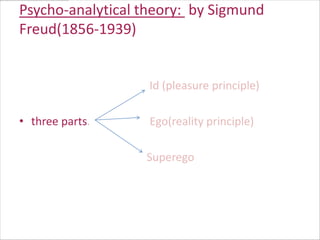
Psycho-analytical theory: by Sigmund
Freud(1856-1939)


                   Id (pleasure principle)

• three parts.     Ego(reality principle)

                  Superego
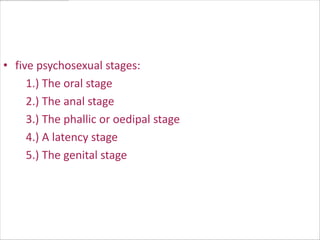
• five psychosexual stages:
     1.) The oral stage
     2.) The anal stage
     3.) The phallic or oedipal stage
     4.) A latency stage
     5.) The genital stage
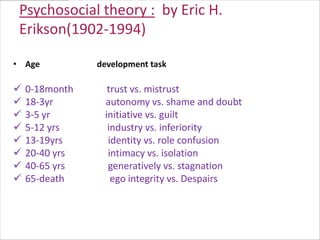
Psychosocial theory : by Eric H.
 Erikson(1902-1994)

• Age           development task

   0-18month     trust vs. mistrust
   18-3yr       autonomy vs. shame and doubt
   3-5 yr       initiative vs. guilt
   5-12 yrs      industry vs. inferiority
   13-19yrs      identity vs. role confusion
   20-40 yrs     intimacy vs. isolation
   40-65 yrs     generatively vs. stagnation
   65-death       ego integrity vs. Despairs
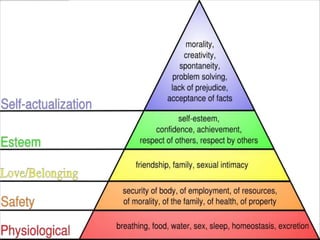
Abraham Maslow Theory:

• Two things:
 our capacity for growth or self actualization
 our desire to satisfy a variety of needs.
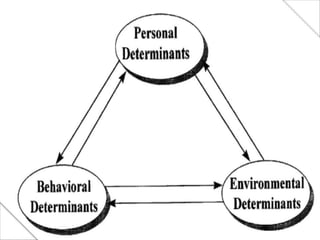
Social Cognitive Theory

• personality development is primarily shaped by three
  factors:
 Environmental
 Cognitive- personal factors
 Behavior
• Environment: social, cultural
• Cognitive: perception and interpretation
• Cognitive-personal: beliefs, values, expectations,
  genetic influences
TRAIT THEORY (Gordon Allport’s Trait
Theory):
• A trait are stable characteristic that causes
  individuals to behave in certain ways.
Types of traits

• cardinal traits(dominate an individual’s whole life,
  often to the point that the person becomes known
  specifically for these traits.)
• central traits (general characteristics, intelligent,
  honest, shy and anxious
• secondary traits ( These are the traits that are
  sometimes related to attitudes or preferences ) often
  appear only in certain situations or under specific
  circumstances. Some examples would be getting
  anxious when speaking to a group or impatient while
  waiting in line.
Conclusion:
Recaptulization
Bibliography
• Anthikad.Jacob. Psychology for Graduate Nurses,2004 third
  edition (New Delhi) Jaypee Brothers Medical Publishers
  Ltd.25-43
• Morgan, Understanding basic asychology
• http://en.wikipedia.org/wiki/Human_behavior
• http://library.thinkquest.org/26618/
• http://www.britannica.com/EBchecked/topic/275332/hum
  an-behaviour
• https://www.google.co.in/search?q=HUMAN+BEHAV
  IOUR&hl=en&prmd=imvnsb&tbm=isch&tbo=u&sour
  ce=univ&sa=X&ei=-
  NJMUN3rGILJrAeVw4CYDg&ved=0CFsQsAQ&biw=13
  66&bih=673
• http://www.humanbehaviour.com.hk/index.do
• http://sadhuji.blogspot.in/
• http://psychology.about.com/od/personalitydevelop
  ment/a/personality-dev.htm
Human behaviour.and personality development.ppt

Human behaviour.and personality development.ppt

  • 1.
    HUMAN BEHAVIOUR AND PERSONALITY DEVELOPMENT • Supervised by: Ms. Sonia (Lecturer, NIN) • Presented by: Monika sharma (M.Sc. Nursing 1st year)
  • 3.
    INTRODUCTION • Human behaviorrefers to the range of activities exhibited by humans and which are influenced by culture, attitudes, emotions, values, ethics, authority, rapport and genetic factors.
  • 4.
    Definition: • Human behavior,in general is the potential and expressed capacity for physical, mental, and social activity during the phases of human life. OR Behavior can be defined as a response/s which is observed directly/indirectly. Direct observation is possible by studying the responses of people to a work environment. Indirect observations are decision
  • 5.
    ASSUMPTION: • Individual Differences: •A Whole Person: • Caused Behavior (Motivation):
  • 6.
    • Individual Differences result of interaction between individual characteristics and the characteristics of the environment in which the behavior occurs. Inherited • Individual characteristics: Learned
  • 7.
    • Individual characteristics:age, sex, race, education and abilities, psychological factors • Environmental factors: as economic conditions, social and. cultural norms, and political factors
  • 8.
    • social environment:relationships with family, friends, co-workers, supervisors and subordinates and membership in groups such as unions
  • 9.
    • Caused Behavior(Motivation) People's behavior is need based, so for the effective performance and positive behavior there should be proper motivation of the person.
  • 10.
    • Value ofthe Person (Human Dignity):  People have to be treated with respect and as an individual.  They should be recognized and treated accordingly to increase uniqueness of the person.
  • 11.
    MODELS OF HUMANBEHAVIOUR: • Psychoanalytic Model • Existential Model • Internal vs. External Determinants of Behavior • Personality vs. the Environment • Cognition vs. the Environment
  • 12.
    • Psychoanalytic Model(Freud): behavior is not always consciously explained. "Unconscious" is the major factor which guides the individual's behavior. behavior depends on three factors:  id, Ego and Super ego.
  • 14.
    • Id: 1.) childhood 2.) pleasure principle 3.) unconscious 4.) can be constructive and destructive( aggressiveness ,fighting, destroying) 5.) controlled with maturity
  • 15.
    • Ego: 1.) conscious stage of behaving 2.) maintain balance between id and superego
  • 16.
    • Superego: • 1.) represents conscience of the individual • 2.)Based on perfection principles. • 3.) depend upon cultural values and morals
  • 17.
    Existential Model: • thedepersonalizing effects of environment forces individuals to make their own destiny. So the individuals shape their own identity and make their "existence" meaningful and worthwhile to themselves. (survival for the fittest)
  • 18.
    Internal vs. ExternalDeterminants of Behaviour • Internal: genetic endowment • External: environment
  • 19.
    Personality vs. theEnvironment • Both personality and situational variables must be taken into account in order to explain an individual's behavior
  • 20.
    Cognition vs. theEnvironment • Depends upon individual's past responses (Stimulus and response)
  • 21.
    need to studyHuman Nature :
  • 22.
    Personality • Acc. ToMunn N.L : “Personality may be defined as the most characteristic, an integration of individual structures, mode of behavior, interests, attitudes, capacities, abilities and aptitude”.
  • 23.
    Personality development: • Different on different stages • Childhood • Adolescence • Adulthood • Old age
  • 24.
    First six years: •starts with the pregnancy or pre-natal period • Formed by the end of three years ,after that only further development of these qualities takes place. • activities like feeding, weaning, loving, scolding, beating and developing the habits of cleanliness
  • 25.
    • Proper loveand care -- emotional stability • Excessive love and pampering --- unnstable and stubborn • 2-3 years: friendship, determination and influencing others • of 4-5 years: competitiveness develops.
  • 26.
    Pre-adolescence or Pre-pubertalchildhood • pre-pubertal childhood 1.) school environment affects the child. 2.) child learns equality, freedom and independent. 3.) Success and failure during adjustment in the group teaches good and bad habits in the child. 4.) leans leadership quality.
  • 27.
    Puberty and adolescence: • maturing of sex organs • more independent • If child is restricted in this stage then personality development may stops • development of personality
  • 28.
    Adulthood: • requires moreadjustments • do job, gets married and gives birth to children. • If these are satisfactory, then personality remains balanced and if unsatisfactory then maintaining balance of personality becomes difficult. •
  • 29.
    Old age: • Nosignificant changes
  • 30.
    THEORIES OF PERSONALITY DEVELOPMENT: • Psycho-analytical theory: • Psychosocial theory: • Abrahm Maslow Theory: • Social Cognitive Theory: • TRAIT THEORY (Gordon Allport’s Trait Theory):
  • 31.
    Psycho-analytical theory: bySigmund Freud(1856-1939) Id (pleasure principle) • three parts. Ego(reality principle) Superego
  • 33.
    • five psychosexualstages: 1.) The oral stage 2.) The anal stage 3.) The phallic or oedipal stage 4.) A latency stage 5.) The genital stage
  • 35.
    Psychosocial theory :by Eric H. Erikson(1902-1994) • Age development task  0-18month trust vs. mistrust  18-3yr autonomy vs. shame and doubt  3-5 yr initiative vs. guilt  5-12 yrs industry vs. inferiority  13-19yrs identity vs. role confusion  20-40 yrs intimacy vs. isolation  40-65 yrs generatively vs. stagnation  65-death ego integrity vs. Despairs
  • 37.
    Abraham Maslow Theory: •Two things:  our capacity for growth or self actualization  our desire to satisfy a variety of needs.
  • 39.
    Social Cognitive Theory •personality development is primarily shaped by three factors:  Environmental  Cognitive- personal factors  Behavior
  • 40.
    • Environment: social,cultural • Cognitive: perception and interpretation • Cognitive-personal: beliefs, values, expectations, genetic influences
  • 42.
    TRAIT THEORY (GordonAllport’s Trait Theory): • A trait are stable characteristic that causes individuals to behave in certain ways.
  • 43.
    Types of traits •cardinal traits(dominate an individual’s whole life, often to the point that the person becomes known specifically for these traits.) • central traits (general characteristics, intelligent, honest, shy and anxious • secondary traits ( These are the traits that are sometimes related to attitudes or preferences ) often appear only in certain situations or under specific circumstances. Some examples would be getting anxious when speaking to a group or impatient while waiting in line.
  • 44.
  • 45.
  • 46.
  • 47.
    • Anthikad.Jacob. Psychologyfor Graduate Nurses,2004 third edition (New Delhi) Jaypee Brothers Medical Publishers Ltd.25-43 • Morgan, Understanding basic asychology • http://en.wikipedia.org/wiki/Human_behavior • http://library.thinkquest.org/26618/ • http://www.britannica.com/EBchecked/topic/275332/hum an-behaviour
  • 48.
    • https://www.google.co.in/search?q=HUMAN+BEHAV IOUR&hl=en&prmd=imvnsb&tbm=isch&tbo=u&sour ce=univ&sa=X&ei=- NJMUN3rGILJrAeVw4CYDg&ved=0CFsQsAQ&biw=13 66&bih=673 • http://www.humanbehaviour.com.hk/index.do • http://sadhuji.blogspot.in/ • http://psychology.about.com/od/personalitydevelop ment/a/personality-dev.htm