Developmental Psychology
C. Settley 2016
Student Outcomes
• Student should explain various psychological developmental processes
across the human life span with reference to identifiable stages and
attendant features.
• Student should Identify the issues, problems, crises and unique challenges
associated with each stage and discussed with reference to understanding
of others and implications for service delivery within health care.
• Student should discuss various stages of development in relation to own
stage of development and the likely impact on understanding of and
empathy towards health care users.
• Student should explore different in theoretical approaches for their
usefulness in explaining and contributing towards an understanding of
psychological development in a variety of contexts.
What is developmental
Psychology?
• Developmental psychology is the study of
human development over the entire
lifespan, from conception to death.
• Much more than the observable aspects.
• Underlying processes.
• Meaningful stages.
• Factors that influences development.
Underlying processes of
development
• 1) Maturation, growth and ageing.
• 2) Increase in complexity: differentiation
and integration.
• 3) Learning.
• 4) Socialisation.
• 5) Interaction between various processes.
Underlying processes of development:
1) Maturation, growth and ageing.
• Genetic factors.
• Maturation: normal development of the body.
• Body and organ changes takes place in an orderly pattern.
• Divided into sub processes: Growth and ageing.
• Growth is dominant and more observable during the first 18-20 years of an
individual’s life.
• Ageing (decay) already begins while growth takes place.
• Examples of maturation:
• Motor skills (standing, walking), appearance of teeth, proportions of
children’s bodies, puberty and menopause, greying of hair and baldness,
eye sight.
Underlying processes of development:
1) Maturation, growth and ageing.
• Developmental trends related to maturation process are the proximodistal
and cephalocaudal trends of development.
• The proximodistal trend is the tendency for more general functions of limbs
to develop before more specific or fine motor skills. It comes from the Latin
words proxim- which means "close" and "-dis-" meaning "away from",
because the trend essentially describes a path from the center outward.
• The cephalocaudal trend is also the trend of infants learning to use their
upper limbs before their lower limbs.
Underlying processes of development:
1) Maturation, growth and ageing.
Proximodistal: From center of the
body to the extremities
Cephalocaudal: From head to toe
Underlying processes of development:
1) Maturation, growth and ageing.
• Critical period: is a maturational stage in the lifespan of an organism
during which the nervous system is especially sensitive to certain
environmental stimuli.
• Optimal period: when specific behaviour develops most
successfully.
Underlying processes of development:
1) Maturation, growth and ageing.
• Critical period: EXAMPLES
• Early visual experience is essential for typical development of visual
processing. If visual experiences are blocked during the critical period of
visual development, the brain reorganizes visual-processing.
• Learning foreign languages. Infants and young children readily learn
multiple languages with native-level proficiency. However, starting around
puberty, this ability to learn a new language rapidly declines, with many
people unable to ever reach native fluency. As a person learns one
language, it becomes difficult to learn another because of interference
between the languages.
• For example, the embryonic stage in humans is a critical period for certain
types of growth (such as the appearance of the heart, eyes, ears, hands,
and feet) which must occur for prenatal development to proceed normally.
Underlying processes of development:
2) Increase in complexity:
Differentiation and Integration.
• Differentiation is the different words that a child might learn.
• Integration generally means combining parts so that they work
together or form a whole. In information technology, there are
several common usages.
• Integration during product development is a process in which
separately produced components or subsystems are combined and
problems in their interactions are addressed.
• The two processes occur simultaneously.
Underlying processes of development:
3) Learning
• Plays a very important role in human development. Can be
distinguished:
• Learning by association or classical conditioning: Associative
learning is the process by which an association between two stimuli
or a behavior and a stimulus is learned. The two forms of
associative learning are classical and operant conditioning.
• Instrumental or operant conditioning: learning in which a particular
response is elicited by a stimulus because that response produces
desirable consequences (reward). It differs from classical
conditioning in that the reinforcement takes place only after the
subject performs a specific act that has been previously designated.
If no unconditioned stimulus is used to bring about this act, the
desired behavior is known as an operant. Once the behavior occurs
with regularity the behavior may be called a conditioned response.
Underlying processes of development:
3) Learning
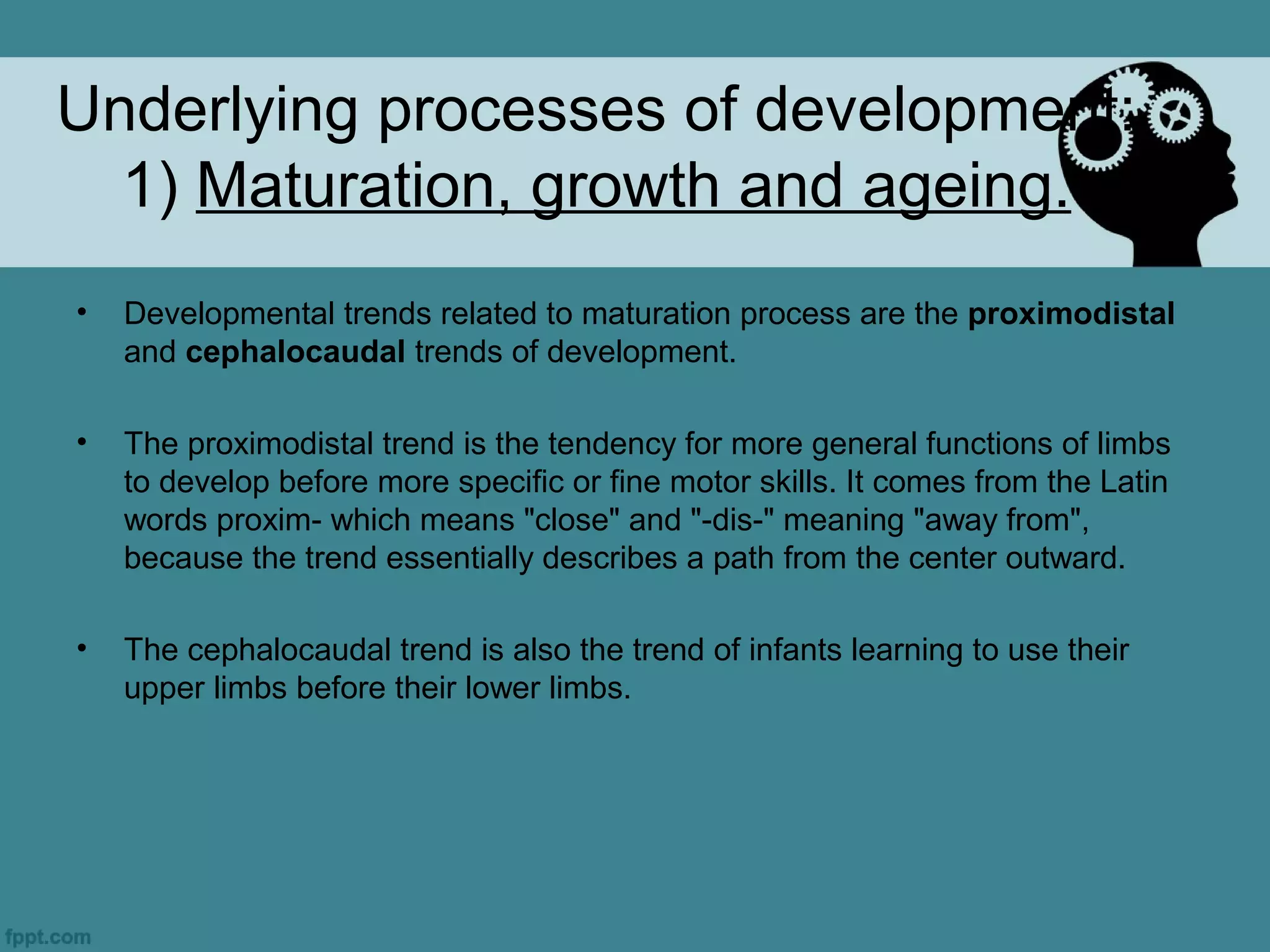
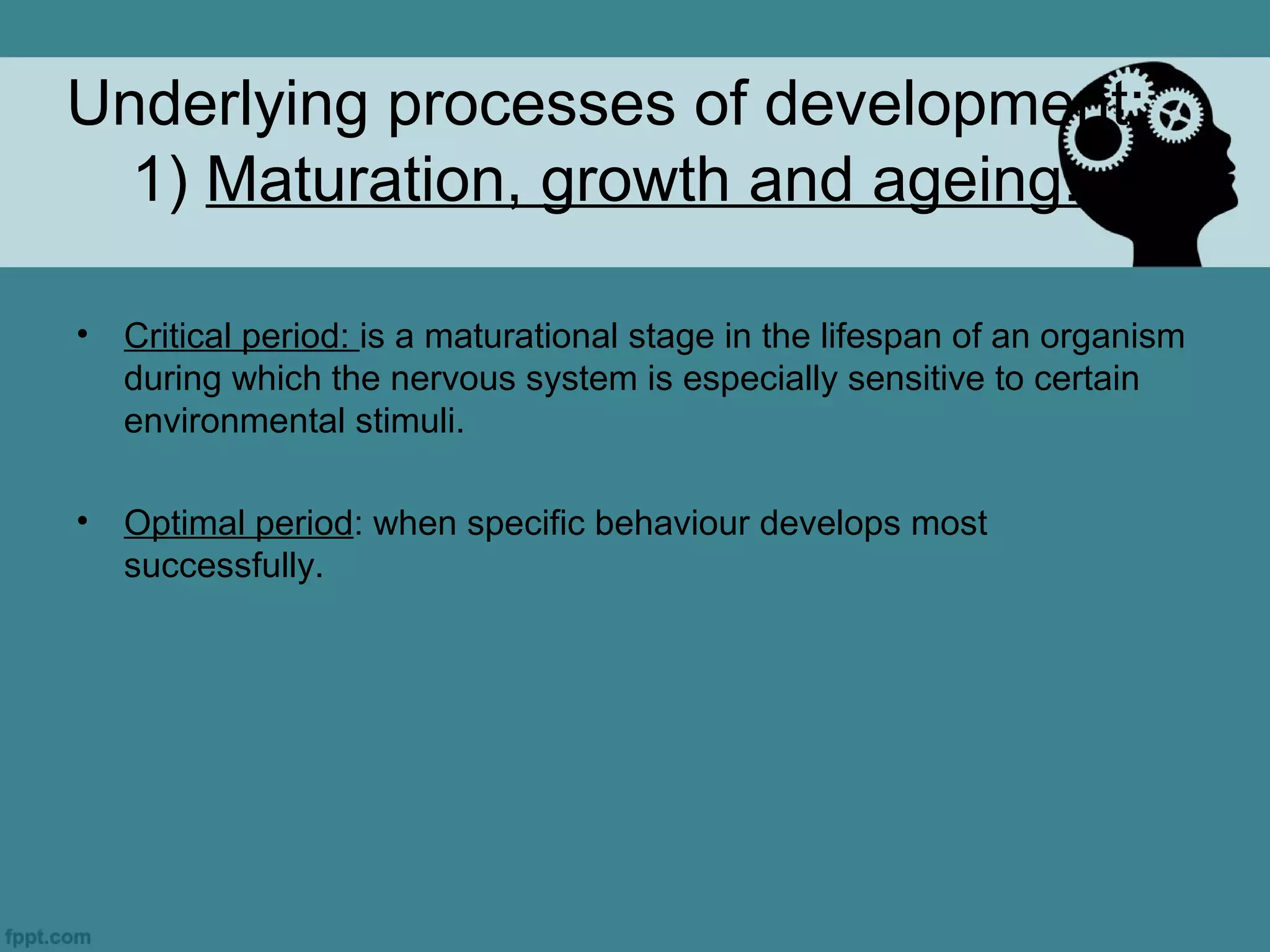
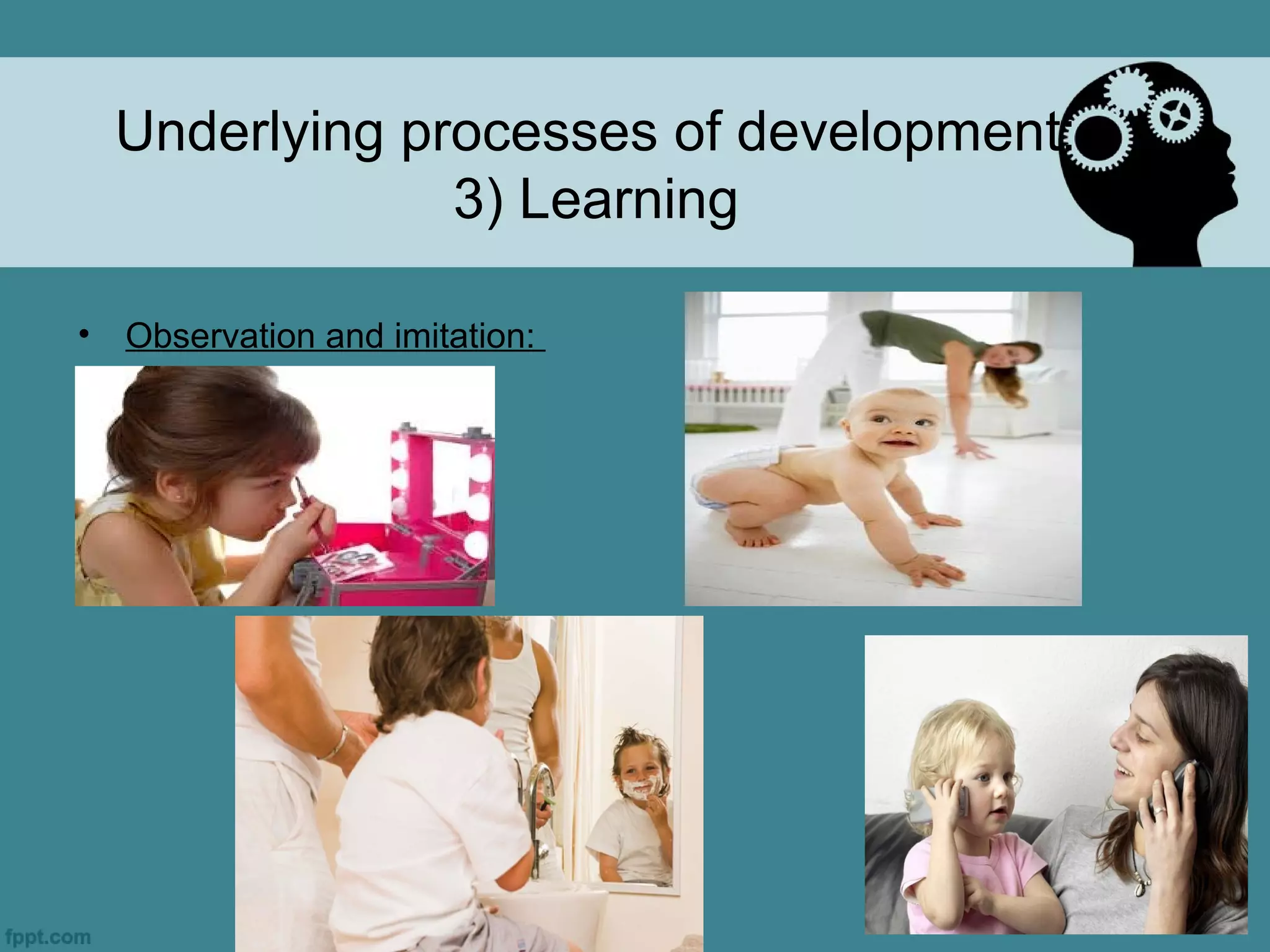
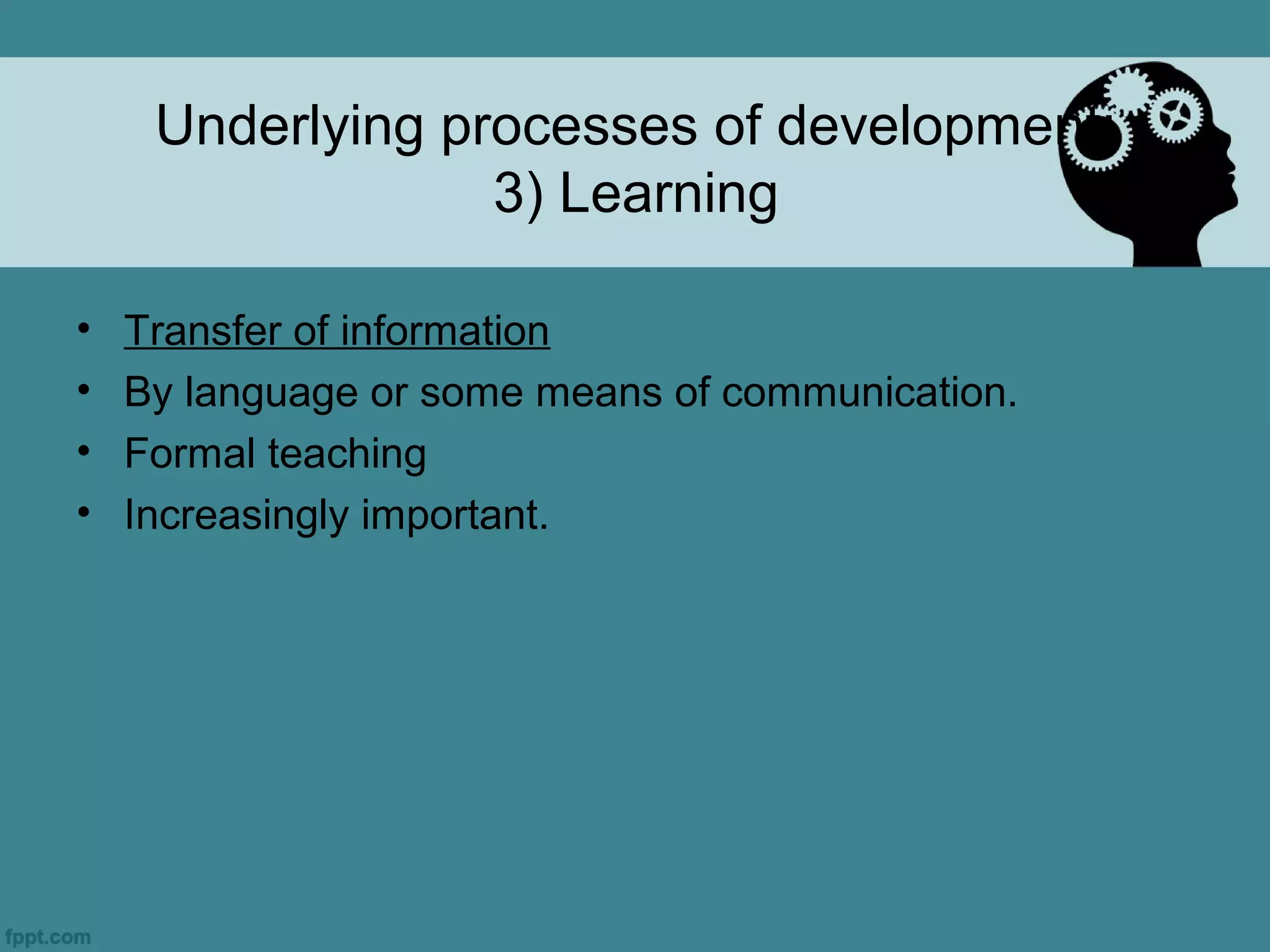
• Observation and imitation:
Underlying processes of development:
3) Learning
• Transfer of information
• By language or some means of communication.
• Formal teaching
• Increasingly important.
Underlying processes of development:
4) Socialisation
• Socialisation, is a term used by sociologists, social
psychologists, anthropologists, political scientists, and
educationalists to refer to the lifelong process of
inheriting and disseminating norms, customs, values and
ideologies, providing an individual with the skills and
habits necessary .
Underlying processes of development:
5) Interaction between various processes
• Processes are all related.
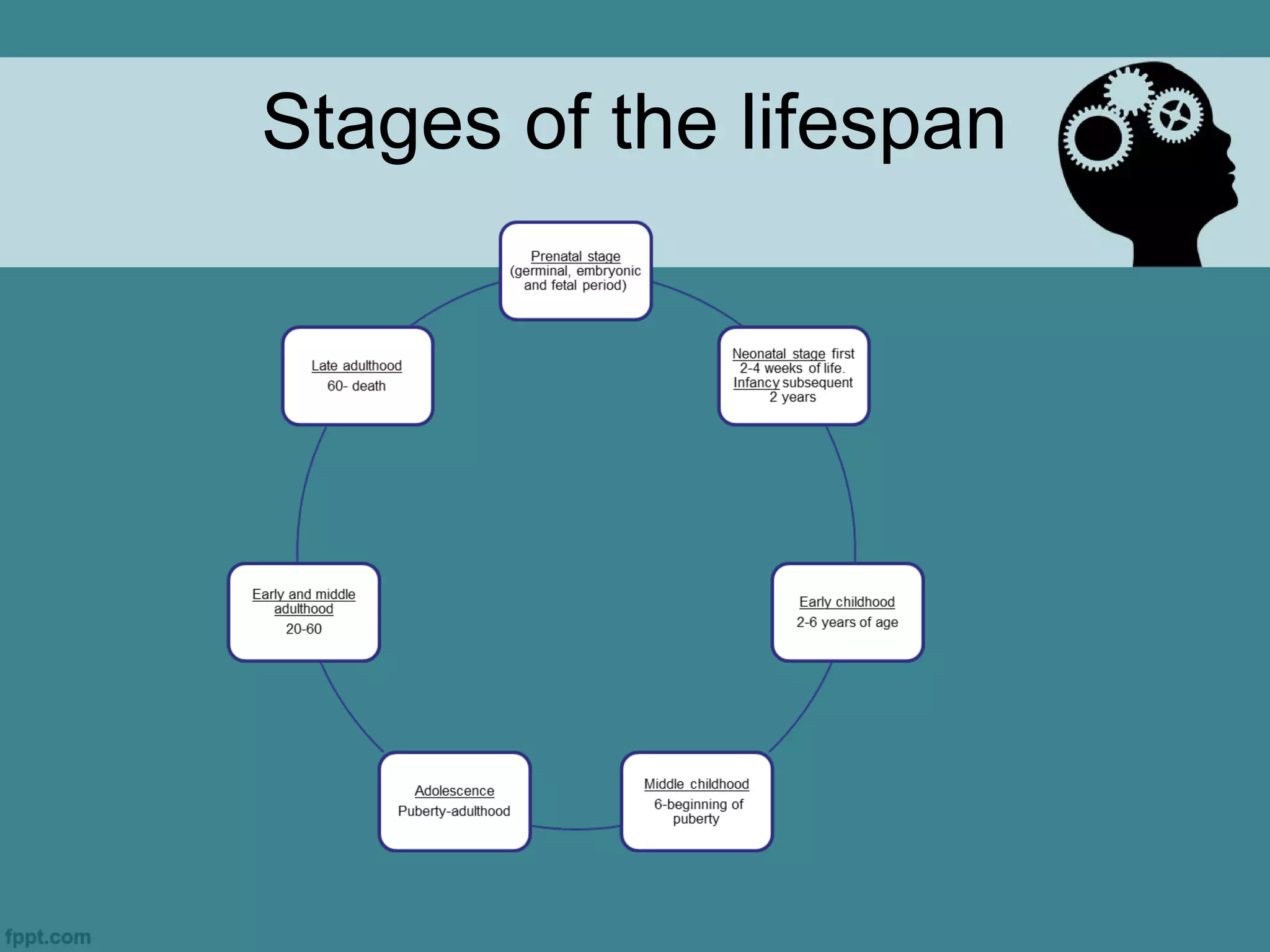
Stages of the lifespan
Areas of development
• Physical development
• Cognitive development
• Personality development
• Social development
Factors that determine
development
• Genetic determinants
• Constitutional determinants
• Environmental determinants
• Personal determinants
• Activity: HOW DOES THESE FACTORS
INFLUENCE OR DETERMINE
DEVELOPMENT OF AN INDIVIDUAL?
References
• Read more: Critical Period - Feral
Children, Term, and Imprinting - JRank
Articles
http://psychology.jrank.org/pages/157/Critical-P
• - Marijose- PPP Template

Developmental psychology

  • 1.
  • 2.
    Student Outcomes • Studentshould explain various psychological developmental processes across the human life span with reference to identifiable stages and attendant features. • Student should Identify the issues, problems, crises and unique challenges associated with each stage and discussed with reference to understanding of others and implications for service delivery within health care. • Student should discuss various stages of development in relation to own stage of development and the likely impact on understanding of and empathy towards health care users. • Student should explore different in theoretical approaches for their usefulness in explaining and contributing towards an understanding of psychological development in a variety of contexts.
  • 3.
    What is developmental Psychology? •Developmental psychology is the study of human development over the entire lifespan, from conception to death. • Much more than the observable aspects. • Underlying processes. • Meaningful stages. • Factors that influences development.
  • 4.
    Underlying processes of development •1) Maturation, growth and ageing. • 2) Increase in complexity: differentiation and integration. • 3) Learning. • 4) Socialisation. • 5) Interaction between various processes.
  • 5.
    Underlying processes ofdevelopment: 1) Maturation, growth and ageing. • Genetic factors. • Maturation: normal development of the body. • Body and organ changes takes place in an orderly pattern. • Divided into sub processes: Growth and ageing. • Growth is dominant and more observable during the first 18-20 years of an individual’s life. • Ageing (decay) already begins while growth takes place. • Examples of maturation: • Motor skills (standing, walking), appearance of teeth, proportions of children’s bodies, puberty and menopause, greying of hair and baldness, eye sight.
  • 6.
    Underlying processes ofdevelopment: 1) Maturation, growth and ageing. • Developmental trends related to maturation process are the proximodistal and cephalocaudal trends of development. • The proximodistal trend is the tendency for more general functions of limbs to develop before more specific or fine motor skills. It comes from the Latin words proxim- which means "close" and "-dis-" meaning "away from", because the trend essentially describes a path from the center outward. • The cephalocaudal trend is also the trend of infants learning to use their upper limbs before their lower limbs.
  • 7.
    Underlying processes ofdevelopment: 1) Maturation, growth and ageing. Proximodistal: From center of the body to the extremities Cephalocaudal: From head to toe
  • 8.
    Underlying processes ofdevelopment: 1) Maturation, growth and ageing. • Critical period: is a maturational stage in the lifespan of an organism during which the nervous system is especially sensitive to certain environmental stimuli. • Optimal period: when specific behaviour develops most successfully.
  • 9.
    Underlying processes ofdevelopment: 1) Maturation, growth and ageing. • Critical period: EXAMPLES • Early visual experience is essential for typical development of visual processing. If visual experiences are blocked during the critical period of visual development, the brain reorganizes visual-processing. • Learning foreign languages. Infants and young children readily learn multiple languages with native-level proficiency. However, starting around puberty, this ability to learn a new language rapidly declines, with many people unable to ever reach native fluency. As a person learns one language, it becomes difficult to learn another because of interference between the languages. • For example, the embryonic stage in humans is a critical period for certain types of growth (such as the appearance of the heart, eyes, ears, hands, and feet) which must occur for prenatal development to proceed normally.
  • 10.
    Underlying processes ofdevelopment: 2) Increase in complexity: Differentiation and Integration. • Differentiation is the different words that a child might learn. • Integration generally means combining parts so that they work together or form a whole. In information technology, there are several common usages. • Integration during product development is a process in which separately produced components or subsystems are combined and problems in their interactions are addressed. • The two processes occur simultaneously.
  • 11.
    Underlying processes ofdevelopment: 3) Learning • Plays a very important role in human development. Can be distinguished: • Learning by association or classical conditioning: Associative learning is the process by which an association between two stimuli or a behavior and a stimulus is learned. The two forms of associative learning are classical and operant conditioning. • Instrumental or operant conditioning: learning in which a particular response is elicited by a stimulus because that response produces desirable consequences (reward). It differs from classical conditioning in that the reinforcement takes place only after the subject performs a specific act that has been previously designated. If no unconditioned stimulus is used to bring about this act, the desired behavior is known as an operant. Once the behavior occurs with regularity the behavior may be called a conditioned response.
  • 12.
    Underlying processes ofdevelopment: 3) Learning • Observation and imitation:
  • 13.
    Underlying processes ofdevelopment: 3) Learning • Transfer of information • By language or some means of communication. • Formal teaching • Increasingly important.
  • 14.
    Underlying processes ofdevelopment: 4) Socialisation • Socialisation, is a term used by sociologists, social psychologists, anthropologists, political scientists, and educationalists to refer to the lifelong process of inheriting and disseminating norms, customs, values and ideologies, providing an individual with the skills and habits necessary .
  • 15.
    Underlying processes ofdevelopment: 5) Interaction between various processes • Processes are all related.
  • 16.
    Stages of thelifespan
  • 17.
    Areas of development •Physical development • Cognitive development • Personality development • Social development
  • 18.
    Factors that determine development •Genetic determinants • Constitutional determinants • Environmental determinants • Personal determinants • Activity: HOW DOES THESE FACTORS INFLUENCE OR DETERMINE DEVELOPMENT OF AN INDIVIDUAL?
  • 19.
    References • Read more:Critical Period - Feral Children, Term, and Imprinting - JRank Articles http://psychology.jrank.org/pages/157/Critical-P • - Marijose- PPP Template