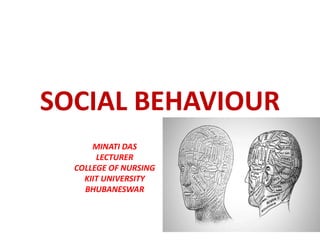
SOCIAL BEHAVIOUR
MINATI DAS
LECTURER
COLLEGE OF NURSING
KIIT UNIVERSITY
BHUBANESWAR
MEANING OF SOCIAL
• 1-relating to society or its organization.
• 2-The term social refers to a characteristic of
living organisms as applied to populations of
humans and other animals. It always refers to
the interaction of organisms with other
organisms and to their collective co-existence,
irrespective of whether they are aware of it or
not, and irrespective of whether the
interaction is voluntary or involuntary.
CONTN…
• 3-an informal social gathering, especially one
organized by the members of a particular club
or group.
MEANING OF BEHAVIOUR
• 1-the way in which one acts or conducts
oneself, especially towards others.
• 2-the way in which an animal or person
behaves in response to a particular situation
or stimulus.
• 3-” Any manifestation of life is activity” and
behavior is a collective name for these
activities.
MEANING OF SOCIAL BEHAVIOUR
• 1-In physiology and sociology, social behavior
is behavior directed towards society, or taking
place between members of the same species.
Behaviors such as predation—which involves
members of different species—are not social.
CONTN…
• 2-A behavior is always to be taken
transactionally: ie., never as of the organism
alone, any more than of the environment
alone, but always as of the organic-
environmental situation, with organisms and
environmental objects taken as equally its
aspect.
---- Dewey and Bentley, 1949
ORGANIZATIONAL BEHAVIOUR
• DEFINITION:-
• 1- Organizational behaviour is a field of study
that investigates the impact that individuals,
groups and structure have on behaviour
within organizations for the purpose of
applying such knowledge towards improving
an organization’s effectiveness.
(Stephen p. Robbins)
Contn…
• 2- organizational behaviour is the study and
application of knowledge of how people act or
behave within an organization.
(keith Davis and John Newstrom)
Concepts of organization behaviour
• Individual difference
• Whole person
• Caused behaviour
• Human dignity
• Social systems
• Mutuality of interests
• Holistic concept
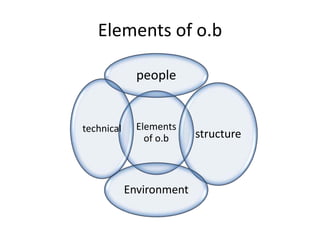
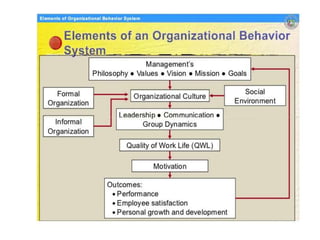
Elements of o.b
Elements
of o.b
people
structure
Environment
technical
1- people
• People are the main source of any
organization.
• O.b is a field where the study of human beings
and their behavior is involved.
2- structure
• Organization is a social system .
• Any social system has its own structure and
that could be either formal or informal.
• The company is a formal organization.
• Informal organization are formed individuals
depending on various factors such as
teamwork.
3-environment
• There are two types of environment
• 1-internal
• 2-external
• 1- The internal environment includes ,for
instance, the working environment, individual
attitudes etc.
• 2- The external environment comprises factors
such as government rules and procedures,
customers of the company etc.
4- technology
• This means the materials, equipment,
machines and system with which the
individuals work.
• The company purchases technological tools
for purposes of production and service and
this is an important element of an
organization behavioral system.
THEORIES OF ORGANIZATIONAL
BEHAVIOUR
• Classified into three categories-
• 1- classical doctrine
• 2- humanistic school
• 3- modern organization theory
1- classical doctrine
• Classical doctrine is the oldest theory in the
study of organizations.
• It emphasizes rigid, centralized control of workers
to promote high production.
• An institution is very efficient in accoplishing its
goal-
• 1- frederick taylor:- frederick taylor is considered
the father of classical theory and the father of
scientific management.
• He believed high production could be achieved by
paying high wages.
Contn..
• 2- Henry Fayol:- Fayol identified 14 principles
of m/m and developed Taylor’s ideas(1949) .
• His principles made it clear that production,
efficiency and profit were of prime
importances, while individuals or workers
were of comparatively less importance.
• His principles include-
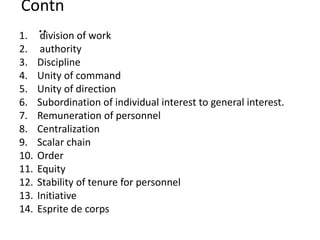
Contn
..1. division of work
2. authority
3. Discipline
4. Unity of command
5. Unity of direction
6. Subordination of individual interest to general interest.
7. Remuneration of personnel
8. Centralization
9. Scalar chain
10. Order
11. Equity
12. Stability of tenure for personnel
13. Initiative
14. Esprite de corps
2- humanistic school
• It was the demonstrated lack of concern for
workers that led to the formulation of new theory
of organization in the 1930.
• The h.t.,also called behavioral or neoclassical
theory, identifies two major functions of
organizations-
• 1- one maintaining the external balance, that is
the economics
• 2- the other maintaining in the internal balance,
that is the social org.of the workers through
which they stratify their own desires and needs.
3-moden organization theory
• The m.o.t began in the late 1950s as
researchers recognizesd that in the humanistic
as well as in the classical approach .
• Its consisting of two main approaches-
• 1- system
• 2- contingency

Social behaviour ppt

  • 1.
    SOCIAL BEHAVIOUR MINATI DAS LECTURER COLLEGEOF NURSING KIIT UNIVERSITY BHUBANESWAR
  • 2.
    MEANING OF SOCIAL •1-relating to society or its organization. • 2-The term social refers to a characteristic of living organisms as applied to populations of humans and other animals. It always refers to the interaction of organisms with other organisms and to their collective co-existence, irrespective of whether they are aware of it or not, and irrespective of whether the interaction is voluntary or involuntary.
  • 3.
    CONTN… • 3-an informalsocial gathering, especially one organized by the members of a particular club or group.
  • 4.
    MEANING OF BEHAVIOUR •1-the way in which one acts or conducts oneself, especially towards others. • 2-the way in which an animal or person behaves in response to a particular situation or stimulus. • 3-” Any manifestation of life is activity” and behavior is a collective name for these activities.
  • 5.
    MEANING OF SOCIALBEHAVIOUR • 1-In physiology and sociology, social behavior is behavior directed towards society, or taking place between members of the same species. Behaviors such as predation—which involves members of different species—are not social.
  • 6.
    CONTN… • 2-A behavioris always to be taken transactionally: ie., never as of the organism alone, any more than of the environment alone, but always as of the organic- environmental situation, with organisms and environmental objects taken as equally its aspect. ---- Dewey and Bentley, 1949
  • 7.
    ORGANIZATIONAL BEHAVIOUR • DEFINITION:- •1- Organizational behaviour is a field of study that investigates the impact that individuals, groups and structure have on behaviour within organizations for the purpose of applying such knowledge towards improving an organization’s effectiveness. (Stephen p. Robbins)
  • 8.
    Contn… • 2- organizationalbehaviour is the study and application of knowledge of how people act or behave within an organization. (keith Davis and John Newstrom)
  • 9.
    Concepts of organizationbehaviour • Individual difference • Whole person • Caused behaviour • Human dignity • Social systems • Mutuality of interests • Holistic concept
  • 10.
    Elements of o.b Elements ofo.b people structure Environment technical
  • 11.
    1- people • Peopleare the main source of any organization. • O.b is a field where the study of human beings and their behavior is involved.
  • 12.
    2- structure • Organizationis a social system . • Any social system has its own structure and that could be either formal or informal. • The company is a formal organization. • Informal organization are formed individuals depending on various factors such as teamwork.
  • 14.
    3-environment • There aretwo types of environment • 1-internal • 2-external • 1- The internal environment includes ,for instance, the working environment, individual attitudes etc. • 2- The external environment comprises factors such as government rules and procedures, customers of the company etc.
  • 15.
    4- technology • Thismeans the materials, equipment, machines and system with which the individuals work. • The company purchases technological tools for purposes of production and service and this is an important element of an organization behavioral system.
  • 16.
    THEORIES OF ORGANIZATIONAL BEHAVIOUR •Classified into three categories- • 1- classical doctrine • 2- humanistic school • 3- modern organization theory
  • 17.
    1- classical doctrine •Classical doctrine is the oldest theory in the study of organizations. • It emphasizes rigid, centralized control of workers to promote high production. • An institution is very efficient in accoplishing its goal- • 1- frederick taylor:- frederick taylor is considered the father of classical theory and the father of scientific management. • He believed high production could be achieved by paying high wages.
  • 18.
    Contn.. • 2- HenryFayol:- Fayol identified 14 principles of m/m and developed Taylor’s ideas(1949) . • His principles made it clear that production, efficiency and profit were of prime importances, while individuals or workers were of comparatively less importance. • His principles include-
  • 19.
    Contn ..1. division ofwork 2. authority 3. Discipline 4. Unity of command 5. Unity of direction 6. Subordination of individual interest to general interest. 7. Remuneration of personnel 8. Centralization 9. Scalar chain 10. Order 11. Equity 12. Stability of tenure for personnel 13. Initiative 14. Esprite de corps
  • 20.
    2- humanistic school •It was the demonstrated lack of concern for workers that led to the formulation of new theory of organization in the 1930. • The h.t.,also called behavioral or neoclassical theory, identifies two major functions of organizations- • 1- one maintaining the external balance, that is the economics • 2- the other maintaining in the internal balance, that is the social org.of the workers through which they stratify their own desires and needs.
  • 21.
    3-moden organization theory •The m.o.t began in the late 1950s as researchers recognizesd that in the humanistic as well as in the classical approach . • Its consisting of two main approaches- • 1- system • 2- contingency