Human behaviour at work
 Human factors refer to environmental, organisational
and job factors, and human and individual
characteristics, which influence behaviour at work in a
way which can affect health and safety’
 This definition includes three interrelated aspects that
must be considered:
the job,
the individual( personal factors)and
the organisation
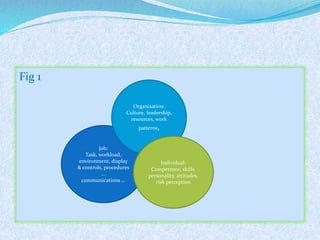
Fig 1
Job:
Task, workload,
environment, display
& controls, procedures
…
communications …
Organisation:
Culture, leadership,
resources, work
patterns,
Individual:
Competence, skills,
personality, attitudes,
risk perception
The job
 includes areas such as the nature of the task,
workload, the working environment, the design of
displays and controls, and the role of procedures.
 Tasks should be designed in accordance with
ergonomic principles to take account of both human
limitations and strengths.
 This includes matching the job to the physical and the
mental strengths and limitations of people.
 Mental aspects e.g. perceptual, attentional and
decision making requirements.
The individual
 includes his/her competence, skills, personality,
attitude, and risk perception.
 Individual characteristics influence behaviour in
complex ways.
 Some characteristics such as personality are fixed;
 others such as skills and attitudes may be changed or
enhanced.
The organisation:
 Includes; work patterns, the culture of the workplace,
resources, communications, leadership and so on.
 Such factors are often overlooked during the design of
jobs but have a significant influence on individual and
group behaviour.
Human failures
There are two types of human failures (unsafe acts) that may
lead to major accidents:
Unintentional errors:
 Errors (slips/lapses) are “actions that were not as planned”
(unintended actions)in familiar task e.g. omissions in
repair, maintenance, calibration or testing. Unlikely to
eliminated by training and need to be designed out.
 Mistakes are also errors, but errors of judgement or
decision-making.Training is the key to avoiding mistakes.
e.g. making a poor judgement when overtaking
Intentional errors:
 Violations differ from the above in that they are
intentional failures, such as taking a short- cut or non-
compliance with procedures
a) Routine violations: a behaviour in opposition to a
rule, procedure, or instruction that has become the
normal way of behaving .
b) Exceptional violations: happen only in unusual and
particular circumstances, often when something goes
wrong in unpredicted circumstances e.g. emergency
c) Situational violations: these violations by factors
dictated by the worker’s immediate work space or
environment (physical or organisational).
d) Acts of sabotage: e.g vandalism, acts of terrorism
 There are several ways to manage violations, including
taking steps to increase their detection, ensuring that
rules and procedures are relevant/practical and
explaining the rationale behind certain rules.
 Involving the workforce in drawing up rules increases
their acceptance. Getting to the root cause of any
violation is the key to understanding and hence
preventing the violation.
FACTOR INFLUENCING HUMAN
BEHAVIOUR
human characteristics that can lead to difficulties
interacting with the working environment.
 Attention - workplace can 'overload' human attention
with enormous amounts of information, far in excess
of the normal
 Perception -to correctly perceive it and the dangers it
holds. Work environments often challenge human
perception systems and information misinterpreted.
 Memory: due to inadequate knowledge
 Logical reasoning -Failures in reasoning have severe
implications for complex systems such as chemical
plants, maintenance.
 Environmental, organisational and job
factors,influence the behaviour at work in a way which
can affect health and safety.
Individual factors include;Low skill and
competence level, Tired staff , Bored or disheartened
staff, Individual medical problems
Job factors include; Illogical design of equipment
and instruments , Constant disturbances and
interruptions, Missing or unclear instructions , Poorly
maintained equipment, High workload , Noisy and
unpleasant working conditions
Organisation and management factors
include;Poor work planning, leading to high work
pressure ,Poor SOPs ,Lack of safety systems and
barriers ,Inadequate responses to previous incident ,
Poor management of health and safety,Poor health
and safety culture.
 performance of human is being strongly influenced
by organizational, regulatory, cultural and
environmental factors affecting the workplace.
 organizational processes influence predictable human
errors, including inadequate communication facilities,
Error Management
 By error management means using available data to understand
the causes of errors and taking appropriate actions, including
 changing policy, procedures, and special training to reduce their
incidence of error and to minimize the consequences of those
that do occur.
Implementing Error Management
Successful error management may include;
 Trust ƒ
 A non-punitive policy toward error ƒ
 Commitment to taking action to reduce error-inducing conditions ƒ
 Data that show the nature and types of errors occurring
 Training in error avoidance and management strategies for employees ƒ
 Training in evaluating and reinforcing error management for
instructors and evaluators

human behaviour presentation

  • 1.
    Human behaviour atwork  Human factors refer to environmental, organisational and job factors, and human and individual characteristics, which influence behaviour at work in a way which can affect health and safety’  This definition includes three interrelated aspects that must be considered: the job, the individual( personal factors)and the organisation
  • 2.
    Fig 1 Job: Task, workload, environment,display & controls, procedures … communications … Organisation: Culture, leadership, resources, work patterns, Individual: Competence, skills, personality, attitudes, risk perception
  • 3.
    The job  includesareas such as the nature of the task, workload, the working environment, the design of displays and controls, and the role of procedures.  Tasks should be designed in accordance with ergonomic principles to take account of both human limitations and strengths.  This includes matching the job to the physical and the mental strengths and limitations of people.  Mental aspects e.g. perceptual, attentional and decision making requirements.
  • 4.
    The individual  includeshis/her competence, skills, personality, attitude, and risk perception.  Individual characteristics influence behaviour in complex ways.  Some characteristics such as personality are fixed;  others such as skills and attitudes may be changed or enhanced.
  • 5.
    The organisation:  Includes;work patterns, the culture of the workplace, resources, communications, leadership and so on.  Such factors are often overlooked during the design of jobs but have a significant influence on individual and group behaviour.
  • 6.
    Human failures There aretwo types of human failures (unsafe acts) that may lead to major accidents: Unintentional errors:  Errors (slips/lapses) are “actions that were not as planned” (unintended actions)in familiar task e.g. omissions in repair, maintenance, calibration or testing. Unlikely to eliminated by training and need to be designed out.  Mistakes are also errors, but errors of judgement or decision-making.Training is the key to avoiding mistakes. e.g. making a poor judgement when overtaking
  • 7.
    Intentional errors:  Violationsdiffer from the above in that they are intentional failures, such as taking a short- cut or non- compliance with procedures a) Routine violations: a behaviour in opposition to a rule, procedure, or instruction that has become the normal way of behaving . b) Exceptional violations: happen only in unusual and particular circumstances, often when something goes wrong in unpredicted circumstances e.g. emergency c) Situational violations: these violations by factors dictated by the worker’s immediate work space or environment (physical or organisational). d) Acts of sabotage: e.g vandalism, acts of terrorism
  • 8.
     There areseveral ways to manage violations, including taking steps to increase their detection, ensuring that rules and procedures are relevant/practical and explaining the rationale behind certain rules.  Involving the workforce in drawing up rules increases their acceptance. Getting to the root cause of any violation is the key to understanding and hence preventing the violation.
  • 9.
    FACTOR INFLUENCING HUMAN BEHAVIOUR humancharacteristics that can lead to difficulties interacting with the working environment.  Attention - workplace can 'overload' human attention with enormous amounts of information, far in excess of the normal  Perception -to correctly perceive it and the dangers it holds. Work environments often challenge human perception systems and information misinterpreted.
  • 10.
     Memory: dueto inadequate knowledge  Logical reasoning -Failures in reasoning have severe implications for complex systems such as chemical plants, maintenance.  Environmental, organisational and job factors,influence the behaviour at work in a way which can affect health and safety.
  • 11.
    Individual factors include;Lowskill and competence level, Tired staff , Bored or disheartened staff, Individual medical problems Job factors include; Illogical design of equipment and instruments , Constant disturbances and interruptions, Missing or unclear instructions , Poorly maintained equipment, High workload , Noisy and unpleasant working conditions Organisation and management factors include;Poor work planning, leading to high work pressure ,Poor SOPs ,Lack of safety systems and barriers ,Inadequate responses to previous incident , Poor management of health and safety,Poor health and safety culture.
  • 12.
     performance ofhuman is being strongly influenced by organizational, regulatory, cultural and environmental factors affecting the workplace.  organizational processes influence predictable human errors, including inadequate communication facilities,
  • 13.
    Error Management  Byerror management means using available data to understand the causes of errors and taking appropriate actions, including  changing policy, procedures, and special training to reduce their incidence of error and to minimize the consequences of those that do occur. Implementing Error Management Successful error management may include;  Trust ƒ  A non-punitive policy toward error ƒ  Commitment to taking action to reduce error-inducing conditions ƒ  Data that show the nature and types of errors occurring  Training in error avoidance and management strategies for employees ƒ  Training in evaluating and reinforcing error management for instructors and evaluators