CHAPTER 7 MOTIVATION By- Aastha Tyagi
Motivation “ A great man is one who can make a small man feel great, and perform great.”
MOTIVATION ??? it is defined as a driving force that initiates and directs behavior.  motivation is a kind of internal energy which drives a person to do something in order to achieve something.  It is a temporal or dynamic state within a person which is not concerned with his/her personality
MOTIVATION Derived from Latin word  movere , which means  to move . Stephen P. robbins --- “the willingness to exert high levels of effort towards organizational goals, conditioned by the effort’s ability to satisfy some individual needs.”
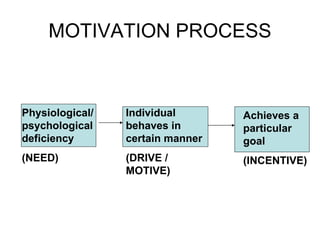
MOTIVATION PROCESS Physiological/ psychological deficiency (NEED) Individual behaves in certain manner (DRIVE / MOTIVE) Achieves a particular goal  (INCENTIVE)
NEED:-- a physiological or psychological imbalance leads to creation of need. DRIVES (MOTIVES):-- propel individuals to attain their goals or satisfy their need INCENTIVES:-- anything that can mitigate a need and decrease the intensity of a drive
CLASSIFICATION OF MOTIVES 1.  Primary Motives :-- Not learned Physiological based.
2.  General Motives (Stimulus motives):-- Nether purely primary nor secondary. Not learned and not physiologically based. Stimulate tension within a person Curiosity, manipulation & activity motives Affection motives (love )
3.  Secondary motives:-- Are learned or acquired over time. Power Motive Achievement Motive (TAT) Affiliation Motive Security Motive Status Motive -  Moderate degree of risk taking - Need for prompt and precise feedback - Satisfaction with achievement than rewards - Dedication towards the task NOTE: STATUS – rank a person holds relative to others within a group, organization or society
 
 
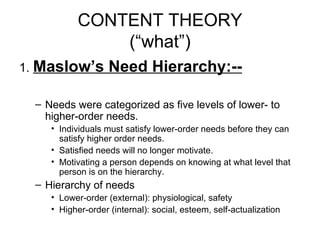
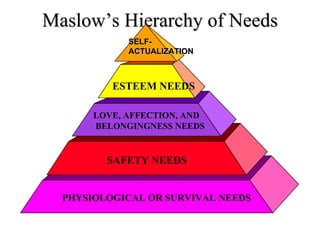
CONTENT THEORY (“what”) 1.  Maslow’s Need Hierarchy:-- Needs were categorized as five levels of lower- to higher-order needs. Individuals must satisfy lower-order needs before they can satisfy higher order needs. Satisfied needs will no longer motivate. Motivating a person depends on knowing at what level that person is on the hierarchy. Hierarchy of needs Lower-order (external): physiological, safety Higher-order (internal): social, esteem, self-actualization
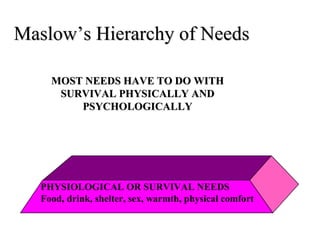
Maslow’s Hierarchy of Needs PHYSIOLOGICAL OR SURVIVAL NEEDS Food, drink, shelter, sex, warmth, physical comfort MOST NEEDS HAVE TO DO WITH SURVIVAL PHYSICALLY AND PSYCHOLOGICALLY
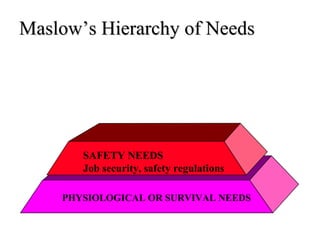
Maslow’s Hierarchy of Needs PHYSIOLOGICAL OR SURVIVAL NEEDS SAFETY NEEDS Job security, safety regulations
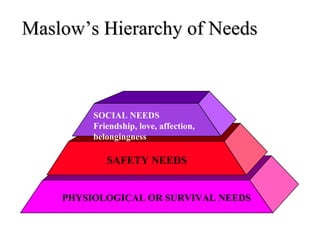
Maslow’s Hierarchy of Needs PHYSIOLOGICAL OR SURVIVAL NEEDS SAFETY NEEDS SOCIAL NEEDS Friendship, love, affection, belongingness
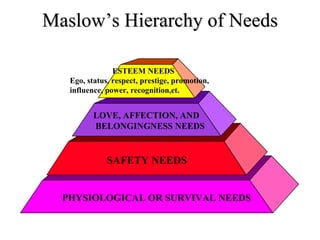
Maslow’s Hierarchy of Needs PHYSIOLOGICAL OR SURVIVAL NEEDS SAFETY NEEDS LOVE, AFFECTION, AND BELONGINGNESS NEEDS ESTEEM NEEDS Ego, status, respect, prestige, promotion,  influence, power, recognition,et.
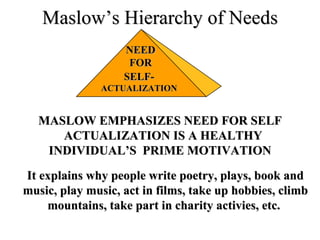
Maslow’s Hierarchy of Needs SELF- ACTUALIZATION NEED FOR MASLOW EMPHASIZES NEED   FOR SELF ACTUALIZATION IS   A HEALTHY  I NDIVIDUAL’S  PRIME   MOTIVATION It explains why people write poetry, plays, book and music, play music, act in films, take up hobbies, climb mountains, take part in charity activies, etc.
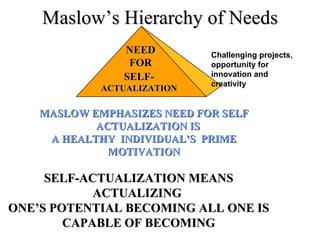
Maslow’s Hierarchy of Needs SELF- ACTUALIZATION NEED FOR MASLOW EMPHASIZES NEED FOR SELF ACTUALIZATION IS A HEALTHY  INDIVIDUAL’S  PRIME MOTIVATION SELF-ACTUALIZATION MEANS ACTUALIZING  ONE’S POTENTIAL BECOMING ALL ONE IS CAPABLE OF BECOMING Challenging projects, opportunity for innovation and creativity
Maslow’s Hierarchy of Needs PHYSIOLOGICAL OR SURVIVAL NEEDS SAFETY NEEDS LOVE, AFFECTION, AND BELONGINGNESS NEEDS ESTEEM NEEDS SELF- ACTUALIZATION
2. Herzberg’s 2 factor Theory Critical Incident Method. Interviewed 200 accountants When did you feel good about your job? When did you feel exceptionally bad about your job?
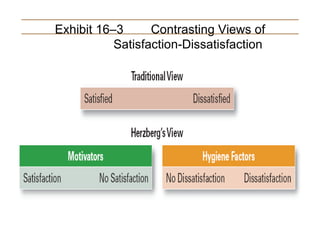
--  Job satisfaction and job dissatisfaction are created by different factors. Hygiene factors (job context factors):  extrinsic  ( job  environment) factors that create job dissatisfaction.   Motivators (job content):  intrinsic (psychological  factors/job content ) factors that create job satisfaction. Attempted to explain why job satisfaction does not result in increased performance. The opposite of satisfaction is not dissatisfaction, but rather no satisfaction.
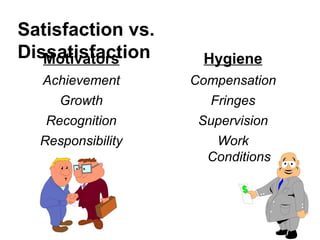
Satisfaction vs. Dissatisfaction Motivators Achievement Growth Recognition Responsibility Hygiene Compensation Fringes Supervision Work Conditions
Exhibit 16–3 Contrasting Views of Satisfaction-Dissatisfaction
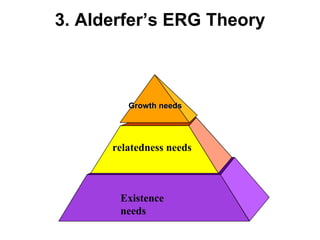
3. Alderfer’s ERG Theory Existence needs relatedness needs Growth needs
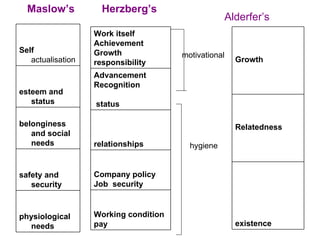
Maslow’s  Herzberg’s Alderfer’s motivational hygiene physiological needs safety and security belonginess and social needs esteem and status Self  actualisation Working condition pay Company policy Job  security relationships Advancement Recognition status Work itself Achievement Growth responsibility existence Relatedness Growth
THE PROCESS THEORIES
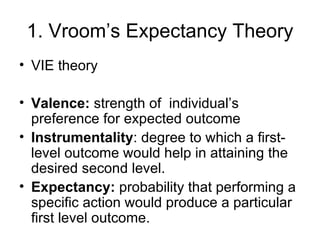
1. Vroom’s Expectancy Theory VIE theory Valence:  strength of  individual’s preference for expected outcome  Instrumentality : degree to which a first-level outcome would help in attaining the desired second level. Expectancy:  probability that performing a specific action would produce a particular first level outcome.
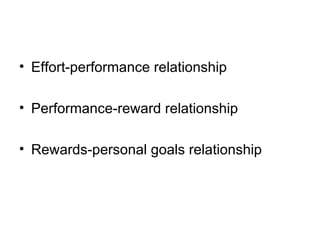
Effort-performance relationship Performance-reward relationship Rewards-personal goals relationship
2. Porter Lawler Model Tried to explore the complex relationship between motivation, satisfaction and performance and pointed out the efforts put in by an employee did not directly result in performance.
Performance is dependent on: Employee desire to perform Ability and skills Clear perception of role
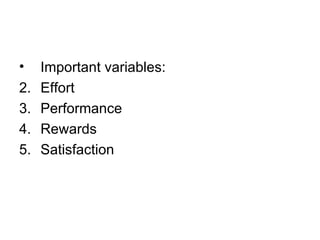
Important variables: Effort Performance Rewards Satisfaction
CONTEMPORARY THEORIES OF WORK MOTIVATION
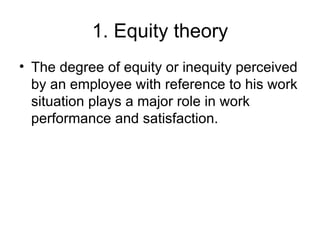
1. Equity theory The degree of equity or inequity perceived by an employee with reference to his work situation plays a major role in work performance and satisfaction.
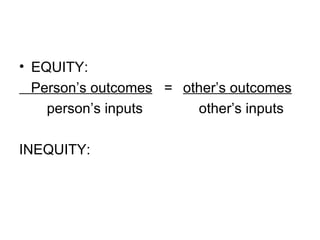
EQUITY: Person’s outcomes   =   other’s outcomes person’s inputs   other’s inputs INEQUITY:
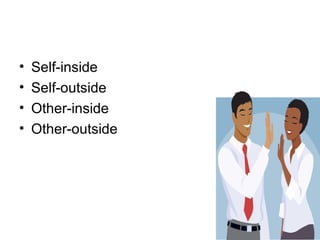
Self-inside Self-outside Other-inside Other-outside
Choices in front of an employee: Change in inputs Change in outcomes Distort perceptions of self Distort perceptions of others Choose a different referent leave the field
2. Attribution Theory It identifies attributions made by people as the basis for their motivation. Explains the relationship between personal perception and interpersonal behavior
Locus of control Consensus, consistency and distinctiveness have an impact on the type of attributions made by persons
Findings: External factors: - Bad-luck attribution Good-luck attribution Internal factors: Challenging goals Desire for achievement
OTHER EMERGING THEORIES cognitive phenomenon Control Theory control function (integral part   of management process) Agency theory
MOTIVATING PERFORMANCE THROUGH JOB DESIGN Job engineering Job enlargement Job rotation Job enrichment Quality of work life Job characteristics -  skill variety -  task identity - task significance - autonomy - feedback
MOTIVATING PERFORMANCE THROUGH GOAL SETTING Goal should be specific goal should be difficult and challenging Goal must be owned and accepted Goals must have a specific time frame Goals should be measurable
Barriers to effective goal setting Lack of top management support Lack of communication Content of goal Technical incompetence
Application of goal setting to organizational system performance The process Consensus on key goals Plan of action Control behavior Periodic appraisal and reviews

Motivation

  • 1.
    CHAPTER 7 MOTIVATIONBy- Aastha Tyagi
  • 2.
    Motivation “ Agreat man is one who can make a small man feel great, and perform great.”
  • 3.
    MOTIVATION ??? itis defined as a driving force that initiates and directs behavior. motivation is a kind of internal energy which drives a person to do something in order to achieve something. It is a temporal or dynamic state within a person which is not concerned with his/her personality
  • 4.
    MOTIVATION Derived fromLatin word movere , which means to move . Stephen P. robbins --- “the willingness to exert high levels of effort towards organizational goals, conditioned by the effort’s ability to satisfy some individual needs.”
  • 5.
    MOTIVATION PROCESS Physiological/psychological deficiency (NEED) Individual behaves in certain manner (DRIVE / MOTIVE) Achieves a particular goal (INCENTIVE)
  • 6.
    NEED:-- a physiologicalor psychological imbalance leads to creation of need. DRIVES (MOTIVES):-- propel individuals to attain their goals or satisfy their need INCENTIVES:-- anything that can mitigate a need and decrease the intensity of a drive
  • 7.
    CLASSIFICATION OF MOTIVES1. Primary Motives :-- Not learned Physiological based.
  • 8.
    2. GeneralMotives (Stimulus motives):-- Nether purely primary nor secondary. Not learned and not physiologically based. Stimulate tension within a person Curiosity, manipulation & activity motives Affection motives (love )
  • 9.
    3. Secondarymotives:-- Are learned or acquired over time. Power Motive Achievement Motive (TAT) Affiliation Motive Security Motive Status Motive - Moderate degree of risk taking - Need for prompt and precise feedback - Satisfaction with achievement than rewards - Dedication towards the task NOTE: STATUS – rank a person holds relative to others within a group, organization or society
  • 10.
  • 11.
  • 12.
    CONTENT THEORY (“what”)1. Maslow’s Need Hierarchy:-- Needs were categorized as five levels of lower- to higher-order needs. Individuals must satisfy lower-order needs before they can satisfy higher order needs. Satisfied needs will no longer motivate. Motivating a person depends on knowing at what level that person is on the hierarchy. Hierarchy of needs Lower-order (external): physiological, safety Higher-order (internal): social, esteem, self-actualization
  • 13.
    Maslow’s Hierarchy ofNeeds PHYSIOLOGICAL OR SURVIVAL NEEDS Food, drink, shelter, sex, warmth, physical comfort MOST NEEDS HAVE TO DO WITH SURVIVAL PHYSICALLY AND PSYCHOLOGICALLY
  • 14.
    Maslow’s Hierarchy ofNeeds PHYSIOLOGICAL OR SURVIVAL NEEDS SAFETY NEEDS Job security, safety regulations
  • 15.
    Maslow’s Hierarchy ofNeeds PHYSIOLOGICAL OR SURVIVAL NEEDS SAFETY NEEDS SOCIAL NEEDS Friendship, love, affection, belongingness
  • 16.
    Maslow’s Hierarchy ofNeeds PHYSIOLOGICAL OR SURVIVAL NEEDS SAFETY NEEDS LOVE, AFFECTION, AND BELONGINGNESS NEEDS ESTEEM NEEDS Ego, status, respect, prestige, promotion, influence, power, recognition,et.
  • 17.
    Maslow’s Hierarchy ofNeeds SELF- ACTUALIZATION NEED FOR MASLOW EMPHASIZES NEED FOR SELF ACTUALIZATION IS A HEALTHY I NDIVIDUAL’S PRIME MOTIVATION It explains why people write poetry, plays, book and music, play music, act in films, take up hobbies, climb mountains, take part in charity activies, etc.
  • 18.
    Maslow’s Hierarchy ofNeeds SELF- ACTUALIZATION NEED FOR MASLOW EMPHASIZES NEED FOR SELF ACTUALIZATION IS A HEALTHY INDIVIDUAL’S PRIME MOTIVATION SELF-ACTUALIZATION MEANS ACTUALIZING ONE’S POTENTIAL BECOMING ALL ONE IS CAPABLE OF BECOMING Challenging projects, opportunity for innovation and creativity
  • 19.
    Maslow’s Hierarchy ofNeeds PHYSIOLOGICAL OR SURVIVAL NEEDS SAFETY NEEDS LOVE, AFFECTION, AND BELONGINGNESS NEEDS ESTEEM NEEDS SELF- ACTUALIZATION
  • 20.
    2. Herzberg’s 2factor Theory Critical Incident Method. Interviewed 200 accountants When did you feel good about your job? When did you feel exceptionally bad about your job?
  • 21.
    -- Jobsatisfaction and job dissatisfaction are created by different factors. Hygiene factors (job context factors): extrinsic ( job environment) factors that create job dissatisfaction. Motivators (job content): intrinsic (psychological factors/job content ) factors that create job satisfaction. Attempted to explain why job satisfaction does not result in increased performance. The opposite of satisfaction is not dissatisfaction, but rather no satisfaction.
  • 22.
    Satisfaction vs. DissatisfactionMotivators Achievement Growth Recognition Responsibility Hygiene Compensation Fringes Supervision Work Conditions
  • 23.
    Exhibit 16–3 ContrastingViews of Satisfaction-Dissatisfaction
  • 24.
    3. Alderfer’s ERGTheory Existence needs relatedness needs Growth needs
  • 25.
    Maslow’s Herzberg’sAlderfer’s motivational hygiene physiological needs safety and security belonginess and social needs esteem and status Self actualisation Working condition pay Company policy Job security relationships Advancement Recognition status Work itself Achievement Growth responsibility existence Relatedness Growth
  • 26.
  • 27.
    1. Vroom’s ExpectancyTheory VIE theory Valence: strength of individual’s preference for expected outcome Instrumentality : degree to which a first-level outcome would help in attaining the desired second level. Expectancy: probability that performing a specific action would produce a particular first level outcome.
  • 28.
    Effort-performance relationship Performance-rewardrelationship Rewards-personal goals relationship
  • 29.
    2. Porter LawlerModel Tried to explore the complex relationship between motivation, satisfaction and performance and pointed out the efforts put in by an employee did not directly result in performance.
  • 30.
    Performance is dependenton: Employee desire to perform Ability and skills Clear perception of role
  • 31.
    Important variables: EffortPerformance Rewards Satisfaction
  • 32.
    CONTEMPORARY THEORIES OFWORK MOTIVATION
  • 33.
    1. Equity theoryThe degree of equity or inequity perceived by an employee with reference to his work situation plays a major role in work performance and satisfaction.
  • 34.
    EQUITY: Person’s outcomes = other’s outcomes person’s inputs other’s inputs INEQUITY:
  • 35.
  • 36.
    Choices in frontof an employee: Change in inputs Change in outcomes Distort perceptions of self Distort perceptions of others Choose a different referent leave the field
  • 37.
    2. Attribution TheoryIt identifies attributions made by people as the basis for their motivation. Explains the relationship between personal perception and interpersonal behavior
  • 38.
    Locus of controlConsensus, consistency and distinctiveness have an impact on the type of attributions made by persons
  • 39.
    Findings: External factors:- Bad-luck attribution Good-luck attribution Internal factors: Challenging goals Desire for achievement
  • 40.
    OTHER EMERGING THEORIEScognitive phenomenon Control Theory control function (integral part of management process) Agency theory
  • 41.
    MOTIVATING PERFORMANCE THROUGHJOB DESIGN Job engineering Job enlargement Job rotation Job enrichment Quality of work life Job characteristics - skill variety - task identity - task significance - autonomy - feedback
  • 42.
    MOTIVATING PERFORMANCE THROUGHGOAL SETTING Goal should be specific goal should be difficult and challenging Goal must be owned and accepted Goals must have a specific time frame Goals should be measurable
  • 43.
    Barriers to effectivegoal setting Lack of top management support Lack of communication Content of goal Technical incompetence
  • 44.
    Application of goalsetting to organizational system performance The process Consensus on key goals Plan of action Control behavior Periodic appraisal and reviews