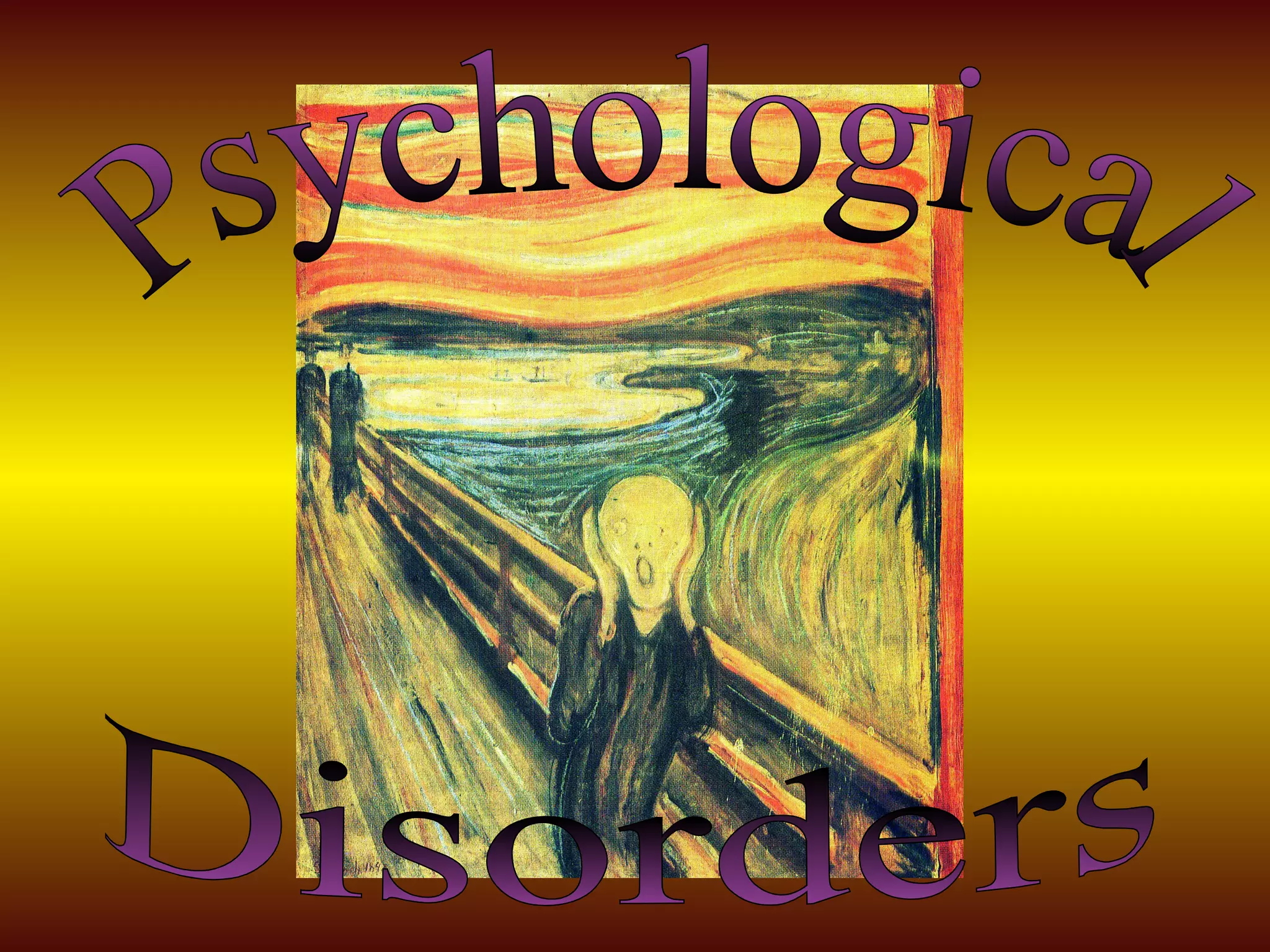
Psychological Disorders
What is Abnormal Behavior? Behavior that is: Statistically unusual Considered strange or undesirable by most people A source of unhappiness There are biological, psychological (personal standards), & socio-cultural factors involved in defining abnormal behavior.
What is Normal Behavior? Normality is Often Confused with Reality. Reality is That Which is Perceived by the Senses. Normal Behavior Agrees with or Conforms to the Society’s Accepted Patterns of Customs, Rules, Laws, Fears, and Taboos.
The Early Historical Model of Psychological Disorders The Supernatural Model Abnormal behavior is the result of possession by demons, through magic, &/or the result of supernatural power. Consequently, only certain people could remove the problem.
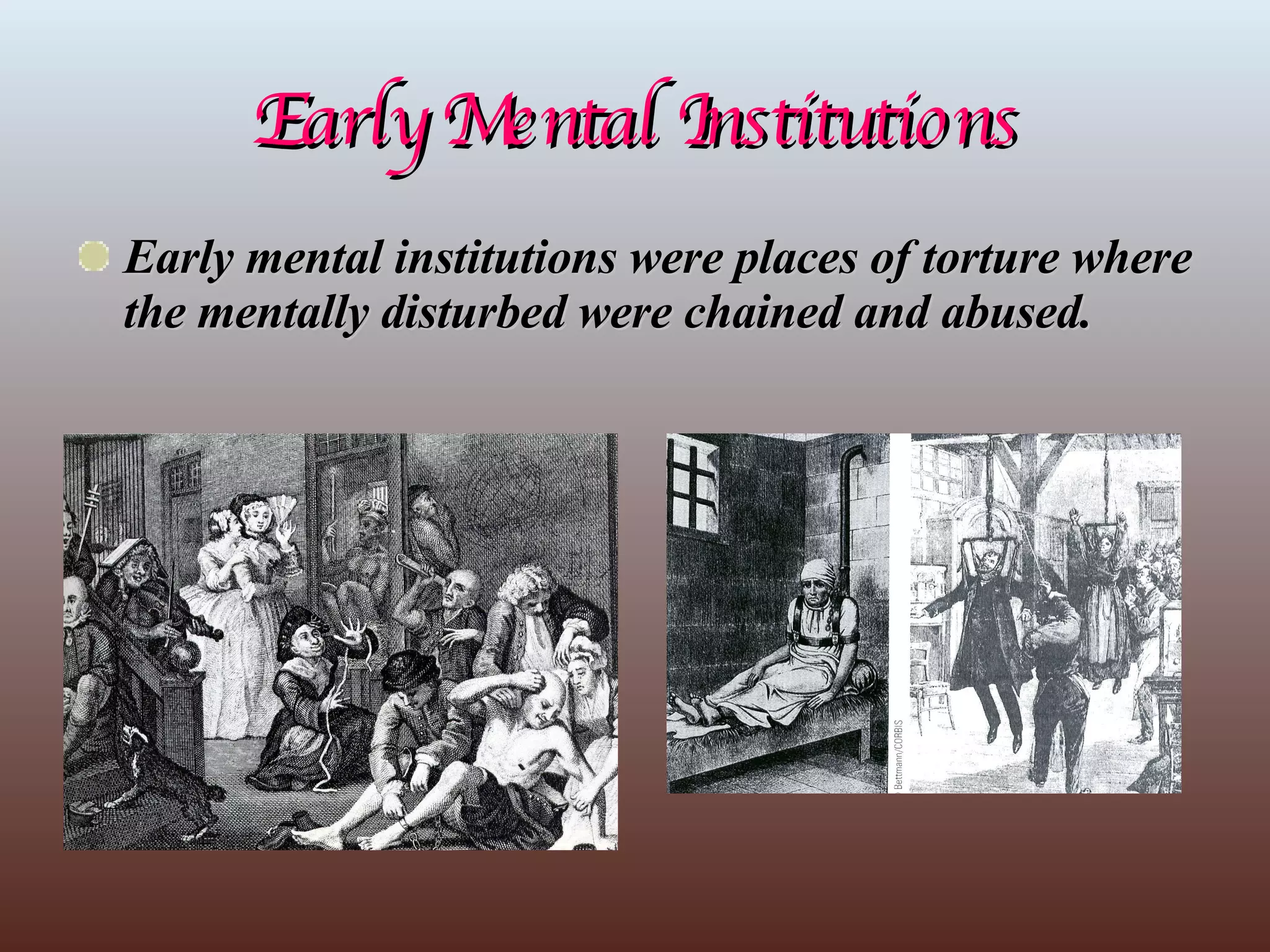
Early Mental Institutions Early mental institutions were places of torture where the mentally disturbed were chained and abused.
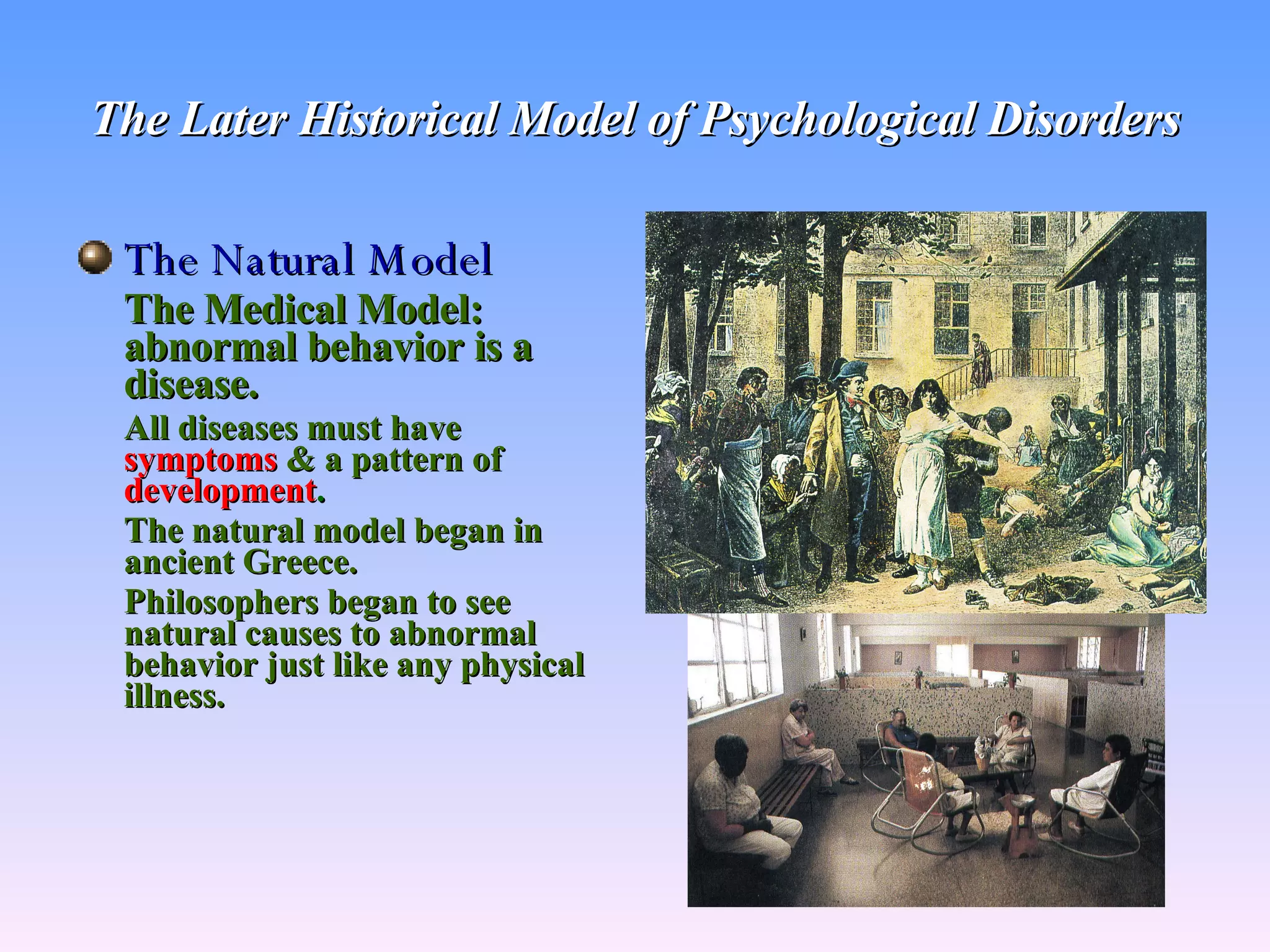
The Later Historical Model of Psychological Disorders The Natural Model The Medical Model: abnormal behavior is a disease. All diseases must have   symptoms   & a   pattern of  development . The natural model began in ancient Greece. Philosophers began to see natural causes to abnormal behavior just like any physical illness.
Modern Models of Abnormal Behavior The Psychoanalytic Model Abnormal behaviors are the result of unconscious conflicts. The Biological Model All abnormal behaviors have a biological or physiological basis. The Cognitive-Behavioral Model Abnormal behaviors are the result of learning maladaptive behaviors. The Diathesis-Stress Model. Abnormal behavior is a biological predisposition & the disorder is seen under stress. The Systems Approach Model Abnormal behaviors are produced from life-style stressors & expectations combined with biological predispositions.
Classifying Abnormal Behaviors DSM-IV-TR Handbook of disorders used by therapists. It provides descriptions, not causes or treatments.
The Mood Disorders Depression Depressed mood, motor retardation, uneasiness & apprehension, intense dejection, self-depreciation, self-condemnation, guilt which can become delusional. Types of Depression Clinical   or endogenous depression Psychological   or exogenous depression Major Depression vs. Dysthymia Major depression is an intense sadness that lasts for months. Dysthymia is a   less intense   sadness with little relief for at least 2 years.
When Frogs get The "Blues"
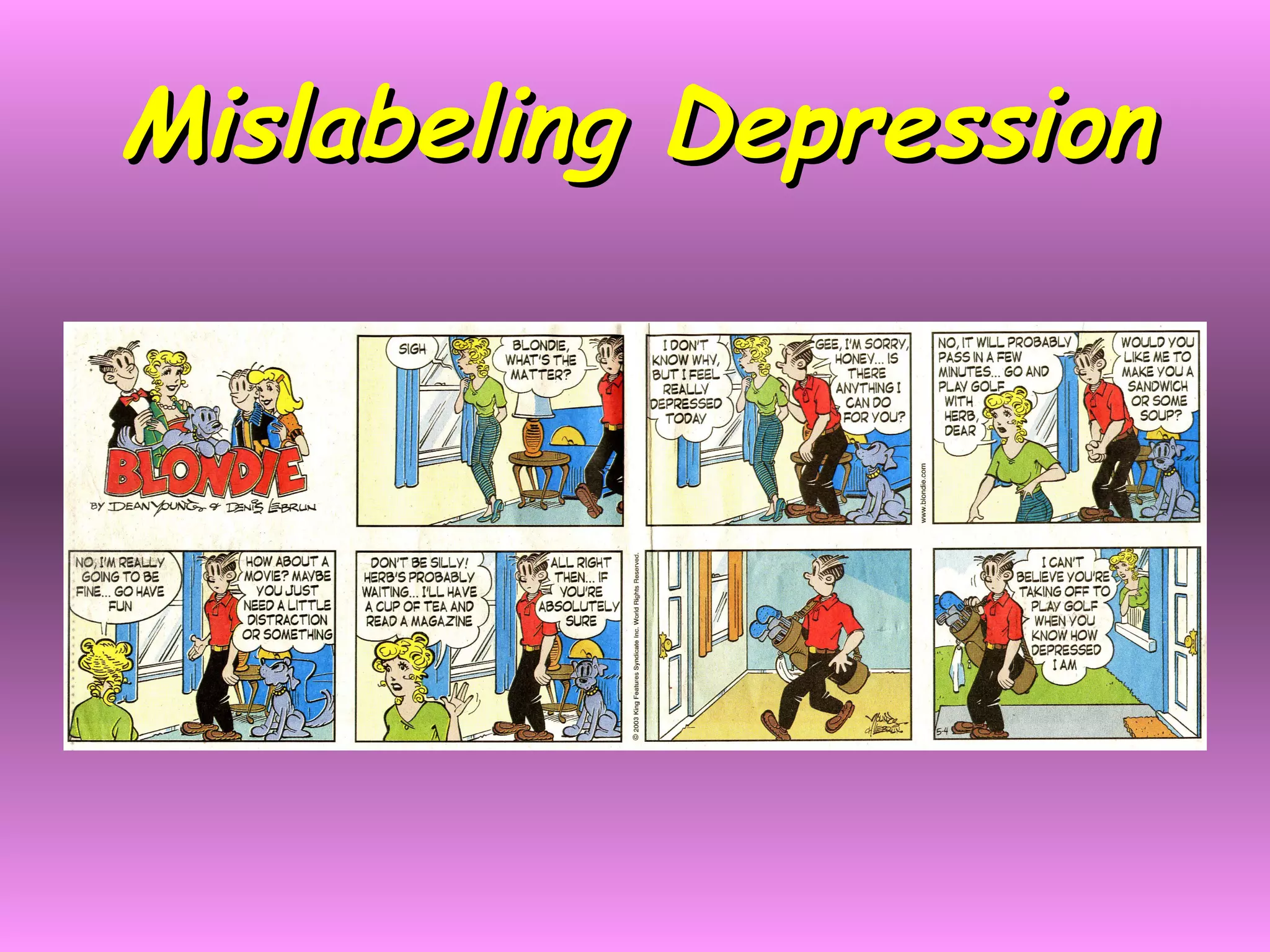
Mislabeling Depression
The Mood Disorders Suicide 30,000 people per year in the U.S.A. commit suicide. More women attempt suicide, but more men commit it. Men take more active means. Stress is often involved in suicides. Leaving home, college, career, broken romance, unemployment, financial strain are major reasons. The person tends to be overwhelmed with hopelessness.
The Mood Disorders Mania The opposite of depression. Overtalkativeness, heightened motor activity, flight of ideas, extreme elation. 2 types of mania: Hypomania   – a mild form of mania Acute mania   – boastfulness, expansive, unrealistic, ambitious, boisterousness & violent. The Causes of Mood Disorders Biological cause Genetics & biochemistry Psychological cause Cognitive distortions of the environment Social cause Interpersonal problems
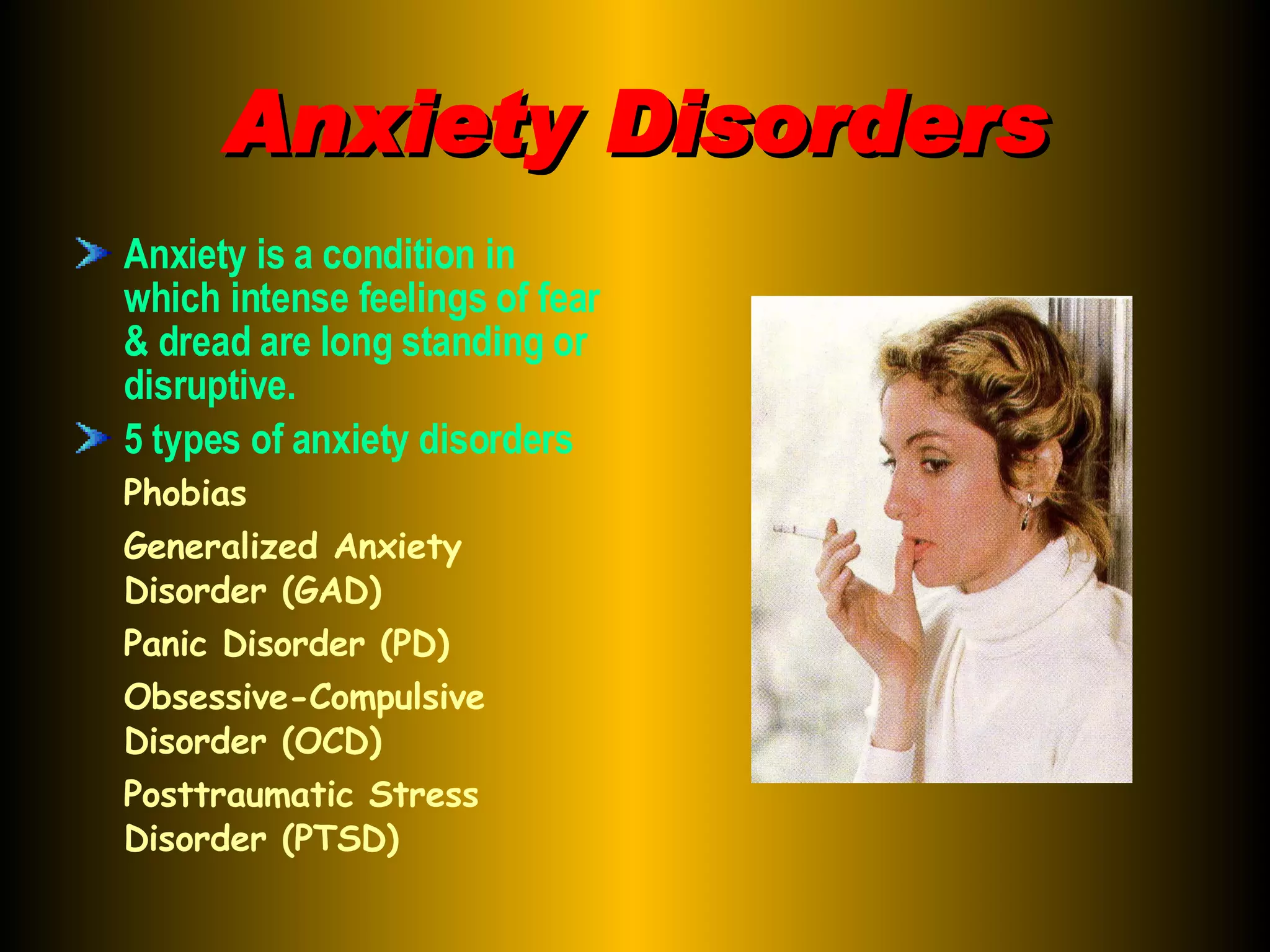
Anxiety Disorders Anxiety is a condition in which intense feelings of fear & dread are long standing or disruptive. 5 types of anxiety disorders Phobias Generalized Anxiety Disorder (GAD) Panic Disorder (PD) Obsessive-Compulsive Disorder (OCD) Posttraumatic Stress Disorder (PTSD)
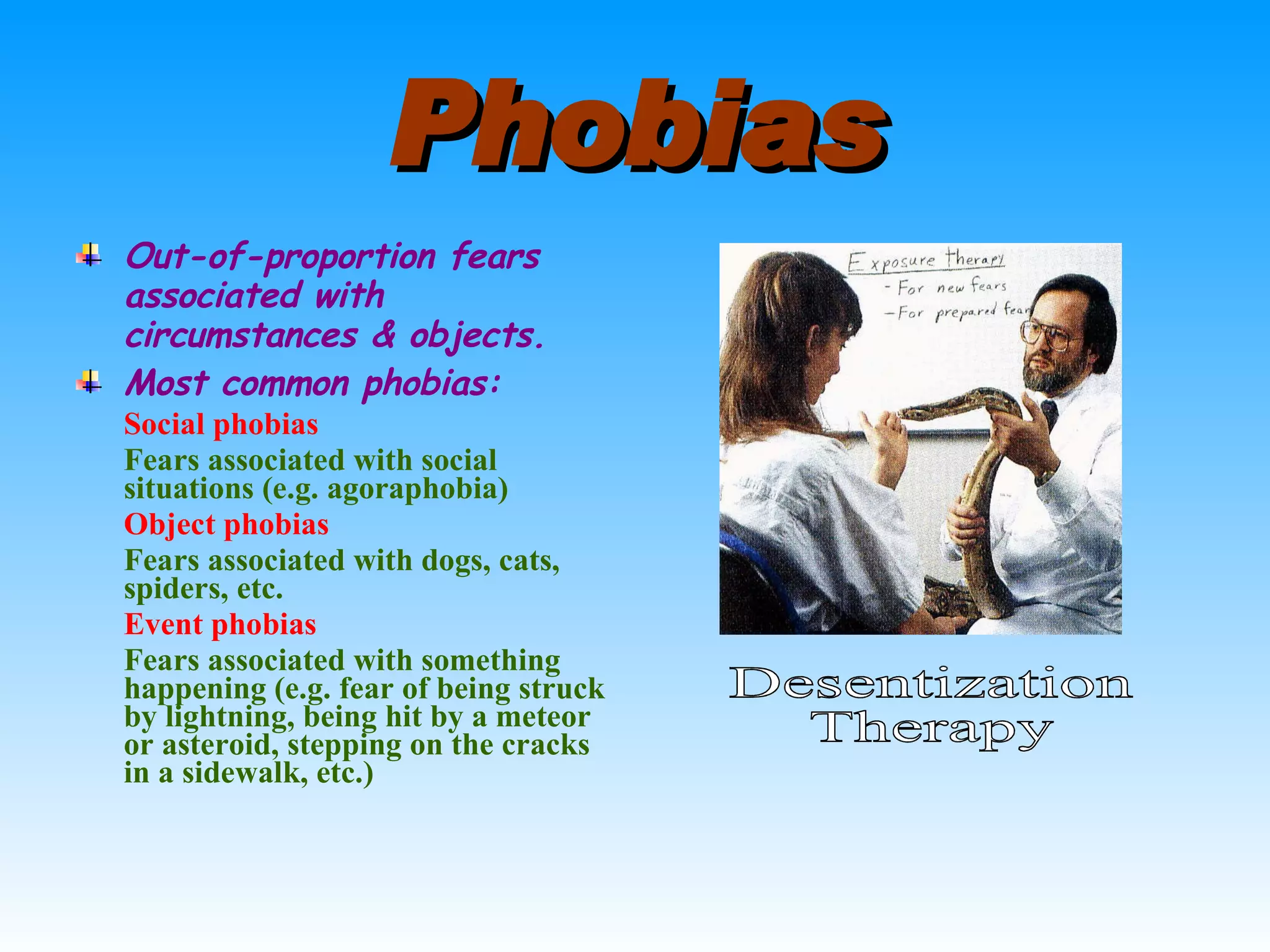
Phobias Out-of-proportion fears associated with circumstances & objects. Most common phobias: Social phobias Fears associated with social situations (e.g. agoraphobia) Object phobias Fears associated with dogs, cats, spiders, etc. Event phobias Fears associated with something happening (e.g. fear of being struck by lightning, being hit by a meteor or asteroid, stepping on the cracks in a sidewalk, etc.) Desentization Therapy
Not all Phobias are on the List
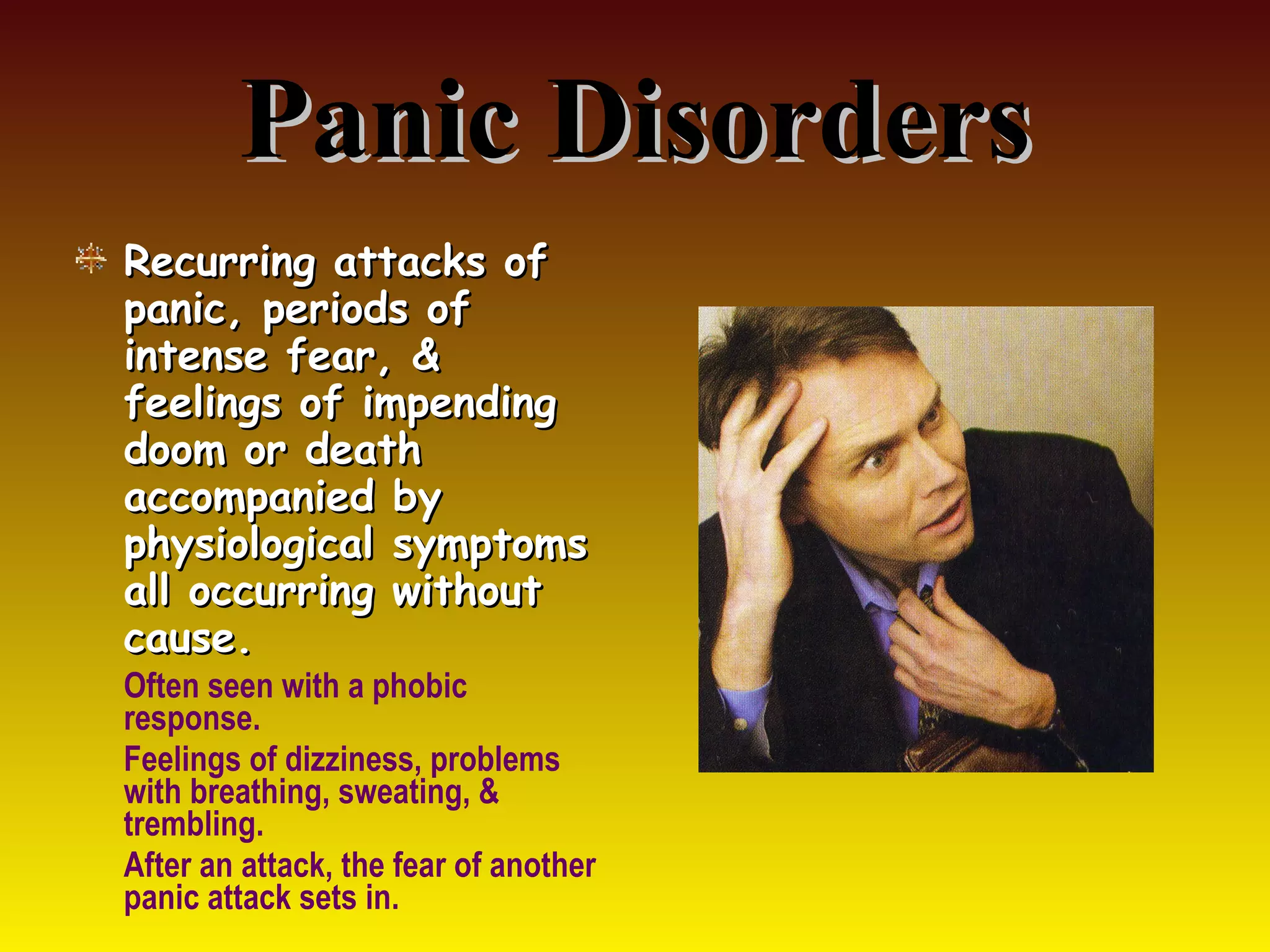
Panic Disorders Recurring attacks of panic, periods of intense fear, & feelings of impending doom or death accompanied by physiological symptoms all occurring without cause. Often seen with a phobic response. Feelings of dizziness, problems with breathing, sweating, & trembling. After an attack, the fear of another panic attack sets in.
Other Anxiety Disorders Generalized Anxiety Disorder Prolonged, unfocused, intense fear response. Not attached to any object or event Obsessive-Compulsive Disorder Persistent, intrusion of unwanted thoughts, urges, or actions that are unable to stop. Includes the “pack-rat”
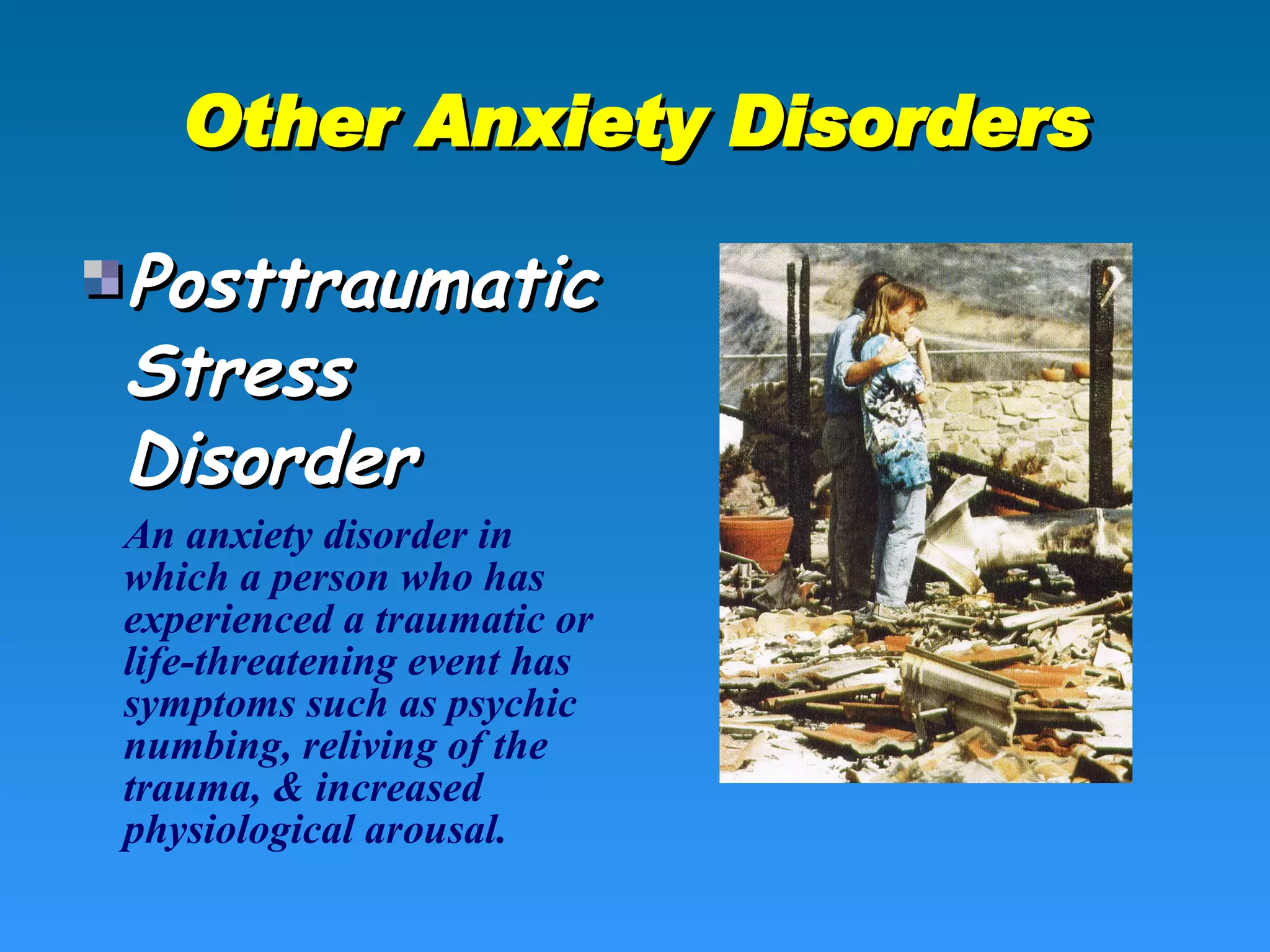
Other Anxiety Disorders Posttraumatic Stress Disorder An anxiety disorder in which a person who has experienced a traumatic or life-threatening event has symptoms such as psychic numbing, reliving of the trauma, & increased physiological arousal.
Causes of Anxiety Disorders Depends on the point   of view 1. Learned Either directly or vicariously Locus of control seen outside. 2. Biological Genetic predispositions. 3. Psychological Internal conflicts produce anxiety. Follow this with extensive use of the defense mechanisms.
Psychosomatic & Somatoform Disorders Psychosomatic Disorders Psychological factors produce real physical disorders. Stress is strongly indicated . Somatoform Disorders Physical symptoms persist without any identifiable physical cause. Conversion Disorders Hypochondriasis Body Dysmorphic Disorder
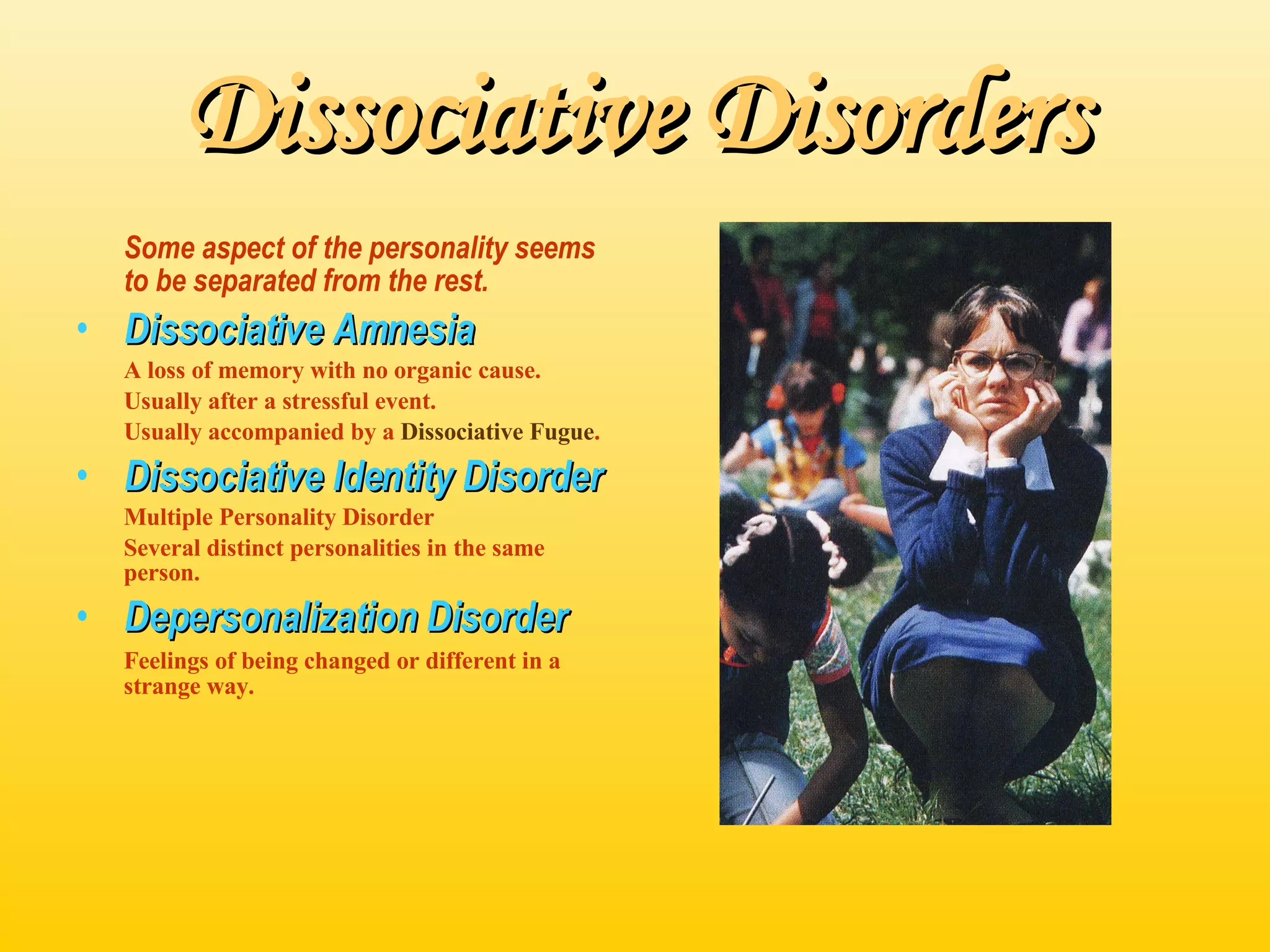
Dissociative Disorders Some aspect of the personality seems to be separated from the rest. Dissociative Amnesia A loss of memory with no organic cause. Usually after a stressful event. Usually accompanied by a  Dissociative Fugue . Dissociative Identity Disorder Multiple Personality Disorder Several distinct personalities in the same person. Depersonalization Disorder Feelings of being changed or different in a strange way.
Sexual & Gender-Identity Disorders Sexual Dysfunction Erectile Disorder The inability to achieve or maintain an erection Physical or Psychological causes Female Sexual Arousal Disorder The inability to become excited or achieve orgasm About 1/3 have genetic construct, others are psychological
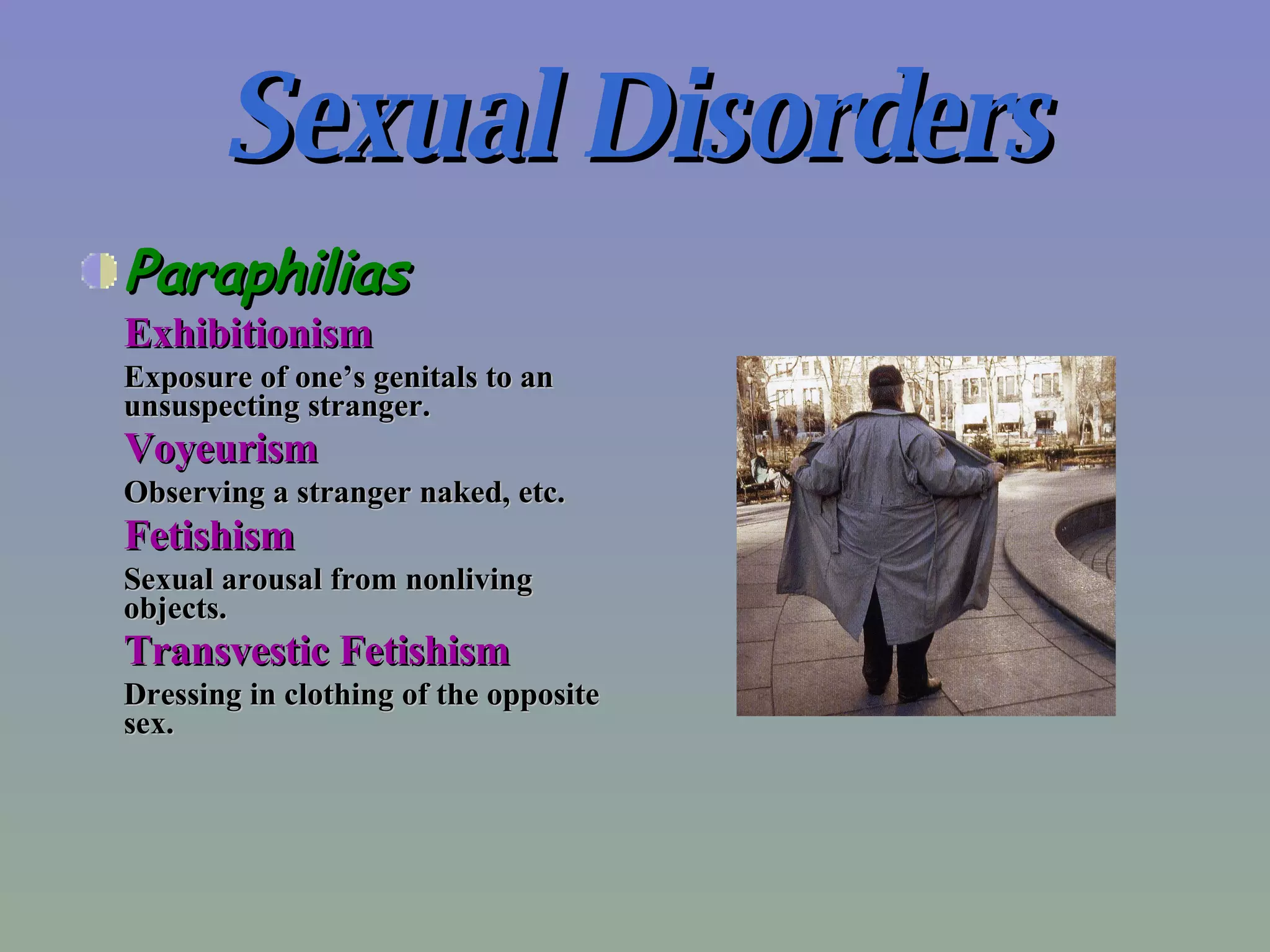
Sexual Disorders Paraphilias Exhibitionism Exposure of one’s genitals to an unsuspecting stranger. Voyeurism Observing a stranger naked, etc. Fetishism Sexual arousal from nonliving objects. Transvestic Fetishism Dressing in clothing of the opposite sex.
Sexual Disorders Sadism & Masochism Arousal from dominating or being dominated. Frotteurism Touching or rubbing against a non-consenting person. Necrophilia Obsession with dead bodies. Klismaphilia Sexual excitement from enemas. Coprophilia Arousal through feces. Zoophilia Sexual activity with animals.
Gender-Identity Disorder The desire to become or the insistence one is the opposite sex. Trans-sexuals & certain transvestites In children it is seen as boys playing with girls toys and girls playing with boys toys.
Personality Disorders Inflexible, maladaptive ways of thinking & behaving learned in early life which cause distress & conflict with others. These behaviors impair personal or social functioning & are a source of distress to the individual or to other people. Included in these disorders are: Schizotypal Personality Disorder Schizoid Personality Disorder Paranoid Personality Disorder Dependant Personality Disorder Avoidant Personality Disorder Narcissistic Personality Disorder Borderline Personality Disorder Antisocial Personality Disorder Obsessive-Compulsive Personality  Disorder Passive-Aggressive Personality Disorder
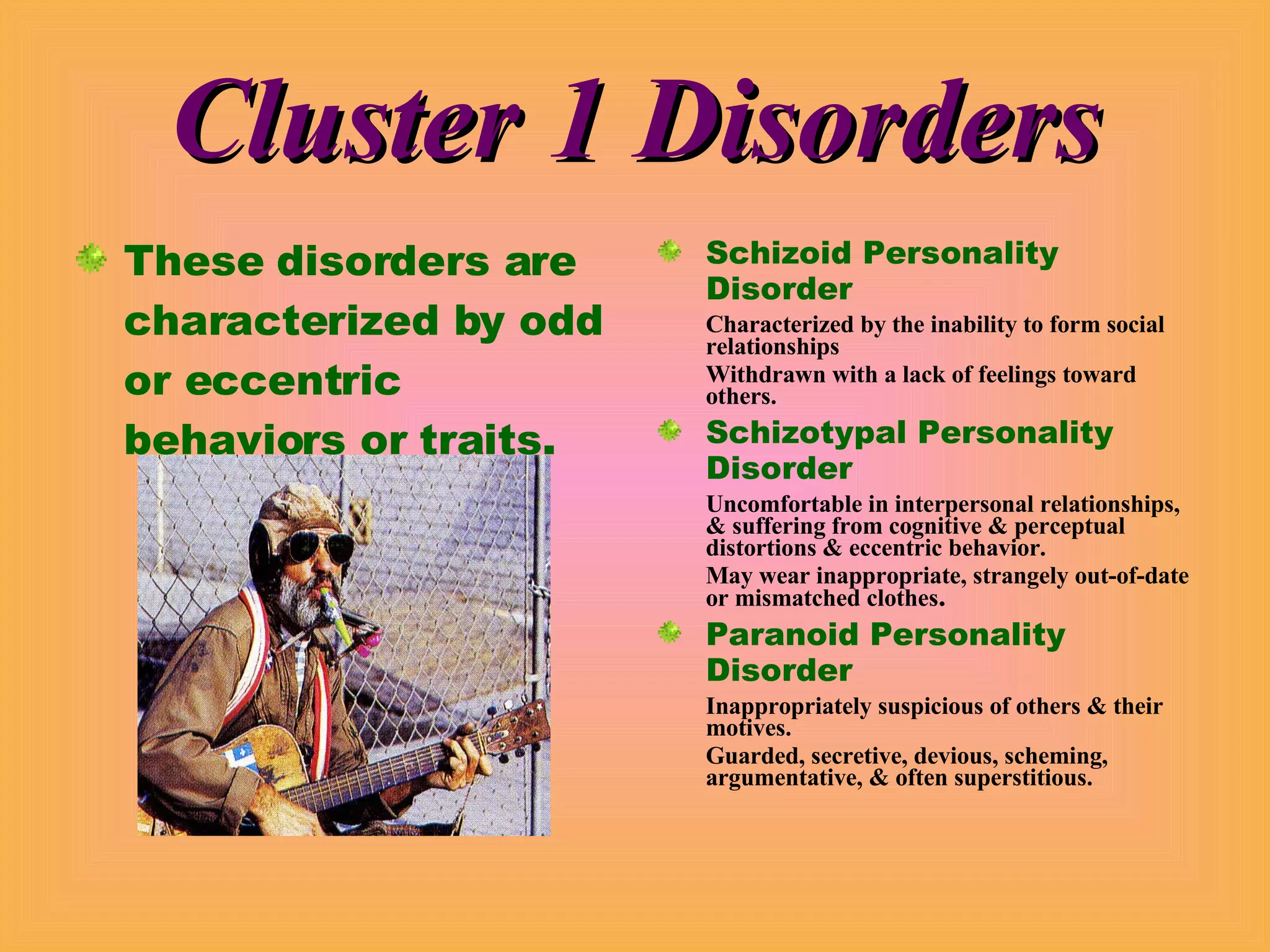
Cluster 1 Disorders These disorders are characterized by odd or eccentric behaviors or traits. Schizoid Personality Disorder Characterized by the inability to form social relationships Withdrawn with a lack of feelings toward others. Schizotypal Personality Disorder Uncomfortable in interpersonal relationships, & suffering from cognitive & perceptual distortions & eccentric behavior. May wear inappropriate, strangely out-of-date or mismatched clothes . Paranoid Personality Disorder Inappropriately suspicious of others & their motives. Guarded, secretive, devious, scheming, argumentative, & often superstitious.
Cluster 2 Disorders Characterized by dramatic, emotional or erratic behavior. They have very unstable interpersonal relationships, self-image and moods. Borderline Personality Disorder Very unstable in self-image, mood, & relationships. Acts impulsively & self-destructively. Manipulative, self-destructive impulses when trying to control or strengthen  personal relationships. Histrionic Personality Disorder Overly dramatic behavior, self-centered, & craving attention.
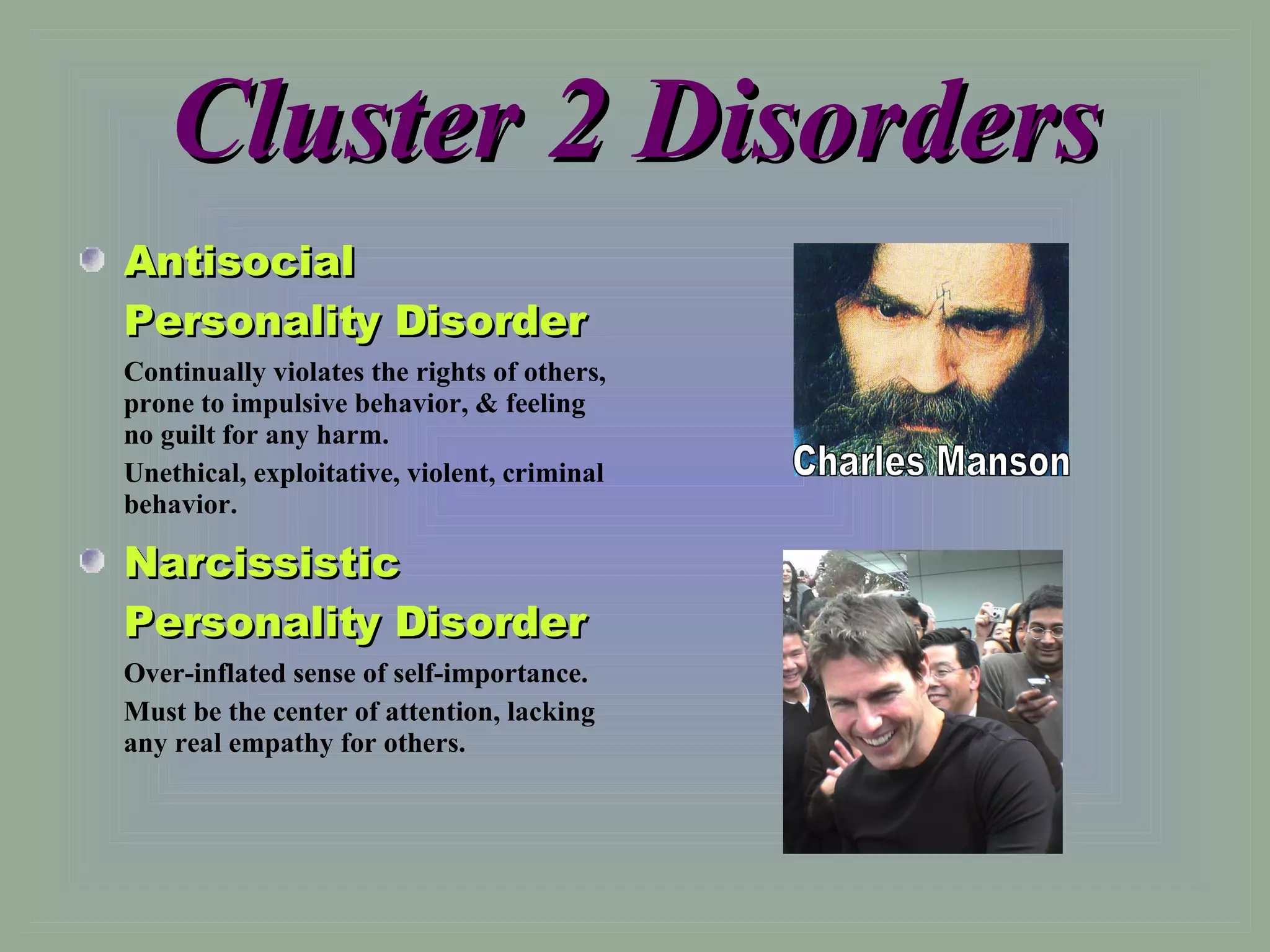
Cluster 2 Disorders Antisocial Personality Disorder Continually violates the rights of others, prone to impulsive behavior, & feeling no guilt for any harm. Unethical, exploitative, violent, criminal behavior. Narcissistic Personality Disorder Over-inflated sense of self-importance. Must be the center of attention, lacking any real empathy for others. Charles Manson
Cluster 3 Disorders Characterized by anxious or fearful behavior. Avoidant personality Disorder Hypersensitive to potential rejection by others, causing social withdrawal despite a desire for social relationships. Has social anxiety & is timid, anxious, & fearful of relationships. Obsessive-Compulsive Personality Disorder Preoccupation with rules, schedules, & trivial details, & unable to express emotional warmth. Preoccupied with orderliness & perfectionism.
Cluster 3 Disorders Dependent Personality Disorder The inability to make decisions or to act independently. Fails to take responsibility for one’s own life, instead relies on other to make their decisions. Can’t tolerate being alone. Has a fear of abandonment. Passive-Aggressive Personality Disorder Unassertive, indirect resistance to demands, as in forgetting, procrastinating, being late, and being indifferent.
Schizophrenic Disorders Mental Disorders that interfere greatly with life. Common Symptoms: Cognitive Distortions Hallucinations Delusions Behavioral and Social Disturbances Language Problems Emotional Disturbances
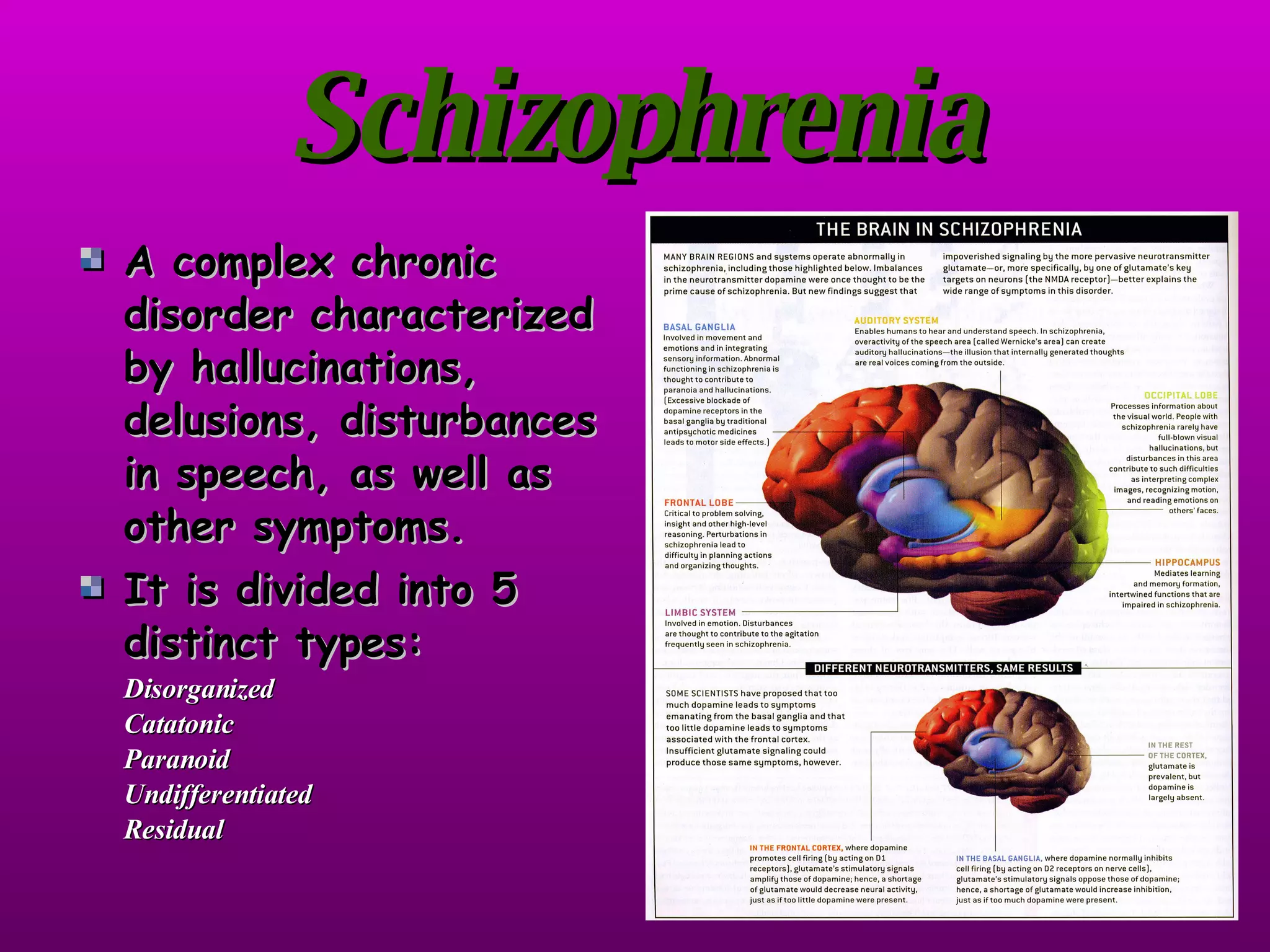
Schizophrenia A complex chronic disorder characterized by hallucinations, delusions, disturbances in speech, as well as other symptoms. It is divided into 5 distinct types: Disorganized Catatonic Paranoid Undifferentiated Residual
Origins of Schizophrenia Affects 1%-2% of people in the U.S. Usually begins in the late teens or early 20s. Factors in the disorder: Genetic Factors Family Factors Cognitive Factors Brain Dysfunction Biochemical Factors
Types of Schizophrenia Disorganized Type Originally called hebephrenic There is an absence of  and shallow emotions with bizarre & silly, child-like behaviors, poorly developed delusions, regressive behavior & verbal incoherence.   Catatonic Type Unusual patterns of motor activity (e.g. rigid postures or extreme excitedness), will be either mute or extremely talkative chattering incoherently.
Types of Schizophrenia Paranoid Type Preoccupied with one or more sets of bizarre delusions (of grandeur or persecution), often based on the “out to get me” attitude. Is extremely suspicious. Nothing makes sense.   Residual Originally called simple schizophrenia. Characterized by withdrawal, minimal emotional responding, absence of motivation. Ted Kozynski
Types of Schizophrenia Undifferentiated Type Has many symptoms (e.g. delusions, hallucinations, and incoherence) but doesn’t fit neatly into any specific category.
Disorders of Aging Alzheimer’s Disease An age-related disease characterized by memory loss, mental confusion, &, in it’s later stages, a nearly total loss of mental abilities.
Disorders of Aging Parkinson’s Disease A degenerative disease where the person has difficulty performing simple acts due to  marked disturbances dopamine neurons in the   substantia nigra. In the later stages, the individual may have a shuffling gait, a blank expression on the face, and is unable to initiate movements.
The Cause of Alzheimer’s & Parkinson’s? Blue-Green Algae Cynobacteria produces a toxin called BMAA which has been linked to neurodegenertive disorders such as Alzheimer’s and an illness that mimics Lou Gherig’s and Parkinson’s diseases. Cynobacteria live in marine, brackish and freshwater environments world-wide. With more pollution & global warming, blooms can cover thousands of square kilometers causing health concerns.
Childhood Disorders ADHD A psychological disorder in which children are unable to concentrate their attention on any task for more than a few minutes. Inattention, impulsiveness, hyperactive behavior A CNS arousal problem. Underarousal Affects Dopamine use in the Basal Ganglia and Prefrontal Cortex Psychostimulants are used to manage the behavior. They increase the child’s ability to focus attention. There are only short-term benefits. Non-stimulant drugs are now being used.
Childhood Disorders Autism A condition arising in infancy, in which the child is motivated to avoid stimulation, including social interaction. They have poor social skills & emotional responding. They dislike changes in their routine, perform monotonous actions, & ignore stimuli other than that which they are attending to. They remain distant & withdrawn. Dyslexia The inability to identify or write correctly letters & words or to read with understanding. Generally considered a learning disorder. When a child is below achievement in school learning as would be expected for his intelligence, a learning disorder is suspected.

Abnormal Behavior

  • 1.
  • 2.
  • 3.
    What is AbnormalBehavior? Behavior that is: Statistically unusual Considered strange or undesirable by most people A source of unhappiness There are biological, psychological (personal standards), & socio-cultural factors involved in defining abnormal behavior.
  • 4.
    What is NormalBehavior? Normality is Often Confused with Reality. Reality is That Which is Perceived by the Senses. Normal Behavior Agrees with or Conforms to the Society’s Accepted Patterns of Customs, Rules, Laws, Fears, and Taboos.
  • 5.
    The Early HistoricalModel of Psychological Disorders The Supernatural Model Abnormal behavior is the result of possession by demons, through magic, &/or the result of supernatural power. Consequently, only certain people could remove the problem.
  • 6.
    Early Mental InstitutionsEarly mental institutions were places of torture where the mentally disturbed were chained and abused.
  • 7.
    The Later HistoricalModel of Psychological Disorders The Natural Model The Medical Model: abnormal behavior is a disease. All diseases must have symptoms & a pattern of development . The natural model began in ancient Greece. Philosophers began to see natural causes to abnormal behavior just like any physical illness.
  • 8.
    Modern Models ofAbnormal Behavior The Psychoanalytic Model Abnormal behaviors are the result of unconscious conflicts. The Biological Model All abnormal behaviors have a biological or physiological basis. The Cognitive-Behavioral Model Abnormal behaviors are the result of learning maladaptive behaviors. The Diathesis-Stress Model. Abnormal behavior is a biological predisposition & the disorder is seen under stress. The Systems Approach Model Abnormal behaviors are produced from life-style stressors & expectations combined with biological predispositions.
  • 9.
    Classifying Abnormal BehaviorsDSM-IV-TR Handbook of disorders used by therapists. It provides descriptions, not causes or treatments.
  • 10.
    The Mood DisordersDepression Depressed mood, motor retardation, uneasiness & apprehension, intense dejection, self-depreciation, self-condemnation, guilt which can become delusional. Types of Depression Clinical or endogenous depression Psychological or exogenous depression Major Depression vs. Dysthymia Major depression is an intense sadness that lasts for months. Dysthymia is a less intense sadness with little relief for at least 2 years.
  • 11.
    When Frogs getThe "Blues"
  • 12.
  • 13.
    The Mood DisordersSuicide 30,000 people per year in the U.S.A. commit suicide. More women attempt suicide, but more men commit it. Men take more active means. Stress is often involved in suicides. Leaving home, college, career, broken romance, unemployment, financial strain are major reasons. The person tends to be overwhelmed with hopelessness.
  • 14.
    The Mood DisordersMania The opposite of depression. Overtalkativeness, heightened motor activity, flight of ideas, extreme elation. 2 types of mania: Hypomania – a mild form of mania Acute mania – boastfulness, expansive, unrealistic, ambitious, boisterousness & violent. The Causes of Mood Disorders Biological cause Genetics & biochemistry Psychological cause Cognitive distortions of the environment Social cause Interpersonal problems
  • 15.
    Anxiety Disorders Anxietyis a condition in which intense feelings of fear & dread are long standing or disruptive. 5 types of anxiety disorders Phobias Generalized Anxiety Disorder (GAD) Panic Disorder (PD) Obsessive-Compulsive Disorder (OCD) Posttraumatic Stress Disorder (PTSD)
  • 16.
    Phobias Out-of-proportion fearsassociated with circumstances & objects. Most common phobias: Social phobias Fears associated with social situations (e.g. agoraphobia) Object phobias Fears associated with dogs, cats, spiders, etc. Event phobias Fears associated with something happening (e.g. fear of being struck by lightning, being hit by a meteor or asteroid, stepping on the cracks in a sidewalk, etc.) Desentization Therapy
  • 17.
    Not all Phobiasare on the List
  • 18.
    Panic Disorders Recurringattacks of panic, periods of intense fear, & feelings of impending doom or death accompanied by physiological symptoms all occurring without cause. Often seen with a phobic response. Feelings of dizziness, problems with breathing, sweating, & trembling. After an attack, the fear of another panic attack sets in.
  • 19.
    Other Anxiety DisordersGeneralized Anxiety Disorder Prolonged, unfocused, intense fear response. Not attached to any object or event Obsessive-Compulsive Disorder Persistent, intrusion of unwanted thoughts, urges, or actions that are unable to stop. Includes the “pack-rat”
  • 20.
    Other Anxiety DisordersPosttraumatic Stress Disorder An anxiety disorder in which a person who has experienced a traumatic or life-threatening event has symptoms such as psychic numbing, reliving of the trauma, & increased physiological arousal.
  • 21.
    Causes of AnxietyDisorders Depends on the point of view 1. Learned Either directly or vicariously Locus of control seen outside. 2. Biological Genetic predispositions. 3. Psychological Internal conflicts produce anxiety. Follow this with extensive use of the defense mechanisms.
  • 22.
    Psychosomatic & SomatoformDisorders Psychosomatic Disorders Psychological factors produce real physical disorders. Stress is strongly indicated . Somatoform Disorders Physical symptoms persist without any identifiable physical cause. Conversion Disorders Hypochondriasis Body Dysmorphic Disorder
  • 23.
    Dissociative Disorders Someaspect of the personality seems to be separated from the rest. Dissociative Amnesia A loss of memory with no organic cause. Usually after a stressful event. Usually accompanied by a Dissociative Fugue . Dissociative Identity Disorder Multiple Personality Disorder Several distinct personalities in the same person. Depersonalization Disorder Feelings of being changed or different in a strange way.
  • 24.
    Sexual & Gender-IdentityDisorders Sexual Dysfunction Erectile Disorder The inability to achieve or maintain an erection Physical or Psychological causes Female Sexual Arousal Disorder The inability to become excited or achieve orgasm About 1/3 have genetic construct, others are psychological
  • 25.
    Sexual Disorders ParaphiliasExhibitionism Exposure of one’s genitals to an unsuspecting stranger. Voyeurism Observing a stranger naked, etc. Fetishism Sexual arousal from nonliving objects. Transvestic Fetishism Dressing in clothing of the opposite sex.
  • 26.
    Sexual Disorders Sadism& Masochism Arousal from dominating or being dominated. Frotteurism Touching or rubbing against a non-consenting person. Necrophilia Obsession with dead bodies. Klismaphilia Sexual excitement from enemas. Coprophilia Arousal through feces. Zoophilia Sexual activity with animals.
  • 27.
    Gender-Identity Disorder Thedesire to become or the insistence one is the opposite sex. Trans-sexuals & certain transvestites In children it is seen as boys playing with girls toys and girls playing with boys toys.
  • 28.
    Personality Disorders Inflexible,maladaptive ways of thinking & behaving learned in early life which cause distress & conflict with others. These behaviors impair personal or social functioning & are a source of distress to the individual or to other people. Included in these disorders are: Schizotypal Personality Disorder Schizoid Personality Disorder Paranoid Personality Disorder Dependant Personality Disorder Avoidant Personality Disorder Narcissistic Personality Disorder Borderline Personality Disorder Antisocial Personality Disorder Obsessive-Compulsive Personality Disorder Passive-Aggressive Personality Disorder
  • 29.
    Cluster 1 DisordersThese disorders are characterized by odd or eccentric behaviors or traits. Schizoid Personality Disorder Characterized by the inability to form social relationships Withdrawn with a lack of feelings toward others. Schizotypal Personality Disorder Uncomfortable in interpersonal relationships, & suffering from cognitive & perceptual distortions & eccentric behavior. May wear inappropriate, strangely out-of-date or mismatched clothes . Paranoid Personality Disorder Inappropriately suspicious of others & their motives. Guarded, secretive, devious, scheming, argumentative, & often superstitious.
  • 30.
    Cluster 2 DisordersCharacterized by dramatic, emotional or erratic behavior. They have very unstable interpersonal relationships, self-image and moods. Borderline Personality Disorder Very unstable in self-image, mood, & relationships. Acts impulsively & self-destructively. Manipulative, self-destructive impulses when trying to control or strengthen personal relationships. Histrionic Personality Disorder Overly dramatic behavior, self-centered, & craving attention.
  • 31.
    Cluster 2 DisordersAntisocial Personality Disorder Continually violates the rights of others, prone to impulsive behavior, & feeling no guilt for any harm. Unethical, exploitative, violent, criminal behavior. Narcissistic Personality Disorder Over-inflated sense of self-importance. Must be the center of attention, lacking any real empathy for others. Charles Manson
  • 32.
    Cluster 3 DisordersCharacterized by anxious or fearful behavior. Avoidant personality Disorder Hypersensitive to potential rejection by others, causing social withdrawal despite a desire for social relationships. Has social anxiety & is timid, anxious, & fearful of relationships. Obsessive-Compulsive Personality Disorder Preoccupation with rules, schedules, & trivial details, & unable to express emotional warmth. Preoccupied with orderliness & perfectionism.
  • 33.
    Cluster 3 DisordersDependent Personality Disorder The inability to make decisions or to act independently. Fails to take responsibility for one’s own life, instead relies on other to make their decisions. Can’t tolerate being alone. Has a fear of abandonment. Passive-Aggressive Personality Disorder Unassertive, indirect resistance to demands, as in forgetting, procrastinating, being late, and being indifferent.
  • 34.
    Schizophrenic Disorders MentalDisorders that interfere greatly with life. Common Symptoms: Cognitive Distortions Hallucinations Delusions Behavioral and Social Disturbances Language Problems Emotional Disturbances
  • 35.
    Schizophrenia A complexchronic disorder characterized by hallucinations, delusions, disturbances in speech, as well as other symptoms. It is divided into 5 distinct types: Disorganized Catatonic Paranoid Undifferentiated Residual
  • 36.
    Origins of SchizophreniaAffects 1%-2% of people in the U.S. Usually begins in the late teens or early 20s. Factors in the disorder: Genetic Factors Family Factors Cognitive Factors Brain Dysfunction Biochemical Factors
  • 37.
    Types of SchizophreniaDisorganized Type Originally called hebephrenic There is an absence of and shallow emotions with bizarre & silly, child-like behaviors, poorly developed delusions, regressive behavior & verbal incoherence. Catatonic Type Unusual patterns of motor activity (e.g. rigid postures or extreme excitedness), will be either mute or extremely talkative chattering incoherently.
  • 38.
    Types of SchizophreniaParanoid Type Preoccupied with one or more sets of bizarre delusions (of grandeur or persecution), often based on the “out to get me” attitude. Is extremely suspicious. Nothing makes sense. Residual Originally called simple schizophrenia. Characterized by withdrawal, minimal emotional responding, absence of motivation. Ted Kozynski
  • 39.
    Types of SchizophreniaUndifferentiated Type Has many symptoms (e.g. delusions, hallucinations, and incoherence) but doesn’t fit neatly into any specific category.
  • 40.
    Disorders of AgingAlzheimer’s Disease An age-related disease characterized by memory loss, mental confusion, &, in it’s later stages, a nearly total loss of mental abilities.
  • 41.
    Disorders of AgingParkinson’s Disease A degenerative disease where the person has difficulty performing simple acts due to marked disturbances dopamine neurons in the substantia nigra. In the later stages, the individual may have a shuffling gait, a blank expression on the face, and is unable to initiate movements.
  • 42.
    The Cause ofAlzheimer’s & Parkinson’s? Blue-Green Algae Cynobacteria produces a toxin called BMAA which has been linked to neurodegenertive disorders such as Alzheimer’s and an illness that mimics Lou Gherig’s and Parkinson’s diseases. Cynobacteria live in marine, brackish and freshwater environments world-wide. With more pollution & global warming, blooms can cover thousands of square kilometers causing health concerns.
  • 43.
    Childhood Disorders ADHDA psychological disorder in which children are unable to concentrate their attention on any task for more than a few minutes. Inattention, impulsiveness, hyperactive behavior A CNS arousal problem. Underarousal Affects Dopamine use in the Basal Ganglia and Prefrontal Cortex Psychostimulants are used to manage the behavior. They increase the child’s ability to focus attention. There are only short-term benefits. Non-stimulant drugs are now being used.
  • 44.
    Childhood Disorders AutismA condition arising in infancy, in which the child is motivated to avoid stimulation, including social interaction. They have poor social skills & emotional responding. They dislike changes in their routine, perform monotonous actions, & ignore stimuli other than that which they are attending to. They remain distant & withdrawn. Dyslexia The inability to identify or write correctly letters & words or to read with understanding. Generally considered a learning disorder. When a child is below achievement in school learning as would be expected for his intelligence, a learning disorder is suspected.