
PLANNING

SUPERVISED BY : Mrs. Lekha Singh
                Lecturer,(NIN)
PRESENTED BY : Monika Sharma
              M.Sc.Nursing 1st year(NIN)
Till now:
 Introduction to nursing process
Assessment
Diagnosis
Setting up of goals
INTRODUCTION

Planning is the third step of the
nursing process, is a category of
nursing behaviours in which a nurse
sets a client cantered goal, expected
outcomes and plans nursing
interventions.
DEFINITION:


        Plan is a scheme, program, or
     method worked out beforehand for
     the accomplishment of an objective.


         A category of nursing behaviour in which
         a strategy is designed to achieve the goals
            of care for an individual patient, as
          established in assessing and analyzing.
CONT…


   Planning (also called forethought) is the
   process of thinking about and organizing
      the activities required to achieve a
                  desired goal.


                A nursing care plan is a part of
                  the nursing process which
                outlines the plan of action that
                 will be implemented during a
                     patients’ medical care.
PURPOSE


         to develop the care plan that specifies the goals and
                         interventions


to promote,       maintain,       restore      prevent illness
ADVANTAGES


  Management by objectives


             Facilitate communication


  Strengthen nursing process
CONT…


Facilitate quality care


           Minimizes uncertainities


 Facilitate co-ordination
CONT…


Improves moral

        economy


           Facilitate controlling
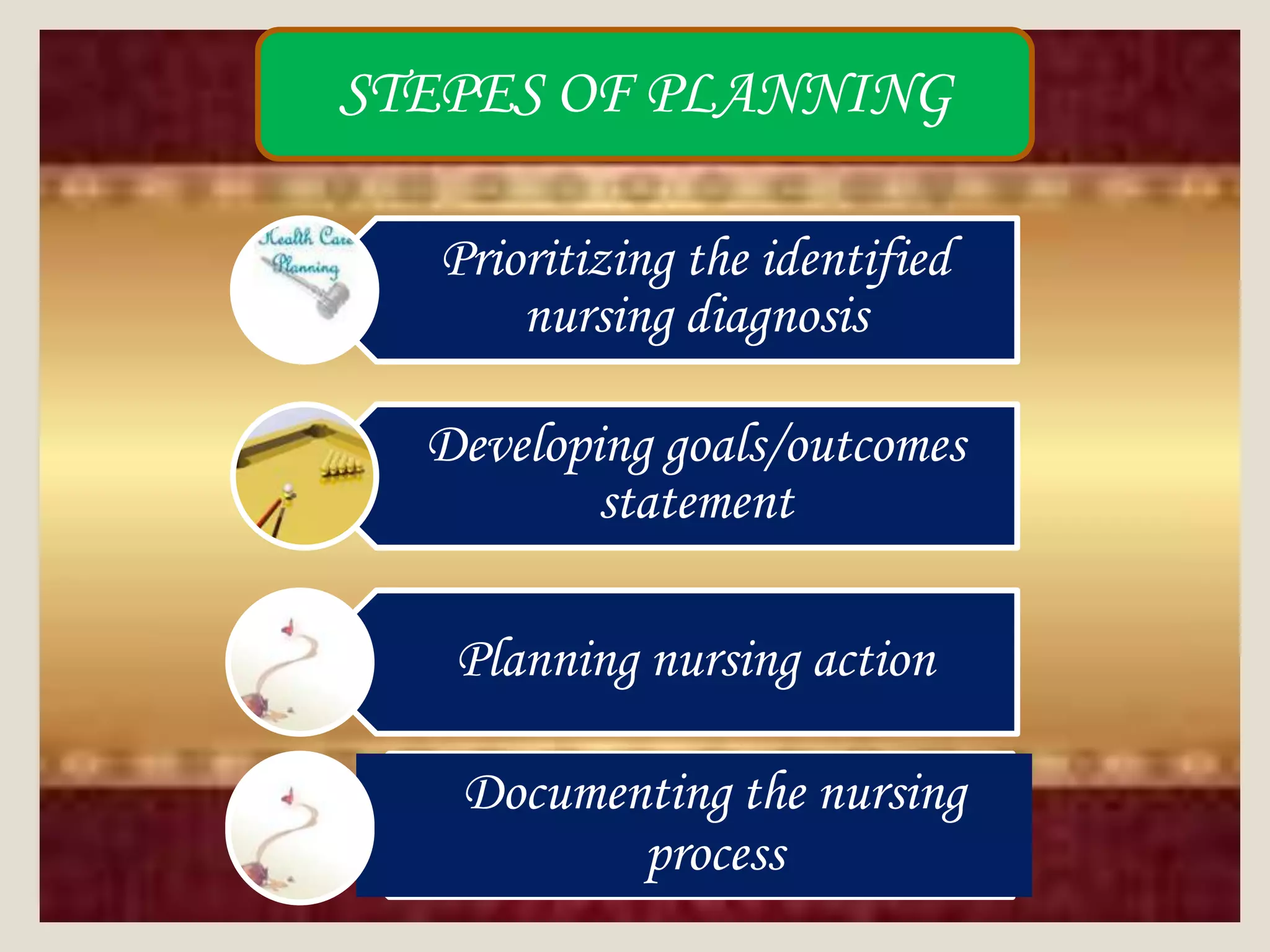
STEPES OF PLANNING

  Prioritizing the identified
      nursing diagnosis

  Developing goals/outcomes
          statement

   Planning nursing action

   Documenting the nursing
          process
PRIORITISING NURSING
     DIAGNOSIS
SETTING GOALS
PLANNING NURSING CARE

Planning nursing interventions for specific
nursing diagnoses means determining the
actions or activities which will achieve the
expected outcome
Types of nursing interventions

Nurse-initiated interventions
Dependent-nursing interventions
Collaborative interventions:
Types of nursing interventions

Nurse-initiated interventions
e.g. elevating an oedematous extremity.
Types of nursing interventions


Dependent-nursing interventions
e.g. administration of medications, preparing
client for diagnostic test
Types of nursing interventions


Collaborative interventions:
e.g teaching exercises to the patient (need consultation of
physiotherapist), Teaching about diet plan(need consultation of
dietician)
GUIDELINES FOR WRITING PLANNING:
  Identify  the problem
         E.g Potential impairment of skin integrity related
                      to prolonged bed rest.

     identifies the etiological factors
            E.g: Potential impairment of skin integrity related to
                         prolonged bedrest.

     identifies the signs and symptoms present
             E.g: Impaired skin integrity related to prolonged
       bedrest as evidenced by red sacral pressure point
GUIDELINES FOR WRITING PLANNING:
     individualized to the client
     based upon the goals to be achieved
     should start with “TO ”.
     should be cost effective (for nutrition either sprouts, anar)
     Put safety first
     should have scientific rationale
GUIDELINES FOR WRITING PLANNING:


  State nursing actions clearly and specifically(to
  increase fluid intake in patient)

  Make nursing actions realistic
  (limitations, age, developmental level, capabilities
  and resources available )
CONT…

Do not plan any nursing actions which can interfere
with other therapies,
, involve the client in planning the nursing actions
It should be documented
Characteristics


  Goal                                   measurable
directed


           sequential         flexible
Characteristics


 future                                   continuous
oriented                                    process


           intellectual        decision
             process           making
Nursing orders

 The nurse writes Nursing actions or interventions in the
nursing care plan as nursing orders

 Nursing orders describe the specific actions or activities
which are to be done by all nurses caring for that client.
Importance of writing nursing orders


  communicates nursing care priorities
  Identifies and co-ordinates resources
  Organizes information exchanged in change
 of shift reports.
  It enhances the continuity of care.
Importance of writing nursing orders


   Written plans includes the expected outcome
 , so we can evaluate weather goal has been
 achieved or not.

  A written care plan is blueprint of action
 so we can implement it easily and evaluate the
 client’s response to nursing actions.
CONCEPT MAPS:


  It is the visual representation of client’s problems and
interventions that shows the relationship to one another.
RECAPTULIZATION
BIBLIOGRAHY
Planning ..phase of nursing process

Planning ..phase of nursing process

  • 2.
    PLANNING SUPERVISED BY :Mrs. Lekha Singh Lecturer,(NIN) PRESENTED BY : Monika Sharma M.Sc.Nursing 1st year(NIN)
  • 4.
    Till now:  Introductionto nursing process Assessment Diagnosis Setting up of goals
  • 5.
    INTRODUCTION Planning is thethird step of the nursing process, is a category of nursing behaviours in which a nurse sets a client cantered goal, expected outcomes and plans nursing interventions.
  • 6.
    DEFINITION: Plan is a scheme, program, or method worked out beforehand for the accomplishment of an objective. A category of nursing behaviour in which a strategy is designed to achieve the goals of care for an individual patient, as established in assessing and analyzing.
  • 7.
    CONT… Planning (also called forethought) is the process of thinking about and organizing the activities required to achieve a desired goal. A nursing care plan is a part of the nursing process which outlines the plan of action that will be implemented during a patients’ medical care.
  • 8.
    PURPOSE to develop the care plan that specifies the goals and interventions to promote, maintain, restore prevent illness
  • 9.
    ADVANTAGES Managementby objectives Facilitate communication Strengthen nursing process
  • 10.
    CONT… Facilitate quality care Minimizes uncertainities Facilitate co-ordination
  • 11.
    CONT… Improves moral economy Facilitate controlling
  • 13.
    STEPES OF PLANNING Prioritizing the identified nursing diagnosis Developing goals/outcomes statement Planning nursing action Documenting the nursing process
  • 14.
  • 15.
  • 16.
    PLANNING NURSING CARE Planningnursing interventions for specific nursing diagnoses means determining the actions or activities which will achieve the expected outcome
  • 17.
    Types of nursinginterventions Nurse-initiated interventions Dependent-nursing interventions Collaborative interventions:
  • 18.
    Types of nursinginterventions Nurse-initiated interventions e.g. elevating an oedematous extremity.
  • 19.
    Types of nursinginterventions Dependent-nursing interventions e.g. administration of medications, preparing client for diagnostic test
  • 20.
    Types of nursinginterventions Collaborative interventions: e.g teaching exercises to the patient (need consultation of physiotherapist), Teaching about diet plan(need consultation of dietician)
  • 21.
    GUIDELINES FOR WRITINGPLANNING: Identify the problem E.g Potential impairment of skin integrity related to prolonged bed rest.  identifies the etiological factors E.g: Potential impairment of skin integrity related to prolonged bedrest.  identifies the signs and symptoms present E.g: Impaired skin integrity related to prolonged bedrest as evidenced by red sacral pressure point
  • 22.
    GUIDELINES FOR WRITINGPLANNING:  individualized to the client  based upon the goals to be achieved  should start with “TO ”.  should be cost effective (for nutrition either sprouts, anar)  Put safety first  should have scientific rationale
  • 23.
    GUIDELINES FOR WRITINGPLANNING: State nursing actions clearly and specifically(to increase fluid intake in patient) Make nursing actions realistic (limitations, age, developmental level, capabilities and resources available )
  • 24.
    CONT… Do not planany nursing actions which can interfere with other therapies, , involve the client in planning the nursing actions It should be documented
  • 25.
    Characteristics Goal measurable directed sequential flexible
  • 26.
    Characteristics future continuous oriented process intellectual decision process making
  • 27.
    Nursing orders  Thenurse writes Nursing actions or interventions in the nursing care plan as nursing orders  Nursing orders describe the specific actions or activities which are to be done by all nurses caring for that client.
  • 28.
    Importance of writingnursing orders  communicates nursing care priorities  Identifies and co-ordinates resources  Organizes information exchanged in change of shift reports.  It enhances the continuity of care.
  • 29.
    Importance of writingnursing orders  Written plans includes the expected outcome , so we can evaluate weather goal has been achieved or not.  A written care plan is blueprint of action so we can implement it easily and evaluate the client’s response to nursing actions.
  • 30.
    CONCEPT MAPS: It is the visual representation of client’s problems and interventions that shows the relationship to one another.
  • 32.
  • 33.