Adoption and Change
Col Zulfiquer Ahmed Amin
M Phil, MPH, PGD (Health Economics), MBBS
Armed Forces Medical Institute (AFMI)
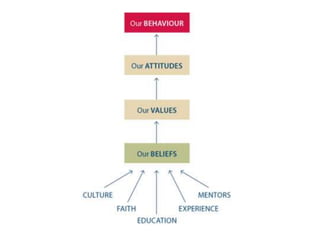
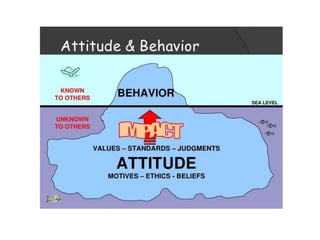
Behavior is the observable component of what we do; while
attitude is the non-observable component of why we do.
Attitude is the psychological characteristics that define who we
are.
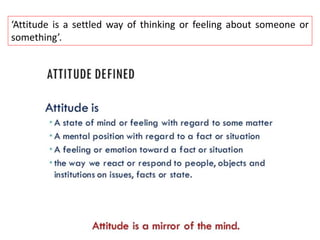
‘Attitude is a settled way of thinking or feeling about someone or
something’.
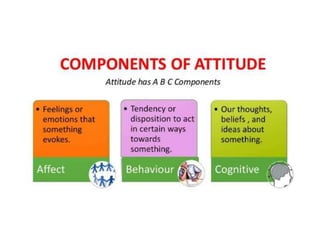
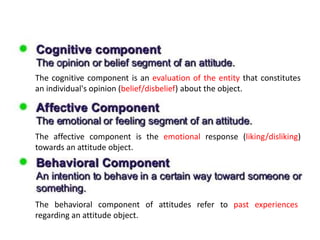
The cognitive component is an evaluation of the entity that constitutes
an individual's opinion (belief/disbelief) about the object.
The affective component is the emotional response (liking/disliking)
towards an attitude object.
The behavioral component of attitudes refer to past experiences
regarding an attitude object.
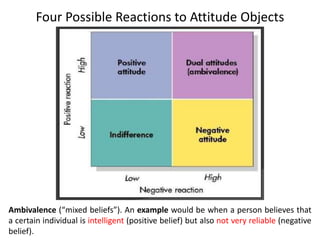
Four Possible Reactions to Attitude Objects
Ambivalence (“mixed beliefs”). An example would be when a person believes that
a certain individual is intelligent (positive belief) but also not very reliable (negative
belief).
Attitude Formation
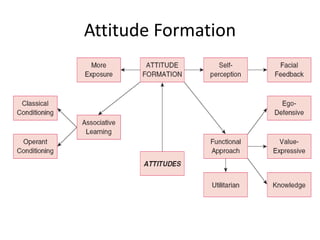
Four distinct ways in which attitudes can form towards some
issue, event, person or thing.
In order of increasing psychological complexity:
-Mere exposure,
-Associative learning,
-Self-perception, and
-Functional reasons.
These four ways in which attitudes can be formed apply
mostly when there is no prior or existing attitude or
knowledge about the attitude object.
Ways of Attitude Formation
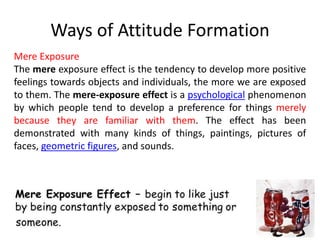
Mere Exposure
The mere exposure effect is the tendency to develop more positive
feelings towards objects and individuals, the more we are exposed
to them. The mere-exposure effect is a psychological phenomenon
by which people tend to develop a preference for things merely
because they are familiar with them. The effect has been
demonstrated with many kinds of things, paintings, pictures of
faces, geometric figures, and sounds.
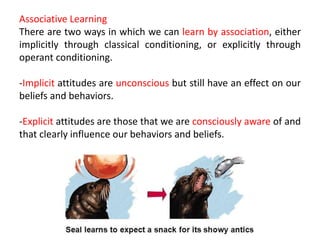
Associative Learning
There are two ways in which we can learn by association, either
implicitly through classical conditioning, or explicitly through
operant conditioning.
-Implicit attitudes are unconscious but still have an effect on our
beliefs and behaviors.
-Explicit attitudes are those that we are consciously aware of and
that clearly influence our behaviors and beliefs.
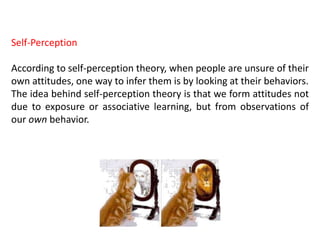
Self-Perception
According to self-perception theory, when people are unsure of their
own attitudes, one way to infer them is by looking at their behaviors.
The idea behind self-perception theory is that we form attitudes not
due to exposure or associative learning, but from observations of
our own behavior.
Most people would agree, for example, that a person who
perceives himself or herself as interested in road biking may, as a
result of that interest, buy bicycling equipment and go on long
cycling rides. That is, the person’s attitudes influence his or her
behavior. Daryl Bem, however, reversed this relation by
suggesting that it is also possible that people understand their
attitudes and interests because they have made inferences based
on their behavior. Thus, this person could infer that he or she is
interested in road biking on the basis of frequent cycling trips and
lavish spending on a nice bike.
Functional approach
The three ways in which attitudes can form discussed so far –
exposure, learning and self-perception – all operate apparently
outside of people’s awareness. Typically people are not aware of
mere exposure effects, nor conditioning, nor the fact that their
behaviors can sometimes influence their attitudes. All of these
theories argue that attitude formation is a passive process.
According to the functional approach attitudes are sometimes
formed based on the degree to which they satisfy different
psychological needs, so this is an active rather than passive
attitude theory.
Psychological Needs for Attitude Formation
(Functions of Attitude)
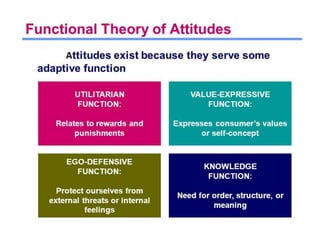
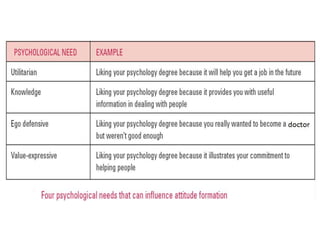
There are four basic psychological needs that manipulate our
attitude:
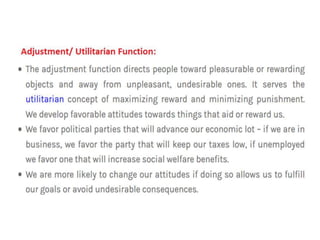
-Utilitarian (Adaptive/Instrumental),
-Knowledge,
-Ego-defensive and
-Value-expression.
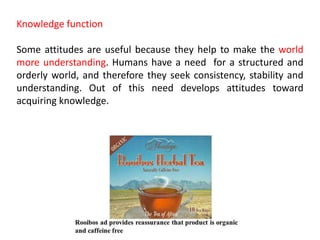
Knowledge function
Some attitudes are useful because they help to make the world
more understanding. Humans have a need for a structured and
orderly world, and therefore they seek consistency, stability and
understanding. Out of this need develops attitudes toward
acquiring knowledge.
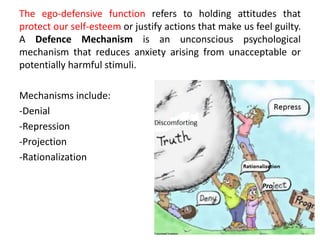
The ego-defensive function refers to holding attitudes that
protect our self-esteem or justify actions that make us feel guilty.
A Defence Mechanism is an unconscious psychological
mechanism that reduces anxiety arising from unacceptable or
potentially harmful stimuli.
Mechanisms include:
-Denial
-Repression
-Projection
-Rationalization
Repression: Repression is an unconscious mechanism employed by the
ego to keep disturbing or threatening thoughts from becoming
conscious. Thoughts that are often repressed are those that would
result in feelings of guilt from the superego.
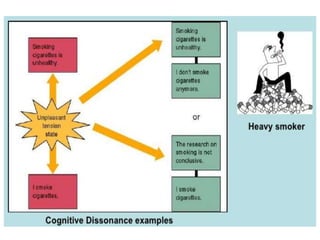
Denial: If some situation is just too much to handle, the person just
refuses to experience it. For example, smokers may refuse to admit to
themselves that smoking is bad for their health.
Rationalization: Rationalization is the cognitive distortion of "the
facts" to make an event or an impulse less threatening. We do it often
enough on a fairly conscious level when we provide ourselves with
excuses.
Projection: You might hate someone, but your super-ego tells you that
such hatred is unacceptable. You can solve the problem, by believing
that they hate you.
Value expressive attitude enable the expression of the person’s
centrally held values.
Some values are important to a person because they express
values that are integral to that person’s self-concept (Their ideas
about who they are).
If we view ourselves as muslim, we can reinforce that image by
adopting Islamic beliefs and values.
Attitude Formation
Psychological
The attitude of a person is determined by psychological factors
like ideas, values, beliefs, perception, etc. All these have a
complex role in determining a person's attitude.
Economic
A person's attitude also depends on issues such as his salary,
status, work , etc.
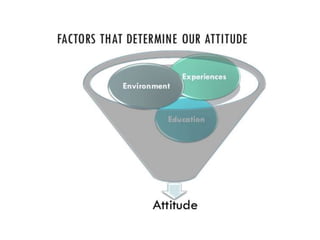
Factors which Influence Attitude
Family
Family plays a significant role in the primary stage of attitudes held
by individuals. Initially, a person develops certain attitudes from his
parents, brothers, sister, and elders in the family.
Society
Societies play an important role in formatting the attitudes of an
individual. The culture, the tradition, the language, etc., influence a
person's attitudes. Society, tradition, and the culture teach
individuals what is and what is not acceptable.
Experience
Attitudes form directly as a result of experience. They may
emerge due to direct personal experience, or they may result
from observation.
Social Factors
Social roles and social norms can have a strong influence on
attitudes. Social roles relate to how people are expected to
behave in a particular role or context. Social norms involve
society's rules for what behaviors are considered appropriate.
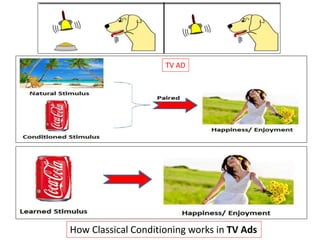
Learning
Attitudes can be learned in a variety of ways. Advertisers use
classical conditioning to influence our attitude toward a particular
product. In a television commercial, we find young, beautiful people
having fun in on a tropical beach while enjoying a sports drink. This
attractive and appealing imagery causes to develop a positive
association with this particular beverage.
Operant conditioning can also be used to influence how attitudes
develop. Imagine a young man who has just started smoking.
Whenever he lights up a cigarette, people complain, chastise him,
and ask him to leave their vicinity. This negative feedback from
those around him eventually causes him to develop an unfavorable
opinion of smoking and he decides to give up the habit.
TV AD
How Classical Conditioning works in TV Ads
Model for Predicting Behavior
The theory of planned behavior was developed to account for
the processes by which people consciously decide to engage in
specific actions. It states that behavioral intentions are the most
proximal determinant of behavior, and that three factors
(Attitude, norms and perceived behavioral control) converge to
predict behavioral intentions.
It has been applied in various fields such as advertising, public
relations, advertising campaigns and healthcare.
The ‘Theory of Planned Behavior’:
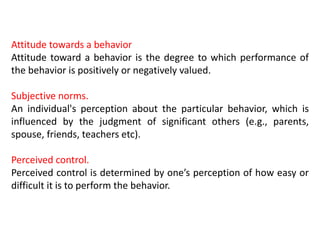
Attitude towards a behavior
Attitude toward a behavior is the degree to which performance of
the behavior is positively or negatively valued.
Subjective norms.
An individual's perception about the particular behavior, which is
influenced by the judgment of significant others (e.g., parents,
spouse, friends, teachers etc).
Perceived control.
Perceived control is determined by one’s perception of how easy or
difficult it is to perform the behavior.
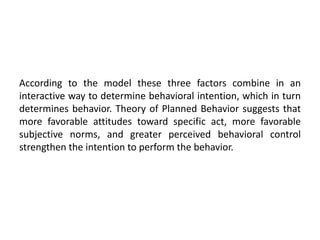
According to the model these three factors combine in an
interactive way to determine behavioral intention, which in turn
determines behavior. Theory of Planned Behavior suggests that
more favorable attitudes toward specific act, more favorable
subjective norms, and greater perceived behavioral control
strengthen the intention to perform the behavior.
imagine someone who wants to try to quit smoking. The attitude
may be positive (“I want to stop smoking”); the subjective norms
may also be positive (“my family wants me to stop smoking”), but
perceived control may be low (“I’m addicted and don’t know
whether I can stop”). All three factors feed into behavioral
intention, even perceived control. However, while there may be
strong intention, ultimately the behavior may not be carried out
because when the person comes to try to engage the behavior (stop
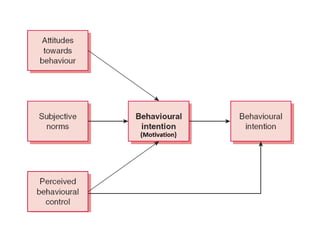
smoking) they may find it too difficult because of low behavioral
control (withdrawal effects) which feed directly into actual behavior.
ATTITUDE CHANGE
Attitude changes can take place by following methods:
-Self-perception.
-Learning theory.
-Cognitive Dissonance.
-Persuasion.
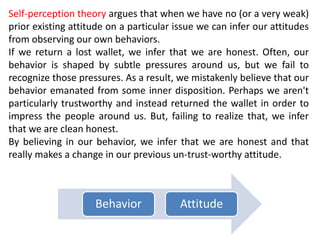
Self-perception theory argues that when we have no (or a very weak)
prior existing attitude on a particular issue we can infer our attitudes
from observing our own behaviors.
If we return a lost wallet, we infer that we are honest. Often, our
behavior is shaped by subtle pressures around us, but we fail to
recognize those pressures. As a result, we mistakenly believe that our
behavior emanated from some inner disposition. Perhaps we aren't
particularly trustworthy and instead returned the wallet in order to
impress the people around us. But, failing to realize that, we infer
that we are clean honest.
By believing in our behavior, we infer that we are honest and that
really makes a change in our previous un-trust-worthy attitude.
Behavior Attitude
Self perception theory provides the most accepted explanation of
the Foot-in-the-Door effect. Compliance to the initial request is
posited to lead us to infer that we like to be ‘helpful’. That makes a
real change to be ‘helpful’ in our attitude.
Now, newly formed attitude resulting from the initial compliance
make us more receptive to the second , larger request. This
technique is commonly used by the salespeople, and it is also
employed to increase compliance with requests made by charitable
organizations, like Red Cross. More generally, the ‘foot-in-the-door’
effect suggests that each small commitment people make to a
personal, organizational or career goal will lead to a larger
commitment to that goal.
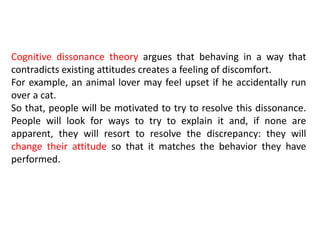
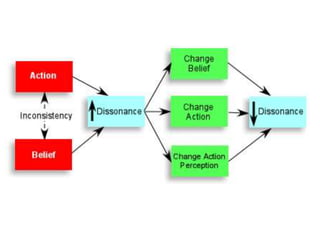
Cognitive dissonance theory argues that behaving in a way that
contradicts existing attitudes creates a feeling of discomfort.
For example, an animal lover may feel upset if he accidentally run
over a cat.
So that, people will be motivated to try to resolve this dissonance.
People will look for ways to try to explain it and, if none are
apparent, they will resort to resolve the discrepancy: they will
change their attitude so that it matches the behavior they have
performed.
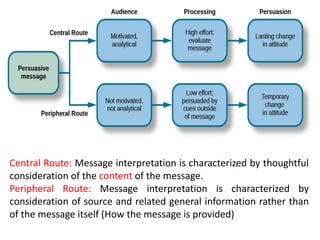
Persuasion
While cognitive dissonance is attitude change via an internal
discrepancy, persuasion refers to attitude change via an external
message. How do people think about, and incorporate information
they receive in TV that is counter to their current point of view?
This theory of persuasion suggests that people can alter their
attitudes in two ways. First, they can be motivated to listen and
think about the message, thus leading to an attitude shift. Or, they
might be influenced by characteristics of the speaker, leading to a
temporary or surface shift in attitude. Messages that are thought-
provoking and that appeal to logic are more likely to lead to
permanent changes in attitudes.
Central Route: Message interpretation is characterized by thoughtful
consideration of the content of the message.
Peripheral Route: Message interpretation is characterized by
consideration of source and related general information rather than
of the message itself (How the message is provided)
Learning Theory: Classical conditioning, operant conditioning,
and observational learning can be used to bring about attitude
change. Classical conditioning can be used to create positive
emotional reactions to an object, person, or event by associating
positive feelings with the target object. Operant conditioning can
be used to strengthen desirable attitudes and weaken
undesirable ones. People can also change their attitudes after
observing the behavior of others.
Attitude- Formation and Change

Attitude- Formation and Change

  • 1.
    Adoption and Change ColZulfiquer Ahmed Amin M Phil, MPH, PGD (Health Economics), MBBS Armed Forces Medical Institute (AFMI)
  • 3.
    Behavior is theobservable component of what we do; while attitude is the non-observable component of why we do. Attitude is the psychological characteristics that define who we are.
  • 5.
    ‘Attitude is asettled way of thinking or feeling about someone or something’.
  • 7.
    The cognitive componentis an evaluation of the entity that constitutes an individual's opinion (belief/disbelief) about the object. The affective component is the emotional response (liking/disliking) towards an attitude object. The behavioral component of attitudes refer to past experiences regarding an attitude object.
  • 14.
    Four Possible Reactionsto Attitude Objects Ambivalence (“mixed beliefs”). An example would be when a person believes that a certain individual is intelligent (positive belief) but also not very reliable (negative belief).
  • 15.
    Attitude Formation Four distinctways in which attitudes can form towards some issue, event, person or thing. In order of increasing psychological complexity: -Mere exposure, -Associative learning, -Self-perception, and -Functional reasons. These four ways in which attitudes can be formed apply mostly when there is no prior or existing attitude or knowledge about the attitude object.
  • 16.
    Ways of AttitudeFormation Mere Exposure The mere exposure effect is the tendency to develop more positive feelings towards objects and individuals, the more we are exposed to them. The mere-exposure effect is a psychological phenomenon by which people tend to develop a preference for things merely because they are familiar with them. The effect has been demonstrated with many kinds of things, paintings, pictures of faces, geometric figures, and sounds.
  • 17.
    Associative Learning There aretwo ways in which we can learn by association, either implicitly through classical conditioning, or explicitly through operant conditioning. -Implicit attitudes are unconscious but still have an effect on our beliefs and behaviors. -Explicit attitudes are those that we are consciously aware of and that clearly influence our behaviors and beliefs.
  • 18.
    Self-Perception According to self-perceptiontheory, when people are unsure of their own attitudes, one way to infer them is by looking at their behaviors. The idea behind self-perception theory is that we form attitudes not due to exposure or associative learning, but from observations of our own behavior.
  • 19.
    Most people wouldagree, for example, that a person who perceives himself or herself as interested in road biking may, as a result of that interest, buy bicycling equipment and go on long cycling rides. That is, the person’s attitudes influence his or her behavior. Daryl Bem, however, reversed this relation by suggesting that it is also possible that people understand their attitudes and interests because they have made inferences based on their behavior. Thus, this person could infer that he or she is interested in road biking on the basis of frequent cycling trips and lavish spending on a nice bike.
  • 20.
    Functional approach The threeways in which attitudes can form discussed so far – exposure, learning and self-perception – all operate apparently outside of people’s awareness. Typically people are not aware of mere exposure effects, nor conditioning, nor the fact that their behaviors can sometimes influence their attitudes. All of these theories argue that attitude formation is a passive process. According to the functional approach attitudes are sometimes formed based on the degree to which they satisfy different psychological needs, so this is an active rather than passive attitude theory.
  • 21.
    Psychological Needs forAttitude Formation (Functions of Attitude) There are four basic psychological needs that manipulate our attitude: -Utilitarian (Adaptive/Instrumental), -Knowledge, -Ego-defensive and -Value-expression.
  • 24.
    Knowledge function Some attitudesare useful because they help to make the world more understanding. Humans have a need for a structured and orderly world, and therefore they seek consistency, stability and understanding. Out of this need develops attitudes toward acquiring knowledge.
  • 25.
    The ego-defensive functionrefers to holding attitudes that protect our self-esteem or justify actions that make us feel guilty. A Defence Mechanism is an unconscious psychological mechanism that reduces anxiety arising from unacceptable or potentially harmful stimuli. Mechanisms include: -Denial -Repression -Projection -Rationalization
  • 26.
    Repression: Repression isan unconscious mechanism employed by the ego to keep disturbing or threatening thoughts from becoming conscious. Thoughts that are often repressed are those that would result in feelings of guilt from the superego. Denial: If some situation is just too much to handle, the person just refuses to experience it. For example, smokers may refuse to admit to themselves that smoking is bad for their health. Rationalization: Rationalization is the cognitive distortion of "the facts" to make an event or an impulse less threatening. We do it often enough on a fairly conscious level when we provide ourselves with excuses. Projection: You might hate someone, but your super-ego tells you that such hatred is unacceptable. You can solve the problem, by believing that they hate you.
  • 27.
    Value expressive attitudeenable the expression of the person’s centrally held values. Some values are important to a person because they express values that are integral to that person’s self-concept (Their ideas about who they are). If we view ourselves as muslim, we can reinforce that image by adopting Islamic beliefs and values.
  • 29.
  • 30.
    Psychological The attitude ofa person is determined by psychological factors like ideas, values, beliefs, perception, etc. All these have a complex role in determining a person's attitude. Economic A person's attitude also depends on issues such as his salary, status, work , etc. Factors which Influence Attitude
  • 31.
    Family Family plays asignificant role in the primary stage of attitudes held by individuals. Initially, a person develops certain attitudes from his parents, brothers, sister, and elders in the family. Society Societies play an important role in formatting the attitudes of an individual. The culture, the tradition, the language, etc., influence a person's attitudes. Society, tradition, and the culture teach individuals what is and what is not acceptable.
  • 32.
    Experience Attitudes form directlyas a result of experience. They may emerge due to direct personal experience, or they may result from observation. Social Factors Social roles and social norms can have a strong influence on attitudes. Social roles relate to how people are expected to behave in a particular role or context. Social norms involve society's rules for what behaviors are considered appropriate.
  • 33.
    Learning Attitudes can belearned in a variety of ways. Advertisers use classical conditioning to influence our attitude toward a particular product. In a television commercial, we find young, beautiful people having fun in on a tropical beach while enjoying a sports drink. This attractive and appealing imagery causes to develop a positive association with this particular beverage. Operant conditioning can also be used to influence how attitudes develop. Imagine a young man who has just started smoking. Whenever he lights up a cigarette, people complain, chastise him, and ask him to leave their vicinity. This negative feedback from those around him eventually causes him to develop an unfavorable opinion of smoking and he decides to give up the habit.
  • 34.
    TV AD How ClassicalConditioning works in TV Ads
  • 35.
    Model for PredictingBehavior The theory of planned behavior was developed to account for the processes by which people consciously decide to engage in specific actions. It states that behavioral intentions are the most proximal determinant of behavior, and that three factors (Attitude, norms and perceived behavioral control) converge to predict behavioral intentions. It has been applied in various fields such as advertising, public relations, advertising campaigns and healthcare. The ‘Theory of Planned Behavior’:
  • 37.
    Attitude towards abehavior Attitude toward a behavior is the degree to which performance of the behavior is positively or negatively valued. Subjective norms. An individual's perception about the particular behavior, which is influenced by the judgment of significant others (e.g., parents, spouse, friends, teachers etc). Perceived control. Perceived control is determined by one’s perception of how easy or difficult it is to perform the behavior.
  • 38.
    According to themodel these three factors combine in an interactive way to determine behavioral intention, which in turn determines behavior. Theory of Planned Behavior suggests that more favorable attitudes toward specific act, more favorable subjective norms, and greater perceived behavioral control strengthen the intention to perform the behavior.
  • 39.
    imagine someone whowants to try to quit smoking. The attitude may be positive (“I want to stop smoking”); the subjective norms may also be positive (“my family wants me to stop smoking”), but perceived control may be low (“I’m addicted and don’t know whether I can stop”). All three factors feed into behavioral intention, even perceived control. However, while there may be strong intention, ultimately the behavior may not be carried out because when the person comes to try to engage the behavior (stop smoking) they may find it too difficult because of low behavioral control (withdrawal effects) which feed directly into actual behavior.
  • 40.
    ATTITUDE CHANGE Attitude changescan take place by following methods: -Self-perception. -Learning theory. -Cognitive Dissonance. -Persuasion.
  • 41.
    Self-perception theory arguesthat when we have no (or a very weak) prior existing attitude on a particular issue we can infer our attitudes from observing our own behaviors. If we return a lost wallet, we infer that we are honest. Often, our behavior is shaped by subtle pressures around us, but we fail to recognize those pressures. As a result, we mistakenly believe that our behavior emanated from some inner disposition. Perhaps we aren't particularly trustworthy and instead returned the wallet in order to impress the people around us. But, failing to realize that, we infer that we are clean honest. By believing in our behavior, we infer that we are honest and that really makes a change in our previous un-trust-worthy attitude. Behavior Attitude
  • 42.
    Self perception theoryprovides the most accepted explanation of the Foot-in-the-Door effect. Compliance to the initial request is posited to lead us to infer that we like to be ‘helpful’. That makes a real change to be ‘helpful’ in our attitude. Now, newly formed attitude resulting from the initial compliance make us more receptive to the second , larger request. This technique is commonly used by the salespeople, and it is also employed to increase compliance with requests made by charitable organizations, like Red Cross. More generally, the ‘foot-in-the-door’ effect suggests that each small commitment people make to a personal, organizational or career goal will lead to a larger commitment to that goal.
  • 43.
    Cognitive dissonance theoryargues that behaving in a way that contradicts existing attitudes creates a feeling of discomfort. For example, an animal lover may feel upset if he accidentally run over a cat. So that, people will be motivated to try to resolve this dissonance. People will look for ways to try to explain it and, if none are apparent, they will resort to resolve the discrepancy: they will change their attitude so that it matches the behavior they have performed.
  • 46.
    Persuasion While cognitive dissonanceis attitude change via an internal discrepancy, persuasion refers to attitude change via an external message. How do people think about, and incorporate information they receive in TV that is counter to their current point of view? This theory of persuasion suggests that people can alter their attitudes in two ways. First, they can be motivated to listen and think about the message, thus leading to an attitude shift. Or, they might be influenced by characteristics of the speaker, leading to a temporary or surface shift in attitude. Messages that are thought- provoking and that appeal to logic are more likely to lead to permanent changes in attitudes.
  • 47.
    Central Route: Messageinterpretation is characterized by thoughtful consideration of the content of the message. Peripheral Route: Message interpretation is characterized by consideration of source and related general information rather than of the message itself (How the message is provided)
  • 48.
    Learning Theory: Classicalconditioning, operant conditioning, and observational learning can be used to bring about attitude change. Classical conditioning can be used to create positive emotional reactions to an object, person, or event by associating positive feelings with the target object. Operant conditioning can be used to strengthen desirable attitudes and weaken undesirable ones. People can also change their attitudes after observing the behavior of others.