Illness Behavior and
Perceptions of Illness
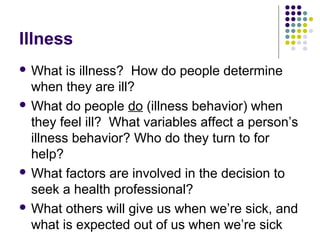
Illness
 What

is illness? How do people determine
when they are ill?
 What do people do (illness behavior) when
they feel ill? What variables affect a person’s
illness behavior? Who do they turn to for
help?
 What factors are involved in the decision to
seek a health professional?
 What others will give us when we’re sick, and
what is expected out of us when we’re sick
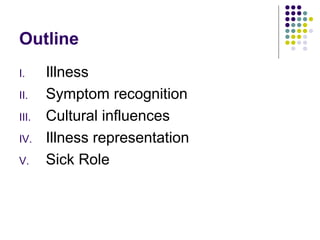
Outline
I.
II.
III.
IV.
V.

Illness
Symptom recognition
Cultural influences
Illness representation
Sick Role
How do people determine when
they’re ill?
Illness is a condition of pronounced deviation
from the normal healthy state
 Illness is a subjective experience




When do patients report illness?





When they’re unable to engage in day-to-day activities
When they have decreased stamina
When they feel pain, nausea, fatigue
When they just don’t feel well
(DiMattteo & Martin, 2002)
Illness Behavior
 Think

of your most recent experience of
illness
 What did you do?
 Why?
Illness Behavior
 What

do you do when you feel ill?
 Most people do not consult a doctor or a
health professional when they first feel ill

 When

and why do people seek
professional attention?
Illness Behavior
 Biological

predisposition
 Nature of
symptomatology
 Learned patterns of
response
 Attribution

 The

situation
 Access to health
care
 Availability of
secondary benefits
(i.e., decreased
responsibilities)

(Mechanic, 1995)
Illness Behavior
 Illness

behavior is described as the state
when the individual feels ill and behaves in a
particular way

 Illness



is a psychological concept:

It has different meanings for different people
It’s based upon an individual’s personal
evaluation of his/her bodily state and ability to
function
 Current

paradox

Americans are objectively healthier than they
use to be
 However, Americans report feeling worse


(DiMatteo & Martin, 2002)
Illness
 Often

it is difficult to decide objectively
whether someone is ill or not
 Some suggest using scales that define illness
based on a total score of symptoms
 However, illness is a relative concept, and
is often functionally based
 Let’s

return to your thoughts on how you
know when your ill…
Symptoms
 Illness

is recognized because of the presence
of symptoms, either physical or mental

 People

respond to symptoms in a variety of
ways including dismissing, ignoring, denying,
and/or maximizing their symptoms

 If

we experience unusual symptoms, which
are severe enough, we may feel that we are
ill and then behave in certain ways
Symptoms
 Illness

is recognized because of the presence
of symptoms
 Recognition of symptoms can be
affected by a patient's beliefs and
expectations
 Pennebaker

and Skelton, 1981
 Anderson and Pennebaker, 1980
Pennebaker and Skelton, 1981


Three groups
1.
2.
3.

Participants were told that ultrasonic noise
may cause an increase in skin temperature
Participants were told that ultrasonic noise
may cause an decrease in skin temperature
Control group – did not receive any research
expectations



Next participants were exposed to a tape of
‘ultrasonic noise’



Results? Implications?
(DiClemente & Raczynski, 1999, p. 85)
Anderson and Pennebaker, 1980
 Participants

sandpaper

placed their fingers on vibrating

Group 1: expect pain
 Group 2: expect pleasant sensation


 Dependent


variable

Participants rated the pleasantness or
painfulness of the sandpaper experience

 Results?

(DiClemente & Raczynski, 1999, p. 85)
Symptoms
 Patient

recognition of a symptom depends on
the cognitive schemata that the patient has of
the symptom
 The more we know, the more our awareness
of symptoms – diagnoses increase
 Health

professionals themselves may be very
aware of physical symptoms and this may
contribute to professional stress
Symptom Reporting
 When

do people decide it’s time to report
their symptoms?

 People

do not necessarily report all of their
symptoms and certainly choose to whom they
report them
Symptom Reporting
 Factors

that influence symptom
reporting:
Number and persistence of symptoms
 Extent of the social and physical disability
resulting from the symptoms
 Recognition and identification of the
symptom
 Perceived severity of the symptoms
 Symptom change

Cultural Influences on Illness
Behavior
 There

are many cultural and demographic
influences on health and these affect illness
behavior

 Consider

Chinese traditional medicine with
Western medicine
Cultural Influences
 Chinese

traditional medicine is based on the
forces of Yin and Yang and the interaction of
the five elements (metal, water, wood, fire,
and earth)
 Traditional Chinese doctors look to balance
the Yin and Yang by the use of acupuncture,
Chinese herbs, and massage
 This

contrasts with Western medicine which
uses drugs or surgery to treat symptoms
Cultural Influences
 Culture






and the cancer pain experience

Taoism: Pain results when Qi is blocked. Pain
relief comes via removing the blockage and living in
harmony with the universe
Buddhism: Pain is suffering; suffering is relieved by
following the 8 right ways (i.e., right view, right
intention, right speech, right action, right livelihood,
right effort, right mindfulness, and right
concentration)
Confucian: Pain is an essential element of life;
hence, endurance is the key
(Chen, Dodd, & Pantilat, 2008)
Sociological and Demographic
Influences on Illness Behavior
 More

illness is found in community surveys in
lower socio-economic groups

 However,

people in higher socio-economic
groups are more likely to seek health care

 Older

people consult their doctor less than
younger people do in relation to their level of
illness
Illness Representation
 Symptom

recognition is not necessarily
enough to make people think that they are ill

 Symptoms

on their own have no meaning
and are merely bodily sensations
 Different symptoms will be accounted for in
different ways
 Consider

the symptom of a backache
Illness Representation
 Illness

representation will determine how
someone responds to potential health
threats

 Illness

representation includes:

 Information





about the illness

Its symptoms
Possible causes
Likely time course
Potential consequences
Illness Representation
 Illness

representations interpret symptoms
and give them meaning

 The

course of action taken will be
determined by the representation
Symptoms
 Symptoms

may also suggest the course of

the illness
 So, if symptoms disappear does this mean
the illness is over?
 If

they are tightly joined to one another, then
if the symptoms improve, the illness may be
thought to have gotten better and the person
may stop treatment
Symptoms
 There

is an asymmetrical relationship
between symptoms and the diagnostic
label:
People with symptoms seek a diagnostic
label
 People given a diagnosis seek symptoms




Having recognized that they have
symptoms, what do people do?
Self Medication
 An

Australian study evaluated the
actions taken by 360 people who had
minor symptoms or condition in the
previous two weeks
 Their actions included using:
Left over prescription medicines
 Home remedies
 Over-the-counter medicines
(Wilkinson et al., 1987)

What’s in your medicine
cabinet?
 Medicine?
 OTC

meds?
 How old are
they?
 Why have you
kept them?
What’s in your medicine
cabinet?
 Aloe

vera
 Chamomile
 Tea tree oil
 St. John's Wort
 Kava
 Green tabs
 Probiotics
 Super digest

 Adrenal

support
 Colloidal silver
 Ricola
Self Medication
 Elderly

people were found to be twice as
likely to treat a minor illness with an over the
counter medication than any other option
 Because drugs are available without a
prescription, they may be thought to be
harmless
 Poly-pharmacy among elderly people is
very common and prescribed drugs may be
taken in combination with over the counter
medicines and the combination may change
their effectiveness
Self Medication
 The

practice of taking over the counter
medicines may begin in early adulthood
Headaches are common in all age groups
 In a study of adolescents, it was found that
most of them used medication to cope with
headaches

Self Medication
 Self-medication

is extremely common
 It has been suggested that those who
take non-prescription medicine may be
less likely to consult doctors
The Sick Role
 The

sick role – any activity undertaken for
the purpose of getting well by those who
consider themselves ill

 This

is a social role
 A patient who enters the sick role has both
rights and obligations
 There are positives and negatives to the sick
role
The Sick Role
 Advantages

Exempt from many
daily activities
 Able to rest and be
taken care of
 Social support
 Meaning
 Workers
compensation,
disability


 Disadvantages

Behaviors are
scrutinized
 Others may view
behaviors as
illegitimate attempt to
gain advantages
 Confusion, discomfort,
decreased
functioning, and
distress

The Sick Role
 People

are not expected to will themselves
better by effort, and the illness is not
considered to be their fault
 However, the symptoms must be recognized
by others
 Sick people are expected to want to get
better
 They are also expected to seek professional
help if needed and to comply with health
recommendations
The Sick Role
 The




(societal) obligations:

The person’s symptoms must correspond
with a diagnosis recognized by society
There must be overt symptoms before others
will recognize the illness
The patient must accept the sick role, and is
expected to take steps to get well
The Sick Role—more (societal)
obligations


Sick people are expected to remain
optimistic and cheerful and not display
distress



Not everyone is willing to act sick and
some people may conceal their symptoms
to avoid becoming dependent
 In

some conditions this is seen as desirable
The Sick Role
 Most

believe being ill is temporary and in most
cases, this is true
 Chronic diseases bring about different
responsibilities and the person cannot stay in
the sick role forever
 Most people have symptoms of one sort or
another at any one time, but whether or not
they enter the sick role may be only loosely
related to the severity or persistence of
symptoms
References
Chen, L., Miaskowski, C., Dodd, M., Pantilat S. (2008).

Concepts within the Chinese culture that influence
the cancer pain experience. Cancer Nurse. 31(2):1038.

Mechanic, D. (1995). "Sociological Dimensions of
Illness Behavior." Social Science and Medicine
41:1207–1216
DiClemente, R. & Raczynski, J. (1999). Handbook of
health promotion and disease prevention. Springer.
DiMattteo & Martin, Health Psychology, 2002
Pennebaker, et al. (1981)Journal of Personality and
Social Psychology. 1981 Aug Vol 41(2) 213-223

4. illness behavior and perceptions of illness

  • 1.
  • 2.
    Illness  What is illness?How do people determine when they are ill?  What do people do (illness behavior) when they feel ill? What variables affect a person’s illness behavior? Who do they turn to for help?  What factors are involved in the decision to seek a health professional?  What others will give us when we’re sick, and what is expected out of us when we’re sick
  • 3.
  • 4.
    How do peopledetermine when they’re ill? Illness is a condition of pronounced deviation from the normal healthy state  Illness is a subjective experience   When do patients report illness?     When they’re unable to engage in day-to-day activities When they have decreased stamina When they feel pain, nausea, fatigue When they just don’t feel well (DiMattteo & Martin, 2002)
  • 5.
    Illness Behavior  Think ofyour most recent experience of illness  What did you do?  Why?
  • 6.
    Illness Behavior  What doyou do when you feel ill?  Most people do not consult a doctor or a health professional when they first feel ill  When and why do people seek professional attention?
  • 7.
    Illness Behavior  Biological predisposition Nature of symptomatology  Learned patterns of response  Attribution  The situation  Access to health care  Availability of secondary benefits (i.e., decreased responsibilities) (Mechanic, 1995)
  • 8.
    Illness Behavior  Illness behavioris described as the state when the individual feels ill and behaves in a particular way  Illness   is a psychological concept: It has different meanings for different people It’s based upon an individual’s personal evaluation of his/her bodily state and ability to function
  • 9.
     Current paradox Americans areobjectively healthier than they use to be  However, Americans report feeling worse  (DiMatteo & Martin, 2002)
  • 10.
    Illness  Often it isdifficult to decide objectively whether someone is ill or not  Some suggest using scales that define illness based on a total score of symptoms  However, illness is a relative concept, and is often functionally based  Let’s return to your thoughts on how you know when your ill…
  • 11.
    Symptoms  Illness is recognizedbecause of the presence of symptoms, either physical or mental  People respond to symptoms in a variety of ways including dismissing, ignoring, denying, and/or maximizing their symptoms  If we experience unusual symptoms, which are severe enough, we may feel that we are ill and then behave in certain ways
  • 12.
    Symptoms  Illness is recognizedbecause of the presence of symptoms  Recognition of symptoms can be affected by a patient's beliefs and expectations  Pennebaker and Skelton, 1981  Anderson and Pennebaker, 1980
  • 13.
    Pennebaker and Skelton,1981  Three groups 1. 2. 3. Participants were told that ultrasonic noise may cause an increase in skin temperature Participants were told that ultrasonic noise may cause an decrease in skin temperature Control group – did not receive any research expectations  Next participants were exposed to a tape of ‘ultrasonic noise’  Results? Implications? (DiClemente & Raczynski, 1999, p. 85)
  • 14.
    Anderson and Pennebaker,1980  Participants sandpaper placed their fingers on vibrating Group 1: expect pain  Group 2: expect pleasant sensation   Dependent  variable Participants rated the pleasantness or painfulness of the sandpaper experience  Results? (DiClemente & Raczynski, 1999, p. 85)
  • 15.
    Symptoms  Patient recognition ofa symptom depends on the cognitive schemata that the patient has of the symptom  The more we know, the more our awareness of symptoms – diagnoses increase  Health professionals themselves may be very aware of physical symptoms and this may contribute to professional stress
  • 16.
    Symptom Reporting  When dopeople decide it’s time to report their symptoms?  People do not necessarily report all of their symptoms and certainly choose to whom they report them
  • 17.
    Symptom Reporting  Factors thatinfluence symptom reporting: Number and persistence of symptoms  Extent of the social and physical disability resulting from the symptoms  Recognition and identification of the symptom  Perceived severity of the symptoms  Symptom change 
  • 18.
    Cultural Influences onIllness Behavior  There are many cultural and demographic influences on health and these affect illness behavior  Consider Chinese traditional medicine with Western medicine
  • 19.
    Cultural Influences  Chinese traditionalmedicine is based on the forces of Yin and Yang and the interaction of the five elements (metal, water, wood, fire, and earth)  Traditional Chinese doctors look to balance the Yin and Yang by the use of acupuncture, Chinese herbs, and massage  This contrasts with Western medicine which uses drugs or surgery to treat symptoms
  • 20.
    Cultural Influences  Culture    andthe cancer pain experience Taoism: Pain results when Qi is blocked. Pain relief comes via removing the blockage and living in harmony with the universe Buddhism: Pain is suffering; suffering is relieved by following the 8 right ways (i.e., right view, right intention, right speech, right action, right livelihood, right effort, right mindfulness, and right concentration) Confucian: Pain is an essential element of life; hence, endurance is the key (Chen, Dodd, & Pantilat, 2008)
  • 21.
    Sociological and Demographic Influenceson Illness Behavior  More illness is found in community surveys in lower socio-economic groups  However, people in higher socio-economic groups are more likely to seek health care  Older people consult their doctor less than younger people do in relation to their level of illness
  • 22.
    Illness Representation  Symptom recognitionis not necessarily enough to make people think that they are ill  Symptoms on their own have no meaning and are merely bodily sensations  Different symptoms will be accounted for in different ways  Consider the symptom of a backache
  • 23.
    Illness Representation  Illness representationwill determine how someone responds to potential health threats  Illness representation includes:  Information     about the illness Its symptoms Possible causes Likely time course Potential consequences
  • 24.
    Illness Representation  Illness representationsinterpret symptoms and give them meaning  The course of action taken will be determined by the representation
  • 25.
    Symptoms  Symptoms may alsosuggest the course of the illness  So, if symptoms disappear does this mean the illness is over?  If they are tightly joined to one another, then if the symptoms improve, the illness may be thought to have gotten better and the person may stop treatment
  • 26.
    Symptoms  There is anasymmetrical relationship between symptoms and the diagnostic label: People with symptoms seek a diagnostic label  People given a diagnosis seek symptoms   Having recognized that they have symptoms, what do people do?
  • 27.
    Self Medication  An Australianstudy evaluated the actions taken by 360 people who had minor symptoms or condition in the previous two weeks  Their actions included using: Left over prescription medicines  Home remedies  Over-the-counter medicines (Wilkinson et al., 1987) 
  • 28.
    What’s in yourmedicine cabinet?  Medicine?  OTC meds?  How old are they?  Why have you kept them?
  • 29.
    What’s in yourmedicine cabinet?  Aloe vera  Chamomile  Tea tree oil  St. John's Wort  Kava  Green tabs  Probiotics  Super digest  Adrenal support  Colloidal silver  Ricola
  • 30.
    Self Medication  Elderly peoplewere found to be twice as likely to treat a minor illness with an over the counter medication than any other option  Because drugs are available without a prescription, they may be thought to be harmless  Poly-pharmacy among elderly people is very common and prescribed drugs may be taken in combination with over the counter medicines and the combination may change their effectiveness
  • 31.
    Self Medication  The practiceof taking over the counter medicines may begin in early adulthood Headaches are common in all age groups  In a study of adolescents, it was found that most of them used medication to cope with headaches 
  • 32.
    Self Medication  Self-medication isextremely common  It has been suggested that those who take non-prescription medicine may be less likely to consult doctors
  • 33.
    The Sick Role The sick role – any activity undertaken for the purpose of getting well by those who consider themselves ill  This is a social role  A patient who enters the sick role has both rights and obligations  There are positives and negatives to the sick role
  • 34.
    The Sick Role Advantages Exempt from many daily activities  Able to rest and be taken care of  Social support  Meaning  Workers compensation, disability   Disadvantages Behaviors are scrutinized  Others may view behaviors as illegitimate attempt to gain advantages  Confusion, discomfort, decreased functioning, and distress 
  • 35.
    The Sick Role People are not expected to will themselves better by effort, and the illness is not considered to be their fault  However, the symptoms must be recognized by others  Sick people are expected to want to get better  They are also expected to seek professional help if needed and to comply with health recommendations
  • 36.
    The Sick Role The    (societal) obligations: The person’s symptoms must correspond with a diagnosis recognized by society There must be overt symptoms before others will recognize the illness The patient must accept the sick role, and is expected to take steps to get well
  • 37.
    The Sick Role—more(societal) obligations  Sick people are expected to remain optimistic and cheerful and not display distress  Not everyone is willing to act sick and some people may conceal their symptoms to avoid becoming dependent  In some conditions this is seen as desirable
  • 38.
    The Sick Role Most believe being ill is temporary and in most cases, this is true  Chronic diseases bring about different responsibilities and the person cannot stay in the sick role forever  Most people have symptoms of one sort or another at any one time, but whether or not they enter the sick role may be only loosely related to the severity or persistence of symptoms
  • 39.
    References Chen, L., Miaskowski,C., Dodd, M., Pantilat S. (2008). Concepts within the Chinese culture that influence the cancer pain experience. Cancer Nurse. 31(2):1038. Mechanic, D. (1995). "Sociological Dimensions of Illness Behavior." Social Science and Medicine 41:1207–1216 DiClemente, R. & Raczynski, J. (1999). Handbook of health promotion and disease prevention. Springer. DiMattteo & Martin, Health Psychology, 2002 Pennebaker, et al. (1981)Journal of Personality and Social Psychology. 1981 Aug Vol 41(2) 213-223