UNIT 2
• MANAGEMENT OF INDIVIDUAL BEHAVIOUR
IN ORGANIZATION- I
PERSONALITY
PERCEPTIONS
VALUES
ATTITUDES
LEARNING
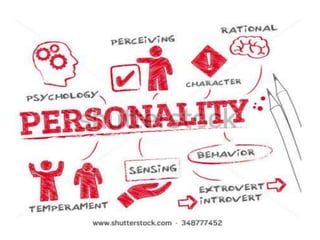
PERSONALITY
• Personality refers to the characteristics of an individual
which make him her different from others
• Personality is a set of individual differences that are
affected by the development of an individual: values,
attitudes, personal memories, social relationships, habits,
and skills
• Personality
• According to American Psychological Association
Personality refers to individual differences in characteristic
patterns of thinking, feeling and behaving.
• The term "personality trait" refers to enduring personal
characteristics that are revealed in a particular pattern of
behaviour in a variety of situations.
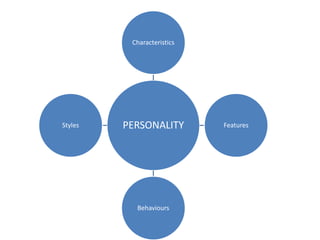
PERSONALITY
Characteristics
Features
Behaviours
Styles
• Personality can be inherited as well as shaped
by the environment.
• It can be genetic (thoughts & values) or
shaped with life experiences
• Can personality be changed?
• Internal + external traits = Personality
EXAMPLES
• introverts
• Extroverts
• Conscientiousness
• agreeableness
• neuroticism
• Religious
• Ambitious
• Sincere
• Hardworking
• Kind
• Loyal
• loving
• Personality development is
the development of the organized pattern of
behaviors and attitudes that makes a person
distinctive. Personality developmentoccurs by
the ongoing interaction of temperament ,
character, and environment.
THEORIES OF PERSONALITY
• TYPE
• TRAIT
• PSYCHOANALYTIC
• SOCIAL LEARNING
• HUMANISTIC
TYPE THEORY
• Based on Physical + Psychological factors
Kretschmer & Sheldon (PHYSICAL)
• In this theory relationship was sought to be established
between features of face & body
• Short person was considered to be sociable & even
tempered
• Tall thin person was self conscious & restrained
• Heavy muscular person was noisy, callous, fond of physical
activity
• This theory is simple and popular but has NO SUBSTANCE
Carl Jung (Psychological)
• Type theory is based on psychological factors
• Personalities can be Introverts & Extroverts
CRITICISM
• Fails to reveal all Complexities of a personality
TRAIT THEORY
• According to this theory personality differs according to
SITUATIONS
• Rather can classifying a person by just feature trait
theory classifies personality by set of features
(intelligence, emotional stability, creativeness,
aggressiveness)
• Theory suggests to measure personality on a scale
• How to measure it?
• 1) By answering questions about your feelings,
attitudes, behaviour (set of questionnaire)
• 2) By someone evaluating your personality by
observation
PSYCHOANALYTIC THEORY
• Sigmund Freud developed a :
 Comprehensive personality theory
 Method for treating neurotic ills
 Clinical observations on experience & self analysis
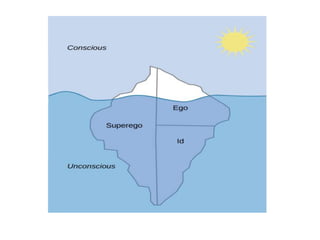
 MIND –ICEBERG
 A small segment is protruded above the surface of water which
represents conscious experience while larger part of iceberg below
water represents the unconscious (passion, thoughts, behaviour,
impulses)
 He wanted the person to talk about everything that comes to his
mind no matter how ridiculous it might seem. (recall of dream,
early childhood memory)
 By analyzing it Freud divided personality into : id, ego, superego
• ID: Latin word for ‘IT’ which refers to innate component of
personality. Everything which is inherited, present at birth, instincts
• ID does not know any laws, obeys no rule and remains basic to
individuals throughout life (hunger, sneezing, coughing)
• EGO: it develops from ID because of the necessity for dealing with
real world. Hungry man must have food if tension is to be reduced.
• EGO makes decisions, controls action, allows thinking, problem
solving
• SUPEREGO: in order to live in society man should have values,
morals, ethics & norms which are compatible with society
• SUPEREGO judges whether an action is right or wrong according to
standards of society
• ID+EGO+SUPEREGO= WORK TOGETHER AS A TEAM TO PRODUCE
INTEGRATED BEHAVIOUR
SHAPING OF PERSONALITY
• FREUDIAN STAGES
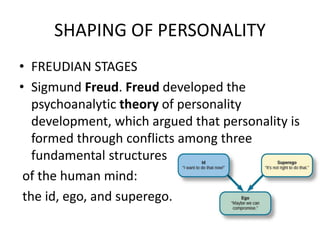
• Sigmund Freud. Freud developed the
psychoanalytic theory of personality
development, which argued that personality is
formed through conflicts among three
fundamental structures
of the human mind:
the id, ego, and superego.
SHAPING OF PERSONALITY
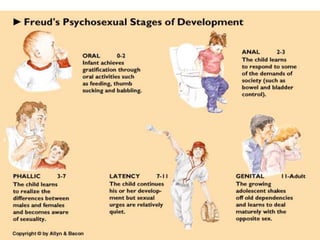
1. Oral Stage:
• FIRST YEAR OF LIFE. EG. INFANTS
• Total dependency on others for survival. Instant gratification .
• Mouth is the important body zone eg. Thumb sucking then biting
• Optimistic, immature, pessimism, argumentation etc.
2. Anal Stage:
• SECOND & THIRD YEARS OF LIFE
• Anal region becomes more important.
• Toilet training is given by parents
• If mother is to harsh the child withholds feces and if this becomes excessive child
develops traits like stinginess, orderliness,Stubbornness, Meticulousness and
obsessed with Order, Punctuality and Precision (anal retentive personality) are
developed
• If the mother pleads the child to have regular bowel movements traits like cruelty,
disorderliness are developed
• The Freudians believe this phase is associated with later hostile, sadistic and
obsessive behaviour.
3. Phallic Stage:
FOUR YEARS OF AGE
SEXUAL GRATIFICATION THROUGH SEX ORGANS
More interest in matters of birth and gender.
Oedipus complex occurs at this stage. Child both loves and hates their
parents. Traits like brash, boastful, ambitious, flirtatiousness etc. are
seen although individual may seem innocent
4. Latency Stage:
6-7 YEARS AND ONSET OF ADOLESCENCE
SEEKS GRATIFICATION FROM OUTSIDE WORLD
Traits like curiosity, knowledge etc are seen. This stage is very
important for social development of the child and for acquiring
knowledge & skills
5. Genital Stage:
ADOLESCENCE TO ADULTHOOD
SEXUAL AND AGGRESSIVE IMPULSES TOWARDS
OPPOSITE SEX.
AT THIS STAGE individuals should learn to give
love, security, physical comfort without
expecting anything in return and become
responsible.
SOCIAL LEARNING THEORY
• Human behaviour can be learned or modified by
learning
• Learning can be through knowledge, language,
skills, attitudes, self insight
• Two ways of learning:
Reinforcement, direct experiences
Observing others
• SITUATIONS play an important role
• This theory focuses on how an individual will
behave in a particular situation
HUMANISTIC APPROACH
Carl Rogers & Abraham Maslow
• Rogers Self theory
• He had a lot of respect for human nature.
• According to him, behaviour is utterly dependant
on how one perceives the world. He said that
core human nature is forward moving, purposive,
constructive & trustworthy
• Human beings once satisfied with their inner
nature they show positive feeling and behave in
harmony with others
Maslow’s Self Actualisation theory
• According to him each person is responsible
for his own existence
• Man is always in process of becoming
something different and tries to use his
potential to become a useful member of
society in order to live a fruitful life.
• This drive of man which is inherent to him is
called self actualisation
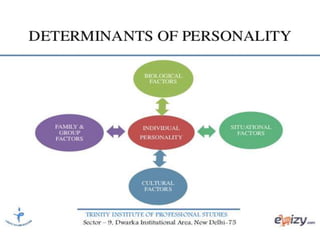
DETERMINANTS OF PERSONALITY
SOME PERSONALITY TRAITS
• Authoritarianism
• Locus of Control
 It refers to an individuals belief that events are either within ones control
(internal) or beyond ones control (external)
 Those who believe that things are always beyond their control tend to be
less satisfied with jobs, high absenteeism rates and less involved in work.
 Those who believe that things are in their control tend to be more
information seeking and active
 Machiavellianism
 Derived from Nicolo Machiavelli which refers an individuals propensity to
manipulate people. They are prone to participate in org. politics, power
tactics.
 Machiavellians are good at bargaining and perform better in certain jobs
 Self monitoring
 Achievement orientation
MYERS BRIGGS INDICATOR
• Katherine & Isable Briggs Myers developed the
Myers Briggs Type Indicator (MBTI)
• It is a personality test that measures each of the
traits of Carl Jungs model. The other dimensions
are:
Sensing/Intuitions
Thinking/feeling
Judging/perceiving
# MBTI helps in TEAM BUILDING
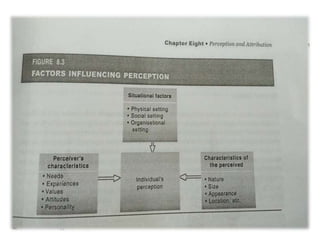
PERCEPTIONS
• Act of seeing what is there to be seen
• Perception is the process of receiving information
and making sense of the world around us.
• It’s the process through which we identify how to
interpret and organize sensory information to
produce relationship between objects
• Receiving information (seeing, hearing, feeling,
tasting,smelling)
object+environment+individual
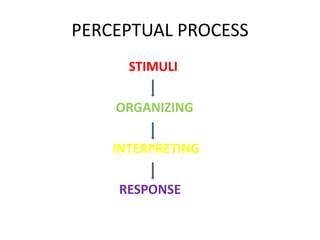
PERCEPTUAL PROCESS
STIMULI
ORGANIZING
INTERPRETING
RESPONSE
VALUES
• Stable & long lasting BELIEFS
• Values are something which help us define what is RIGHT &
WRONG, GOOD & BAD, JUST & UNJUST
• Money vs Morals
• Values usually stand for some social & cultural standards
• Values differ from attitudes. Values are general beliefs towards life
whereas attitudes are directed towards events, objects or people
• 2 types of values:
1) Terminal values (to live in a world of beauty, equality, comfortable
life)
2) Instrumental values (desirable mode of behaviour -polite,
courageous, logical, self control)
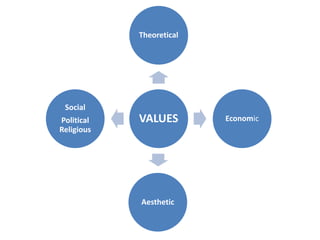
VALUES
Theoretical
Economic
Aesthetic
Social
Political
Religious
MERGING PERSONAL &
ORGANIZATIONAL VALUES
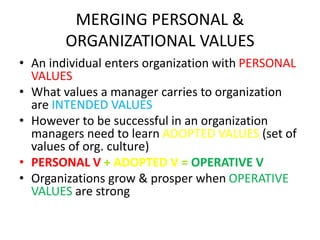
• An individual enters organization with PERSONAL
VALUES
• What values a manager carries to organization
are INTENDED VALUES
• However to be successful in an organization
managers need to learn ADOPTED VALUES (set of
values of org. culture)
• PERSONAL V + ADOPTED V = OPERATIVE V
• Organizations grow & prosper when OPERATIVE
VALUES are strong
ATTITUDES
• ATTITUDE refer to beliefs, feelings and action
tendencies of an individual towards objects,
people & ideas
• Attitudes can be learned?
• All people irrespective of their status or
intelligence hold ATTITUDE
• ATTITUDE is the mental state of readiness,
learned and organized through experience and
situations
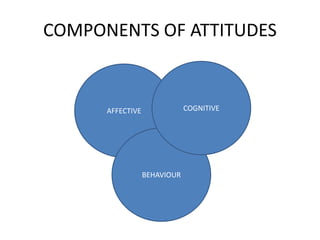
COMPONENTS OF ATTITUDES
AFFECTIVE
BEHAVIOUR
COGNITIVE
ABC MODEL
• Affective – feelings, moods, emotions
• Cognitive – beliefs, opinion, knowledge,
information
• Behavioral – predispositions to get
favourable/unfavourable evaluation of
something
• IN ORDER TO UNDERSTAND ATTITUDE ONE
MUST ASSESS ALL 3 COMPONENTS
ATTITUDE FORMATION
• It is acquired from several sources
• Attitude is Formed through direct experiences:
• DIRECT EXPERIENCE WITH OBJECT
• CLASSICAL CONDITIONING (eg. Ads)
• OPERANT CONDITIONING (attitude acquisition or
reinforcement)
• VICARIOUS LEARNING (observing others)
• FAMILY & PEER GROUPS & NEIGHBOURS
• ECONOMIC STATUS
• MASS COMMUNICATION
MEASURING ATTITUDE
• Self report technique
• Likert scale (5or7 point scale)
• Osgood s scale (pairs of adjectives opposite in
meaning)
• Sociometry
LEARNING
• Modification of behaviour through practice,
training or experience in support with:
• First, learning involves change
• Second, not all changes reflect learning
• Third, learning should be reflected in behaviour
• Fourth, change in behaviour should occur as a
result of experience, practice or training
• Fifth, experience, practice or training should be
reinforced
• Learning is a continuous process
• It is defined as a permanent change in behaviour
that occurs as a result of prior experience
• The 21st century learning skills are often called
the 4 C's: critical thinking, creative thinking,
communicating, and collaborating. These skills
help students learn, and so they are vital to
success in school/college and beyond.
Learning- Explicit & Tacit Knowledge
• Explicit knowledge: is organized and can be
communicated from one person to other
• Tacit knowledge: is acquired through
observation & direct experiences eg.
swimming
THEORIES OF LEARNING
• CLASSICAL CONDITIONING
• OPERANT CONDITIONING
• COGNITIVE THEORY
• SOCIAL LEARNING
CLASSICAL CONDITIONING
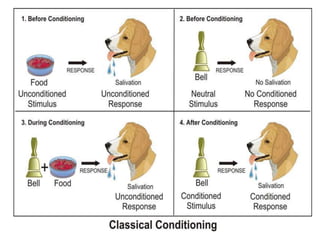
• This theory was studied in detail by Ivan
Pavlov (PSYCHOLOGIST)through experiments with dogs.
• Conducted experiment on dog and tried to relate dogs
salivation and ringing of a bell.
• When the dog was given a piece of meat the dog had
increased salivation and when no meat was given and just a
bell was rang there was no salivation.
• Then Pavlov proceeded to link the meat & ringing of the
bell.
• After repeatedly hearing the bell before getting the food
the dog began to salivate as soon as the bell rang.
• After a while the dog would salivate merely at the sound of
bell even if no food was offered . In effect the dog has
learnt to respond to the bell.
OPERANT CONDITIONING
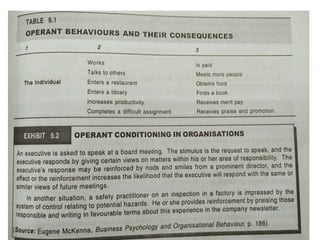
• Also called as instrumental conditioning and it
says our behaviour is the function of its
consequences.
• Refers to the process that our behaviour
produces certain consequences and how we
behave in future will depend on what those
consequences are.
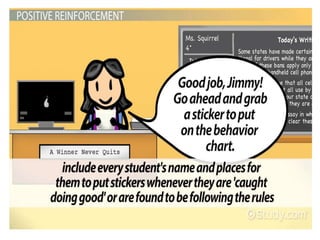
• If our actions have pleasant effects then we will
be more likely to repeat them in future. If it is
unpleasant we are less likely to repeat them
COGNITIVE THEORY
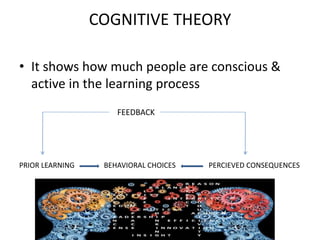
• It shows how much people are conscious &
active in the learning process
FEEDBACK
PRIOR LEARNING BEHAVIORAL CHOICES PERCIEVED CONSEQUENCES
SOCIAL LEARNING THEORY
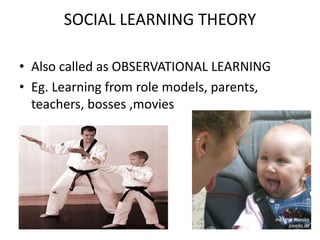
• Also called as OBSERVATIONAL LEARNING
• Eg. Learning from role models, parents,
teachers, bosses ,movies
UNIT 2 (1).pptx

UNIT 2 (1).pptx

  • 1.
  • 3.
    • MANAGEMENT OFINDIVIDUAL BEHAVIOUR IN ORGANIZATION- I PERSONALITY PERCEPTIONS VALUES ATTITUDES LEARNING
  • 5.
    PERSONALITY • Personality refersto the characteristics of an individual which make him her different from others • Personality is a set of individual differences that are affected by the development of an individual: values, attitudes, personal memories, social relationships, habits, and skills • Personality • According to American Psychological Association Personality refers to individual differences in characteristic patterns of thinking, feeling and behaving. • The term "personality trait" refers to enduring personal characteristics that are revealed in a particular pattern of behaviour in a variety of situations.
  • 6.
  • 7.
    • Personality canbe inherited as well as shaped by the environment. • It can be genetic (thoughts & values) or shaped with life experiences • Can personality be changed? • Internal + external traits = Personality
  • 8.
    EXAMPLES • introverts • Extroverts •Conscientiousness • agreeableness • neuroticism • Religious • Ambitious • Sincere • Hardworking • Kind • Loyal • loving
  • 9.
    • Personality developmentis the development of the organized pattern of behaviors and attitudes that makes a person distinctive. Personality developmentoccurs by the ongoing interaction of temperament , character, and environment.
  • 10.
    THEORIES OF PERSONALITY •TYPE • TRAIT • PSYCHOANALYTIC • SOCIAL LEARNING • HUMANISTIC
  • 11.
    TYPE THEORY • Basedon Physical + Psychological factors Kretschmer & Sheldon (PHYSICAL) • In this theory relationship was sought to be established between features of face & body • Short person was considered to be sociable & even tempered • Tall thin person was self conscious & restrained • Heavy muscular person was noisy, callous, fond of physical activity • This theory is simple and popular but has NO SUBSTANCE
  • 12.
    Carl Jung (Psychological) •Type theory is based on psychological factors • Personalities can be Introverts & Extroverts CRITICISM • Fails to reveal all Complexities of a personality
  • 13.
    TRAIT THEORY • Accordingto this theory personality differs according to SITUATIONS • Rather can classifying a person by just feature trait theory classifies personality by set of features (intelligence, emotional stability, creativeness, aggressiveness) • Theory suggests to measure personality on a scale • How to measure it? • 1) By answering questions about your feelings, attitudes, behaviour (set of questionnaire) • 2) By someone evaluating your personality by observation
  • 14.
    PSYCHOANALYTIC THEORY • SigmundFreud developed a :  Comprehensive personality theory  Method for treating neurotic ills  Clinical observations on experience & self analysis  MIND –ICEBERG  A small segment is protruded above the surface of water which represents conscious experience while larger part of iceberg below water represents the unconscious (passion, thoughts, behaviour, impulses)  He wanted the person to talk about everything that comes to his mind no matter how ridiculous it might seem. (recall of dream, early childhood memory)  By analyzing it Freud divided personality into : id, ego, superego
  • 15.
    • ID: Latinword for ‘IT’ which refers to innate component of personality. Everything which is inherited, present at birth, instincts • ID does not know any laws, obeys no rule and remains basic to individuals throughout life (hunger, sneezing, coughing) • EGO: it develops from ID because of the necessity for dealing with real world. Hungry man must have food if tension is to be reduced. • EGO makes decisions, controls action, allows thinking, problem solving • SUPEREGO: in order to live in society man should have values, morals, ethics & norms which are compatible with society • SUPEREGO judges whether an action is right or wrong according to standards of society • ID+EGO+SUPEREGO= WORK TOGETHER AS A TEAM TO PRODUCE INTEGRATED BEHAVIOUR
  • 16.
    SHAPING OF PERSONALITY •FREUDIAN STAGES • Sigmund Freud. Freud developed the psychoanalytic theory of personality development, which argued that personality is formed through conflicts among three fundamental structures of the human mind: the id, ego, and superego.
  • 18.
    SHAPING OF PERSONALITY 1.Oral Stage: • FIRST YEAR OF LIFE. EG. INFANTS • Total dependency on others for survival. Instant gratification . • Mouth is the important body zone eg. Thumb sucking then biting • Optimistic, immature, pessimism, argumentation etc. 2. Anal Stage: • SECOND & THIRD YEARS OF LIFE • Anal region becomes more important. • Toilet training is given by parents • If mother is to harsh the child withholds feces and if this becomes excessive child develops traits like stinginess, orderliness,Stubbornness, Meticulousness and obsessed with Order, Punctuality and Precision (anal retentive personality) are developed • If the mother pleads the child to have regular bowel movements traits like cruelty, disorderliness are developed • The Freudians believe this phase is associated with later hostile, sadistic and obsessive behaviour.
  • 19.
    3. Phallic Stage: FOURYEARS OF AGE SEXUAL GRATIFICATION THROUGH SEX ORGANS More interest in matters of birth and gender. Oedipus complex occurs at this stage. Child both loves and hates their parents. Traits like brash, boastful, ambitious, flirtatiousness etc. are seen although individual may seem innocent 4. Latency Stage: 6-7 YEARS AND ONSET OF ADOLESCENCE SEEKS GRATIFICATION FROM OUTSIDE WORLD Traits like curiosity, knowledge etc are seen. This stage is very important for social development of the child and for acquiring knowledge & skills
  • 20.
    5. Genital Stage: ADOLESCENCETO ADULTHOOD SEXUAL AND AGGRESSIVE IMPULSES TOWARDS OPPOSITE SEX. AT THIS STAGE individuals should learn to give love, security, physical comfort without expecting anything in return and become responsible.
  • 22.
    SOCIAL LEARNING THEORY •Human behaviour can be learned or modified by learning • Learning can be through knowledge, language, skills, attitudes, self insight • Two ways of learning: Reinforcement, direct experiences Observing others • SITUATIONS play an important role • This theory focuses on how an individual will behave in a particular situation
  • 23.
    HUMANISTIC APPROACH Carl Rogers& Abraham Maslow • Rogers Self theory • He had a lot of respect for human nature. • According to him, behaviour is utterly dependant on how one perceives the world. He said that core human nature is forward moving, purposive, constructive & trustworthy • Human beings once satisfied with their inner nature they show positive feeling and behave in harmony with others
  • 24.
    Maslow’s Self Actualisationtheory • According to him each person is responsible for his own existence • Man is always in process of becoming something different and tries to use his potential to become a useful member of society in order to live a fruitful life. • This drive of man which is inherent to him is called self actualisation
  • 25.
  • 26.
    SOME PERSONALITY TRAITS •Authoritarianism • Locus of Control  It refers to an individuals belief that events are either within ones control (internal) or beyond ones control (external)  Those who believe that things are always beyond their control tend to be less satisfied with jobs, high absenteeism rates and less involved in work.  Those who believe that things are in their control tend to be more information seeking and active  Machiavellianism  Derived from Nicolo Machiavelli which refers an individuals propensity to manipulate people. They are prone to participate in org. politics, power tactics.  Machiavellians are good at bargaining and perform better in certain jobs  Self monitoring  Achievement orientation
  • 27.
    MYERS BRIGGS INDICATOR •Katherine & Isable Briggs Myers developed the Myers Briggs Type Indicator (MBTI) • It is a personality test that measures each of the traits of Carl Jungs model. The other dimensions are: Sensing/Intuitions Thinking/feeling Judging/perceiving # MBTI helps in TEAM BUILDING
  • 28.
    PERCEPTIONS • Act ofseeing what is there to be seen • Perception is the process of receiving information and making sense of the world around us. • It’s the process through which we identify how to interpret and organize sensory information to produce relationship between objects • Receiving information (seeing, hearing, feeling, tasting,smelling) object+environment+individual
  • 29.
  • 31.
    VALUES • Stable &long lasting BELIEFS • Values are something which help us define what is RIGHT & WRONG, GOOD & BAD, JUST & UNJUST • Money vs Morals • Values usually stand for some social & cultural standards • Values differ from attitudes. Values are general beliefs towards life whereas attitudes are directed towards events, objects or people • 2 types of values: 1) Terminal values (to live in a world of beauty, equality, comfortable life) 2) Instrumental values (desirable mode of behaviour -polite, courageous, logical, self control)
  • 32.
  • 33.
    MERGING PERSONAL & ORGANIZATIONALVALUES • An individual enters organization with PERSONAL VALUES • What values a manager carries to organization are INTENDED VALUES • However to be successful in an organization managers need to learn ADOPTED VALUES (set of values of org. culture) • PERSONAL V + ADOPTED V = OPERATIVE V • Organizations grow & prosper when OPERATIVE VALUES are strong
  • 34.
    ATTITUDES • ATTITUDE referto beliefs, feelings and action tendencies of an individual towards objects, people & ideas • Attitudes can be learned? • All people irrespective of their status or intelligence hold ATTITUDE • ATTITUDE is the mental state of readiness, learned and organized through experience and situations
  • 35.
  • 36.
    ABC MODEL • Affective– feelings, moods, emotions • Cognitive – beliefs, opinion, knowledge, information • Behavioral – predispositions to get favourable/unfavourable evaluation of something • IN ORDER TO UNDERSTAND ATTITUDE ONE MUST ASSESS ALL 3 COMPONENTS
  • 37.
    ATTITUDE FORMATION • Itis acquired from several sources • Attitude is Formed through direct experiences: • DIRECT EXPERIENCE WITH OBJECT • CLASSICAL CONDITIONING (eg. Ads) • OPERANT CONDITIONING (attitude acquisition or reinforcement) • VICARIOUS LEARNING (observing others) • FAMILY & PEER GROUPS & NEIGHBOURS • ECONOMIC STATUS • MASS COMMUNICATION
  • 38.
    MEASURING ATTITUDE • Selfreport technique • Likert scale (5or7 point scale) • Osgood s scale (pairs of adjectives opposite in meaning) • Sociometry
  • 41.
    LEARNING • Modification ofbehaviour through practice, training or experience in support with: • First, learning involves change • Second, not all changes reflect learning • Third, learning should be reflected in behaviour • Fourth, change in behaviour should occur as a result of experience, practice or training • Fifth, experience, practice or training should be reinforced
  • 42.
    • Learning isa continuous process • It is defined as a permanent change in behaviour that occurs as a result of prior experience • The 21st century learning skills are often called the 4 C's: critical thinking, creative thinking, communicating, and collaborating. These skills help students learn, and so they are vital to success in school/college and beyond.
  • 43.
    Learning- Explicit &Tacit Knowledge • Explicit knowledge: is organized and can be communicated from one person to other • Tacit knowledge: is acquired through observation & direct experiences eg. swimming
  • 44.
    THEORIES OF LEARNING •CLASSICAL CONDITIONING • OPERANT CONDITIONING • COGNITIVE THEORY • SOCIAL LEARNING
  • 45.
    CLASSICAL CONDITIONING • Thistheory was studied in detail by Ivan Pavlov (PSYCHOLOGIST)through experiments with dogs. • Conducted experiment on dog and tried to relate dogs salivation and ringing of a bell. • When the dog was given a piece of meat the dog had increased salivation and when no meat was given and just a bell was rang there was no salivation. • Then Pavlov proceeded to link the meat & ringing of the bell. • After repeatedly hearing the bell before getting the food the dog began to salivate as soon as the bell rang. • After a while the dog would salivate merely at the sound of bell even if no food was offered . In effect the dog has learnt to respond to the bell.
  • 47.
    OPERANT CONDITIONING • Alsocalled as instrumental conditioning and it says our behaviour is the function of its consequences. • Refers to the process that our behaviour produces certain consequences and how we behave in future will depend on what those consequences are. • If our actions have pleasant effects then we will be more likely to repeat them in future. If it is unpleasant we are less likely to repeat them
  • 50.
    COGNITIVE THEORY • Itshows how much people are conscious & active in the learning process FEEDBACK PRIOR LEARNING BEHAVIORAL CHOICES PERCIEVED CONSEQUENCES
  • 51.
    SOCIAL LEARNING THEORY •Also called as OBSERVATIONAL LEARNING • Eg. Learning from role models, parents, teachers, bosses ,movies