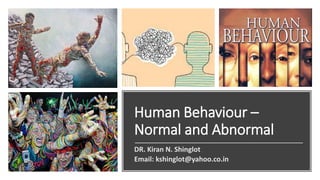
Human Behaviour –
Normal and Abnormal
DR. Kiran N. Shinglot
Email: kshinglot@yahoo.co.in
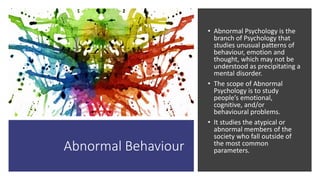
Abnormal Behaviour
• Abnormal Psychology is the
branch of Psychology that
studies unusual patterns of
behaviour, emotion and
thought, which may not be
understood as precipitating a
mental disorder.
• The scope of Abnormal
Psychology is to study
people’s emotional,
cognitive, and/or
behavioural problems.
• It studies the atypical or
abnormal members of the
society who fall outside of
the most common
parameters.
What is behaviour?
• Most people use the word
‘behaviour’ to mean conduct.
• Behaviour is anything that a
person does.
• In psychology, behaviour is
regarded as any observable
activity by human being.
• Most human behaviour results
from a combination of factors
such as culture, attitudes,
emotions, values, ethics,
authority, rapport, persuasion,
coercion and genetics.
Principles of
Human
Behaviour
Almost all human behaviour is learned.
All behaviours occur for a reason.
No behaviours occur “out of blue.”
Behaviours continue to occur because
they are effective.
Behaviours stop occurring when they are
ineffective.
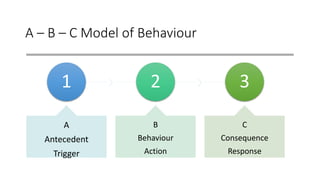
A – B – C Model of Behaviour
1
A
Antecedent
Trigger
2
B
Behaviour
Action
3
C
Consequence
Response
• “When will you understand
that being normal is not
necessarily a virtue. It rather
denotes a lack of courage.”
- Unknown
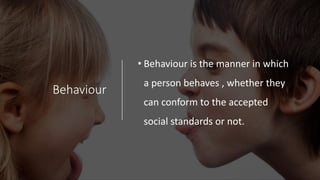
Behaviour
• Behaviour is the manner in which
a person behaves , whether they
can conform to the accepted
social standards or not.
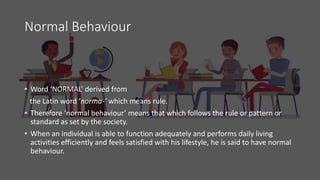
Normal Behaviour
• Word ‘NORMAL’ derived from
the Latin word ‘norma-’ which means rule.
• Therefore ‘normal behaviour’ means that which follows the rule or pattern or
standard as set by the society.
• When an individual is able to function adequately and performs daily living
activities efficiently and feels satisfied with his lifestyle, he is said to have normal
behaviour.
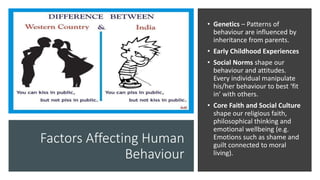
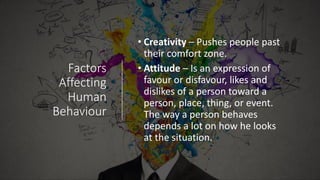
Factors Affecting Human
Behaviour
• Genetics – Patterns of
behaviour are influenced by
inheritance from parents.
• Early Childhood Experiences
• Social Norms shape our
behaviour and attitudes.
Every individual manipulate
his/her behaviour to best ‘fit
in’ with others.
• Core Faith and Social Culture
shape our religious faith,
philosophical thinking and
emotional wellbeing (e.g.
Emotions such as shame and
guilt connected to moral
living).
Factors
Affecting
Human
Behaviour
• Creativity – Pushes people past
their comfort zone.
• Attitude – Is an expression of
favour or disfavour, likes and
dislikes of a person toward a
person, place, thing, or event.
The way a person behaves
depends a lot on how he looks
at the situation.
Characteristics of Normal Behaviour
• A perception of reality.
• A positive attitude toward one’s own
self, accepting weaknesses and taking
pride in strengths.
• Adequate in work, play and leisure.
• Willing to use problem solving
approaches in life process.
• Capacity to adapt oneself to current
situation.
• Capacity for withstanding anxiety and
stress.
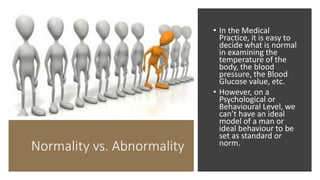
Normality vs. Abnormality
• In the Medical
Practice, it is easy to
decide what is normal
in examining the
temperature of the
body, the blood
pressure, the Blood
Glucose value, etc.
• However, on a
Psychological or
Behavioural Level, we
can’t have an ideal
model of a man or
ideal behaviour to be
set as standard or
norm.
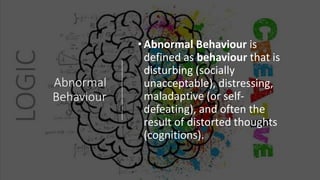
Abnormal
Behaviour
•Abnormal Behaviour is
defined as behaviour that is
disturbing (socially
unacceptable), distressing,
maladaptive (or self-
defeating), and often the
result of distorted thoughts
(cognitions).
Abnormal Behaviour
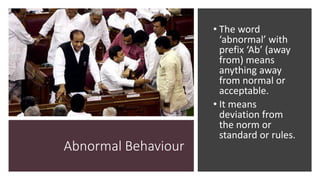
• The word
‘abnormal’ with
prefix ‘Ab’ (away
from) means
anything away
from normal or
acceptable.
• It means
deviation from
the norm or
standard or rules.
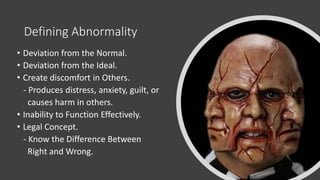
Defining Abnormality
• Deviation from the Normal.
• Deviation from the Ideal.
• Create discomfort in Others.
- Produces distress, anxiety, guilt, or
causes harm in others.
• Inability to Function Effectively.
• Legal Concept.
- Know the Difference Between
Right and Wrong.
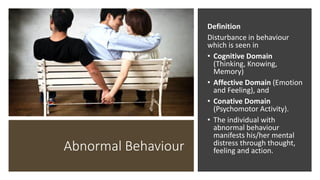
Abnormal Behaviour
Definition
Disturbance in behaviour
which is seen in
• Cognitive Domain
(Thinking, Knowing,
Memory)
• Affective Domain (Emotion
and Feeling), and
• Conative Domain
(Psychomotor Activity).
• The individual with
abnormal behaviour
manifests his/her mental
distress through thought,
feeling and action.
Defining (ab-)normal Behaviour
• Behaviour that is Harmful to the Self or
to the others without serving interest of
the self.
• Poor Reality Contact – e.g. Beliefs that
most people don’t hold or sensory
perceptions of things that most people
do not perceive.
• Emotional Reactions inappropriate to
the person’s situation.
• Erratic Behaviour – i.e. Behaviour that
shifts unpredictably.
Characteristics of
Abnormal Behaviour
• Change in Person’s Thinking Process,
Memory, Perception and Judgement.
• Reduced Work Efficiency and General
Stamina.
• Forgetfulness
• Unable to Cope with Stresses.
• Develops Anxiety and Worries at the
Slightest Disturbance in Daily Routine.
• Complete Lack of Respect for Self and
Others.
• Lack of Self-Confidence.
• Lack of Gratification.
Symptoms of Abnormal
Behaviour
• Easily getting annoyed or nervous.
• Often or always appearing angry.
• Always putting the blame on
others.
• Refusing to follow rules or
questioning authority.
• Arguing and throwing temper
tantrums.
• Having difficulty in handling
frustration.
Psychological Disorders Associated
with Serious Behavioural
Abnormalities
1. Anxiety Disorders, such as –
- Post Traumatic Stress Disorder
(PTSD)
- Obsessive Compulsive Disorder
(OCD)
- Panic Disorders
- Phobia
Psychological
Disorders
Associated
with Serious
Behavioural
Abnormalities
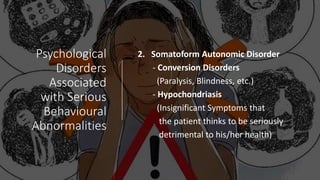
2. Somatoform Autonomic Disorder
- Conversion Disorders
(Paralysis, Blindness, etc.)
- Hypochondriasis
(Insignificant Symptoms that
the patient thinks to be seriously
detrimental to his/her health)
Psychological Disorders Associated with
Serious Behavioural Abnormalities
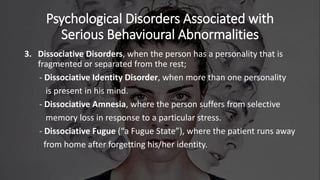
3. Dissociative Disorders, when the person has a personality that is
fragmented or separated from the rest;
- Dissociative Identity Disorder, when more than one personality
is present in his mind.
- Dissociative Amnesia, where the person suffers from selective
memory loss in response to a particular stress.
- Dissociative Fugue (“a Fugue State”), where the patient runs away
from home after forgetting his/her identity.
Psychological Disorders Associated with Serious
Behavioural Abnormalities
4. Affective Disorders, in which person suffers from abnormally high or
low moods for long periods of time.
- Major Depressive Disorder where he suffers from hopelessness, guilt,
sadness, and apathy for more than two weeks. Caused by endogenous
depletion of Neurotransmitter Serotonin’
- Mania, where there is overly hyperactive and optimistic state.
Because of overconfidence, the patient takes series of terrible
decisions leading to overspending.
- Bipolar Disorder with extreme shift in moods, Depressive phase may
lead to suicidal thoughts, or action out of overconfidence leading to
accidental death.
Psychological Disorders Associated with
Serious Behavioural Abnormalities
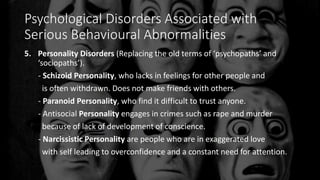
5. Personality Disorders (Replacing the old terms of ‘psychopaths’ and
‘sociopaths’).
- Schizoid Personality, who lacks in feelings for other people and
is often withdrawn. Does not make friends with others.
- Paranoid Personality, who find it difficult to trust anyone.
- Antisocial Personality engages in crimes such as rape and murder
because of lack of development of conscience.
- Narcissistic Personality are people who are in exaggerated love
with self leading to overconfidence and a constant need for attention.
Psychological Disorders Associated with
Serious Behavioural Abnormalities
6. Schizophrenic Disorders, with disturbances in thoughts, emotions,
communication, and perception. Hallucinations and Delusions.
- Disorganised Schizophrenia (Inappropriate Mood, Bizarre Speech and
behavioural patterns);
- Catatonic Schizophrenia (Difficulty in movements; either inability to move
or uncontrolled hypermobility, person may copy other’s movements or have
waxy flexibility);
- Paranoid Schizophrenia (Being suspicious of everyone and everything);
- Undifferentiated Schizophrenia (with a mixture of any or all the other types
of schizophrenia)
Causes of Abnormal
Human Behaviour
• The causation of any
particular behaviour pattern
is tremendously complex
and impossible to predict
how given circumstances
will affect of has affected the
person.
Causes of Abnormal
Human Behaviour
Abnormal Human Behaviour is the
result of –
a) Outcome of Faulty Development;
b) Psycho-social Stress
c) Combination of Both
Causes of Abnormal Human Behaviour
• Biological Factors, such as –
- Chromosomal Abnormalities
- Genetic Defects
- Physical Deprivation: Malnutrition, Illness, Injuries,
Sleep Deprivation, Fatigue, etc.
Causes of Abnormal Human Behaviour
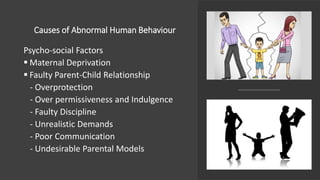
Psycho-social Factors
▪ Maternal Deprivation
▪ Faulty Parent-Child Relationship
- Overprotection
- Over permissiveness and Indulgence
- Faulty Discipline
- Unrealistic Demands
- Poor Communication
- Undesirable Parental Models
Causes of
Abnormal
Human
Behaviour
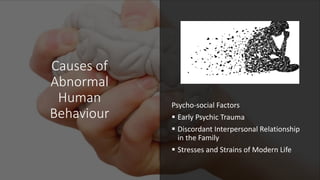
Psycho-social Factors
▪ Early Psychic Trauma
▪ Discordant Interpersonal Relationship
in the Family
▪ Stresses and Strains of Modern Life
Causes of
Abnormal
Human
Behaviour
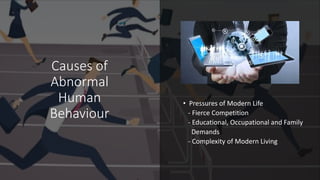
• Pressures of Modern Life
- Fierce Competition
- Educational, Occupational and Family
Demands
- Complexity of Modern Living
Causes of
Abnormal
Human
Behaviour
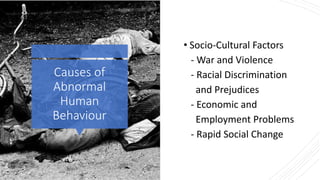
• Socio-Cultural Factors
- War and Violence
- Racial Discrimination
and Prejudices
- Economic and
Employment Problems
- Rapid Social Change
Human behaviour.PPT

Human behaviour.PPT

  • 1.
    Human Behaviour – Normaland Abnormal DR. Kiran N. Shinglot Email: kshinglot@yahoo.co.in
  • 2.
    Abnormal Behaviour • AbnormalPsychology is the branch of Psychology that studies unusual patterns of behaviour, emotion and thought, which may not be understood as precipitating a mental disorder. • The scope of Abnormal Psychology is to study people’s emotional, cognitive, and/or behavioural problems. • It studies the atypical or abnormal members of the society who fall outside of the most common parameters.
  • 3.
    What is behaviour? •Most people use the word ‘behaviour’ to mean conduct. • Behaviour is anything that a person does. • In psychology, behaviour is regarded as any observable activity by human being. • Most human behaviour results from a combination of factors such as culture, attitudes, emotions, values, ethics, authority, rapport, persuasion, coercion and genetics.
  • 4.
    Principles of Human Behaviour Almost allhuman behaviour is learned. All behaviours occur for a reason. No behaviours occur “out of blue.” Behaviours continue to occur because they are effective. Behaviours stop occurring when they are ineffective.
  • 5.
    A – B– C Model of Behaviour 1 A Antecedent Trigger 2 B Behaviour Action 3 C Consequence Response
  • 6.
    • “When willyou understand that being normal is not necessarily a virtue. It rather denotes a lack of courage.” - Unknown
  • 7.
    Behaviour • Behaviour isthe manner in which a person behaves , whether they can conform to the accepted social standards or not.
  • 8.
    Normal Behaviour • Word‘NORMAL’ derived from the Latin word ‘norma-’ which means rule. • Therefore ‘normal behaviour’ means that which follows the rule or pattern or standard as set by the society. • When an individual is able to function adequately and performs daily living activities efficiently and feels satisfied with his lifestyle, he is said to have normal behaviour.
  • 9.
    Factors Affecting Human Behaviour •Genetics – Patterns of behaviour are influenced by inheritance from parents. • Early Childhood Experiences • Social Norms shape our behaviour and attitudes. Every individual manipulate his/her behaviour to best ‘fit in’ with others. • Core Faith and Social Culture shape our religious faith, philosophical thinking and emotional wellbeing (e.g. Emotions such as shame and guilt connected to moral living).
  • 10.
    Factors Affecting Human Behaviour • Creativity –Pushes people past their comfort zone. • Attitude – Is an expression of favour or disfavour, likes and dislikes of a person toward a person, place, thing, or event. The way a person behaves depends a lot on how he looks at the situation.
  • 11.
    Characteristics of NormalBehaviour • A perception of reality. • A positive attitude toward one’s own self, accepting weaknesses and taking pride in strengths. • Adequate in work, play and leisure. • Willing to use problem solving approaches in life process. • Capacity to adapt oneself to current situation. • Capacity for withstanding anxiety and stress.
  • 12.
    Normality vs. Abnormality •In the Medical Practice, it is easy to decide what is normal in examining the temperature of the body, the blood pressure, the Blood Glucose value, etc. • However, on a Psychological or Behavioural Level, we can’t have an ideal model of a man or ideal behaviour to be set as standard or norm.
  • 13.
    Abnormal Behaviour •Abnormal Behaviour is definedas behaviour that is disturbing (socially unacceptable), distressing, maladaptive (or self- defeating), and often the result of distorted thoughts (cognitions).
  • 15.
    Abnormal Behaviour • Theword ‘abnormal’ with prefix ‘Ab’ (away from) means anything away from normal or acceptable. • It means deviation from the norm or standard or rules.
  • 16.
    Defining Abnormality • Deviationfrom the Normal. • Deviation from the Ideal. • Create discomfort in Others. - Produces distress, anxiety, guilt, or causes harm in others. • Inability to Function Effectively. • Legal Concept. - Know the Difference Between Right and Wrong.
  • 17.
    Abnormal Behaviour Definition Disturbance inbehaviour which is seen in • Cognitive Domain (Thinking, Knowing, Memory) • Affective Domain (Emotion and Feeling), and • Conative Domain (Psychomotor Activity). • The individual with abnormal behaviour manifests his/her mental distress through thought, feeling and action.
  • 18.
    Defining (ab-)normal Behaviour •Behaviour that is Harmful to the Self or to the others without serving interest of the self. • Poor Reality Contact – e.g. Beliefs that most people don’t hold or sensory perceptions of things that most people do not perceive. • Emotional Reactions inappropriate to the person’s situation. • Erratic Behaviour – i.e. Behaviour that shifts unpredictably.
  • 19.
    Characteristics of Abnormal Behaviour •Change in Person’s Thinking Process, Memory, Perception and Judgement. • Reduced Work Efficiency and General Stamina. • Forgetfulness • Unable to Cope with Stresses. • Develops Anxiety and Worries at the Slightest Disturbance in Daily Routine. • Complete Lack of Respect for Self and Others. • Lack of Self-Confidence. • Lack of Gratification.
  • 20.
    Symptoms of Abnormal Behaviour •Easily getting annoyed or nervous. • Often or always appearing angry. • Always putting the blame on others. • Refusing to follow rules or questioning authority. • Arguing and throwing temper tantrums. • Having difficulty in handling frustration.
  • 21.
    Psychological Disorders Associated withSerious Behavioural Abnormalities 1. Anxiety Disorders, such as – - Post Traumatic Stress Disorder (PTSD) - Obsessive Compulsive Disorder (OCD) - Panic Disorders - Phobia
  • 22.
    Psychological Disorders Associated with Serious Behavioural Abnormalities 2. SomatoformAutonomic Disorder - Conversion Disorders (Paralysis, Blindness, etc.) - Hypochondriasis (Insignificant Symptoms that the patient thinks to be seriously detrimental to his/her health)
  • 23.
    Psychological Disorders Associatedwith Serious Behavioural Abnormalities 3. Dissociative Disorders, when the person has a personality that is fragmented or separated from the rest; - Dissociative Identity Disorder, when more than one personality is present in his mind. - Dissociative Amnesia, where the person suffers from selective memory loss in response to a particular stress. - Dissociative Fugue (“a Fugue State”), where the patient runs away from home after forgetting his/her identity.
  • 24.
    Psychological Disorders Associatedwith Serious Behavioural Abnormalities 4. Affective Disorders, in which person suffers from abnormally high or low moods for long periods of time. - Major Depressive Disorder where he suffers from hopelessness, guilt, sadness, and apathy for more than two weeks. Caused by endogenous depletion of Neurotransmitter Serotonin’ - Mania, where there is overly hyperactive and optimistic state. Because of overconfidence, the patient takes series of terrible decisions leading to overspending. - Bipolar Disorder with extreme shift in moods, Depressive phase may lead to suicidal thoughts, or action out of overconfidence leading to accidental death.
  • 25.
    Psychological Disorders Associatedwith Serious Behavioural Abnormalities 5. Personality Disorders (Replacing the old terms of ‘psychopaths’ and ‘sociopaths’). - Schizoid Personality, who lacks in feelings for other people and is often withdrawn. Does not make friends with others. - Paranoid Personality, who find it difficult to trust anyone. - Antisocial Personality engages in crimes such as rape and murder because of lack of development of conscience. - Narcissistic Personality are people who are in exaggerated love with self leading to overconfidence and a constant need for attention.
  • 26.
    Psychological Disorders Associatedwith Serious Behavioural Abnormalities 6. Schizophrenic Disorders, with disturbances in thoughts, emotions, communication, and perception. Hallucinations and Delusions. - Disorganised Schizophrenia (Inappropriate Mood, Bizarre Speech and behavioural patterns); - Catatonic Schizophrenia (Difficulty in movements; either inability to move or uncontrolled hypermobility, person may copy other’s movements or have waxy flexibility); - Paranoid Schizophrenia (Being suspicious of everyone and everything); - Undifferentiated Schizophrenia (with a mixture of any or all the other types of schizophrenia)
  • 27.
    Causes of Abnormal HumanBehaviour • The causation of any particular behaviour pattern is tremendously complex and impossible to predict how given circumstances will affect of has affected the person.
  • 28.
    Causes of Abnormal HumanBehaviour Abnormal Human Behaviour is the result of – a) Outcome of Faulty Development; b) Psycho-social Stress c) Combination of Both
  • 29.
    Causes of AbnormalHuman Behaviour • Biological Factors, such as – - Chromosomal Abnormalities - Genetic Defects - Physical Deprivation: Malnutrition, Illness, Injuries, Sleep Deprivation, Fatigue, etc.
  • 30.
    Causes of AbnormalHuman Behaviour Psycho-social Factors ▪ Maternal Deprivation ▪ Faulty Parent-Child Relationship - Overprotection - Over permissiveness and Indulgence - Faulty Discipline - Unrealistic Demands - Poor Communication - Undesirable Parental Models
  • 31.
    Causes of Abnormal Human Behaviour Psycho-social Factors ▪Early Psychic Trauma ▪ Discordant Interpersonal Relationship in the Family ▪ Stresses and Strains of Modern Life
  • 32.
    Causes of Abnormal Human Behaviour • Pressuresof Modern Life - Fierce Competition - Educational, Occupational and Family Demands - Complexity of Modern Living
  • 33.
    Causes of Abnormal Human Behaviour • Socio-CulturalFactors - War and Violence - Racial Discrimination and Prejudices - Economic and Employment Problems - Rapid Social Change