…
HPLC
Presented by;
Salman Shehzada
CONTENTS
Introduction
History
Instrumentation
Operation
Types
Advantages
Disadvantages
Introduction
 Abbreviated for;
High-performance liquid chromatography
OR
High-pressure liquid chromatography
 Defined as;
“A chromatographic technique used to separate components of
mixture for the purpose to identify, quantify or purify the
individual components of the mixture “.
 Widely used in field of biochemistry and analytical chemistry.
History
 Invented by Martin and Synge as extension of gas
chromatography.
 The main idea was that;
“Small sorbent particles and pressure could produce fast
liquid chromatography techniques”.
 The method was used practically in late 1960s for separation
amino acids.
Instrumentation
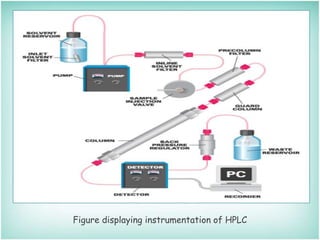
 HPLC involves following functional instruments.
1. Mobile phase reservoir
2. Pump
3. Injector
4. Stationary phase ( Column)
5. Detector
6. Computer
1. Mobile phase reservoir:
• Commonly glass bottles with caps are used.
• Teflon tubings and filters are connected to purge gas (helium) for
degassing.
• Vaccum for 5-10 min is also used for degassing.
2. Pump:
• It forces the mobile phase to pass through column.
• Flow rate is 1-2 ml/ min.
• Trypical pressure is 6000 – 9000psi.
3. Injector:
• Can be manually (syringe) or automated.
• Sample volume 5-20µl.
• Ideal to stand pressure of mobile phase.
• Autosampler is used for analysis of many samples automatically.
4. Stationary phase (Column):
• Heart of HPLC.
• Separate sample components on basis of physical and chemical
parameters.
• Lenght 10-30cm.
• Diameter 4-10nm.
• Packing material 5-10nm thick.
5. Detector:
• Detection of elutes from column.
• Quantitative analysis of sample components.
• Output transferred to recorder/ computer.
6. Computer:
• Data system that controls modules of HPLC.
• Signals from detector are interpreted to determine elution time,
quantitative and qualitative analysis of sample.
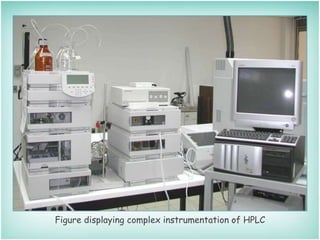
Figure displaying instrumentation of HPLC
Figure displaying complex instrumentation of HPLC
Operation
• Operation strategies are explained as follows;
1. Sample:
 The sample to be analyzed is introduced into stream of mobile
phase in minute quantity, mostly in microliters.
 The components of sample moves through different velocities
reaching the column where it physically interacts with the
sorbent.
 Velocity of sample components depends on;
• Chemical nature of sample
• Nature of column
• Composition of mobile phase
2. Column:
• Also known as stationary phase.
• Composed of sorbent material varying in particle size, and surface
chemistry.
• Size of particles can be smaller which improves chromatographic
resolution.
• In terms of surface chemistry, the column can be hydrophobic and
polar in nature.
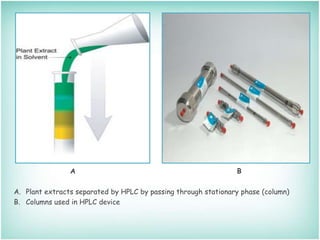
A B
A. Plant extracts separated by HPLC by passing through stationary phase (column)
B. Columns used in HPLC device
3. Eluent:
• Also known as mobile phase.
 Type of solvent used:
• Commonly it is composed of water miscible with organic solvents. For
example methanol.
• Some HPLC utilizes water free mobile phase and uses acids such as
formic acid or phosphoric acid.
• Many mobile phase works well by using salts such as sodium
phosphate.
 Composition of eluent:
• It depends on;
• Intensity of interactions between analytes and stationary phase. For
example;
i. Hydrophobic interactions in reversed-phase HPLC
ii. Polar interactions in normal phase HPLC
iii. Ionic interaction in ion exchange HPLC
• Often a series of trial runs are performed with the sample in
order to find the HPLC method which gives adequate separation.
Figure showing mobile phase reserviors
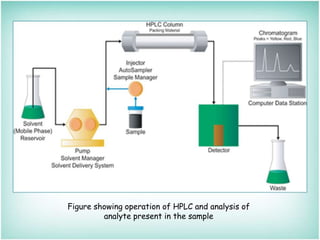
Figure showing operation of HPLC
Figure showing operation of HPLC and analysis of
analyte present in the sample
Types
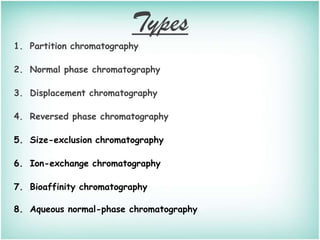
1. Partition chromatography
2. Normal phase chromatography
3. Displacement chromatography
4. Reversed phase chromatography
5. Size-exclusion chromatography
6. Ion-exchange chromatography
7. Bioaffinity chromatography
8. Aqueous normal-phase chromatography
Advantages
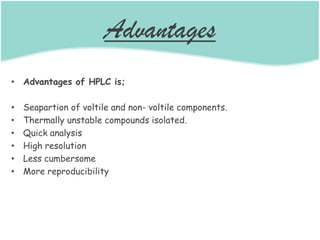
• Advantages of HPLC is;
• Seapartion of voltile and non- voltile components.
• Thermally unstable compounds isolated.
• Quick analysis
• High resolution
• Less cumbersome
• More reproducibility
Disadvantages
• Disadvantages of HPLC are;
• Tedious to detect co-elution.
• High cost.
• Complex to operate.
Thank you …

Hplc

  • 1.
  • 2.
  • 3.
    Introduction  Abbreviated for; High-performanceliquid chromatography OR High-pressure liquid chromatography  Defined as; “A chromatographic technique used to separate components of mixture for the purpose to identify, quantify or purify the individual components of the mixture “.  Widely used in field of biochemistry and analytical chemistry.
  • 4.
    History  Invented byMartin and Synge as extension of gas chromatography.  The main idea was that; “Small sorbent particles and pressure could produce fast liquid chromatography techniques”.  The method was used practically in late 1960s for separation amino acids.
  • 5.
    Instrumentation  HPLC involvesfollowing functional instruments. 1. Mobile phase reservoir 2. Pump 3. Injector 4. Stationary phase ( Column) 5. Detector 6. Computer
  • 6.
    1. Mobile phasereservoir: • Commonly glass bottles with caps are used. • Teflon tubings and filters are connected to purge gas (helium) for degassing. • Vaccum for 5-10 min is also used for degassing. 2. Pump: • It forces the mobile phase to pass through column. • Flow rate is 1-2 ml/ min. • Trypical pressure is 6000 – 9000psi. 3. Injector: • Can be manually (syringe) or automated. • Sample volume 5-20µl. • Ideal to stand pressure of mobile phase. • Autosampler is used for analysis of many samples automatically.
  • 7.
    4. Stationary phase(Column): • Heart of HPLC. • Separate sample components on basis of physical and chemical parameters. • Lenght 10-30cm. • Diameter 4-10nm. • Packing material 5-10nm thick. 5. Detector: • Detection of elutes from column. • Quantitative analysis of sample components. • Output transferred to recorder/ computer. 6. Computer: • Data system that controls modules of HPLC. • Signals from detector are interpreted to determine elution time, quantitative and qualitative analysis of sample.
  • 8.
  • 9.
    Figure displaying complexinstrumentation of HPLC
  • 10.
    Operation • Operation strategiesare explained as follows; 1. Sample:  The sample to be analyzed is introduced into stream of mobile phase in minute quantity, mostly in microliters.  The components of sample moves through different velocities reaching the column where it physically interacts with the sorbent.  Velocity of sample components depends on; • Chemical nature of sample • Nature of column • Composition of mobile phase
  • 11.
    2. Column: • Alsoknown as stationary phase. • Composed of sorbent material varying in particle size, and surface chemistry. • Size of particles can be smaller which improves chromatographic resolution. • In terms of surface chemistry, the column can be hydrophobic and polar in nature.
  • 12.
    A B A. Plantextracts separated by HPLC by passing through stationary phase (column) B. Columns used in HPLC device
  • 13.
    3. Eluent: • Alsoknown as mobile phase.  Type of solvent used: • Commonly it is composed of water miscible with organic solvents. For example methanol. • Some HPLC utilizes water free mobile phase and uses acids such as formic acid or phosphoric acid. • Many mobile phase works well by using salts such as sodium phosphate.
  • 14.
     Composition ofeluent: • It depends on; • Intensity of interactions between analytes and stationary phase. For example; i. Hydrophobic interactions in reversed-phase HPLC ii. Polar interactions in normal phase HPLC iii. Ionic interaction in ion exchange HPLC • Often a series of trial runs are performed with the sample in order to find the HPLC method which gives adequate separation.
  • 15.
    Figure showing mobilephase reserviors
  • 16.
  • 17.
    Figure showing operationof HPLC and analysis of analyte present in the sample
  • 18.
    Types 1. Partition chromatography 2.Normal phase chromatography 3. Displacement chromatography 4. Reversed phase chromatography 5. Size-exclusion chromatography 6. Ion-exchange chromatography 7. Bioaffinity chromatography 8. Aqueous normal-phase chromatography
  • 19.
    Advantages • Advantages ofHPLC is; • Seapartion of voltile and non- voltile components. • Thermally unstable compounds isolated. • Quick analysis • High resolution • Less cumbersome • More reproducibility
  • 20.
    Disadvantages • Disadvantages ofHPLC are; • Tedious to detect co-elution. • High cost. • Complex to operate.
  • 21.