HPLC


Presented by
ANU BALA
OUTLINE
•   INTRODUCTION
•   TYPES OF CHROMATOGRAPHY
•   RP LIQUID CHROMATOGRAPHY
•   INSTRUMENTATION
•   CHROMATOGRAM
•   METHOD DEVELPOMENT LAYOUT
•   ADVANTAGES OF HPLC
INTRODUCTION
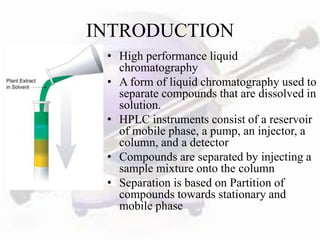
 • High performance liquid
   chromatography
 • A form of liquid chromatography used to
   separate compounds that are dissolved in
   solution.
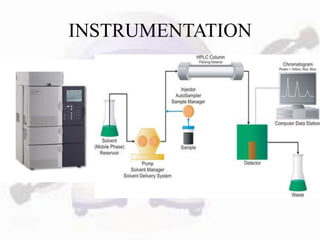
 • HPLC instruments consist of a reservoir
   of mobile phase, a pump, an injector, a
   column, and a detector
 • Compounds are separated by injecting a
   sample mixture onto the column
 • Separation is based on Partition of
   compounds towards stationary and
   mobile phase
TYPES OF CHROMATOGRAPHY
A. Based on modes of chromatography
                 1. Normal phase mode
                 2.Reverse phase mode
B. Based on principle of separation
                 1. Adsorption chromatography
                 2. Ion exchange chromatography
                 3. Partition chromatography
                 4. Size exclusion
C. Based on elution technique
                 1. Isocratic separation
                 2. Gradient separation
D. Based on the scale of operation
               1. Analytical HPLC
               2. Preparative HPLC
E. Based on the type of analysis
               1. Qualitative analysis
               2. Quantitative analysis
INSTRUMENTATION
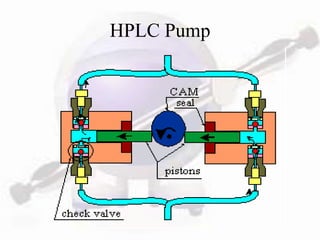
HPLC Pump
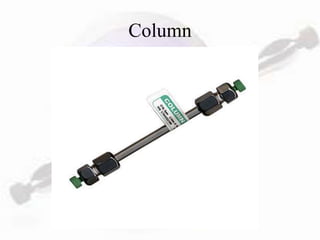
Column
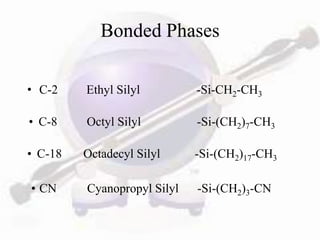
Bonded Phases

• C-2    Ethyl Silyl         -Si-CH2-CH3

• C-8    Octyl Silyl         -Si-(CH2)7-CH3

• C-18   Octadecyl Silyl     -Si-(CH2)17-CH3

• CN     Cyanopropyl Silyl   -Si-(CH2)3-CN
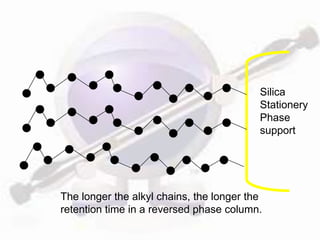
Silica
                                          Stationery
                                          Phase
                                          support


The longer the alkyl chains, the longer the
retention time in a reversed phase column.
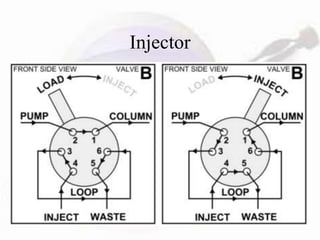
Injector
Detector
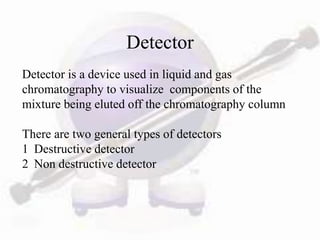
Detector is a device used in liquid and gas
chromatography to visualize components of the
mixture being eluted off the chromatography column

There are two general types of detectors
1 Destructive detector
2 Non destructive detector
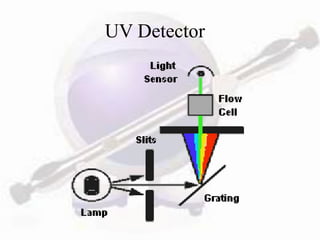
UV Detector
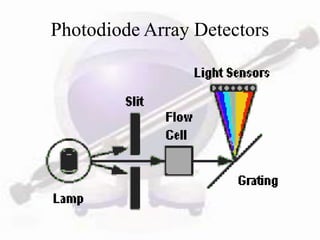
Photodiode Array Detectors
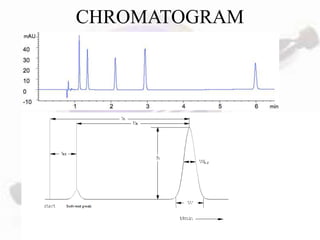
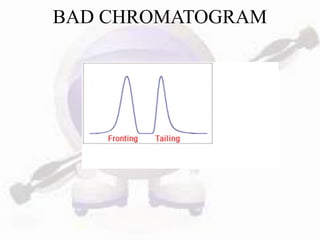
CHROMATOGRAM
BAD CHROMATOGRAM
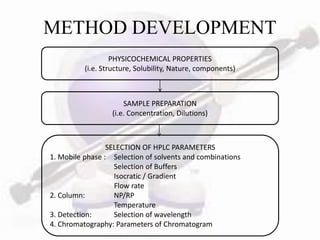
METHOD DEVELOPMENT
                   PHYSICOCHEMICAL PROPERTIES
          (i.e. Structure, Solubility, Nature, components)


                      SAMPLE PREPARATION
                  (i.e. Concentration, Dilutions)


                 SELECTION OF HPLC PARAMETERS
1. Mobile phase : Selection of solvents and combinations
                   Selection of Buffers
                   Isocratic / Gradient
                   Flow rate
2. Column:         NP/RP
                   Temperature
3. Detection:      Selection of wavelength
4. Chromatography: Parameters of Chromatogram
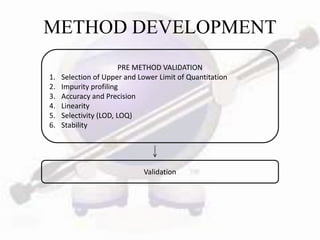
METHOD DEVELOPMENT
                        PRE METHOD VALIDATION
1.   Selection of Upper and Lower Limit of Quantitation
2.   Impurity profiling
3.   Accuracy and Precision
4.   Linearity
5.   Selectivity (LOD, LOQ)
6.   Stability


                             Validation
Advantages of HPLC
High sensitivity
High performance
Rapid process and hence time saving
Can be used for qualitative as well as quantitative
estimation
Can be used for both analytical and preparative
purpose
HPLC

HPLC

  • 1.
  • 2.
    OUTLINE • INTRODUCTION • TYPES OF CHROMATOGRAPHY • RP LIQUID CHROMATOGRAPHY • INSTRUMENTATION • CHROMATOGRAM • METHOD DEVELPOMENT LAYOUT • ADVANTAGES OF HPLC
  • 3.
    INTRODUCTION • Highperformance liquid chromatography • A form of liquid chromatography used to separate compounds that are dissolved in solution. • HPLC instruments consist of a reservoir of mobile phase, a pump, an injector, a column, and a detector • Compounds are separated by injecting a sample mixture onto the column • Separation is based on Partition of compounds towards stationary and mobile phase
  • 4.
    TYPES OF CHROMATOGRAPHY A.Based on modes of chromatography 1. Normal phase mode 2.Reverse phase mode B. Based on principle of separation 1. Adsorption chromatography 2. Ion exchange chromatography 3. Partition chromatography 4. Size exclusion C. Based on elution technique 1. Isocratic separation 2. Gradient separation
  • 5.
    D. Based onthe scale of operation 1. Analytical HPLC 2. Preparative HPLC E. Based on the type of analysis 1. Qualitative analysis 2. Quantitative analysis
  • 7.
  • 8.
  • 9.
  • 10.
    Bonded Phases • C-2 Ethyl Silyl -Si-CH2-CH3 • C-8 Octyl Silyl -Si-(CH2)7-CH3 • C-18 Octadecyl Silyl -Si-(CH2)17-CH3 • CN Cyanopropyl Silyl -Si-(CH2)3-CN
  • 11.
    Silica Stationery Phase support The longer the alkyl chains, the longer the retention time in a reversed phase column.
  • 12.
  • 13.
    Detector Detector is adevice used in liquid and gas chromatography to visualize components of the mixture being eluted off the chromatography column There are two general types of detectors 1 Destructive detector 2 Non destructive detector
  • 14.
  • 15.
  • 16.
  • 17.
  • 18.
    METHOD DEVELOPMENT PHYSICOCHEMICAL PROPERTIES (i.e. Structure, Solubility, Nature, components) SAMPLE PREPARATION (i.e. Concentration, Dilutions) SELECTION OF HPLC PARAMETERS 1. Mobile phase : Selection of solvents and combinations Selection of Buffers Isocratic / Gradient Flow rate 2. Column: NP/RP Temperature 3. Detection: Selection of wavelength 4. Chromatography: Parameters of Chromatogram
  • 19.
    METHOD DEVELOPMENT PRE METHOD VALIDATION 1. Selection of Upper and Lower Limit of Quantitation 2. Impurity profiling 3. Accuracy and Precision 4. Linearity 5. Selectivity (LOD, LOQ) 6. Stability Validation
  • 20.
    Advantages of HPLC Highsensitivity High performance Rapid process and hence time saving Can be used for qualitative as well as quantitative estimation Can be used for both analytical and preparative purpose