Prepared
by,
R
INTRODUCTION:
• Developed by American scientist,
D. T. Day.
• Later M. S. Tswett, botanist used
adsorption columns, for the
investigation of plant pigments.
PRINCIPLE:
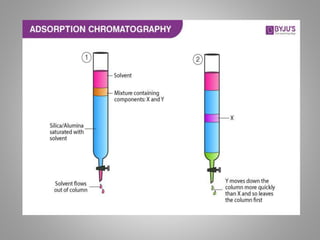
 In this chromatography, seperation of
components of a mixture takes place by
the adsorption efficiency of the sample.
 The most strongly adsorbed component
forms the topmost band.
 the least adsorbed component forms
the lowermost band on the adsorbent
column.
 Degree of separation depends upon the
separation of surface area of
adsorbent.
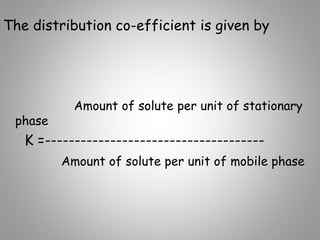
The distribution co-efficient is given by
Amount of solute per unit of stationary
phase
K =-------------------------------------
Amount of solute per unit of mobile phase
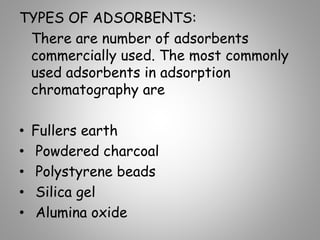
TYPES OF ADSORBENTS:
There are number of adsorbents
commercially used. The most commonly
used adsorbents in adsorption
chromatography are
• Fullers earth
• Powdered charcoal
• Polystyrene beads
• Silica gel
• Alumina oxide
FULLERS EARTH:
• It consists of a mixture of minerals
obtained from certain clay deposits.
• It is widely used to decolorize the
food.
• Used in the removal of pigments from
wine sample.
• It is cheap.
• It sold under the name of Florisil.
POWDERED CHARCOAL:
 Powerful adsorbent
 Resource material are bone, coconut
 Finely divided charcoal is very difficult
to wet
 Preparing a column packed with
charcoal is very troublesome
POLYSTYRENE BEADS:
• It is modified as tiny beads
• It doesnot have any charged groups in
its surface.
• Function is only adsorption
• Useful in the separation of alkaloids,
steroids
• Commercial name is XAD resins
SILICA GEL:
 It is a popular adsorbent
 It is less stable than alumina
 It should handled properly to avoid
changes in the result
 It is available in the form of crushed
and powdered glass
ALUMINA:
 It is powerful adsorbent
 It is prepared as a precipitate of
aluminium hydroxide
PREPARATION OF THE COLUMN:
DRY PACKING
• The powdered sample is poured inside
the tube (both the sample and the
stationary column remain dry)
WET PACKING
• The bottom of the tube is closed
• The column is filled with solvent
• This method is known as wet packing
APPLICATIONS
Used for the separation of
• Polycyclic aromatic compounds
• Plasma cortisol
• Geometrical isomers

Adsorption chromatography

  • 1.
  • 2.
    INTRODUCTION: • Developed byAmerican scientist, D. T. Day. • Later M. S. Tswett, botanist used adsorption columns, for the investigation of plant pigments.
  • 3.
    PRINCIPLE:  In thischromatography, seperation of components of a mixture takes place by the adsorption efficiency of the sample.  The most strongly adsorbed component forms the topmost band.  the least adsorbed component forms the lowermost band on the adsorbent column.  Degree of separation depends upon the separation of surface area of adsorbent.
  • 4.
    The distribution co-efficientis given by Amount of solute per unit of stationary phase K =------------------------------------- Amount of solute per unit of mobile phase
  • 6.
    TYPES OF ADSORBENTS: Thereare number of adsorbents commercially used. The most commonly used adsorbents in adsorption chromatography are • Fullers earth • Powdered charcoal • Polystyrene beads • Silica gel • Alumina oxide
  • 7.
    FULLERS EARTH: • Itconsists of a mixture of minerals obtained from certain clay deposits. • It is widely used to decolorize the food. • Used in the removal of pigments from wine sample. • It is cheap. • It sold under the name of Florisil.
  • 8.
    POWDERED CHARCOAL:  Powerfuladsorbent  Resource material are bone, coconut  Finely divided charcoal is very difficult to wet  Preparing a column packed with charcoal is very troublesome
  • 9.
    POLYSTYRENE BEADS: • Itis modified as tiny beads • It doesnot have any charged groups in its surface. • Function is only adsorption • Useful in the separation of alkaloids, steroids • Commercial name is XAD resins
  • 10.
    SILICA GEL:  Itis a popular adsorbent  It is less stable than alumina  It should handled properly to avoid changes in the result  It is available in the form of crushed and powdered glass
  • 11.
    ALUMINA:  It ispowerful adsorbent  It is prepared as a precipitate of aluminium hydroxide
  • 12.
    PREPARATION OF THECOLUMN: DRY PACKING • The powdered sample is poured inside the tube (both the sample and the stationary column remain dry) WET PACKING • The bottom of the tube is closed • The column is filled with solvent • This method is known as wet packing
  • 13.
    APPLICATIONS Used for theseparation of • Polycyclic aromatic compounds • Plasma cortisol • Geometrical isomers