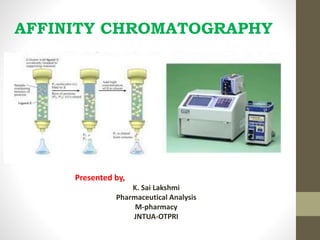
AFFINITY CHROMATOGRAPHY
Presented by,
K. Sai Lakshmi
Pharmaceutical Analysis
M-pharmacy
JNTUA-OTPRI
Chromatography: It is a collective term for a set of laboratory techniques for
the separation of mixtures
Affinity Chromatography is the purification of a biomolecule with respect
to the specific binding of that biomolecule due to the chemical structure
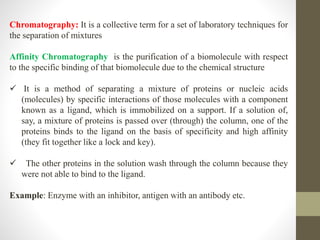
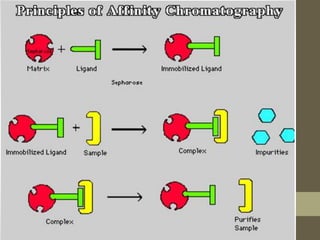
 It is a method of separating a mixture of proteins or nucleic acids
(molecules) by specific interactions of those molecules with a component
known as a ligand, which is immobilized on a support. If a solution of,
say, a mixture of proteins is passed over (through) the column, one of the
proteins binds to the ligand on the basis of specificity and high affinity
(they fit together like a lock and key).
 The other proteins in the solution wash through the column because they
were not able to bind to the ligand.
Example: Enzyme with an inhibitor, antigen with an antibody etc.
PRINCIPLE
 Affinity chromatography is one of the most diverse and powerful
chromatographic methods for purification of a specific molecule or a group
of molecules from complex mixtures
 It is based on highly specific biological interactions between two molecules
such as interactions between enzyme and substrate, receptor and ligand, or
antibody and antigen.
 These interactions which are typically reversible are used for purification
by placing one of the interacting molecules referred to as affinity ligand
onto a solid matrix to create a stationary phase while a target molecule is in
the mobile phase.
 Many of the commonly used ligands coupled to affinity matrices are now
commercially available and are ready to use.
Types:
 Lectin Affinity Chromatography
 Immuno Affinity chromatography
 Metal Chelate Chromatography
 Dye Ligand Chromatography
 Covalent chromatography
Chromatographic Media
• A matrix in its use here is a substance, usually in bead form to which a
specific ligand is covalently bound.
 In order to for the matrix to be effective it must have certain characters:
1)It must be insoluble in solvents and buffers employed in the process
2)It must be chemically and mechanically stable..
3)It must be easily coupled to a ligand or spacer arm onto which the ligand can
be attached.
4)It must exhibit good flow properties and have a relatively large surface area
for attachment.
Immobilized Ligand
• The ligand can be selected only after the nature of the macromolecule to be
isolated is known.
• When a hormone receptor protein is to be purified by affinity
chromatography, the hormone itself is an ideal candidate for the ligand.
• For antibody isolation ,an antigen or hapten may be used as ligand.
• If an enzyme is to be purified, a substrate analog, inhibitor, cofactor, or
effect or may be used as a the immobilized ligand.
Attachment Of Ligand To Matrix
• Several procedures have been developed for the covalent attachment of
the ligand to the stationary phase. all procedures for gel modification
proceed in two separate chemical steps:
1)Activation of the functional groups on the matrix and
2)Joining of the ligand to the functional group on the matrix.
• A wide variety of activated gels is now commercially available. the most
widely used are described in the following
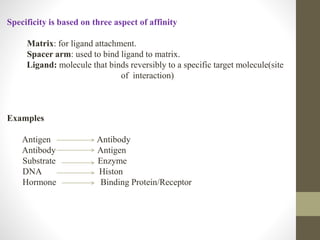
Specificity is based on three aspect of affinity
Matrix: for ligand attachment.
Spacer arm: used to bind ligand to matrix.
Ligand: molecule that binds reversibly to a specific target molecule(site
of interaction)
Examples
Antigen Antibody
Antibody Antigen
Substrate Enzyme
DNA Histon
Hormone Binding Protein/Receptor
Uses of Affinity Chromatography
 Purify and concentrate a substance from a mixture into a buffering solution
 Reduce the amount of a substance in a mixture
 Discern what biological compounds bind to a particular substance, such as drugs
 Purify and concentrate an enzyme solution
Limitations of Affinity Chromatography
 Time consuming method.
 More amounts of solvents are required which may be expensive.
 Intense labor
 Non-specific adsorption cannot be totally eliminated, it can only be minimized.
 Limited availability and high cost of immobilized ligands.
 Proteins get denatured if required pH is not adjusted.
Advantages Of Affinity Chromatography
 High specificity
 Target molecules can be obtained in a highly pure state
 Single step purification
 The matrix can be reused rapidly.
 The matrix is a solid, can be easily washed and dried.
 Give purified product with high yield.
 Affinity chromatography can also be used to remove specific contaminants, such as
proteases.
Disadvantages Of Affinity Chromatography
 Expensive ligands
 Leakage of ligand
 Degradation of the solid support
 Limited lifetime
 Non-specific adsorption
 Relatively low productivity
APPLICATIONS
 It is used for isolation and purification of all biological
macromolecule.
 It is used to purify nucleic acid, antibodies, enzymes etc..,
 To notice which biological compounds bind to a particular
substance.
 To reduce a amount of substance in a mixture.
 Used in Genetic Engineering - nucleic acid purification
 Production of Vaccines - antibody purification from blood serum
 And Basic Metabolic Research - protein or enzyme purification
from cell free extracts
Affinity chromatography

Affinity chromatography

  • 1.
    AFFINITY CHROMATOGRAPHY Presented by, K.Sai Lakshmi Pharmaceutical Analysis M-pharmacy JNTUA-OTPRI
  • 2.
    Chromatography: It isa collective term for a set of laboratory techniques for the separation of mixtures Affinity Chromatography is the purification of a biomolecule with respect to the specific binding of that biomolecule due to the chemical structure  It is a method of separating a mixture of proteins or nucleic acids (molecules) by specific interactions of those molecules with a component known as a ligand, which is immobilized on a support. If a solution of, say, a mixture of proteins is passed over (through) the column, one of the proteins binds to the ligand on the basis of specificity and high affinity (they fit together like a lock and key).  The other proteins in the solution wash through the column because they were not able to bind to the ligand. Example: Enzyme with an inhibitor, antigen with an antibody etc.
  • 3.
    PRINCIPLE  Affinity chromatographyis one of the most diverse and powerful chromatographic methods for purification of a specific molecule or a group of molecules from complex mixtures  It is based on highly specific biological interactions between two molecules such as interactions between enzyme and substrate, receptor and ligand, or antibody and antigen.  These interactions which are typically reversible are used for purification by placing one of the interacting molecules referred to as affinity ligand onto a solid matrix to create a stationary phase while a target molecule is in the mobile phase.  Many of the commonly used ligands coupled to affinity matrices are now commercially available and are ready to use.
  • 5.
    Types:  Lectin AffinityChromatography  Immuno Affinity chromatography  Metal Chelate Chromatography  Dye Ligand Chromatography  Covalent chromatography
  • 6.
    Chromatographic Media • Amatrix in its use here is a substance, usually in bead form to which a specific ligand is covalently bound.  In order to for the matrix to be effective it must have certain characters: 1)It must be insoluble in solvents and buffers employed in the process 2)It must be chemically and mechanically stable.. 3)It must be easily coupled to a ligand or spacer arm onto which the ligand can be attached. 4)It must exhibit good flow properties and have a relatively large surface area for attachment.
  • 7.
    Immobilized Ligand • Theligand can be selected only after the nature of the macromolecule to be isolated is known. • When a hormone receptor protein is to be purified by affinity chromatography, the hormone itself is an ideal candidate for the ligand. • For antibody isolation ,an antigen or hapten may be used as ligand. • If an enzyme is to be purified, a substrate analog, inhibitor, cofactor, or effect or may be used as a the immobilized ligand.
  • 8.
    Attachment Of LigandTo Matrix • Several procedures have been developed for the covalent attachment of the ligand to the stationary phase. all procedures for gel modification proceed in two separate chemical steps: 1)Activation of the functional groups on the matrix and 2)Joining of the ligand to the functional group on the matrix. • A wide variety of activated gels is now commercially available. the most widely used are described in the following
  • 9.
    Specificity is basedon three aspect of affinity Matrix: for ligand attachment. Spacer arm: used to bind ligand to matrix. Ligand: molecule that binds reversibly to a specific target molecule(site of interaction) Examples Antigen Antibody Antibody Antigen Substrate Enzyme DNA Histon Hormone Binding Protein/Receptor
  • 10.
    Uses of AffinityChromatography  Purify and concentrate a substance from a mixture into a buffering solution  Reduce the amount of a substance in a mixture  Discern what biological compounds bind to a particular substance, such as drugs  Purify and concentrate an enzyme solution Limitations of Affinity Chromatography  Time consuming method.  More amounts of solvents are required which may be expensive.  Intense labor  Non-specific adsorption cannot be totally eliminated, it can only be minimized.  Limited availability and high cost of immobilized ligands.  Proteins get denatured if required pH is not adjusted.
  • 11.
    Advantages Of AffinityChromatography  High specificity  Target molecules can be obtained in a highly pure state  Single step purification  The matrix can be reused rapidly.  The matrix is a solid, can be easily washed and dried.  Give purified product with high yield.  Affinity chromatography can also be used to remove specific contaminants, such as proteases. Disadvantages Of Affinity Chromatography  Expensive ligands  Leakage of ligand  Degradation of the solid support  Limited lifetime  Non-specific adsorption  Relatively low productivity
  • 12.
    APPLICATIONS  It isused for isolation and purification of all biological macromolecule.  It is used to purify nucleic acid, antibodies, enzymes etc..,  To notice which biological compounds bind to a particular substance.  To reduce a amount of substance in a mixture.  Used in Genetic Engineering - nucleic acid purification  Production of Vaccines - antibody purification from blood serum  And Basic Metabolic Research - protein or enzyme purification from cell free extracts