ELISA
FAYYAZ MUHAMMAD ALI
ENZYME LINKED
IMMUNOSORBENT
ASSAY
INTRODUCTION TO ELISA
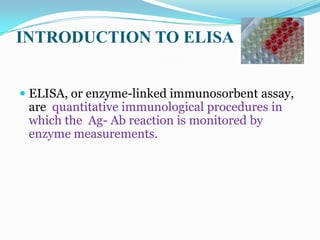
 ELISA, or enzyme-linked immunosorbent assay,
are quantitative immunological procedures in
which the Ag- Ab reaction is monitored by
enzyme measurements.
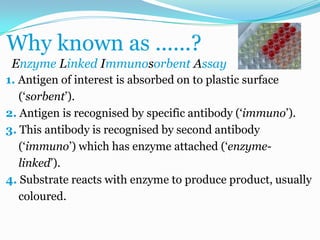
Why known as ......?
Enzyme Linked Immunosorbent Assay
1. Antigen of interest is absorbed on to plastic surface
(„sorbent‟).
2. Antigen is recognised by specific antibody („immuno‟).
3. This antibody is recognised by second antibody
(„immuno‟) which has enzyme attached („enzyme-
linked‟).
4. Substrate reacts with enzyme to produce product, usually
coloured.
BASIC PRINCIPLE OF ELISA
 Use an enzyme to detect the binding of antigen (Ag)
antibody (Ab).
 The enzyme converts a colorless substrate
(chromogen) to a colored product, indicating the
presence of Ag : Ab binding.
 An ELISA can be used to detect either the presence
of Antigens or antibodies in a sample depending how
the test is designed.
Substrate
Primary
antibody
Secondary
antibody
Different antigens in sample
Coloured
product
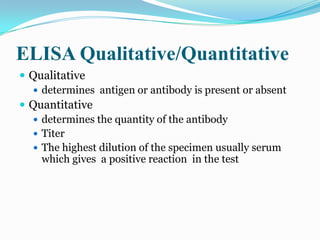
ELISA Qualitative/Quantitative
 Qualitative
 determines antigen or antibody is present or absent
 Quantitative
 determines the quantity of the antibody
 Titer
 The highest dilution of the specimen usually serum
which gives a positive reaction in the test
Basic Steps Of
Enzyme-Linked
Immunosorbant
Assay
ANTIGEN (Ag)
 Any molecule that induces production of antibodies
when introduced in the body of an animal is called
antigen.
OR
 any “thing”, foreign to the immune system. e.g.
bacteria, viruses, (or their parts), pollen, etc.
 Protein molecule
 Carbohydrate molecule.
 Microorganisms
 Allergens.
 Viruses Etc.
SYMBOL FOR ANTIGEN
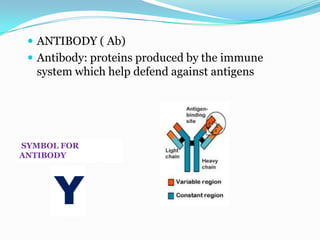
 ANTIBODY ( Ab)
 Antibody: proteins produced by the immune
system which help defend against antigens
SYMBOL FOR
ANTIBODY
Y
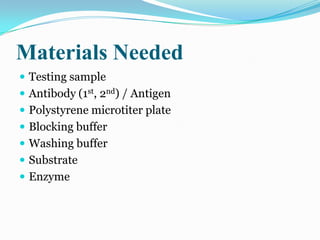
Materials Needed
 Testing sample
 Antibody (1st, 2nd) / Antigen
 Polystyrene microtiter plate
 Blocking buffer
 Washing buffer
 Substrate
 Enzyme
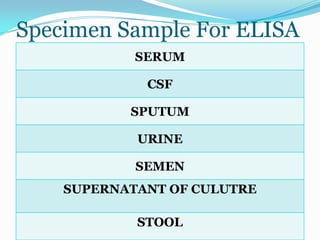
Specimen Sample For ELISA
SERUM
CSF
SPUTUM
URINE
SEMEN
SUPERNATANT OF CULUTRE
STOOL
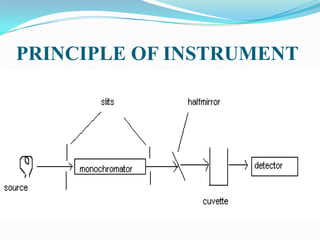
PRINCIPLE OF INSTRUMENT
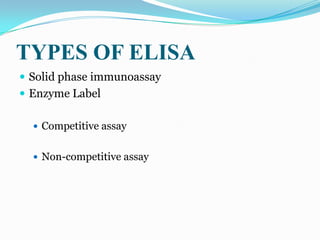
TYPES OF ELISA
 Solid phase immunoassay
 Enzyme Label
 Competitive assay
 Non-competitive assay
Comparison between Indirect Sandwich & Competitive ELISA
to detect Ab (HIV, HCV)
to detect Ag ( Tumor Markers, Hormones )
to detect Ag ( Free Testosterone)
Results
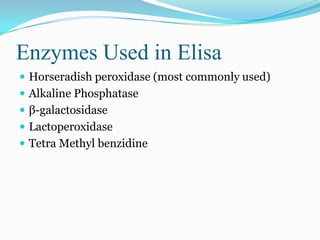
Enzymes Used in Elisa
 Horseradish peroxidase (most commonly used)
 Alkaline Phosphatase
 β-galactosidase
 Lactoperoxidase
 Tetra Methyl benzidine
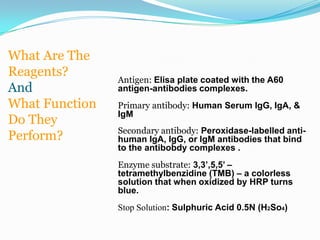
What Are The
Reagents?
And
What Function
Do They
Perform?
Antigen: Elisa plate coated with the A60
antigen-antibodies complexes.
Primary antibody: Human Serum IgG, IgA, &
IgM
Secondary antibody: Peroxidase-labelled anti-
human IgA, IgG, or IgM antibodies that bind
to the antibobdy complexes .
Enzyme substrate: 3,3’,5,5’ –
tetramethylbenzidine (TMB) – a colorless
solution that when oxidized by HRP turns
blue.
Stop Solution: Sulphuric Acid 0.5N (H2So4)
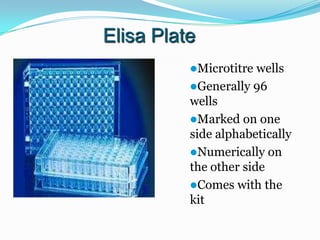
Elisa Plate
Microtitre wells
Generally 96
wells
Marked on one
side alphabetically
Numerically on
the other side
Comes with the
kit
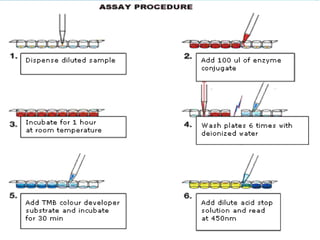
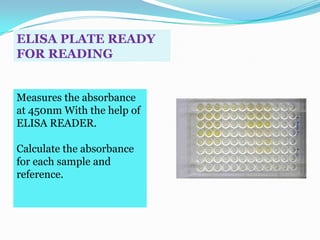
Measures the absorbance
at 450nm With the help of
ELISA READER.
Calculate the absorbance
for each sample and
reference.
ELISA PLATE READY
FOR READING
ELISA READER
THERMOLAB SYSTEM
(USA)
WHAT IS CUT OF VALUE?
ELISA is semiquantitative method. The calculation is done as
follows. The units of ELISA is OD ratio:
Sample value= sample OD/cut-off OD
What is Cut-off Value ………?
APPLICATIONS OF ELISA
1- Hormones 7- Vaccine Quality Control
2- Proteins 8- FOR GMO (Genetically modified
organism)
3- Infectious Agent ( Viral, Bacterial,
Parasitic, Fungal )
9- For Rapid Test
4- Drug Markers 10- IgG, IgM, IgA
5- Tumor Markers 11- In New Born Screening
6- Serum Proteins 12- In Clinical Research
THANKYOU

Modified elisa

  • 1.
  • 2.
  • 3.
    INTRODUCTION TO ELISA ELISA, or enzyme-linked immunosorbent assay, are quantitative immunological procedures in which the Ag- Ab reaction is monitored by enzyme measurements.
  • 4.
    Why known as......? Enzyme Linked Immunosorbent Assay 1. Antigen of interest is absorbed on to plastic surface („sorbent‟). 2. Antigen is recognised by specific antibody („immuno‟). 3. This antibody is recognised by second antibody („immuno‟) which has enzyme attached („enzyme- linked‟). 4. Substrate reacts with enzyme to produce product, usually coloured.
  • 5.
    BASIC PRINCIPLE OFELISA  Use an enzyme to detect the binding of antigen (Ag) antibody (Ab).  The enzyme converts a colorless substrate (chromogen) to a colored product, indicating the presence of Ag : Ab binding.  An ELISA can be used to detect either the presence of Antigens or antibodies in a sample depending how the test is designed.
  • 6.
  • 7.
    ELISA Qualitative/Quantitative  Qualitative determines antigen or antibody is present or absent  Quantitative  determines the quantity of the antibody  Titer  The highest dilution of the specimen usually serum which gives a positive reaction in the test
  • 8.
  • 9.
    ANTIGEN (Ag)  Anymolecule that induces production of antibodies when introduced in the body of an animal is called antigen. OR  any “thing”, foreign to the immune system. e.g. bacteria, viruses, (or their parts), pollen, etc.  Protein molecule  Carbohydrate molecule.  Microorganisms  Allergens.  Viruses Etc. SYMBOL FOR ANTIGEN
  • 10.
     ANTIBODY (Ab)  Antibody: proteins produced by the immune system which help defend against antigens SYMBOL FOR ANTIBODY Y
  • 11.
    Materials Needed  Testingsample  Antibody (1st, 2nd) / Antigen  Polystyrene microtiter plate  Blocking buffer  Washing buffer  Substrate  Enzyme
  • 12.
    Specimen Sample ForELISA SERUM CSF SPUTUM URINE SEMEN SUPERNATANT OF CULUTRE STOOL
  • 13.
  • 14.
    TYPES OF ELISA Solid phase immunoassay  Enzyme Label  Competitive assay  Non-competitive assay
  • 15.
    Comparison between IndirectSandwich & Competitive ELISA to detect Ab (HIV, HCV) to detect Ag ( Tumor Markers, Hormones ) to detect Ag ( Free Testosterone)
  • 16.
  • 17.
    Enzymes Used inElisa  Horseradish peroxidase (most commonly used)  Alkaline Phosphatase  β-galactosidase  Lactoperoxidase  Tetra Methyl benzidine
  • 18.
    What Are The Reagents? And WhatFunction Do They Perform? Antigen: Elisa plate coated with the A60 antigen-antibodies complexes. Primary antibody: Human Serum IgG, IgA, & IgM Secondary antibody: Peroxidase-labelled anti- human IgA, IgG, or IgM antibodies that bind to the antibobdy complexes . Enzyme substrate: 3,3’,5,5’ – tetramethylbenzidine (TMB) – a colorless solution that when oxidized by HRP turns blue. Stop Solution: Sulphuric Acid 0.5N (H2So4)
  • 19.
    Elisa Plate Microtitre wells Generally96 wells Marked on one side alphabetically Numerically on the other side Comes with the kit
  • 21.
    Measures the absorbance at450nm With the help of ELISA READER. Calculate the absorbance for each sample and reference. ELISA PLATE READY FOR READING
  • 22.
  • 23.
    WHAT IS CUTOF VALUE? ELISA is semiquantitative method. The calculation is done as follows. The units of ELISA is OD ratio: Sample value= sample OD/cut-off OD What is Cut-off Value ………?
  • 24.
    APPLICATIONS OF ELISA 1-Hormones 7- Vaccine Quality Control 2- Proteins 8- FOR GMO (Genetically modified organism) 3- Infectious Agent ( Viral, Bacterial, Parasitic, Fungal ) 9- For Rapid Test 4- Drug Markers 10- IgG, IgM, IgA 5- Tumor Markers 11- In New Born Screening 6- Serum Proteins 12- In Clinical Research
  • 25.