High-Performance Liquid
Chromatography (HPLC)
BY
A.MANOJ KUMAR
INDRODUCTION
 High performance liquid chromatography or commonly
known as HPLC is an analytical technique used to separate,
identify or quantify each component in a mixture.
 The mixture is separated using the basic principle of
column chromatography and then identified and quantified
by spectroscopy.
 In the 1960s the column chromatography LC with its low-
pressure suitable glass columns was further developed to the
HPLC with its high-pressure adapted metal columns.
 HPLC is thus basically a highly improved form of column
liquid chromatography. Instead of a solvent being allowed to
drip through a column under gravity, it is forced through
under high pressures of up to 400 atmospheres.
PRINCIPLE OF HPLC
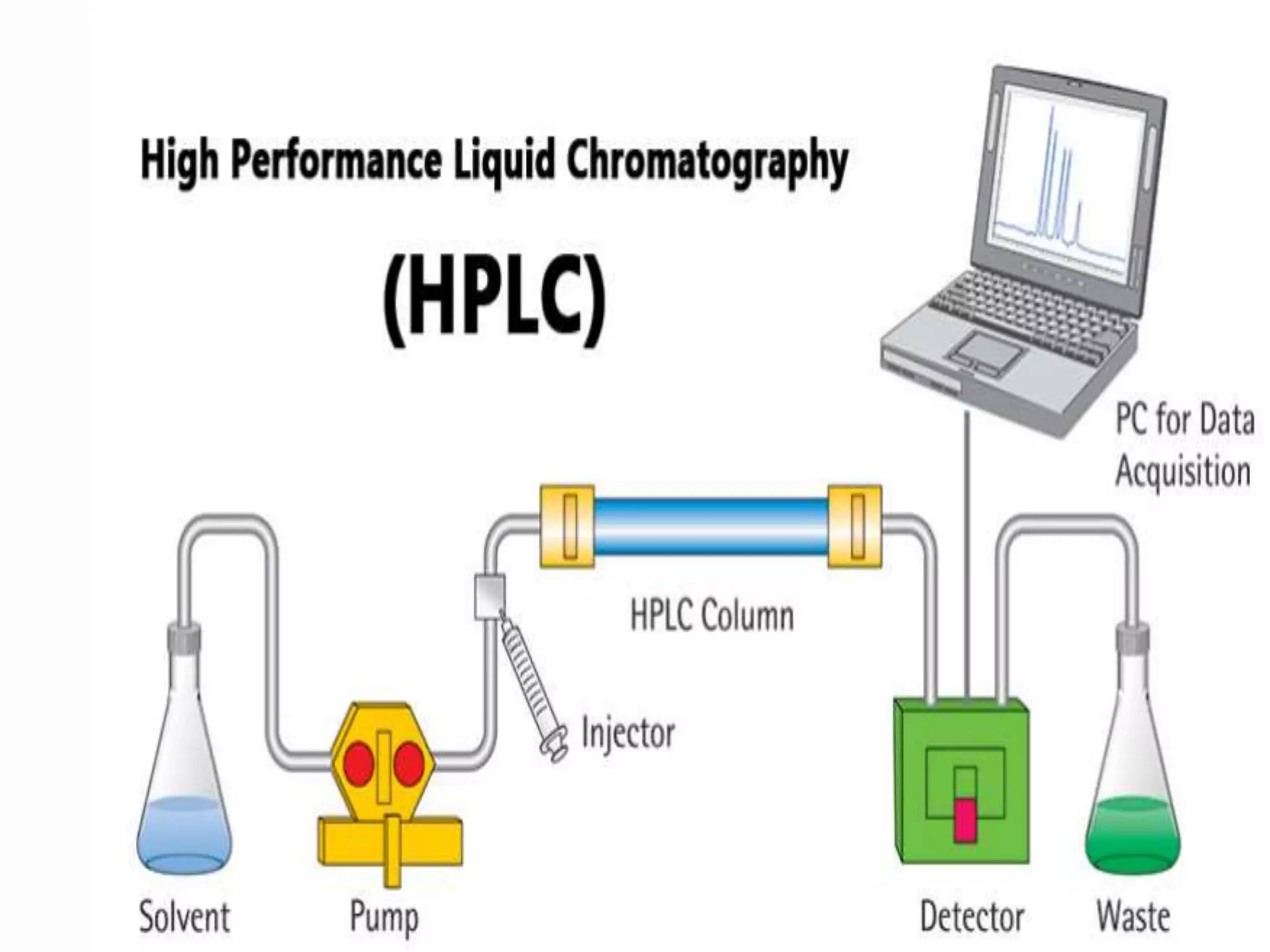
 The purification takes place in a separation column
between a stationary and a mobile phase.
 The stationary phase is a granular material with very small
porous particles in a separation column.
 The mobile phase, on the other hand, is a solvent or
solvent mixture which is forced at high pressure through the
separation column.
 Via a valve with a connected sample loop, i.e. a small
tube or a capillary made of stainless steel, the sample is
injected into the mobile phase flow from the pump to the
separation column using a syringe.
 Subsequently, the individual components of the sample
migrate through the column at different rates because they
are retained to a varying degree by interactions with the
stationary phase.
 After leaving the column, the individual substances are
detected by a suitable detector and passed on as a signal to
the HPLC software on the computer.
 At the end of this operation/run, a chromatogram in the
HPLC software on the computer is obtained.
 The chromatogram allows the identification and
quantification of the different substances.
INSTRUMENTATION
INSTRUMENTATION OF HPLC
The Pump
The development of HPLC led to the development of the
pump system.
The pump is positioned in the most upper stream of
the liquid chromatography system and generates a flow of
eluent from the solvent reservoir into the system.
High-pressure generation is a “standard” requirement of
pumps besides which, it should also to be able to provide a
consistent pressure at any condition and a controllable and
reproducible flow rate.
Most pumps used in current LC systems generate the
flow by back-and-forth motion of a motor-driven piston
(reciprocating pumps). Because of this piston motion, it
produces “pulses”.
Injector
An injector is placed next to the pump.
The simplest method is to use a syringe, and the
sample is introduced to the flow of eluent.
The most widely used injection method is based on
sampling loops.
The use of the autosampler (auto-injector) system
is also widely used that allows repeated injections in a set
scheduled-timing.
Column
The separation is performed inside the column.
The recent columns are often prepared in a
stainless steel housing, instead of glass columns.
The packing material generally used is silica or
polymer gels compared to calcium carbonate.
The eluent used for LC varies from acidic to basic
solvents.
Most column housing is made of stainless steel
since stainless is tolerant towards a large variety of solvents.
Detector
Separation of analytes is performed inside the column,
whereas a detector is used to observe the obtained separation.
The composition of the eluent is consistent when no analyte is
present.
While the presence of analyte changes the composition of the
eluent.
What detector does is to measure these differences.
This difference is monitored as a form of an electronic signal.
There are different types of detectors available.
Recorder
The change in eluent detected by a detector is in
the form of an electronic signal, and thus it is still not visible
to our eyes.
In older days, the pen (paper)-chart recorder was
popularly used. Nowadays, a computer-based data processor
(integrator) is more common.
There are various types of data processors; from a
simple system consisting of the in-built printer and word
processor while those with software that are specifically
designed for an LC system which not only data acquisition but
features like peak-fitting, baseline correction, automatic
concentration calculation, molecular weight determination,
etc.
Degasser
The eluent used for LC analysis may contain gases
such as oxygen that are non-visible to our eyes.
When gas is present in the eluent, this is detected
as noise and causes an unstable baseline.
Degasser uses special polymer membrane tubing to
remove gases.
The numerous very small pores on the surface of
the polymer tube allow the air to go through while preventing
any liquid to go through the pore.
Column Heater
The LC separation is often largely influenced by the
column temperature.
In order to obtain repeatable results, it is important to
keep consistent temperature conditions.
Also for some analysis, such as sugar and organic acid,
better resolutions can be obtained at elevated temperatures
(50 to 80°C).
Thus columns are generally kept inside the column
oven (column heater).
TYPES OF HPLC
Normal phase:
Column packing is polar (e.g silica) and the mobile phase is
non-polar. It is used for water-sensitive compounds,
geometric isomers, cis-trans isomers, and chiral compounds.
Reverse phase:
The column packing is non-polar (e.g C18), the mobile phase
is water+ miscible solvent (e.g methanol). It can be used for
polar, non-polar, ionizable and ionic samples.
Ion exchange:
Column packing contains ionic groups and the mobile phase is
buffer. It is used to separate anions and cations.
Size exclusion:
Molecules diffuse into pores of a porous medium and are
separated according to their relative size to the pore size.
Large molecules elute first and smaller molecules elute later.
APPLICATION OF HPLC
The HPLC has developed into a universally applicable method
so that it finds its use in almost all areas of chemistry,
biochemistry, and pharmacy.
Analysis of drugs
Analysis of synthetic polymers
Analysis of pollutants in environmental analytics
Determination of drugs in biological matrices
Isolation of valuable products
Product purity and quality control of industrial products and
fine chemicals
Separation and purification of biopolymers such as enzymes
or nucleic acids
Water purification
Pre-concentration of trace components
Ligand-exchange chromatography
Speed
Efficiency
Accuracy
Versatile and extremely precise when it comes to
identifying and quantifying chemical components.
LIMITATION OF HPLC
Cost: Despite its advantages, HPLC can be costly, requiring
large quantities of expensive organics.
Complexity
HPLC does have low sensitivity for certain compounds, and
some cannot be detected as they are irreversibly adsorbed.
Volatile substances are better separated by gas
chromatography.
Ion-exchange chromatography of proteins
ADVANTAGE OF HPLC
THANK YOU...

HPLC-High Performance Liquid Chromatography

  • 1.
  • 2.
    INDRODUCTION  High performanceliquid chromatography or commonly known as HPLC is an analytical technique used to separate, identify or quantify each component in a mixture.  The mixture is separated using the basic principle of column chromatography and then identified and quantified by spectroscopy.  In the 1960s the column chromatography LC with its low- pressure suitable glass columns was further developed to the HPLC with its high-pressure adapted metal columns.  HPLC is thus basically a highly improved form of column liquid chromatography. Instead of a solvent being allowed to drip through a column under gravity, it is forced through under high pressures of up to 400 atmospheres.
  • 4.
    PRINCIPLE OF HPLC The purification takes place in a separation column between a stationary and a mobile phase.  The stationary phase is a granular material with very small porous particles in a separation column.  The mobile phase, on the other hand, is a solvent or solvent mixture which is forced at high pressure through the separation column.  Via a valve with a connected sample loop, i.e. a small tube or a capillary made of stainless steel, the sample is injected into the mobile phase flow from the pump to the separation column using a syringe.
  • 5.
     Subsequently, theindividual components of the sample migrate through the column at different rates because they are retained to a varying degree by interactions with the stationary phase.  After leaving the column, the individual substances are detected by a suitable detector and passed on as a signal to the HPLC software on the computer.  At the end of this operation/run, a chromatogram in the HPLC software on the computer is obtained.  The chromatogram allows the identification and quantification of the different substances.
  • 6.
  • 7.
    INSTRUMENTATION OF HPLC ThePump The development of HPLC led to the development of the pump system. The pump is positioned in the most upper stream of the liquid chromatography system and generates a flow of eluent from the solvent reservoir into the system. High-pressure generation is a “standard” requirement of pumps besides which, it should also to be able to provide a consistent pressure at any condition and a controllable and reproducible flow rate. Most pumps used in current LC systems generate the flow by back-and-forth motion of a motor-driven piston (reciprocating pumps). Because of this piston motion, it produces “pulses”.
  • 8.
    Injector An injector isplaced next to the pump. The simplest method is to use a syringe, and the sample is introduced to the flow of eluent. The most widely used injection method is based on sampling loops. The use of the autosampler (auto-injector) system is also widely used that allows repeated injections in a set scheduled-timing.
  • 9.
    Column The separation isperformed inside the column. The recent columns are often prepared in a stainless steel housing, instead of glass columns. The packing material generally used is silica or polymer gels compared to calcium carbonate. The eluent used for LC varies from acidic to basic solvents. Most column housing is made of stainless steel since stainless is tolerant towards a large variety of solvents.
  • 10.
    Detector Separation of analytesis performed inside the column, whereas a detector is used to observe the obtained separation. The composition of the eluent is consistent when no analyte is present. While the presence of analyte changes the composition of the eluent. What detector does is to measure these differences. This difference is monitored as a form of an electronic signal. There are different types of detectors available.
  • 11.
    Recorder The change ineluent detected by a detector is in the form of an electronic signal, and thus it is still not visible to our eyes. In older days, the pen (paper)-chart recorder was popularly used. Nowadays, a computer-based data processor (integrator) is more common. There are various types of data processors; from a simple system consisting of the in-built printer and word processor while those with software that are specifically designed for an LC system which not only data acquisition but features like peak-fitting, baseline correction, automatic concentration calculation, molecular weight determination, etc.
  • 12.
    Degasser The eluent usedfor LC analysis may contain gases such as oxygen that are non-visible to our eyes. When gas is present in the eluent, this is detected as noise and causes an unstable baseline. Degasser uses special polymer membrane tubing to remove gases. The numerous very small pores on the surface of the polymer tube allow the air to go through while preventing any liquid to go through the pore.
  • 13.
    Column Heater The LCseparation is often largely influenced by the column temperature. In order to obtain repeatable results, it is important to keep consistent temperature conditions. Also for some analysis, such as sugar and organic acid, better resolutions can be obtained at elevated temperatures (50 to 80°C). Thus columns are generally kept inside the column oven (column heater).
  • 14.
    TYPES OF HPLC Normalphase: Column packing is polar (e.g silica) and the mobile phase is non-polar. It is used for water-sensitive compounds, geometric isomers, cis-trans isomers, and chiral compounds. Reverse phase: The column packing is non-polar (e.g C18), the mobile phase is water+ miscible solvent (e.g methanol). It can be used for polar, non-polar, ionizable and ionic samples. Ion exchange: Column packing contains ionic groups and the mobile phase is buffer. It is used to separate anions and cations. Size exclusion: Molecules diffuse into pores of a porous medium and are separated according to their relative size to the pore size. Large molecules elute first and smaller molecules elute later.
  • 15.
    APPLICATION OF HPLC TheHPLC has developed into a universally applicable method so that it finds its use in almost all areas of chemistry, biochemistry, and pharmacy. Analysis of drugs Analysis of synthetic polymers Analysis of pollutants in environmental analytics Determination of drugs in biological matrices Isolation of valuable products Product purity and quality control of industrial products and fine chemicals Separation and purification of biopolymers such as enzymes or nucleic acids Water purification Pre-concentration of trace components Ligand-exchange chromatography
  • 16.
    Speed Efficiency Accuracy Versatile and extremelyprecise when it comes to identifying and quantifying chemical components. LIMITATION OF HPLC Cost: Despite its advantages, HPLC can be costly, requiring large quantities of expensive organics. Complexity HPLC does have low sensitivity for certain compounds, and some cannot be detected as they are irreversibly adsorbed. Volatile substances are better separated by gas chromatography. Ion-exchange chromatography of proteins ADVANTAGE OF HPLC
  • 17.