High Performance Liquid
Chromatography
By Mehwish Nawaz
Contents
• Introduction
• HPLC instrumentation
• Classification of HPLC
• HPLC Chromatogram
• Applications
• Advantages
• Disadvantages
HPLC
• It separates, identifies and quantifies the
components dissolved in a liquid solvent by
using a high analytical resolution.
• Sample is carried by a moving gas stream of
helium and Nitrogen.
Introduction
• A type of column chromatography.
• HPLC is a form of liquid chromatography used to
separate compounds that are dissolved in solution.
• It is especially suitable for compounds which are:
• Not easily volatilized
• Thermally unstable
• High molecular weights.
Important Points
• Mobile/Stationary phase
Based on interactions of both phases
• Characteristics
Based on separation of compounds
• Mechanism
Polar & non-polar molecules
Principle
• Separation of a sample into its constituent
parts because of the difference in the relative
affinities of different molecules for the mobile
phase and the stationary phase used in
the separation.
HPLC instrumentation
• HPLC instruments consist of:
• A reservoir of mobile phase
• A pump
• An injector
• A separation column
• A detector
Components of HPLC
• Solvent Reservoir
Isocratic elution - single solvent separation
Gradient elution - 2 or more solvents, varied during separation
• Pumps
Capable of pumping solvent up to a pressure of 4000 psi and at flows of up to 10 ml/min)
• Sample Injection System
Sample valve, Syringe/injector
• Columns
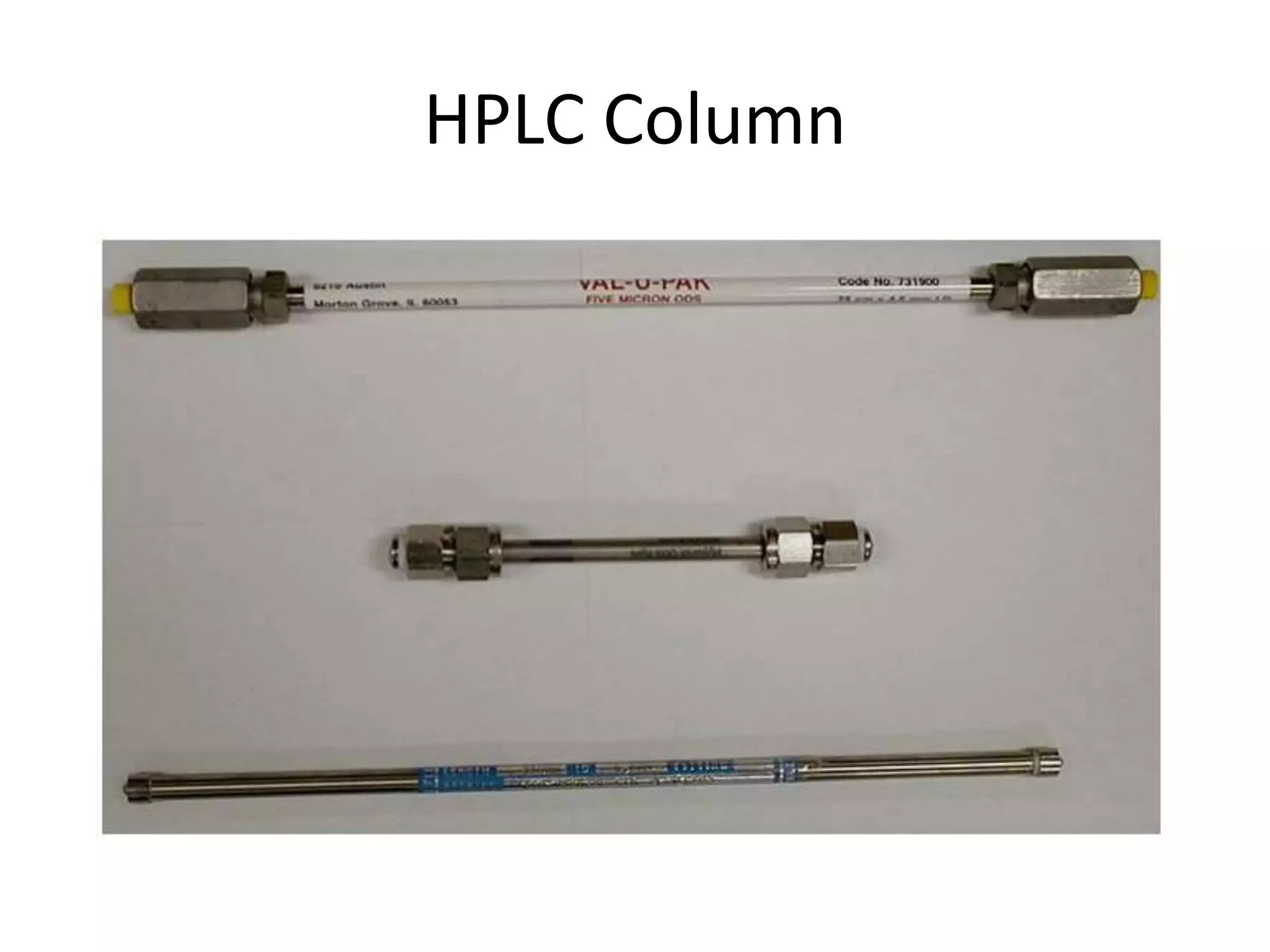
Straight, 15 to 150 cm in length; 2 to 3 mm packing - silica gel, alumina, Celite
• Detectors
UV, fluorescence, Refractive index
• Data Processing
Specific softwares connected to HPLC)
• Waste
HPLC
HPLC Column
Types of column
• Guard Column Guard Column
• Fast Column Fast Column
• Preparative column
• Capillary column
• Nano column
• Analytical column
HPLC Detectors
• UV/Vis
• Refractive index
• Fluorescence
• Evaporative light scattering (ELSD)
• MS
• Diode Array Detector (DAD)
• Electrochemical detectors.
Classification of HPLC
• Reverse phase HPLC
Hydrophobic stationary phase
Hydrophilic compounds will elute first
• Normal Phase HPLC
Hydrophilic stationary phase
Hydrophobic will elute first
HPLC chromatogram
•to - elution time of unretained peak
•tR- retention time - determines sample identity
Factors affecting HPLC activity
1. Internal diameter of column
the smaller in diameter, the higher in
sensitivity
2. Pump pressure
the higher in pressure, the higher in
separation
3. Column dimensions
2.1–4.6 mm diameter, and 30–250 mm
length
4. The polarity
sample, solvent and column
5. Temperature
the higher in temperature, the higher in
separation
Applications
• Pharmaceuticals industry
• Analysis of natural contamination
• Forensic test
• Clinical test
• Food and essence manufacture
Advantages
• High speed
• High resolution
• High sensitivity
• Re-usable column
• No destruction of the components
• The instrumentation are automatic,
computerized
• Sample is recovered completely
• Quantitative work is more easily and most
sensitive
Disadvantages
• It can be costly, complex to operate and
doesn't work for all samples.
• Need a skill to run the instruments
• Solvents consuming
How to resolve these problems?????
The following table lists frequent problems in HPLC:
1. Uncommon peak shapes
2. Lack of sensitivity
3. Poor sample recovery
4. Pressure problems
5. Baseline problems
6. Leaks
7. Changing retention times

High performance liquid chromatography

  • 1.
  • 2.
    Contents • Introduction • HPLCinstrumentation • Classification of HPLC • HPLC Chromatogram • Applications • Advantages • Disadvantages
  • 3.
    HPLC • It separates,identifies and quantifies the components dissolved in a liquid solvent by using a high analytical resolution. • Sample is carried by a moving gas stream of helium and Nitrogen.
  • 4.
    Introduction • A typeof column chromatography. • HPLC is a form of liquid chromatography used to separate compounds that are dissolved in solution. • It is especially suitable for compounds which are: • Not easily volatilized • Thermally unstable • High molecular weights.
  • 5.
    Important Points • Mobile/Stationaryphase Based on interactions of both phases • Characteristics Based on separation of compounds • Mechanism Polar & non-polar molecules
  • 6.
    Principle • Separation ofa sample into its constituent parts because of the difference in the relative affinities of different molecules for the mobile phase and the stationary phase used in the separation.
  • 7.
    HPLC instrumentation • HPLCinstruments consist of: • A reservoir of mobile phase • A pump • An injector • A separation column • A detector
  • 8.
    Components of HPLC •Solvent Reservoir Isocratic elution - single solvent separation Gradient elution - 2 or more solvents, varied during separation • Pumps Capable of pumping solvent up to a pressure of 4000 psi and at flows of up to 10 ml/min) • Sample Injection System Sample valve, Syringe/injector • Columns Straight, 15 to 150 cm in length; 2 to 3 mm packing - silica gel, alumina, Celite • Detectors UV, fluorescence, Refractive index • Data Processing Specific softwares connected to HPLC) • Waste
  • 9.
  • 10.
  • 11.
    Types of column •Guard Column Guard Column • Fast Column Fast Column • Preparative column • Capillary column • Nano column • Analytical column
  • 12.
    HPLC Detectors • UV/Vis •Refractive index • Fluorescence • Evaporative light scattering (ELSD) • MS • Diode Array Detector (DAD) • Electrochemical detectors.
  • 13.
    Classification of HPLC •Reverse phase HPLC Hydrophobic stationary phase Hydrophilic compounds will elute first • Normal Phase HPLC Hydrophilic stationary phase Hydrophobic will elute first
  • 14.
    HPLC chromatogram •to -elution time of unretained peak •tR- retention time - determines sample identity
  • 15.
    Factors affecting HPLCactivity 1. Internal diameter of column the smaller in diameter, the higher in sensitivity 2. Pump pressure the higher in pressure, the higher in separation 3. Column dimensions 2.1–4.6 mm diameter, and 30–250 mm length 4. The polarity sample, solvent and column 5. Temperature the higher in temperature, the higher in separation
  • 16.
    Applications • Pharmaceuticals industry •Analysis of natural contamination • Forensic test • Clinical test • Food and essence manufacture
  • 17.
    Advantages • High speed •High resolution • High sensitivity • Re-usable column • No destruction of the components • The instrumentation are automatic, computerized • Sample is recovered completely • Quantitative work is more easily and most sensitive
  • 18.
    Disadvantages • It canbe costly, complex to operate and doesn't work for all samples. • Need a skill to run the instruments • Solvents consuming
  • 19.
    How to resolvethese problems????? The following table lists frequent problems in HPLC: 1. Uncommon peak shapes 2. Lack of sensitivity 3. Poor sample recovery 4. Pressure problems 5. Baseline problems 6. Leaks 7. Changing retention times