INSTRUMENTATION OF HPLC
Presented by:
SK.SAMIYA,
Dept. of Pharmacology.
CONTENTS
 Introduction
 Types
 Instrumentation
 Advantages
 Disadvantages
 Applications
INTRODUCTION
 HPLC- High Performance Liquid Chromatography
Or
High pressure liquid chromatography
Definition:
 It is a chromatographic technique used to separate components of
mixture for the purpose to identify, quantify or purify the individual
components of the mixture.
 This is widely used in field of biochemistry and analytical chemistry.
Types of HPLC techniques
 Based on mode of chromatography
 Based on principle of separation
 Based on elution technique
 Based on scale of operation
 Based on type of analysis
Based on modes of chromatography
Normal phase mode:
 The stationary phase is polar in nature & the mobile phase is non-
polar.
 This is not advantageous in pharmaceutical application since most of
the drug molecules are polar in nature and takes longer time to be
eluted and detected.
Reverse phase:
 The stationary phase is non-polar & the mobile phase is polar in
nature.
 Since most of the drugs and pharmaceuticals are polar in nature, they
are not retained for a longer time and eluted faster.
Based on principle of separation
 Adsorption chromatography: Separation of components takes place
because of the difference in affinity of compounds towards stationary
phase.
 Ion exchange chromatography: An ion is used to separate a mixture
of similar charged ions.
 Size exclusion or gel permeation chromatography: A mixture of
components with different molecular sizes are separated by using gels
which acts as sieve.
Based on elution technique
 Isocratic separation: In this technique, the same mobile phase
combination is used throughout the process of separation. The same
polarity or elution strength is maintained throughout the process.
 Gradient separation: In this technique, a mobile phase combination
of lower polarity or elution strength is used followed by gradually
increasing the polarity or elution strength.
Based on the scale of operation
 Analytical HPLC: Where only analysis of the samples are done.
Recovery of the samples is not done
 Preparative HPLC: Where the individual fractions of pure
compound can be collected using fraction collector. The collector
samples are reused.
Based on the type of analysis
 Qualitative analysis: Which is used to identify the compound, detect
the impurities, to find the number of components, etc
 Quantitative analysis: Which is done to determine the quantity of
the individual or several components in a mixture. This can be done
by comparing peak area of the standard and sample
INSTRUMENTATION
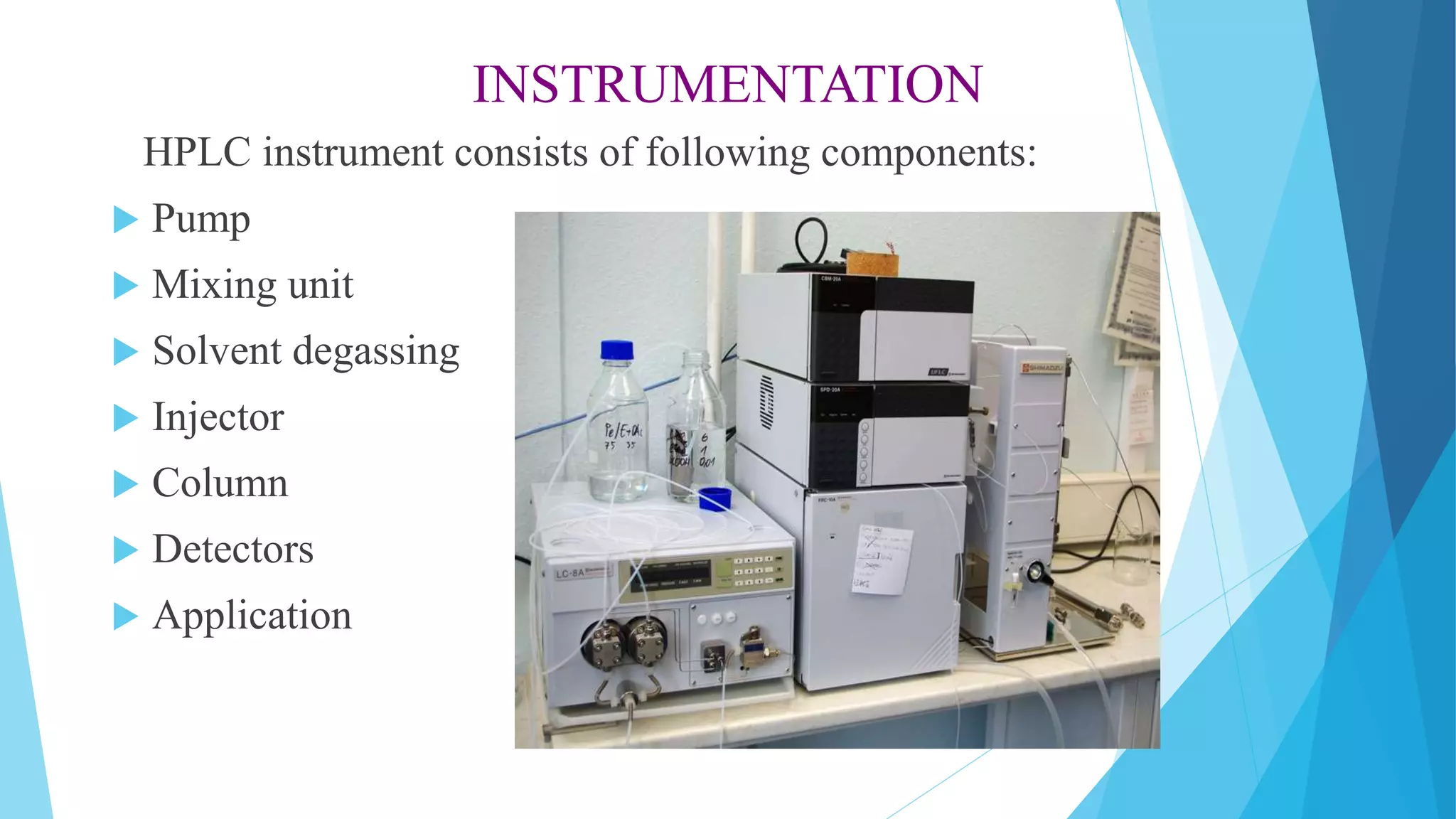
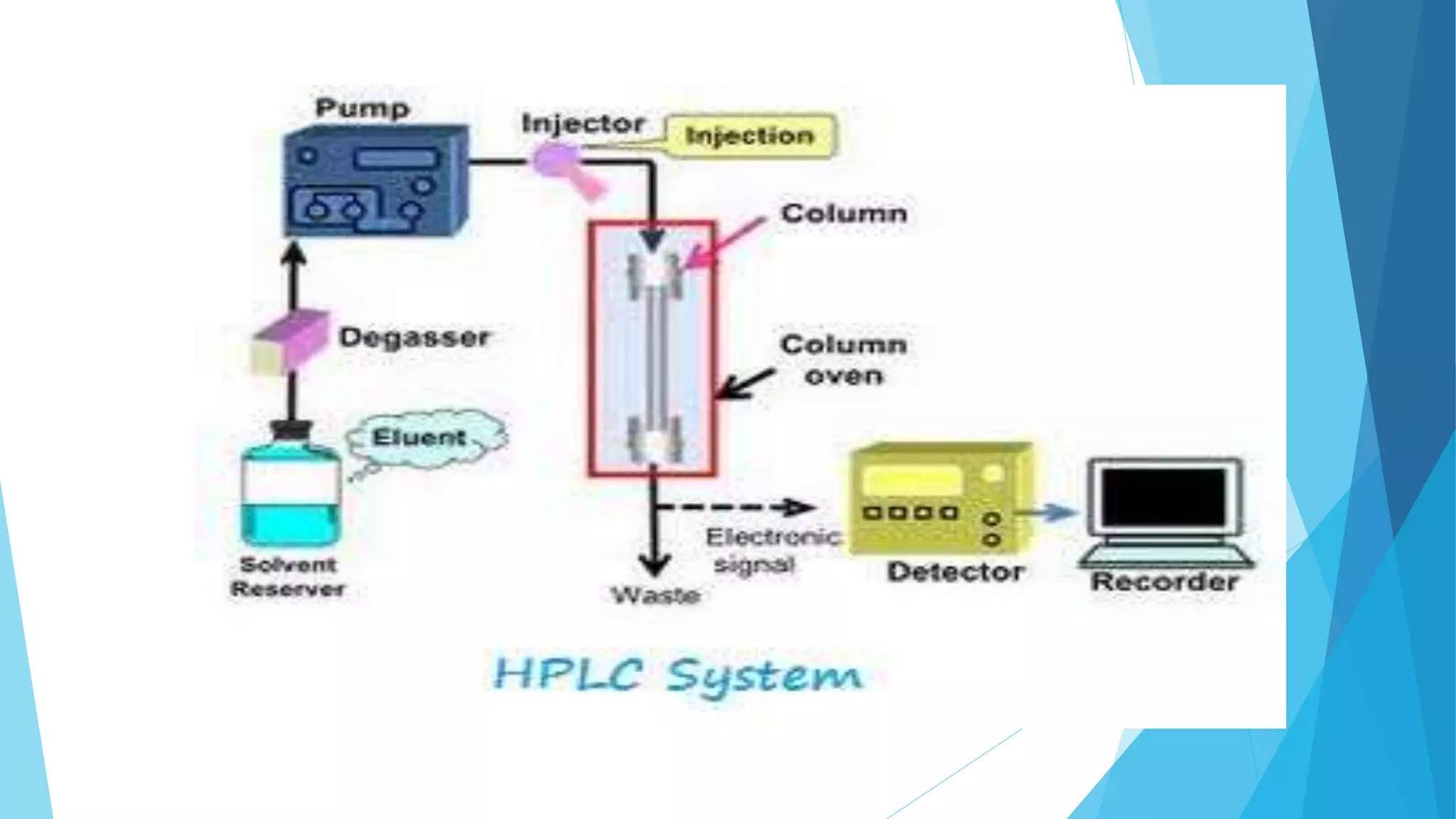
HPLC instrument consists of following components:
 Pump
 Mixing unit
 Solvent degassing
 Injector
 Column
 Detectors
 Application
PUMP
 The role of the pump is to force a liquid ( called the mobile phase)
through the liquid chromatography at a specific flow rate, expressed
in milliliters per min (mL/min)
 Normal flow rates in HPLC are in the 1-2mL/min range.
 During the chromatographic experiment, a pump can deliver a
constant mobile phase composition (isocratic) or an increasing mobile
phase composition (gradient).
 Best for the analysis of complex samples.
Types of pumps:
Mainly three types:
• Constant flow reciprocating pump
• Syringe type pump
• Pneumatic pump
Constant flow reciprocating pump
 The term reciprocating describes
any continuously repeated
backwards and forwards motion.
 Widely used type of pump.
 Solvent is sucked during back
stroke and gets deliver to the
column in forward stroke.
Syringe or displacement type pump
 Consists of large syringe like chamber.
 Suitable for small bore column.
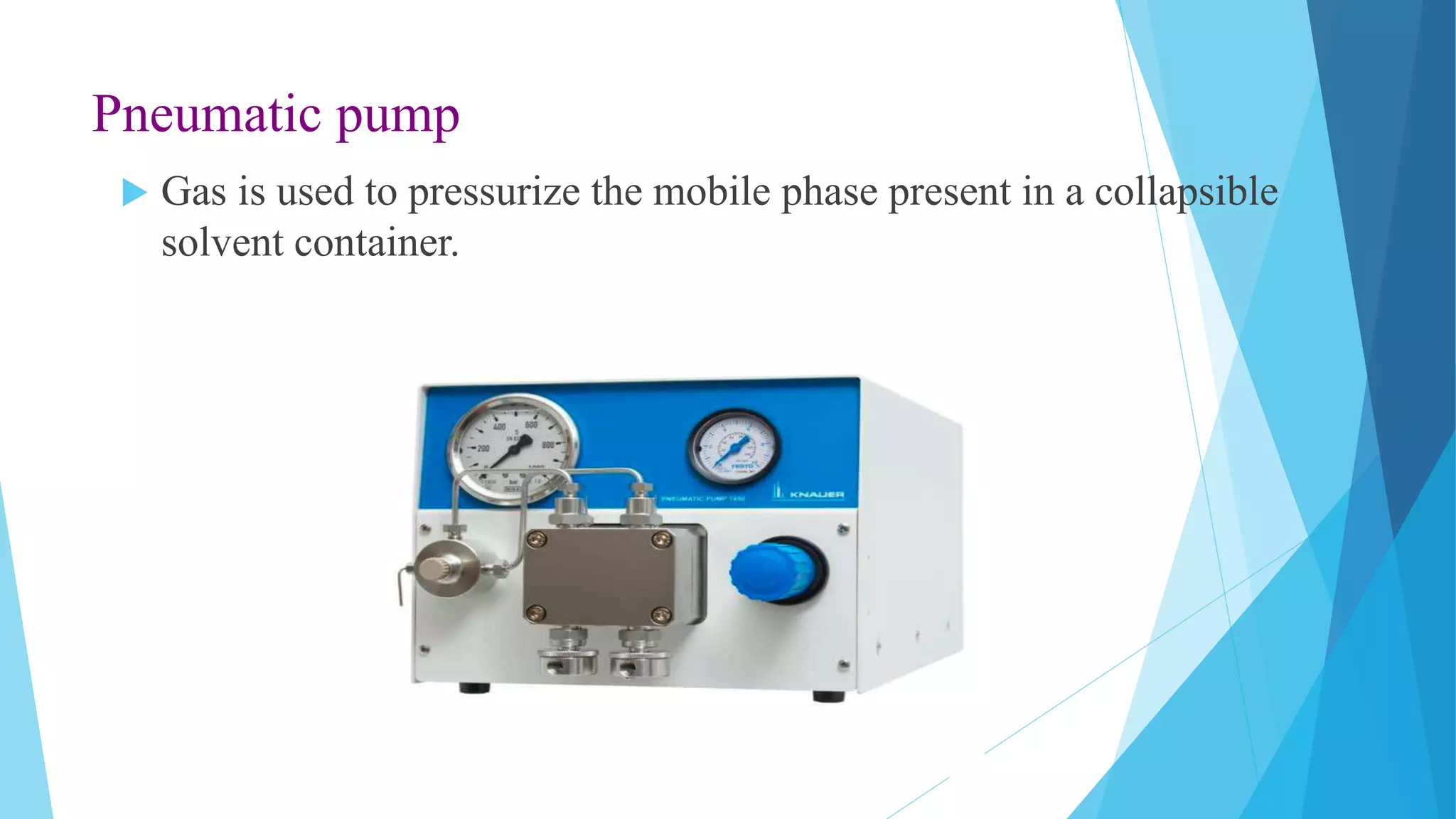
Pneumatic pump
 Gas is used to pressurize the mobile phase present in a collapsible
solvent container.
MIXING UNIT
 Mixing unit is used to mix solvents in different proportions and pass
through the column.
 There are two types of mixing units.
- they are low pressure mixing chamber which uses helium for
degassing solvents.
- high pressure mixing chamber does not require helium for degassing
solvents
 Mixing of solvent is done either with a static mixer which is packed
with beads or a dynamic mixer which uses magnetic stirrer and
operates under high pressure.
SOLVENT DEGASSING
 Several gases are soluble in organic solvents.
 When solvents are pumped under high pressure, gas bubbles are
formed which will interfere with the separation process, steady
baseline and the shape of the peak.
 Hence degassing is necessary.
This can be done by using following techniques:
 Vacuum filtration:- which can remove air bubbles, but it is not always
reliable and complete.
 Helium purging:- By passing helium through the solvent. This is very
effective but expensive.
 Ultrasonification:- By using Ultrasonicator, which converts ultra high
frequency to mechanical vibrations. This causes the removal of air
bubbles.
INJECTOR
 The injector serves to introduce the liquid sample into the flow stear
the mobile phase.
 Typical sample volumes are 5-20microliters
 The injector must also be able to withstand the high pressure of the
liquid system.
 An auto sampler is the automatic version for when the user has many
samples to analyze or when manual injection is not practical.
Types of injectors:
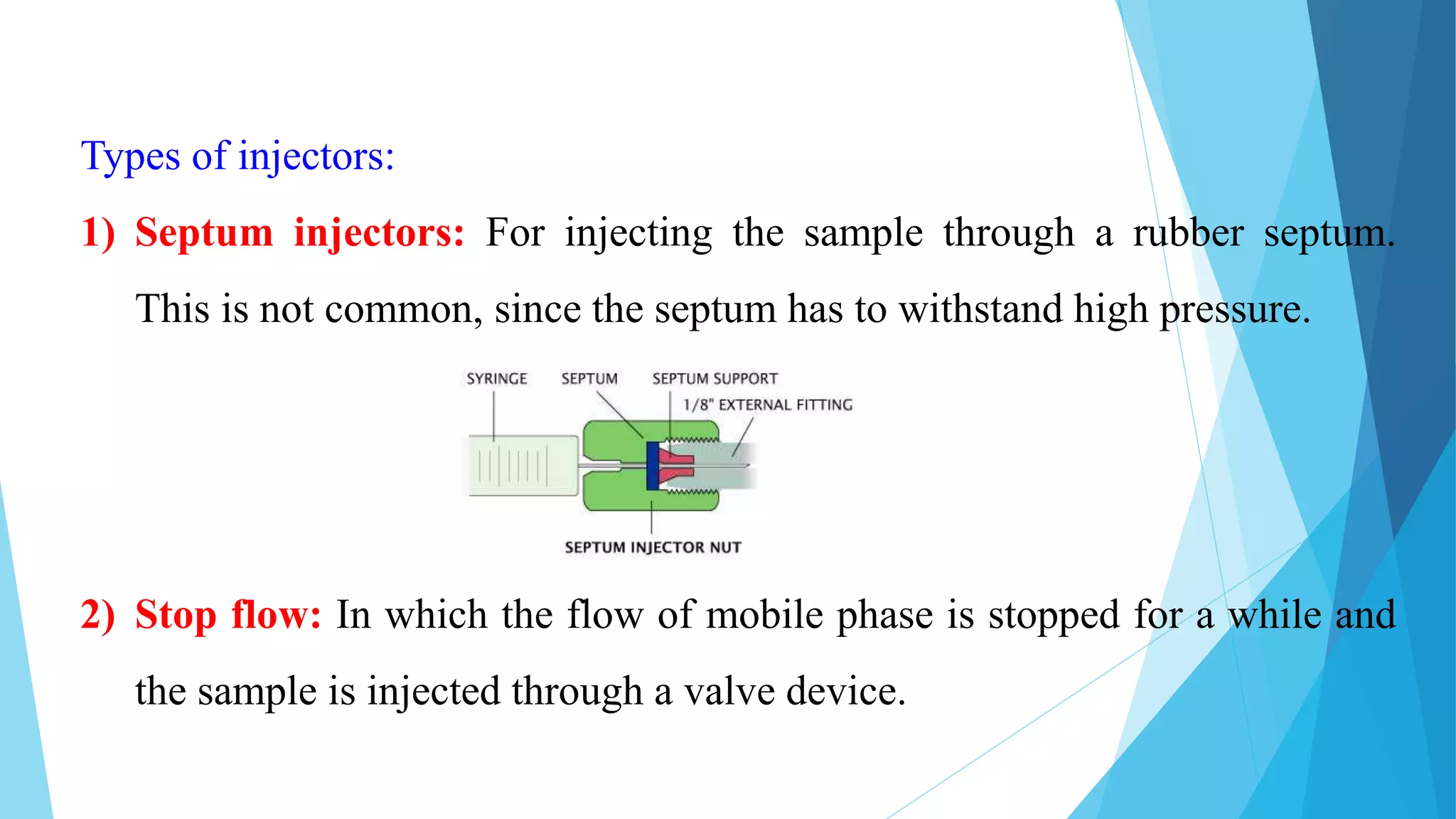
1) Septum injectors: For injecting the sample through a rubber septum.
This is not common, since the septum has to withstand high pressure.
2) Stop flow: In which the flow of mobile phase is stopped for a while and
the sample is injected through a valve device.
3) Rheodyne injector: It is the most popular injector. This has a fixed
volume loop like 20µL or 50µL or more. Injector has 2 modes, i.e., load
position when the sample is loaded in the loop and inject mode when
the sample is injected.
COLUMN
 It is the heart of the chromatograph
Column length: varies from 5cm to 30cm
Column diameter: ranges from 2mm to 50mm
Particle size: from 1µ to 20µ
Particle nature: spherical, uniform sized, porous materials are used.
Materials of construction for the tubing:
 Stainless steel ( the most popular, gives high pressure
capabilities)
 Glass (mostly for biomolecules)
 PEEK (poly ether ether ketone) polymer (biocompatibility and
chemically inert to most solvents).
Packing material:
 The packing material is prepared from SILICA particle,
ALUMINA particle and ion exchange RESIN.
 Porous plug of stainless steel or Teflon are used in the end of the
columns to retain the packing material.
DETECTORS
 UV detectors
 Refractive index detector
 Flourimetric detector
 Conductivity detector
 Amperometric detector
ADVANTAGES
 Separation of volatile and non-volatile components
 Quick analysis
 High resolution
 More reproducibility
DISADVANTAGES
 High cost
 Complex to operate
APPLICATIONS OF HPLC
 Qualitative analysis
 Checking the impurity of a compound
 Presence of impurities
 Quantitative analysis
 Isolation and identification of drugs
 Isolation and identification of mixture of components
 Biopharmaceutical and pharmacokinetic studies
 Stability studies
 purification.
instrumentation of HPLC

instrumentation of HPLC

  • 1.
    INSTRUMENTATION OF HPLC Presentedby: SK.SAMIYA, Dept. of Pharmacology.
  • 2.
    CONTENTS  Introduction  Types Instrumentation  Advantages  Disadvantages  Applications
  • 3.
    INTRODUCTION  HPLC- HighPerformance Liquid Chromatography Or High pressure liquid chromatography Definition:  It is a chromatographic technique used to separate components of mixture for the purpose to identify, quantify or purify the individual components of the mixture.  This is widely used in field of biochemistry and analytical chemistry.
  • 4.
    Types of HPLCtechniques  Based on mode of chromatography  Based on principle of separation  Based on elution technique  Based on scale of operation  Based on type of analysis
  • 5.
    Based on modesof chromatography Normal phase mode:  The stationary phase is polar in nature & the mobile phase is non- polar.  This is not advantageous in pharmaceutical application since most of the drug molecules are polar in nature and takes longer time to be eluted and detected. Reverse phase:  The stationary phase is non-polar & the mobile phase is polar in nature.  Since most of the drugs and pharmaceuticals are polar in nature, they are not retained for a longer time and eluted faster.
  • 6.
    Based on principleof separation  Adsorption chromatography: Separation of components takes place because of the difference in affinity of compounds towards stationary phase.  Ion exchange chromatography: An ion is used to separate a mixture of similar charged ions.  Size exclusion or gel permeation chromatography: A mixture of components with different molecular sizes are separated by using gels which acts as sieve.
  • 7.
    Based on elutiontechnique  Isocratic separation: In this technique, the same mobile phase combination is used throughout the process of separation. The same polarity or elution strength is maintained throughout the process.  Gradient separation: In this technique, a mobile phase combination of lower polarity or elution strength is used followed by gradually increasing the polarity or elution strength.
  • 8.
    Based on thescale of operation  Analytical HPLC: Where only analysis of the samples are done. Recovery of the samples is not done  Preparative HPLC: Where the individual fractions of pure compound can be collected using fraction collector. The collector samples are reused.
  • 9.
    Based on thetype of analysis  Qualitative analysis: Which is used to identify the compound, detect the impurities, to find the number of components, etc  Quantitative analysis: Which is done to determine the quantity of the individual or several components in a mixture. This can be done by comparing peak area of the standard and sample
  • 10.
    INSTRUMENTATION HPLC instrument consistsof following components:  Pump  Mixing unit  Solvent degassing  Injector  Column  Detectors  Application
  • 13.
    PUMP  The roleof the pump is to force a liquid ( called the mobile phase) through the liquid chromatography at a specific flow rate, expressed in milliliters per min (mL/min)  Normal flow rates in HPLC are in the 1-2mL/min range.  During the chromatographic experiment, a pump can deliver a constant mobile phase composition (isocratic) or an increasing mobile phase composition (gradient).  Best for the analysis of complex samples.
  • 14.
    Types of pumps: Mainlythree types: • Constant flow reciprocating pump • Syringe type pump • Pneumatic pump
  • 15.
    Constant flow reciprocatingpump  The term reciprocating describes any continuously repeated backwards and forwards motion.  Widely used type of pump.  Solvent is sucked during back stroke and gets deliver to the column in forward stroke.
  • 16.
    Syringe or displacementtype pump  Consists of large syringe like chamber.  Suitable for small bore column.
  • 17.
    Pneumatic pump  Gasis used to pressurize the mobile phase present in a collapsible solvent container.
  • 18.
    MIXING UNIT  Mixingunit is used to mix solvents in different proportions and pass through the column.  There are two types of mixing units. - they are low pressure mixing chamber which uses helium for degassing solvents. - high pressure mixing chamber does not require helium for degassing solvents  Mixing of solvent is done either with a static mixer which is packed with beads or a dynamic mixer which uses magnetic stirrer and operates under high pressure.
  • 19.
    SOLVENT DEGASSING  Severalgases are soluble in organic solvents.  When solvents are pumped under high pressure, gas bubbles are formed which will interfere with the separation process, steady baseline and the shape of the peak.  Hence degassing is necessary.
  • 20.
    This can bedone by using following techniques:  Vacuum filtration:- which can remove air bubbles, but it is not always reliable and complete.  Helium purging:- By passing helium through the solvent. This is very effective but expensive.  Ultrasonification:- By using Ultrasonicator, which converts ultra high frequency to mechanical vibrations. This causes the removal of air bubbles.
  • 21.
    INJECTOR  The injectorserves to introduce the liquid sample into the flow stear the mobile phase.  Typical sample volumes are 5-20microliters  The injector must also be able to withstand the high pressure of the liquid system.  An auto sampler is the automatic version for when the user has many samples to analyze or when manual injection is not practical.
  • 22.
    Types of injectors: 1)Septum injectors: For injecting the sample through a rubber septum. This is not common, since the septum has to withstand high pressure. 2) Stop flow: In which the flow of mobile phase is stopped for a while and the sample is injected through a valve device.
  • 23.
    3) Rheodyne injector:It is the most popular injector. This has a fixed volume loop like 20µL or 50µL or more. Injector has 2 modes, i.e., load position when the sample is loaded in the loop and inject mode when the sample is injected.
  • 24.
    COLUMN  It isthe heart of the chromatograph Column length: varies from 5cm to 30cm Column diameter: ranges from 2mm to 50mm Particle size: from 1µ to 20µ Particle nature: spherical, uniform sized, porous materials are used.
  • 26.
    Materials of constructionfor the tubing:  Stainless steel ( the most popular, gives high pressure capabilities)  Glass (mostly for biomolecules)  PEEK (poly ether ether ketone) polymer (biocompatibility and chemically inert to most solvents). Packing material:  The packing material is prepared from SILICA particle, ALUMINA particle and ion exchange RESIN.  Porous plug of stainless steel or Teflon are used in the end of the columns to retain the packing material.
  • 27.
    DETECTORS  UV detectors Refractive index detector  Flourimetric detector  Conductivity detector  Amperometric detector
  • 28.
    ADVANTAGES  Separation ofvolatile and non-volatile components  Quick analysis  High resolution  More reproducibility DISADVANTAGES  High cost  Complex to operate
  • 29.
    APPLICATIONS OF HPLC Qualitative analysis  Checking the impurity of a compound  Presence of impurities  Quantitative analysis  Isolation and identification of drugs  Isolation and identification of mixture of components  Biopharmaceutical and pharmacokinetic studies  Stability studies  purification.