PRESENTED BY
RD
 Introduction
 History
 Definition of column chromatography
 Principle
 Classification of column chromatography
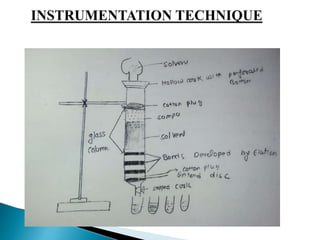
 Experimental technique of column chromatography
 Requirements
 Application
 Advantages
 Disadvantages
 References
 DEFINITION:-
 Chromatography is a physical method of separation in which the
components to be separated are distributed between two phases :
 Stationary phase
 Mobile phase
o The stationary phase may be a solid or liquid supported on a solid or gel.
• May be packed in a column Eg.-Column Chromatography.
• Spread as a layer on glass/aluminium plate Eg. – TLC, HPTLC.
• Distributed as a liquid film Eg.- GLC
o The mobile phase may be a liquid /solvent/mixture of solvent or gases.
 The first chromatography column was developed by the
Russian botanist Mikhail Tsvet in 1901.
 Who washed an organic solution of plant pigments
through a vertical glass column packed with an
adsorptive material.
 He discovered that the pigments separated into a series
of discrete colored bands on the column, divided by
regions entirely free of color.
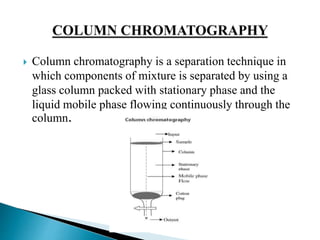
 Column chromatography is a separation technique in
which components of mixture is separated by using a
glass column packed with stationary phase and the
liquid mobile phase flowing continuously through the
column.
 Column chromatography is separated into two categories, depending on
how the solvent flows down the column.
 Gravity column chromatography:- If the solvent is allowed to flow down
the column by gravity, it is called gravity column chromatography.
 Flash chromatography:-If the solvent is forced down the column by
positive air pressure, it is called flash column chromatography, currently
used in organic chemistry research laboratories
 A solid stationary phase and a liquid mobile phase is used and the principle
of separation is adsorption.
 The mixture to be separated is dissolved in a suitable solvent and allowed
to pass through a tube containing the adsorbent
 The component which have greater absorbing power is adsorb in the upper
part of the column.
 The next component is adsorb in lower portion of the column which have
less adsorbing power than the first component.
 The process is continued. As a result the materials are partially separated
and adsorbed in the various part of the column. The type of interaction
between the stationary phase and solute is reversible in nature.
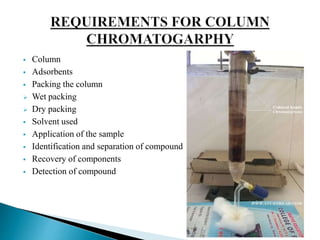
 Column
 Adsorbents
 Packing the column
 Wet packing
 Dry packing
 Solvent used
 Application of the sample
 Identification and separation of compound
 Recovery of components
 Detection of compound
 Separation of mixture of compound.
 Removal of impurities or purification process.
 Isolation of active constituents.
 Isolation of metabolites from biological fluids.
 Estimation of drug in formulation and crude drug extract.
 Any type of mixture can be separated by column chromatography.
 Any quantity of mixture can also be.
 Wider choice of Mobile Phase
 Time consuming method.
 More amount of solvent are required which are expensive.
 Use of maximum adsorbent.
 Drying and bubble presence are possible.
 Kar Ashutosh, “pharmaceutical Analysis’’,CBS
Publishers & Distributors pvt.ltd , Volume 2nd , page
no 161-181.
 Indian Pharmacopoeia , ministry of health sciences
government of India 2014 edition , volume 1st , page
no 163-166.
Column chromatography

Column chromatography

  • 1.
  • 2.
     Introduction  History Definition of column chromatography  Principle  Classification of column chromatography  Experimental technique of column chromatography  Requirements  Application  Advantages  Disadvantages  References
  • 3.
     DEFINITION:-  Chromatographyis a physical method of separation in which the components to be separated are distributed between two phases :  Stationary phase  Mobile phase o The stationary phase may be a solid or liquid supported on a solid or gel. • May be packed in a column Eg.-Column Chromatography. • Spread as a layer on glass/aluminium plate Eg. – TLC, HPTLC. • Distributed as a liquid film Eg.- GLC o The mobile phase may be a liquid /solvent/mixture of solvent or gases.
  • 4.
     The firstchromatography column was developed by the Russian botanist Mikhail Tsvet in 1901.  Who washed an organic solution of plant pigments through a vertical glass column packed with an adsorptive material.  He discovered that the pigments separated into a series of discrete colored bands on the column, divided by regions entirely free of color.
  • 5.
     Column chromatographyis a separation technique in which components of mixture is separated by using a glass column packed with stationary phase and the liquid mobile phase flowing continuously through the column.
  • 6.
     Column chromatographyis separated into two categories, depending on how the solvent flows down the column.  Gravity column chromatography:- If the solvent is allowed to flow down the column by gravity, it is called gravity column chromatography.  Flash chromatography:-If the solvent is forced down the column by positive air pressure, it is called flash column chromatography, currently used in organic chemistry research laboratories
  • 7.
     A solidstationary phase and a liquid mobile phase is used and the principle of separation is adsorption.  The mixture to be separated is dissolved in a suitable solvent and allowed to pass through a tube containing the adsorbent  The component which have greater absorbing power is adsorb in the upper part of the column.  The next component is adsorb in lower portion of the column which have less adsorbing power than the first component.  The process is continued. As a result the materials are partially separated and adsorbed in the various part of the column. The type of interaction between the stationary phase and solute is reversible in nature.
  • 9.
     Column  Adsorbents Packing the column  Wet packing  Dry packing  Solvent used  Application of the sample  Identification and separation of compound  Recovery of components  Detection of compound
  • 10.
     Separation ofmixture of compound.  Removal of impurities or purification process.  Isolation of active constituents.  Isolation of metabolites from biological fluids.  Estimation of drug in formulation and crude drug extract.
  • 11.
     Any typeof mixture can be separated by column chromatography.  Any quantity of mixture can also be.  Wider choice of Mobile Phase
  • 12.
     Time consumingmethod.  More amount of solvent are required which are expensive.  Use of maximum adsorbent.  Drying and bubble presence are possible.
  • 13.
     Kar Ashutosh,“pharmaceutical Analysis’’,CBS Publishers & Distributors pvt.ltd , Volume 2nd , page no 161-181.  Indian Pharmacopoeia , ministry of health sciences government of India 2014 edition , volume 1st , page no 163-166.