AGA KHAN
UNIVERSITY ,
HOSPITAL

The Study Of
Chromosomes And Related
Diseases That is caused by
changes in the number of
chromosomes and their
structure
CYTOGENETICS

 Karyotype is an organized profile of an individual’s
chromosomes
 Karyotyping is a technique that is use to examine
chromosomes in a sample of cells which can help
identify genetic problems as the cause of disorder or
a disease
KARYOTYPING

 Main purpose of the karyotyping is to locate or
visualize the changes in the number of chromosomes
and abnormality in the structure
 Also to locate the evolution
MAIN PURPOSE OF
KARYOTYPING

Basically karyotyping is based on three patterns
On the basis of size of chromatids
On the basis of bending patterns
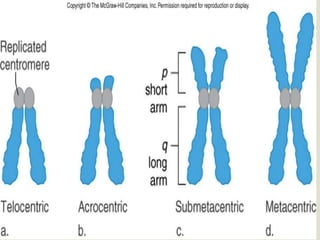
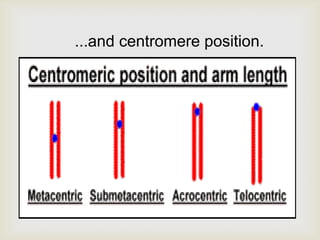
On the basis of centromeric positions
Basis of karyotyping
...and centromere position.

 Through karyotype analysis , you will obtained the
following information about your cell lines
 Species identification .
 Index of genome stability
 Validation of normal diploid karyotype
 Numerical chromosomes abnormalities
 Monoploidy , poliploidy
 Monotomy , trisomy
 Structural abnormalities
Continued……….

Deletion
Duplication
Translocation
Inversion
Continued……….

The karyotype is
obtained
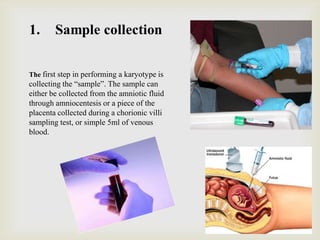
The first step in performing a karyotype is
collecting the “sample”. The sample can
either be collected from the amniotic fluid
through amniocentesis or a piece of the
placenta collected during a chorionic villi
sampling test, or simple 5ml of venous
blood.

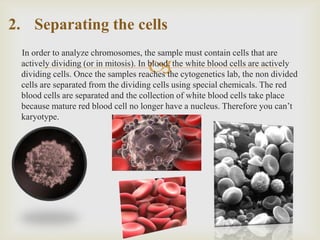
In order to analyze chromosomes, the sample must contain cells that are
actively dividing (or in mitosis). In blood, the white blood cells are actively
dividing cells. Once the samples reaches the cytogenetics lab, the non divided
cells are separated from the dividing cells using special chemicals. The red
blood cells are separated and the collection of white blood cells take place
because mature red blood cell no longer have a nucleus. Therefore you can’t
karyotype.
2. Separating the cells

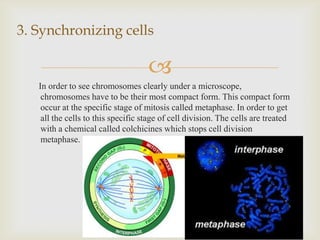
In order to see chromosomes clearly under a microscope,
chromosomes have to be their most compact form. This compact form
occur at the specific stage of mitosis called metaphase. In order to get
all the cells to this specific stage of cell division. The cells are treated
with a chemical called colchicines which stops cell division
metaphase.
3. Synchronizing cells
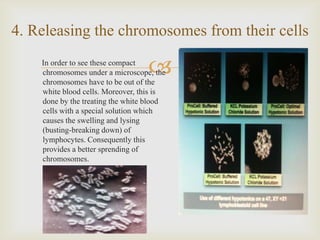
In order to see these compact
chromosomes under a microscope, the
chromosomes have to be out of the
white blood cells. Moreover, this is
done by the treating the white blood
cells with a special solution which
causes the swelling and lysing
(busting-breaking down) of
lymphocytes. Consequently this
provides a better sprending of
chromosomes.
4. Releasing the chromosomes from their cells
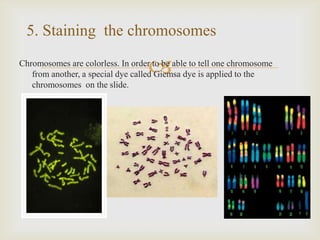
Chromosomes are colorless. In order to be able to tell one chromosome
from another, a special dye called Giemsa dye is applied to the
chromosomes on the slide.
5. Staining the chromosomes

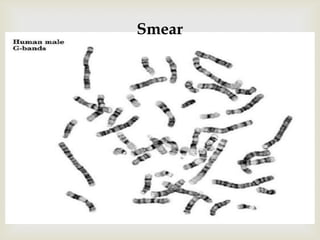
Smear

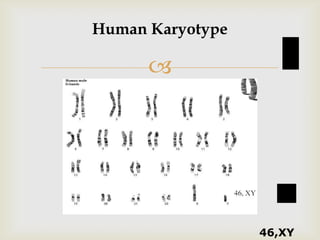
Human Karyotype
46,XY

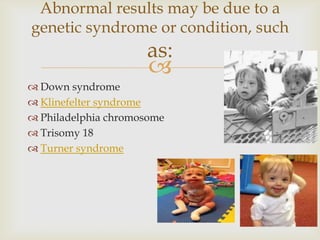
 Down syndrome
 Klinefelter syndrome
 Philadelphia chromosome
 Trisomy 18
 Turner syndrome
Abnormal results may be due to a
genetic syndrome or condition, such
as:
The end

KARYOTYPING

  • 1.
  • 2.
     The Study Of ChromosomesAnd Related Diseases That is caused by changes in the number of chromosomes and their structure CYTOGENETICS
  • 3.
      Karyotype isan organized profile of an individual’s chromosomes  Karyotyping is a technique that is use to examine chromosomes in a sample of cells which can help identify genetic problems as the cause of disorder or a disease KARYOTYPING
  • 4.
      Main purposeof the karyotyping is to locate or visualize the changes in the number of chromosomes and abnormality in the structure  Also to locate the evolution MAIN PURPOSE OF KARYOTYPING
  • 5.
     Basically karyotyping isbased on three patterns On the basis of size of chromatids On the basis of bending patterns On the basis of centromeric positions Basis of karyotyping
  • 7.
  • 8.
      Through karyotypeanalysis , you will obtained the following information about your cell lines  Species identification .  Index of genome stability  Validation of normal diploid karyotype  Numerical chromosomes abnormalities  Monoploidy , poliploidy  Monotomy , trisomy  Structural abnormalities Continued……….
  • 9.
  • 10.
  • 11.
    The first stepin performing a karyotype is collecting the “sample”. The sample can either be collected from the amniotic fluid through amniocentesis or a piece of the placenta collected during a chorionic villi sampling test, or simple 5ml of venous blood.
  • 12.
     In order toanalyze chromosomes, the sample must contain cells that are actively dividing (or in mitosis). In blood, the white blood cells are actively dividing cells. Once the samples reaches the cytogenetics lab, the non divided cells are separated from the dividing cells using special chemicals. The red blood cells are separated and the collection of white blood cells take place because mature red blood cell no longer have a nucleus. Therefore you can’t karyotype. 2. Separating the cells
  • 13.
     In order tosee chromosomes clearly under a microscope, chromosomes have to be their most compact form. This compact form occur at the specific stage of mitosis called metaphase. In order to get all the cells to this specific stage of cell division. The cells are treated with a chemical called colchicines which stops cell division metaphase. 3. Synchronizing cells
  • 14.
    In order tosee these compact chromosomes under a microscope, the chromosomes have to be out of the white blood cells. Moreover, this is done by the treating the white blood cells with a special solution which causes the swelling and lysing (busting-breaking down) of lymphocytes. Consequently this provides a better sprending of chromosomes. 4. Releasing the chromosomes from their cells
  • 15.
    Chromosomes are colorless.In order to be able to tell one chromosome from another, a special dye called Giemsa dye is applied to the chromosomes on the slide. 5. Staining the chromosomes
  • 16.
  • 17.
  • 18.
      Down syndrome Klinefelter syndrome  Philadelphia chromosome  Trisomy 18  Turner syndrome Abnormal results may be due to a genetic syndrome or condition, such as:
  • 19.